I will pour out my Spirit on all flesh; your sons and your daughters shall prophesy.” What once came on a few — the Spirit of God — Joel promises to everyone: old and young, male and female, slave and free. And joined to it is a promise of rescue: “everyone who calls on the name of the Lord shall be saved.” On the day of Pentecost Peter stood and said, “this is what was uttered through the prophet Joel.” This study works Joel 2:28–32 from the poured-out Spirit to the open door of the gospel. See the method →
Joel 2:28–32 (English) = Hebrew & Greek 3:1–5
Hebrew · LXX · ESVThe Shape of the Passage
InclusioJoel prophesied around a devastating locust plague, reading it as a foretaste of the Day of the Lord. After a call to repent and a promise of restoration, God pledges something new: his Spirit poured out on all his people.
Author
The prophet Joel uses a locust invasion as a lens on the coming Day of the Lord — a day of both judgment and salvation. After the people return to God “with all your heart” (2:12–13) and God promises to restore “the years that the swarming locust has eaten” (2:25), comes the climax: “afterward… I will pour out my Spirit on all flesh.” What in Israel had belonged to prophets, priests, and kings — the Spirit of God — is promised to everyone: sons and daughters, old and young, slave and free.
Spirit and salvation. The outpouring is joined to the great Day and to a promise of rescue: “everyone who calls on the name of the Lord shall be saved,” with a remnant preserved in Zion. The oracle holds the universal gift of the Spirit and the universal offer of salvation in one breath.
Audience
A stricken people — fields ruined, hope thin — hearing that God’s answer to their emptiness is not only restored harvests but his own Spirit. To a community where prophecy was rare and the Spirit came on a few, the promise that all the Lord’s people would prophesy (cf. Moses’ wish, Num 11:29) was breathtaking.
How they heard it. Later Jewish tradition mourned that the Spirit of prophecy had departed with the last prophets, and looked for its return in the age to come. Joel’s promise fed that hope — and on the day of Pentecost Peter stood up and announced it fulfilled: “this is what was uttered through the prophet Joel” (Acts 2:16). The Spirit had been poured out; the last days had begun.
Orient on the Spirit, the Day of the LORD, and calling on the Name.
Search by topic: Holy Spirit, Day of the LORD, Joel, Pentecost, prophecy.
Which articles are relevant?
- Anchor Bible Dictionary — “Spirit,” “Day of the Lord (OT/NT),” “Joel,” “Prophecy.”
- Dictionary of the OT: Prophets — “Joel, Book of,” “Spirit of God,” “Day of the Lord,” “Remnant.”
- NIDOTTE / TDOT — שָׁפַךְ (šāp̄aḵ, pour out), רוּחַ (rûaḥ, Spirit), כָּל־בָּשָׂר (kol-bāśār, all flesh), קָרָא (qārāʾ, call).
Bibliography surfaced:
- Hans Walter Wolff (Hermeneia), Leslie Allen (NICOT), Douglas Stuart (WBC), John Barton (OTL) on Joel.
- Studies of Joel 2:28–32 in Acts 2 and Romans 10; the Day-of-the-Lord and Spirit themes.
- Beale & Carson, Commentary on the NT Use of the OT (Acts; Romans).
The democratized Spirit, cosmic portents, and calling on the Name.
Read the outpouring against Israel’s hope for the Spirit, note the Greek Joel behind Acts, then follow the promise to Pentecost.
Which parallels shed light on religion and worldview?
The Spirit for everyone. In the Old Testament the Spirit came selectively — on prophets, judges, kings, craftsmen — and Moses longed that “all the Lord’s people were prophets” (Num 11:29). Joel promises exactly that: the Spirit poured out “on all flesh,” crossing every line of gender, age, and status. “All flesh” is the universal scope of the gift, not a promise that all are automatically saved — salvation is for “everyone who calls on the name of the Lord” (2:32).
Cosmic signs of the Day. The darkened sun and blood-red moon are the standard imagery of the Day of the Lord — a theophany that shakes creation. Second-Temple texts share the picture (1 Enoch 80; Testament of Moses 10). The New Testament reads Pentecost as the inauguration of these last days while the cosmic portents await their consummation — the outpouring genuinely begun, the great Day not yet fully come.
- Numbers 11:24–29; Ezekiel 36:26–27; 39:29 — the Spirit shared with the seventy, the promise of God’s Spirit within (see the dry bones).
- Wadi Murabbaʿat Minor Prophets scroll (Mur88) (Dead Sea Scrolls — a witness, not Scripture) — preserves Joel 3:1–5 (= Eng 2:28–32) in a text close to the Masoretic, evidence of a stable proto-Masoretic Hebrew by the early second century AD (the Bar Kokhba period).
- 1 Enoch 80:4–7; Testament of Moses 10:1–6 (Pseudepigrapha — witnesses, not Scripture) — the sun, moon, and stars disturbed at the end: the shared Day-of-the-Lord imagery.
- b. Yoma 9b (rabbinic — a witness, not Scripture) — the tradition that the Spirit departed with the last prophets, awaiting the age to come: the backdrop to Joel’s renewed outpouring.
On the day of Pentecost, when the Spirit fell and the disciples spoke in the tongues of the nations, Peter stood and named the moment: “this is what was uttered through the prophet Joel” (Acts 2:16), and quoted Joel 2:28–32 in full. He follows the Greek but shapes it: “in the last days” for Joel’s “afterward,” framing Pentecost as the dawn of the promised age. So the outpouring on “all flesh” begins — the Spirit given to every believer, the community of prophecy Moses longed for, born. And the oracle’s climax becomes the gospel invitation: “everyone who calls upon the name of the Lord shall be saved” (Acts 2:21). Paul makes the stunning move explicit: in Joel the Name is the Lord (YHWH), but Paul applies it to the risen Jesus — “the same Lord is Lord of all… for ‘everyone who calls on the name of the Lord will be saved’” (Rom 10:12–13). To call on Jesus is to call on the Lord. The last days are here; the Spirit is poured out; and the door is open to all who call.
The vocabulary of outpouring, all flesh, and calling on the Name.
Watch the “pour out,” the “all flesh,” and “everyone who calls.”
“I will pour out” (root šāp̄aḵ) — the lavish, generous outpouring of the Spirit (LXX ἐκχεῶ); the Greek reads it partitively, “from my Spirit.”
“All flesh” — every category of person: sons/daughters, old/young, male/female servants. The universal scope of the gift, not universal automatic salvation.
“And they shall prophesy” — the whole covenant people become a prophetic community, fulfilling Moses’ wish (Num 11:29).
“Everyone who calls” on the Name — the condition of rescue (yimmālēṭ, “shall be saved”; LXX σωθήσεται); quoted at Acts 2:21 and Rom 10:13.
How the New Testament reuses Joel:
- Acts 2:16–21 — Peter quotes Joel 2:28–32 at Pentecost as fulfilled, framing it “in the last days.”
- Acts 2:38–39 — “the promise is for you and for your children and for all who are far off”: the Spirit-gift extended to all who repent and call.
- Romans 10:12–13 — “everyone who calls on the name of the Lord will be saved” (Joel 2:32), applied to the risen Jesus, for Jew and Greek alike.
- Acts 21:9; 1 Corinthians 12–14 — daughters who prophesy; the Spirit’s gifts across the church: the outpouring at work.
From the promised Spirit to the church of the last days.
Trace the Spirit-promise through the prophets to Pentecost, and “calling on the Name” to the gospel offer.
Which cross-references matter?
- Numbers 11:24–29; Isaiah 44:3; Ezekiel 36:26–27; 39:29 — the Spirit poured out, the heart renewed: Joel’s companions (see the new covenant).
- Acts 2:1–41 — Pentecost: the Spirit poured out, Joel proclaimed, three thousand who “call on the Name” baptized.
- Romans 10:9–13 — “if you confess… Jesus is Lord… you will be saved”; “everyone who calls” — the universal offer.
- Joel 2:12–13, 25–27 — the call to return and the promise to restore: the context of the outpouring.
- Revelation 6:12; Matthew 24:29 — the sun darkened and moon like blood: the cosmic signs of the consummated Day.
Joel 2:28–32 is the interpretive key Peter hands the church for Pentecost. By declaring “this is that,” he reads the Spirit’s coming as the beginning of the last days — inaugurated eschatology: the age of the Spirit has arrived, even though the cosmic Day of the Lord is not yet consummated. Peter’s own adaptations are deliberate — “in the last days” for “afterward,” and an added “and they shall prophesy” that stresses the point — and he follows the Greek’s “magnificent” day where the Hebrew reads “awesome.” Then the sermon turns the oracle’s last line into an altar call: “everyone who calls upon the name of the Lord shall be saved” is answered by “repent and be baptized… in the name of Jesus Christ” (Acts 2:38). Paul, in Romans 10, presses the same verse into the service of the mission: because the risen Jesus is the Lord on whom all may call, the gospel must be preached so that faith may come by hearing (Rom 10:14–17). Joel’s promise, fulfilled at Pentecost, is the church’s charter: the Spirit for all God’s people, and salvation for all who call.
The scholarship on Joel 2:28-32.
The commentators on Joel; the studies of Acts 2’s use of Joel; Beale & Carson.
Commentaries & studies:
- Hans Walter Wolff (Joel and Amos, Hermeneia), Leslie C. Allen (NICOT), Douglas Stuart (WBC), John Barton (OTL) on Joel.
- James L. Crenshaw (Anchor); studies of Joel 2:28–32 in Acts 2 (the “last days” adaptation) and Romans 10.
- G. K. Beale & D. A. Carson, eds., Commentary on the New Testament Use of the Old Testament.
Interpretation notes worth keeping:
- Versification. English Joel 2:28–32 = Hebrew and Greek Joel 3:1–5; the English “chapter 3” (the nations judged) = Hebrew/Greek chapter 4.
- Already / not yet. Peter says “this is that” of Pentecost (the Spirit poured out), while the cosmic signs await the consummated Day — inaugurated eschatology, avoiding both “all fulfilled” and “nothing yet.”
- “Calls on the name of the Lord.” In Joel the Name is YHWH; Acts and Romans apply it to Jesus — the New Testament’s inspired identification of the risen Lord with the Lord of the Old, and the ground of the universal offer.
From the poured-out Spirit to your own calling on the Name.
Name what you learned, why it matters, and one concrete response.
What should we carry away — and do?
- The Spirit is for you. Not for a spiritual elite but for “all flesh” — every believer, young and old. If you are in Christ, the promised Spirit is poured out on you.
- Salvation is a call away. “Everyone who calls on the name of the Lord shall be saved.” The way is exclusive — salvation is in Jesus alone — yet the invitation is open wide: everyone who calls on him will be saved.
- We live in the last days. Pentecost began them; the great Day will end them. Live as a person of the Spirit in the overlap of the ages — expectant, prayerful, and ready.
Step in response: if you have never simply “called on the name of the Lord,” do it — ask Jesus to save you, plainly and today. And if you have, live as one filled: ask the Spirit for boldness to speak of him, and point one person this week to the Lord on whom “everyone who calls” may be saved.
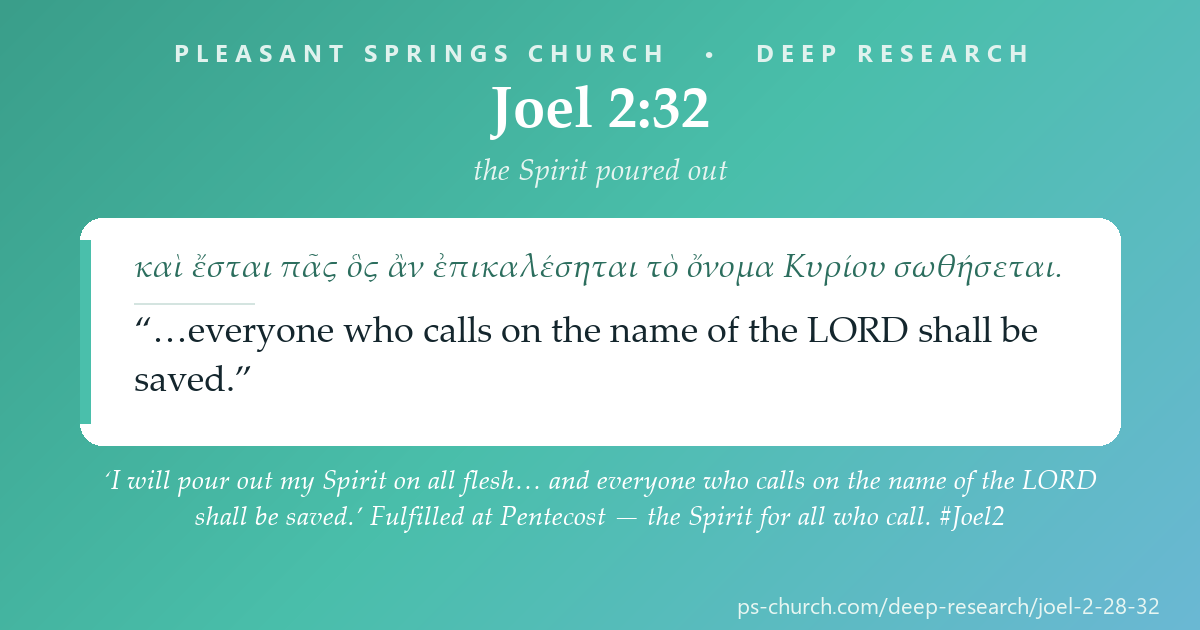
Joel 2:32 · to share
LXX + ESVEvery Deep Research page traces its passage across the whole sweep — the Old Testament, the Second-Temple world between the testaments (historical witnesses, not Scripture), and the New Testament. Follow the thread:
Pleasant Springs Church — Deep Research
Research method after Michael S. Heiser’s Bible Research Method (examine dictionaries → ancient literature → important words → textual connections → academic publications → share), with the Pleasant Springs “Author & Audience” foundation. Scripture set in the Hebrew, the Greek editions named on each page and the ESV (Old Testament), and the Greek New Testament and the ESV (New Testament), per the practice of Pleasant Springs Church. Joel 2:28–32 research grounded in Wolff, Allen, Stuart, Barton, and Crenshaw, with Beale & Carson on the New Testament use; the Day-of-the-Lord background; Second-Temple material per the Murabbaʿat scroll, 1 Enoch, and rabbinic tradition (read as witnesses, not Scripture).
Scripture quotations marked ESV are from the ESV® Bible (The Holy Bible, English Standard Version®), © 2001 by Crossway, a publishing ministry of Good News Publishers. ESV Text Edition: 2016. Used by permission. All rights reserved. The ESV text may not be quoted in any publication made available to the public by a Creative Commons license, and the ESV may not be translated in whole or in part into any other language. www.esv.org
|
Did this study bless you today? 💚 Give to Support PS Church100% of gifts go to the General Fund — thank you. |