God sets Ezekiel down in a valley full of dry bones and asks the impossible question: “Son of man, can these bones live?” Then he answers it — summoning his ruach (breath, wind, Spirit) from the four winds until the slain stand up, “an exceedingly great army.” It is first the promise to raise exiled Israel; beyond that, a picture of the Spirit who gives life — the Spirit the risen Jesus would breathe on his church, and who will raise our mortal bodies. This study works Ezekiel 37 from exile-as-death to resurrection by the Spirit. See the method →
Ezekiel 37:3–14 (selections)
Hebrew · LXX · ESVThe Shape of the Passage
Parallel panelsEzekiel prophesied among the exiles in Babylon after 597 BC. To a people who felt as good as dead, God gives a vision of resurrection — and names its meaning plainly (37:11).
Author
The prophet Ezekiel, a priest in exile, ministered to Judah’s deportees in Babylon. His book moves from judgment (chs. 1–24) to hope (chs. 33–48); the dry-bones vision stands at the turn, answering the exiles’ despair. God carries Ezekiel to a valley of scattered, sun-bleached bones — the image of a nation destroyed — and stages a two-stage resurrection: first sinew and flesh, then the breath that makes them alive. The prophet is made to prophesy to the bones and to the breath, so that the word of God is the very means of the miracle.
Named for us. The text supplies its own interpretation: “these bones are the whole house of Israel… I will open your graves… and bring you into the land” (37:11–12). The primary promise is the restoration of the exiled nation. But the imagery — graves opened, the dead raised by God’s Spirit — reaches beyond, and the New Testament will draw it toward the Spirit’s life-giving work and the resurrection of the body.
Audience
The exiles — who said, “Our bones are dried up, and our hope is lost; we are indeed cut off” (37:11). To people convinced their national life was over, God shows a valley of bones becoming a living army: no situation is too dead for his Spirit to raise.
How they heard it. The vision became a wellspring of hope — for return from exile, and, increasingly in the Second-Temple period, for the resurrection of the dead. Later Jewish art (the Dura-Europos synagogue) and texts read it of bodily resurrection; the New Testament hears in it the Spirit who raised Jesus and will raise us (Rom 8:11), and the risen Christ breathing the Spirit into his church (John 20:22).
Orient on spirit/breath, resurrection, and restoration.
Search by topic: spirit (ruach), breath, resurrection, restoration, Ezekiel.
Which articles are relevant?
- Anchor Bible Dictionary — “Spirit,” “Resurrection,” “Ezekiel,” “Exile.”
- Dictionary of the OT: Prophets — “Spirit of God,” “Resurrection,” “Restoration,” “Ezekiel.”
- NIDOTTE / TDOT — רוּחַ (rûaḥ, breath/wind/spirit), עֶצֶם (ʿeṣem, bone), חָיָה (ḥāyâ, live), קֶבֶר (qeḇer, grave).
Bibliography surfaced:
- Daniel Block (NICOT), Iain Duguid (NIVAC), Walther Zimmerli (Hermeneia) on Ezekiel.
- Studies of the dry-bones vision, ruach, and the growth of resurrection hope; 4Q385 (Pseudo-Ezekiel).
- Beale & Carson, Commentary on the NT Use of the OT (John; Revelation).
The breath of life, exile as death, and the Spirit who raises.
Read the ruach wordplay and the exile-as-death image, then follow the breath to the resurrection and Pentecost.
Which parallels shed light on religion and worldview?
Breath = life. Across the ancient world, breath was the mark of life; in Israel’s Scriptures it is God’s gift — the Lord breathed into the first man the “breath of life” (Gen 2:7). Ezekiel’s valley deliberately echoes creation: bones re-formed with sinew and flesh, then given ruach to live. Restoration is told as a new creation, God re-animating what death had claimed.
One word, three senses. Hebrew רוּחַ means breath, wind, and spirit, and the vision plays on all three: the “four winds,” the “breath” that enters the slain, and God’s own “Spirit” put within (37:14). The Greek keeps the play with πνεῦμα. Exile is portrayed as death; return, as resurrection by the Spirit — the same Spirit the New Testament says raised Jesus.
- Genesis 2:7 — the Lord breathes the “breath of life” into the man (see Genesis 2): the creation-echo behind the valley.
- 4Q385 (Pseudo-Ezekiel) (Dead Sea Scrolls — a witness, not Scripture) — retells the dry-bones vision, read as the bodily resurrection of the righteous.
- 2 Maccabees 7; Daniel 12:2 — the Second-Temple hope of resurrection to which Ezekiel 37 contributed (Daniel canonical; 2 Macc a witness, not Scripture).
- The Dura-Europos synagogue fresco (3rd c. AD) — a later Jewish painting of Ezekiel 37 as literal resurrection: a window on its reception.
The New Testament gathers Ezekiel 37 into its theology of the Spirit and the resurrection. On Easter evening the risen Jesus “breathed on them and said to them, ‘Receive the Holy Spirit’” (John 20:22) — the same verb the Greek Old Testament uses when God breathes life into the man (Gen 2:7) and when the breath is commanded to breathe on the slain (Ezek 37:9): the risen Christ is the giver of the life-giving ruach. Paul makes the connection explicit: “If the Spirit of him who raised Jesus from the dead dwells in you… he will also give life to your mortal bodies through his Spirit” (Rom 8:11). And what the vision pictures for the nation, the gospel works first in the individual: those “dead in… trespasses” are made alive (Eph 2:1–5). The valley of bones is exile answered by return, death answered by resurrection, and both are the work of the Spirit God pours out — at Pentecost, and at the last day.
The vocabulary of breath, bones, and opened graves.
Watch the one word ruach in its three senses, and the graves God opens.
“Breath / wind / Spirit” — one word, sounded ~10× in the vision (LXX πνεῦμα). The four winds, the breath in the slain, and God’s Spirit within are all ruach.
“Can they live?” — God’s question to the prophet; the answer, “you know,” leaves resurrection wholly in God’s hands — his to give, not ours to manufacture.
“Bones” — “very many… and very dry”: the image of a nation utterly dead. “These bones are the whole house of Israel” (37:11).
“Your graves” — “I will open your graves and raise you”: language that stretched Israel’s hope toward the resurrection of the dead (cf. Dan 12:2).
How the New Testament reuses the dry bones:
- John 20:22 — the risen Jesus “breathed on them” and gave the Spirit: the life-giving ruach from the living Lord.
- Romans 8:11 — the Spirit who raised Jesus “will also give life to your mortal bodies”: Ezekiel’s promise applied to resurrection.
- Ephesians 2:1–5; Colossians 2:13 — those “dead in… trespasses” made alive: the valley worked in the individual heart.
- Revelation 11:11 — “a breath of life from God entered them, and they stood up”: Ezekiel’s image in the last book of the Bible.
From the breath of creation to the resurrection of the dead.
Trace the life-giving breath from Eden through the valley to the empty tomb and the last day.
Which cross-references matter?
- Genesis 2:7 — the breath of life given to the first man (see Genesis 2): the creation pattern the valley reenacts.
- Ezekiel 36:24–27; 39:29 — “a new heart… my Spirit within you”: the outpoured Spirit that makes the dry-bones promise personal (cf. Jer 31, see the new covenant).
- Daniel 12:2; Isaiah 26:19 — the OT hope of bodily resurrection Ezekiel 37 nourished.
- John 20:22; Romans 8:11; 1 Corinthians 15 — the risen Christ’s Spirit, the resurrection of the body.
- Acts 2:1–4 — the rushing wind and the Spirit poured out at Pentecost: the ruach breathed on the church.
The New Testament reads Ezekiel 37 on two levels at once. First, it is the Spirit’s life-giving power: John frames the risen Jesus’ gift of the Spirit (John 20:22) with the same “breathing” verb the Greek uses at Genesis 2:7 and Ezekiel 37:9, presenting the resurrection as a new creation in which Christ bestows the ruach. Second, it is resurrection hope: Paul’s promise that the Spirit “will… give life to your mortal bodies” (Rom 8:11) and John’s vision of the slain witnesses raised by “a breath of life from God” (Rev 11:11) both draw on the valley. The vision’s own referent — the national restoration of Israel — is not left behind; rather, the gospel shows the same God, by the same Spirit, doing the same work on an ever-widening scale: reviving a nation, regenerating a heart, and raising the dead.
The scholarship on the valley of dry bones.
The commentators on Ezekiel; the studies of ruach and resurrection hope; Beale & Carson on the NT use.
Commentaries & studies:
- Daniel I. Block (NICOT), Iain M. Duguid (NIVAC), Walther Zimmerli (Hermeneia) on Ezekiel.
- Studies of Ezekiel 37, the ruach wordplay, and the emergence of resurrection belief (incl. 4Q385).
- G. K. Beale & D. A. Carson, eds., Commentary on the New Testament Use of the Old Testament.
Interpretation notes worth keeping:
- Restoration first. The vision’s stated meaning is the raising of exiled Israel (37:11–14); it is a metaphor of national resurrection before it is a proof-text for individual resurrection — though it genuinely nourished that hope.
- Word and Spirit together. The bones live only as Ezekiel prophesies and the ruach comes: God’s word and God’s Spirit work as one — the pattern of all spiritual life (cf. 1 Pet 1:23–25).
- New creation. The two-stage forming (body, then breath) echoes Genesis 2:7; the New Testament reads the resurrection as new creation and the Spirit as its life-giver.
From the valley of bones to your own hope.
Name what you learned, why it matters, and one concrete response.
What should we carry away — and do?
- No situation is too dead for God. The exiles said, “our hope is lost.” God answered with an army of the raised. What looks finished to you is not finished to the Spirit who gives life.
- Life comes by the Spirit, through the word. The bones lived as the word was spoken and the breath came. Speak God’s word and pray for his Spirit over dead places — a cold heart, a broken relationship, a lifeless church.
- Resurrection is your future. The same Spirit who raised Jesus dwells in you and will raise your mortal body. The valley is a promise: death does not have the last word.
Step in response: name the “dry bones” in your life — the place where hope feels lost — and instead of managing it alone, prophesy hope over it: bring God’s word to bear and ask his Spirit to breathe life. Then live as one who believes the grave is not the end.
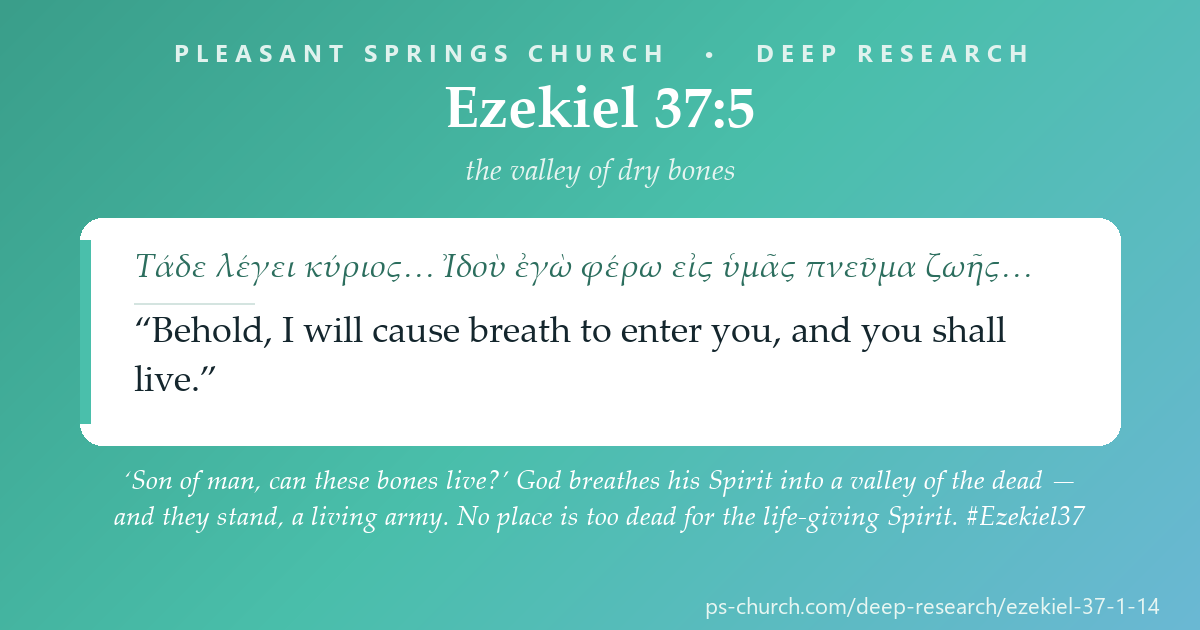
Ezekiel 37:5 · to share
LXX + ESVEvery Deep Research page traces its passage across the whole sweep — the Old Testament, the Second-Temple world between the testaments (historical witnesses, not Scripture), and the New Testament. Follow the thread:
Pleasant Springs Church — Deep Research
Research method after Michael S. Heiser’s Bible Research Method (examine dictionaries → ancient literature → important words → textual connections → academic publications → share), with the Pleasant Springs “Author & Audience” foundation. Scripture set in the Hebrew, the Greek editions named on each page and the ESV (Old Testament), and the Greek New Testament and the ESV (New Testament), per the practice of Pleasant Springs Church. Ezekiel 37:1–14 research grounded in Block, Duguid, and Zimmerli, with Beale & Carson on the New Testament use; the ruach word-study and resurrection-hope scholarship; Second-Temple material per 4Q385 (Pseudo-Ezekiel) read as a witness, not Scripture.
Scripture quotations marked ESV are from the ESV® Bible (The Holy Bible, English Standard Version®), © 2001 by Crossway, a publishing ministry of Good News Publishers. ESV Text Edition: 2016. Used by permission. All rights reserved. The ESV text may not be quoted in any publication made available to the public by a Creative Commons license, and the ESV may not be translated in whole or in part into any other language. www.esv.org
|
Did this study bless you today? 💚 Give to Support PS Church100% of gifts go to the General Fund — thank you. |