After the cosmic week, Genesis zooms all the way in: a potter kneeling in the dirt, shaping a man from clay and breathing into his face; a gardener planting a paradise with a tree of life at its heart. Eden is the first sanctuary, humanity its priesthood — a place of lavish freedom with a single boundary. This study works the garden-temple from the breath of life to the one command, and follows the tree of life all the way to Revelation. See the method →
Genesis 2:4–17 (selections)
Hebrew · LXX · ESVThe Shape of the Passage
InclusioSame Author and audience as Genesis 1:1 — but the lens now zooms from the cosmos to a single garden and a single man, and the tone turns intimate.
Author
The Torah of Moses opens its second panel with a new heading (2:4, the first of Genesis’ “toledot” / “generations” formulas) and a new name for God: the Lord God (יְהוָה אֱלֹהִים). Chapter 1’s cosmic, ordered week gives way to a close-up: God as a potter shaping clay, a gardener planting trees, a Father breathing into a face. This is not a rival creation account but a complementary one — the same events told from ground level, centered on humanity and the garden.
Eden as sanctuary. The man is placed in the garden “to work it and keep it” (עָבַד / שָׁמַר) — the same verb-pair also used for the priests’ service and guarding of the tabernacle (Num 3:7–8). Eden is a garden-temple, humanity its priesthood, and the tree of life its center.
Audience
Israel — a people with their own sanctuary, priesthood, and a lampstand shaped like a tree. For them, the garden’s temple echoes were unmistakable: God walks in Eden as he will “walk among” them in the camp (Lev 26:12), and the way to the tree of life will one day be guarded by cherubim (3:24) as the ark was.
How they heard it. Every human is dust and divine breath — humble origin, royal dignity. Life is a gift held on trust, in a place of abundance (“you may surely eat of every tree”) with a single boundary. Freedom and limit arrive together in the same sentence — and the whole future of the race hangs on how the limit is received.
Orient on Eden, the trees, and the garden-temple.
Search by topic: Eden, paradise, tree of life, garden, temple/sanctuary imagery, creation of humanity.
Which articles are relevant?
- Anchor Bible Dictionary — “Eden, Garden of,” “Tree of Life,” “Paradise,” “Adam.”
- Dictionary of the OT: Pentateuch — “Eden,” “Creation,” “Sacred Space,” “Adam.”
- NIDOTTE / TDOT — עֵדֶן (Eden), נֶפֶשׁ (nep̄eš), עָבַד / שָׁמַר.
Bibliography surfaced:
- Gordon Wenham, “Sanctuary Symbolism in the Garden of Eden,” and his Genesis 1–15 (WBC).
- G. K. Beale, The Temple and the Church’s Mission — Eden as the first sanctuary, a theme running to Revelation.
- T. Stordalen, Echoes of Eden; Nahum Sarna, Genesis (JPS).
Gardens of the gods, the plant of life, and Eden as holy of holies.
Compare the ANE paradise and immortality traditions, then follow Eden into the Second-Temple texts that read the garden as the holiest place on earth.
Which parallels shed light on religion and worldview?
Gardens of the gods. The ANE knew luxuriant divine gardens watered by rivers — the Mesopotamian Dilmun, a paradise-land of the gods — and jeweled gardens on the cosmic mountain (Ezek 28; the garden reached past Mount Mashu in Gilgamesh IX). Genesis shares the imagery of a well-watered paradise with a life-giving center, but Eden is no gods’ private preserve: it is made for humanity, entrusted to human care.
The plant of life. In the Epic of Gilgamesh, the hero wins the plant that restores youth — and a serpent steals it, so death remains. In the Adapa myth, a man is offered the bread and water of life, refuses on bad advice, and forfeits immortality for humankind. Eden’s tree of life sits in the same ancient conversation about mortality — but here the loss comes not by a trickster god’s deception but by a freely broken trust (ch. 3).
- Epic of Gilgamesh XI — the plant of rejuvenation seized by a serpent, and immortality lost (the jeweled garden of the gods is Tablet IX).
- Adapa myth — the bread and water of life declined; a near-miss with immortality.
- Jubilees 3:9–12 (Pseudepigrapha — a witness, not Scripture) — calls Eden holier than all the earth besides (3:12) and derives the Levitical purity law from Adam’s delayed entry; the book later makes the reading explicit — Eden is “the holy of holies, the dwelling of the Lord” (Jubilees 8:19).
- 1 Enoch 24–25 (Pseudepigrapha — likewise not Scripture) — the tree of life on the cosmic mountain, reserved for the righteous to eat at the end.
- Ezekiel 28:13–14 — “Eden, the garden of God… the holy mountain of God” with gemstones and a guardian cherub: a canonical witness to Eden-as-sanctuary.
The Second-Temple reading of Eden as the first sanctuary — now widely held (Wenham, Beale) — is not merely a later imposition; its defenders point to the text’s own priestly vocabulary (work/keep, God walking, the guarding cherubim, the tree-shaped lampstand). This is the arc the whole Bible travels: humanity exiled from the garden-temple in Genesis 3, and welcomed back to the tree of life and the river in Revelation 22 — the sanctuary reopened by the last Adam.
The vocabulary of dust, breath, garden, and command.
Watch the covenant name, the dust-and-breath pairing, the priestly “work/keep,” and the emphatic death-warning the serpent will contradict.
“The Lord God” — the covenant name joined to “God” of ch. 1: the cosmic Creator is Israel’s covenant Lord. The two accounts are one God.
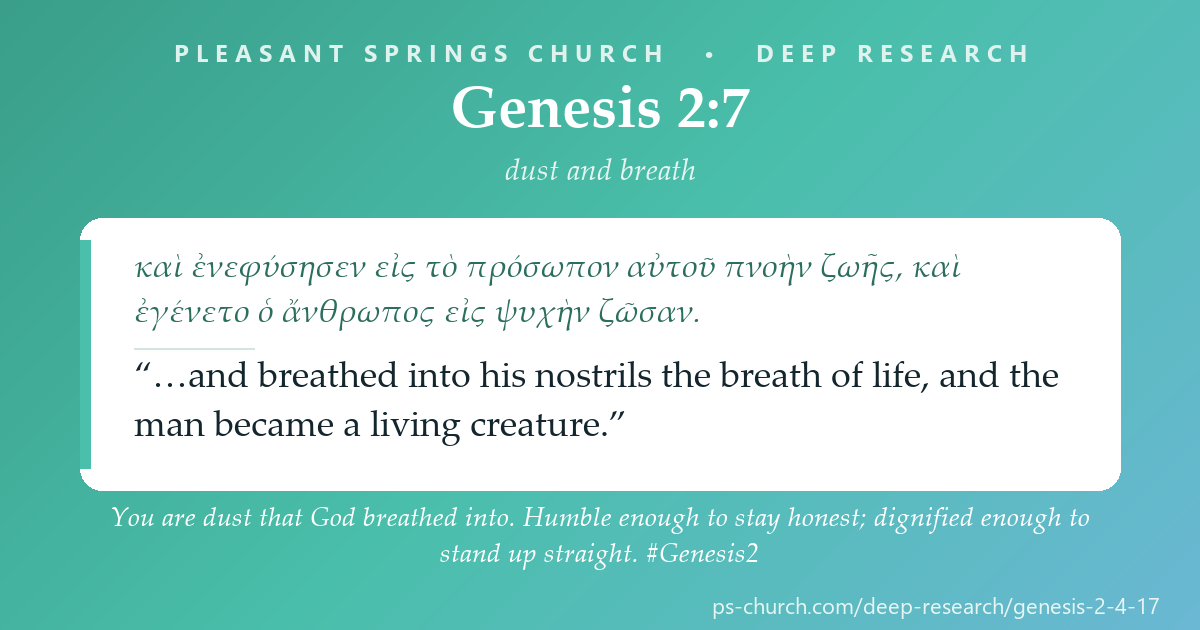
“Dust” and “breath of life” — humanity is both: humble clay and God’s own inbreathing. Mortality and dignity in one creature.
“Garden” — LXX παράδεισος (a walled royal park), which gives us “paradise” (Luke 23:43; Rev 2:7): Eden as the lost-and-regained garden.
“The tree of life” — the garden’s center, barred after the fall (3:22–24), reopened in the New Jerusalem (Rev 22:2, 14): the canon’s great bracket.
“Work / keep” — the priestly service-and-guard pair (Num 3:7–8). Human vocation is priestly cultivation of a holy place, not mere labor.
“You shall surely die” — an emphatic infinitive. The warning is real and total; the serpent will deny this very phrase (3:4).
How the New Testament reuses Eden and the trees:
- Revelation 2:7; 22:1–2, 14 — “the tree of life… in the paradise of God,” the river, and the leaves for healing: Eden restored and enlarged into the city (with Ezek 47).
- 1 Corinthians 15:45 — “the first man Adam became a living being (ψυχὴν ζῶσαν, Gen 2:7 LXX); the last Adam became a life-giving spirit”: Genesis 2:7 read christologically.
- Romans 5:12–19 — Adam’s trust and trespass in the garden set the frame for Christ’s obedience.
- Luke 23:43 — “today you will be with me in παραδείσῳ”: the crucified King reopens paradise to a thief.
From the garden-temple to the city with the tree.
Trace Eden through the sanctuary texts, the tree-of-life thread, and the Adam typology — then note the Beale & Carson trajectory.
Which cross-references matter?
- Numbers 3:7–8; 1 Chronicles 9:23 — the priests “work and keep” the sanctuary: the same charge given Adam in Eden.
- Ezekiel 28:13–14; 31:8–9 — Eden as “the garden of God” on the holy mountain: a prophetic witness to the sanctuary reading.
- Genesis 3:22–24 — the way to the tree of life guarded by cherubim: exile from the garden-temple, the problem the gospel resolves.
- Proverbs 3:18; 11:30 — wisdom as “a tree of life”: the motif re-blooming in Israel’s wisdom.
- Revelation 22:1–5, 14 — river, tree of life, no more curse, the servants seeing God’s face: the garden-temple fully restored — the Bible ends where it began, only better.
Beale’s work (with the Beale–Carson Commentary’s Revelation chapters) traces the tree of life and river from Genesis 2 through Ezekiel 47 to Revelation 22, arguing that Eden was the archetypal sanctuary and that the whole Bible drives toward its restoration and expansion into a cosmic temple. This study’s garden is thus not a lost idyll but the pattern of the end — opened again by Christ, “the resurrection and the life,” in a garden of his own (John 20:15).
The scholarship on Eden and the garden-temple.
Wenham and Beale for the sanctuary reading; Stordalen for the Eden traditions; the commentaries for the exegesis.
Commentaries & studies:
- Gordon Wenham, Genesis 1–15 (WBC), and “Sanctuary Symbolism in the Garden of Eden Story.”
- G. K. Beale, The Temple and the Church’s Mission; Terje Stordalen, Echoes of Eden.
- von Rad, Westermann, Sarna (JPS), Hamilton (NICOT); John Walton, Genesis (NIVAC) on Eden and sacred space.
Interpretation notes worth keeping:
- Two accounts, one witness. Genesis 1 and 2 differ in order and style because they answer different questions (the cosmos; the human vocation); read together they are complementary, not contradictory — Jesus cites both as one (1:27 + 2:24 in Matt 19:4–5).
- “In the day… you shall surely die.” The death that follows is at once spiritual and mortal (exile from life’s source, and dust returning to dust, 3:19); the sentence is real, and mercy delays its full weight.
- The garden-temple reading is now widely held (Wenham, Beale) and is the key that links Genesis 2 to Ezekiel and Revelation.
From the garden to your own trust.
Name what you learned, why it matters, and one concrete response.
What should we carry away — and do?
- You are dust and breath. Neither a god nor a machine — humble clay carrying the very breath of God. Both halves keep you honest: dependent, and dignified.
- Work is priestly. The first job description is “work and keep” a holy place. Ordinary cultivation — of a garden, a home, a craft — is temple service when done before God.
- Abundance came first, one limit second. “You may surely eat of every tree” — then one boundary. God’s law is a fence around a feast, not a fence around a desert.
Step in response: receive one ordinary task this week as garden-keeping — done as service in God’s presence — and thank him that the tree of life, barred in Eden, is thrown open again in Christ (Rev 22:14).
Genesis 2:7 · to share
LXX + ESVEvery Deep Research page traces its passage across the whole sweep — the Old Testament, the Second-Temple world between the testaments (historical witnesses, not Scripture), and the New Testament. Follow the thread:
Pleasant Springs Church — Deep Research
Research method after Michael S. Heiser’s Bible Research Method (examine dictionaries → ancient literature → important words → textual connections → academic publications → share), with the Pleasant Springs “Author & Audience” foundation. Scripture set in the Hebrew, the Greek editions named on each page and the ESV (Old Testament), and the Greek New Testament and the ESV (New Testament), per the practice of Pleasant Springs Church. Genesis 2:4–17 research grounded in Wenham, Beale, Stordalen, von Rad, and Walton; ancient parallels from Gilgamesh and the Adapa myth; Second-Temple Eden material per Jubilees 3 and 1 Enoch 24–25 (read as witnesses, not Scripture).
Scripture quotations marked ESV are from the ESV® Bible (The Holy Bible, English Standard Version®), © 2001 by Crossway, a publishing ministry of Good News Publishers. ESV Text Edition: 2016. Used by permission. All rights reserved. The ESV text may not be quoted in any publication made available to the public by a Creative Commons license, and the ESV may not be translated in whole or in part into any other language. www.esv.org
|
Did this study bless you today? 💚 Give to Support PS Church100% of gifts go to the General Fund — thank you. |