The first thing God says after the fall is not a sentence but a search: “Where are you?” What follows is judgment — thorns, sweat, pain, dust, exile — but woven into the curse on the serpent is the Bible’s first promise of a rescuer: a child of the woman who will crush the serpent’s head. This study works the aftermath of Eden from the blame-shifting to the guarded tree, and follows the protoevangelium all the way to the dragon’s defeat. See the method →
Genesis 3:8–24 (selections)
Hebrew · LXX · ESVThe Shape of the Passage
ChiasmSame Author and audience as Genesis 1:1 — and the fall’s aftermath turns, astonishingly, into the Bible’s first announcement of grace.
Author
The Torah of Moses gives the fall’s consequences a precise shape. God comes seeking, not smiting: “Where are you?” (a question, not an accusation). The pair blame-shift down the chain — man blames woman (and God, “the woman you gave”), woman blames serpent. Then come the curses, matching the order of the temptation (serpent, woman, man) and reversing the order of the interrogation — and buried in the curse on the serpent is the first gleam of hope: a coming offspring of the woman who will crush the serpent’s head (3:15).
Grace inside judgment. Even the sentence carries mercy: God clothes their shame with garments of skin (3:21) — the first death, a covering God provides — and bars the tree of life not to punish but so they will not live forever in a fallen state. Exile is severe; it is also protective.
Audience
Israel — a people who knew curse and exile firsthand, and who lived by sacrifice and a sanctuary guarded by cherubim. The same cherubim that guard Eden’s tree (3:24) were woven into the tabernacle veil and overshadowed the ark: the way back to God’s presence is closed — and marked as a place blood must open.
How they heard it. The world’s brokenness — painful childbirth, thorns, sweat, death, alienation — is real and explained here, not as the way things must be but as the way things went wrong. And already, in the same breath, God promises an offspring who will undo it. Israel’s whole hope of a deliverer begins in this verse.
Orient on the fall, the curse, and the protoevangelium.
Search by topic: fall, curse, sin, protoevangelium/seed of the woman, cherubim, atonement.
Which articles are relevant?
- Anchor Bible Dictionary — “Fall, The,” “Curse,” “Cherubim,” “Seed.”
- Dictionary of the OT: Pentateuch — “Fall,” “Blessings and Curses,” “Messiah,” “Sacrifice.”
- NIDOTTE / TDOT — זֶרַע (zeraʿ, seed), שׁוּף (šûp̄), אָרַר (ʾārar, curse), כְּרוּב (cherub).
Bibliography surfaced:
- Henri Blocher, Original Sin; Wenham, Genesis 1–15 (WBC); Hamilton (NICOT).
- T. D. Alexander, “Messianic Ideology in the Book of Genesis” and From Paradise to the Promised Land — the seed theme.
- Jack Collins, “A Syntactical Note on Genesis 3:15” (on the singular “he”).
Curse, covering, and the coming seed — read in the Second-Temple imagination.
Compare the ANE curse and exile motifs, then follow the seed-of-the-woman promise into its early messianic reception.
Which parallels shed light on religion and worldview?
Curse and exile. The ANE knew curses, expulsions from sacred precincts, and guardian figures at temple gates. The winged cherubim recall the composite guardian creatures (kūribu) stationed at Mesopotamian temple and palace doorways. Genesis uses the familiar image of the armed temple-guardian — but here it guards the way back to life, a way the rest of Scripture labors to reopen.
- Mesopotamian temple guardians (kūribu / lamassu) — winged hybrid figures at sacred thresholds: the cultural backdrop to Eden’s cherubim and the tabernacle’s.
- Jubilees 3:17–35 (Pseudepigrapha — a witness, not Scripture) — retells the fall and expulsion, dating them and deriving purity practice; Adam offers incense on leaving Eden.
- Life of Adam and Eve / Apocalypse of Moses (Pseudepigrapha — likewise not Scripture) — expands the couple’s repentance and hope after Eden; an influential Second-Temple retelling.
- Targum Pseudo-Jonathan & Neofiti on 3:15 (later rabbinic-era witnesses, likely preserving older tradition) — read the seed’s victory over the serpent as fulfilled “in the days of King Messiah”: a messianic reading of the verse in Judaism.
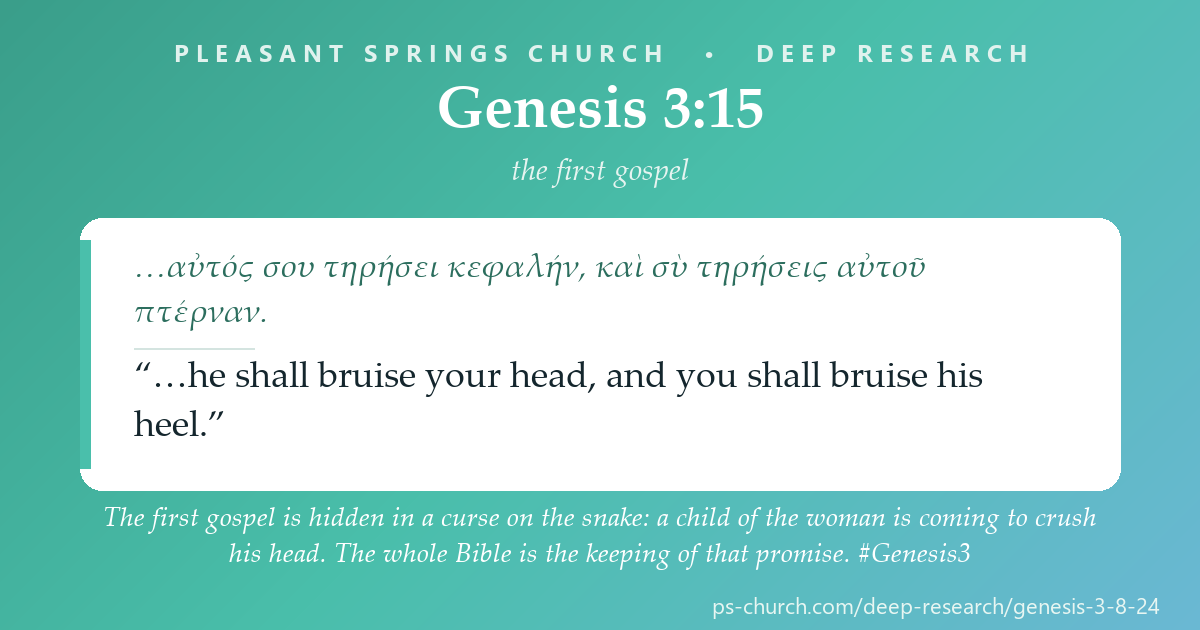
Christians from Irenaeus on have read 3:15 as the first good news (later termed the protoevangelium). The clues are in the text: the promise singles out the woman’s seed (offspring are normally reckoned by the father), the LXX’s masculine “he” (αὐτός) points to an individual champion, and the ancient Jewish Targums already heard a Messiah here. The New Testament confirms it: Paul echoes 3:15 — “the God of peace will soon crush Satan under your feet” (Rom 16:20) — and Revelation stages the whole drama: the woman, her male child, and the dragon (that ancient serpent) who fails to devour him (Rev 12).
The vocabulary of the curse and the promise.
Watch God’s seeking question, the double-edged “bruise,” the seed-thread, and the covering skins.
“Where are you?” — God’s first word after the fall is a seeking question, not a verdict. Grace goes looking for the hiding.
“Seed / offspring” — both collective and (with the singular “he”) individual. The seed-thread runs through Abraham (22:18) to Christ (Gal 3:16).
“Bruise / crush / strike at” — the same verb for both blows, but the targets differ: the serpent’s head (mortal), the seed’s heel (wounding, survivable).
“Garments of skin” — God’s covering for their shame; the first death, an animal in the sinner’s place: the seed of substitutionary sacrifice.
“Cherubim” — guardian throne-creatures. The same figures on the tabernacle veil and the ark: the way to life is barred, awaiting the blood that opens it (Heb 10:19–20).
“Dust… to dust” — death as return to the ground from which the man was formed (2:7). The wage of sin, reversed only in resurrection.
How the New Testament reuses Genesis 3:8–24:
- Romans 16:20 — “the God of peace will soon crush Satan under your feet”: Genesis 3:15 applied to the church, in the victory of the woman’s Seed.
- Galatians 4:4; Revelation 12:1–17 — the Son “born of woman”; the woman, the male child, and the dragon: the seed-vs-serpent war brought to its climax.
- Romans 8:20–22 — creation “subjected to futility” and groaning: the curse of 3:17–19 awaiting release; Revelation 22:3 — “no longer will there be anything accursed.”
- Hebrews 9:22; 10:19–20 — “without the shedding of blood there is no forgiveness”; the new and living way opened “through the curtain” the cherubim once guarded.
From the first promise to the crushed serpent.
Trace the seed-thread, the curse, and the guarded way — then note the Beale & Carson trajectory into Revelation.
Which cross-references matter?
- Genesis 22:17–18; Galatians 3:16 — the “seed” narrowed to Abraham’s offspring and finally to Christ: the thread that begins in 3:15.
- Genesis 3:1–7 & 2:9 — the serpent and the tree of life, now under enmity and a guard: this passage is the previous scene’s reckoning.
- Isaiah 7:14; 9:6; Micah 5:2–3 — the promised child of the seed-line, developing 3:15’s hope.
- Romans 5:12–19; 8:19–23 — the one man’s trespass, the curse on creation, and its coming release in Christ.
- Revelation 12:1–17; 20:2–10; 22:1–3 — the woman’s child, the dragon crushed, the curse undone, the tree of life reopened: Genesis 3 answered in full.
The Beale–Carson Commentary’s Revelation chapters read chapter 12 as the direct fulfillment of Genesis 3:15: the woman, her male child “caught up to God,” and the enraged dragon making war on “the rest of her offspring” (Rev 12:17) are the enmity, the Seed, and the serpent of the protoevangelium, now on the cosmic stage. The Bible’s first promise and its last battle are the same story — and the head-crushing is secured at the cross (Col 2:15; Heb 2:14).
The scholarship on the fall and the protoevangelium.
Blocher on original sin; Alexander and Collins on the seed and 3:15; the commentaries for the curses.
Commentaries & studies:
- Henri Blocher, Original Sin: Illuminating the Riddle; Wenham (WBC), Hamilton (NICOT), Sarna (JPS), von Rad.
- T. Desmond Alexander, “Messianic Ideology in Genesis” & The Servant King; C. John Collins, Genesis 1–4 and his 3:15 syntax note.
- James Hamilton, “The Skull-Crushing Seed of the Woman: Inner-Biblical Interpretation of Genesis 3:15.”
Interpretation notes worth keeping:
- Is 3:15 messianic? The minimal sense is ongoing enmity between humans and snakes; but the singular “he,” the LXX’s αὐτός, the seed-thread to Abraham and David, and the Targums’ messianic reading together support the church’s protoevangelium — a promise that culminates in Christ.
- “Her desire… he shall rule” (3:16) is illuminated by the near-identical wording of 4:7 (sin’s “desire”): the terms describe a struggle for mastery introduced by the fall, read variously by interpreters.
- Garments of skin are widely seen as the Bible’s first hint of substitution — God covering sin at the cost of a life — though Genesis states it without comment.
From the curse to the covering.
Name what you learned, why it matters, and one concrete response.
What should we carry away — and do?
- God seeks before he sentences. His first word to fallen people is “where are you?” — grace on the move toward the hiding. He still comes looking.
- The gospel is older than the fall is deep. Before the first exile, God had already promised the Seed who would crush the serpent. No brokenness in your story predates his rescue plan.
- God covers what we cannot. Fig leaves failed; God made garments of skin. Our shame is answered not by our effort but by a covering he provides — finally, the Lamb (Rev 7:14).
Step in response: stop hiding from the God who asks “where are you?” — bring one hidden thing into the light this week — and thank him that the head-crushing Seed has already come, and the curse is being unmade (Rev 22:3).
Genesis 3:15 · to share
LXX + ESVEvery Deep Research page traces its passage across the whole sweep — the Old Testament, the Second-Temple world between the testaments (historical witnesses, not Scripture), and the New Testament. Follow the thread:
Pleasant Springs Church — Deep Research
Research method after Michael S. Heiser’s Bible Research Method (examine dictionaries → ancient literature → important words → textual connections → academic publications → share), with the Pleasant Springs “Author & Audience” foundation. Scripture set in the Hebrew, the Greek editions named on each page and the ESV (Old Testament), and the Greek New Testament and the ESV (New Testament), per the practice of Pleasant Springs Church. Genesis 3:8–24 research grounded in Blocher, Alexander, Collins, Wenham, and Hamilton; ancient guardian-figure background per Mesopotamian kūribu; Second-Temple readings per Jubilees 3, the Life of Adam and Eve, and the Targums (read as witnesses, not Scripture).
Scripture quotations marked ESV are from the ESV® Bible (The Holy Bible, English Standard Version®), © 2001 by Crossway, a publishing ministry of Good News Publishers. ESV Text Edition: 2016. Used by permission. All rights reserved. The ESV text may not be quoted in any publication made available to the public by a Creative Commons license, and the ESV may not be translated in whole or in part into any other language. www.esv.org
|
Did this study bless you today? 💚 Give to Support PS Church100% of gifts go to the General Fund — thank you. |