Jubilees 3 to 5 retells Genesis from the naming of the animals to the opening of the ark — Eden, the fall, Cain and Abel, the line from Seth to Noah with every wife named, Enoch, the Watchers, the flood — in a hundred verses, and it dates almost everything. This page measured both halves of that sentence. In Geʻez, the one language the whole book survives in, the retelling shares a median of two consecutive words a verse with the Ethiopic Genesis, and fourteen of its hundred verses share no two at all. The dates are another matter. Every birth from Seth to Noah falls within seven years of the sum the Samaritan Genesis gives, and a century or more from the sums of the CATSS Greek and of the Ethiopic Genesis (which carries the Greek numbers for seven fathers and the Masoretic for the last two). It is not Scripture for us: Jubilees is read here as a Second-Temple witness, and tested by the canon. See the method →
Jubilees is a Second-Temple Jewish retelling of Genesis and the start of Exodus, presented as revealed to Moses on Sinai and dictated by the angel of the presence, with all history counted in jubilees of 49 years. VanderKam’s introduction, as quoted on the Open Siddur page held here, says it survives complete only in Ethiopic and “enjoyed canonical status in the Abyssinian Church”; Hebrew fragments of it were found at Qumran (11Q12 is measured on this page). It is not Scripture for us. We read it as we read the other Second-Temple books — as a window on how Genesis was being read in the centuries before Christ — critically, gratefully for the light it throws, and testing everything by the canon. Where it carries what Genesis lacks — heavenly tablets, Enoch’s books, Eden as a sanctuary — this page reports it and does not adopt it. The book’s 364-day calendar, argued in chapter 6, is its own position; the shelf reports it and does not endorse it. For the book’s introduction see Jubilees, Prologue & 1.
⚠️ What this page can and cannot measure — read this first.
HELD: Charles’s English Jubilees (Prologue and 1,307 verses); VanderKam’s Geʻez Jubilees (1,308 rows with the incipit, measurement only); Dillmann’s Ethiopic Genesis (1,526 rows, numbered like the Greek); the Masoretic Genesis and Leviticus; the CATSS Greek Genesis (1,531 rows); the Samaritan Genesis (Chester Beatty 751, 1,533 verses); the Clementine Vulgate; the Cambridge Septuagint’s running text of Genesis 6 (an eye-transcription); and, fetched for this page, the Qumran Hebrew fragments of 11Q12 from Scripta Qumranica Electronica (CC BY-SA 4.0), with every letter marked preserved or restored.
NOT HELD: any Greek, Latin or Syriac Jubilees; VanderKam’s apparatus, so no Ethiopic manuscript variant can be checked; Dillmann’s printed pages, so the Ethiopic Genesis is read only as digitised; the printed edition of 11Q12; any other Qumran Jubilees manuscript measured for this range (none was fetched for this page; a later page’s folder now holds SQE transcriptions of them, and whether another preserves words of 3:1–5:32 was not established here); and 1 Enoch in any measured corpus — raw scans of Charles’s 1912 English and of Swete’s Greek of chapters 1–32 sit unaligned in the witness folders and nothing here uses them.
CONSEQUENCE: the Greek New Testament screen cannot run — there is no Greek Jubilees to run it with — so every New Testament connection on this page is named, never measured. The word screens that do run are Geʻez against Geʻez and Hebrew against Hebrew. English is never run against anything.
Jubilees 3:1–5:32 — sixteen verses, each with what was measured
English: R. H. Charles (1902; SPCK reprint 1917) · Geʻez measured, quoted only in short phrasesThree consecutive Geʻez words with the Ethiopic Genesis 2:18 — ባሕቲቱ ፡ ንግበር ፡ ሎቱ, alone; let us make for him — tie band 1 from both sides. The middle word is also a reading: let us make is plural in Jubilees, in the Ethiopic Genesis, in the CATSS Greek (ποιήσωμεν) and in the Vulgate (faciamus); the Masoretic and Samaritan Hebrew read I will make (אֶֽעֱשֶׂה).
The first of five verses in these chapters that send a story up to the heavenly tablets (3:10, 3:31, 4:5, 4:32, 5:13). The day counts are Leviticus 12’s exactly: 7 + 33 = 40 for a son, 14 + 66 = 80 for a daughter (Masoretic Lev 12:2–5), and 3:9 brings Adam into Eden after forty days and the woman on the eightieth. No Hebrew or Greek of this verse is held, so the agreement is counted in numbers, not measured in words.
The deepest Geʻez contact in all hundred verses: seven consecutive words with the Ethiopic Genesis 3:5, tie band 1 from both sides — but three of the seven, [ወትከውኑ ፡ ከመ ፡ አማልክት ፡] (and you will be like gods), stand inside Dillmann’s square brackets, his sign for words missing in his older manuscripts and supplied from later ones. Drop the bracketed words and the verse still reaches six — with Genesis 3:4 instead, where the run starts one word late because the Ethiopic Genesis makes the serpent say it in the feminine (ወትቤላ) and Jubilees in the masculine (ወይቤላ).
Here Charles printed four dots, and the 1917 edition’s note says he suspected a lacuna. Measured: Genesis 3:15 — the enmity between the serpent’s seed and the woman’s — shares no two consecutive Geʻez words with any of the 1,308 rows of Jubilees, prologue included. The verse division is not Charles’s either: in VanderKam’s Geʻez, 3:23 runs on into God’s anger with the woman (ወለብእሲትሂ ፡ ተምዕዓ, and with the woman he was angry), which Charles numbers 3:24 — and no gap is marked there.
Three consecutive words with the Ethiopic Genesis 3:20 — and the run breaks on the name. Jubilees has ሔዋ, Eve, as the Masoretic and Samaritan Hebrew have חַוָּ֑ה and the Vulgate Heva; the Ethiopic Genesis has ሕይወት, Life, as the CATSS Greek has Ζωή.
Six consecutive Geʻez words with the Ethiopic Genesis 4:25, tie band 1 from both sides: ወወለደት ፡ ሎቱ ፡ ወልደ ፡ ወሰመዮ ፡ ስሞ ፡ ሴት, she bore him a son, and he called his name Seth. He, not she — Stage 4 sets that one verb out across seven texts, and on the leather of the Qumran fragment 11Q12 the letters ויקרא are preserved, not restored. And the date — the fourth year of the fifth week of the third jubilee — is AM 130, Adam’s age at Seth’s birth in the Masoretic and Samaritan Genesis. The CATSS Greek and the Ethiopic Genesis say 230.
The words in parentheses are Charles’s, not the text’s. The Geʻez says only ወበራብዑ, and in its fourth. Counted in the week just named — the fifth — that is AM 228; Charles’s supplement makes it AM 235, which is the Masoretic and Samaritan sum for Enosh. VanderKam’s translation, printed beside the digitised Geʻez on its host page, dates it 228. The one birth in these chapters where agreement with the Hebrew sums rests on an editor’s parenthesis.
In these hundred verses only one person writes. An active form of write — four perfects, he wrote, and at 4:23 the imperfect ይጽሕፍ, he writes — stands five times in the Geʻez, at 4:17, 4:18, 4:19, 4:21 and 4:23, and every time its subject is Enoch. Every other form of the verb is passive — ተጽሕፈ, it was written, eight times in seven verses (3:10, 3:14, 4:5, 4:30, 5:13 twice, 5:17, 5:18), and the participle ወጽሑፍ, and written, once more at 5:14.
Into the Garden of Eden. Genesis 5:24 says only that God took him (Masoretic, Samaritan, Vulgate tulit eum Deus) or translated him (CATSS μετέθηκεν αὐτὸν ὁ θεός) — but the Ethiopic Genesis 5:24 ends (ውስተ ፡ ገነት), into the garden, inside Dillmann’s round brackets, his sign for an Ethiopic addition against the Greek. In Geʻez the two verses still share only one consecutive word, because Jubilees uses the bound form ገነተ ፡ ኤዶም.
The book’s frame breaks the surface. “this mountain on which thou art this day, Mount Sinai” — the dictating angel turning to Moses. It is the only one of the hundred verses that names Sinai, in the English and in the Geʻez (ደብረ ፡ ሲና).
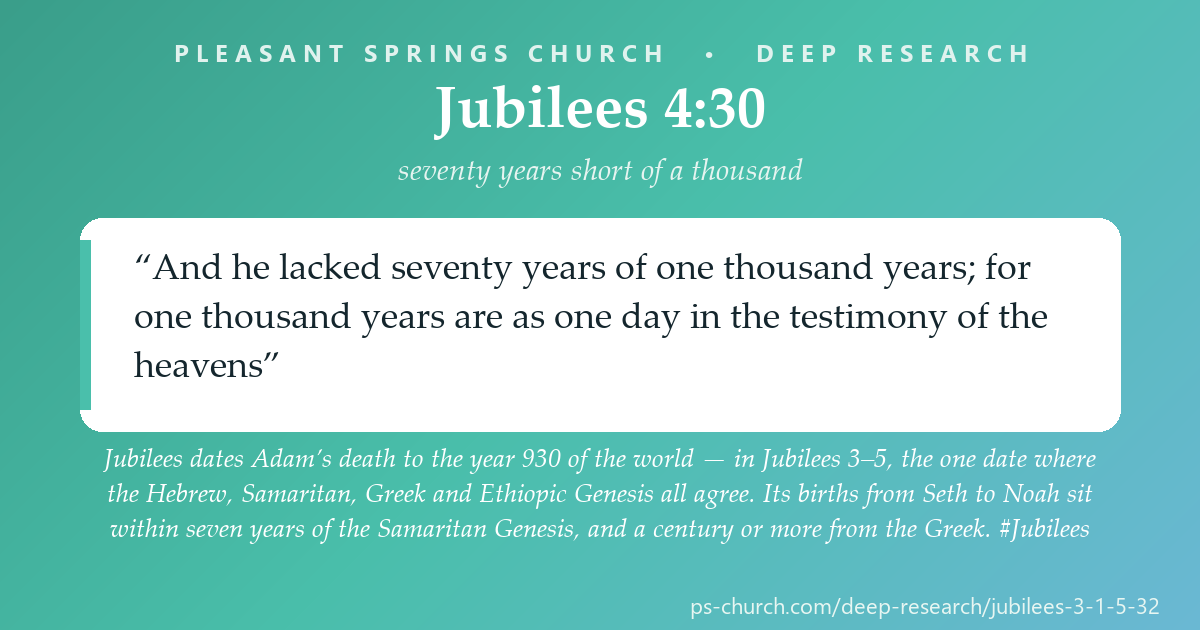
AM 930: the close of the nineteenth jubilee, its seventh week, its sixth year — 49×18 + 7×6 + 6. Of the eleven dates in Stage 4’s table it is the only one on which the Masoretic, Samaritan, CATSS Greek and Ethiopic Genesis all agree (Genesis 5:5).
Seventy short of a thousand: 1,000 − 70 = 930. The 1917 edition’s note sets one thousand years are as one day beside 2 Peter 3:8 and Justin’s Dialogue 81; Psalm 90:4 is the Old Testament verse with the same thought. Neither the Psalm nor the epistle is held in Geʻez, so no Geʻez run is possible. Hebrew against Hebrew, 11Q12’s fragment 5 preserves three whole-word sequences of this verse — אלף (thousand), הדעת כיא (the knowledge, for) and שני היום (the years of the day) — and against the Masoretic Psalm 90:4 they share one word, אלף, and no two in sequence. The epistle cannot be run at all.
In Charles’s English this is Genesis 6:1–2 almost clause for clause. In Geʻez its longest shared run with the Ethiopic Genesis 6:1 is one word, and with 6:2 one word. The reading differs as well: Jubilees has መላእክተ ፡ እግዚአብሔር, the angels of God; the Ethiopic Genesis has ውሉደ ፡ እግዚአብሔር, the children of God, as the CATSS Greek has οἱ υἱοὶ τοῦ θεοῦ and the Hebrew בְנֵי־הָֽאֱלֹהִים֙. Angels of God is what the Cambridge Septuagint of 1906 prints at 6:2 from Codex Alexandrinus: οἱ ἄγγελοι τοῦ θεοῦ — written in A over an erasure, its apparatus notes, and listed there also for Codex E, several minuscules, Philo and Josephus.
Bound in the depths of the earth — and kept so “until the day of the great condemnation” (5:10). Jude 6 and 2 Peter 2:4 speak of angels kept in chains, or in Tartarus, for judgment. The page names them and measures nothing: there is no way to run a Geʻez or English text against the Greek New Testament.
AM 1,307 — 49×26 + 7×4 + 5. It is the Samaritan Genesis’s flood year (Noah born 707, flood at 600). The Geʻez as digitised does not say twenty-seventh: it reads በክልኤቱ ፡ ኢዮቤልዉ, in the two jubilee, which would be AM 82. VanderKam’s own translation beside it says twenty-seventh. Reported in Stage 5.
Forty days and forty nights — and in Geʻez this verse shares no two consecutive words with Genesis 7:12. Jubilees: አርብዓ ፡ መዋዕለ ፡ ወአርብዓ ፡ ለያልየ. The Ethiopic Genesis: አርብዓ ፡ ዕለተ ፡ ወአርብዓ ፡ ሌሊተ. Different words for day and for night. This is the page’s plainest counter-example: a Geʻez screen measures the wording of two Ethiopic texts, not whether the story is the same.
Versification — a third state, stated because it is not the usual one. There is no Masoretic, no Septuagint, no KJV, no ESV and no Vulgate Jubilees, so there is no MT/LXX offset, no KJV shape and no Vulgate shape to report: the shelf’s King James loader raises on Jubilees rather than return nothing, and the Clementine Vulgate on this disk has no such book.
The two texts that do exist count alike. Charles’s English: chapter 3 has 35 verses, chapter 4 has 33, chapter 5 has 32 — 100. VanderKam’s Geʻez: 35, 33, 32. Agreement of count is not agreement of division: VanderKam’s 3:23 carries God’s anger with the woman, which Charles numbers 3:24 (see the codex). Every verse number on this page is Charles’s, and both texts are aligned by those numbers.
The Genesis side has no offset in this range. Genesis 2–8 has the same chapter lengths — 25, 24, 26, 32, 22, 24, 22 — in the Masoretic text, the CATSS Greek and the Samaritan file; Dillmann’s Ethiopic numbering follows the Greek and matches them too, except that his Genesis 6 has no row 6:20 (a gap in the source itself, so chapter 6 has 21 rows there). The Clementine Vulgate on this disk is the one exception in shape: it counts Genesis 5 as 31 verses, its 5:31 carrying the Masoretic 5:31–32; none of the Vulgate verses quoted on this page is affected.
The Shape of the Passage
Sequence, with a fivefold refrain (counted)This is a sequence, and it is not offered as a chiasm. The chapters run forward through Genesis 2–8 without folding back on themselves; what gives them a shape is the refrain and the dates. And they sit inside the book’s own frame: an angel of the presence dictating to Moses on Sinai (1:27–2:1) — here narrating as we in ten verses (3:1, 3:4, 3:9, 3:12, 3:15, 4:6, 4:18, 4:23, 5:6, 5:23) and addressing Moses once (4:26) — dating everything by jubilees of 49 years to the fiftieth, which 50:4 makes the entry into Canaan: forty-nine jubilees, one week and two years to Sinai, and forty years more, 2,450 years. These hundred verses run from AM 1 to AM 1309 — 53% of the book’s years in under 8% of its 1,307 verses.
⚠️ Where this page sits. Jubilees is filed here under Pseudepigrapha & Second Temple. VanderKam’s introduction to his translation, as quoted on the Open Siddur page held on this disk, says the Ethiopic version “enjoyed canonical status in the Abyssinian Church”. It is not Scripture for us, and nothing taught at Pleasant Springs rests on it.
Author
Anonymous, and speaking through an angel. The book presents itself as dictated by the angel of the presence to Moses on Sinai. In these three chapters the narrator says we in ten verses — we brought the animals to Adam, we brought him into the garden, we conducted Enoch into Eden, He bade us bind the angels — and turns to Moses once, at 4:26.
Dated by VanderKam to between 161 and 152 BC, against Nickelsburg’s and Goldstein’s date just before 167 (both reported in VanderKam’s introduction, as quoted on the Open Siddur page held here); nothing on this page tests the date. The writer’s interests show in what his chapters carry and Genesis lacks: purity law (3:8–14), incense offered by Adam (3:27) and by Enoch (4:25), a sanctuary reading of Eden (3:12), and a date on almost every event.
And he counts. Twenty-one of these hundred verses date an event, and Charles printed thirty-three years of the world beside them in his margin; the wives in Seth’s line, unnamed in Genesis, are all named.
Audience
Readers who wanted to know when. Genesis gives the ages of the fathers; Jubilees gives the year of the world for each birth, and the month and day for the fall, the expulsion and every stage of the flood.
Readers for whom the law was older than Sinai. Five times in these chapters a story ends in a rule written on the heavenly tablets — purity after childbirth, covering one’s nakedness, a curse on striking a neighbour treacherously, like-for-like punishment, the judgment of all.
Readers who knew more about Enoch than Genesis tells. Genesis 5:21–24 gives him four verses; Jubilees 4:16–26 gives him eleven, and he writes, testifies and is taken into Eden. The 1917 edition infers that the author knew Enochic writings (Stage 2); that his readers did is this page’s guess from that, and neither is tested here.
Orient on Jubilees, its chronology, and the Watchers.
Search by topic: Jubilees, Book of; chronology (biblical); Samaritan Pentateuch; Septuagint chronology; Enoch; Watchers; heavenly tablets; Qumran Jubilees manuscripts.
Which articles are relevant?
- Anchor Bible Dictionary — its article on Jubilees (VanderKam, as the shelf’s Jubilees 1 page also cites), and its articles on biblical chronology, the Samaritan Pentateuch and 1 Enoch.
- Eerdmans Dictionary of Early Judaism — its entries on Jubilees, the Watchers, the Enoch literature and the calendars.
- Dictionary of New Testament Background (IVP) — its entries on Jubilees, on rewritten Bible and on the Enoch literature.
- On the numbers — any article that sets out the Masoretic, Samaritan and Greek ages in Genesis 5 side by side. An article that speaks of ‘the biblical chronology’ as if there were one is not usable for this chapter.
Bibliography surfaced:
- James C. VanderKam, The Book of Jubilees: A Critical Text (CSCO 510, Scriptores Aethiopici 87; Louvain: Peeters, 1989) — the Geʻez measured on this page, and his commentary Jubilees (Hermeneia).
- R. H. Charles, The Book of Jubilees, or the Little Genesis (London: A. & C. Black, 1902; SPCK reprint 1917) — the English quoted here.
- J. T. A. G. M. van Ruiten, Primaeval History Interpreted (Brill) — how Jubilees rewrites Genesis 1–11, clause by clause.
- James L. Kugel, A Walk Through Jubilees; Michael Segal, The Book of Jubilees.
Four Genesis texts, a Qumran fragment, and the Enoch books nobody here can measure.
Jubilees 3–5 is read beside every Genesis the disk holds, because they do not agree with each other — and the page will not pretend there is one Genesis to compare it with.
Which parallels shed light on the world of the text?
Genesis exists in at least four forms on this disk, and in Genesis 5 they disagree by centuries. The Masoretic and Samaritan Hebrew give Adam 130 years at Seth’s birth; the CATSS Greek and the Ethiopic Genesis give 230. The two Hebrew texts agree on six of the nine fathers and part at three — Jared begets Enoch at 162 in the Masoretic text and at 62 in the Samaritan, Methuselah begets Lamech at 187 and 67, Lamech begets Noah at 182 and 53. The Ethiopic Genesis agrees with the CATSS Greek for the first seven fathers, then has 187 and 182 — the Masoretic numbers — where the CATSS Greek has 167 and 188. Stage 4 sets Jubilees’ dates against all four.
Leviticus 12 is inside chapter 3. The purity law for a mother — 7 + 33 days for a son, 14 + 66 for a daughter — is given an origin in Eden: Adam was brought in after forty days, the woman after eighty.
The 1917 edition’s notes read 4:15–26 against the Enoch books. They say that 4:15’s “in his days the angels of the Lord descended on the earth” “looks like a quotation from 1 Enoch vi. 6”, and they report Charles’s inference that the author knew 1 Enoch 6–16, 23–36 and 72–90; they also note that there is nothing in 1 or 2 Enoch about ‘jubilees’. None of that is tested here: 1 Enoch is in no corpus this shelf measures.
- What Jubilees says Enoch wrote (Charles’s English, 4:17–23): the signs of heaven by the order of their months, in a book (4:17); a testimony, reckoning the weeks of the jubilees, the days of the years, the months and the sabbaths of years (4:18); his testimony of a dream-vision of everything until the day of judgment (4:19); everything the angels showed him over six jubilees, “the rule of the sun” among it (4:21); and, in Eden, “the condemnation and judgment of the world” (4:23). Reported, not checked against any Enoch text.
- 11Q12 (11QJubilees) — Hebrew fragments of this very range from Qumran Cave 11, read by this page against Charles’s English as covering 4:6–11, 4:13–14, 4:16–18, 4:29–31 and 5:1–2. Of their 1,089 Hebrew letters, 223 are preserved; the rest is the editors’ restoration. Stage 4 measures only the 223.
- Josephus, Antiquities 1.1.4 — named by the 1917 notes beside 3:28 (the animals once spoke) and 3:23 (the serpent’s feet). Not consulted here.
- Genesis Rabbah and Pirqe de Rabbi Eliezer — named by the 1917 notes for the hours Adam spent in the garden and for Cain’s wife. Not consulted here.
Noah’s birth, as the sum of the fathers’ ages at begetting in Genesis 5: Masoretic 1,056; Samaritan 707; CATSS Greek 1,642; Ethiopic Genesis 1,656. Add the 600 years of Genesis 7:6 and the flood falls in AM 1,656 (Masoretic), 1,307 (Samaritan) or 2,242 (CATSS Greek). The Ethiopic Genesis is left out of that last sum on purpose: as digitised, its 7:6 reads seven hundred, and its 7:11 and 8:13 the seven hundred and first year, where the other three have six hundred; this page has not seen Dillmann’s printed page and does not resolve it.
Jubilees makes the ark in AM 1,307 and closes it in AM 1,308. The Samaritan sum is the only one within a year of it.
A unit of time, a heavenly archive, a name for fallen angels, a scribe, and a name for Eve.
Counts are over the digitised Geʻez of Jubilees (1,308 rows) and Dillmann’s Ethiopic Genesis (1,526 rows), split into word forms as written; a headword count below includes every prefixed, suffixed or plural form that contains the headword, and says so where the bare form differs. English counts are over Charles’s text. They are counts over these files, not over ‘the Ethiopic Bible’.
Twenty-six times in the Geʻez of these hundred verses, counting every prefixed and plural form (the bare form alone: seventeen; Charles’s English: jubilee or jubilees twenty-four times). A jubilee is 49 years, a week of years seven, so every date reduces to AM = 49(N−1) + 7(M−1) + K — the formula every number in Stage 4 is computed with. One spelling in the digitisation is broken (ኢዮበቤልዉ at 4:20).
Five verses, five rules: 3:10 (childbirth), 3:31 (nakedness), 4:5 (a treacherous blow), 4:32 (like for like), 5:13 (the judgment of all). The law of Sinai is presented as older than Sinai — which is the book’s claim, reported, and not the church’s.
Twice in these chapters (4:15, 4:22) and five times in the whole Geʻez Jubilees (4:15, 4:22, 7:21, 8:3, 10:5), counting every form built on the stem; this exact form, with la-, only at 4:22. No form of it in the Ethiopic Genesis. At 4:15 they come down “that they should instruct the children of men, and that they should do judgment and uprightness on the earth” — a good errand that goes wrong by 4:22.
Five active forms in these hundred verses, all of them Enoch’s (4:17, 4:18, 4:19, 4:21, 4:23). The passive ተጽሕፈ, it was written, stands eight times, for what heaven has already recorded. Enoch is the only human scribe in these chapters.
Twice in the whole Geʻez Jubilees (3:33, 4:10), always without the final -n. The Ethiopic Genesis spells her ለሔዋን (4:1, 4:25; and with a different prefix, (ወሔዋን ፡), inside Dillmann’s round brackets at 5:2) and at 3:20, where Adam names her, does not use the name at all — it says Life, with the Greek.
Counted here, not assumed:
- 2,001 Geʻez word forms in the hundred verses, twenty a verse; not one written as a numeral. The Ethiopic Genesis 2:4–8:19 carries 42 numeral tokens — Genesis 5’s ages are written in figures, Jubilees’ dates in words. Which is one reason Genesis 5 and Jubilees 4 share almost no wording at all.
- Thirty-three dated events in twenty-one verses, 3:15–5:31 — exactly the thirty-three Anno Mundi numbers Charles printed in his margin — thirty-one of them recomputed by Stage 4’s formula (the other two, 3:17 and 3:32, AM 8, follow from the seven years of 3:15–17; 3:32 itself gives only a month).
- Nine wives named where Genesis 5 names none: ’Azûrâ, Nôâm, Mûalêlêth, Dînâh, Bâraka, Ednî, Ednâ, Bêtênôs, ’Ĕmzârâ — and Cain’s wife ’Âwân (4:9). Six of them are called the daughter of his father’s brother, three his sister.
The words seldom match; the numbers nearly always do.
Four measurements, and what each one can see. (1) Geʻez Jubilees against the Ethiopic Genesis, word forms, both ways. (2) The preserved Hebrew letters of 11Q12 against the Masoretic and Samaritan Genesis. (3) Five readings where the Genesis texts themselves disagree. (4) Every date, recomputed and set against four sets of Genesis numbers. Then the New Testament, named and not measured.
1. Geʻez against Geʻez: the distribution first.
The normalisation, declared. Words are split on the Geʻez divider and on spaces; the full stop and other punctuation, and Dillmann’s brackets themselves, are removed; every word form is kept exactly as written — no prefix is stripped, so and-he-called and he-called are different words. Dillmann’s bracketed words are kept. A run is consecutive identical forms; 0 means the verse shares no two consecutive forms with any verse.
Jubilees 3:1–5:32, 100 verses, against all 1,526 rows of the Ethiopic Genesis: 86 reach two, 24 reach three, 7 reach four, 4 reach five, 2 reach six, 1 reaches seven, and nothing reaches eight. Fourteen reach nothing at all. The median verse shares two consecutive words. One caveat: the two words of 4:2 (partner Genesis 12:8, ወጸውዐ ፡ ስሞ, and he called his name, band 1) come from the clause of 4:14 that the digitised row wrongly carries (Stage 5). Cut at the break, 4:2 reaches nothing, which would make fifteen zeros and sixty-one verses whose deepest run is two. The figures here keep the row as digitised.
Folded, nothing moves. Manuscripts interchange the Geʻez letters ሀ/ሐ/ኀ, ሰ/ሠ, አ/ዐ and ጸ/ፀ in all their vowel orders; merge each series and rerun, and not one of the hundred depths changes — one tie band does (5:20, from 5 Genesis verses to 6). Drop Dillmann’s square-bracketed words and two depths change: 3:19 falls from 7 to 6 (its partner moves from Genesis 3:5 to 3:4) and 3:1 from 4 to 3; four bands shift by one. Every number below is the unfolded screen with the brackets kept, and says so.
The two Geʻez texts come from different editors and different manuscripts — VanderKam’s critical text of 1989 and Dillmann’s of 1853 — and both stand at the end of a chain of translation: VanderKam’s introduction, as quoted on the Open Siddur page held here, says the Ethiopic Jubilees was “apparently translated from Greek”, and the Ethiopic Genesis is numbered like the Greek. A shared run is therefore a lower bound on any wording the two have in common, and a missing run may be an editor’s or a translator’s choice rather than the author’s. Zero does not mean free composition: of the fourteen zeros, six plainly retell a Genesis verse in Charles’s English — 3:20 (Genesis 3:6), 4:1 (4:1–2), 5:25 (7:12), 5:28 (8:4), 5:30 (8:5), 5:32 (8:18–19) — and against those verses they share one word or none. The other eight are law (3:11, 4:32), additions Genesis does not have (4:8, 4:31, 5:14, 5:18) and two that retell part of a verse (3:16, 3:35).
Where the wording runs deepest — with the tie band from both sides:
| Jubilees | Ethiopic Genesis | run | band, Jubilees side (Genesis rows at that depth) | band, Genesis side (Jubilees rows at that depth, of 1,308) |
|---|---|---|---|---|
| 3:19 | 3:5 | 7 | 1 | 1 — 3 of the 7 words are in Dillmann’s square brackets |
| 4:7 | 4:25 | 6 | 1 | 1 |
| 3:6 | 2:23 | 5 | 1 | 1 — bone of my bones |
| 3:25 | 3:17 | 5 | 1 | 1 — the tree I commanded you not to eat |
| 4:28 | 5:29 | 4 | 1 | 1 — Noah’s naming |
| 3:1 | 1:25 | 4 | 1 | 2 — a creation formula, outside the range |
| 3:17 | 8:14 | 4 | 1 | 1 — a date formula: the serpent’s day against the day the earth dried |
The fall is the closest stretch. Its nine verses, 3:17–25, have a median run of three and an average of 3.22; the other 91 have a median of two and an average of 1.99. The flood, 5:20–32, averages 1.54. Of the 86 verses that reach two, only 29 have every deepest partner inside Genesis 2:4–8:19 — the range the 1917 edition’s own headings name; 23 have every one outside it. Many two-word runs here are stock phrases — sons of men, on the earth, before the Lord, the shared run of five, four and three of the 62 verses whose deepest run is two — and are not read as contact.
The page’s own counter-examples. Jubilees 5:1 is Genesis 6:1–2 in Charles’s English and shares one word with each in Geʻez. 5:25 is forty days and forty nights and shares none in sequence with Genesis 7:12. 3:17’s run of four with Genesis 8:14 is two dates that happen to share a month. Depth is not contact, and its absence is not independence.
All 100 verses — deepest Geʻez partner in the Ethiopic Genesis, with the tie band both ways (click to open)
| Jub | run | band | deepest Ethiopic Genesis partner(s) | the partner’s own deepest run against all 1,308 Jubilees rows · its band · ✓ if this verse is among them | inside Gen 2:4–8:19? |
|---|---|---|---|---|---|
| 3:1 | 4 | 1 | Gen 1:25 | 4 / 2 ✓ | no |
| 3:2 | 2 | 2 | Gen 2:20 Gen 5:2 | 2 / 2 ✓ 3 / 1 – | yes |
| 3:3 | 2 | 7 | Gen 1:27 Gen 5:2 Gen 6:19 + 4 more | 2 / 1 ✓ 3 / 1 – 2 / 9 ✓ | partly |
| 3:4 | 3 | 1 | Gen 2:18 | 3 / 1 ✓ | yes |
| 3:5 | 2 | 1 | Gen 2:21 | 2 / 2 ✓ | yes |
| 3:6 | 5 | 1 | Gen 2:23 | 5 / 1 ✓ | yes |
| 3:7 | 2 | 1 | Gen 2:24 | 2 / 2 ✓ | yes |
| 3:8 | 2 | 12 | Gen 2:24 Gen 7:4 Gen 7:10 + 9 more | 2 / 2 ✓ 4 / 1 – 2 / 16 ✓ | partly |
| 3:9 | 2 | 6 | Gen 22:1 Gen 22:20 Gen 39:7 + 3 more | 5 / 1 – 2 / 10 ✓ 2 / 11 ✓ | no |
| 3:10 | 2 | 9 | Gen 7:4 Gen 7:10 Gen 8:10 + 6 more | 4 / 1 – 2 / 16 ✓ 2 / 55 ✓ | partly |
| 3:11 | 0 | 0 | — | — | — |
| 3:12 | 3 | 4 | Gen 1:29 Gen 9:19 Gen 19:31 + 1 more | 3 / 2 ✓ 3 / 6 ✓ 3 / 6 ✓ | no |
| 3:13 | 2 | 2 | Gen 39:16 Gen 49:10 | 2 / 34 ✓ 2 / 28 ✓ | no |
| 3:14 | 2 | 2 | Gen 3:14 Gen 3:17 | 3 / 1 – 5 / 1 – | yes |
| 3:15 | 2 | 3 | Gen 2:25 Gen 3:8 Gen 31:41 | 3 / 1 – 2 / 10 ✓ 2 / 7 ✓ | partly |
| 3:16 | 0 | 0 | — | — | — |
| 3:17 | 4 | 1 | Gen 8:14 | 4 / 1 ✓ | yes |
| 3:18 | 3 | 1 | Gen 3:3 | 3 / 1 ✓ | yes |
| 3:19 | 7 | 1 | Gen 3:5 | 7 / 1 ✓ | yes |
| 3:20 | 0 | 0 | — | — | — |
| 3:21 | 2 | 3 | Gen 8:13 Gen 9:22 Gen 13:10 | 2 / 13 ✓ 2 / 1 ✓ 3 / 1 – | partly |
| 3:22 | 2 | 3 | Gen 3:7 Gen 33:17 Gen 37:3 | 2 / 3 ✓ 2 / 4 ✓ 2 / 3 ✓ | partly |
| 3:23 | 3 | 1 | Gen 3:14 | 3 / 1 ✓ | yes |
| 3:24 | 3 | 1 | Gen 3:16 | 3 / 1 ✓ | yes |
| 3:25 | 5 | 1 | Gen 3:17 | 5 / 1 ✓ | yes |
| 3:26 | 2 | 2 | Gen 19:3 Gen 26:30 | 2 / 8 ✓ 2 / 6 ✓ | no |
| 3:27 | 2 | 5 | Gen 7:13 Gen 15:18 Gen 34:25 + 2 more | 2 / 9 ✓ 2 / 8 ✓ 3 / 1 – | partly |
| 3:28 | 2 | 3 | Gen 7:13 Gen 9:2 Gen 15:18 | 2 / 9 ✓ 2 / 36 ✓ 2 / 8 ✓ | partly |
| 3:29 | 2 | 14 | Gen 2:16 Gen 6:12 Gen 6:17 + 11 more | 2 / 5 ✓ 3 / 1 – 4 / 1 – | partly |
| 3:30 | 2 | 2 | Gen 8:19 Gen 9:5 | 3 / 4 – 2 / 13 ✓ | partly |
| 3:31 | 2 | 3 | Gen 19:25 Gen 34:24 Gen 34:30 | 3 / 2 – 2 / 13 ✓ 3 / 7 – | no |
| 3:32 | 2 | 28 | Gen 2:25 Gen 3:8 Gen 4:16 + 25 more | 3 / 1 – 2 / 10 ✓ 3 / 8 – | partly |
| 3:33 | 3 | 1 | Gen 3:20 | 3 / 1 ✓ | yes |
| 3:34 | 2 | 3 | Gen 10:18 Gen 15:1 Gen 15:14 | 2 / 2 ✓ 5 / 1 – 2 / 3 ✓ | no |
| 3:35 | 0 | 0 | — | — | — |
| 4:1 | 0 | 0 | — | — | — |
| 4:2 | 2 | 1 | Gen 12:8 | 2 / 54 ✓ | no |
| 4:3 | 2 | 2 | Gen 11:4 Gen 15:5 | 2 / 41 ✓ 5 / 1 – | no |
| 4:4 | 2 | 33 | Gen 1:11 Gen 1:14 Gen 1:15 + 30 more | 2 / 39 ✓ 3 / 1 – 3 / 1 – | partly |
| 4:5 | 2 | 5 | Gen 19:25 Gen 33:10 Gen 34:24 + 2 more | 3 / 2 – 3 / 1 – 2 / 13 ✓ | no |
| 4:6 | 2 | 12 | Gen 2:1 Gen 2:4 Gen 10:9 + 9 more | 2 / 3 ✓ 2 / 16 ✓ 2 / 24 ✓ | partly |
| 4:7 | 6 | 1 | Gen 4:25 | 6 / 1 ✓ | yes |
| 4:8 | 0 | 0 | — | — | — |
| 4:9 | 3 | 1 | Gen 4:17 | 3 / 4 ✓ | yes |
| 4:10 | 2 | 1 | Gen 30:7 | 2 / 1 ✓ | no |
| 4:11 | 2 | 6 | Gen 16:15 Gen 16:16 Gen 21:21 + 3 more | 2 / 8 ✓ 2 / 7 ✓ 2 / 32 ✓ | no |
| 4:12 | 2 | 8 | Gen 4:14 Gen 4:26 Gen 6:12 + 5 more | 2 / 22 ✓ 2 / 2 ✓ 3 / 1 – | partly |
| 4:13 | 3 | 1 | Gen 4:25 | 6 / 1 – | yes |
| 4:14 | 3 | 1 | Gen 4:25 | 6 / 1 – | yes |
| 4:15 | 3 | 1 | Gen 4:25 | 6 / 1 – | yes |
| 4:16 | 3 | 1 | Gen 4:25 | 6 / 1 – | yes |
| 4:17 | 2 | 30 | Gen 1:11 Gen 1:14 Gen 1:15 + 27 more | 2 / 39 ✓ 3 / 1 – 3 / 1 – | partly |
| 4:18 | 2 | 6 | Gen 2:5 Gen 2:7 Gen 7:21 + 3 more | 2 / 44 ✓ 2 / 10 ✓ 3 / 1 – | partly |
| 4:19 | 2 | 39 | Gen 1:11 Gen 1:14 Gen 1:15 + 36 more | 2 / 39 ✓ 3 / 1 – 3 / 1 – | partly |
| 4:20 | 2 | 8 | Gen 4:25 Gen 12:8 Gen 16:15 + 5 more | 6 / 1 – 2 / 54 ✓ 2 / 8 ✓ | partly |
| 4:21 | 2 | 2 | Gen 3:1 Gen 34:29 | 3 / 2 – 2 / 2 ✓ | partly |
| 4:22 | 2 | 2 | Gen 6:2 Gen 6:4 | 2 / 4 ✓ 3 / 1 – | yes |
| 4:23 | 2 | 6 | Gen 2:5 Gen 2:7 Gen 7:21 + 3 more | 2 / 44 ✓ 2 / 10 ✓ 3 / 1 – | partly |
| 4:24 | 3 | 1 | Gen 6:17 | 4 / 1 – | yes |
| 4:25 | 2 | 6 | Gen 10:9 Gen 18:22 Gen 19:13 + 3 more | 2 / 24 ✓ 2 / 23 ✓ 2 / 23 ✓ | no |
| 4:26 | 2 | 3 | Gen 4:14 Gen 6:12 Gen 7:3 | 2 / 22 ✓ 3 / 1 – 3 / 1 – | yes |
| 4:27 | 2 | 1 | Gen 12:8 | 2 / 54 ✓ | no |
| 4:28 | 4 | 1 | Gen 5:29 | 4 / 1 ✓ | yes |
| 4:29 | 2 | 25 | Gen 1:22 Gen 1:25 Gen 1:30 + 22 more | 2 / 42 ✓ 4 / 2 – 3 / 2 – | partly |
| 4:30 | 3 | 1 | Gen 32:33 | 3 / 14 ✓ | no |
| 4:31 | 0 | 0 | — | — | — |
| 4:32 | 0 | 0 | — | — | — |
| 4:33 | 2 | 6 | Gen 16:15 Gen 16:16 Gen 21:21 + 3 more | 2 / 8 ✓ 2 / 7 ✓ 2 / 32 ✓ | no |
| 5:1 | 2 | 10 | Gen 2:5 Gen 2:7 Gen 6:4 + 7 more | 2 / 44 ✓ 2 / 10 ✓ 3 / 1 – | partly |
| 5:2 | 3 | 2 | Gen 6:13 Gen 7:21 | 3 / 1 ✓ 3 / 1 ✓ | yes |
| 5:3 | 3 | 1 | Gen 6:12 | 3 / 1 ✓ | yes |
| 5:4 | 2 | 6 | Gen 7:23 Gen 8:7 Gen 8:9 + 3 more | 3 / 3 – 2 / 12 ✓ 2 / 33 ✓ | partly |
| 5:5 | 2 | 2 | Gen 18:3 Gen 39:4 | 2 / 1 ✓ 2 / 2 ✓ | no |
| 5:6 | 2 | 23 | Gen 1:22 Gen 1:25 Gen 1:30 + 20 more | 2 / 42 ✓ 4 / 2 – 3 / 2 – | partly |
| 5:7 | 2 | 1 | Gen 41:46 | 4 / 4 – | no |
| 5:8 | 2 | 1 | Gen 6:3 | 2 / 27 ✓ | yes |
| 5:9 | 2 | 11 | Gen 2:6 Gen 2:9 Gen 2:19 + 8 more | 2 / 6 ✓ 2 / 8 ✓ 2 / 13 ✓ | partly |
| 5:10 | 2 | 9 | Gen 10:9 Gen 18:22 Gen 19:13 + 6 more | 2 / 24 ✓ 2 / 23 ✓ 2 / 23 ✓ | no |
| 5:11 | 2 | 1 | Gen 40:5 | 3 / 2 – | no |
| 5:12 | 2 | 4 | Gen 3:14 Gen 3:17 Gen 6:3 + 1 more | 3 / 1 – 5 / 1 – 2 / 27 ✓ | partly |
| 5:13 | 2 | 3 | Gen 23:10 Gen 32:20 Gen 50:14 | 2 / 12 ✓ 2 / 10 ✓ 3 / 1 – | no |
| 5:14 | 0 | 0 | — | — | — |
| 5:15 | 2 | 1 | Gen 49:28 | 2 / 6 ✓ | no |
| 5:16 | 2 | 6 | Gen 2:17 Gen 3:1 Gen 34:29 + 3 more | 2 / 8 ✓ 3 / 2 – 2 / 2 ✓ | partly |
| 5:17 | 2 | 3 | Gen 32:33 Gen 42:5 Gen 45:21 | 3 / 14 – 3 / 3 – 3 / 1 – | no |
| 5:18 | 0 | 0 | — | — | — |
| 5:19 | 2 | 8 | Gen 6:17 Gen 7:7 Gen 7:10 + 5 more | 4 / 1 – 2 / 12 ✓ 2 / 16 ✓ | partly |
| 5:20 | 3 | 5 | Gen 1:26 Gen 1:28 Gen 7:4 + 2 more | 3 / 4 ✓ 3 / 4 ✓ 4 / 1 – | partly |
| 5:21 | 2 | 6 | Gen 6:17 Gen 7:7 Gen 7:10 + 3 more | 4 / 1 – 2 / 12 ✓ 2 / 16 ✓ | partly |
| 5:22 | 2 | 4 | Gen 6:22 Gen 7:5 Gen 7:9 + 1 more | 2 / 5 ✓ 2 / 2 ✓ 2 / 5 ✓ | partly |
| 5:23 | 2 | 6 | Gen 7:11 Gen 8:4 Gen 8:14 + 3 more | 2 / 8 ✓ 3 / 4 – 4 / 1 – | partly |
| 5:24 | 2 | 1 | Gen 8:2 | 2 / 2 ✓ | yes |
| 5:25 | 0 | 0 | — | — | — |
| 5:26 | 2 | 27 | Gen 1:11 Gen 1:14 Gen 1:15 + 24 more | 2 / 39 ✓ 3 / 1 – 3 / 1 – | partly |
| 5:27 | 3 | 1 | Gen 7:23 | 3 / 3 ✓ | yes |
| 5:28 | 0 | 0 | — | — | — |
| 5:29 | 2 | 1 | Gen 8:2 | 2 / 2 ✓ | yes |
| 5:30 | 0 | 0 | — | — | — |
| 5:31 | 2 | 2 | Gen 8:14 Gen 41:46 | 4 / 1 – 4 / 4 – | partly |
| 5:32 | 0 | 0 | — | — | — |
…and from Genesis’s side: what the retelling passes over.
Genesis 2:4–8:19 is 168 rows in the Ethiopic Genesis. 82 of them share no two consecutive words with any verse of Jubilees 3–5; 45 share none with any verse of the whole book. Many of the 82 are Genesis 5’s formula verses, whose numbers are written in figures. The rest is a list of what the retelling does not reproduce in these words:
- Genesis 3:9–12 — where are you?, and the man’s answer that blames the woman: no two consecutive words with any verse of Jubilees 3–5. Jubilees goes from the fig-leaves (3:22) straight to the curses (3:23). Genesis 3:13, where the woman blames the serpent, is not a zero: it shares the serpent’s two-word name, አርዌ ፡ ምድር, with Jubilees 3:17, 3:19 and 3:23 (run 2, band 3) — a name, not a retold line.
- Genesis 3:15 — no two consecutive words with any verse in the whole book. Neither do Genesis 3:10 and 3:23.
- Genesis 4:1–8 — the births, the offerings, sin is crouching at the door, the murder: seven of the eight verses (all but 4:6) are zeros against Jubilees 3–5, and 4:2, 4:4, 4:5, 4:7 and 4:8 are zeros against the whole book.
- Genesis 4:18–24 — Cain’s line and Lamech’s song: all seven verses zero against Jubilees 3–5.
- Genesis 6:14–16 — the ark’s timber, pitch and cubits: zero against the whole book.
- Genesis 7:16 — the Lord shut him in: zero against the whole book, though Jubilees 5:23 says the same thing — the verb carries a different pronoun ending in each.
The 82 Genesis verses of 2:4–8:19 with no two-word partner in Jubilees 3–5 (click to open)
2:10, 2:12, 2:13, 2:14, 2:15, 3:6, 3:9, 3:10, 3:11, 3:12, 3:15, 3:21, 3:23, 3:24, 4:1, 4:2, 4:3, 4:4, 4:5, 4:7, 4:8, 4:12, 4:13, 4:18, 4:19, 4:20, 4:21, 4:22, 4:23, 4:24, 5:1, 5:4, 5:5, 5:6, 5:7, 5:8, 5:9, 5:10, 5:11, 5:12, 5:13, 5:14, 5:15, 5:16, 5:17, 5:18, 5:19, 5:20, 5:21, 5:22, 5:23, 5:24, 5:25, 5:26, 5:27, 5:28, 5:30, 5:31, 5:32, 6:6, 6:8, 6:9, 6:10, 6:11, 6:14, 6:15, 6:16, 6:18, 6:21, 7:1, 7:12, 7:14, 7:16, 7:18, 7:20, 7:22, 7:24, 8:1, 8:6, 8:8, 8:16, 8:18.
Of these, the 45 with none anywhere in the book: 2:10, 2:12, 2:13, 2:14, 2:15, 3:10, 3:15, 3:23, 4:2, 4:4, 4:5, 4:7, 4:8, 4:13, 4:18, 4:19, 4:22, 4:23, 4:24, 5:4, 5:6, 5:7, 5:9, 5:10, 5:12, 5:13, 5:15, 5:16, 5:18, 5:19, 5:21, 5:22, 5:25, 5:26, 5:28, 5:30, 5:32, 6:10, 6:14, 6:15, 6:16, 6:18, 7:16, 7:20, 7:22.
2. Hebrew against Hebrew: the letters on the leather.
11Q12, fragments 1–7: 1,089 Hebrew letters in the edition, 223 of them not marked as restored. (The SQE file also types two full stops and three dashes as letters; they are not counted.) Only those 223 are measured — a restored letter is the editors’ guess, often made from Genesis itself, and counting it against Genesis would be circular. Whole preserved words make 20 sequences, 37 words in all.
Against all 1,533 verses of the Masoretic Genesis, the deepest preserved run is three. Fragment 1, line 6 — אחר תחת הבל כיא הרגו, another instead of Abel, for … killed him — matches אַחֵ֔ר תַּ֣חַת הֶ֔בֶל in Genesis 4:25 and nowhere else (band 1). Read Qumran’s spelling כיא as כי and the run is five, still band 1, the whole preserved phrase. The same in the Samaritan Genesis.
Line 5 is the reading. ותלד לו בן ויקרא את — and she bore him a son and he called — reaches three against the Masoretic Genesis only at 4:26 and 38:3 (band 2), not at 4:25, because the Masoretic 4:25 reads וַתִּקְרָ֥א, she called. Against the Samaritan Genesis it reaches three at 4:25 and 4:26. And the word לו, to him, is in neither Hebrew text of Genesis 4:25.
3. Five places where the Genesis texts disagree — and where Jubilees stands:
| Genesis | the point of difference | reads one way | reads the other way | Jubilees |
|---|---|---|---|---|
| 2:18 · Jub 3:4 | who makes the helper | I will make: Masoretic אֶֽעֱשֶׂה, Samaritan אעשה | let us make: CATSS ποιήσωμεν, Vulgate faciamus, Ethiopic Genesis ንግበር | let us make (ንግበር) |
| 3:20 · Jub 3:33 | the name Adam gives | Eve: Masoretic חַוָּ֑ה, Samaritan חוה, Vulgate Heva | Life: CATSS Ζωή, Ethiopic Genesis ሕይወት | Eve (ሔዋ) |
| 4:25 · Jub 4:7 | who names Seth (the Vulgate’s vocavitque … dicens does not mark the gender, though its subject runs on from peperit, she bore) | she: Masoretic וַתִּקְרָ֥א; CATSS ἐπωνόμασεν with the feminine λέγουσα | he: Samaritan ויקרא, Ethiopic Genesis ወሰመዮ … ወይቤ | he, in the Geʻez (ወሰመዮ) and on the leather of 11Q12 (ויקרא) |
| 5:24 · Jub 4:23 | where Enoch was taken | nowhere named: Masoretic, Samaritan (כי לקח אתו אלהים), CATSS (μετέθηκεν), Vulgate (tulit) | into the garden: Ethiopic Genesis (ውስተ ፡ ገነት), inside Dillmann’s sign for an Ethiopic addition | into the Garden of Eden (ውስተ ፡ ገነተ ፡ ኤዶም) |
| 6:2 · Jub 5:1 | who sees the daughters | sons / children of God: Masoretic, Samaritan (בני האלהים), CATSS (οἱ υἱοὶ τοῦ θεοῦ), Vulgate (filii Dei), Ethiopic Genesis (ውሉደ ፡ እግዚአብሔር) | angels of God: the Cambridge Septuagint (1906), printing Codex Alexandrinus (οἱ ἄγγελοι τοῦ θεοῦ) | angels of God (መላእክተ ፡ እግዚአብሔር) |
Five readings, five different companions: the Greek, the Vulgate and the Ethiopic Genesis at 2:18; the two Hebrew texts and the Vulgate at 3:20; the Samaritan and the Ethiopic Genesis at 4:25; the Ethiopic Genesis’s own addition at 5:24; and at 6:2 the reading the Cambridge Septuagint prints from Codex Alexandrinus — written there over an erasure, its apparatus notes, and listed also for Codex E, several minuscules, Philo and Josephus. No single Genesis text agrees with Jubilees in all five, and the page draws no line of descent from any of them. The Geʻez column also has a limit the table cannot show: the Ethiopic Jubilees was, on VanderKam’s account, translated from Greek, and the Ethiopic Genesis is numbered like the Greek (see the caution in §1), so an agreement between them may be an agreement of translators.
4. The dates: every one recomputed, then set against four Genesis texts.
The dates in these chapters are given in jubilees, weeks and years, and AM = 49(N−1) + 7(M−1) + K. Each was parsed twice — from Charles’s English and from the Geʻez — and checked against the margin numbers Charles printed. The two languages agree everywhere but two places: 4:11, where the Geʻez gives 228 and Charles’s parenthesis 235; and 5:22, where the digitised Geʻez says two for twenty-seven — a difference that carries into 5:23 and 5:31, which count from 5:22’s jubilee: parsed on the Geʻez alone, they fall in AM 83 and 84, where the English gives 1308 and 1309. (At 4:2 the Geʻez says only its first of the third jubilee, which fits a first year or a first week; the rest of the verse is not 4:2 at all — Stage 5.) Charles disagrees with himself once: at 4:2 his text says the first (year), AM 99, and his margin 99–105 A.M., a whole week.
The fathers’ ages at begetting, computed from the texts: Masoretic 130, 105, 90, 70, 65, 162, 65, 187, 182; Samaritan 130, 105, 90, 70, 65, 62, 65, 67, 53; CATSS Greek 230, 205, 190, 170, 165, 162, 165, 167, 188; Ethiopic Genesis 230, 205, 190, 170, 165, 162, 165, 187, 182. Summed:
| birth or event | Jubilees, AM English / Geʻez | Masoretic | Samaritan | CATSS Greek | Ethiopic Genesis | nearest |
|---|---|---|---|---|---|---|
| Seth (4:7) | 130 / 130 | 130 | 130 | 230 | 230 | MT = SP, exact |
| Enosh (4:11) | 235 / 228 | 235 | 235 | 435 | 435 | MT = SP: exact on Charles’s parenthesis, 7 off on the Geʻez |
| Kenan (4:13) | 325 / 325 | 325 | 325 | 625 | 625 | MT = SP, exact |
| Mahalalel (4:14) | 395 / 395 | 395 | 395 | 795 | 795 | MT = SP, exact |
| Jared (4:15) | 461 / 461 | 460 | 460 | 960 | 960 | MT = SP, 1 off |
| Enoch (4:16) | 522 / 522 | 622 | 522 | 1122 | 1122 | SP, exact |
| Methuselah (4:20) | 587 / 587 | 687 | 587 | 1287 | 1287 | SP, exact |
| Lamech (4:27) | 652 / 652 | 874 | 654 | 1454 | 1474 | SP, 2 off |
| Noah (4:28) | 701–707 | 1056 | 707 | 1642 | 1656 | SP, inside the week |
| Adam dies (4:29) | 930 / 930 | 930 | 930 | 930 | 930 | all four |
| the flood | 1308 (ark closed, 5:23) | 1656 | 1307 | 2242 | not summed — see Stage 2 | SP, 1 off |
At every birth from Seth to Noah, Jubilees’ year lies within seven of the Samaritan sum — exactly on it at five (six on Charles’s reading of 4:11), and Noah’s week contains it. It lies on the Masoretic sum at the first four (three on the Geʻez of 4:11), one year off it at Jared, and then 100 to 349 years away. It is never closer than 100 years to the CATSS Greek or to the Ethiopic Genesis — the Genesis written in Jubilees’ own surviving language. Which of these the author counted from is not something arithmetic can say, and the page does not say it.
And the purity law of 3:10–11 is Leviticus 12 to the day. The Masoretic Leviticus 12:2–5 gives שִׁבְעַ֣ת יָמִ֔ים and וּשְׁלֹשִׁ֥ים יוֹם֙ וּשְׁלֹ֣שֶׁת יָמִ֔ים for a son (7 + 33 = 40), שְׁבֻעַ֖יִם and וְשִׁשִּׁ֥ים יוֹם֙ וְשֵׁ֣שֶׁת יָמִ֔ים for a daughter (14 + 66 = 80). Jubilees 3:9 has Adam brought into Eden after forty days and his wife on the eightieth.
The New Testament — named, never measured:
- Jude 14 — Enoch, the seventh from Adam. Counted in Jubilees 4 as in Genesis 5: Adam, Seth, Enos, Kenan, Mahalalel, Jared, Enoch. Jude introduces the words that follow as Enoch’s prophecy. Charles’s notes to 1 Enoch 1:9 (1912; an unaligned scan held here) say that verse “has been quoted by Jude 14, 15 in a compressed form” — reported, and not tested, since 1 Enoch is in no measured corpus here (the scope card).
- Jude 6; 2 Peter 2:4–5 — angels who sinned, kept in chains for judgment; Noah preserved. Beside Jubilees 5:6–10 and 5:19.
- Hebrews 11:5 — Enoch taken up and not found. Beside Genesis 5:24 and Jubilees 4:23.
- 2 Peter 3:8; Psalm 90:4 — a day as a thousand years. Beside Jubilees 4:30, where the idea explains why Adam died within his ‘day’.
- Luke 17:26–27; Hebrews 11:7; 1 Peter 3:20 — the days of Noah and the ark.
- Hebrews 9:7 — the high priest’s entry once a year, named by the 1917 note beside 5:18’s yearly mercy, which Charles bracketed as displaced or interpolated.
- Acts 7:53; Galatians 3:19; Hebrews 2:2 — the law delivered through angels: the shape of the book’s whole frame, which surfaces at 4:26.
It settles two things about these chapters, and they point different ways. The wording, measured in the only language the whole book survives in, shares a median of two consecutive words a verse with the Ethiopic Genesis. The dates land within seven years of the Samaritan sums at all nine births — and never closer than a hundred to the Ethiopic Genesis’s own.
It does not settle why. Not which Genesis the author read, not whether a translator smoothed or roughened the wording, and not whether the New Testament writers who mention Enoch, the Watchers or a thousand-year day had read this book. Those are questions for evidence this disk does not hold, and the page leaves them open.
What this page could not check, what it found broken, and where it is weakest.
This is the section that makes the shelf trustworthy. It is long because the texts under this page are digitisations of digitisations, and several of them were found to be wrong while it was built.
⚠️ Faults found in the corpora while building this page — reported, not fixed:
- The Geʻez of 4:2 is not 4:2. After Cain killed, every copy on this disk — HaCohen’s page, the Open Siddur page and the Beta maṣāḥəft file — continues with the words of 4:14 (a son born in the ninth jubilee … and he called his name Mahalalel). The host’s own English column has 4:2 right. A naive date-parser would read a second date, AM 395, into the murder of Abel. This page uses only the opening phrase, ወበቀዳሚሁ ፡ ለኢዮቤልዉ ፡ ሣልስ, in the first of the third jubilee.
- The Geʻez of 5:22 says two where both translations say twenty-seventh (see the codex). Unresolvable without VanderKam’s printed page.
- Small slips in the Geʻez digitisation, each read but not corrected: ነገተ for garden at 3:29 (the right form, ገነተ, stands sixteen times in the book counting its prefixed forms, ten times bare, and once in the same verse, as እምገነተ), ጽሳተ for tablets at 4:5, ብእኢተ for wife and ኢዮበቤልዉ for jubilee at 4:20, and Kenan’s name split in two at 4:13. Letter slips like these lower runs; only an unlikely coincidence could raise one — another reason the screen is a lower bound. The displaced clause at 4:2 is the exception that happened: it raises that row from none to two, through and he called his name and Genesis 12:8 (Stage 4, §1).
- The English file reads Thy spirit at 5:8; both printed scans on disk — 1902 and 1917 — read My spirit. The slip is in the sacred-texts transcription the file was built from. This page quotes the file verbatim, so it does not quote 5:8.
- The Ethiopic Genesis’s numerals are not all sound as digitised. 9:29 reads ፱ወ፶ዓመተ, fifty-nine years, for Noah’s whole life; 7:6, 7:11 and 8:13 read seven hundred (and seven hundred and one) where the other three Genesis texts have six hundred. The Genesis 5 ages used above are the Greek’s for the first seven fathers and the Masoretic text’s for the last two, which is a plausible text — but none of them has been checked against Dillmann’s printed page.
⚠️ What this page could NOT check:
- Any Greek, Latin or Syriac Jubilees. None is held, so the Greek New Testament screen this shelf runs on every canonical page cannot run here at all.
- The Ethiopic manuscripts behind either Geʻez text. VanderKam’s apparatus and Dillmann’s are not held. Every Geʻez agreement or disagreement on this page is between two editors’ texts, not between manuscripts.
- 11Q12’s printed edition and plates. The Hebrew is the SQE transcription; its marking of preserved and restored letters is taken as given.
- The other Qumran Jubilees manuscripts. Only 11Q12 was fetched for this page. SQE transcriptions of the others now sit in a later page’s witness folder; whether one of them preserves words of 3:1–5:32 was not established here.
- 1 Enoch. Not in any measured corpus. What the 1917 notes say about Jubilees’ use of it is reported as theirs.
- Whether the Samaritan agreement is the author’s. Jubilees’ dates were computed from two late texts of it; nothing here can show what its Hebrew original read at 4:11 or 5:22.
⚠️ Where this page is weakest:
- The English column is quotation, not a measured parallel, and an old one. Charles translated from his own Ethiopic text (1895); VanderKam’s Geʻez, the one measured here, is a later and different critical text. Where they diverge, the codex says so — at 3:23, 4:11, 5:22.
- The Geʻez screen measures two translations. Its shallowness is real, but how much of it belongs to the author, how much to the Greek translators and how much to the Ethiopic ones, this page cannot divide.
- The readings table is five rows. Five is enough to show that no one Genesis text accounts for Jubilees’ readings; it is not a survey.
- The dating is commentary’s, not ours. VanderKam’s 161–152 BC, and the date just before 167 he reports from Nickelsburg and Goldstein, are taken from his introduction as quoted on the Open Siddur page; his printed introduction was not consulted, and nothing on this page depends on the date.
Commentaries & studies:
- James C. VanderKam, The Book of Jubilees: A Critical Text (CSCO 510, 1989); Jubilees (Hermeneia).
- R. H. Charles, The Book of Jubilees (1902; SPCK reprint 1917, introduction by G. H. Box).
- The Open Siddur Project, Sefer haYovelim (the book of Jubilees, in Geʻez) — the page that quotes VanderKam’s introduction to his translation (date, Greek Vorlage, canonical status in Ethiopia); the printed introduction itself was not consulted.
- R. H. Charles, The Book of Enoch, or 1 Enoch (Oxford: Clarendon Press, 1912) — his note to 1:9 only, from an unaligned scan.
- A. Dillmann, Veteris Testamenti Aethiopici Tomus Primus, sive Octateuchus Aethiopicus (Leipzig, 1853–55).
- A. E. Brooke and N. McLean, The Old Testament in Greek, vol. I part I, Genesis (Cambridge, 1906).
- Christian Canu Højgaard, Martijn Naaijer and Stefan Schorch, Text-Fabric Dataset of the Samaritan Pentateuch (Zenodo, 2023), after Schorch’s editio maior.
- Scripta Qumranica Electronica, 11Q12 — transcription by Reinhard G. Kratz, Ingo Kottsieper and Annette Steudel on the basis of the Qumran-Wörterbuch text (Göttingen) and Martin Abegg’s preliminary text, CC BY-SA 4.0.
- J. T. A. G. M. van Ruiten, Primaeval History Interpreted; James L. Kugel, A Walk Through Jubilees; Michael Segal, The Book of Jubilees.
Numbers that match, words that seldom do, and a man who wrote things down.
Name what you learned, why it matters, and one concrete response.
What should we carry away — and do?
- “The Bible’s chronology” is several chronologies. The Hebrew, Samaritan and Greek Genesis disagree by centuries in chapter 5, and the Ethiopic tradition carries both Jubilees and a Genesis — here Dillmann’s text, as digitised — whose numbers are a century or more apart at every birth. When someone tells you how old the world is, it is fair to ask whose Genesis they are counting.
- A retelling can agree on the numbers and not on the words. Measured in Geʻez, Jubilees 3–5 shares a median of two consecutive words a verse with the Genesis it retells. Measure before you say a text quotes another.
- What a retelling leaves out is part of what it says. These chapters have no where are you?, no am I my brother’s keeper?, and no two consecutive Geʻez words of Genesis 3:15. Read Genesis 3:15 where it is, and notice that this book does not carry it.
- The church’s view, labelled as such: the law written on the heavenly tablets and the yearly mercy of 5:17–18 are Jubilees’ claims. Pleasant Springs reads Hebrews 9–10 as the end of every yearly round — once for all (Hebrews 9:12).
- One concrete response. Enoch is the only person in these chapters who writes anything down. This week, write down one thing God has done for you, with the date.
Jubilees 4:30 · to share
English (Charles)Every Deep Research page traces its passage across the whole sweep — the Old Testament, the Second-Temple world between the testaments (historical witnesses, not Scripture), and the New Testament. Follow the thread:
Pleasant Springs Church — Deep Research
Research method after Michael S. Heiser’s Bible Research Method (examine dictionaries → ancient literature → important words → textual connections → academic publications → share), with the Pleasant Springs “Author & Audience” foundation. Scripture set in the Hebrew, the Greek editions named on each page and the ESV (Old Testament), and the Greek New Testament and the ESV (New Testament), per the practice of Pleasant Springs Church. ⚠️ Status: Jubilees is not Scripture for Pleasant Springs; it is filed under Pseudepigrapha & Second Temple and read as a witness. English: R. H. Charles, The Book of Jubilees (1902; SPCK reprint 1917), public domain, quoted verbatim from the transcription held here (sacred-texts.com, J. B. Hare). Geʻez of Jubilees: VanderKam’s critical text (1989), digitised by Ran HaCohen — measured, and quoted only in short phrases. Ethiopic Genesis: Dillmann, Octateuchus Aethiopicus (1853); digitised by Ran HaCohen; Beta maṣāḥəft, CC BY-SA 4.0. Hebrew: the Masoretic text (Miqra according to the Masorah); the Samaritan Pentateuch, MS Chester Beatty 751, Text-Fabric dataset of Højgaard, Naaijer and Schorch (CC BY-NC 4.0), consonants only, editorial dots removed; 11Q12 from Scripta Qumranica Electronica (Kratz, Kottsieper, Steudel; CC BY-SA 4.0), preserved letters only. Greek: the CATSS morphological Septuagint, and Brooke & McLean (1906) for one reading at Genesis 6:2. Latin: the Clementine Vulgate. No ESV verse is printed on this page; a few short italic scripture phrases follow its wording. Background: VanderKam’s introduction as quoted on the Open Siddur page; Charles’s notes to 1 Enoch (1912), unaligned scan. Direction of influence is nowhere asserted.
Scripture quotations marked ESV are from the ESV® Bible (The Holy Bible, English Standard Version®), © 2001 by Crossway, a publishing ministry of Good News Publishers. ESV Text Edition: 2016. Used by permission. All rights reserved. The ESV text may not be quoted in any publication made available to the public by a Creative Commons license, and the ESV may not be translated in whole or in part into any other language. www.esv.org
|
Did this study bless you today? 💚 Give to Support PS Church100% of gifts go to the General Fund — thank you. |