A genealogy that reads like a drumbeat. Ten generations from Adam to Noah, each ending the same way: he lived, he fathered, “and he died.” The refrain tolls eight times — the fulfillment of “you shall surely die.” The chapter insists the image of God is real and passed on, and aches under the curse. But one entry breaks the pattern: of Enoch it is not said “and he died” but “he walked with God, and he was not, for God took him.” This study works Genesis 5:1–32 — death reigns, yet one man is taken. See the method →
Genesis 5:1, 3, 5, 24, 29
Hebrew · LXX · ESVThe Shape of the Passage
SequenceGenesis 5 is the first “book of generations” (toledot) and carries the line of promise from Adam, past the murder of Abel and the violence of Cain’s line, down to Noah and the flood. It looks like a bare list; it is in fact a quiet sermon on the image of God, the wages of sin, and the hope of a rescue.
Author
Moses opens with a heading found nowhere else quite like it: “This is the book (sefer) of the generations of Adam” (5:1). And immediately he reaches back to creation: “When God created man, he made him in the likeness of God” (echoing 1:26–27). Then comes the crucial line: Adam “fathered a son in his own likeness, after his image” (5:3). The very terms used of God’s making of humanity — likeness (demut) and image (tselem) — are now passed from Adam to Seth. The image of God is not erased by the fall; it is transmitted, generation to generation, down the whole human family. Every person in this genealogy, and every person reading it, bears it still.
‘And he died.’ But over that dignity falls a shadow, and it tolls like a bell. Eight times the chapter ends an entry with the same two Hebrew words: wayyamot, “and he died.” The lifespans are staggering — Adam 930, Methuselah 969, the longest life ever recorded — and yet the refrain overrides every number: and he died. Longevity is not immortality. This is the sound of Genesis 2:17 coming true across the generations: “in the day you eat of it you shall surely die.” The image-bearers die. The genealogy is honest about the one enemy no culture, no lifespan, and no achievement can defeat.
Enoch — the exception, and the hope. Then, in the seventh generation from Adam, the pattern breaks. Twice it is said of Enoch that he “walked with God” (wayyithallek et-ha’Elohim, 5:22, 24) — a rich idiom of habitual, intimate fellowship, used later of Noah (6:9) and commanded of Abraham (17:1). And of Enoch alone the death-refrain is withheld: “and he was not, for God took him” (laqach, 5:24) — the same verb later used of Elijah’s being taken up (2 Kgs 2). One man, in a chapter ruled by death, is simply taken to God. The Septuagint renders “walked with God” as “was well-pleasing to God” (euērestēsen) — and it is that Greek phrase the New Testament takes up: “By faith Enoch was taken up so that he should not see death… he was commended as having pleased God” (Heb 11:5). Enoch is the genealogy’s lit window: proof that fellowship with God is possible even here, and that death is not the necessary end of those who walk with him.
Audience
Israel — and every reader who must reckon with mortality. The genealogy sets two facts side by side and refuses to soften either: we bear the image of God (a dignity nothing can cancel), and we die (a doom nothing human can undo). Between them stands Enoch, walking with God, taken by God — the hint that the second fact is not the last word for those who live by the first. The chapter teaches Israel to measure life not by its length (even Methuselah died) but by its direction: to walk with God.
Noah — a cry for relief. The chapter ends leaning forward. Lamech (of Seth’s line, not Cain’s) names his son Noah with a hope: “this one shall bring us relief from our work and from the painful toil of our hands, out of the ground that the Lord has cursed” (5:29). Every word looks back to the fall — the “painful toil” and the “cursed ground” are lifted straight from Genesis 3:17. The genealogy is not neutral bookkeeping; it groans under the curse and longs for its reversal. That longing is answered only partly and ironically in Noah (rest comes through the judgment of the flood), and fully at last in the greater Son who says, “Come to me, all who labor and are heavy laden, and I will give you rest” (Matt 11:28). The ache of Genesis 5 is finally stilled at the empty tomb and the new creation, where “death shall be no more” (Rev 21:4).
Orient on genealogy, the image of God, death, and Enoch.
Search by topic: genealogy (toledot), image of God, death, longevity, Enoch, walking with God.
Which articles are relevant?
- Anchor Bible Dictionary — “Genealogy,” “Image of God,” “Enoch,” “Death.”
- Dictionary of the OT: Pentateuch — “Genealogies,” “Image of God,” “Life, Death,” “Primeval History.”
- NIDOTTE / TDOT — toledot (generations), tselem / demut (image / likeness), halakh (walk), laqach (take).
Bibliography surfaced:
- Gordon Wenham (WBC), Victor Hamilton (NICOT), Kenneth Mathews (NAC), Bruce Waltke, Nahum Sarna (JPS) on Genesis.
- Studies of the antediluvian genealogy and the Sumerian King List; the MT/LXX/Samaritan chronology (Emanuel Tov).
- Beale & Carson, Commentary on the NT Use of the OT (Hebrews 11; Jude).
Long-lived ancestors, the death refrain, and the man who was taken.
Read the great lifespans, the tolling “and he died,” and Enoch’s translation against their Ancient Near Eastern backdrop.
Which parallels shed light on religion and worldview?
The long-lived ancestors. Israel’s neighbors also remembered primeval ancestors who lived fantastic spans. The Sumerian King List records antediluvian kings reigning for tens of thousands of years — figures dwarfing even Methuselah’s 969. Genesis shares the ancient sense that the world’s first age was one of extraordinary vitality, but it does something the King List never does: it makes the point of the list not the reigns but the deaths. The Sumerian list glorifies its god-kings; Genesis 5 tolls a funeral bell over its patriarchs. Where the pagan lists inflate human greatness, Genesis, even amid the great numbers, keeps confessing that these image-bearers were mortal — “and he died.” (On the numbers themselves: the Hebrew, the Samaritan, and the Greek traditions differ — the Septuagint generally adds a hundred years to each patriarch’s age at fatherhood — so any chronology must follow one text; this study follows the Hebrew that the ESV translates.)
‘Walked with God.’ The idiom used of Enoch (and Noah, 6:9) is striking: hithallek et-ha’Elohim, a reflexive form suggesting a habitual, back-and-forth walking “with God” — a life lived in his company. It is the same picture as God “walking” in Eden in the cool of the day (3:8), now restored in one man: not sinless perfection, but a sustained, intimate fellowship. Against the backdrop of Cain’s line running away from God’s presence (4:16), Enoch walks with him — and does not die. The Hebrew leaves the manner unexplained (“he was not, for God took him”); Second Temple Judaism, fascinated by the gap, spun a whole literature around Enoch (the books of 1 Enoch), and Jude even quotes one such tradition (Jude 14–15). The canonical text, however, keeps its focus narrow and clear: he walked with God, and God took him.
The Septuagint’s Enoch and the New Testament. The Greek translators rendered the Hebrew “walked with God” interpretively as “was well-pleasing to God” (euērestēsen tō theō), and “God took him” as “God translated him” (metethēken). The writer of Hebrews reaches for exactly this Greek: “By faith Enoch was taken up (metetethē) so that he should not see death… he was commended as having pleased God” (Heb 11:5). Here is a small window into how the New Testament read its Scripture — often through the Septuagint — and how it heard, in this ancient genealogy, a testimony of faith: Enoch’s walk with God was faith, and faith is what pleases God (Heb 11:6). The genealogy of death contains, at its center, a witness to the life of faith that death cannot hold.
- Genesis 1:26–27; 3:8; 6:9 — humanity in God’s image; God walking in Eden; Noah who “walked with God”: the image passed on and the fellowship restored (see the image of God).
- Genesis 2:17; 3:17–19 — “you shall surely die”; the cursed ground and painful toil: the doom the refrain enacts and the curse Noah’s name laments (see the curse & exile).
- 2 Kings 2:9–11; Hebrews 11:5–6; Jude 14–15 — Elijah “taken up”; Enoch commended as having pleased God; the Enoch tradition quoted: the man who did not see death.
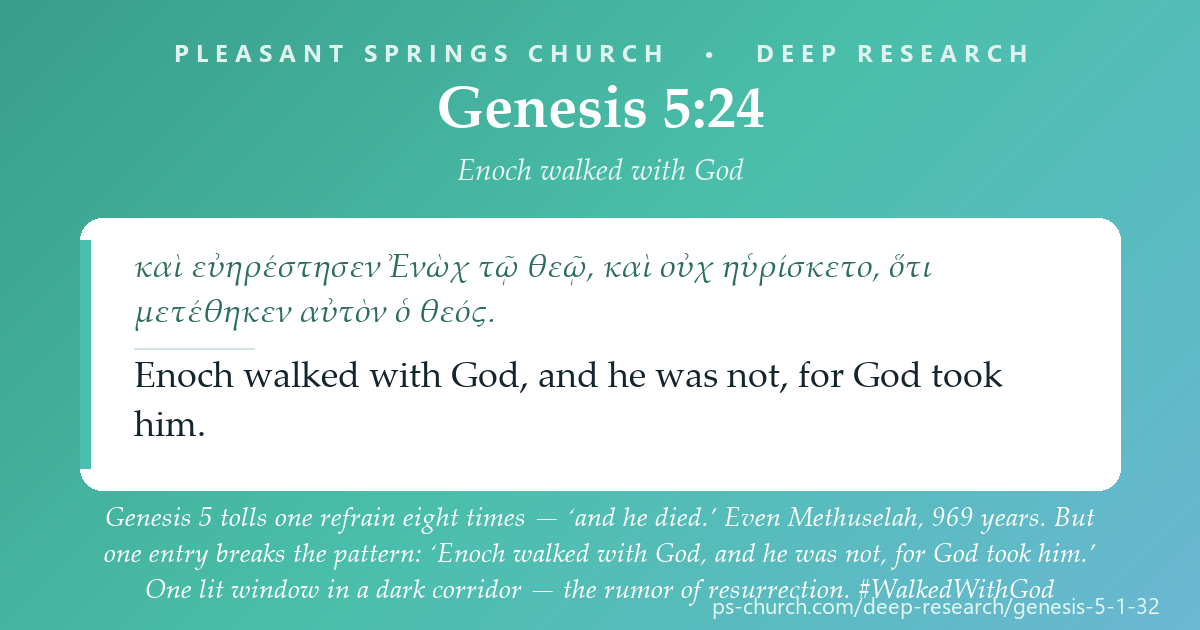
The genealogy of Genesis 5 has a rhythm, and the rhythm is the message. Each patriarch is introduced with the years he lived before fathering his son, then the years he lived afterward, then the sum of his days — and then, with the regularity of a tolling bell, the same two words: and he died. It comes again and again, eight times, until the reader can hear it before it arrives. The great ages only sharpen the point. Here is Methuselah, who lived nine hundred and sixty-nine years — nearly a millennium, the longest life the Bible records — and the sentence still falls: and he died. The message is inescapable and it is meant to be: mortality is now the universal human condition, the settled wages of Eden’s rebellion, and no length of days can outrun it. This is what makes the single exception so arresting. In the seventh generation the bell does not ring. Of Enoch it is not written ‘and he died’ but ‘and he was not, for God took him.’ The very silence where the refrain should be is the loudest word in the chapter. It tells us that the reign of death, universal as it looks, is not absolute — that there is such a thing as a man who walks with God and is not surrendered to the grave. Enoch is not yet the resurrection; he is the rumor of it, the first hint that the God who walks with his people will not finally leave them in the dust. The genealogy of death carries, folded quietly into its seventh entry, the seed of the Easter hope.
The vocabulary of the image, the refrain, and the walk with God.
Watch the “book of generations,” the image passed to Seth, the tolling “and he died,” the “walked with God,” and the “took.”
“Generations” / “book.” The toledot formula structures Genesis (2:4; 6:9; 10:1; 11:10; …); here uniquely it is called a sefer (“book/scroll”). The LXX renders it biblos geneseōs — the exact phrase Matthew 1:1 borrows for “the book of the genealogy of Jesus Christ.”
“Image” / “likeness.” The terms of 1:26–27, now transmitted: Adam fathers Seth “in his own likeness, after his image.” The image of God survives the fall and is passed down the whole human line — a dignity that grounds human worth (Gen 9:6; Jas 3:9).
“And he died.” The refrain closing eight entries — the audible fulfillment of “you shall surely die” (2:17). Longevity is not immortality; the great ages only make the toll heavier. Death now reigns over the image-bearers (Rom 5:14).
“He walked with God” — a reflexive form of halakh, habitual intimate fellowship (as God walked in Eden, 3:8; as Noah walked, 6:9). The LXX renders it “was well-pleasing to God,” the phrase Hebrews 11:5 quotes: Enoch’s walk was faith.
“He took.” Of Enoch alone the death-refrain is withheld: “he was not, for God took him.” The same verb marks Elijah’s being taken up (2 Kgs 2:3, 9); the LXX reads “translated” (metatithēmi), echoed in Heb 11:5. A rumor of resurrection in a chapter of death.
“Noah” / “he will bring us relief.” A sound-play (the name’s root is nuach, “rest”; the wish plays on nacham, “comfort/relief”). The verse quotes the curse of 3:17 (“painful toil,” “cursed ground”): the genealogy aches for the reversal of the fall.
How the rest of Scripture fills out the generations:
- Genesis 9:6; James 3:9 — the image of God as the ground of human worth (murder and cursing an image-bearer condemned): the dignity Genesis 5 transmits.
- Romans 5:12–14; 1 Corinthians 15:21–22 — “death reigned from Adam…”; “in Adam all die”: the theology behind the refrain (see Romans 5).
- Hebrews 11:5–7; Jude 14–15 — Enoch commended for faith and taken up; the Enoch tradition cited: the man who did not see death.
- Matthew 1:1; Luke 3:36–38 — “the book of the genealogy”; Jesus’ line traced back through “Enosh, Seth, Adam, the son of God”: the Sethite line running to Christ.
From the image passed on to death undone.
Trace the two threads of Genesis 5 — the image of God and the reign of death — to their resolution in Christ.
Which cross-references matter?
- Genesis 1:26–27; 4:25–26; 6:9 — the image of God; the Sethite line launched; Noah who walked with God: the roots of this genealogy (see the image of God, the seed of Seth).
- Genesis 2:17; Romans 5:12–21; 1 Corinthians 15:21–22, 45 — the sentence of death; death reigning through Adam and undone in Christ, the last Adam (see Romans 5).
- Hebrews 11:5–6; 2 Kings 2:9–11 — Enoch and Elijah taken up; faith that pleases God: the exception to the refrain.
- Matthew 11:28–30; Genesis 5:29 — the “rest” Noah’s name longs for, given by the greater Son to all who labor.
- Revelation 21:1–4; 22:3 — “death shall be no more”; “no longer anything accursed”: the refrain silenced and the curse reversed at last (see the new creation).
A modern reader tends to skim genealogies, and Genesis 5 looks like the driest of them — ten names, a string of enormous numbers, the same formula over and over. But to read it that way is to miss what it is doing in the shape of the whole book. Genesis has just shown us two lines diverging from Adam: the line of Cain, which built cities and forged tools and sang songs of vengeance, and the line of Seth, which began to call on the name of the Lord. Chapter 5 now follows the line of Seth — the line of promise, the line that carries the ‘seed’ of chapter three — and traces it, name by name, through the long centuries down to Noah, and so toward Abraham, and David, and finally the One whom Luke will call ‘the son of Enosh, the son of Seth, the son of Adam, the son of God.’ The point of the list is that God is keeping a promise across generations that come and go like the tide. Men are born, they father sons, they live their allotted centuries, and they die — and through it all, quietly, invisibly, God is preserving a single thread of promise that no death in the chain can break. The refrain ‘and he died’ is real and it is heavy; but running underneath it, unbroken, is the line that will one day produce the death-conqueror. That is why the chapter can hold both its bell of mortality and its one lit window: the God who takes Enoch is the God who is guiding this whole line toward the day when the tomb is empty and the last enemy is destroyed.
The scholarship on Genesis 5:1-32.
The commentators on the genealogy; the studies of the image of God, the long lifespans, the chronology traditions, and Enoch.
Commentaries & studies:
- Gordon J. Wenham (WBC), Victor P. Hamilton (NICOT), Kenneth A. Mathews (NAC), Bruce K. Waltke, Nahum M. Sarna (JPS) on Genesis.
- Emanuel Tov, Textual Criticism of the Hebrew Bible (the MT/LXX/Samaritan chronology divergences); studies of the Sumerian King List parallel.
- G. K. Beale & D. A. Carson, eds., Commentary on the NT Use of the OT (Hebrews, Jude).
Interpretation notes worth keeping:
- The image passed on. Seth is fathered “in Adam’s likeness, after his image” (5:3, the terms of 1:26) — the image of God survives the fall and is transmitted, grounding human dignity (Gen 9:6; Jas 3:9).
- Chronology: pick one text. MT, Samaritan, and LXX largely agree on total lifespans but differ on age-at-fatherhood (the LXX generally +100 years), yielding different creation-to-flood totals. Follow one system (the Hebrew, for an ESV study) and footnote the others; never blend them. The numbers are not given for date-setting (Ussher-style dogma).
- Enoch. “Walked with God… God took him” (5:24) = intimate fellowship and translation without death; the LXX “pleased God” is what Heb 11:5 quotes. The 1 Enoch literature is a Second Temple witness (Jude 14–15), not the measure of the canonical text.
- The death refrain. Eightfold “and he died” enacts Gen 2:17 and undergirds Rom 5:12–14 — death as the universal consequence of Adam’s sin.
- Noah’s name. A sound-play (not strict etymology) on “rest/relief,” quoting the 3:17 curse — the genealogy’s longing for the reversal of the fall.
From the tolling bell to the lit window — walk with God.
Name what you learned, why it matters, and one concrete response.
What should we carry away — and do?
- You bear the image, and you will die. Genesis 5 refuses to soften either fact. Your dignity is real and unerasable; your mortality is real and undodgeable. Between them stands the question of direction.
- Measure life by its walk, not its length. Even Methuselah died. What set Enoch apart was not his years but his walk with God — and that walk, the New Testament says, was faith (Heb 11:5–6).
- Death is not the last word. One window is lit in the dark corridor: “he was not, for God took him.” The rumor of Genesis 5 becomes the reality at the empty tomb, where the One who conquered death guarantees that those who walk with him will not be lost to it.
Step in response: take up Enoch’s one distinction — walk with God. Not sinless perfection, but a habitual, daily, back-and-forth fellowship: praying, obeying, keeping company with him through ordinary years. Let the tolling “and he died” make you serious about how you spend your days, and let the lit window make you hopeful: the God who took Enoch has, in Christ, defeated the death that Genesis 5 laments.
Genesis 5:24 · to share
LXX + ESVEvery Deep Research page traces its passage across the whole sweep — the Old Testament, the Second-Temple world between the testaments (historical witnesses, not Scripture), and the New Testament. Follow the thread:
Pleasant Springs Church — Deep Research
Research method after Michael S. Heiser’s Bible Research Method (examine dictionaries → ancient literature → important words → textual connections → academic publications → share), with the Pleasant Springs “Author & Audience” foundation. Scripture set in the Hebrew, the Greek editions named on each page and the ESV (Old Testament), and the Greek New Testament and the ESV (New Testament), per the practice of Pleasant Springs Church. Genesis 5:1–32 research grounded in Wenham, Hamilton, Mathews, Waltke, and Sarna, with Tov on the chronology traditions; the image of God (tselem/demut) read as surviving the fall and transmitted (5:3, grounding human dignity, Gen 9:6); the eightfold “and he died” as the fulfillment of Gen 2:17 (Rom 5:12–14); Enoch’s “walked with God… God took him” as intimate fellowship and translation without death, the LXX “pleased God” (euērestēsen) being the verb Heb 11:5 echoes, with the 1 Enoch literature noted as a Second Temple witness (Jude 14–15) not the measure of the text; the MT/LXX/Samaritan chronology divergence handled by following the Hebrew (ESV) and footnoting the LXX +100 pattern, and not used for date-setting; Noah’s name as a sound-play on “rest/relief” quoting the 3:17 curse.
Scripture quotations marked ESV are from the ESV® Bible (The Holy Bible, English Standard Version®), © 2001 by Crossway, a publishing ministry of Good News Publishers. ESV Text Edition: 2016. Used by permission. All rights reserved. The ESV text may not be quoted in any publication made available to the public by a Creative Commons license, and the ESV may not be translated in whole or in part into any other language. www.esv.org
|
Did this study bless you today? 💚 Give to Support PS Church100% of gifts go to the General Fund — thank you. |