Two family trees grow out of the fall. Cain’s line builds the first city and a dazzling burst of culture — herding, music, metalwork — but crests in Lamech’s sword-song, vengeance lifted into a boast: “seventy-sevenfold.” Then the camera turns to Seth, the “another offspring” God appointed in place of murdered Abel, and his son Enosh (“frail man”) — and there the counter-melody sounds: “people began to call upon the name of the LORD.” This study works Genesis 4:17–26 — two humanities: the way of Cain, and the seed of Seth. See the method →
Genesis 4:17, 23–26
Hebrew · LXX · ESVThe Shape of the Passage
Parallel panelsAfter the murder of Abel and the sending of Cain (4:1–16), Genesis traces two lines forward — Cain’s, ending in Lamech’s vengeance, and Seth’s, ending in worship. The passage is a study in the two directions a fallen humanity can run: away from God into self-assertion, or back to God in prayer.
Author
Moses lays two genealogies side by side. Cain’s line (4:17–24) is a portrait of civilization apart from God — and it is not simply ugly. Cain builds a city and names it after his son Enoch; his descendants become the founders of culture: Jabal the father of herdsmen, Jubal the father of musicians (“the lyre and pipe”), Tubal-cain the forger of “bronze and iron.” The Bible does not despise cities, music, or metalwork; these are good gifts. But they grow here on a root of exile, and the line comes to its climax not in a psalm but in a sword-song. Lamech — the first polygamist — boasts to his two wives that he has killed a man merely for wounding him, and he seizes God’s protective word over Cain (“sevenfold,” 4:15) and inflates it into a creed of vengeance: “seventy-sevenfold.” Cain killed and hid; Lamech kills and sings. Sin does not stay still; it escalates.
‘Another offspring.’ Then the narrative turns (4:25) with a note of grace. Adam and Eve have another son, and Eve names him Seth (from shat, “he has appointed/set”): “God has appointed for me another offspring (zera’) instead of Abel.” That word “offspring” is the same word as the promised “seed” of Genesis 3:15 — the line through which the serpent-crusher will come. Where the murderer’s line runs on, God quietly preserves and re-plants the seed of promise. The whole later story — Noah, Abraham, David, and at last Christ — comes down this Sethite branch (Luke 3:36–38 traces Jesus’ line back through “Enosh, Seth, Adam”).
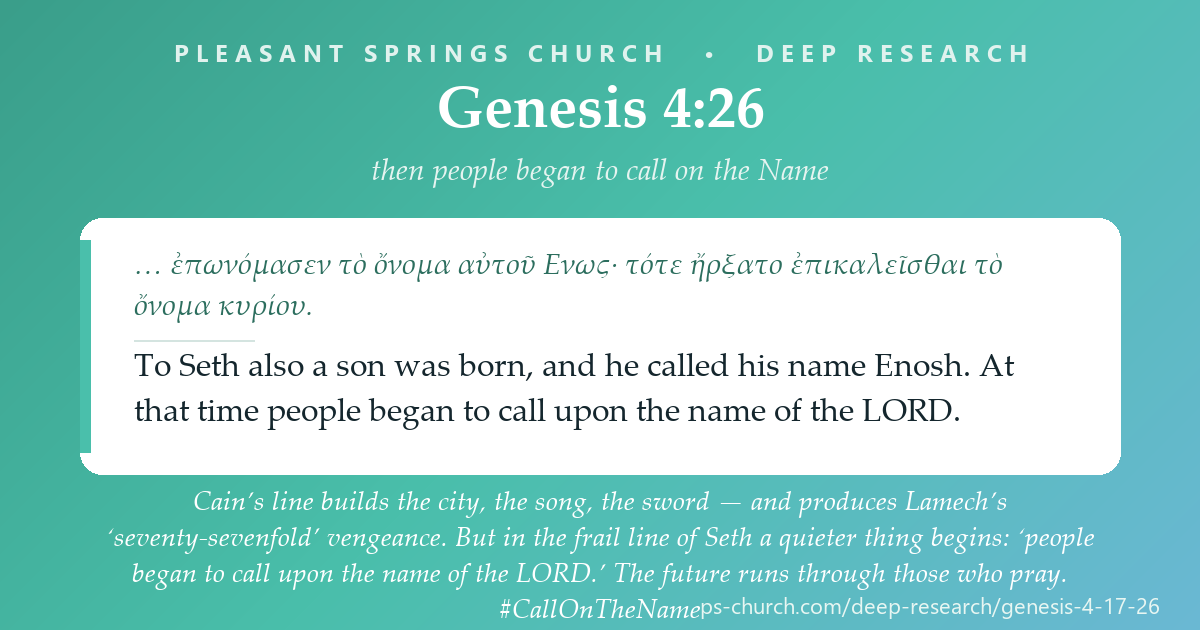
‘People began to call on the name of the Lord.’ The chapter ends (4:26) with a phrase that will echo through all of Scripture. Enosh is born — his very name means “frail, mortal man” — and “then people began to call upon the name of the Lord” (qara’ b’shem YHWH). The verb form is impersonal and corporate: not one person’s private act but the beginning of a movement — public, gathered worship, invoking the covenant name of God. Against Cain’s city of self-reliance rises a community of dependence. (The phrasing carries a genuine ambiguity: the Hebrew verb huchal can mean “began” or, from a homonym, “profane” — and an old Jewish tradition read it “then men began to profane the Name.” But the Septuagint and the ESV, and the phrase’s consistent later use for true worship, support the positive reading: worship began.)
Audience
Israel — who themselves “called on the name of the Lord” at every altar of the patriarchs (12:8; 13:4; 21:33; 26:25) — are being shown the deep ancestry of worship and the deep ancestry of violence, and asked which line they belong to. The two genealogies are not about biology but about direction: every generation must choose the way of Cain or the seed of Seth. The mark of the true line is not culture or power but calling on the Name — the posture of the frail creature (Enosh) who knows he cannot save himself.
The way of Cain, undone in Christ. The New Testament remembers both lines pointedly. It warns against those who walk “in the way of Cain” (Jude 11) and holds up Lamech’s “seventy-sevenfold” as the very thing the gospel reverses: when Peter asks whether to forgive “seven times,” Jesus answers “seventy-seven times” (Matt 18:22, the same Greek as the Septuagint of Gen 4:24) — the exact figure of Lamech’s vengeance now turned into the measure of grace. And the Sethite cry, “call on the name of the Lord,” becomes the gospel’s open door: “everyone who calls on the name of the Lord will be saved” (Joel 2:32; Acts 2:21; Rom 10:13). The frail creature who calls is heard.
Orient on genealogy, the city, worship, and the Name.
Search by topic: Cain / Cainites, genealogy, city, worship, the name of the LORD, vengeance.
Which articles are relevant?
- Anchor Bible Dictionary — “Cain,” “Genealogy,” “City,” “Name.”
- Dictionary of the OT: Pentateuch — “Genealogies,” “Cain and Abel,” “Worship,” “Seth.”
- NIDOTTE / TDOT — qara’ (call/invoke), shem (name), naqam (avenge), ’ir (city).
Bibliography surfaced:
- Gordon Wenham (WBC), Victor Hamilton (NICOT), Kenneth Mathews (NAC), Bruce Waltke, Nahum Sarna (JPS) on Genesis.
- Studies of the Cainite and Sethite genealogies and their contrast; the “call on the name” motif in biblical theology.
- Beale & Carson, Commentary on the NT Use of the OT (Acts, Romans).
Culture-founders, the escalation of violence, and the birth of worship.
Read the city and the culture-founders, Lamech’s song, and the “call on the Name” against their Ancient Near Eastern backdrop.
Which parallels shed light on religion and worldview?
The founders of civilization. Ancient cultures loved to trace their crafts and institutions to primeval culture-heroes — a first king, a first musician, a first metalworker. Genesis knows this convention and uses it, but with a sober twist: it locates the origins of herding, music, and metallurgy in the line of Cain, east of Eden. The point is not that culture is evil — these are genuine goods, and the same crafts will later serve the tabernacle (Bezalel works “bronze,” Exod 31:4). The point is that human civilization, for all its brilliance, grows here on the far side of the fall, apart from the God whose presence Cain fled. Technology and art advance; the human heart does not heal. The most “advanced” man in the chapter is also its most violent.
Lamech’s sword-song — the oldest poem in Genesis. Lamech’s boast (4:23–24) is cast in tight Hebrew poetry, and it is chilling precisely because it is art: violence set to verse. He has killed a young man merely for a wound, and instead of hiding it (as Cain did) he celebrates it before his wives. Then he seizes the one word of restraint in the story — God’s promise to avenge Cain “sevenfold” if anyone killed him (4:15), a limit on others’ violence — and twists it into a license for his own: “seventy-sevenfold.” Grace meant to protect becomes a slogan for revenge. This is the trajectory of the city apart from God: not a return toward Eden but an accelerating flight away from it, sin compounding into a culture.
The counter-community: calling on the Name. Over against all this, the chapter’s last line is deliberately understated: “then people began to call upon the name of the Lord” (4:26). The phrase qara’ b’shem YHWH is the technical language of covenant worship — proclaiming and invoking God’s name in prayer and sacrifice — and this is its first appearance in the Bible. It will become the signature of the patriarchs, who build altars and “call on the name of the Lord” wherever they go. The contrast is total: Cain’s line makes a name for itself (a city named after a son, a song sung to two wives); Seth’s line calls on the name of God. And it begins, fittingly, with a man named Enosh — “frail, mortal” — because worship begins where self-sufficiency ends.
- Genesis 4:1–16; 3:15 — the murder of Abel and the sending of Cain; the promised “seed”: what Seth’s line re-plants (see Cain and Abel, the curse & exile).
- Genesis 12:8; 13:4; 21:33; 26:25 — the patriarchs “call on the name of the Lord” at every altar: the Sethite worship continued (see the call of Abram).
- Jude 11; Matthew 18:21–22; Joel 2:32 — “the way of Cain”; the “seventy-seven” of vengeance turned into forgiveness; “everyone who calls on the name of the Lord shall be saved.”
It would be easy to read these two genealogies as a simple contrast between bad guys and good guys — Cain’s wicked line and Seth’s righteous line — but the text is subtler and more honest than that. Cain’s line is not a line of monsters. They are builders and herdsmen and musicians and smiths; they make cities and instruments and tools; they are, in every worldly sense, the makers of civilization, and civilization is a real and dazzling thing. If you were choosing which family to be born into on the basis of culture and achievement, you would choose Cain’s. And that is precisely the warning. The line that produces the most impressive human culture also produces Lamech, who turns God’s word of mercy into a boast of murder and sets his vengeance to music. Genius and violence grow on the same branch. Meanwhile the line of Seth produces almost nothing the world would notice — no cities, no songs, no inventions the chapter bothers to name — just a man called ‘Frailty’ and a people who begin to pray. The Bible’s judgment on the two lines is the opposite of the world’s. What finally distinguishes a family, a culture, a life, is not what it builds or invents or achieves, but whether it calls on the name of the Lord. And the whole history of redemption runs, not through the impressive city of Cain, but through the frail, praying seed of Seth — down to the One who taught us to answer Lamech’s seventy-sevenfold vengeance with seventy-sevenfold forgiveness.
The vocabulary of the city, the sword-song, and the Name.
Watch the built city, the escalation from “sevenfold” to “seventy-sevenfold,” the appointed “seed,” and the first “call on the Name.”
“To call upon / invoke the name of the Lord.” The signature phrase of covenant worship — proclaiming and invoking God in prayer and sacrifice (Gen 12:8; 13:4; 21:33). Its FIRST appearance here marks the start of public worship in the Sethite line, and it flows straight to the gospel: “everyone who calls on the name of the Lord will be saved” (Joel 2:32; Acts 2:21; Rom 10:13).
“It was begun” (impersonal Hophal of chalal) — a corporate movement, not one person’s act. A homonym chalal means “to profane,” which fed an old rabbinic reading (“began to profane the Name”); the LXX and ESV take the positive sense (worship began).
“Another offspring / seed.” Eve’s word for Seth is the same “seed” as the promise of 3:15 — the line of the serpent-crusher, preserved and re-planted after Abel’s murder. The messianic seed-line runs through Seth (Luke 3:38).
“Seth” (from shat, “appointed/set”) and “Enosh” (“frail, mortal man”). The names preach: God appoints a new line, and its worship begins with a man whose name confesses human frailty — worship rises where self-sufficiency ends.
“Seventy-sevenfold” — Lamech’s inflation of God’s protective “sevenfold” (4:15) into a boast of vengeance. Jesus deliberately reverses the figure (Matt 18:22, same Greek as the LXX here): the measure of Cain’s revenge becomes the measure of the disciple’s forgiveness.
“Building a city.” The first city in Scripture, built by Cain the exile and named after his son. Cities are not condemned (the story ends in the city of God, Rev 21) — but this one is founded east of Eden, a monument to a name made apart from God.
How the rest of Scripture fills out the two lines:
- Genesis 5:1–32 — the Sethite genealogy (Adam… Enosh… Enoch… Noah) that this passage launches: the line of promise traced to the flood (see the generations of Adam).
- Matthew 18:21–22; Romans 12:19 — forgiveness “seventy-seven times”; “vengeance is mine”: the gospel’s reversal of Lamech.
- Joel 2:32; Acts 2:21; Romans 10:12–13; 1 Corinthians 1:2 — “everyone who calls on the name of the Lord will be saved”: the Sethite cry become the gospel invitation (see Pentecost).
- Hebrews 11:4; Jude 11; 1 John 3:12 — Abel’s faith; “the way of Cain”: the two lines weighed in the New Testament.
From the way of Cain to the seed that calls on the Name.
Trace the two humanities forward — Cain’s violence answered by the gospel of forgiveness, Seth’s worship flowering into the church.
Which cross-references matter?
- Genesis 3:15; 4:1–16; 5:1–32 — the promised seed; the murder of Abel; the Sethite line: the roots and the fruit of this passage (see Cain and Abel, the generations of Adam).
- Matthew 18:21–35; Luke 6:27–36 — forgiveness seventy-seven times; love of enemies: Lamech’s sword-song reversed by the Son.
- Joel 2:28–32; Acts 2:16–21; Romans 10:9–13 — the outpoured Spirit and the promise to “everyone who calls”: the first worship of Gen 4:26 fulfilled (see Pentecost).
- Genesis 11:1–9; Revelation 21:1–4 — Babel, the city that makes a name for itself, and the city of God that comes down: the two cities from Cain to the consummation (see Babel, the new creation).
- Hebrews 11:4–7; Jude 11 — the faith of Abel and Enoch and Noah in the Sethite line; the warning against “the way of Cain.”
The last sentence of Genesis 4 is easy to read straight past, but it is one of the hinges of the whole primeval history. After four chapters dominated by disobedience, murder, wandering, and a swelling tide of violence that crests in Lamech’s gleeful song, the narrator sets down a single quiet line: in the days of Enosh, people began to call on the name of the Lord. It is the first mention of corporate worship in the Bible, and it comes as a kind of dawn after a long night. Notice where it is placed — not in Cain’s impressive city with its music and metalwork, but in the obscure line of Seth, through a man whose name means ‘frail mortal.’ The Bible is telling us where the future of the human race really lies. It does not lie with the builders and the strong and the makers of culture, however much the world admires them; it lies with the frail people who pray. To ‘call on the name of the Lord’ is to confess that you cannot save yourself, that your help is outside you, that the Name is your refuge. And that little phrase, born here in the shadow of the first murder, runs like a golden thread all the way through Scripture — through Abraham at his altars, through the psalmists in their distress, through Joel’s promise — until it arrives, unchanged, at the heart of the gospel: everyone who calls on the name of the Lord will be saved. The way of Cain builds a name for itself and ends in violence; the seed of Seth calls on the name of God and ends in salvation.
The scholarship on Genesis 4:17-26.
The commentators on the Cainite and Sethite lines; the studies of the culture-founders, Lamech’s song, and the “call on the Name” motif.
Commentaries & studies:
- Gordon J. Wenham (WBC), Victor P. Hamilton (NICOT), Kenneth A. Mathews (NAC), Bruce K. Waltke, Nahum M. Sarna (JPS) on Genesis.
- Studies of the two genealogies and the “name of the LORD” motif; the Matt 18:22 / Gen 4:24 reversal.
- G. K. Beale & D. A. Carson, eds., Commentary on the NT Use of the OT.
Interpretation notes worth keeping:
- Culture is not condemned. Herding, music, and metalwork are genuine goods (later serving the tabernacle); the warning is that human civilization here grows apart from God and crests in Lamech’s violence — not that cities or arts are inherently evil.
- Recorded, not sanctioned. Lamech’s polygamy (4:19) and vengeance (4:23–24) are narrated as escalating disorder, not endorsed by being in Scripture.
- Gen 4:26, positively. “Began to call on the name of the Lord” = the start of corporate worship (LXX, ESV); the homonym-based “began to profane” is a recognized rabbinic alternative rooted in a genuine lexical ambiguity, not the primary reading. The Name was not unknown before (cf. Exod 3–6 concerns God’s self-revelation, not the name’s first utterance).
- The seed preserved. Seth’s “another offspring” (zera’) re-plants the 3:15 promise; the messianic line runs through Seth (Luke 3:38), not Cain.
- Text/LXX note. The LXX read 4:26 as “he hoped to call” (ēlpisen, from yachal “hope”) rather than “began” — a vocalization choice; the ESV follows the Hebrew “began.”
From the sword-song to the prayer — which line will you belong to?
Name what you learned, why it matters, and one concrete response.
What should we carry away — and do?
- Genius and violence grow on the same branch. Cain’s line builds the city and the song — and produces Lamech. Achievement is not the same as healing; a culture can advance while the heart runs further from God.
- The future runs through the frail who pray. Not the impressive city but the obscure, praying line of Seth carries the seed of promise. What finally marks a life is whether it calls on the name of the Lord.
- The gospel reverses Lamech. The “seventy-sevenfold” of vengeance becomes the measure of forgiveness (Matt 18:22); the cry “call on the Name” becomes the promise that everyone who calls will be saved.
Step in response: refuse Lamech’s math. Where you are tempted to answer a wound with escalation, answer it with the seventy-sevenfold forgiveness Christ commands. And do the one thing that marks the seed of Seth — call on the name of the Lord. Worship begins where self-sufficiency ends; bring your frailty to God and pray.
Genesis 4:26 · to share
LXX + ESVEvery Deep Research page traces its passage across the whole sweep — the Old Testament, the Second-Temple world between the testaments (historical witnesses, not Scripture), and the New Testament. Follow the thread:
Pleasant Springs Church — Deep Research
Research method after Michael S. Heiser’s Bible Research Method (examine dictionaries → ancient literature → important words → textual connections → academic publications → share), with the Pleasant Springs “Author & Audience” foundation. Scripture set in the Hebrew, the Greek editions named on each page and the ESV (Old Testament), and the Greek New Testament and the ESV (New Testament), per the practice of Pleasant Springs Church. Genesis 4:17–26 research grounded in Wenham, Hamilton, Mathews, Waltke, and Sarna; the Cainite culture (city, music, metalwork) read as genuine goods grown apart from God and cresting in Lamech’s violence — recorded, not sanctioned; Lamech’s “seventy-sevenfold” (4:24) reversed by Jesus’ “seventy-seven” forgiveness (Matt 18:22, same LXX Greek); Seth’s “another offspring” (zera’) re-planting the 3:15 seed (the messianic line, Luke 3:38); Gen 4:26 “began to call on the name of the Lord” taken positively (the start of corporate worship, LXX + ESV) with the homonym-based “began to profane” noted as a recognized rabbinic alternative rooted in genuine ambiguity; the LXX “he hoped to call” (ēlpisen) noted as a vocalization choice, the ESV following the Hebrew “began”; small-caps Lord for the Tetragrammaton at 4:26.
Scripture quotations marked ESV are from the ESV® Bible (The Holy Bible, English Standard Version®), © 2001 by Crossway, a publishing ministry of Good News Publishers. ESV Text Edition: 2016. Used by permission. All rights reserved. The ESV text may not be quoted in any publication made available to the public by a Creative Commons license, and the ESV may not be translated in whole or in part into any other language. www.esv.org
|
Did this study bless you today? 💚 Give to Support PS Church100% of gifts go to the General Fund — thank you. |