On a plain in Babylonia, a united humanity set out to build a tower to the heavens and “make a name” for themselves — and to never be scattered. God’s reply is devastating irony: the tower meant to reach heaven is so small he must “come down” to see it, and he scatters them across the earth, confusing the one language into many. This study works the last scene of primeval history — the birth of the nations — and follows the scattering to its reversal at Pentecost. See the method →
Genesis 11:1–9 (selections)
Hebrew · LXX · ESVThe Shape of the Passage
ChiasmSame Author and audience as Genesis 1:1 — and Babel is the last scene of primeval history, the hinge before God calls Abram to bless the very nations here scattered.
Author
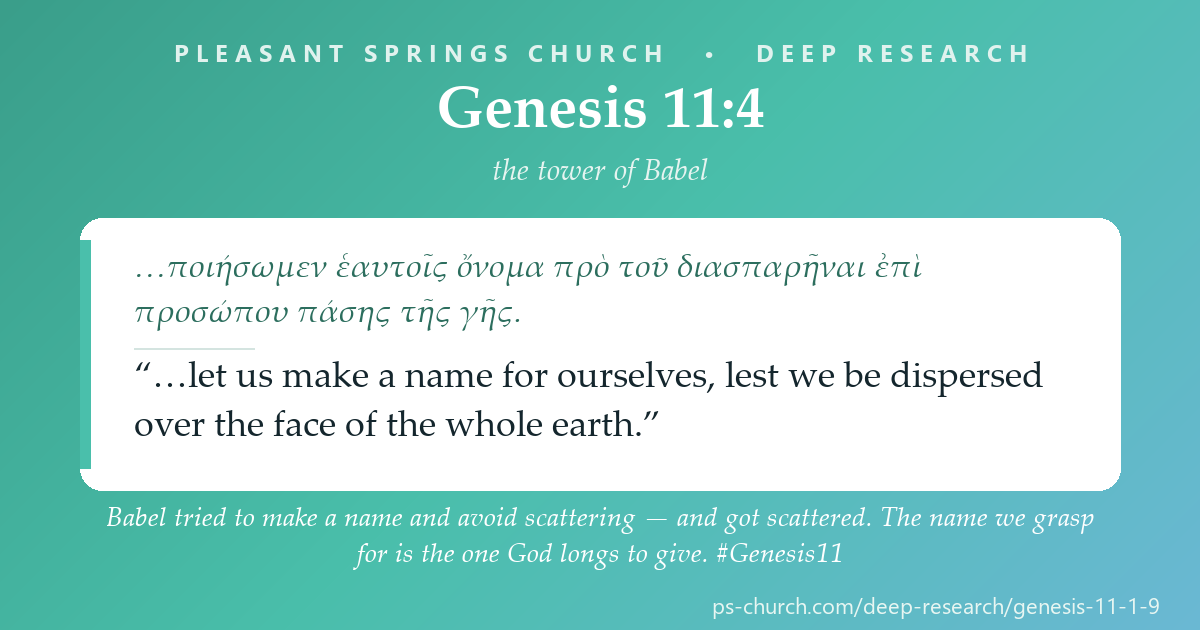
The Torah of Moses caps the primeval history (chs. 1–11) with humanity’s grandest self-project. On the plain of Shinar (Babylonia), they build a city and a tower with its top in the heavens — and state the motive twice: to “make a name for ourselves,” and to avoid being scattered. It is the ambition to reach heaven and secure identity apart from God. His response is quiet irony: the tower meant to reach the heavens is so small that God must “come down” to see it — and he does the very thing they feared: he scatters them.
Name and scattering. They sought a name (שֵׁם) by their own works; the next chapter opens with God promising to make Abram’s name great (12:2) — the gift Babel grasped for. Their fear of scattering becomes their judgment; the blessing they forfeited will be restored through one scattered family.
Audience
Israel — whose great enemy was Babylon, the empire of the towering ziggurat and the exile. To them, the mockery lands: “Babel,” the city that called itself “gate of god,” is really “babble.” The proudest human civilization is, before God, confusion.
How they heard it. The origin of the world’s many nations and tongues is not an accident but a judgment on collective pride — and, the Scriptures hint, a merciful restraint on united human evil (cf. 11:6). The scattering that begins here awaits its reversal: a day when the tongues will be gathered again, not by a tower, but by the Spirit (Acts 2) — and every nation will stand before the throne (Rev 7:9).
Orient on Babel, the ziggurat, and the nations.
Search by topic: Babel/Babylon, ziggurat, tower, nations/table of nations, confusion of tongues.
Which articles are relevant?
- Anchor Bible Dictionary — “Babel, Tower of,” “Babylon,” “Ziggurat,” “Nations, Table of.”
- Dictionary of the OT: Pentateuch — “Babel,” “Nations,” “City.”
- NIDOTTE / TDOT — שֵׁם (šēm, name), בָּלַל (bālal), מִגְדָּל (miḡdāl, tower), פּוּץ (pûṣ, scatter).
Bibliography surfaced:
- Wenham, Genesis 1–15 (WBC); Hamilton (NICOT); Sarna (JPS).
- John Walton, “The Mesopotamian Background of the Tower of Babel” and Genesis (NIVAC).
- Michael Heiser, The Unseen Realm — Babel and the Deuteronomy 32 division of the nations.
The ziggurat, the divided nations, and Babylon’s pride.
Read the tower against Mesopotamian temple-architecture, then follow the “scattering of the nations” into its deepest biblical development in Deuteronomy 32.
Which parallels shed light on religion and worldview?
The ziggurat. The “tower with its top in the heavens” is a ziggurat — the stepped temple-tower of Mesopotamian cities, whose name and mythology cast it as a stairway between earth and the gods (Babylon’s great ziggurat was called Etemenanki, “house of the foundation of heaven and earth”). In the Babylonian mind, the tower brought the gods down to be served. Genesis inverts the boast: the Lord must “come down” even to see the puny thing.
- The Etemenanki building inscriptions (Nabopolassar, Nebuchadnezzar II) — the great ziggurat of Babylon, whose top the kings boast should “rival heaven”: the very phrase Genesis 11:4 echoes and deflates. (Enuma Elish narrates the building of Babylon and its temple Esagila, comparing the tower’s height to the Apsu, the deep.)
- Deuteronomy 32:8–9 — “When the Most High gave to the nations their inheritance… he fixed the borders… according to the number of the sons of God” (so the Dead Sea Scrolls, 4QDeut, and the LXX ἀγγέλων/υἱῶν θεοῦ; the traditional Hebrew reads “sons of Israel”). On this reading, the scattering at Babel is when God apportioned the nations — keeping Israel as his own portion. See our study, Paul and the Deuteronomy 32 Worldview.
- Jubilees 10:18–27 (Pseudepigrapha — a witness, not Scripture) — retells Babel, giving the tower’s vast height and God’s wind that topples it.
- Josephus, Antiquities 1.113–118 — makes Nimrod the tyrant who builds the tower in defiance of God: an influential Second-Temple reading.
Babel explains the map: many peoples, many tongues, born from a judgment on united pride. Deuteronomy 32 goes further — on the older reading of Deut 32:8, God allotted the nations at the scattering, and the biblical story becomes the long road by which God draws the nations back to himself. That road runs through Abram (“in you all the families of the earth shall be blessed”) to Pentecost, where the Spirit undoes Babel — not by erasing the languages but by making every one of them hear “the mighty works of God” (Acts 2:6–11) — and on to the throne, where “from every nation, from all tribes and peoples and languages” stands together at last (Rev 7:9).
The vocabulary of pride and scattering.
Watch the grasped “name,” the divine “let us go down,” the Babel/babble pun, and the scattering they feared.
“Name / reputation” — they grasp for it by works; God will give it to Abram (12:2) and finally exalt the name of Jesus above all (Phil 2:9).
“Tower” — a ziggurat, the temple-stairway “with its top in the heavens.” Human religion reaching up; the gospel is God reaching down.
“Come, let us go down” — the divine plural (cf. 1:26) answering the human “come, let us build”: God’s deliberate response to human self-exaltation.
“Confuse, mix” — the pun on Bābel. “Gate of god” becomes “babble”; LXX Σύγχυσις, “Confusion.”
“Scatter, disperse” — the very fate they built to avoid (11:4) becomes their judgment. What we grasp to secure ourselves is often what we lose.
“One language” (lit. “one lip”) — unity used for rebellion. Its reversal at Pentecost gives many tongues one gospel (Acts 2).
How the New Testament reuses Babel:
- Acts 2:1–11 — Pentecost, the reversal of Babel: the Spirit gives the disciples other tongues, and every nation hears the gospel in its own language. Unity restored not by a tower but by the Spirit.
- Philippians 2:9–11 — God “bestowed on him the name that is above every name”: the name Babel grasped for is given to the humbled Christ, and every tongue confesses him.
- Revelation 7:9–10 — “from every nation, from all tribes and peoples and languages” before the throne: the scattered peoples of Babel gathered, worshiping as one.
- Zephaniah 3:9 — “I will change the speech of the peoples to a pure speech… that all of them may call upon the name of the Lord”: the promised undoing of Babel’s confusion.
From the scattered nations to the gathered throng.
Trace the “name” and “nations” threads, the Babel/Babylon motif, and the Pentecost reversal — then note the Beale & Carson trajectory at Acts 2.
Which cross-references matter?
- Genesis 12:1–3 — the answer to Babel: God makes Abram’s name great and promises blessing to “all the families of the earth” — the scattered nations.
- Deuteronomy 32:8–9; Acts 17:26–27 — God set the boundaries of the nations “that they should seek God”: the Babel-scattering with a redemptive aim.
- Genesis 10 (Table of Nations); Psalm 2 — the seventy nations and the raging peoples, all under the Lord and his Anointed.
- Isaiah 13–14; Jeremiah 50–51; Revelation 17–18 — “Babylon” as the enduring symbol of proud, God-defying civilization — and its fall.
- Acts 2:1–11; Revelation 7:9; 5:9 — the tongues regathered by the Spirit, and every language ransomed for God.
The commentary’s Acts treatment reads Pentecost as the deliberate reversal of Babel: where God once confused one language into many to scatter a proud humanity, the Spirit now takes the many languages and unites them under one gospel to gather a worshiping humanity. Babel is not simply undone — it is overcome: the diversity of tongues, once a judgment, becomes the glory of the redeemed, “from every tribe and language and people and nation” (Rev 5:9). The name humanity could not seize, Christ received — and shares with all who call on it.
The scholarship on Babel and the nations.
Walton for the ziggurat background; the commentaries for the structure; Heiser for the Deuteronomy 32 connection.
Commentaries & studies:
- Wenham (WBC), Hamilton (NICOT), Sarna (JPS), Cassuto; John Walton, Genesis (NIVAC) and his ziggurat studies.
- Michael Heiser, The Unseen Realm — Babel and the division of the nations (Deut 32); read alongside our Deuteronomy 32 study.
- Bernhard Anderson, “Unity and Diversity in God’s Creation: A Study of the Babel Story.”
Interpretation notes worth keeping:
- The tower is a ziggurat (Walton): not a naive attempt to physically reach the sky, but a temple-tower to bring the divine down — religion on human terms, which Genesis judges.
- The Deuteronomy 32:8 reading turns on a textual variant: “sons of God” (Dead Sea Scrolls, LXX) vs. “sons of Israel” (Masoretic Text). The reading many scholars judge the older — “sons of God” (DSS, LXX) — links Babel to the allotment of the nations to lesser powers — a reading the church holds with care, keeping Christ’s lordship over all nations central.
- Babel and Pentecost frame the biblical story of the nations: scattered in judgment, regathered in the Spirit — the through-line most fruitful for teaching this text.
From the tower to your own name-building.
Name what you learned, why it matters, and one concrete response.
What should we carry away — and do?
- We still build Babel. Every project to “make a name for ourselves” and secure our identity apart from God is a tower on the plain of Shinar. The name we grasp for is the name God longs to give.
- Religion reaches up; the gospel comes down. The tower was humanity climbing to heaven; the gospel is God descending to us — finally in Christ, who “came down” not to confuse but to save.
- Your language is not a barrier to God. Pentecost sanctified every tongue. The scattering of Babel is being gathered into a choir — and you are meant to be in it (Rev 7:9).
Step in response: name one “tower” you are building for your own reputation or security — and lay it down, receiving instead the name God gives in Christ. Then take one concrete step toward a people or language not your own, in the spirit of Pentecost.
Genesis 11:4 · to share
LXX + ESVEvery Deep Research page traces its passage across the whole sweep — the Old Testament, the Second-Temple world between the testaments (historical witnesses, not Scripture), and the New Testament. Follow the thread:
Pleasant Springs Church — Deep Research
Research method after Michael S. Heiser’s Bible Research Method (examine dictionaries → ancient literature → important words → textual connections → academic publications → share), with the Pleasant Springs “Author & Audience” foundation. Scripture set in the Hebrew, the Greek editions named on each page and the ESV (Old Testament), and the Greek New Testament and the ESV (New Testament), per the practice of Pleasant Springs Church. Genesis 11:1–9 research grounded in Wenham, Hamilton, Sarna, Walton, and Heiser; Mesopotamian ziggurat background per Etemenanki and the Enuma Elish; Second-Temple material per Jubilees 10 and Josephus; the Deuteronomy 32 division of the nations held with care (read as witnesses, not Scripture).
Scripture quotations marked ESV are from the ESV® Bible (The Holy Bible, English Standard Version®), © 2001 by Crossway, a publishing ministry of Good News Publishers. ESV Text Edition: 2016. Used by permission. All rights reserved. The ESV text may not be quoted in any publication made available to the public by a Creative Commons license, and the ESV may not be translated in whole or in part into any other language. www.esv.org
|
Did this study bless you today? 💚 Give to Support PS Church100% of gifts go to the General Fund — thank you. |