Jubilees 6–10 covers the same ground as Genesis 8:20–11:9 — the altar after the flood, the covenant and the bow, the vineyard and the curse, the sons of Noah’s sons, the tower — and carries what Genesis does not have: the feast of weeks kept on the heavenly tables, a year of exactly 364 days and a warning against the moon, Noah’s testament against blood, Kainam copying the Watchers’ star-lore off a rock, the earth divided by lot, the demons bound and a tenth left to Mastema. The book survives complete only in Ethiopic, and Genesis survives in Ethiopic too — which means the two can be measured in the same language. Across all 158 verses, the Ethiopic Jubilees shares five consecutive words with the Ethiopic Genesis exactly once, and it is Noah’s blessing of Shem. The law of blood for blood that Charles marks as Genesis 9:6 shares two; the generations from Arpachshad to Reu, which both books tell, share not two in a row. Across the whole book the deepest contact anywhere is eight words. It is not Scripture for us; it is a Second-Temple witness, read critically. See the method →
← Jubilees 3:1–5:32 · Jubilees 6:1–10:36 · Jubilees 11:1–16:31 → · the book’s frame: Prologue & 1
Jubilees is a Second-Temple Jewish retelling of Genesis and of Exodus as far as Sinai, framed as a revelation to Moses on Sinai dictated by the angel of the presence (1:27; 2:1). The 1917 introduction put its writing “probably in the latter years of the second century B.C.”; the date is argued in the works listed in Stage 1, and nothing on this page tests it. It survives complete only in Geʻez, and it is canonical in the Ethiopian Orthodox Church. It is not Scripture for us. We read it the way we read the other Second-Temple books — as a window into how Jews before Christ read Genesis — and we read it critically, gratefully for the light it throws, testing everything by the canon and noting where it adds to Scripture or departs from it. Its calendar of 364 days and its polemic against reckoning by the moon (6:32–38) are the book’s own position; this page reports them and does not endorse them.
⚠️ What this page can and cannot measure — read this first.
HELD: Charles’s English (all 1,307 verses and the Prologue); VanderKam’s Geʻez of the same 1,307 verses (3,260 Geʻez words in these 158); the Ethiopic Genesis (1,526 rows); the Masoretic Genesis; the CATSS Greek Genesis; the Samaritan Pentateuch’s Genesis (one manuscript, Chester Beatty 751); the Greek New Testament; and the Scripta Qumranica Electronica transcriptions of 19 Qumran manuscripts.
NOT HELD: any Greek or Latin text of Jubilees; VanderKam’s critical apparatus; the older Ethiopic editions of Dillmann (1859) and Charles (1895), which exist only as page images; and, so far as this page could locate, any Hebrew of Jubilees 6–10 — a negative from a screen that sees only lines sharing wording with Genesis (Stage 5).
CONSEQUENCE: no Greek New Testament run can be measured against this book — a Geʻez or English text cannot be screened against Greek, and English against English proves only that two translators chose the same words. The measurement this page can make is Ethiopic against Ethiopic: the Geʻez Jubilees against the Geʻez Genesis, and Hebrew against Hebrew for the Qumran fragments. New Testament connections are named in Stage 4 with attribution and no numbers.
Jubilees 6:1–10:36 — eleven verses, in Charles’s English, verbatim
English: Charles (1902; SPCK reprint 1917) · Geʻez measured, not printedThe one verse on this page whose run the declared fold lifts above two. In Geʻez the opening words here — and the Lord smelled a good odour (this page’s word-for-word gloss of the Geʻez; Charles’s rendering is above) — also open Ethiopic Genesis 8:21, except that one letter of ‘odour’ is written in a different vowel order: Jubilees መዓዛ, Genesis መዐዛ. As printed, the run is 2; with the laryngeal-order fold declared in Stage 4, it is 4.
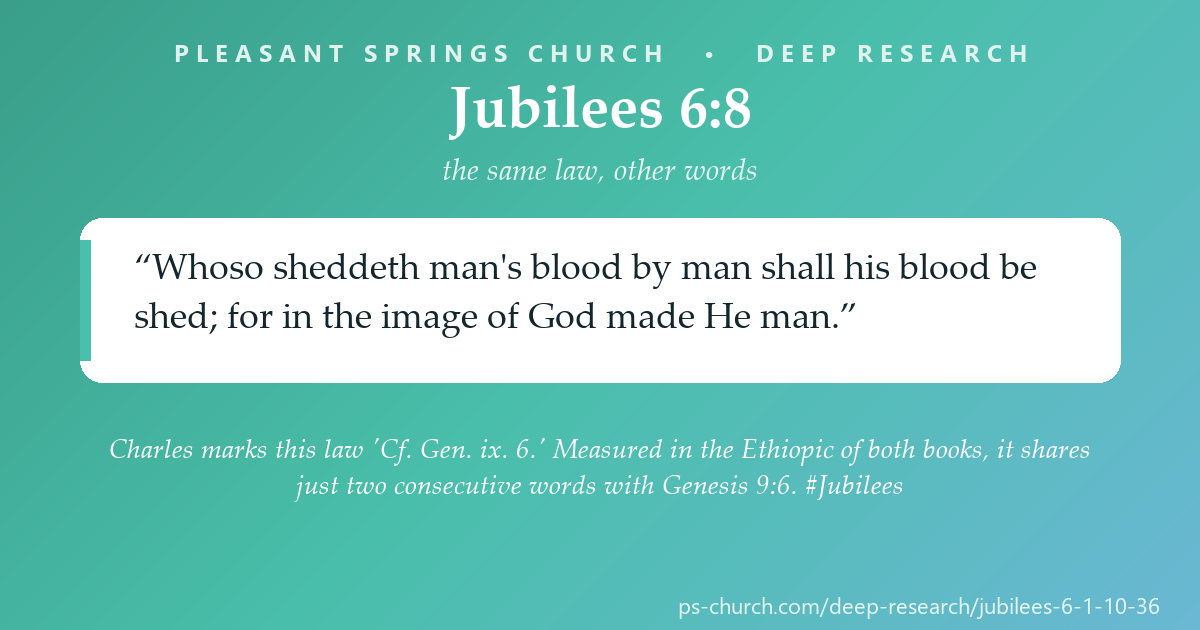
The 1917 edition’s note here reads “Cf. Gen. ix. 6.” In Ethiopic, this verse and Genesis 9:6 share two consecutive words — ደመ ፡ ሰብእ, ‘the blood of man’ — and Genesis 9:6 is the only verse of the Ethiopic Genesis that reaches even two with it (tie band 1). The two books use different nouns for ‘image’: Jubilees በመልክዐ, Genesis በአምሳለ.
One of four verses in these chapters that name the heavenly tables (6:17, 6:29, 6:31, 6:35) — the same four in Charles’s English and in the Geʻez. Its Ethiopic shares no more than two consecutive words with any verse of the Ethiopic Genesis, and the verses that reach two are creation-week verses (Genesis 1:14, 1:15, 1:17; tie band 3).
Measured from the text itself: 52 weeks × 7 = 364 (6:30, 6:32); four divisions of 13 weeks each (6:29) = 52; 13 × 7 = 91 days to a quarter. Charles’s English and the Geʻez agree on every one of these numbers. The 364-day year is the book’s own position; this page reports it and does not adopt it.
The text gives the shortfall — ten days a year — and nothing more. 364 − 10 = 354, which is twelve months of 29½ days; that last step is astronomy, not the text. The 1917 edition’s note gives the same 354 for a lunar year.
The deepest contact anywhere in these five chapters between the two Ethiopic books: five consecutive words — አምላኩ ፡ ለሴም ፡ ወይኩን ፡ ከናአን ፡ ገብሮ, ‘the God of Shem, and let Canaan be his servant’ — with Ethiopic Genesis 9:26, tie band 1 from both sides. The run is broken one word earlier by the divine name: Jubilees እግዚአብሔር, Genesis እግዚእ. Seven of the eight words of Genesis 9:26 stand in this verse in the same order.
Kainam. The Geʻez spells him ቃይናም — and spells the Kenan of 4:14, before the flood, ቃይናን. Dated by the text: 29th jubilee, 1st week, 1st year = 1,373; the birth in the 3rd year = 1,375; Charles’s margin prints the same two numbers. The square brackets are Charles’s own: [ ] marks words he judged interpolated.
Genesis has no such episode, and the measurement agrees: no verse of the Ethiopic Genesis shares more than two consecutive words with this one (tie band 3).
‘Lot’ stands in seven verses of Charles’s English in these chapters, every one between 8:11 and 10:31; ‘blood’ stands in 21, every one between 6:2 and 7:33. The two words never share a chapter. See the structure below.
Shares no two consecutive words with any verse of the Ethiopic Genesis. Mastema is first named in the book at 10:8 — in Charles’s English and in the Geʻez alike.
Dated by the text: 34th jubilee, 4th week, 1st year = 1,639, and the Geʻez reads the same jubilee. Charles’s margin prints 1688 here (at 10:26) and 1645–1688 at 10:21 — and 1,688 is the 35th jubilee, not the 34th. Taking the bricks of 10:20 in the 33rd jubilee’s fourth week (1,590–1,596), the text’s own numbers are consistent: 1,596 + 43 = 1,639.
No Geʻez verse is printed. The Ethiopic Jubilees on this disk is VanderKam’s 1989 critical text as digitised by Ran HaCohen, and the licence chain for that digitisation is disputed, so it is used here as measurement substrate: a few Geʻez words appear on this page only where they carry a measured finding (Geʻez: VanderKam’s critical text (1989), digitised by Ran HaCohen). The Ethiopic Genesis words are from Dillmann’s edition (Dillmann, Octateuchus Aethiopicus (1853); digitised by Ran HaCohen; Beta maṣāḥəft, CC BY-SA 4.0).
Three slips in the transcribed English are not quoted here. The file reads Sherri at 9:2, the whole cast at 8:16 and which. is not thine at 10:30; the scans of the printed book on this disk read Shem, the whole east and which is not thine. Stage 5 lists them.
Versification — stated, as on every page here, and for this book it is a third state.
There is no Masoretic Jubilees, no Greek Jubilees in the CATSS files, no King James Jubilees, no ESV Jubilees and no Vulgate Jubilees on this disk — the shelf’s loaders find nothing for any of the five. So there is no MT/LXX offset to state, and the page will not manufacture one.
The two texts of Jubilees it does hold agree exactly in these chapters. Charles’s English counts 38 · 39 · 30 · 15 · 36 verses in chapters 6–10 = 158; VanderKam’s Geʻez counts the same in every chapter. Every dated verse in the table in Stage 4 carries its date at the same verse number in both. Offset between the two: none.
On the Genesis side: the Ethiopic Genesis numbers its verses as the Septuagint does. Genesis 8:20–11:9 is 72 rows in the Ethiopic file against 73 verses in the Masoretic text, 73 in the Greek and 73 in the Clementine Vulgate — the same verse numbers in all three, so no offset among them in this range — and the Ethiopic source has no verse numbered 10:12. And in the Greek and the Ethiopic alike, the whole generation of Kainan is packed into verse 11:13, so a verse number there does not mean the same text in the three Genesis traditions.
The Shape of the Passage
A dated sequence in two halves — measured, and not a chiasmThe book’s frame shows through, and is counted too. The angel speaks to Moses as thou in eight verses, all in chapter 6 (6:11, 6:13, 6:19, 6:20, 6:22, 6:32, 6:35, 6:38); the angels speak of themselves as we in eight verses, all between 8:10 and 10:23. That count is this page’s reading of who is speaking in each verse; the verse list is checked against the text.
The dated events run forward, with one exception (setting aside 6:18’s look ahead to Noah’s death). 1,309 → 1,317 → 1,324–1,372 → 1,373 → 1,429 → 1,499 → 1,564 → 1,569 → 1,583–1,589 — and then Noah’s death (1,659, by 6:18’s arithmetic) is told at 10:15–16, before Peleg’s marriage (1,576) and the dispersal (1,639). It is the one joint where the narration runs against its own dates.
This is NOT offered as a chiasm. Nothing in the second half mirrors the first. What the text does build is a setup and a payoff — the oath on the lots at 9:14–15 and Canaan’s breach of it at 10:29–34 — and that is labelled as what it is.
⚠️ Where these chapters sit. Jubilees dates everything by jubilees of 49 years, weeks of years, and years. Its last chapter counts forty-nine jubilees from the days of Adam until this day, and one week and two years — Adam to Sinai, 2,410 years — and forty more to the Jordan: 2,450 = 50 × 49, the book’s whole scheme ending at the entry into Canaan (50:4). Chapters 6–10 run from 1,309 to 1,659 — the 27th to the 34th of those fifty jubilees — and 6:32 and 6:38 are the only verses in the whole book that name its year of 364 days.
Author
Anonymous, and speaking in an angel’s voice. The book presents itself as dictated by the angel of the presence to Moses on Sinai. In these chapters that frame surfaces twice: the angel turns to Moses directly through chapter 6 — do thou command the children of Israel — and from 8:10 to 10:23 the angels speak of themselves as we: one of us, who had been sent; we explained to Noah all the medicines; we descended with Him.
Law runs through what Genesis lacks. Many of the things these chapters carry and Genesis does not come with a command: blood is not to be eaten, the feast of weeks is to be kept on its day, the year is to be 364 days, fruit is holy in its fourth year, and a portion received by lot is not to be seized. The 1917 introduction calls the author “so priestly a writer”. Nothing on this page tests the book’s date or its author.
Audience
Jews told that their calendar was written on the heavenly tables. The warning of 6:34–38 is about Israel itself — all the children of Israel will forget — and the danger it names is feasts kept on the wrong day: there will be those who will assuredly make observations of the moon.
Stories for why the world is as it is. Why there are demons (10:1–11), why the nations live where they live (8–9), why one people’s land was held to be another’s by right (10:29–34). The book answers each with a story set in Noah’s lifetime. Those answers are reported on this page, not adopted.
Orient on the book, its calendar, its demons, and its map.
Search by topic: Jubilees, Book of; calendars in early Judaism; 364-day year; Shavuot / Feast of Weeks; Mastema; Watchers; Noahide laws; Table of Nations; Cainan.
Which articles are relevant?
- Anchor Bible Dictionary — its article on Jubilees (VanderKam, as the earlier Jubilees 1 page also cites), and its entries on the ancient calendars, the feast of weeks, and Cainan.
- Eerdmans Dictionary of Early Judaism — its entries on Jubilees, on calendars and chronography, on demons, and on rewritten Bible.
- Dictionary of New Testament Background (IVP) — its entries on Jubilees, on the Jewish calendars, and on Pentecost.
- The entry titles are not quoted, because the page did not open the volumes; the topics are what to look up.
- On the text — any article that says which Jubilees it is quoting: the Ethiopic, the Hebrew fragments from Qumran, or the Latin. For chapters 6–10 this page could only check the Ethiopic.
Bibliography surfaced:
- James C. VanderKam, The Book of Jubilees: A Critical Text (CSCO 510, 1989) and The Book of Jubilees (CSCO 511, translation) — the Ethiopic measured on this page is the digitised text of the first.
- James C. VanderKam, Jubilees (Hermeneia, 2 vols.) — a commentary.
- J. T. A. G. M. van Ruiten, Primaeval History Interpreted: The Rewriting of Genesis 1–11 in the Book of Jubilees (Brill).
- James M. Scott, Geography in Early Judaism and Christianity: The Book of Jubilees (Cambridge) — on the division of the earth in chapters 8–9.
- James C. VanderKam, Calendars in the Dead Sea Scrolls: Measuring Time (Routledge) — on the 364-day year.
- R. H. Charles, The Book of Jubilees, or the Little Genesis (1902) — the English printed on this page, in its 1917 SPCK reprint.
Genesis, the Enoch literature, Josephus, and the later rabbis — each beside these chapters.
Where a parallel below is named from the notes of the 1917 edition, it says so. Where this disk holds the other text, the page checked that the passage says what the note says.
Which parallels shed light on the world of the text?
Genesis 8:20–11:9 is the ground these chapters cover — the altar, the covenant and the bow, the vineyard and the curse, the sons of the three brothers, the tower — and the page measures exactly how much of its wording the Ethiopic texts share in Stage 4. (Our studies of 8:20–9:17, 9:18–29, 10 and 11:1–9.) What Genesis does not have is most of what Jubilees spends its words on: the feast of weeks, the four memorial days and the 364-day year, Noah’s testament, Kainam and the Watchers’ writing, the lots, the demons and Mastema, the forty-three years of building.
The 1917 notes set the Watchers and the calendar beside the Enoch literature. They point the calendar at 1 Enoch 75 and 82 and the Watchers at 1 Enoch 7 and 9, and at 7:20 and 10:1 they call 7:20–39 and 10:1–15 fragments of a lost book of Noah (a Book of Noah at 7:20, an Apocalypse of Noah at 10:1) — “From here to the end of the chapter there is incorporated a fragment of the lost Book of Noah.” That is the note’s judgement; no book of Noah is held on this disk, and the page neither adopts nor tests it.
- Josephus, Antiquities 1 — on the tower, Josephus cites the Sibyl: “the gods sent storms of wind and overthrew the tower”. Jubilees 10:26: “the Lord sent a mighty wind against the tower and overthrew it upon the earth”. Genesis 11 has no wind and no overthrow. Checked in the Whiston translation held on this disk; the two are set side by side, and neither is said to depend on the other.
- Josephus again, on astronomy before the flood — the 1917 note at 8:3 sets Kainam’s discovery beside Josephus’s descendants of Seth, who were “the inventors of that peculiar sort of wisdom which is concerned with the heavenly bodies” and cut it on two pillars. In Jubilees the writing on the rock is the Watchers’, and copying it is a sin.
- The later rabbis — the 1917 notes at 7:21 and 7:31 set Noah’s commands beside the seven “Noachic” laws of later Jewish tradition, citing Maimonides. Reported from the notes; not checked here.
- Tobit — the 1917 note names the angel who teaches Noah his medicines (10:10–13) as Raphael, on the authority of the Hebrew Book of Noah, and points to Tobit 3:17 and 12:14–15. Measured: the name Raphael occurs in neither Charles’s English nor the Geʻez of Jubilees as the angel’s name — not once in the whole book (the Geʻez file’s one Rāfāʾēl, at 29:9, is the land Charles calls the land of the Rephaim). The angel in 10:10 is one of us. (Our study of Tobit.)
Two passages here assign a people a curse and a land. At 7:10 Noah curses Canaan, as in Genesis 9:25. At 10:29–34 Canaan saw the land of Lebanon to the river of Egypt and dwelt in the land of Lebanon, which by 8:21 fell to Shem, and his father and brothers pronounce on him the curse of the oath of 9:14. The 1917 note observes “Canaan is included in Shem's lot.” and concludes that the later Israelite conquest is thereby justified. That is the note’s reading of Jubilees’ purpose, reported as such. This page reports what the book says and what its editor said of it, and draws no line from either to any later people or conflict.
The unit of time, the substance of the law, the archive in heaven, the accuser, and one name.
Counts are over Charles’s English and the Geʻez of Jubilees 6–10 (158 verses) unless a wider scope is named. English counts are counts of a translator’s words; where the Geʻez could be counted too, it was, and the page says when the two agree.
The book’s unit of time: 49 years. ‘Jubilee’ stands in fourteen verses of Charles’s English in these chapters, and every date the page derives is built from it: AM = 49(N−1) + 7(M−1) + K for the Nth jubilee, Mth week, Kth year.
21 verses, the same 21 in Charles’s English and in the Geʻez, 32 Geʻez tokens, every one between 6:2 and 7:33. Blood eaten, blood shed, blood that only the blood of the shedder can cleanse (7:33) — and then not one occurrence in chapters 8–10.
Four verses — 6:17, 6:29, 6:31, 6:35, in both texts — and every one is about the feast or the calendar. Charles renders it heavenly tables.
First named in the whole book at 10:8, in both texts. Across the book the name stands in 12 verses of Charles’s English and 11 of the Geʻez file. The one difference is 11:5, where the file reads ወስቴማ — one letter off the name — and VanderKam’s own English on the host page reads Prince Mastema: very likely a slip in the digitisation (Stage 5). At 10:11 the same figure is called Satan; the 1917 note reads “Thus Satan and Mastêmâ are identical.”
One verse in the whole Geʻez book: 8:1. The Greek Genesis on this disk spells the name Καιναν; the Greek New Testament spells it Καϊνὰμ (Luke 3:36, SBLGNT text). The spelling is reported, not argued from.
Counted here, not assumed:
- The calendar numbers. Thirteen weeks to a quarter (6:29), 52 weeks to the year (6:30), 364 days (6:32 and 6:38), ten days’ error a year from the moon (6:36). The English and the Geʻez agree on all five. 364 is divisible by 7, so in this year every date falls on the same weekday every year — arithmetic, and the reason the book can fix a feast to a day.
- The four memorial days. Charles’s 6:23 names the new moons of the first, fourth, seventh and tenth months. The Geʻez file names only three — first, fourth and tenth — and then says in the four divisions of the year. VanderKam’s own English, printed beside the Geʻez on the host page, names all four, so the missing seventh month is very likely a slip in the digitisation. Reported in Stage 5; it changes no number on this page.
- Noah’s years, in the book’s own units. 6:18: seven jubilees and one week of years = 7 × 49 + 7 = 350. 10:16: nineteen jubilees and two weeks and five years = 931 + 14 + 5 = 950. Both equal the figures of Genesis 9:28–29 in the Masoretic, Samaritan and Greek texts.
- The sixteen grandsons. Ham divides among four sons (9:1), Shem among five (9:2–6), Japheth among seven (9:7–13: the seventh portion goes to Tiras). Those are the four, five and seven sons listed at 7:13, 7:18 and 7:19.
Two Ethiopic books, one story, and five consecutive words — once.
The measurement. Every verse of the Geʻez Jubilees 6–10 (158 rows) screened against every row of the Ethiopic Genesis (1,526 rows, the whole book, so that a tie band is a band over all of Genesis), and back again: every Genesis row of 8:20–11:19, every Genesis verse that partners a verse here, and the partner of the book’s deepest run, against every Jubilees row. Then, for scale, all 1,307 verses of Jubilees the same way. Contiguous runs of whole word forms, with the shelf’s own run engine and unigram fallback OFF — so 0 means ‘shares no two consecutive words’, as on the Hebrew-side pages. Normalisation, declared: split on the word divider ፡ and on spaces; strip ። and every other Ethiopic punctuation mark, Ethiopic numerals, brackets and asterisks; nothing else. F1 additionally folds the consonant series manuscripts interchange — ሐ/ኀ→ሀ, ሠ→ሰ, ዐ→አ, ፀ→ጸ, in every vowel order. F2 is F1 plus one more fold the data forced: the first and fourth vowel orders of the two laryngeals left after F1 (ሀ/ሃ, አ/ኣ). Every headline number is given with and without the folds; the per-verse table and the lists of verses with no partner are as printed, and what F2 would change in them is stated beside them. English set beside Geʻez words on this page is the page’s own word-for-word gloss, not Charles’s translation.
The distribution, from both sides:
| Screen (unigram fallback off: 0 = no two consecutive words shared) | rows | reach 2 | reach 3 | reach 4 | reach 5 | share no two |
|---|---|---|---|---|---|---|
| Jubilees 6–10 → all 1,526 rows of the Ethiopic Genesis, as printed | 158 | 104 | 16 | 5 | 1 | 54 |
| the same, with the consonant fold (F1) | 158 | 104 | 16 | 5 | 1 | 54 |
| the same, with the consonant and laryngeal-order fold (F2) | 158 | 106 | 17 | 6 | 1 | 52 |
| Genesis 8:20–11:9 → Jubilees 6–10, as printed (F1 the same) | 72 | 31 | 7 | 4 | 1 | 41 |
| the same, with F2 | 72 | 33 | 8 | 5 | 1 | 39 |
| Genesis 8:20–11:9 → all 1,308 rows of Jubilees, as printed (F1 the same) | 72 | 41 | 8 | 4 | 1 | 31 |
| the same, with F2 | 72 | 42 | 9 | 5 | 1 | 30 |
Read the first line slowly. Of 158 verses, 54 share no two consecutive words with any verse of the Ethiopic Genesis; 88 top out at two; 16 reach three, 5 reach four, and one reaches five. Nothing reaches six. The consonant fold changes nothing at all. The laryngeal-order fold moves three verses — 6:4, 7:8 and 9:9 — and only 6:4 above two.
From the Genesis side it is the same picture. Of the 72 Ethiopic rows of Genesis 8:20–11:9, 41 share no two consecutive words with any verse of Jubilees 6–10 (39 with F2). Genesis 10, the Table of Nations, has 31 rows, and 3 of them reach even two — under every fold.
All 158 verses — each one’s deepest partner in the Ethiopic Genesis, with the tie band both ways (as printed, no fold; click to open)
| Jub | run | band | deepest Ethiopic Genesis partner(s) | that Genesis verse’s own deepest run against all 1,308 Jubilees rows · its band · ✓ if this verse is among them | inside Gen 8:20–11:9? |
|---|---|---|---|---|---|
| 6:1 | 2 | 2 | Gen 8:16 Gen 8:19 | 2 / 1 ✓ 3 / 4 – | no |
| 6:2 | 3 | 1 | Gen 40:5 | 3 / 2 ✓ | no |
| 6:3 | 2 | 13 | Gen 7:6 Gen 10:9 Gen 16:12 + 10 more | 2 / 18 ✓ 2 / 24 ✓ 2 / 6 ✓ | partly |
| 6:4 | 2 | 8 | Gen 3:14 Gen 3:17 Gen 6:17 + 5 more | 3 / 1 – 5 / 1 – 4 / 1 – | partly |
| 6:5 | 2 | 25 | Gen 1:22 Gen 1:25 Gen 1:29 + 22 more | 2 / 42 ✓ 4 / 2 – 3 / 2 – | partly |
| 6:6 | 4 | 1 | Gen 1:25 | 4 / 2 ✓ | no |
| 6:7 | 2 | 9 | Gen 6:12 Gen 6:17 Gen 6:19 + 6 more | 3 / 1 – 4 / 1 – 2 / 9 ✓ | partly |
| 6:8 | 2 | 1 | Gen 9:6 | 2 / 5 ✓ | yes |
| 6:9 | 2 | 25 | Gen 1:11 Gen 1:14 Gen 1:15 + 22 more | 2 / 39 ✓ 3 / 1 – 3 / 1 – | partly |
| 6:10 | 2 | 10 | Gen 10:9 Gen 18:22 Gen 19:13 + 7 more | 2 / 24 ✓ 2 / 23 ✓ 2 / 23 ✓ | partly |
| 6:11 | 2 | 6 | Gen 32:33 Gen 33:10 Gen 37:2 + 3 more | 3 / 14 – 3 / 1 – 2 / 9 ✓ | no |
| 6:12 | 2 | 4 | Gen 3:14 Gen 3:17 Gen 6:5 + 1 more | 3 / 1 – 5 / 1 – 3 / 1 – | no |
| 6:13 | 2 | 9 | Gen 10:9 Gen 18:22 Gen 19:13 + 6 more | 2 / 24 ✓ 2 / 23 ✓ 2 / 23 ✓ | partly |
| 6:14 | 2 | 21 | Gen 1:8 Gen 1:10 Gen 1:12 + 18 more | 2 / 10 ✓ 2 / 9 ✓ 2 / 11 ✓ | partly |
| 6:15 | 3 | 1 | Gen 6:17 | 4 / 1 – | no |
| 6:16 | 4 | 1 | Gen 6:17 | 4 / 1 ✓ | no |
| 6:17 | 2 | 3 | Gen 1:14 Gen 1:15 Gen 1:17 | 3 / 1 – 3 / 1 – 3 / 1 – | no |
| 6:18 | 0 | — | — | — | — |
| 6:19 | 2 | 2 | Gen 39:16 Gen 49:10 | 2 / 34 ✓ 2 / 28 ✓ | no |
| 6:20 | 0 | — | — | — | — |
| 6:21 | 0 | — | — | — | — |
| 6:22 | 2 | 6 | Gen 35:22 Gen 44:1 Gen 47:12 + 3 more | 3 / 1 – 2 / 3 ✓ 2 / 5 ✓ | no |
| 6:23 | 0 | — | — | — | — |
| 6:24 | 2 | 4 | Gen 7:11 Gen 9:12 Gen 39:16 + 1 more | 2 / 8 ✓ 2 / 15 ✓ 2 / 34 ✓ | partly |
| 6:25 | 2 | 1 | Gen 8:14 | 4 / 1 – | no |
| 6:26 | 0 | — | — | — | — |
| 6:27 | 0 | — | — | — | — |
| 6:28 | 2 | 2 | Gen 6:3 Gen 13:15 | 2 / 27 ✓ 3 / 3 – | no |
| 6:29 | 2 | 2 | Gen 24:8 Gen 28:16 | 3 / 1 – 3 / 2 – | no |
| 6:30 | 0 | — | — | — | — |
| 6:31 | 0 | — | — | — | — |
| 6:32 | 2 | 4 | Gen 35:5 Gen 45:20 Gen 46:8 + 1 more | 2 / 9 ✓ 2 / 7 ✓ 2 / 16 ✓ | no |
| 6:33 | 0 | — | — | — | — |
| 6:34 | 0 | — | — | — | — |
| 6:35 | 2 | 1 | Gen 38:10 | 2 / 34 ✓ | no |
| 6:36 | 0 | — | — | — | — |
| 6:37 | 0 | — | — | — | — |
| 6:38 | 2 | 10 | Gen 6:12 Gen 6:17 Gen 6:19 + 7 more | 3 / 1 – 4 / 1 – 2 / 9 ✓ | partly |
| 7:1 | 2 | 2 | Gen 21:5 Gen 41:46 | 2 / 7 ✓ 4 / 4 – | no |
| 7:2 | 0 | — | — | — | — |
| 7:3 | 0 | — | — | — | — |
| 7:4 | 0 | — | — | — | — |
| 7:5 | 2 | 10 | Gen 6:13 Gen 6:22 Gen 10:9 + 7 more | 3 / 1 – 2 / 5 ✓ 2 / 24 ✓ | partly |
| 7:6 | 0 | — | — | — | — |
| 7:7 | 2 | 1 | Gen 20:3 | 2 / 12 ✓ | no |
| 7:8 | 0 | — | — | — | — |
| 7:9 | 2 | 1 | Gen 9:23 | 2 / 1 ✓ | yes |
| 7:10 | 2 | 2 | Gen 1:31 Gen 9:24 | 2 / 2 ✓ 2 / 3 ✓ | partly |
| 7:11 | 5 | 1 | Gen 9:26 | 5 / 1 ✓ | yes |
| 7:12 | 2 | 5 | Gen 1:17 Gen 2:8 Gen 9:26 + 2 more | 3 / 1 – 2 / 16 ✓ 5 / 1 – | partly |
| 7:13 | 0 | — | — | — | — |
| 7:14 | 0 | — | — | — | — |
| 7:15 | 0 | — | — | — | — |
| 7:16 | 2 | 1 | Gen 31:54 | 2 / 5 ✓ | no |
| 7:17 | 2 | 1 | Gen 25:18 | 2 / 24 ✓ | no |
| 7:18 | 2 | 1 | Gen 10:22 | 2 / 1 ✓ | yes |
| 7:19 | 0 | — | — | — | — |
| 7:20 | 2 | 3 | Gen 9:20 Gen 40:5 Gen 43:33 | 2 / 2 ✓ 3 / 2 – 2 / 8 ✓ | partly |
| 7:21 | 3 | 2 | Gen 7:17 Gen 33:10 | 3 / 1 ✓ 3 / 1 ✓ | no |
| 7:22 | 2 | 8 | Gen 2:5 Gen 2:7 Gen 7:21 + 5 more | 2 / 44 ✓ 2 / 10 ✓ 3 / 1 – | partly |
| 7:23 | 0 | — | — | — | — |
| 7:24 | 2 | 37 | Gen 1:11 Gen 1:14 Gen 1:15 + 34 more | 2 / 39 ✓ 3 / 1 – 3 / 1 – | partly |
| 7:25 | 2 | 5 | Gen 1:31 Gen 6:7 Gen 8:8 + 2 more | 2 / 2 ✓ 2 / 13 ✓ 2 / 3 ✓ | no |
| 7:26 | 2 | 18 | Gen 6:13 Gen 6:17 Gen 7:1 + 15 more | 3 / 1 – 4 / 1 – 2 / 10 ✓ | partly |
| 7:27 | 2 | 29 | Gen 1:22 Gen 1:25 Gen 1:30 + 26 more | 2 / 42 ✓ 4 / 2 – 3 / 2 – | partly |
| 7:28 | 2 | 3 | Gen 9:6 Gen 45:20 Gen 46:32 | 2 / 5 ✓ 2 / 7 ✓ 2 / 1 ✓ | partly |
| 7:29 | 2 | 25 | Gen 1:11 Gen 1:14 Gen 1:15 + 22 more | 2 / 39 ✓ 3 / 1 – 3 / 1 – | partly |
| 7:30 | 3 | 1 | Gen 7:23 | 3 / 3 ✓ | no |
| 7:31 | 2 | 10 | Gen 6:12 Gen 6:17 Gen 6:19 + 7 more | 3 / 1 – 4 / 1 – 2 / 9 ✓ | partly |
| 7:32 | 2 | 31 | Gen 1:11 Gen 1:14 Gen 1:15 + 28 more | 2 / 39 ✓ 3 / 1 – 3 / 1 – | partly |
| 7:33 | 2 | 1 | Gen 29:2 | 2 / 6 ✓ | no |
| 7:34 | 4 | 2 | Gen 11:8 Gen 11:9 | 4 / 1 ✓ 4 / 1 ✓ | yes |
| 7:35 | 0 | — | — | — | — |
| 7:36 | 2 | 15 | Gen 2:1 Gen 2:4 Gen 10:9 + 12 more | 2 / 3 ✓ 2 / 16 ✓ 2 / 24 ✓ | partly |
| 7:37 | 0 | — | — | — | — |
| 7:38 | 2 | 1 | Gen 38:10 | 2 / 34 ✓ | no |
| 7:39 | 3 | 1 | Gen 25:6 | 3 / 1 ✓ | no |
| 8:1 | 3 | 1 | Gen 4:25 | 6 / 1 – | no |
| 8:2 | 0 | — | — | — | — |
| 8:3 | 2 | 3 | Gen 26:28 Gen 37:9 Gen 39:3 | 3 / 1 – 2 / 4 ✓ 4 / 2 – | no |
| 8:4 | 0 | — | — | — | — |
| 8:5 | 2 | 8 | Gen 5:29 Gen 11:29 Gen 12:8 + 5 more | 4 / 1 – 2 / 3 ✓ 2 / 54 ✓ | no |
| 8:6 | 2 | 4 | Gen 21:21 Gen 28:6 Gen 30:37 + 1 more | 2 / 32 ✓ 2 / 28 ✓ 2 / 4 ✓ | no |
| 8:7 | 2 | 10 | Gen 4:25 Gen 12:8 Gen 16:15 + 7 more | 6 / 1 – 2 / 54 ✓ 2 / 8 ✓ | no |
| 8:8 | 2 | 6 | Gen 4:25 Gen 12:8 Gen 16:15 + 3 more | 6 / 1 – 2 / 54 ✓ 2 / 8 ✓ | no |
| 8:9 | 0 | — | — | — | — |
| 8:10 | 2 | 2 | Gen 3:22 Gen 18:1 | 2 / 7 ✓ 2 / 15 ✓ | no |
| 8:11 | 2 | 1 | Gen 45:4 | 2 / 13 ✓ | no |
| 8:12 | 2 | 1 | Gen 9:12 | 2 / 15 ✓ | yes |
| 8:13 | 0 | — | — | — | — |
| 8:14 | 2 | 1 | Gen 24:62 | 3 / 8 – | no |
| 8:15 | 0 | — | — | — | — |
| 8:16 | 2 | 2 | Gen 2:8 Gen 32:4 | 2 / 16 ✓ 3 / 1 – | no |
| 8:17 | 2 | 2 | Gen 6:3 Gen 13:15 | 2 / 27 ✓ 3 / 3 – | no |
| 8:18 | 2 | 10 | Gen 1:17 Gen 2:8 Gen 5:29 + 7 more | 3 / 1 – 2 / 16 ✓ 4 / 1 – | partly |
| 8:19 | 2 | 2 | Gen 13:10 Gen 41:7 | 3 / 1 – 2 / 5 ✓ | no |
| 8:20 | 2 | 2 | Gen 6:3 Gen 13:15 | 2 / 27 ✓ 3 / 3 – | no |
| 8:21 | 2 | 4 | Gen 8:4 Gen 9:12 Gen 32:4 + 1 more | 3 / 4 – 2 / 15 ✓ 3 / 1 – | partly |
| 8:22 | 2 | 8 | Gen 7:19 Gen 14:2 Gen 14:3 + 5 more | 2 / 37 ✓ 2 / 7 ✓ 2 / 7 ✓ | no |
| 8:23 | 0 | — | — | — | — |
| 8:24 | 2 | 15 | Gen 4:11 Gen 4:16 Gen 6:3 + 12 more | 3 / 1 – 3 / 8 – 2 / 27 ✓ | no |
| 8:25 | 2 | 1 | Gen 2:8 | 2 / 16 ✓ | no |
| 8:26 | 0 | — | — | — | — |
| 8:27 | 2 | 1 | Gen 2:8 | 2 / 16 ✓ | no |
| 8:28 | 0 | — | — | — | — |
| 8:29 | 2 | 17 | Gen 4:11 Gen 4:16 Gen 6:3 + 14 more | 3 / 1 – 3 / 8 – 2 / 27 ✓ | no |
| 8:30 | 0 | — | — | — | — |
| 9:1 | 2 | 1 | Gen 2:8 | 2 / 16 ✓ | no |
| 9:2 | 0 | — | — | — | — |
| 9:3 | 0 | — | — | — | — |
| 9:4 | 0 | — | — | — | — |
| 9:5 | 0 | — | — | — | — |
| 9:6 | 2 | 2 | Gen 2:8 Gen 31:21 | 2 / 16 ✓ 2 / 4 ✓ | no |
| 9:7 | 0 | — | — | — | — |
| 9:8 | 2 | 1 | Gen 2:8 | 2 / 16 ✓ | no |
| 9:9 | 0 | — | — | — | — |
| 9:10 | 0 | — | — | — | — |
| 9:11 | 0 | — | — | — | — |
| 9:12 | 0 | — | — | — | — |
| 9:13 | 0 | — | — | — | — |
| 9:14 | 2 | 2 | Gen 40:5 Gen 43:33 | 3 / 2 – 2 / 8 ✓ | no |
| 9:15 | 2 | 9 | Gen 3:5 Gen 6:3 Gen 13:15 + 6 more | 7 / 1 – 2 / 27 ✓ 3 / 3 – | no |
| 10:1 | 0 | — | — | — | — |
| 10:2 | 2 | 3 | Gen 7:9 Gen 7:15 Gen 26:32 | 2 / 5 ✓ 2 / 8 ✓ 2 / 8 ✓ | no |
| 10:3 | 2 | 36 | Gen 2:6 Gen 2:9 Gen 2:19 + 33 more | 2 / 6 ✓ 2 / 8 ✓ 2 / 13 ✓ | partly |
| 10:4 | 0 | — | — | — | — |
| 10:5 | 2 | 2 | Gen 40:5 Gen 46:31 | 3 / 2 – 2 / 21 ✓ | no |
| 10:6 | 2 | 1 | Gen 44:18 | 2 / 4 ✓ | no |
| 10:7 | 0 | — | — | — | — |
| 10:8 | 2 | 4 | Gen 6:3 Gen 41:31 Gen 41:57 + 1 more | 2 / 27 ✓ 2 / 4 ✓ 2 / 50 ✓ | no |
| 10:9 | 0 | — | — | — | — |
| 10:10 | 2 | 2 | Gen 3:5 Gen 31:2 | 7 / 1 – 2 / 3 ✓ | no |
| 10:11 | 2 | 25 | Gen 1:11 Gen 1:14 Gen 1:15 + 22 more | 2 / 39 ✓ 3 / 1 – 3 / 1 – | partly |
| 10:12 | 0 | — | — | — | — |
| 10:13 | 2 | 2 | Gen 7:5 Gen 24:66 | 2 / 2 ✓ 2 / 5 ✓ | no |
| 10:14 | 2 | 2 | Gen 27:1 Gen 37:4 | 2 / 5 ✓ 2 / 2 ✓ | no |
| 10:15 | 0 | — | — | — | — |
| 10:16 | 2 | 1 | Gen 7:24 | 2 / 2 ✓ | no |
| 10:17 | 2 | 25 | Gen 1:11 Gen 1:14 Gen 1:15 + 22 more | 2 / 39 ✓ 3 / 1 – 3 / 1 – | partly |
| 10:18 | 3 | 3 | Gen 4:25 Gen 25:1 Gen 26:34 | 6 / 1 – 3 / 1 ✓ 3 / 1 ✓ | no |
| 10:19 | 2 | 4 | Gen 2:8 Gen 10:25 Gen 11:4 + 1 more | 2 / 16 ✓ 2 / 2 ✓ 2 / 41 ✓ | partly |
| 10:20 | 2 | 1 | Gen 11:3 | 2 / 3 ✓ | yes |
| 10:21 | 2 | 1 | Gen 47:9 | 2 / 11 ✓ | no |
| 10:22 | 2 | 5 | Gen 3:5 Gen 11:7 Gen 39:16 + 2 more | 7 / 1 – 2 / 3 ✓ 2 / 34 ✓ | partly |
| 10:23 | 2 | 2 | Gen 11:4 Gen 11:5 | 2 / 41 ✓ 2 / 13 ✓ | yes |
| 10:24 | 0 | — | — | — | — |
| 10:25 | 2 | 2 | Gen 11:9 Gen 21:31 | 4 / 1 – 4 / 1 – | partly |
| 10:26 | 2 | 44 | Gen 1:22 Gen 1:25 Gen 1:30 + 41 more | 2 / 42 ✓ 4 / 2 – 3 / 2 – | no |
| 10:27 | 0 | — | — | — | — |
| 10:28 | 3 | 8 | Gen 4:16 Gen 12:1 Gen 15:13 + 5 more | 3 / 8 ✓ 4 / 2 – 4 / 2 – | no |
| 10:29 | 3 | 2 | Gen 12:14 Gen 49:15 | 3 / 1 ✓ 3 / 1 ✓ | no |
| 10:30 | 4 | 1 | Gen 15:13 | 4 / 2 ✓ | no |
| 10:31 | 0 | — | — | — | — |
| 10:32 | 0 | — | — | — | — |
| 10:33 | 3 | 3 | Gen 19:37 Gen 32:33 Gen 47:26 | 3 / 13 ✓ 3 / 14 ✓ 4 / 1 – | no |
| 10:34 | 2 | 24 | Gen 11:31 Gen 12:5 Gen 12:6 + 21 more | 2 / 23 ✓ 2 / 21 ✓ 3 / 1 – | no |
| 10:35 | 3 | 3 | Gen 19:37 Gen 32:33 Gen 47:26 | 3 / 13 ✓ 3 / 14 ✓ 4 / 1 – | no |
| 10:36 | 0 | — | — | — | — |
Which verses have no partner at all — both sides (click to open)
The 54 verses of Jubilees 6–10 that share no two consecutive words with any of the 1,526 rows of the Ethiopic Genesis: 6:18, 6:20–21, 6:23, 6:26–27, 6:30–31, 6:33–34, 6:36–37, 7:2–4, 7:6, 7:8, 7:13–15, 7:19, 7:23, 7:35, 7:37, 8:2, 8:4, 8:9, 8:13, 8:15, 8:23, 8:26, 8:28, 8:30, 9:2–5, 9:7, 9:9–13, 10:1, 10:4, 10:7, 10:9, 10:12, 10:15, 10:24, 10:27, 10:31–32, 10:36.
The 41 rows of Ethiopic Genesis 8:20–11:9 that share no two consecutive words with any verse of Jubilees 6–10: 8:22, 9:8, 9:10, 9:17–18, 9:21–22, 9:25, 9:28–29, 10:1–8, 10:10–11, 10:13–21, 10:23–24, 10:26–32, 11:1–2, 11:6.
Of those, the 31 that share none with any verse anywhere in the book: 9:21, 9:25, 9:28, 10:1–8, 10:10–11, 10:13–17, 10:19–21, 10:23–24, 10:26–32, 11:1.
These lists are as printed. Under F2 they shrink: Jubilees 7:8 and 9:9 leave the first, and Genesis 9:22 and 9:25 leave the second — Ham’s report, which then meets its own parallel, Jubilees 7:8, and also 9:9, at two; and the curse of Canaan, which meets its own parallel, Jubilees 7:10, at two. Genesis 9:25 leaves the third list as well. Each of those runs turns on the word for ‘his brothers’, which the Jubilees file writes in the fourth vowel order and the Genesis file in the first.
A row with no partner is not proof of free composition, or of a passage passed over: the same event can be told in other words, as Stage 4 shows. It is where the wording parts.
Is that thin for this book? The whole of Jubilees, measured the same way. All 1,307 verses of chapters 1–50 against all 1,526 rows of the Ethiopic Genesis: the deepest contact anywhere in the book is eight consecutive words, once — Jubilees 24:1 with Genesis 25:11, the blessing of Isaac after Abraham’s death, tie band 1 from both sides. 31 verses of the book reach five or more (33 with the F2 fold), and 7:11 is the only one of them in chapters 6–10; 309 verses of the book share no two consecutive words with any verse of Genesis (301 with F2). So the thinness is the book’s habit, not these chapters’ alone — and these chapters hold its extreme. Chapter 9, the division of the earth, is the thinnest chapter in the whole book: ten of its fifteen verses share no two consecutive words with any verse of Genesis (nine with F2) — the highest share of any chapter under every fold; the next is chapter 48, at 10 of 19. Chapter 9 draws borders by rivers, seas and mountains; Genesis 10 lists descendants. The measurement shows where the wording parts; the content says why it might.
The deepest run, and what it is:
Jubilees 7:11 ↔ Ethiopic Genesis 9:26 — a run of five, tie band 1 from the Jubilees side, and tie band 1 from the Genesis side against all 1,308 rows of Jubilees. አምላኩ ፡ ለሴም ፡ ወይኩን ፡ ከናአን ፡ ገብሮ — the God of Shem, and let Canaan be his servant. It is Noah’s blessing of Shem, and it is the same under every fold.
And it is held apart by one word. Genesis 9:26 has eight words; seven of them stand in Jubilees 7:11 in the same order. The eighth is the divine name — Genesis እግዚእ, Jubilees እግዚአብሔር — and it falls inside the sentence, so the contiguous run is five. A run engine is strict by design; this is the kind of thing it hides, and the page shows it. The refrain carries on into the next verse: Genesis 9:27 meets the same Jubilees verse at four, band 1 — and meets its own content-parallel, Jubilees 7:12, at only two.
⚠️ The other runs of four — the page’s counter-examples:
As printed, five Jubilees verses reach four or more. Only one of the five meets the Genesis verse it is covering. With the F2 fold, six reach four, and the sixth — 6:4 against Genesis 8:21 — is a true parallel, which makes it two of six. Each band below is given from both sides: the Jubilees verse among the 1,526 Genesis rows, and the Genesis verse among the 1,308 Jubilees rows.
- 6:6 → Genesis 1:25 — four, band 1; from the Genesis side, band 2 (Jubilees 3:1 ties it: the beasts brought to Adam, who names them in 3:2). And everything that moves upon the earth (this page’s gloss of the four Geʻez words; Charles’s 6:6 has everything that moveth on the earth): a creation-list formula — and in Dillmann’s Genesis 1:25 all four stand inside his square brackets (see below). Jubilees 6:6 is covering Genesis 9:2–3, and against Genesis 9:3 it measures three.
- 6:16 → Genesis 6:17 — four, band 1 from both sides. A flood of water upon the earth: the bow verse meets God’s announcement of the flood at Genesis 6:17, not the bow verse of Genesis. Against Genesis 9:15 it measures three.
- 7:34 → Genesis 11:8 and 11:9 — four, band 2. ውስተ ፡ ገጸ ፡ ኵሉ ፡ ምድር — upon the face of all the earth. Noah’s testament, meeting the scattering at Babel. From the Genesis side, the deepest Jubilees partner of Genesis 11:8 and 11:9 is this verse (four, band 1) — and Jubilees’ own tower story, 10:18–27, measures no more than two against any verse of Genesis 11:1–9.
- 10:30 → Genesis 15:13 — four, band 1; from the Genesis side, band 2. ውስተ ፡ ምድር ፡ እንተ ፡ ኢኮነት — in a land that is not … Canaan rebuked for settling in a land not his, and Abraham told his seed will sojourn in a land not theirs. From the Genesis side the tie is with Jubilees 14:13, the book’s own retelling of Genesis 15:13 — but on other words (to Abram: know for certain that, this page’s gloss). Where Genesis 15:13 has in a land that is not theirs, the Geʻez of Jubilees 14:13 reads ውስተ ፡ ምድረ ፡ ነኪር, in a foreign land; the four words of Genesis stand, in the whole Geʻez Jubilees, only at 10:30. A run of four with a band of one, in a passage Genesis 15 is not about. Printed so that the four above it are not read as more than they are.
The blood law at two — and the one run the fold lifts above two:
Jubilees 6:8 and Genesis 9:6 — Whoso sheddeth man's blood by man shall his blood be shed — are the same law, and the 1917 edition marks the one with the other. In Ethiopic they share two consecutive words. The screen does find the right verse — from the Jubilees side, Genesis 9:6 is the only verse of Genesis that reaches two (band 1) — but from the Genesis side, Genesis 9:6 reaches two with 5 verses of Jubilees (3 of them in these chapters) and three with none. The law is the same; the Ethiopic words for it mostly are not.
Jubilees 6:4 and Genesis 8:21 are the one place the declared fold lifts a run above two: 2 as printed, 4 with F2 — because ‘odour’ is መዓዛ in one file and መዐዛ in the other. From the Genesis side the fold changes the picture just as much: as printed, Genesis 8:21’s deepest Jubilees partners reach only two, a tie of 10 verses; under F2 it is four with 6:4 alone (band 1). Both numbers are printed, because an undeclared fold would have printed only the larger.
The generations both books tell — and share no wording for:
Jubilees 8:1–8 and 10:18 tell the births from Kainam to Reu; Ethiopic Genesis 11:10–19 tells the same line. Of those ten Genesis rows, not one shares two consecutive words with any verse of Jubilees 6–10, and nine share none with any verse anywhere in the book; Genesis 11:10 reaches two, with Jubilees 4:30 only. The same under both folds. From the Jubilees side, 8:1’s deepest Genesis partner is Genesis 4:25 at three, band 1 — Seth’s birth, sharing ወወለደት ፡ ሎቱ ፡ ወልደ, and she bare him a son: a birth formula, not this line.
The two books count the generations in different terms. Genesis gives a father’s age and the years he lived after; Jubilees gives the jubilee, week and year, names every wife (8:1, 8:5, 8:6, 8:7, 10:18), and gives a reason for three of the names (Shelah, Peleg, Reu). The measurement shows that in Ethiopic the two tellings share no wording; it does not say why. Because no Jubilees verse of 6–10 has a partner in Genesis 11:10–19, widening the ‘inside’ column of the table above to 11:19 would change none of its rows.
⚠️ The calibration: Jubilees recalling its own words
At 8:18 Noah remembers his own blessing — for he had said: Blessed be the Lord God of Shem, And may the Lord dwell in the dwelling of Shem — words the book gave him at 7:11–12. Measured in the same Geʻez file, the recalled words share two consecutive words with 7:11 and three with 7:12.
So a low number here is not, by itself, a verdict on anything. The same edition, recalling the same speech a chapter later, does not repeat its own wording either. What the distribution above shows is that the two Ethiopic books carry the same events in largely different words — not why.
⚠️ What this measurement does and does not settle:
Two editors, two manuscript bases. The Ethiopic Jubilees here is VanderKam’s critical text of 1989; the Ethiopic Genesis is Dillmann’s eclectic text of 1853. Agreement between them is a lower bound — a word the two editors spelled differently can break a run the manuscripts share — and disagreement may be editorial. The normalisation also removes Dillmann’s own editorial signs, keeping the words inside them. The digitiser’s information page explains them: “In general terms, Parentheses ( ) mark an Ethiopic addition to the Septuagint. Square brackets [ ] mark an omission corrected according to later Ethiopic manuscripts. Asterisks * * mark rare additions (mostly of omitted names) by Dillmann himself.” In Genesis 8:20–11:9, 20 of the 72 rows have words inside square brackets (18 of the 31 rows of Genesis 10; a bracket can open in one verse and close in the next) and three carry parentheses; five of the ten rows of Genesis 11:10–19 have bracketed words; and the four words Jubilees 6:6 shares with Genesis 1:25 lie wholly inside a bracketed clause. No Genesis word printed on this page lies inside brackets, and Genesis 9:26 and 9:27, the headline verses, carry no sign at all. The folds test the commonest spelling variation and change almost nothing, which is some evidence that the differences lie mostly in the words themselves, not in how they are spelled.
Reported, NOT measured here: the 1917 introduction says “It is generally agreed that both the Ethiopic and Latin versions were translated from the Greek”, and the Ethiopic Genesis is commonly read as a translation of the Greek Genesis. This disk holds no Greek Jubilees, so that account cannot be tested here, and the page does not say which, if either, of the two Ethiopic texts was made with the other in view.
The names, in every text this disk holds:
The Table of Nations can be compared honestly only at the level of names. The second Kainan and the eighth son of Japheth are where the texts part.
| Text (as held here) | An eighth son of Japheth, Elisa (Gen 10:2) | A sixth son of Shem, Kainan (Gen 10:22) | Kainan between Arpachshad and Shelah |
|---|---|---|---|
| Masoretic Genesis | no — seven sons | no — five sons | no (10:24; 11:12–13) |
| Samaritan Pentateuch (MS Chester Beatty 751) | no | no | no (10:24; 11:12–13) |
| Greek Genesis (CATSS) | yes Ελισα | yes Καιναν | yes (10:24 and 11:12–13) |
| Ethiopic Genesis (Dillmann) | yes ኤልሳ | no | not at 10:24; yes at 11:12–13 ቃያናን |
| Latin Vulgate (Clementine) | no — seven sons, the last Thiras | no — five sons | no — Arphaxad genuit Sale (10:24); at 11:12, Arphaxad vixit triginta quinque annis, et genuit Sale |
| Jubilees (Charles and the Geʻez) | no — seven sons (7:19; the Geʻez file runs Javan and Tubal together as one word there), seven portions (9:8–13) | no — five sons (7:18), five portions (9:2–6) | yes — Kainam (8:1–5) |
| Luke 3 (SBLGNT) | — | — | yes — Luke 3:36 (names only) |
Jubilees matches the Greek Genesis’s longer list in one place and the shorter lists in two. Kainam stands between Arpachshad and Shelah as in the Greek (and in Luke 3:36); but Shem has five sons, not the Greek’s six, and Japheth seven, not eight. The Ethiopic Genesis is a third pattern again: Elisa yes, Kainan among Shem’s sons no, Kainan in the genealogy of 11:12–13 yes but not at 10:24. Counts only; no text is said to have added or dropped anything. Across the Greek Old Testament files held here Καιναν occurs 13 times, 7 of them after the flood (Genesis 10:22, where he is a son of Shem; and 10:24 twice, 11:12 and 11:13 three times, where he is the son of Arpachshad); the Greek New Testament has Καϊνὰμ twice, Luke 3:36 and 3:37 (the second is the Kenan before the flood).
Charles’s note on the name, checked. At 8:1 the 1917 edition reads “This name occurs in the LXX of Gen. xi. 13, but not in the MT or other Versions. It also occurs in the genealogy in Luke iii. 36.” On this disk the Samaritan Pentateuch and the Latin Vulgate agree with the note; the Ethiopic Genesis — itself a version — does not, carrying the name at 11:12 and 11:13; and the Greek has him at 10:22 and 10:24 as well as in chapter 11. The 1917 note does not say which versions it means. Charles’s fuller note in the 1902 printing, in the scan on this disk, names the Masoretic, Samaritan, Syriac and Vulgate texts and the Targums — not the Ethiopic. The table reports what each file reads.
One remark of the 1917 introduction can be set beside the table — on these three names only. Of the text of Genesis that Jubilees carries, it says “It is noteworthy that it never agrees with M against all the other authorities.” In the table Jubilees stands with the Masoretic, Samaritan and Latin against the Greek on the sons of Shem and of Japheth (the Ethiopic Genesis siding with the Greek on Japheth’s), and with the Greek and the Ethiopic Genesis against the other three on Kainam. It never stands with the Masoretic alone. Three names are not a test of a whole text; the remark is reported, and these rows do not contradict it.
The book’s own dates, derived and checked:
Jubilees dates its events by jubilee, week and year, so every date can be computed from the text: AM = 49(N−1) + 7(M−1) + K. Each date below was derived from Charles’s English and from the Geʻez, and checked against the Anno Mundi figures Charles printed in his margin — his own computations, used here as a cross-check and never as the measurement.
| Verse | Charles’s words | jubilee · week · year | AM by the formula | Charles’s margin | check |
|---|---|---|---|---|---|
| 6:18 | “twenty-six jubilees and five weeks of years” | 26 × 49 + 5 × 7 | 1,309 | 1309–1659 | agrees |
| 6:18 | “seven jubilees and one week of years” | 7 × 49 + 7 = 350 more | 1,659 | 1309–1659 | agrees |
| 7:1 | “in the seventh week in the first year thereof, in this jubilee” | 27 · 7 · 1 | 1,317 | 1317 | agrees |
| 8:1 | “In the twenty-ninth jubilee, in the first week, in the beginning thereof” | 29 · 1 · 1 | 1,373 | 1373 | agrees |
| 8:1 | “in the third year in this week” | 29 · 1 · 3 | 1,375 | 1375 | agrees |
| 8:5 | “in the thirtieth jubilee, in the second week, in the first year thereof” | 30 · 2 · 1 | 1,429 | 1429 | agrees |
| 8:5 | “in the fourth year he begat a son” | 30 · 2 · 4 | 1,432 | 1432 | agrees |
| 8:6 | “in the one and thirtieth jubilee, in the fifth week, in the first year thereof” | 31 · 5 · 1 | 1,499 | 1499 | agrees; the Geʻez file reads 30 |
| 8:7 | “she bare him a son in the fifth year thereof” | 31 · 5 · 5 | 1,503 | 1503 | agrees |
| 8:7 | “in the thirty-second jubilee, in the seventh week, in the third year thereof” | 32 · 7 · 3 | 1,564 | 1564 | agrees |
| 8:8 | “in the sixth year thereof, she bare him a son” | 32 · 7 · 6 | 1,567 | 1567 | agrees |
| 8:10 | “in the beginning of the thirty-third jubilee” | 33 · 1 · 1 | 1,569 | 1569 | agrees |
| 10:1 | “in the third week of this jubilee” | 33 · 3 | 1,583–1,589 | — | no margin |
| 10:16 | “nineteen jubilees and two weeks and five years” | 931 + 14 + 5 = 950 | (death 1,659) | 1659 | agrees with 6:18; 4:28 + 950 gives 1,651–1,657 |
| 10:18 | “in the three and thirtieth jubilee, in the first year in the second week” | 33 · 2 · 1 | 1,576 | — | no margin |
| 10:18 | “in the fourth year of this week” | 33 · 2 · 4 | 1,579 | — | no margin |
| 10:27 | “In the fourth week in the first year in the beginning thereof in the four and thirtieth jubilee” | 34 · 4 · 1 | 1,639 | 1688 (10:26) | disagrees |
17 margin figures fall in these chapters. 15 agree with the text’s own arithmetic. Two do not, and both are the tower. The text dates the dispersal to the 34th jubilee, fourth week, first year — 1,639 — in English and in Geʻez; Charles’s margin prints 1688, which is the 35th. The page does not know why, and says so. And one Geʻez date disagrees with the English: at 8:6 the file reads በዓመት ፡ ወበሠላሳ ፡ ኢዮቤልዉ — in the year and in the thirtieth jubilee (this page’s gloss) — with no ‘one’, where Charles has one and thirtieth and VanderKam’s own English has thirty-first. Read as printed it would make Shelah 18 at his marriage instead of 67. Almost certainly a digitisation slip; reported, not corrected.
Jubilees’ chronology against the three Genesis traditions — arithmetic only:
Every Genesis figure below was computed on this disk from the number-words of each text. None of it says which text Jubilees used. It says which numbers its numbers sit nearest to.
| Computed from each text | Masoretic | Samaritan (CB 751) | Greek (CATSS) | Jubilees, by its own dates |
|---|---|---|---|---|
| Ages at begetting, Adam to Noah (Gen 5), summed | 1,056 | 707 | 1,642 | Noah born in the 15th jubilee, 3rd week = 701–707 (4:28) |
| Noah’s age at the flood (7:6) | 600 | 600 | 600 | entry into the ark: 1,308 (5:23) |
| Noah’s 601st year, when the ark was opened (8:13) | 1,657 | 1,308 | 2,243 | 1,309 (6:18: 26 jubilees + 5 weeks) |
| Noah after the flood (9:28) | 350 | 350 | 350 | 350 (6:18) |
| Noah’s whole life (9:29) | 950 | 950 | 950 | 950 (10:16) |
| Arpachshad at his son’s birth | 35 (Shelah) | 135 (Shelah) | 135 (Kainan) | 65 (Kainam)* |
| Kainan at Shelah’s birth | — | — | 130 | 57 |
| Shelah at Eber’s birth | 30 | 130 | 130 | 71 |
| Eber at Peleg’s birth | 34 | 134 | 134 | 64 |
| Peleg at Reu’s birth | 30 | 130 | 130 | 12 |
| Arpachshad’s birth to Reu’s | 129 | 529 | 659 | 269 |
* Arpachshad was born two years after the flood (7:18), and the flood began in 1,308 (5:22–23 in Charles and in VanderKam’s English; the Geʻez file at 5:22 reads two jubilees, not twenty-seven, very likely a slip in the digitisation), which puts him at 1,310 and Kainam’s birth in 1,375 at 65.
Before the flood, Jubilees sits nearest the Samaritan figures: 6:18’s 1,309 years from creation to Noah’s covenant is one year from the Samaritan figure for the opening of the ark (1,308), and 348 and 934 years from the Masoretic and Greek ones. A one-year gap is the size a counting convention alone can make (elapsed years against ordinal years). After the flood, it sits on no line at all. Each of the four father-at-birth intervals the Masoretic text also has is nearer the Masoretic figure than the Samaritan or Greek one — and equal to none; Peleg is a father at 12. From Arpachshad’s birth to Reu’s, Jubilees counts 269 years against 129, 529 and 659.
And its own numbers do not quite close. 6:18 has Noah keep the feast from 1,309 for 350 years, to his death in 1,659; 4:28 has him born in 701–707, and 10:16 gives him 950 years — which ends at 1,651–1,657. Reported, not harmonised.
The Ethiopic Genesis is left out of the comparison on purpose. As digitised, it gives Noah 700 years at the flood (7:6) and 701 at 7:11 and 8:13, and writes his whole life at 9:29 as ‘nine and fifty’ ፱ወ፶. Its Genesis 5 sums to 1,656; its Genesis 11 ages match the Greek. Those readings may be the edition’s or the digitisation’s; this disk cannot tell, so they are reported and not used.
The New Testament — named, not measured:
Four of these are named by the 1917 notes (Luke 3:36, Jude 14, 2 Thessalonians 2:3, 2 Peter 2:5); the rest are set beside these chapters by this page, by subject only.
- Luke 3:36 — the son of Cainan, the son of Arphaxad; the 1917 note at 8:1 names it. Name-level only, as the table above shows: Luke has a Kainan where Jubilees and the Greek Genesis have one. (Our study of Luke 3.)
- Jude 14 — Enoch, the seventh from Adam. The 1917 note at 7:39, where Noah calls Enoch the seventh in his generation, cites it with 1 Enoch: “Cf. 1 Enoch lx. 8, xciii. 3; Jude 14.” Named, not measured.
- 2 Thessalonians 2:3 — the son of destruction (the King James Version has son of perdition). The 1917 note “Cf. 2 Thess. ii. 3.” sets it beside Noah’s prayer at 10:3, as Thou didst the sons of perdition. Named, not measured.
- Acts 15:20, 29 — the Gentile believers asked to abstain from blood. The same subject as Jubilees 6–7; no wording can be compared across the languages, and none is claimed.
- Acts 7:53; Galatians 3:19; Hebrews 2:2 — the law delivered through angels. Jubilees’ whole frame is an angel dictating to Moses; the New Testament texts are named beside it, not linked to it.
- Galatians 4:10; Colossians 2:16 — Paul on the observance of days, months, seasons and years. Named because these chapters are where Jubilees makes its calendar law.
- Acts 2:1 — Pentecost, the feast of weeks that Jubilees 6:17–21 ties to Noah’s covenant. The 1917 note: “Later Judaism associated it with the giving of the Law on Sinai.” No typology is drawn.
- 2 Peter 2:5 — Noah, a herald of righteousness; the 1917 note cites it at 7:34, inside Noah’s testament (7:20–39). Jude 6; 2 Peter 2:4 — angels kept in chains for judgment; Jubilees binds the Watchers at 5:6 and nine parts of their spirits here at 10:9–11.
The shelf’s usual New Testament measurement screens a Greek text against the 7,927 verses of the Greek New Testament. This page cannot: there is no Greek Jubilees to screen, and an English-to-Greek or Geʻez-to-Greek ‘run’ would measure a translator, not a text. The honest number for Jubilees 6–10 against the New Testament is no number.
What could not be checked, what the files get wrong, and where this page is weakest.
This section is longer than usual because the witnesses are unusual: two Ethiopic digitisations with disputed and open licences, an English transcription with slips, and no Hebrew.
⚠️ The Hebrew that was looked for and not found:
19 Qumran manuscripts were screened — the Scripta Qumranica Electronica transcriptions of 1Q17–18, 2Q19–20, 3Q5, 4Q216–224, 11Q12, and 4Q176, 4Q176a–b, 4Q482–483 — 802 lines, 5,414 words, against the 101 verses of Masoretic Genesis 8:15–11:32, Hebrew against Hebrew, consonants only (MAM’s inline notes and paragraph letters removed). Counting only words whose every letter is preserved on the leather, 10 lines reach two consecutive words, one reaches three, and nothing reaches four. The one is 4Q216, column 7, line 2, meeting Genesis 9:6 at made man; once the editors’ reconstructions are counted, its neighbours in the same column meet Genesis 1:26 and 2:2 — the creation account. Counting reconstructions everywhere, 62 lines reach two, three reach three, all in 4Q216, and nothing reaches four.
So no Hebrew of Jubilees 6–10 was located. But the screen can only see lines that share wording with Genesis: a fragment of the calendar, the testament or the lots would be invisible to it. Mas 1j could not be fetched (the server returned an error). The published inventories of Jubilees manuscripts were not consulted.
⚠️ Defects found in the files while building this page — reported, not fixed:
- Charles’s English, as transcribed. Three readings in the corpus file are not what the printed book has: 9:2 Sherri for Shem; 8:16 the whole cast for the whole east; 10:30 which. is not thine for which is not thine. Checked against the scans of the 1917 and 1902 printings on this disk. None of the three is quoted on this page.
- The Geʻez Jubilees, as digitised. 6:23 names three memorial new moons where Charles and VanderKam’s own English name four (the seventh month is missing); 7:19 runs Javan and Tubal together as one word; 8:6 reads thirty where Charles reads one and thirtieth and VanderKam’s English thirty-first; and, just outside this range, 5:22 reads two jubilees where both Englishes have the twenty-seventh, and 11:5 reads ወስቴማ where VanderKam’s English has Prince Mastema. All five are in the Open Siddur copy too, which is the same digitisation.
- The Ethiopic Genesis, as digitised. 9:29 is written ፱ወ፶ — fifty-nine — where the Masoretic, Samaritan and Greek have 950; the Beta maṣāḥəft source file has the same. 7:6 reads 700 and 7:11 and 8:13 read 701 where the other three have 600, 600 and 601. Whether these are the edition’s or the digitiser’s, no file on this disk can say.
- The shelf’s own Hebrew tokeniser. It keeps the Masoretic text’s inline notes and its paragraph letters פ and ס as if they were words — 3,380 of the 23,204 Masoretic verse units end in one. This page’s Hebrew screen strips them; run either way, the result is identical. Reported for the shelf; the frozen tokeniser was not touched.
- Charles’s margin. Of 17 Anno Mundi figures in these chapters, the two at the tower (10:21, 10:26) do not follow from the text’s own date at 10:27.
⚠️ What this page could NOT check:
- Any Greek or Latin Jubilees. Neither is held. The account that the Ethiopic was translated from Greek is reported, not tested.
- VanderKam’s apparatus. The digitised critical text comes without it, so the page cannot say where the Ethiopic manuscripts of Jubilees disagree — including at 8:6 and 6:23, where the digitisation looks wrong.
- Dillmann’s 1859 Jubilees and Charles’s 1895 Ethiopic. Page images only; no usable text.
- The lost book of Noah. The 1917 notes call 7:20–39 and 10:1–15 fragments of it and say that a Hebrew text of 10:1–2 and 10:9–14 is extant. Nothing of it is held, and that Hebrew was not consulted.
- Direction of influence between any two texts on this page. Not measurable, not asserted.
- The commentaries and monographs listed below and in Stage 1. Not opened for this page; nothing on it is drawn from them, and what they say about these chapters is not reported here.
⚠️ Where this page is weakest:
- The headline rests on two digitisations by one digitiser — both Ethiopic texts were digitised by Ran HaCohen — of two different editions. A systematic habit in either edition’s spelling could depress every run. The folds test the commonest such habits; they cannot test all of them.
- The second fold was chosen after looking at the data. F2 exists because 6:4 against Genesis 8:21 showed a vowel-order difference. That is why both numbers are printed everywhere it matters. The per-verse table is as printed, with no fold; F2 would raise the run in three of its rows (6:4, 7:8, 9:9) and change the band, the partners shown or their own runs in seven more (6:3, 6:22, 7:5, 7:10, 7:25, 7:30, 10:16). The Genesis-side lines of the distribution table and the lists of verses with no partner state both.
- A whole-form run engine is strict in a language that writes its conjunctions and prepositions onto the word. And, in, to and the pronoun suffixes are part of the Geʻez word, so one extra and breaks a run. The same is true of the Hebrew screens on this shelf. It can only lower the numbers on this page, never raise them; the calibration (Jubilees recalling its own words at two and three) is the nearest thing here to a measure of how far.
- The licence of the Geʻez Jubilees is disputed, so the reader cannot see the verses the page measured. Every number is re-derived by the page’s self-check from the file itself.
- The dates table rests on reading ‘this jubilee’ at 7:1 and 10:1 as the last jubilee named (the 27th, from 5:22, and the 33rd, from 8:10), and on placing the bricks of 10:20 in the 33rd jubilee. Those are this page’s readings, stated as such.
- The Samaritan figures are one manuscript (Chester Beatty 751), not an edition; the Greek is Rahlfs as digitised by CATSS; the Masoretic is the Sefaria MAM text.
- The English is quotation, not a measured parallel. Charles’s words are a translator’s, and the page counts them only where it says so.
Commentaries & studies:
- James C. VanderKam, The Book of Jubilees: A Critical Text (CSCO 510, 1989) and translation (CSCO 511); Jubilees (Hermeneia).
- R. H. Charles, The Book of Jubilees, or the Little Genesis (1902); the 1917 SPCK reprint with an introduction by G. H. Box.
- August Dillmann, Octateuchus Aethiopicus (1853) — the Ethiopic Genesis.
- J. T. A. G. M. van Ruiten, Primaeval History Interpreted; James M. Scott, Geography in Early Judaism and Christianity: The Book of Jubilees.
- James L. Kugel, A Walk Through Jubilees; Michael Segal, The Book of Jubilees: Rewritten Bible, Redaction, Ideology and Theology.
The same story in other words, and a law that outlived its wording.
Name what you learned, why it matters, and one concrete response.
What should we carry away — and do?
- The same story can travel in different words. Two Ethiopic books tell what happened after the flood, and across 158 verses they share five consecutive words once. Agreement in substance and agreement in wording are different things; it is worth knowing which one you are being shown.
- Measure before you repeat. The deepest runs of four in these chapters are a creation formula, a flood formula, a phrase about the face of the earth, and a phrase about a land “not theirs”. The page printed them so they would not be mistaken for more.
- Life is in the blood. …for the life of all flesh is in the blood, says 6:7, and Jubilees spends twenty-one verses on it. Genesis 9:6 grounds the law in the image of God, and Acts 15 still asked Gentile believers to keep clear of blood. Whatever else this book carries beyond Genesis, it saw that human life is sacred because God made man in his image.
- The calendar is the book’s, not the canon’s. Jubilees makes a 364-day year divine law, written on the heavenly tables. The New Testament speaks to the keeping of days in Romans 14:5–6 and Colossians 2:16–17. Read those, and weigh the book by them, not the other way round.
- One concrete response. Read Genesis 9:1–7 and Jubilees 6:4–9 side by side this week. Then give thanks for the life of one person you find hard to love, because God made them in his image.
Jubilees 6:8 · to share
English: Charles (1902; SPCK reprint 1917)Every Deep Research page traces its passage across the whole sweep — the Old Testament, the Second-Temple world between the testaments (historical witnesses, not Scripture), and the New Testament. Follow the thread:
← Jubilees 3:1–5:32 · Jubilees 6:1–10:36 · Jubilees 11:1–16:31 → · the book’s frame: Prologue & 1
Pleasant Springs Church — Deep Research
Research method after Michael S. Heiser’s Bible Research Method (examine dictionaries → ancient literature → important words → textual connections → academic publications → share), with the Pleasant Springs “Author & Audience” foundation. Scripture set in the Hebrew, the Greek editions named on each page and the ESV (Old Testament), and the Greek New Testament and the ESV (New Testament), per the practice of Pleasant Springs Church. ⚠️ Status: Jubilees is not part of the Protestant canon; it is canonical in the Ethiopian Orthodox Church and is filed on this shelf under Pseudepigrapha & Second Temple. Nothing taught at Pleasant Springs rests on it. English: R. H. Charles, The Book of Jubilees (1902; SPCK reprint 1917), public domain. The host transcription’s notice, kept as it asks: Scanned at sacred-texts.com, July 2004. John Bruno Hare, redactor. This text is in the public domain in the USA. These files may be used for any non-commercial purpose, provided this notice of attribution is left intact. Every English line is read verbatim from the corpus file and checked character for character by the page’s self-check. Geʻez: J. C. VanderKam, The Book of Jubilees: A Critical Text (CSCO 510, 1989), digitised by Ran HaCohen — licence chain disputed, used as measurement substrate; no verse printed. Ethiopic Genesis: Dillmann, Octateuchus Aethiopicus (1853); digitised by Ran HaCohen; Beta maṣāḥəft, CC BY-SA 4.0. Greek Genesis: the CATSS morphologically analysed Septuagint. Hebrew: Masoretic Genesis (Sefaria, MAM); Samaritan Pentateuch, MS Chester Beatty 751, from the Text-Fabric dataset of Hoejgaard, Naaijer and Schorch (CC BY-NC 4.0); Qumran transcriptions from Scripta Qumranica Electronica (R. G. Kratz, I. Kottsieper, A. Steudel, on the basis of the Qumran-Wörterbuch text, after M. Abegg; CC BY-SA 4.0). Greek New Testament: SBLGNT via MorphGNT, names only. Josephus in Whiston’s translation. Direction of influence is nowhere asserted. Texts and notes after VanderKam (the critical text, and his English on the host page) and Charles (translation and notes); the commentaries and monographs listed in Stages 1 and 5 were not opened for this page.
Scripture quotations marked ESV are from the ESV® Bible (The Holy Bible, English Standard Version®), © 2001 by Crossway, a publishing ministry of Good News Publishers. ESV Text Edition: 2016. Used by permission. All rights reserved. The ESV text may not be quoted in any publication made available to the public by a Creative Commons license, and the ESV may not be translated in whole or in part into any other language. www.esv.org
|
Did this study bless you today? 💚 Give to Support PS Church100% of gifts go to the General Fund — thank you. |