Deep Research • Luke · 3:1–38

The Salvation of God, and One Extra Name

John the Baptist and the genealogy — where Luke keeps reading after Matthew and Mark stop, and where his list of fathers runs one link longer than the Hebrew

Matthew and Mark both quote Isaiah at the Jordan, and both stop at the end of Isaiah 40:3. Luke keeps reading. He carries the citation through 40:4 and 40:5 and stops on four words: the salvation of God. Screened against 30,637 units of the Greek Old Testament, those three verses are the three deepest measurements in the chapter — 13, 11 and 8 words, each with a tie band of one. Then the chapter ends with seventy-six names, and one of them is a man the Hebrew Genesis does not have. This study measures both ends, prints its own counter-examples, and says plainly what it could not check. See the method →

The Passage

Luke 3:1–38 (selections)

Greek NT · ESV
Ἐν ἔτει δὲ πεντεκαιδεκάτῳ τῆς ἡγεμονίας Τιβερίου Καίσαρος, ἡγεμονεύοντος Ποντίου Πιλάτου τῆς Ἰουδαίας, καὶ τετρααρχοῦντος τῆς Γαλιλαίας Ἡρῴδου, Φιλίππου δὲ τοῦ ἀδελφοῦ αὐτοῦ τετρααρχοῦντος τῆς Ἰτουραίας καὶ Τραχωνίτιδος χώρας, καὶ Λυσανίου τῆς Ἀβιληνῆς τετρααρχοῦντος, ἐπὶ ἀρχιερέως Ἅννα καὶ Καϊάφα, ἐγένετο ῥῆμα θεοῦ ἐπὶ Ἰωάννην τὸν Ζαχαρίου υἱὸν ἐν τῇ ἐρήμῳ.3:1–2 = ESV 3:1–2 · no offset anywhere in this book“In the fifteenth year of the reign of Tiberius Caesar, Pontius Pilate being governor of Judea, and Herod being tetrarch of Galilee, and his brother Philip tetrarch of the region of Ituraea and Trachonitis, and Lysanias tetrarch of Abilene, during the high priesthood of Annas and Caiaphas, the word of God came to John the son of Zechariah in the wilderness.” — Luke dates the gospel by six named powers and then hands the sentence to a man in a desert. The call-formula in our Greek Old Testament runs two ways, and both were counted: ἐγένετο λόγος κυρίου 85 times and ἐγένετο ῥῆμα κυρίου five times across the 64 CATSS files held here, and neither of them at all in the Greek New Testament. Luke writes ἐγένετο ῥῆμα θεοῦ instead: zero hits in the Greek Old Testament held here, and exactly one in the Greek New Testament — this verse. Screened whole, 3:2 reaches a run of only 3 against the Greek Old Testament, tie band 133 — ἐν τῇ ἐρήμῳ, which is what a formula looks like. The echo is unmistakable and the verbatim contact is almost nothing. Both facts belong on the page.
καὶ ἦλθεν εἰς πᾶσαν περίχωρον τοῦ Ἰορδάνου κηρύσσων βάπτισμα μετανοίας εἰς ἄφεσιν ἁμαρτιῶν,3:3“And he went into all the region around the Jordan, proclaiming a baptism of repentance for the forgiveness of sins.” — Six words verbatim with Mark 1:4, tie band 1 across the rest of the Greek New Testament. The phrase ἄφεσιν ἁμαρτιῶν, forgiveness of sins, occurs seven times in the Greek New Testament, and five of the seven are Luke’s — Luke 3:3; 24:47; Acts 5:31; 10:43; 26:18. It is the phrase his Gospel ends on and his second volume runs on, and it enters at the Jordan.
ὡς γέγραπται ἐν βίβλῳ λόγων Ἠσαΐου τοῦ προφήτου· Φωνὴ βοῶντος ἐν τῇ ἐρήμῳ· Ἑτοιμάσατε τὴν ὁδὸν κυρίου, εὐθείας ποιεῖτε τὰς τρίβους αὐτοῦ.3:4“As it is written in the book of the words of Isaiah the prophet, ‘The voice of one crying in the wilderness: Prepare the way of the Lord, make his paths straight.’” — Thirteen consecutive words, verbatim with Greek Isaiah 40:3, tie band 1 across 30,637 verse units. Nothing else in the Greek Old Testament held here comes near it. And the run stops on one word: Greek Isaiah reads τὰς τρίβους τοῦ θεοῦ ἡμῶν, the paths of our God; Luke reads αὐτοῦ, his. Matthew 3:3 and Mark 1:3 also reach exactly 13 against Greek Isaiah 40:3, and break at exactly the same word in exactly the same way. Against each other, Luke 3:4 runs 14 with Matthew 3:3 and 14 with Mark 1:3, tie band 2. The three Synoptics are one word closer to each other here than any of them is to the Septuagint. This page does not say who copied whom. It says the three of them leave the Greek Isaiah at the same word.
πᾶσα φάραγξ πληρωθήσεται καὶ πᾶν ὄρος καὶ βουνὸς ταπεινωθήσεται, καὶ ἔσται τὰ σκολιὰ εἰς εὐθείαν καὶ αἱ τραχεῖαι εἰς ὁδοὺς λείας·3:5“Every valley shall be filled, and every mountain and hill shall be made low, and the crooked shall become straight, and the rough places shall become level ways…” — Eleven words verbatim with Greek Isaiah 40:4, tie band 1 — and then three divergences in a row. Greek Isaiah has πάντα τὰ σκολιά, all the crooked places, where Luke has τὰ σκολιά; and Greek Isaiah closes with the singular ἡ τραχεῖα εἰς πεδία where Luke has the plural αἱ τραχεῖαι εἰς ὁδοὺς λείας. And Matthew and Mark are simply not here. Screened against the rest of the Greek New Testament, Luke 3:5 reaches a run of 4, band 1, and the verse it reaches is Revelation 6:14 — καὶ πᾶν ὄρος καί, which has nothing to do with the case. The synoptic parallel ends exactly where Luke’s extra Isaiah begins.
καὶ ὄψεται πᾶσα σὰρξ τὸ σωτήριον τοῦ θεοῦ.3:6“…and all flesh shall see the salvation of God.” — This is the page’s finding, and it has three measured parts. (1) Luke 3:6 is eight words verbatim with Greek Isaiah 40:5, tie band 1. (2) The Hebrew of Isaiah 40:5 has no word for salvation in it: וְרָא֤וּ כׇל־בָּשָׂר֙ יַחְדָּ֔ו — and all flesh shall see it together. Where the Masoretic text has an adverb, the Greek has the noun τὸ σωτήριον τοῦ θεοῦ. (3) That neuter σωτήριον stands in that form three times in the whole Greek New Testament — Luke 2:30, Luke 3:6, Acts 28:28 — and all three are Luke’s. The word itself occurs once more, in the genitive, at Ephesians 6:17 (τοῦ σωτηρίου, the helmet of salvation), so the lexicon count for the word is four and three of the four are Luke’s; this shelf counts word forms, never lemmas, and says which it is counting. The full phrase τὸ σωτήριον τοῦ θεοῦ occurs twice: here, and in the last speech of Acts. Luke opens John’s preaching and closes his second volume on the same four words — words that stand at this point in the Greek Isaiah and not in the Hebrew one. One further observation, offered only as an observation: the clause of Isaiah 40:5 that Greek and Hebrew agree on — the glory of the Lord shall be revealed — is the clause Luke does not carry.
Ἔλεγεν οὖν τοῖς ἐκπορευομένοις ὄχλοις βαπτισθῆναι ὑπ’ αὐτοῦ· Γεννήματα ἐχιδνῶν, τίς ὑπέδειξεν ὑμῖν φυγεῖν ἀπὸ τῆς μελλούσης ὀργῆς; ποιήσατε οὖν καρποὺς ἀξίους τῆς μετανοίας· καὶ μὴ ἄρξησθε λέγειν ἐν ἑαυτοῖς· Πατέρα ἔχομεν τὸν Ἀβραάμ, λέγω γὰρ ὑμῖν ὅτι δύναται ὁ θεὸς ἐκ τῶν λίθων τούτων ἐγεῖραι τέκνα τῷ Ἀβραάμ. ἤδη δὲ καὶ ἡ ἀξίνη πρὸς τὴν ῥίζαν τῶν δένδρων κεῖται· …3:7–9“He said therefore to the crowds that came out to be baptized by him, ‘You brood of vipers! Who warned you to flee from the wrath to come? Bear fruits in keeping with repentance. And do not begin to say to yourselves, “We have Abraham as our father.” For I tell you, God is able from these stones to raise up children for Abraham. Even now the axe is laid to the root of the trees…’” — The deepest verbatim contact anywhere in Luke 3 is not with the Old Testament at all. 3:8 reaches 22 consecutive words with Matthew 3:9, tie band 1; 3:9 reaches 20 with Matthew 3:10, band 1; 3:7 reaches 10 with Matthew 3:7, band 1. Against the whole Greek Old Testament the same three verses reach 3, 3 and 2, with tie bands of 11, 7 and 433. The preaching that sounds most like a prophet turns out to have almost no verbatim contact with any prophet we hold. This is the rule this shelf keeps repeating: the measurement finds verbatim contact, not allusion.
Καὶ ἐπηρώτων αὐτὸν οἱ ὄχλοι λέγοντες· Τί οὖν ποιήσωμεν; ἀποκριθεὶς δὲ ἔλεγεν αὐτοῖς· Ὁ ἔχων δύο χιτῶνας μεταδότω τῷ μὴ ἔχοντι, καὶ ὁ ἔχων βρώματα ὁμοίως ποιείτω.3:10–11“And the crowds asked him, ‘What then shall we do?’ And he answered them, ‘Whoever has two tunics is to share with him who has none, and whoever has food is to do likewise.’” — The first of three identical questions. The form ποιήσωμεν, shall we do, occurs eight times in the Greek New Testament, and three of the eight are in these five verses (3:10, 3:12, 3:14). The nearest thing to a fourth is Acts 2:37 — the crowd at Pentecost, cut to the heart, asking Peter in the same words. Luke is the only New Testament writer who puts that word form into a crowd’s mouth, and he does it twice: at the Jordan, and at Pentecost. The count is of the form and not of the sense — John 6:28 has a crowd asking Jesus τί ποιῶμεν, a present subjunctive, which this measurement does not count and this page will not hide.
ἦλθον δὲ καὶ τελῶναι βαπτισθῆναι καὶ εἶπαν πρὸς αὐτόν· Διδάσκαλε, τί ποιήσωμεν; ὁ δὲ εἶπεν πρὸς αὐτούς· Μηδὲν πλέον παρὰ τὸ διατεταγμένον ὑμῖν πράσσετε. ἐπηρώτων δὲ αὐτὸν καὶ στρατευόμενοι λέγοντες· Τί ποιήσωμεν καὶ ἡμεῖς; καὶ εἶπεν αὐτοῖς· Μηδένα διασείσητε μηδὲ συκοφαντήσητε, καὶ ἀρκεῖσθε τοῖς ὀψωνίοις ὑμῶν.3:12–14“Tax collectors also came to be baptized and said to him, ‘Teacher, what shall we do?’ And he said to them, ‘Collect no more than you are authorized to do.’ Soldiers also asked him, ‘And we, what shall we do?’ And he said to them, ‘Do not extort money from anyone by threats or by false accusation, and be content with your wages.’” — A counter-example this page prints against itself. Two rows tie for fourth-deepest in all of Luke 3 against the Greek Old Testament, both at 5; this one has a tie band of 1 — and it belongs to the five bolded words here, ὁ δὲ εἶπεν πρὸς αὐτούς, matching Genesis 24:56, where Abraham’s servant asks Laban to let him leave. A band of one on a run of five, and it means nothing whatever. Depth is not significance. That is exactly why the run, the band, the source and the sense all have to be printed together.
Προσδοκῶντος δὲ τοῦ λαοῦ καὶ διαλογιζομένων πάντων ἐν ταῖς καρδίαις αὐτῶν περὶ τοῦ Ἰωάννου, μήποτε αὐτὸς εἴη ὁ χριστός, ἀπεκρίνατο λέγων πᾶσιν ὁ Ἰωάννης· Ἐγὼ μὲν ὕδατι βαπτίζω ὑμᾶς· ἔρχεται δὲ ὁ ἰσχυρότερός μου, οὗ οὐκ εἰμὶ ἱκανὸς λῦσαι τὸν ἱμάντα τῶν ὑποδημάτων αὐτοῦ· αὐτὸς ὑμᾶς βαπτίσει ἐν πνεύματι ἁγίῳ καὶ πυρί·3:15–16“As the people were in expectation, and all were questioning in their hearts concerning John, whether he might be the Christ, John answered them all, saying, ‘I baptize you with water, but he who is mightier than I is coming, the strap of whose sandals I am not worthy to untie. He will baptize you with the Holy Spirit and fire.’” — Eight words verbatim with Matthew 3:11, band 1. Against the Greek Old Testament 3:16 reaches 4 with a band of 1, and the row it reaches is Psalms of Solomon 17:37 — a first-century-BC Jewish poem about a coming son of David, carried in some Septuagint manuscripts and not Scripture on this shelf. Four words with a band of one is a coincidence-grade number and the page reports it as one. It is printed because leaving it out would be choosing which numbers the reader is allowed to see.
οὗ τὸ πτύον ἐν τῇ χειρὶ αὐτοῦ διακαθᾶραι τὴν ἅλωνα αὐτοῦ καὶ συναγαγεῖν τὸν σῖτον εἰς τὴν ἀποθήκην αὐτοῦ, τὸ δὲ ἄχυρον κατακαύσει πυρὶ ἀσβέστῳ. Πολλὰ μὲν οὖν καὶ ἕτερα παρακαλῶν εὐηγγελίζετο τὸν λαόν·3:17–18“His winnowing fork is in his hand, to clear his threshing floor and to gather the wheat into his barn, but the chaff he will burn with unquenchable fire. So with many other exhortations he preached good news to the people.” — The second counter-example, and the plainest one. 3:17’s deepest run against the Greek Old Testament is 4 — with a tie band of 38. The shared words are ἐν τῇ χειρὶ αὐτοῦ, in his hand. A run of four with a band of thirty-eight is a formula, not a quotation, and no argument may be built on it. Beside it, the same verse reaches 7 with Matthew 3:12, band 1. One verse, two very different numbers — and it is the band, not the run, that tells them apart.
ὁ δὲ Ἡρῴδης ὁ τετραάρχης, ἐλεγχόμενος ὑπ’ αὐτοῦ περὶ Ἡρῳδιάδος τῆς γυναικὸς τοῦ ἀδελφοῦ αὐτοῦ καὶ περὶ πάντων ὧν ἐποίησεν πονηρῶν ὁ Ἡρῴδης, προσέθηκεν καὶ τοῦτο ἐπὶ πᾶσιν, καὶ κατέκλεισεν τὸν Ἰωάννην ἐν φυλακῇ.3:19–20“But Herod the tetrarch, who had been reproved by him for Herodias, his brother’s wife, and for all the evil things that Herod had done, added this to them all, that he locked up John in prison.” — Luke shuts John in prison one verse before he narrates the baptism. This is an observation about the arrangement of the chapter, not a measurement, and it is labelled as one. Luke takes the Baptist off the stage before Jesus steps onto it, and then never names who did the baptizing: the verb in 3:21 is passive and agentless — Ἰησοῦ βαπτισθέντος, Jesus having been baptized. The commentaries make a great deal of this. The page notes it and leaves the great deal to them.
Ἐγένετο δὲ ἐν τῷ βαπτισθῆναι ἅπαντα τὸν λαὸν καὶ Ἰησοῦ βαπτισθέντος καὶ προσευχομένου ἀνεῳχθῆναι τὸν οὐρανὸν καὶ καταβῆναι τὸ πνεῦμα τὸ ἅγιον σωματικῷ εἴδει ὡς περιστερὰν ἐπ’ αὐτόν, καὶ φωνὴν ἐξ οὐρανοῦ γενέσθαι· Σὺ εἶ ὁ υἱός μου ὁ ἀγαπητός, ἐν σοὶ εὐδόκησα.3:21–22“Now when all the people were baptized, and when Jesus also had been baptized and was praying, the heavens were opened, and the Holy Spirit descended on him in bodily form, like a dove; and a voice came from heaven, ‘You are my beloved Son; with you I am well pleased.’” — The three Old Testament texts everyone names behind this sentence measure 2, 2 and 1. Greek Psalm 2:7 — which has the same words in the other order, υἱός μου εἶ σύ — reaches 2. Greek Isaiah 42:1 reaches 2. Greek Genesis 22:2, your beloved son, reaches 1, which on the Greek-side convention means they share one word and no two consecutive words. The deepest contact the entire Greek Old Testament offers for the voice at the Jordan is 5, tie band 2 — and it is Isaac in the dark, feeling the hands of a son in disguise: Genesis 27:21 and 27:24, σὺ εἶ ὁ υἱός μου. Nobody thinks that is the source, and this page does not either. Against the Greek New Testament, 3:22 reaches 10 with Mark 1:11, band 1; see also our Matthew 3:13–17 study. The allusions everyone hears here are real; the runs simply cannot see them, and a page that reported only runs would have to pretend they were not there.
Καὶ αὐτὸς ἦν Ἰησοῦς ἀρχόμενος ὡσεὶ ἐτῶν τριάκοντα, ὢν υἱός, ὡς ἐνομίζετο, Ἰωσὴφ τοῦ Ἠλὶ3:23“Jesus, when he began his ministry, was about thirty years of age, being the son (as was supposed) of Joseph, the son of Heli…” — Counted off the SBLGNT text on this disk: seventy-seven genitive names run from Joseph to the last word of the chapter — seventy-six men, and then God. It is a straight ascent: no verbs, no mothers, no kings, no regnal years, just τοῦ seventy-six times, one before every name after Joseph. And Luke brackets the whole climb before it starts: ὡς ἐνομίζετο, as was supposed. The genealogy carries a disclaimer in its first line.
τοῦ Μελεὰ τοῦ Μεννὰ τοῦ Ματταθὰ τοῦ Ναθὰμ τοῦ Δαυὶδ τοῦ Ἰεσσαὶ τοῦ Ἰωβὴλ τοῦ Βόος τοῦ Σαλὰ τοῦ Ναασσὼν τοῦ Ἀμιναδὰβ τοῦ Ἀδμὶν τοῦ Ἀρνὶ τοῦ Ἑσρὼμ τοῦ Φαρὲς τοῦ Ἰούδα3:31–33“…the son of Melea, the son of Menna, the son of Mattatha, the son of Nathan, the son of David, the son of Jesse, the son of Obed, the son of Boaz, the son of Sala, the son of Nahshon, the son of Amminadab, the son of Admin, the son of Arni, the son of Hezron, the son of Perez, the son of Judah…” — Between David and Joseph, Luke lists 41 generations; Matthew lists 26. Counted from the two Greek texts, only five name-forms occur anywhere in both of those stretches — Σαλαθιήλ, Ζοροβαβέλ, Ἀμώς, Ἐλιακίμ and Ἰωσήφ — and only the first two stand at comparable points in the chain. And the bolded pair is the most contested line on this page. Masoretic Ruth 4:19, Greek Ruth 4:19 and Matthew 1:3–4 all put one name between Hezron and Amminadab; the SBLGNT text of Luke puts two, and the edition itself flags the clause as a place where the manuscripts differ. This page measured the SBLGNT and nothing else, and adjudicated no variant anywhere.
τοῦ Σεροὺχ τοῦ Ῥαγαὺ τοῦ Φάλεκ τοῦ Ἔβερ τοῦ Σαλὰ τοῦ Καϊνὰμ τοῦ Ἀρφαξὰδ τοῦ Σὴμ τοῦ Νῶε τοῦ Λάμεχ3:35–36“…the son of Serug, the son of Reu, the son of Peleg, the son of Eber, the son of Shelah, the son of Cainan, the son of Arphaxad, the son of Shem, the son of Noah, the son of Lamech…” — Here is the extra name, and it can be checked on this disk in four places. Read Luke upward: Shelah, then Cainan, then Arphaxad. Greek Genesis 11:12 reads ‘Arphaxad… begot Καιναν’, and Greek Genesis 11:13 carries Cainan’s whole generation before Shelah; Greek Genesis 10:24 has the same order; Greek Genesis 10:22 even lists him among the sons of Shem. Masoretic Genesis 11:12, 10:24, and Masoretic 1 Chronicles 1:18 and 1:24 all read Arpachshad → Shelah, with nobody in between. Count the links: Luke runs 21 names from Adam to Abraham. Greek Genesis 5 and 11 give 21. Masoretic Genesis 5 and 11 give 20. Luke’s list agrees with the Greek. (Our studies of those two chapters: Genesis 5 and Genesis 11:10–32.) What this page does NOT say is which text Luke had in front of him, or whether the Greek added a name or the Hebrew lost one. It says the names line up one way and not the other, and that the difference is countable.
τοῦ Μαθουσαλὰ τοῦ Ἑνὼχ τοῦ Ἰάρετ τοῦ Μαλελεὴλ τοῦ Καϊνὰμ τοῦ Ἐνὼς τοῦ Σὴθ τοῦ Ἀδὰμ τοῦ θεοῦ.3:37–38“…the son of Methuselah, the son of Enoch, the son of Jared, the son of Mahalaleel, the son of Cainan, the son of Enos, the son of Seth, the son of Adam, the son of God.” — This is the second Cainan, and nobody disputes him. Genesis 5:9 has him in Hebrew and in Greek alike, as the son of Enosh. The form Καϊνάμ occurs exactly twice in the whole Greek New Testament, and both are in this genealogy — which is why the count comes to 21 and not 20. And the chapter closes on the word it opened with. θεός occurs four times in Luke 3: at 3:2 the word of God comes down on a man in a desert; at 3:6 all flesh will see the salvation of God; at 3:8 God is able to raise children from stones; and at 3:38 it is the last word of the chapter. Six named powers descend at the top, seventy-six named fathers climb at the bottom, and both lists end at God.
Greek: SBL Greek New Testament as digitised by MorphGNT, display column, editorial sigla stripped · English: ESV. Bold marks the measured contiguous run named in the same cell, except in the four genealogy rows, where it marks the name under discussion — and every run is printed with its tie band, because a run without its band is not a finding. ⚠️ Verse numbering: Luke has no offset. The Greek New Testament and the English Bibles both run 3:1–38; every reference on this page is the same number in either. The sources are a different matter, and the two that matter here are stated where they arise: Isaiah is aligned chapter-for-chapter in Hebrew, Greek and English, and Genesis 11 has 32 verses in both — but the Greek packs a whole extra generation into its verse 13.

The Shape of the Passage

Frame (inclusio) around a sequence
Frame opens3:1–2The list that descends: Tiberius → Pilate → Herod → Philip → Lysanias → Annas and Caiaphas — and then the word of God lands on one man in a desert
13:3–6The voice in the wilderness: Isaiah read further than anyone else reads it, out to “all flesh shall see the salvation of God”
23:7–9Fruit, not descent — “God is able from these stones to raise up children for Abraham”; the axe already at the root
33:10–14Three times over: “What then shall we do?” — crowds, tax collectors, soldiers; three answers, all about other people’s money
43:15–18Not the Christ: water against Spirit and fire, the sandal-strap, the winnowing fork
53:19–20John is shut in prison — taken off the stage before the baptism is told
Hinge3:21–22Heaven opens, the Spirit descends, the voice: “You are my beloved Son”
Frame closes3:23–38The list that ascends: Joseph → … → Adam → of God — seventy-six names climbing back
This is a frame, not a chiasm, and the page will not dress it as one. The material inside the frame is a plain sequence: it does not mirror, and pairing 3:7–9 with 3:15–18 would be an invention. What can be counted is the frame itself. θεός occurs exactly four times in Luke 3 — 3:2, 3:6, 3:8, 3:38 — and the first and the last are the two ends of the same shape: a chapter that opens by descending through six named human powers until the word of God reaches a man in the desert, and closes by climbing back through seventy-six named human fathers until the list reaches God. Six down, seventy-six up, and the same word at both ends. The hinge between them is the only sentence in the chapter spoken by a voice from outside it.
Author & Audience
The Method

Who wrote this, to whom, and why does the chapter open with a Roman date and end with a list of dead men?

Author

Luke — the physician, Paul’s companion (Col 4:14), writing the first of two volumes for Theophilus and promising an “orderly account” (Luke 1:1–4). Chapter 3 is where that promise is cashed. He is the only evangelist who dates the gospel by a synchronism of named rulers — a fifteenth regnal year, a governor, three tetrarchs and a high priesthood — and the only one who carries Isaiah’s wilderness citation past its first verse. Matthew and Mark stop at Isaiah 40:3. Luke goes on through 40:4 and 40:5, and stops on the words the salvation of God.

Why that matters for reading him. Those four words are not a flourish. They come back once, in the last speech of Acts, and nowhere else in the New Testament. Whatever else Luke is doing in chapter 3, he is planting the sentence his second volume will close on.

Audience

Theophilus and a largely Gentile readership — readers for whom a Roman consular-style date is orientation rather than decoration, and for whom “all flesh” is not a throwaway. Luke’s genealogy does not stop at Abraham the way Matthew’s does. It keeps going — past Abraham, past Noah, past Adam — and ends at God. A reader with no Jewish ancestry is inside that list from the second line.

How they would have heard the three questions. Crowds, tax collectors and soldiers all ask the same thing, and John never tells one of them to change his profession. He tells each of them what to do with what is not theirs. The repentance Luke reports is auditable.

The Research, Stage by Stage
1Examine Bible Dictionaries

Orient on John the Baptist, the Roman date, baptism, and ancient genealogy.

The Method

Search by topic: John the Baptist, baptism, tetrarch, Tiberius, genealogy, Septuagint.

Which articles are relevant?

  • Dictionary of Jesus and the Gospels (IVP) — “John the Baptist,” “Baptism,” “Genealogy,” “Chronology.”
  • Anchor Bible Dictionary — “John the Baptist,” “Genealogy (Ancient Israelite),” “Cainan,” “Luke, Gospel of.”
  • Dictionary of New Testament Background — “Herodian Dynasty,” “Roman Administration,” “Septuagint/Greek Old Testament.”

Bibliography surfaced:

  • Joel Green, The Gospel of Luke (NICNT); Darrell Bock, Luke 1:1–9:50 (BECNT); François Bovon, Luke 1 (Hermeneia); John Nolland (WBC).
  • Marshall D. Johnson, The Purpose of the Biblical Genealogies — the standard treatment of Matthew’s and Luke’s lists side by side.
  • Robert Tannehill, The Narrative Unity of Luke-Acts — for the Luke 3:6 / Acts 28:28 frame.
2Ancient Literature & Culture

A Roman date, a desert preacher, and what an ancient genealogy was for.

The Method

Read the chapter against how the ancient world dated events and used ancestor lists — and against the Jewish movements that were also baptising in water.

Which parallels shed light on religion and worldview?

Dating by rulers. Luke’s six-fold synchronism is the standard ancient way of fixing a year — Thucydides does it, and so does Jeremiah 1:1–3 and Ezekiel 1:1–3. The form itself is a prophetic-book opening, and Luke uses it to introduce a prophet.

Genealogy as argument. In the ancient Mediterranean a family list was not an archive record; it was a claim — to land, to priesthood, to a throne, to a people. That is why Matthew’s runs to Abraham and David and Luke’s runs to Adam. They are making different claims, not correcting each other’s data.

  • Josephus, Life 1–6 — a first-century Jew opening his autobiography by reciting his priestly descent from public registers: what genealogies were for.
  • Josephus, Antiquities 18.116–119 — John the Baptist as a historical figure, executed by Herod Antipas: an outside witness to the man Luke dates.
  • 1QS (Community Rule) III–V — a Judaean group practising repeated washings tied to repentance and the Spirit. A parallel, not a source, and not Scripture on this shelf; John’s baptism is once, public, and for outsiders.
  • Jubilees 8:1–5 — a Second-Temple retelling that also knows a Kainan between Arphaxad and Shelah. Not consulted in the original for this page and not Scripture here; noted because it shows the extra name was not unique to one Greek manuscript tradition.
Six down, seventy-six up

Luke 3 begins with the most powerful men alive and ends with a list of the dead. The first list is short, current, and famous; the second is long, obscure, and finished. Both are ways of saying where a person comes from, and Luke lets them face each other across one chapter. Tiberius Caesar is at the top of the world and is not in the genealogy. Cainan is a name nobody can tell you a story about, and he is.

3Important Words

Six words, each of which can be counted.

The Method

Every count in this section came from a search of the corpora on this disk, not from a concordance entry quoted at second hand. Where a count is of the local Greek Old Testament rather than of the whole Septuagint tradition, it says so.

σωτήριονsōtērion3:6

“Salvation” — the substantivised neuter. The form σωτήριον occurs three times in the whole Greek New Testament and all three are Luke’s (2:30, 3:6, Acts 28:28); the word stands once more in the genitive at Ephesians 6:17, so the lexicon count is four. Its presence in Isaiah 40:5 is a feature of the Greek text; the Hebrew there has no noun for salvation at all.

ῥῆμα θεοῦrhēma theou3:2

“The word of God” — the prophetic call-formula with one word changed. Our Greek Old Testament has ἐγένετο λόγος κυρίου 85 times and ἐγένετο ῥῆμα κυρίου 5 times; Luke writes ῥῆμα θεοῦ, which is zero hits there and one hit in the New Testament.

ἄφεσιςaphesis3:3

“Release, forgiveness” — the jubilee word of Leviticus 25, and the New Testament’s word for the forgiveness of sins. Five of the seven occurrences of the accusative ἄφεσιν ἁμαρτιῶν are Luke’s — and adding the other cases (Luke 1:77, Acts 13:38) makes it seven of nine.

ποιήσωμενpoiēsōmen3:10, 12, 14

“What shall we do?” — eight occurrences in the Greek New Testament, three of them in five verses here, and the closest fourth is the crowd at Pentecost (Acts 2:37).

ὡς ἐνομίζετοhōs enomizeto3:23

“As was supposed” — a two-word parenthesis that qualifies the whole list before it begins. Luke does not withdraw the genealogy; he tells you where its first link is not what it appears.

ΚαϊνάμKainam3:36, 37

“Cainan” — two occurrences in the Greek New Testament, both here. The second (Enosh’s son) is in every text; the first (Arphaxad’s son) is in the Greek Genesis and not in the Hebrew one.

How this chapter handles the Old Testament:

Luke 3 quotes the Old Testament once, and says so: “as it is written in the book of the words of Isaiah the prophet.” That single citation runs 13, then 11, then 8 words deep across three verses, each with a tie band of 1 — the three deepest measurements in the chapter against the Greek Old Testament, and they are consecutive. Everything else in the chapter that sounds like the Old Testament measures 5 or less, and the deepest of those are two runs of five — Abraham’s servant talking to Laban, and Isaac feeling for a son in the dark. Prophetic diction is not quotation, and the numbers here separate the two cleanly.

4Textual Connections

The screens, both directions, with the distributions printed.

The Method

Two exhaustive screens. Every one of the 38 verses of Luke 3 against 30,637 verse units of the Greek Old Testament held here; and every one of them against the other 7,889 verses of the Greek New Testament. Runs are contiguous whole word forms, never lemmas. Nothing was sampled.

Screen 1 — Luke 3 against the Greek Old Testament:

Across the 38 rows: 35 reach two, 24 reach three, 12 reach four, 5 reach five, 3 reach eight, 2 reach eleven, 1 reaches thirteen, and nothing reaches fourteen.

  • 3:4 → Greek Isaiah 40:3 — run 13, tie band 1. The deepest in the chapter.
  • 3:5 → Greek Isaiah 40:4 — run 11, tie band 1.
  • 3:6 → Greek Isaiah 40:5 — run 8, tie band 1. Three consecutive verses hold the top three places, and no other row in the chapter reaches even six.
  • 3:13 → Greek Genesis 24:56 — run 5, tie band 1. A narrative formula and nothing more. The band is 1 and the finding is still zero.
  • 3:22 → Greek Genesis 27:21 and 27:24 — run 5, tie band 2. Isaac to Jacob. The deepest contact the voice at the baptism has with the Greek Old Testament is an accident.
  • 3:17 → run 4, tie band 38. ἐν τῇ χειρὶ αὐτοῦ. The band is the whole story.
  • 3:27 → 1 Esdras 5:5 — run 4, tie band 1. τοῦ Ζοροβαβὲλ τοῦ Σαλαθιήλ. The deepest measurement anywhere in the genealogy is four words, and it lands on a book outside the Hebrew canon. It proves nothing except that two names in a row is as much contact as a name-list can generate.

Screen 2 — Luke 3 against the rest of the Greek New Testament:

Across the 38 rows: 31 reach two, 23 reach three, 17 reach four, 9 reach five, 8 reach six, 7 reach seven, 6 reach eight, 5 reach ten, 3 reach fourteen, 2 reach twenty, 1 reaches twenty-two, and nothing reaches twenty-three.

  • 3:8 → Matthew 3:9 — run 22, band 1. 3:9 → Matthew 3:10 — run 20, band 1. 3:7 → Matthew 3:7 — run 10, band 1.
  • 3:4 → Matthew 3:3 and Mark 1:3 — run 14, band 2. One word deeper than any of the three reaches into Greek Isaiah.
  • 3:22 → Mark 1:11 — run 10, band 1. 3:16 → Matthew 3:11 — run 8, band 1. 3:3 → Mark 1:4 — run 6, band 1.
  • 3:6 → Acts 28:28 — run 4, band 1. A short run, and the shortness is the point: the two verses share exactly τὸ σωτήριον τοῦ θεοῦ and nothing around it. Those four words occur in no other verse of the Greek New Testament.
  • 3:5 → Revelation 6:14 — run 4, band 1. Printed as a counter-example. A band of 1 on four ordinary words is not a connection, and this page will not treat one as a connection anywhere else either.
The two ends of the chapter, and the same text behind both

At the top: Luke alone carries the Isaiah citation to 40:5, and the phrase he lands on — τὸ σωτήριον τοῦ θεοῦ — stands in the Greek Isaiah where the Hebrew has an adverb. It returns once, at the end of Acts. At the bottom: Luke’s list runs 21 links from Adam to Abraham, which is what the Greek Genesis gives and one more than the Hebrew, because of Cainan. Two independent measurements, at the two ends of one chapter, pointing the same way. What that means about Luke’s Bible is a question this page raises and does not answer: we did not compare manuscripts, we have no apparatus, and we do not know what a first-century scroll of Isaiah or Genesis in Luke’s hands would have read.

5Academic Publications

What the scholarship says, and what this page could not check.

The Method

This is the section that keeps the shelf honest. It names the limits of the measurement before it names its results.

Commentaries & studies:

  • Joel Green (NICNT), Darrell Bock (BECNT), François Bovon (Hermeneia), John Nolland (WBC), I. H. Marshall (NIGTC) on Luke 3.
  • Marshall D. Johnson, The Purpose of the Biblical Genealogies, with Special Reference to the Setting of the Genealogies of Jesus — the standard monograph.
  • Rick Watts, “Mark,” and David Pao & Eckhard Schnabel, “Luke,” in Beale & Carson, Commentary on the New Testament Use of the Old Testament — on the Isaiah 40 citation and how far each evangelist carries it.
  • Emanuel Tov, Textual Criticism of the Hebrew Bible, and Jennifer Dines, The Septuagint — for the chronology and genealogy differences between the Hebrew and Greek Genesis, of which Cainan is one instance among many.

What this page did NOT check, and where it is weakest:

  • No critical apparatus of any kind was consulted, for any text. Not for the Greek New Testament, not for the Greek Old Testament, not for the Hebrew. The Admin/Arni reading in Luke 3:33 is a live variant and the SBLGNT itself flags it; this page measured the SBLGNT and let the variant stand unadjudicated. Several editions of Luke read Ἀράμ there instead, which would make the list one name shorter.
  • The Cainan question was checked on this disk only. That means: Rahlfs’ Septuaginta as digitised by CATSS, and the Masoretic text as digitised by Sefaria. We did not consult a Genesis manuscript, the Samaritan Pentateuch, the Qumran Genesis fragments, Jubilees in the original, or any Greek Genesis witness older than Rahlfs’ edition. The finding is that these two editions differ in a countable way, and that Luke agrees with one of them. It is not a finding about what any first-century scroll said.
  • Greek 1 Chronicles is too short here to test. Our CATSS 1 Chronicles jumps from 1:17 to 1:24, so the stretch where a Cainan could have appeared in the Greek Chronicles is not in the file at all. Only the Hebrew side of that particular check could be run.
  • 1QIsaa was not consulted. The Isaiah 40:5 point — that the Hebrew has an adverb where the Greek has ‘the salvation of God’ — was made against the Masoretic text alone. The great Isaiah scroll is exactly the witness that could complicate it, and we do not hold it.
  • The runs cannot see allusion, and here that costs a lot. Psalm 2:7, Isaiah 42:1 and Genesis 22:2 all stand behind the voice at the baptism in the judgement of essentially every commentator, and they measure 2, 2 and 1. If this page reported only what the screen returns, it would have to report that the baptism has no Old Testament background, which would be false.
  • Luke’s and Matthew’s genealogies are not harmonised here. Two Josephs, two fathers of Joseph, 41 generations against 26. The historic proposals — Luke gives Mary’s line; levirate marriage; legal against natural descent — are arguments, and this page has measured none of them. It reports the shape of the difference and stops.
  • Direction of influence is never asserted. Nothing here says Luke used Matthew or Matthew used Luke or both used a third source; nothing says Luke read a Greek Isaiah or translated a Hebrew one; nothing says the Greek Genesis added a name or the Hebrew lost one. The runs are printed with their bands and the weighing is left to the reader.
6Share Your Insights

From a desert preacher and a list of the dead, to today.

The Method

Name what you learned, why it matters, and one concrete response.

What should we carry away — and do?

  • The gospel is dated. Luke pins it to a regnal year, a governor and a high priesthood, because it happened. You can be wrong about a claim that is anchored to a calendar; you cannot call it a myth.
  • “All flesh.” The line Matthew and Mark did not reach is the line Luke stopped on, and it is the line his second volume ends on. The salvation of God was aimed past the fence from the first sermon.
  • Repentance is auditable. Three groups asked the same question and got three answers about money, power and other people’s property. Not one of them was told to leave his job.
  • Ancestry is not standing. “We have Abraham as our father” was true and useless. And the list that runs to Adam puts everyone reading this inside it.

Step in response: answer John’s question with a number. Pick the thing in your life that is closest to a second tunic and give it away this week — and then read Acts 28:28 out loud and notice that you are the person it is talking about.

Luke 3:6 · to share

Greek NT + ESV
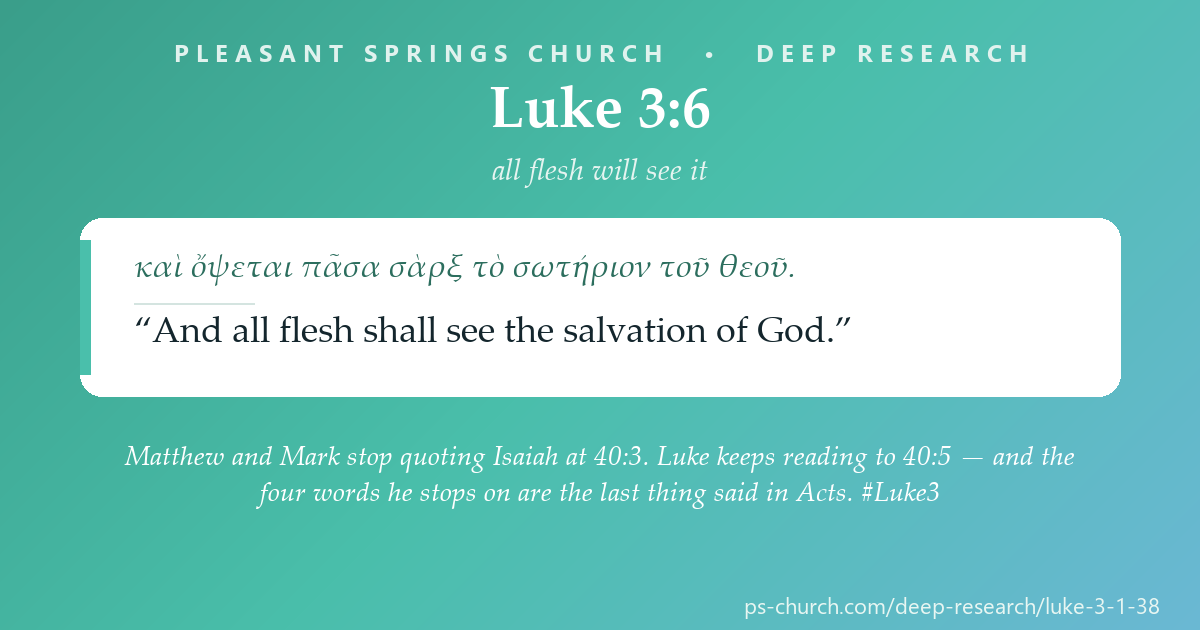
καὶ ὄψεται πᾶσα σὰρξ τὸ σωτήριον τοῦ θεοῦ.3:6“And all flesh shall see the salvation of God.”
Caption to share: Matthew and Mark stop at Isaiah 40:3. Luke keeps reading to 40:5 — and the four words he stops on are the last thing said in Acts. #Luke3
The Thread — OT · Between the Testaments · NT

Every Deep Research page traces its passage across the whole sweep — the Old Testament, the Second-Temple world between the testaments (historical witnesses, not Scripture), and the New Testament. Follow the thread:
Old TestamentIsaiah 40:3–5 · Genesis 5, 11The citation Luke carries two verses further than anyone else, and the two chapters his genealogy counts. Both are places where the Greek and the Hebrew can be shown to differ, and both differences are countable on this disk.→
Second TempleJubilees 8 · Psalms of Solomon 17The extra Cainan is not unique to one Greek manuscript tradition. Jubilees was not consulted in the original for this page. The Greek Psalms of Solomon is one of the 64 CATSS files held here and was screened like the rest — that is how 17:37 turned up under Luke 3:16. Neither book is Scripture on this shelf.
→
New TestamentLuke 3:1–38This study — 38 verses screened twice, with the tie band beside every run and the counter-examples printed.
Share this card Share card — Matthew and Mark stop quoting Isaiah at 40:3. Luke keeps reading to 40:5 — and the four words he stops on, “the salvation of God,” are the last thing said in Acts. #Luke3
Facebook X / Twitter Download

Pleasant Springs Church — Deep Research

Research method after Michael S. Heiser’s Bible Research Method (examine dictionaries → ancient literature → important words → textual connections → academic publications → share), with the Pleasant Springs “Author & Audience” foundation. Scripture set in the Hebrew, the Greek editions named on each page and the ESV (Old Testament), and the Greek New Testament and the ESV (New Testament), per the practice of Pleasant Springs Church. Luke 3 research grounded in Green (NICNT), Bock (BECNT), Bovon (Hermeneia), Nolland (WBC) and Marshall (NIGTC), with Pao & Schnabel in Beale & Carson on the Old Testament use, and Marshall D. Johnson on the genealogies. Text: Greek New Testament from the SBL edition as digitised by MorphGNT; Greek Old Testament from Rahlfs’ Septuaginta as digitised by CATSS; Hebrew from Sefaria’s Miqra according to the Masorah. No critical apparatus of any kind was consulted, and no variant was adjudicated — including the flagged Admin/Arni reading at Luke 3:33, which several editions do not have. ⚠️ VERSE NUMBERING — Luke has NO offset. The SBLGNT and the English Bibles agree that Luke 3 has 38 verses, and every reference to Luke on this page is the same number in a Greek New Testament and in an ESV. The two sources quoted here are also aligned, and one of them only looks it: Isaiah runs chapter-for-chapter in Hebrew, Greek and English (the one seam in that book, at 63/64, is nowhere near chapter 40); and Genesis 11 has 32 verses in the Masoretic text and 32 in the Greek — but the Greek packs Cainan’s entire generation into its verse 13, so the same verse number holds different amounts of text on the two sides. Equal verse counts are not equal contents. ⚠️ The measurement, in full. Greek against Greek. MorphGNT field 6, the normalised word (the column that already resolves elision and the movable nu); CATSS FORM column (cols 0–24), beta-code transliterated first. Both sides lowercased, accents and breathings dropped, final sigma folded, then filtered to Greek letters — the same filter applied to both corpora. Contiguous runs of whole word FORMS, never lemmas: two forms of the same verb do not match. Corpus: the 38 SBLGNT verses of Luke 3 against 30,637 verse units across the 64 CATSS Greek Old Testament files held here, and separately against the other 7,889 verses of the Greek New Testament. Exhaustive and deterministic; nothing was sampled, so no seed applies. Small numbers on this page use the Greek-side convention (unigram_fallback=True): a reported run of 1 means the two verses share one word and no two consecutive words. ⚠️ The runs find verbatim contact, not allusion, and on this page that gap is wide. The deepest Greek Old Testament contact for the voice at the baptism is Isaac speaking to a disguised Jacob (Genesis 27:21, 24; run 5, band 2), while Psalm 2:7, Isaiah 42:1 and Genesis 22:2 — the texts every commentator names — measure 2, 2 and 1. Both facts are printed. Neither cancels the other. ⚠️ The Cainan finding is a finding about two printed editions on this disk. Rahlfs’ Greek Genesis has him at 10:22, 10:24, 11:12 and 11:13; the Masoretic Genesis does not, and neither does Masoretic 1 Chronicles 1:18 or 1:24. Our Greek 1 Chronicles is missing 1:18–23 entirely, so the Greek side of that check could not be run at all. No manuscript, no Qumran fragment, no Samaritan Pentateuch and no apparatus was consulted. The claim is that the two editions differ by one countable link and that Luke’s list matches one of them — nothing about what Luke read. ⚠️ Direction of influence is never asserted. Nothing here says who wrote first among the Synoptics, which text of Isaiah or Genesis stood in front of Luke, whether a name was added or lost, or whether any reading is early or late. Typology is handled per the house position: what the text says, what the New Testament itself draws, and what we see from this side of the cross — with the seeing left to the reader.

Scripture quotations marked ESV are from the ESV® Bible (The Holy Bible, English Standard Version®), © 2001 by Crossway, a publishing ministry of Good News Publishers. ESV Text Edition: 2016. Used by permission. All rights reserved. The ESV text may not be quoted in any publication made available to the public by a Creative Commons license, and the ESV may not be translated in whole or in part into any other language. www.esv.org

Did this study bless you today?

💚  Give to Support PS Church

100% of gifts go to the General Fund — thank you.