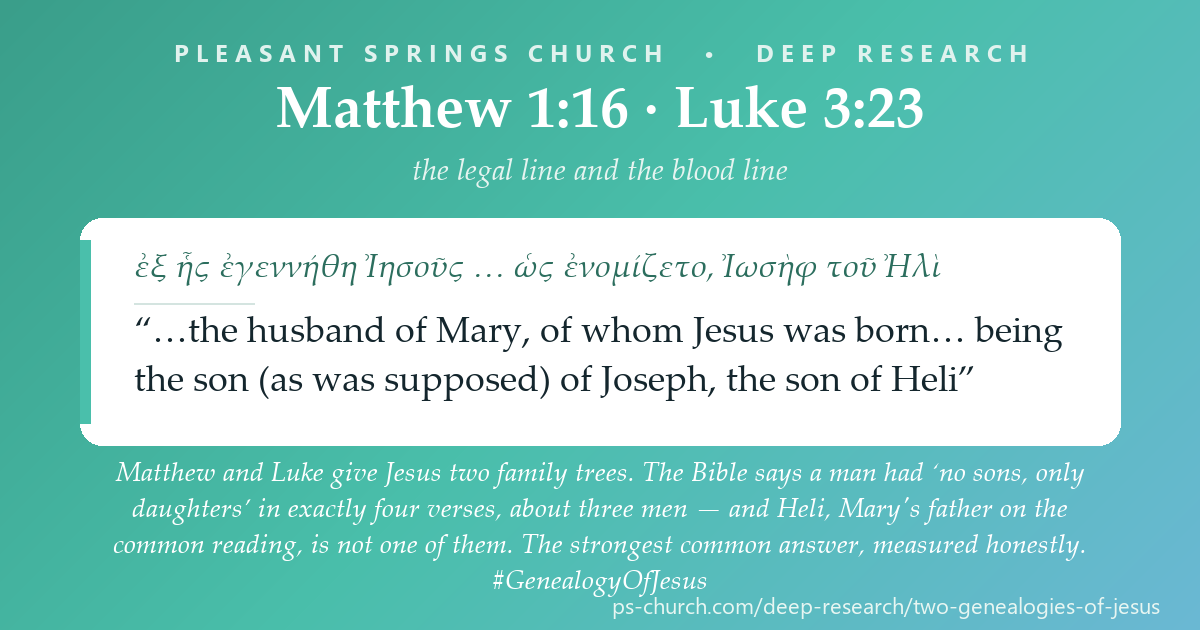
Matthew and Luke give Jesus two different family trees. They agree from Abraham to David, part at David’s sons Solomon and Nathan, cross at two men named Shealtiel and Zerubbabel, part again, and arrive at Joseph with two different fathers, Jacob and Heli. Neither Gospel calls Joseph the father of Jesus. This study draws both lines in full from the Greek, sets out the curse on Jeconiah and the law of the daughters of Zelophehad, and measures the claim the common answer rests on. The Bible has a fixed way of saying a man had “no sons, only daughters.” It uses it in four verses, about three men — and for each of the three men the Bible records whom the daughters married. Heli is not one of the three. See the method →
Which curse, and how the common answer meets it
- The curse is the sentence on King Jeconiah, also called Coniah and Jehoiachin, in Jeremiah 22:30: “none of his offspring shall succeed in sitting on the throne of David.” Matthew puts Jeconiah in Jesus’ line (Matthew 1:11–12).
- The requirement is that the Messiah descend from David by blood: “descended from David according to the flesh” (Romans 1:3; compare 2 Timothy 2:8; Acts 2:30).
- The answer most often given: Jesus is not Joseph’s offspring — he was born of Mary, a virgin (Matthew 1:16, 18–20) — so a sentence on Jeconiah’s offspring cannot reach him through Joseph. He receives Joseph’s legal title as Joseph’s adopted son, which is the line Matthew traces through Solomon. He is David’s son by blood through Mary, on the reading that Luke’s list, which runs through David’s son Nathan, is Mary’s family, entered under her husband’s name as an heiress’s husband was in Israel — the precedent being the daughters of Zelophehad (Numbers 27 and 36).
- How sure is it? It is the strongest common answer. It is not proven. Luke never names Mary in his list, no verse says her father had no sons, and the oldest Christian answer on record reads both lists as Joseph’s. The box below separates what the texts settle from what is argued.
Settled — the texts say this
- Matthew traces Jesus’ line through Solomon and the kings to Jacob, “the father of Joseph the husband of Mary” (Matthew 1:16).
- Luke traces it through Nathan, another son of David by the same mother (1 Chronicles 3:5), to “Joseph, the son of Heli” (Luke 3:23).
- Neither Gospel makes Joseph the father. Matthew stops his verb “was the father of” at Joseph and writes of Mary, “of whom Jesus was born”; Luke writes “the son (as was supposed) of Joseph.”
- Jeremiah 22:30 bars Jeconiah’s offspring from David’s throne, in the Hebrew and in the Greek.
- Matthew names Jeconiah as Jesus’ legal ancestor (1:11–12). No New Testament verse quotes Jeremiah 22:30.
- The New Testament says the Son was “descended from David according to the flesh” (Romans 1:3).
- Both lists divide at David and both pass through men named Shealtiel and Zerubbabel.
- The law of Numbers 27:8 gave a man’s inheritance to his daughter when he had no son, and Numbers 36:6–8 required such a daughter to marry within her father’s tribe.
Disputed — argued, not stated
- That Luke’s list is Mary’s line, with Heli her father and Joseph his son-in-law. The oldest surviving answer (Africanus, third century) reads both lists as Joseph’s.
- That Heli had no sons. No verse says so (Stage 4 counts every verse that uses the Bible’s fixed formula for it).
- That the Zelophehad ruling, which is about land, carries a claim to a throne.
- Whether the curse was lifted when God called Zerubbabel his signet ring (Haggai 2:23).
- Whether Luke’s Shealtiel and Zerubbabel are the same men as Matthew’s — Matthew calls Shealtiel the son of Jechoniah, Luke the son of Neri.
- Whether Luke 1:27’s “of the house of David” describes Mary or Joseph.
- Which name Matthew counts twice to make three fourteens.
Every name below is extracted from the Greek text of the two Gospels and printed in the ESV’s spelling. Matthew writes downward from Abraham; Luke writes upward from Jesus to God. To set them side by side, Luke’s list is drawn here in the same top-down direction as Matthew’s — his last name is at the top. Hover over (or tap) a name for its Greek form and verse.
The chart is wider than a phone screen — scroll sideways inside the frame.
- Matthew: “X was the father of Y” (ἐγέννησεν)
- Luke: “Y, the son of X” (τοῦ)
- a name both lists carry
- a legal tie: adoption, or son-in-law
- inferred by the heiress reading — no verse states it
- blood: born of Mary (Mt 1:16)
- Jeconiah, under the sentence of Jer 22:30
- kings Chronicles lists and Matthew does not
- grey dashes: Matthew’s line passing over the omitted kings
Matthew’s 41 names, in his order (Matthew 1:2–16)
Greek: SBLGNT, the subject of each ἐγέννησεν (nominative), then Joseph and Jesus as 1:16 prints them. The verse given is the one in which the name is that subject, which is often the verse after it first appears as an object (Solomon is first named in 1:6 but fathers in 1:7; Uzziah in 1:8, 1:9). Matthew’s list also names Zerah (1:3), four women — Tamar, Rahab, Ruth and “the wife of Uriah” — and Mary; they are not links in the chain and are not numbered.
| # | ESV | Greek, as printed | verse |
|---|---|---|---|
| 1 | Abraham | Ἀβραὰμ | 1:2 |
| 2 | Isaac | Ἰσαὰκ | 1:2 |
| 3 | Jacob | Ἰακὼβ | 1:2 |
| 4 | Judah | Ἰούδας | 1:3 |
| 5 | Perez | Φαρὲς | 1:3 |
| 6 | Hezron | Ἑσρὼμ | 1:3 |
| 7 | Ram | Ἀρὰμ | 1:4 |
| 8 | Amminadab | Ἀμιναδὰβ | 1:4 |
| 9 | Nahshon | Ναασσὼν | 1:4 |
| 10 | Salmon | Σαλμὼν | 1:5 |
| 11 | Boaz | Βόες | 1:5 |
| 12 | Obed | Ἰωβὴδ | 1:5 |
| 13 | Jesse | Ἰεσσαὶ | 1:6 |
| 14 | David | Δαυὶδ | 1:6 |
| 15 | Solomon | Σολομὼν | 1:7 |
| 16 | Rehoboam | Ῥοβοὰμ | 1:7 |
| 17 | Abijah | Ἀβιὰ | 1:7 |
| 18 | Asaph | Ἀσὰφ | 1:8 |
| 19 | Jehoshaphat | Ἰωσαφὰτ | 1:8 |
| 20 | Joram | Ἰωρὰμ | 1:8 |
| 21 | Uzziah | Ὀζίας | 1:9 |
| 22 | Jotham | Ἰωαθὰμ | 1:9 |
| 23 | Ahaz | Ἀχὰζ | 1:9 |
| 24 | Hezekiah | Ἑζεκίας | 1:10 |
| 25 | Manasseh | Μανασσῆς | 1:10 |
| 26 | Amos | Ἀμὼς | 1:10 |
| 27 | Josiah | Ἰωσίας | 1:11 |
| 28 | Jechoniah | Ἰεχονίας | 1:12 |
| 29 | Shealtiel | Σαλαθιὴλ | 1:12 |
| 30 | Zerubbabel | Ζοροβαβὲλ | 1:13 |
| 31 | Abiud | Ἀβιοὺδ | 1:13 |
| 32 | Eliakim | Ἐλιακὶμ | 1:13 |
| 33 | Azor | Ἀζὼρ | 1:14 |
| 34 | Zadok | Σαδὼκ | 1:14 |
| 35 | Achim | Ἀχὶμ | 1:14 |
| 36 | Eliud | Ἐλιοὺδ | 1:15 |
| 37 | Eleazar | Ἐλεάζαρ | 1:15 |
| 38 | Matthan | Ματθὰν | 1:15 |
| 39 | Jacob | Ἰακὼβ | 1:16 |
| 40 | Joseph | Ἰωσὴφ | 1:16 |
| 41 | Jesus | Ἰησοῦς | 1:16 |
Luke’s 77 names, in his order (Luke 3:23–38, ascending)
Greek: SBLGNT, each name as it stands after τοῦ (genitive). Luke writes upward from Jesus to God; the chart above draws the same list downward so it can stand beside Matthew’s.
| # | ESV | Greek, as printed | verse |
|---|---|---|---|
| 1 | Jesus | Ἰησοῦς | 3:23 |
| 2 | Joseph | Ἰωσὴφ | 3:23 |
| 3 | Heli | Ἠλὶ | 3:23 |
| 4 | Matthat | Μαθθὰτ | 3:24 |
| 5 | Levi | Λευὶ | 3:24 |
| 6 | Melchi | Μελχὶ | 3:24 |
| 7 | Jannai | Ἰανναὶ | 3:24 |
| 8 | Joseph | Ἰωσὴφ | 3:24 |
| 9 | Mattathias | Ματταθίου | 3:25 |
| 10 | Amos | Ἀμὼς | 3:25 |
| 11 | Nahum | Ναοὺμ | 3:25 |
| 12 | Esli | Ἑσλὶ | 3:25 |
| 13 | Naggai | Ναγγαὶ | 3:25 |
| 14 | Maath | Μάαθ | 3:26 |
| 15 | Mattathias | Ματταθίου | 3:26 |
| 16 | Semein | Σεμεῒν | 3:26 |
| 17 | Josech | Ἰωσὴχ | 3:26 |
| 18 | Joda | Ἰωδὰ | 3:26 |
| 19 | Joanan | Ἰωανὰν | 3:27 |
| 20 | Rhesa | Ῥησὰ | 3:27 |
| 21 | Zerubbabel | Ζοροβαβὲλ | 3:27 |
| 22 | Shealtiel | Σαλαθιὴλ | 3:27 |
| 23 | Neri | Νηρὶ | 3:27 |
| 24 | Melchi | Μελχὶ | 3:28 |
| 25 | Addi | Ἀδδὶ | 3:28 |
| 26 | Cosam | Κωσὰμ | 3:28 |
| 27 | Elmadam | Ἐλμαδὰμ | 3:28 |
| 28 | Er | Ἢρ | 3:28 |
| 29 | Joshua | Ἰησοῦ | 3:29 |
| 30 | Eliezer | Ἐλιέζερ | 3:29 |
| 31 | Jorim | Ἰωρὶμ | 3:29 |
| 32 | Matthat | Μαθθὰτ | 3:29 |
| 33 | Levi | Λευὶ | 3:29 |
| 34 | Simeon | Συμεὼν | 3:30 |
| 35 | Judah | Ἰούδα | 3:30 |
| 36 | Joseph | Ἰωσὴφ | 3:30 |
| 37 | Jonam | Ἰωνὰμ | 3:30 |
| 38 | Eliakim | Ἐλιακὶμ | 3:30 |
| 39 | Melea | Μελεὰ | 3:31 |
| 40 | Menna | Μεννὰ | 3:31 |
| 41 | Mattatha | Ματταθὰ | 3:31 |
| 42 | Nathan | Ναθὰμ | 3:31 |
| 43 | David | Δαυὶδ | 3:31 |
| 44 | Jesse | Ἰεσσαὶ | 3:32 |
| 45 | Obed | Ἰωβὴλ | 3:32 |
| 46 | Boaz | Βόος | 3:32 |
| 47 | Sala | Σαλὰ | 3:32 |
| 48 | Nahshon | Ναασσὼν | 3:32 |
| 49 | Amminadab | Ἀμιναδὰβ | 3:33 |
| 50 | Admin | Ἀδμὶν | 3:33 |
| 51 | Arni | Ἀρνὶ | 3:33 |
| 52 | Hezron | Ἑσρὼμ | 3:33 |
| 53 | Perez | Φαρὲς | 3:33 |
| 54 | Judah | Ἰούδα | 3:33 |
| 55 | Jacob | Ἰακὼβ | 3:34 |
| 56 | Isaac | Ἰσαὰκ | 3:34 |
| 57 | Abraham | Ἀβραὰμ | 3:34 |
| 58 | Terah | Θάρα | 3:34 |
| 59 | Nahor | Ναχὼρ | 3:34 |
| 60 | Serug | Σεροὺχ | 3:35 |
| 61 | Reu | Ῥαγαὺ | 3:35 |
| 62 | Peleg | Φάλεκ | 3:35 |
| 63 | Eber | Ἔβερ | 3:35 |
| 64 | Shelah | Σαλὰ | 3:35 |
| 65 | Cainan | Καϊνὰμ | 3:36 |
| 66 | Arphaxad | Ἀρφαξὰδ | 3:36 |
| 67 | Shem | Σὴμ | 3:36 |
| 68 | Noah | Νῶε | 3:36 |
| 69 | Lamech | Λάμεχ | 3:36 |
| 70 | Methuselah | Μαθουσαλὰ | 3:37 |
| 71 | Enoch | Ἑνὼχ | 3:37 |
| 72 | Jared | Ἰάρετ | 3:37 |
| 73 | Mahalaleel | Μαλελεὴλ | 3:37 |
| 74 | Cainan | Καϊνὰμ | 3:37 |
| 75 | Enos | Ἐνὼς | 3:38 |
| 76 | Seth | Σὴθ | 3:38 |
| 77 | Adam | Ἀδὰμ | 3:38 |
| — | God | θεοῦ | 3:38 |
The texts the question turns on
Hebrew · LXX / Greek NT · ESVVersification. For the verses printed in the codex above there is no offset: Jeremiah 22, Haggai 2, Numbers 27 and 36, 1 Chronicles 2 and Ezra 2 carry the same numbers in the Hebrew, in the Greek edition on our disk, and in the ESV, and the New Testament verses are numbered alike in Greek and English. Five verses cited lower down do differ, and we give both numbers where they appear: Numbers 26:33 (Hebrew, ESV) is Numbers 26:37 in the Greek; Nehemiah 7:63 is 2 Esdras 17:63; Psalm 132:11 is Psalm 131:11 in the Greek; Jeremiah 36:30 is Jeremiah 43:30 in the Greek; and 2 Kings 12:21 in the ESV is 12:22 in both the Hebrew and the Greek. Book names in the Greek Bible: 1–2 Samuel and 1–2 Kings are 1–4 Kingdoms, 1–2 Chronicles are 1–2 Paralipomenon, and Ezra–Nehemiah is 2 Esdras.
The Shape of the Passage
Two sequences — a counted descent and an uncounted ascent (no chiasm)Two evangelists, two purposes. Matthew is answering a question about title: by what right is this man David’s heir? Luke is answering a question about sonship: whose son is he, finally? The lists are shaped by the questions.
Matthew
The legal case. Matthew opens with the line of kings, Solomon to Jeconiah, and drives it with one verb, ἐγέννησεν, “was the father of.” It stands 39 times in Matthew 1:2–16 and only three more times in the whole Greek New Testament. Then, at Joseph, it stops. Matthew does not write that Joseph was the father of Jesus. He writes that Joseph was “the husband of Mary, ἐξ ἧς ἐγεννήθη” — “of whom Jesus was born,” with a feminine pronoun and a passive verb. The exact sequence occurs once in the New Testament.
Joseph, son of David. Matthew then has the angel address Joseph as Ἰωσὴφ υἱὸς Δαυίδ, “Joseph, son of David” (1:20), and has Joseph name the child (1:21, 25). Of the six times the phrase υἱὸς Δαυίδ appears in this form in the Greek New Testament, this is the only one said of anyone but Jesus or the Messiah. Matthew’s case is that the royal title reached Jesus through the man who took him as his own.
Luke
The human family. Luke puts his list after the baptism, not at the birth, and writes it upward — from Jesus past David and Abraham to Adam, “the son of God.” His list never uses Matthew’s verb. He sets a genitive article before each name, Ἰωσὴφ τοῦ Ἠλὶ, and qualifies the very first link: ὡς ἐνομίζετο, “as was supposed.” The form ἐνομίζετο stands once in the New Testament, here.
Mary at the centre. Luke’s birth story is told from Mary’s side: the angel comes to her (1:26–38), and it is to her that he promises “the throne of his father David” (1:32). Luke also says Joseph was “of the house and lineage of David” (2:4). Whether Luke 1:27’s “of the house of David” belongs to Joseph or to Mary is one of the disputed points; the Greek order, ἀνδρὶ ᾧ ὄνομα Ἰωσὴφ ἐξ οἴκου Δαυίδ, sets the phrase directly after Joseph’s name.
Orient on the genealogies, the curse, and the law of inheritance.
Search by topic: genealogy of Jesus; Jeconiah (Jehoiachin, Coniah); Zelophehad, daughters of; inheritance; levirate marriage; heiress; Shealtiel; Zerubbabel; Heli; Nathan son of David; Cainan.
Which articles are relevant?
- Dictionary of the Old Testament: Pentateuch (IVP, 2003) — R. G. Branch, “Zelophehad, Daughters Of,” 912–14. Branch reads the sisters’ petition (Numbers 27:1–11) as a formal legal argument about the patrimony of a father with no son — stressing that Zelophehad had no part in Korah’s rebellion, so that only the daughters’ sex stood between them and the inheritance — and notes that Moses took the case to the Lord, whose ruling set an order of succession: daughter, brothers, father’s brothers, nearest clansman. Numbers 36 then requires the heiresses to marry within their father’s tribal clan so the land does not pass between tribes, and Joshua 17:3–6 records the allotment within Manasseh. Branch also notes that later Jewish tradition praised the daughters’ wisdom, and that Rabbi Akiba identified Zelophehad with the Sabbath wood-gatherer of Numbers 15:32 (b. Shabbat 96b). Branch’s entry does not connect the case to Mary or to Jesus’ genealogies; that application belongs to later Christian interpretation, from Eusebius (Stage 2) onward.
- Dictionary of Jesus and the Gospels — “Genealogy”; “Birth of Jesus”; “Son of David.”
- Anchor Bible Dictionary — “Genealogy (NT)”; “Jehoiachin”; “Shealtiel”; “Zerubbabel”; “Inheritance (OT)”; “Levirate Marriage.”
- Smith’s Bible Dictionary — Hervey, “Genealogy of Jesus”: named by the nineteenth-century translator of Eusebius as the able advocate of the view that Matthew gives the royal line of legal successors and Luke the line of actual descent, both Joseph’s (Stage 2).
- Hebrew and Greek lexica — עֲרִירִי (“childless”), חוֹתָם (“signet”), ἐνομίζετο (“it was supposed”), σπέρματος (“seed”).
What is the problem, stated in one paragraph?
Three facts have to be held together. First, the Messiah must be David’s descendant by blood: Paul calls Jesus God’s Son, “descended from David according to the flesh” (Romans 1:3), and Peter says God swore to David “that he would set one of his descendants on his throne” (Acts 2:30; the Greek is ἐκ καρποῦ τῆς ὀσφύος αὐτοῦ, “from the fruit of his loins”). Second, Jesus has no human father: Matthew and Luke both say so (Matthew 1:18–25; Luke 1:34–35). Third, the royal line Matthew traces through Joseph runs through Jeconiah, of whom Jeremiah said “none of his offspring shall succeed in sitting on the throne of David and ruling again in Judah” (22:30). So if Jesus were Joseph’s son by blood he would be under the sentence; and because he is not, his blood descent from David has to come some other way. Luke’s list is the usual place it is looked for.
What the earliest Christian writers said, and the laws they reasoned from.
Read the ancient sources in their own words. Quotations below are from the public-domain translations on our disk: Ante-Nicene Fathers (Roberts & Donaldson) and Nicene and Post-Nicene Fathers, Series 2, vol. 1 (Eusebius, tr. A. C. McGiffert, 1890).
What is the oldest surviving answer?
Julius Africanus, writing in the early third century to one Aristides, is quoted at length by Eusebius (Church History 1.7). He does not take Luke’s list as Mary’s. He holds that both lists are Joseph’s, because Israel reckoned descent two ways:
…the names of the generations were reckoned in Israel either according to nature or according to law;—according to nature by the succession of legitimate offspring, and according to law whenever another raised up a child to the name of a brother dying childless…Africanus, in Eusebius, Church History 1.7.2 (NPNF² 1)
His solution is a levirate marriage one generation up. Matthan (of Solomon’s line) and Melchi (of Nathan’s) married the same woman in turn; Jacob and Heli were therefore half-brothers; Heli died childless; Jacob married his widow and fathered Joseph for him:
Eli having died childless, Jacob raised up seed to him, begetting Joseph, his own son by nature, but by law the son of Eli. Thus Joseph was the son of both.Africanus, in Eusebius, Church History 1.7.16
Two cautions come with the source itself. Africanus says plainly that his solution is not documented: “although we can urge no testimony in its support, we have nothing better or truer to offer” (1.7.15). And he calls Melchi Heli’s father, where our Luke has Matthat and Levi between them; McGiffert’s note judges it “highly probable that the text which Africanus followed omitted the two names Matthat and Levi.”
Where does Zelophehad enter the ancient discussion?
In Eusebius himself, immediately after he finishes quoting Africanus. Having traced Joseph’s lineage, he infers Mary’s tribe from the law of the heiresses:
And the lineage of Joseph being thus traced, Mary also is virtually shown to be of the same tribe with him, since, according to the law of Moses, intermarriages between different tribes were not permitted.Eusebius, Church History 1.7.17 — the translator’s note identifies the law as Numbers 36:6, 7
So the Zelophehad law enters the conversation early — but used to place Mary in Judah, not to make Luke’s list hers. McGiffert’s note on the passage states the history of the two readings directly: Africanus “holds that both genealogies are those of Joseph, and this was the unanimous opinion of antiquity”; and “another opinion which has prevailed widely since the Reformation is that Luke gives the genealogy of Mary.”
Did the early church say Mary was of David?
Yes, several writers say so, without saying how they knew. Ignatius: Jesus “was … conceived in the womb by Mary, of the seed of David, but by the Holy Ghost” (To the Ephesians 18, shorter recension). Justin: “born of a virgin, of the family of Abraham and tribe of Judah, and of David” (Dialogue with Trypho 43). Irenaeus: Jesus Christ “was of the seed of David according to His birth from Mary” (Against Heresies 3.16.3). The second-century Protevangelium of James names Mary’s father — not Heli but Joachim (“In the records of the twelve tribes of Israel was Joachim,” ch. 1) — and says the priest “remembered the child Mary, that she was of the family of David” (ch. 10). That book is not Scripture and its history is doubtful; it is quoted here because a page that names Mary’s father as Heli should say that the oldest text to name him gives another name.
Was the heiress law still alive between the Testaments?
Yes. The book of Tobit, a Jewish story from the centuries between the Testaments (not Scripture), turns on it. Sarah is her father’s only child — one Greek text says he has “υἱὸς ἄρσην οὐδὲ θυγάτηρ ὑπάρχει αὐτῷ πλὴν Σαρρας μόνης” — no male son and no daughter, but Sarah alone (6:12) — and the angel tells Tobias that her inheritance falls to him as her nearest kinsman, so that her father may not give her to another man “κατὰ τὸν νόμον Μωυσῆ”, according to the law of Moses (6:13). In the King James Apocrypha (whose verse numbers run one behind the Greek here):
And the maid is fair and wise: now therefore hear me, and I will speak to her father; and when we return from Rages we will celebrate the marriage: for I know that Raguel cannot marry her to another according to the law of Moses, but he shall be guilty of death, because the right of inheritance doth rather appertain to thee than to any other.Tobit 6:12 KJV (Greek 6:13)
So in a Jewish book written before the Gospels, the law of the heiresses is a living law: an only daughter’s inheritance goes with her to a husband from her father’s kin. Tobit goes beyond Numbers — it gives the nearest kinsman a claim the father cannot refuse. It says nothing about genealogies or thrones, and nothing about how the husband was afterwards named; it shows the law was known and kept, no more.
What was the law behind each answer?
Levirate marriage (behind Africanus): when a man died with no son, his brother married the widow, and “the first son whom she bears shall succeed to the name of his dead brother, that his name may not be blotted out of Israel” (Deuteronomy 25:6). The Greek of 25:5 states the condition more broadly: where the Hebrew says the man “has no son” (וּבֵן אֵין־לוֹ), the Greek says he has no seed, σπέρμα δὲ μὴ ᾖ αὐτῷ.
Daughters as heirs (behind the heiress reading): “If a man dies and has no son, then you shall transfer his inheritance to his daughter” (Numbers 27:8), on condition that “they shall marry within the clan of the tribe of their father” (36:6). Both laws exist to keep a dead man’s name and land in Israel; the sisters’ own plea was “Why should the name of our father be taken away from his clan because he had no son?” (27:4). Neither law, as written, mentions a throne.
Six words and phrases carry the argument. Each was counted in the corpora on our disk.
Counts are exhaustive over the corpora held here: 23,204 verses of the Hebrew Bible (Masoretic), 30,348 verse units of the Greek Old Testament screened (63 CATSS files; the Odes appendix, held, is not screened; not the whole Septuagint), and 7,927 verses of the Greek New Testament (SBLGNT). Each count is a count of the exact form or sequence named.
“As was supposed.” This form stands once in the Greek New Testament. On every reading it denies that Joseph was Jesus’ father by nature. Whether it reaches past Joseph to “of Heli” is disputed; the nineteenth-century debate over Africanus turned on exactly this.
“Of whom (she) … was born.” After 39 active “was the father of,” a passive verb with a feminine pronoun. The three-word sequence occurs once in the New Testament.
“From the seed of David.” Twice in the New Testament (Romans 1:3; 2 Timothy 2:8); with the article, ἐκ τοῦ σπέρματος Δαυίδ, once more (John 7:42). The requirement is stated in the vocabulary of the curse: Jeremiah 22:30 in Greek bars anyone ἐκ τοῦ σπέρματος αὐτοῦ, “from his seed.”
“Childless.” Four times in the Hebrew Bible: of Abram before Isaac (Genesis 15:2), as a penalty (Leviticus 20:20, 21), and of Jeconiah. Yet 1 Chronicles 3:17–18 lists his sons. Jeremiah explains his own word in the next line: none of his offspring “shall succeed.” Where the Hebrew has this word, the Greek has ἐκκήρυκτον (once in the Greek Old Testament).
“Like a signet.” The consonants of חוֹתָם stand alone in nine verses: six times the noun “signet” (Exodus 28:21; 39:6, 30; Jeremiah 22:24; Job 38:14; 41:7), once in Ezekiel 28:12, and twice the personal name Hotham (1 Chronicles 7:32; 11:44); the shorter spelling without the vowel letter adds Exodus 28:11, 36 and 39:14. With “like” the word stands three times: Haggai 2:23 and twice in Song of Songs 8:6. In Greek the two verses do not share the word: Jeremiah has ἀποσφράγισμα (twice in the Greek Old Testament: Jeremiah 22:24, Ezekiel 28:12), Haggai σφραγῖδα.
“Sons, but only daughters.” The Bible’s formula for a man whose heirs are daughters. Exhaustively: four verses in Hebrew and the same four in Greek (υἱοί ἀλλ' ἢ θυγατέρες), about three men. Heli is not one of them. Stage 4 prints all four.
The two lists against each other, against Chronicles and Kings, and against the law of the heiresses.
Every comparison below was made on the texts themselves: names extracted from the Greek of Matthew and Luke, set against the Hebrew and the Greek of Genesis, Ruth, 1–2 Kings and 1 Chronicles. Runs are counts of consecutive identical Greek words; the tie band beside each run is how many verses share that depth. A run measures verbatim contact, not allusion, and says nothing about who borrowed from whom.
Where do the two lists agree, and where do they part?
They agree from Abraham to David except at one place, and they agree again at two names after the exile. Everything else differs.
| Matthew 1:1–17 | Luke 3:23–38 | |
|---|---|---|
| Direction | Down: Abraham → Jesus | Up: Jesus → Adam → God |
| Link word | ἐγέννησεν × 39 | τοῦ × 76 |
| Names in the chain | 41 (Abraham to Jesus) | 77 (Jesus to Adam), then God |
| Before Abraham | — | 20 names, Terah to Adam |
| Abraham to David | 14 names, with Ram | 15 names, with Admin and Arni where Matthew has Ram |
| Son of David | Solomon (1:6) | Nathan (3:31) |
| David to Shealtiel | 14 names, Solomon to Jechoniah (the kings) | 20 names, Nathan to Neri (no kings) |
| Shealtiel’s father | Jechoniah (1:12) | Neri (3:27) |
| Zerubbabel to Joseph | 9 names: Abiud … Matthan, Jacob | 18 names: Rhesa … Matthat, Heli |
| Joseph’s father | Jacob (1:16) | Heli (3:23) |
| Women named | Tamar, Rahab, Ruth, “the wife of Uriah,” Mary | none |
| Joseph and Jesus | “the husband of Mary, of whom Jesus was born” | “the son (as was supposed) of Joseph” |
Matthew’s Ram against Luke’s Admin and Arni is at least partly a matter of text: the Greek edition used here marks a variant at Luke 3:33, and the King James Version, following a different Greek text, reads “Aram” in Luke as in Matthew. Matthew’s “Salmon” and Luke’s “Sala” are one man spelled two ways.
What does Matthew leave out? (checked against Chronicles and Kings)
Matthew says he is counting in fourteens (1:17), and a count of fourteen across four centuries of kings is a selection. Measured against 1 Chronicles 3 in both Hebrew and Greek, his second panel omits four kings: three between Joram and Uzziah, and Jehoiakim between Josiah and Jechoniah. 2 Kings confirms each succession.
| Matthew | 1 Chronicles 3 (Hebrew) | 1 Chronicles 3 (Greek) | Also in Kings |
|---|---|---|---|
| Joram (1:8) | 3:11 יוֹרָם | Ιωραμ | — |
| — not listed — | 3:11 Ahaziah אֲחַזְיָהוּ | Οχοζια | 2 Kgs 8:24 |
| — not listed — | 3:11 Joash יוֹאָשׁ | Ιωας | 2 Kgs 11:2 |
| — not listed — | 3:12 Amaziah אֲמַצְיָהוּ | Αμασιας | 2 Kgs 12:21 (Heb./Gk 12:22) |
| Uzziah (1:8) Ὀζίας | 3:12 Azariah עֲזַרְיָה | Αζαρια | 2 Kgs 14:21; 15:1 |
| Josiah (1:10–11) | 3:14–15 | Ιωσια | — |
| — not listed — | 3:15–16 Jehoiakim יְהוֹיָקִים | Ιωακιμ | 2 Kgs 23:34; 24:6 |
| Jechoniah (1:11–12) | 3:16 יְכׇנְיָה | Ιεχονιας | 2 Kgs 24:6, 8 (Jehoiachin) |
Two notes on the table. Matthew’s Uzziah (Ὀζίας) is the king Chronicles here calls Azariah; the Greek Chronicles uses the name Matthew uses in 2 Chronicles 26. And Matthew’s “Josiah the father of Jechoniah and his brothers” (1:11) passes over Jehoiakim, the king of whom Jeremiah said “He shall have none to sit on the throne of David” (Jeremiah 36:30; Greek 43:30). Why Matthew left out these four, the text does not say, and we do not guess.
The daughters of Zelophehad: what does the law actually say?
Five sisters — Mahlah, Noah, Hoglah, Milcah and Tirzah — came to Moses because their father died with no son (Numbers 27:1–4). The ruling became a statute for Israel: “If a man dies and has no son, then you shall transfer his inheritance to his daughter” (27:8). When the clan heads objected that the land would leave the tribe if the sisters married out (36:1–4), a second ruling followed: “only they shall marry within the clan of the tribe of their father” (36:6), and “every daughter who possesses an inheritance in any tribe … shall be wife to one of the clan of the tribe of her father” (36:8). They did: they “were married to sons of their father’s brothers” (36:11), and under Joshua “he gave them an inheritance among the brothers of their father” (Joshua 17:4).
How the heiress reading uses this. If Mary had no brothers, she was her father’s heir; she married within Judah, as Numbers 36 required; and her husband was entered in her father’s line. On that reading Luke’s “Joseph, the son of Heli” means Heli’s son-in-law, and the line from Heli up through Nathan to David is Mary’s — Jesus’ blood line. The next two questions test the two things the reading needs: that the Bible marks such heiresses, and that it counts an heiress’s husband in her father’s house.
“No sons, only daughters” — every place the Bible says it
The Hebrew Bible has a fixed phrase for a man whose heirs are daughters: בָּנִים כִּי אִם־בָּנוֹת, “sons, but only daughters.” Searched exhaustively, it occurs in four verses. The Greek Old Testament renders it υἱοί ἀλλ' ἢ θυγατέρες, and that phrase occurs in the same four verses and nowhere else. They concern three men:
| Verse | The man | What the text records next |
|---|---|---|
| Numbers 26:33 (Greek 26:37) | Zelophehad | His five daughters named; in 27:1–11 they win the inheritance. |
| Joshua 17:3 | Zelophehad | “He gave them an inheritance among the brothers of their father” (17:4). |
| 1 Chronicles 2:34 | Sheshan, of Judah (yet 1 Chr 2:31 names a son, Ahlai, in Hebrew and Greek) | “So Sheshan gave his daughter in marriage to Jarha his slave, and she bore him Attai” (2:35) — and Sheshan’s line runs on through her son. |
| 1 Chronicles 23:22 | Eleazar, a Levite | “Their kinsmen, the sons of Kish, married them.” |
| — | Heli | No verse. Luke 3:23 names him once; nothing else in either Testament mentions him. |
This is the strongest finding on the page, and it cuts both ways. It shows that Scripture does mark a man whose line passes through daughters, and every time it does, it goes on to say whom the daughters married. Sheshan is the nearest parallel to the heiress reading: a man of Judah said to have no son (though 2:31 names one, Ahlai; the text does not reconcile the two), whose daughter married and whose genealogy then continues through her child. But it also shows that Scripture never says this of Heli. The heiress reading needs Heli to have had no son; the Bible had a way of saying so, used it four times, and did not use it of him.
Was a husband ever counted in his wife’s father’s house?
Yes, and the clearest case is word for word in two books. Among the priests who returned from Babylon were “the sons of Barzillai (who had taken a wife from the daughters of Barzillai the Gileadite, and was called by their name)” (Ezra 2:61; again in Nehemiah 7:63). The Hebrew phrase וַיִּקָּרֵא עַל־שְׁמָם, “and was called by their name,” occurs in exactly those two verses. The Greek of Ezra 2:61 reads ἐκλήθη ἐπὶ τῷ ὀνόματι αὐτῶν.
The same chapter also records what happened next, and the page has to print it: “These sought their registration among those enrolled in the genealogies, but they were not found there, and so they were excluded from the priesthood as unclean” (Ezra 2:62). A man could carry his father-in-law’s name; it did not by itself secure the office.
Sheshan’s case is the other. His daughter’s son Attai (1 Chronicles 2:35) stands in Sheshan’s own genealogy in the tribe of Judah, and the list runs on through Attai’s descendants. One more passage bears on the tribes of Mary and Elizabeth. Luke calls Elizabeth, “from the daughters of Aaron” (1:5), Mary’s “relative” (συγγενίς, the only time the word occurs in the New Testament). Some take that as evidence that Mary was a Levite. But the first daughters of Aaron had a mother from Judah: “Aaron took as his wife Elisheba, the daughter of Amminadab and the sister of Nahshon” (Exodus 6:23) — two names that stand in both genealogies of Jesus. In the Greek of Exodus she is Ελισαβεθ. Kinship between the tribes was possible from the beginning; the verse settles nothing about Mary’s tribe either way.
Shealtiel and Zerubbabel: are they the same men in both lists?
Both Gospels write the pair in the same order: Matthew, “Jechoniah was the father of Shealtiel, and Shealtiel the father of Zerubbabel” (Ἰεχονίας ἐγέννησεν τὸν Σαλαθιήλ, 1:12); Luke, “the son of Zerubbabel, the son of Shealtiel, the son of Neri” (Ζοροβαβὲλ τοῦ Σαλαθιὴλ τοῦ Νηρὶ, 3:27). The question is whether they are the same two men.
For the same men. In the Hebrew Bible there is only one Shealtiel and one Zerubbabel. Shealtiel occurs in ten verses; Zerubbabel in twenty-one; and every verse that names Zerubbabel’s father names Shealtiel — nine verses, from Haggai 1:1 to Nehemiah 12:1 — except one. Two different father-and-son pairs with these exact names, both in David’s line, both around the exile, would be a remarkable coincidence.
For different men. Neither Gospel continues with any son of Zerubbabel that Chronicles lists. 1 Chronicles 3:19–20 gives his children as Meshullam, Hananiah, Shelomith, Hashubah, Ohel, Berechiah, Hasadiah and Jushab-hesed; Matthew’s Abiud and Luke’s Rhesa are in neither the Hebrew nor the Greek of that list. Ῥησὰ occurs nowhere else in the New Testament or the Greek Old Testament; Ἀβιοὺδ occurs in the Greek Old Testament only for Aaron’s son Abihu and, once, a Benjamite, Abihud son of Bela (1 Chronicles 8:3) — never in David’s line. And Luke’s Shealtiel has a different father: Neri, not Jechoniah.
The one exception is the most interesting verse on the page. 1 Chronicles 3:19 in Hebrew reads “the sons of Pedaiah: Zerubbabel and Shimei” — Pedaiah being Shealtiel’s brother (3:18). The Greek of the same verse reads υἱοὶ Σαλαθιηλ Ζοροβαβελ καὶ Σεμεϊ, “the sons of Salathiel: Zorobabel and Semei.” So at the very point where the two Gospel lists cross, the Hebrew Bible itself gives one man two fathers. A legal father and a natural father — by levirate or adoption — is one explanation offered; we cannot test it from the text. Whatever happened at Zerubbabel’s birth, the Scriptures already name two fathers for one son, at this exact link.
Why the heiress reading needs an answer here. If Luke’s Shealtiel is Matthew’s, and if he was Jechoniah’s son by blood, then Luke’s line — and on the heiress reading, Mary’s — also runs through Jechoniah’s blood, and the curse is not avoided by moving to Luke. The reading therefore needs one of two things: that Luke’s pair are different men, or that Shealtiel was Neri’s son by nature and Jechoniah’s by law. 1 Chronicles 3:17 calls Shealtiel Jechoniah’s son; Luke calls him Neri’s. The texts do not decide between those, and this page does not either.
The signet ring: was the curse lifted?
Jeremiah 22:24: “though Coniah the son of Jehoiakim, king of Judah, were the signet ring on my right hand, yet I would tear you off.” Haggai 2:23, to Zerubbabel, the man Matthew names as Jeconiah’s grandson: “I will take you, O Zerubbabel my servant, the son of Shealtiel … and make you like a signet ring, for I have chosen you.” In Hebrew the two verses share the noun חוֹתָם, which with “like” stands only in Haggai 2:23 and Song of Songs 8:6. Many readers take Haggai as a deliberate reversal of Jeremiah: what was torn from the grandfather is given back to the grandson.
Three cautions. The link is verbatim in Hebrew only; the Greek uses two different words. Haggai does not mention Jeconiah or the curse. And Zerubbabel never sat on David’s throne; Haggai calls him “governor of Judah” (1:1). If the curse was lifted, the virgin birth is not needed to avoid it and Matthew’s line could stand by itself; if it was not, the virgin birth is how Jesus avoids it. Either way, Jesus’ claim stands; the two answers give different reasons for it.
Hebrew and Greek: where the texts behind the lists differ
We print the Hebrew and the Greek side by side, so we must say where they part. These are the differences the two genealogies touch.
- The second Cainan (Luke 3:36). Luke has a Cainan between Arphaxad and Shelah. The Greek Genesis has him: ἐγέννησεν τὸν Καιναν (11:12), with his own years in 11:13, and again in 10:24 and in the list of Shem’s sons at 10:22. The Hebrew does not: “When Arpachshad had lived 35 years, he fathered Shelah” (Genesis 11:12; also 10:24 and 1 Chronicles 1:18, 24). The Greek of 1 Chronicles on our disk has no verses 1:18–23 at all, and its 1:24 is the single word Σαλα, so it cannot be checked there. The first Cainan (3:37, Genesis 5:9–14) is in both texts.
- Zerubbabel’s father (1 Chronicles 3:19). Hebrew: Pedaiah. Greek: Shealtiel. See above.
- Jeconiah “the captive” (1 Chronicles 3:17). The Hebrew יְכׇנְיָה אַסִּר is “Jeconiah, the captive”; the Greek on our disk prints the second word as part of the name, Ιεχονια-ασιρ.
- Jeremiah 22:30. Hebrew “childless”; Greek “proclaimed out,” and no clause for “a man who shall not succeed in his days.” See the codex note.
- Coniah or Jechonias (Jeremiah 22:24, 28). The Hebrew uses the short form, Coniah; the Greek uses Ιεχονιας, the form Matthew uses.
- Jehoiachin’s name in 2 Kings 24:6. Hebrew: “Jehoiakim slept with his fathers, and Jehoiachin his son reigned in his place.” The Greek on our disk gives father and son the same name: ἐβασίλευσεν Ιωακιμ υἱὸς αὐτοῦ.
- The promise to David (1 Chronicles 17:11). 2 Samuel 7:12 says the heir “shall come from your body” in both languages. The parallel in Chronicles says “one of your own sons” in Hebrew (מִבָּנֶיךָ) but ἐκ τῆς κοιλίας σου, “from your belly,” in Greek. The bodily-descent wording is in both of the Greek texts and one of the Hebrew.
- Levirate law (Deuteronomy 25:5). Hebrew “has no son”; Greek “has no seed.”
- Sheshan’s servant (1 Chronicles 2:35). Hebrew Jarha; Greek Ιωχηλ.
- Joshua 17. The Greek of 17:3–6 on our disk comes from the Vaticanus-type text (CATSS Joshua B); the Alexandrinus-type file holds no rows for chapter 17. Its 17:5 differs from the Hebrew — there is no “ten portions.”
The spellings of the names also differ, and the pattern is worth seeing. Matthew’s Ram and Salmon are spelled as the Greek of 1 Chronicles 2 spells them, not as the Greek of Ruth 4 does; his Boaz and Obed match neither.
| Person | Matthew | Luke | Greek Old Testament | Hebrew |
|---|---|---|---|---|
| Ram | Ἀρὰμ | Ἀρνὶ, Ἀδμὶν (Arni, Admin) | Αραμ (1 Chr 2:10); Αρραν (Ruth 4:19) | רָם |
| Salmon | Σαλμὼν | Σαλὰ | Σαλμων (1 Chr 2:11); Σαλμαν (Ruth 4:20) | שַׂלְמָה (Ruth 4:20); וְשַׂלְמוֹן (4:21) |
| Boaz | Βόες | Βόος | Βοος | בֹּעַז |
| Obed | Ἰωβὴδ | Ἰωβὴλ | Ωβηδ | וְעֹבֵד |
| Asa | Ἀσὰφ (Asaph) | — | Ασα (1 Chr 3:10) | אָסָא |
| Amon | Ἀμὼς (Amos) | — | Αμων (1 Chr 3:14) | אָמוֹן |
| Nathan | — | Ναθὰμ | Ναθαν (1 Chr 3:5) | וְנָתָן |
| Jared | — | Ἰάρετ | Ιαρεδ (Gen 5:15) | יָרֶד |
| Cainan (2nd) | — | Καϊνὰμ | Καιναν (Gen 10:24; 11:12–13) | absent: Genesis 11:12 אֶת־שָׁלַח |
Luke’s Ἰωβὴλ (Obed, 3:32) is the SBLGNT form. Even the Hebrew of Ruth spells Salmon two ways, שַׂלְמָה in 4:20 and וְשַׂלְמוֹן in 4:21. Matthew’s “Asaph” and “Amos” are the readings of the Greek text used here (and of the ESV); many manuscripts, and the King James Version, have Asa and Amon, the kings’ names.
Runs and tie bands — including the counter-examples
We screened the relevant Greek Old Testament chapters against the whole Greek New Testament. The genealogies make very little verbatim contact with the Old Testament lists they draw on, because the spellings differ and the grammar differs (“X his son” against “X was the father of Y”). And the verses the curse question turns on make no contact that is a citation; the one marked allusion in the table is Psalm 131:11 at Acts 2:30, which Peter himself announces.
| Greek Old Testament verse | Deepest New Testament contact | Run | Tie band | What it is |
|---|---|---|---|---|
| 1 Chronicles 2:4 | Matthew 1:3, τὸν Φαρὲς καὶ τὸν Ζάρα | 5 | 1 | The deepest contact any Old Testament genealogy makes with either list. Names plus articles. |
| 1 Chronicles 2:10, 11, 12 | Matthew 1:4, 1:4, 1:5 | 3 | 1 | “was the father of” + a name, where the two spell the name alike. |
| Ruth 4:19 | Matthew 1:2–16 (all fifteen verses) | 3 | 15 | The verb formula only. Greek Ruth spells Ram and Salmon differently from Matthew, so the names break the run. |
| 1 Chronicles 3 (the kings) | — | 2 | — | Nothing reaches three. Chronicles writes “X his son”; Matthew writes “X was the father of Y.” |
| Jeremiah 22:30 (the curse) | Acts 23:27 and 10 others | 3 | 11 | The verse’s deepest contact is τὸν ἄνδρα τοῦτον, “this man.” John 7:42 ties at the same depth on the words “from the seed” (next row); none is a citation of the curse. |
| Jeremiah 22:30 | Romans 1:3 | 1 | (pair) | No two consecutive words in common: Paul writes ἐκ σπέρματος, Jeremiah ἐκ τοῦ σπέρματος. The verses share the words for “from,” “seed” and “David,” but Paul’s phrase is not the curse’s phrase. |
| Jeremiah 22:30 | John 7:42 | 3 | (pair) — 21 on the Old Testament side | ἐκ τοῦ σπέρματος: the same three words stand in 21 Greek Old Testament verses. A formula. |
| Jeremiah 22:24 (the signet) | Romans 14:11 | 4 | 1 | ζῶ ἐγώ λέγει κύριος, “As I live, says the Lord” — an oath formula that stands in 17 verses of the Greek Old Testament. Not the signet. |
| Haggai 2:23 | Matthew 13:1 and 3 others | 4 | 4 | ἐν τῇ ἡμέρᾳ ἐκείνῃ (ESV Haggai “On that day”; ESV Matthew 13:1 “That same day”) — a formula. No New Testament verse touches the signet. |
| Numbers 27:8; 36:6, 7, 8 (the heiress law) | Acts 7:37; Revelation 21:12; others | 3 | 1–3 | Stock phrases such as “to the sons of Israel.” The law of the daughters of Zelophehad makes no verbatim contact with the New Testament. |
| 1 Chronicles 2:34 (Sheshan) | — | 2 | 251 | “and not” — nothing. |
| Psalm 131:11 (Hebrew 132:11) | Acts 2:30, Luke 1:42 and 14 others | 3 | 16 | One of the sixteen is the tie the New Testament itself marks: Acts 2:30 shares ἐκ καρποῦ τῆς and ἐπὶ τὸν θρόνον, and Peter introduces it as the oath God swore to David — an allusion the text announces, carried by only three words. The tie with Luke 1:42, τῆς κοιλίας σου (“of your womb,” said to David in the Psalm and to Mary by Elizabeth), is no deeper, and the Greek Old Testament uses that phrase in eleven verses. Most of the rest share only words like καὶ οὐ μὴ, “and not.” |
The rows from Jeremiah 22:30 down are printed as counter-examples, the last one included: its real allusion (Acts 2:30) measures no deeper than its accidental ties. “From the seed,” “as I live” and “of your womb” are tempting links between the Davidic promise, the curse and Mary, and in each case the shared words are common Greek phrases. They show what the texts have in common; except where a New Testament writer says he is citing (as Peter does at Acts 2:30), they do not show that one writer was quoting another.
Where the common answer is strong, where it is weak, and what we could not check.
Stage 5 is where a page says what it could not settle. Read this section before quoting the conclusion.
Where is the heiress reading weakest?
- No verse says Heli had no sons. The Bible’s formula for an heiress’s father occurs in four verses about three men, and Heli is not among them (Stage 4).
- Luke does not name Mary in the list. Grammatically, “of Heli” is attached to Joseph. Reading it as “son-in-law” is an inference from Israel’s customs, not something Luke says.
- “As was supposed” is not clearly about Heli. On its face it denies that Jesus was Joseph’s son. Whether it also reaches the next link was argued in the nineteenth century from both sides (see McGiffert’s notes to Eusebius 1.7) and has not been settled.
- Numbers 27 and 36 concern land, not a throne. The ruling transfers a נַחֲלָתוֹ (inheritance) and keeps it within a tribe. In Kings and Chronicles the throne of Judah passes to a son, a brother or an uncle; no verse applies the daughters’ law to the crown.
- A name taken through a wife did not settle a claim. The sons of Barzillai bore their father-in-law’s name and were still excluded from the priesthood when their registration could not be found (Ezra 2:62).
- It is not the ancient reading. The oldest surviving answer (Africanus) reads both lists as Joseph’s, and the 1890 translator of Eusebius calls that “the unanimous opinion of antiquity.” The Mary-line reading is, in his words, the one that “has prevailed widely since the Reformation.”
- The oldest text to name Mary’s father calls him Joachim, not Heli (the Protevangelium of James). It is not Scripture and not a reliable source, but it is older than any statement we have that her father was Heli.
- The crossing at Shealtiel is unresolved. If Luke’s Shealtiel is Jechoniah’s son by blood, Luke’s line does not avoid Jechoniah’s blood (Stage 4).
- Matthew’s case rests on legal fatherhood. Matthew shows Joseph taking Mary as his wife and naming the child (1:24–25). That this naming made Jesus Joseph’s heir in law is a reasonable inference; Matthew does not explain the law.
- The curse may have been lifted. If Haggai 2:23 reverses Jeremiah 22:24–30, the problem the heiress reading solves did not exist after Zerubbabel. That reading has its own difficulty (Zerubbabel was never king), but it is held.
What still stands, whichever reading is right?
The virgin birth is stated by both Gospels, and on any reading it keeps Jesus out of Jeconiah’s blood through Joseph. The legal title through Joseph is Matthew’s explicit case. The Davidic descent of Mary is affirmed by Ignatius, Justin and Irenaeus in the second century, although none of them says it rests on Luke’s list. What is uncertain is the route — whether Luke’s list is Mary’s family or a second line of Joseph’s — not whether the New Testament claims Jesus is David’s son by blood and David’s heir by law. It claims both.
What this page did not check
- The dictionaries named in Stage 1 were not read for this page, with one exception: Branch’s article on the daughters of Zelophehad, summarised in Stage 1. They are listed as the place a reader should start, not as sources of anything stated here.
- Branch’s article on the daughters of Zelophehad is summarised in Stage 1 from the article itself. Its subject is the law and its Jewish reception; it says nothing about Mary or the genealogies of Jesus, so nothing this page says about that application rests on Branch. The page’s statements about Numbers 26, 27 and 36 and Joshua 17 are drawn from the texts themselves.
- Rabbinic inheritance law was not consulted. Whether later Jewish law reckoned a family through a daughter at all bears directly on the heiress reading. Mishnah and Talmud are not on our disk.
- The manuscripts of Luke 3:23–38 and Matthew 1:2–16 were not examined. The edition used marks variant points in Luke at 3:23 (twice — one of them around υἱός, ὡς ἐνομίζετο, the very phrase the heiress argument reads), 3:26, 3:29, 3:32 and 3:33, and in Matthew at 1:5, 1:6, 1:7–8 and 1:10. We compared only the King James Version’s text, which is on our disk. Our count of Luke’s names is a count of one printed edition.
- Only one Greek edition of the Old Testament was used (CATSS, Rahlfs). The Cainan question and the 1 Chronicles readings were checked on that edition only.
- Africanus was read in translation, through Eusebius, through McGiffert. We did not check the Greek of Eusebius.
- Nothing on this page asserts which writer used which source. Runs measure shared words; they do not show borrowing.
Bibliography
- Branch, R. G. 2003. “Zelophehad, Daughters Of.” In Dictionary of the Old Testament: Pentateuch, ed. T. D. Alexander and D. W. Baker, 912–14. Downers Grove: IVP.
- Eusebius. Church History 1.7, incl. Julius Africanus, Epistle to Aristides. Tr. A. C. McGiffert. Nicene and Post-Nicene Fathers, Series 2, vol. 1. 1890.
- Ignatius, To the Ephesians; Justin Martyr, Dialogue with Trypho; Irenaeus, Against Heresies. Ante-Nicene Fathers, vol. 1, ed. A. Roberts and J. Donaldson.
- The Protevangelium of James. Ante-Nicene Fathers, vol. 8.
- Hervey, “Genealogy of Jesus,” in Smith’s Bible Dictionary (cited by McGiffert; not read for this page).
- Raymond E. Brown, The Birth of the Messiah (on both genealogies; not read for this page).
- Texts: Masoretic text, Sefaria Miqra according to the Masorah; Greek Old Testament, CATSS (Rahlfs); Greek New Testament, SBLGNT via MorphGNT; English, ESV (Crossway API).
Two lines, one Son.
Name what you learned, why it matters, and one concrete response.
What should we carry away — and do?
- God kept both promises. David was promised a son from his body and a son on his throne. Jesus is both: born of Mary, David’s son by blood; received by Joseph, David’s heir by law.
- The sentence on Jeconiah did not have the last word. On any reading, the line that Jeremiah closed did not stop God. Either he lifted the sentence, or he brought the King by another road.
- Adoption is real sonship. Joseph took a child who was not his by blood, named him, and gave him everything he had to give. The Gospel opens on a man doing for one son what God does for all his children (Romans 8:15; Galatians 4:5).
- Honest questions are part of faith. The church has argued about these two lists for eighteen hundred years without losing the confession that Jesus is the Son of David. You can hold the confession firmly and the explanation humbly.
Step in response: read Matthew 1:1–17 and Luke 3:23–38 aloud, side by side, and mark where they meet. Then read Luke 1:32 — “the Lord God will give to him the throne of his father David” — and thank God that the throne was given, not inherited by accident.
Every Deep Research page traces its passage across the whole sweep — the Old Testament, the Second-Temple world between the testaments (historical witnesses, not Scripture), and the New Testament. Follow the thread:
Pleasant Springs Church — Deep Research
Research method after Michael S. Heiser’s Bible Research Method (examine dictionaries → ancient literature → important words → textual connections → academic publications → share), with the Pleasant Springs “Author & Audience” foundation. Scripture set in the Hebrew, the Greek editions named on each page and the ESV (Old Testament), and the Greek New Testament and the ESV (New Testament), per the practice of Pleasant Springs Church. Both genealogies were extracted from the SBLGNT Greek of Matthew 1:2–16 and Luke 3:23–38 and checked name for name against the ESV. All counts, runs and tie bands were measured against 23,204 verses of Masoretic Hebrew, 30,348 verse units of Greek Old Testament (CATSS) and 7,927 verses of Greek New Testament; the counter-examples (Jeremiah 22:30 against Romans 1:3 and John 7:42; Psalm 131:11 against Luke 1:42; Haggai 2:23) are printed beside the findings. Hebrew/Greek differences at Genesis 10–11, 1 Chronicles 2:35, 3:17, 3:19 and 17:11, Deuteronomy 25:5, Jeremiah 22:24 and 22:30, and 2 Kings 24:6 are disclosed. The Mary-as-heiress reading is presented as the strongest common answer, not as proven, and the oldest Christian answer, which differs, is quoted in its own words.
Scripture quotations marked ESV are from the ESV® Bible (The Holy Bible, English Standard Version®), © 2001 by Crossway, a publishing ministry of Good News Publishers. ESV Text Edition: 2016. Used by permission. All rights reserved. The ESV text may not be quoted in any publication made available to the public by a Creative Commons license, and the ESV may not be translated in whole or in part into any other language. www.esv.org
|
Did this study bless you today? 💚 Give to Support PS Church100% of gifts go to the General Fund — thank you. |