Five sisters walked to the door of the tent of meeting and stood in front of Moses, the high priest, the chiefs and the whole congregation, and said something no one had said: our father died for his own sin, not in Korah’s rebellion, and he had no son — “why should the name of our father be taken away from his clan…? Give to us a possession” (27:4). Moses did not rule. He carried their case to God — and God answered, “The daughters of Zelophehad are right” (27:7), and turned the answer into law for everyone. In the same chapter Moses is told to climb Abarim, look at the land, and die outside it — and his reply is not a protest but a prayer for the people, that they not be “as sheep that have no shepherd” (27:17). This study works Numbers 27 — Mahlah, Noah, Hoglah, Milcah and Tirzah; the case brought and answered; and Joshua, “a man in whom is the Spirit,” commissioned in the open with hands laid on him. See the method →
Numbers 27:1–23 (selections)
Hebrew · LXX · ESVThe Shape of the Passage
Parallel panelsChapter 27 stands immediately after the second census (ch 26), where Zelophehad and his five daughters are already named (26:33) and where the land is ordered to be divided “according to the number of names.” It looks back to Korah (chs 16–17), which the sisters take pains to distinguish their father from, and to Meribah (ch 20), which is why Moses must hand the leadership on at all. Both halves of the chapter answer the same question in different keys: who inherits, and who leads, when the one who held the place is gone?
Author
The Torah of Moses here does something it does only four times: it records a case that Moses could not decide, and the oracle that settled it. The others are the blasphemer (Lev 24:10–23), the men unclean at Passover (Num 9:6–14) and the man gathering wood on the Sabbath (Num 15:32–36). Israel’s law is not only handed down from a mountain; some of it is given because somebody walked up and asked. That is a remarkable admission for a legal corpus to make about itself, and Numbers makes it without embarrassment.
Two halves, one seam. The chapter is built as a diptych. Verses 1–11: a family without a son, and a name in danger of being erased. Verses 12–23: a nation about to lose its leader, and a people in danger of scattering. In each case the narrator lets the danger stand for a moment — and in each case God provides, through a legal ruling in the one and a public commissioning in the other. The word for “congregation” (עֵדָה) knits the halves together: the sisters stand before “all the congregation” (27:2), and Moses prays that “the congregation of the Lord” not be shepherdless (27:17).
Audience
The new generation on the plains of Moab, freshly counted and about to be given land by lot. For them this chapter is intensely practical: it tells them how a family holding passes when there is no son, and it tells them who will lead them across the Jordan. Both answers matter to people who are about to receive an אֲחֻזָּה — a holding — and who have never known any leader but Moses.
How they heard it. Five women had walked into the most public place in Israel and said, in effect, the law as it stands will erase our father. They were not told to be quiet. Their case was carried to God, and God said they were right — and the ruling was not made a private favor but written into the statute book for everyone (27:8–11). A generation that had watched the previous one perish for refusing to trust God is now shown a God who listens when someone brings him a hard question. And the man who must die outside the land uses his last recorded request not on himself but on them.
Orient on Zelophehad, inheritance and the clan holding, Abarim, the laying on of hands, and the Urim.
Search by topic: Zelophehad, inheritance and patrimony, family and clan (mishpachah), land tenure, Manasseh, Abarim / Nebo, Joshua, Eleazar, ordination and the laying on of hands, Urim and Thummim, shepherd.
Which articles are relevant?
- Anchor Bible Dictionary — “Zelophehad,” “Inheritance,” “Family,” “Land, Tenure of,” “Manasseh,” “Abarim,” “Nebo, Mount,” “Joshua,” “Eleazar,” “Urim and Thummim,” “Shepherd.”
- Dictionary of the OT: Pentateuch — “Inheritance,” “Land,” “Women,” “Law,” “Leadership,” “Moses,” “Joshua,” “Priests and Levites.”
- NIDOTTE / TDOT — נַחֲלָה (naḥălāh, inheritance), אֲחֻזָּה (ʾăḥuzzāh, holding/possession), מִשְׁפָּחָה (mišpāḥāh, clan), סָמַךְ (sāmaḵ, lay hands on), הוֹד (hôḏ, majesty), רָעָה (rāʿāh, to shepherd).
Bibliography surfaced:
- Timothy Ashley (NICOT), Gordon Wenham (TOTC), R. Dennis Cole (NAC), Baruch Levine (AB), Jacob Milgrom (JPS), Dennis Olson (Interpretation) on Numbers.
- Studies of Israelite land tenure and the family holding; the four “oracular” case-laws of the Pentateuch; the transfer of leadership from Moses to Joshua.
- Beale & Carson, Commentary on the NT Use of the OT (Matthew; Mark) on the shepherdless-flock language.
Daughters, dowries and the family holding — and the king who called himself a shepherd.
Read the inheritance ruling against actual ANE family law, check the clan names against real Israelite epigraphy, weigh how Second-Temple and rabbinic readers heard the episode, then let the New Testament set the terms for the shepherd language.
Which parallels shed light on religion and worldview?
Daughters and estates in the ancient Near East. The problem in 27:1–11 was a real and common one, and other legal systems addressed it. The Code of Hammurabi devotes a whole block of laws (§§178–184; ANET 174) to what a daughter — in these laws, a woman dedicated to a temple: “a nun, a hierodule, or a votary,” a lay priestess — receives from her father’s estate. But notice the ceiling those laws impose: a daughter may be given a share and may enjoy its produce “as long as she lives, since her heritage belongs to her brothers.” She has the use; the family line keeps the property. Cuneiform family archives from Nuzi, and later from Emar, preserve the other common workaround — a father could give a daughter the legal standing of an heir (in some documents, of a son) precisely so that a sonless estate would not pass out of the house. Numbers 27 sits in that world and then goes past it: the daughters receive the אֲחֻזָּה itself, and Moses is told to “transfer the inheritance of their father to them” (27:7). It is not a life-interest. It is the holding.
Their names in the ground. The Samaria Ostraca — 63 inked potsherds from the palace at Samaria, assigned to the reign of Jeroboam II, c. 786–746 BC (ANET 321) — are administrative dockets recording deliveries of wine and oil from districts in the hill country of Manasseh. ANET’s own introduction notes their value for “personal names, topography… and clan distribution,” and the specimen it prints includes a docket “from Shemida” (Ostracon No. 30) — a Manassite clan named in Num 26:32. Beyond ANET’s short selection, the wider corpus preserves district names that scholars read as Hoglah and Noah. Whatever the precise relation of district to person, the point is sober and striking: centuries later, in ordinary receipts for oil, names from this chapter are still attached to land in Manasseh. The inheritance held.
‘The shepherd.’ Moses’ image in 27:17 was the standard political vocabulary of the ancient world. Hammurabi’s own prologue introduces him as “the shepherd, called by Enlil” (ANET 164); Mesopotamian and Egyptian rulers alike are shepherds of their people. Israel used the same word — but with a difference the chapter makes plain. The flock is not the leader’s: it is “the congregation of the Lord” (27:17), and the man appointed over it will not command by his own mouth but stand before the priest and inquire (27:21).
- Code of Hammurabi §§178–184 (Old Babylonian, 18th c. BC; ANET 174) — the share of a consecrated daughter (nun, hierodule, votary, lay priestess) in the paternal estate, repeatedly capped: she has the usufruct for life, “since her heritage belongs to her brothers” (§§180–181).
- Code of Hammurabi, prologue (ANET 164) — “Hammurabi, the shepherd, called by Enlil, am I”: the ANE king as shepherd, the idiom behind 27:17.
- Nuzi and Emar family archives (2nd millennium BC cuneiform; not in ANET’s selection) — adoption and heirship documents by which a sonless father could keep an estate in the family through a daughter.
- The Samaria Ostraca (Israelite, c. 786–746 BC; ANET 321) — palace dockets from the districts of Manasseh; ANET’s specimen names Shemida (cf. Num 26:32), and the wider corpus preserves names read as Hoglah and Noah.
- Philo, On the Life of Moses 2.233–245 (Second-Temple — a witness, not Scripture) — the “law of inheritance” is the last of four cases Philo says Moses could answer only by oracle; he calls the petitioners the orphan maidens.
- Josephus, Antiquities 4.7.2, 4.7.5 (Whiston chapters; Second-Temple — a witness, not Scripture) — Moses “was now grown old, and appointed Joshua for his successor,” both prophet and commander; and the inheritance of the daughters, with the marriage restriction of Num 36.
- Mishnah, Bava Batra 8:1–2 (rabbinic-era — a witness, not Scripture) — the order of succession of 27:8–11 codified as the standing law of inheritance.
- b. Bava Batra 119a–b; Sifre Numbers 133–134 (rabbinic-era — witnesses, not Scripture) — the sisters remembered as wise and as students of Scripture; Sifre puts the divine verdict this way — “the daughters of Tzelafchad have claimed well, for thus is this section written before Me on high” — and calls happy the one whose words God so acknowledges, citing the same formula at Num 36:5 and 14:20.
- b. Bava Batra 75a; Sifre Numbers 140–141 (rabbinic-era — witnesses, not Scripture) — on “some of your authority” (27:20): “the face of Moses was as bright as the face of the sun; the face of Joshua was like the face of the moon.”
Ancient records are not generous with women’s names. This one is. Mahlah, Noah, Hoglah, Milcah and Tirzah are listed in the census (Num 26:33), listed again when they come forward (27:1), listed again when they marry, in a different order (Num 36:11: Mahlah, Tirzah, Hoglah, Milcah, Noah), and listed again when they collect their land west of the Jordan (Josh 17:3). Four times the text stops and spells out all five. Scripture could have written “Zelophehad’s daughters” and moved on; instead it does for them exactly what they asked God to do for their father — it refuses to let a name be erased. And it is worth being careful about what the chapter is and is not doing. It is not a manifesto; the sisters ask for one thing, that a family’s name and land not disappear, and the ruling answers that request. But neither should we shrink it. God is asked a question by five women with no standing to ask it, in front of the whole assembly, and his answer opens with the word כֵּן — right. Justice for the vulnerable does not arrive here as an exception granted quietly; it arrives as legislation read out to everyone.
The vocabulary of a case, a holding, a hand laid on, and a shepherd.
Watch ken (“right”) — God’s verdict on a human plea; yiggaraʿ, the erasure they feared; achuzzah, the holding they asked for; mishpat, the case that became statute; samakh, the hand that transfers standing; hod, the authority shared but not duplicated; and roʿeh, the shepherd.
“Right, rightly, so” — God’s one-word verdict on the sisters’ plea (LXX ὀρθῶς, “correctly”). The same formula returns in the follow-up ruling, “the tribe of the people of Joseph is right” (36:5), and it belongs to a small family of moments where God adopts a human sentence as his own — compare “I have pardoned, according to your word” (14:20).
“Be taken away / diminished” — niphal of גָּרַע (gāraʿ, to subtract, withdraw, clip off). The sisters’ fear is not poverty but subtraction: a name struck out of the ledger of the clan. The LXX heightens it — μὴ ἐξαλειφθήτω, “let it not be blotted out” — and turns their question into a plea.
“Holding, possession” — from אָחַז (to grasp); LXX κατάσχεσις. Not merely property but tenure: the word of the land promised to Abraham as an “everlasting possession” (Gen 17:8) and of the ancestral holding that the Jubilee returns to its family (Lev 25:10, 24–28). To ask for an achuzzah is to ask to be written into the map.
“Case, judgment, rule” — one word doing three jobs in this chapter. Moses brings their mishpat (their legal case) before the Lord (27:5); the answer becomes a “statute and rule” for Israel (27:11); and Joshua will be guided by “the judgment of the Urim” (27:21). A question honestly brought becomes law.
“To lean, lay (a hand) upon” (LXX ἐπιτίθημι) — a firm pressing, not a touch. The same verb sets the worshipper’s hand on his offering (Lev 1:4) and Israel’s hands on the Levites (Num 8:10). It transfers standing, publicly and visibly — the root behind later Jewish semikhah, ordination, and behind the church’s own laying on of hands (Acts 6:6; 13:3; 1 Tim 4:14).
“Majesty, splendor, authority” — a royal and even divine word (Ps 8:1; 145:5); LXX δόξα, glory. God says to give Joshua “some of your hod” — the partitive is deliberate, and the rabbis noticed it (b. Bava Batra 75a). Succession is real authority, honestly less than what came before, and enough.
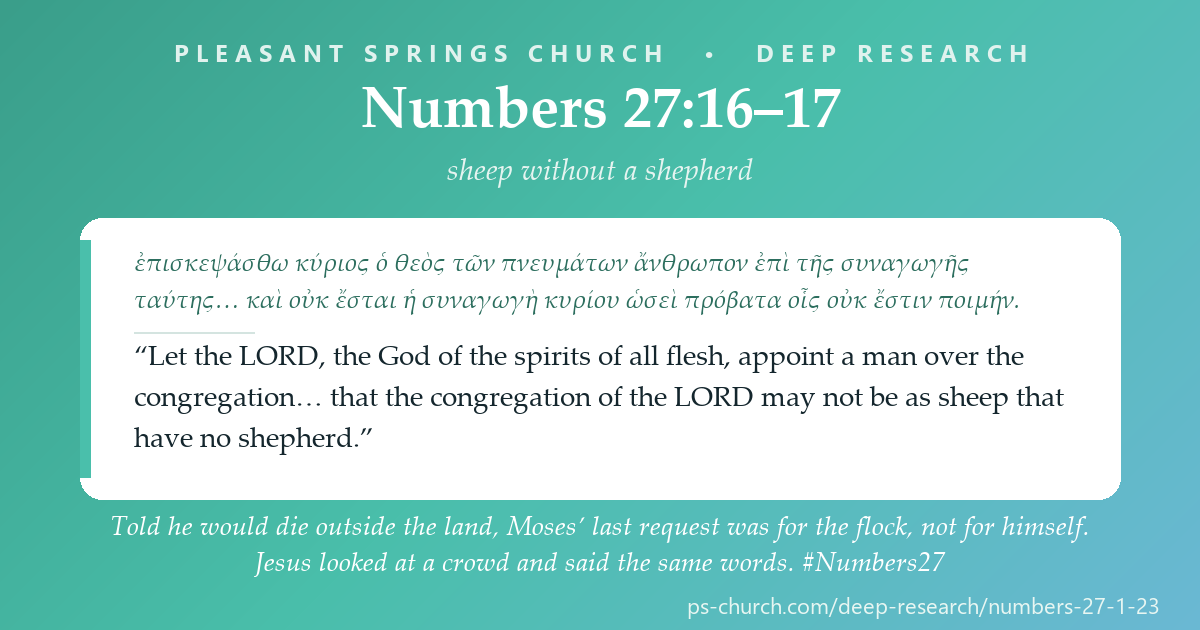
“Shepherd” (LXX ποιμήν) — the ANE word for a king, used here of a man who must go out and come in before the people. Israel’s prophets keep the image and keep its edge: sheep scattered “because there was no shepherd” (Ezek 34:5), “all Israel scattered on the mountains, as sheep that have no shepherd” (1 Kgs 22:17).
A note on the Greek name:
In the Septuagint, Moses’ successor is simply Ἰησοῦς (27:18, 22) — the Greek form of יְהוֹשֻׁעַ, “the Lord saves.” It is the same Greek name the New Testament gives to Jesus, which is why the ESV has to decide by context which man is meant: “Joshua” at Acts 7:45 and Hebrews 4:8, “Jesus” elsewhere. This is a fact about the language, not a hidden code; but Hebrews does make something of it — the Joshua who led them in did not give them the final rest, “for if Joshua had given them rest, God would not have spoken of another day later on” (Heb 4:8; see Hebrews 4:14–16).
From a case at the tent door to a shepherd for the crowds.
Trace three threads: the four cases Moses had to refer to God; the daughters’ inheritance from the census through Numbers 36 to Joshua 17; and the shepherd of the congregation, from Moses’ prayer to the Gospels.
Which cross-references matter?
- The four referred cases — the blasphemer (Lev 24:10–23), the men unclean at Passover (Num 9:6–14), the Sabbath wood-gatherer (Num 15:32–36), and Zelophehad’s daughters (27:1–11). Twice the oracle condemns; twice it grants. Moses’ standard answer to a hard case is to take it to God.
- Numbers 26:33; Numbers 36:1–12; Joshua 17:3–6 — the sisters named in the census, then the follow-up ruling when the Josephite chiefs object that marriage outside the tribe would move the land (God answers with the same word: “the tribe of the people of Joseph is right,” 36:5), and finally the outcome: they come to Eleazar and Joshua and receive their inheritance (Josh 17:3–6). Case, refinement, delivery — and see the second census for the allotment framework.
- Numbers 16–17; Numbers 20:1–13 — the two shadows over this chapter: the sisters insist their father was not in Korah’s company (27:3), and Moses is barred from the land because of Meribah (27:14).
- Numbers 11:16–29; Deuteronomy 34:9; Deuteronomy 31:7–8, 23 — the Spirit given to leaders in Israel (Num 11), and Joshua “full of the spirit of wisdom, for Moses had laid his hands on him” (Deut 34:9). The commissioning of 27:18–23 is repeated and completed in Deuteronomy.
- Deuteronomy 18:15–19 — the promise of a prophet like Moses runs past Joshua and keeps running (see Deuteronomy 18:15–19); Joshua inherits the office but not the face-to-face access of Num 12:8 — he inquires by the Urim (27:21).
- 1 Kings 22:17; Ezekiel 34:1–6, 23; Zechariah 10:2; 13:7 — the shepherdless-flock line becomes a prophetic indictment of Israel’s leaders and a promise: “I will set up over them one shepherd, my servant David” (Ezek 34:23).
- Matthew 9:36; Mark 6:34 — and then the sentence turns up on the lips of the Evangelists: “he had compassion for them, because they were harassed and helpless, like sheep without a shepherd” (Matt 9:36); “he had compassion on them… And he began to teach them many things” (Mark 6:34).
The phrase in Matthew 9:36 and Mark 6:34 is not a general pastoral sentiment; it is Old Testament vocabulary with a history. It begins as Moses’ prayer (Num 27:17), is used by Micaiah of a leaderless army (1 Kgs 22:17), and hardens in Ezekiel 34 into a charge against shepherds who fed themselves while the flock scattered — ending in God’s promise to shepherd them himself and to set one shepherd over them. When Mark says Jesus looked at the crowd and saw sheep without a shepherd, and then taught them, and then fed them in a wilderness place, the Old Testament script is running audibly in the background. Devotional reading: Moses, told he will not enter the land, spends his last request on the flock; centuries later the one who does lead them in says, “I am the good shepherd. The good shepherd lays down his life for the sheep” (John 10:11), and the church prays to “the God of peace who brought again from the dead our Lord Jesus, the great shepherd of the sheep” (Heb 13:20). We hold that connection the way the Gospels themselves make it — not by turning Moses into a cipher, but by hearing his prayer answered further than he asked.
The scholarship on Israelite inheritance law and the transfer of leadership.
Ashley, Wenham, Cole, Levine, Milgrom and Olson for Numbers; land-tenure and family-law studies for 27:1–11; Beale & Carson for the shepherd language in the Gospels.
Commentaries & studies:
- Timothy R. Ashley, The Book of Numbers (NICOT); Gordon J. Wenham, Numbers (TOTC); R. Dennis Cole, Numbers (NAC); Baruch A. Levine, Numbers 21–36 (Anchor); Jacob Milgrom, Numbers (JPS); Dennis T. Olson, Numbers (Interpretation).
- Studies of Israelite land tenure, the nachalah and the family holding, and the legal shape of the Zelophehad case together with its sequel in Numbers 36 and Joshua 17.
- Comparative family law: the Code of Hammurabi’s daughters’-inheritance provisions and the Nuzi / Emar heirship documents.
- G. K. Beale & D. A. Carson, eds., Commentary on the New Testament Use of the Old Testament (Matthew; Mark) on the shepherdless flock.
Interpretation notes worth keeping:
- The ruling is legislation, not a favor. God does not simply give five women an exception; the answer is immediately generalized into a statute with a fixed order of succession — daughter, brothers, uncles, nearest kinsman (27:8–11). What was granted to one family became the right of every family.
- Read the chapter’s own concern. The sisters’ stated aim is that their father’s name not be blotted out of his clan and that his land not be lost. Reading this as a modern political program imports a frame the text does not use; reading it as merely procedural misses that God publicly declares five petitioners right. Let it be what it is: justice for the vulnerable, written into the law.
- Numbers 36 is not a retraction. The follow-up ruling restricts whom the sisters may marry so the holding stays in Manasseh; and it preserves their choice inside that limit — “Let them marry whom they think best, only they shall marry within the clan of the tribe of their father” (36:6); the inheritance itself is never taken back, and 36:10–12 records their obedience. The two chapters together are how a legal system absorbs a new precedent.
- A textual curiosity in 27:7. The Hebrew mixes its pronouns — “give them” with a masculine plural, then “their father… to them” with feminines. Ancient and modern readers have noticed; nothing doctrinal hangs on it, and the ruling is unambiguous either way.
- Moses does not argue. Told to climb the mountain and die, he answers with a request for the people. Do not flatten this into stoicism: Deuteronomy records that he did plead to cross over, and was refused (Deut 3:23–27). Both are true. What Numbers preserves is where his mind went first.
- Succession is real and diminished. Joshua gets “some” of Moses’ authority (27:20) and access by the Urim rather than “mouth to mouth” (Num 12:8). The office continues; the man is not replaced. That is an honest model for every handover in a church.
From “they are right” to a shepherd for the flock.
Name what you learned, why it matters, and one concrete response.
What should we carry away — and do?
- Bring the case. Five women with no legal standing walked to the most public place in Israel and asked. They were not rebuked for asking; their question became Scripture. God is not diminished by hard questions honestly brought.
- ‘They are right.’ Sit with the fact that the Lord says this out loud, in front of everyone, about people the system had overlooked. Justice for the vulnerable is not an add-on to the law of God; here it is the law of God.
- Names matter to God. They feared an erasure, and Scripture has repeated their five names for three thousand years. He does not lose people in the paperwork.
- Ask what a leader asks. Moses had every reason to plead his own case and instead prayed for the flock. Test your own praying: when you are the one being set aside, what is the first thing you ask for?
- Take ‘some’ gladly. Joshua received a portion of Moses’ authority, not all of it, and it was enough for the Jordan. Most of us serve in the light of a moon, not a sun. That has always been how God moves his people forward.
Step in response: do the two things this chapter does. First, bring the case — take the question you have been carrying without asking, and actually put it before God this week, plainly, out loud. Second, look for the one person in your church or family whose name is quietly being left off the list, and put it back on.
Numbers 27:7 · to share
LXX + ESVEvery Deep Research page traces its passage across the whole sweep — the Old Testament, the Second-Temple world between the testaments (historical witnesses, not Scripture), and the New Testament. Follow the thread:
Pleasant Springs Church — Deep Research
Research method after Michael S. Heiser’s Bible Research Method (examine dictionaries → ancient literature → important words → textual connections → academic publications → share), with the Pleasant Springs “Author & Audience” foundation. Scripture set in the Hebrew, the Greek editions named on each page and the ESV (Old Testament), and the Greek New Testament and the ESV (New Testament), per the practice of Pleasant Springs Church. Numbers 27 research grounded in Ashley, Wenham, Cole, Levine, Milgrom and Olson, with Beale & Carson on the New Testament use (Matthew; Mark); ANE background from the Code of Hammurabi (ANET 164, 174) and the Samaria Ostraca (ANET 321), with Nuzi and Emar heirship documents; Second-Temple and rabbinic witnesses (Philo, Josephus, the Mishnah’s Bava Batra, Sifre Numbers, and b. Bava Batra), all read as witnesses, not Scripture. Hebrew, LXX and English agree in versification throughout Numbers 27; genuine Greek divergences are flagged with the passage. The daughters’ case is presented as the text presents it — a family’s name and holding secured, and God declaring five petitioners right — and the shepherd language of 27:17 is carried to Christ only along the line the Gospels themselves draw, labeled as devotional reading.
Scripture quotations marked ESV are from the ESV® Bible (The Holy Bible, English Standard Version®), © 2001 by Crossway, a publishing ministry of Good News Publishers. ESV Text Edition: 2016. Used by permission. All rights reserved. The ESV text may not be quoted in any publication made available to the public by a Creative Commons license, and the ESV may not be translated in whole or in part into any other language. www.esv.org
|
Did this study bless you today? 💚 Give to Support PS Church100% of gifts go to the General Fund — thank you. |