Two acts of consecration stand together in Numbers 8. The seven lamps of the golden lampstand are set to “give light in front of the lampstand” (8:2) — light kept burning before God. Then a whole tribe is cleansed and given: the Levites are sprinkled, shaved, and washed; the people lay hands on them; and Aaron presents them before the Lord as a wave offering, wholly given from among Israel, taken in place of the firstborn, to serve the tent and “make atonement” so that no plague strike the camp (8:11–19). This study works Numbers 8:1–26 — the lamps and the cleansing of the Levites — from the perpetual light to the living, consecrated offering. See the method →
Numbers 8:2–26 (selections)
Hebrew · LXX · ESVThe Shape of the Passage
Parallel panelsNumbers 8 stands in the block of consecration at Sinai, just before Israel breaks camp: the tribes have been numbered (chs 1–2), the Levites counted and given their charge in place of the firstborn (chs 3–4), the camp purified (ch 5) and the altar dedicated (ch 7). Now the lamps are lit and the Levites cleansed — the last preparations before the cloud lifts.
Author
The Torah of Moses gathers the book of Numbers (Hebrew Bəmiḏbar, “in the wilderness”) around the tabernacle and the march. Chapter 8 places two acts of consecration together: the kindling of the lamps and the cleansing of the Levites. Both concern how a holy God is served in the midst of his people — light that never goes dark before him, and a tribe wholly given to tend his dwelling. The lampstand’s making is recalled “according to the pattern that the Lord had shown Moses” (8:4; cf. Exod 25:31–40).
Given in place of the firstborn. The chapter’s heart is a theology of substitution and belonging: because the Lord spared Israel’s firstborn in Egypt and claimed them as his own, he now takes the Levites “instead of” every firstborn (8:16–18). The whole tribe becomes a living gift — presented, like an offering lifted before God, and then handed to Aaron for the service of the tent.
Audience
Israel at Sinai, about to travel. The people themselves are drawn into the rite: they lay their hands on the Levites (8:10), identifying this tribe as their own representatives — the Levites stand in for the firstborn of every household. The Levites’ service is not merely practical; it “makes atonement” and guards the camp, “that there may be no plague among the people of Israel when the people of Israel come near the sanctuary” (8:19). A holy God in the middle of the camp is a mercy that must be handled with reverence.
A called term, an honorable release. The chapter closes with the shape of a life of service: the Levites join the work at twenty-five and are released from the heavy duty at fifty, after which they may still assist their brothers by “keeping guard” (8:23–26). Service has a beginning, a season, and a dignified end — not discarded, but honored.
Orient on the lampstand, the Levites, wave offerings, and consecration.
Search by topic: lampstand / menorah, lamps, Levites, wave offering, firstborn, consecration, atonement, purification.
Which articles are relevant?
- Anchor Bible Dictionary — “Lampstand,” “Levites,” “Firstborn,” “Wave Offering,” “Priests and Levites,” “Purification.”
- Dictionary of the OT: Pentateuch — “Levites,” “Priests, Priesthood,” “Firstborn,” “Sacrifices and Offerings,” “Tabernacle.”
- NIDOTTE / TDOT — מְנוֹרָה (mənôrâ, lampstand), תְּנוּפָה (tənûp̄â, wave offering), נָתַן (nāṯan, give), עֲבֹדָה (ʿăḇōḏâ, service), כָּפַר (kāp̄ar, atone).
Bibliography surfaced:
- Gordon Wenham (TOTC), Timothy Ashley (NICOT), Dennis Cole (NAC), Baruch Levine (AB) on Numbers.
- Studies of the Levites’ ordination as a “wave offering,” the firstborn substitution, and the age of Levitical service.
- Beale & Carson, Commentary on the NT Use of the OT (for the lampstand and the living-sacrifice imagery).
Light before the deity, and a tribe wholly given.
Read the perpetual lamp and the setting-apart of a servant-class against their ancient setting, then follow the light and the living gift into the New Testament — always labeling the typology.
Which parallels shed light on religion and worldview?
Light kept before the deity. Temples across the ancient Near East kept lamps burning before the god as a sign of presence and honor. Israel shares the furniture but transforms the meaning: the seven-branched lampstand is a single hammered work of pure gold (8:4), and its light is not to feed a hungry idol but to shine before the Lord in the tent where he has chosen to dwell — a steady, ordered light in the holy place, tended by the priests as part of the daily service.
A servant-class set apart. Other cultures had temple servants and dedicated persons; Israel’s Levites are unique in being taken as a substitute for the nation’s firstborn and presented to God as a תְּנוּפָה (tənûp̄â), an offering “lifted” before him. They are not property to be exploited but a gift given back to the God who first spared them. The later tradition preserved the details lovingly: the Mishnah’s Tamid describes the daily kindling and tending of the lamps, and Menaḥot treats the oil and the arrangement of the sanctuary’s light.
- Mishnah, Tamid & Menaḥot (rabbinic-era — witnesses, not Scripture) — the daily tending of the lamps and the oil of the sanctuary; how the perpetual light was kept.
- Sifre on Numbers (rabbinic midrash — a witness, not Scripture) — halakhic comment on the lamps and the ordination of the Levites in Numbers 8.
- Josephus, Antiquities 3.199–end; 4 (Second-Temple — a witness, not Scripture) — the lampstand and the ordering of the Levites and their service.
- Philo, On the Life of Moses 2 (Second-Temple — a witness, not Scripture) — a symbolic reading of the seven-lamped stand and the tabernacle’s furniture.
The New Testament takes up both images — always as fulfillment and echo, never leveling them with the text. The people of God become lampstands: John sees the risen Christ walking among seven golden lampstands, which are the churches, called to keep their light burning and not to let it go dark (Rev 1:12–20; cf. Matt 5:14–16). And the Levites, presented as a living תְּנוּפָה wholly given to God, foreshadow the appeal Paul makes to all believers: “present your bodies as a living sacrifice, holy and acceptable to God, which is your spiritual worship” (Rom 12:1). Under the new covenant the whole church is “a chosen race, a royal priesthood” (1 Pet 2:9). These are devotional analogies drawn from the New Testament’s own reading — the pattern of consecrated life: light kept burning, a self wholly given.
The vocabulary of the lampstand, the wave offering, and the given tribe.
Watch the mənôrâ (lampstand) that gives light, the tənûp̄â (wave offering) that presents the Levites, the nətunîm (wholly given) tribe, and the ʿăḇōḏâ (service) that becomes λειτουργία.
“Lampstand” — the seven-lamped stand of hammered gold (LXX λυχνία). Its lamps (נֵרוֹת, nērôṯ) “give light in front of the lampstand” — a steady light before God, made “according to the pattern” shown Moses (8:4; Exod 25:31–40).
“Wave offering” — an offering “lifted / presented” before the Lord. Here it is the Levites themselves, offered as a living gift; the LXX renders it not by a gesture but as ἀπόδομα, a “dedicated gift” that Aaron sets apart.
“Wholly given” — from nāṯan, “to give.” Doubled for emphasis in 8:16 (“given, given”): the Levites are given to God, then given to Aaron (8:19; LXX ἀπόδομα δεδομένους) — belonging entirely to him.
“To make atonement” — the Levites’ guarded service “makes atonement” (ûlḵappēr) for Israel, keeping the plague of unholy nearness away (LXX ἐξιλάσκομαι). Reverent service is itself a means of protection.
“Service / labor” — the ministry of the tent (LXX λειτουργία, whence “liturgy”). Worship as work: a called term of service (8:24–25), begun, carried, and honorably laid down.
How the New Testament takes up these images (devotional):
- Romans 12:1 — “present your bodies as a living sacrifice”: the whole believer as a wave offering, wholly given — the pattern of the consecrated Levite widened to all.
- Revelation 1:12–20; Matthew 5:14–16 — the churches as golden lampstands; the people of God called to give light and not let it go dark.
- 1 Peter 2:9; Hebrews 9:6–14 — a “royal priesthood” serving God; the tabernacle service read as a shadow fulfilled in Christ.
From the firstborn spared to the tribe given, and the light that shines.
Trace the substitution of the Levites for the firstborn, the perpetual light, and the living offering across the canon.
Which cross-references matter?
- Exodus 13:1–2, 11–16; Numbers 3:11–13, 40–51 — the Lord claims Israel’s firstborn because he spared them in Egypt, and takes the Levites in their place (see Numbers 3–4).
- Exodus 25:31–40; 27:20–21; Leviticus 24:1–4 — the lampstand made to pattern, and the lamps tended to burn continually before the Lord (see Exodus 40).
- Exodus 29; Leviticus 8 — the consecration of Aaron and his sons, alongside which the Levites are here cleansed and given (see Exodus 29 and Leviticus 8).
- Numbers 4:1–3; 1 Chronicles 23:24–27 — the age of Levitical service (thirty in ch 4, twenty-five here, later twenty): phases and duties, not a contradiction (see the notes below).
- Romans 12:1; Revelation 1:12–20; 1 Peter 2:9 — the living sacrifice, the lampstand-churches, and the royal priesthood: the images widened to the whole people of God (devotional).
Numbers 8 rests on a single, tender logic of grace. In Egypt the Lord passed over Israel’s firstborn under the blood; from that night every firstborn belonged to him (Exod 13:2). Rather than take one son from every house, he takes a whole tribe “instead of” them (Num 8:16–18) — the Levites, cleansed and lifted before him as a wave offering, wholly given. The people lay hands on them because these are their substitutes; the tribe stands where every firstborn stood. And their service is not danger but shelter: it “makes atonement” so that “no plague” falls when Israel draws near the holy things (8:19). The New Testament does not need to force the type: it simply widens it. What was true of one tribe — belonging wholly to God, presented as a living offering — the gospel makes true of every believer redeemed by the true Passover Lamb (Rom 12:1; 1 Pet 2:9), each a light kept burning before him.
The scholarship on the Levites and the lampstand.
Ashley, Wenham, Cole, and Levine for Numbers; studies of the firstborn substitution and the age of service; Beale & Carson for the New Testament imagery.
Commentaries & studies:
- Timothy R. Ashley, The Book of Numbers (NICOT); Gordon J. Wenham, Numbers (TOTC); R. Dennis Cole (NAC); Baruch A. Levine, Numbers (Anchor).
- Studies of the Levites’ ordination as a “wave offering,” the firstborn-substitution theology, and the perpetual light of the sanctuary.
- G. K. Beale & D. A. Carson, eds., Commentary on the New Testament Use of the Old Testament.
Interpretation notes worth keeping:
- The ages are not a contradiction. Numbers 4 counts Levites from thirty to fifty for the heavy transport of the sanctuary during the march; Numbers 8 sets the general age of entering service at twenty-five; 1 Chronicles 23 later lowers it to twenty once the ark had a fixed home. The differences reflect distinct phases and duties (an apprenticeship from twenty-five, full transport-duty from thirty, and a settled era after the temple was built), not a clash in the text.
- A living wave offering, not a magic rite. The Levites are “offered” as a תְּנוּפָה — presented and wholly given — yet they are not slain; the language is of dedication and belonging. The atonement their service secures is protective and reverent, guarding the holiness of the camp, not a bribe.
- The lamps are read plainly. Chapter 8 keeps to two concrete ordinances; the New Testament’s lampstand and living-sacrifice imagery is drawn from its own pages and is labeled devotional analogy, not read back into Moses as the literal sense.
- Honorable release. That the Levite “withdraws” at fifty yet still “keeps guard” (8:25–26) models a view of service with seasons: called, carried, and laid down with dignity rather than used up.
From the given tribe to a life wholly offered.
Name what you learned, why it matters, and one concrete response.
What should we carry away — and do?
- Belonging is grace before it is duty. The Levites are given to God because he first spared and claimed them. Service flows from having been redeemed, not the other way around.
- Present yourself as a living offering. What was true of one tribe — wholly given, lifted before God — Paul asks of every believer: “present your bodies as a living sacrifice” (Rom 12:1). Consecration is the ordinary shape of worship.
- Keep the light burning. The lamps were tended so they would not go dark; the churches are lampstands. A life and a congregation are meant to give light — steadily, before God, for the world to see.
Step in response: name one part of your life you have kept back from God — a resource, a plan, an hour, a relationship — and consciously “lift” it before him as the Levites were lifted: wholly given. Then tend one lamp this week — a place where your light has gone dim — and let it burn again before the Lord.
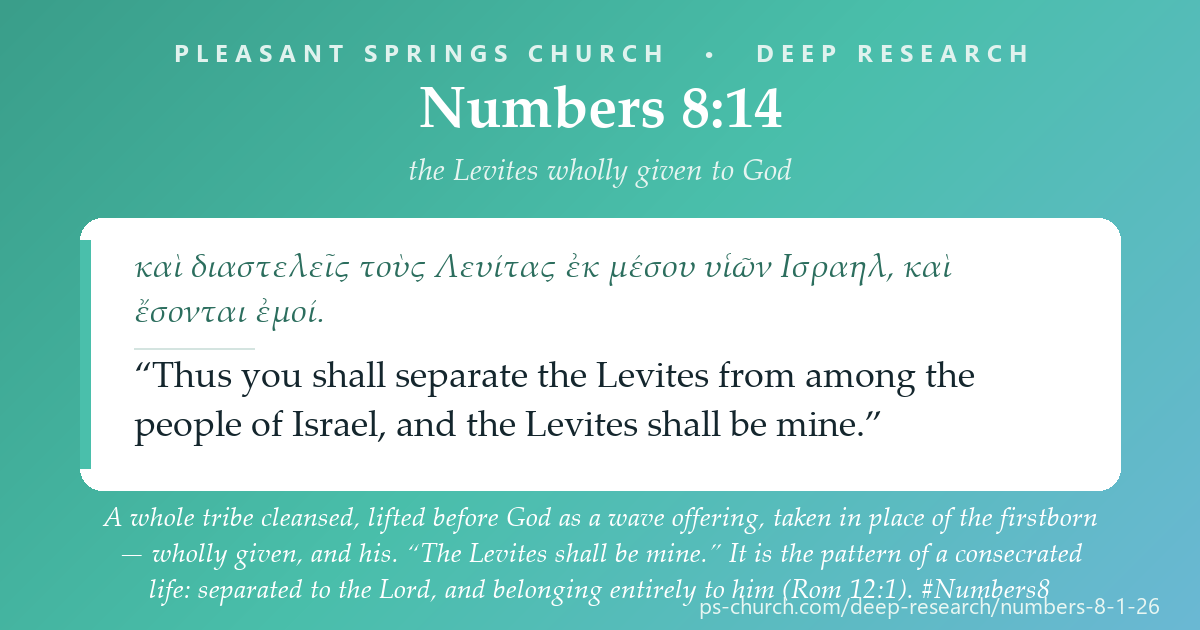
Numbers 8:14 · to share
LXX + ESVEvery Deep Research page traces its passage across the whole sweep — the Old Testament, the Second-Temple world between the testaments (historical witnesses, not Scripture), and the New Testament. Follow the thread:
Pleasant Springs Church — Deep Research
Research method after Michael S. Heiser’s Bible Research Method (examine dictionaries → ancient literature → important words → textual connections → academic publications → share), with the Pleasant Springs “Author & Audience” foundation. Scripture set in the Hebrew, the Greek editions named on each page and the ESV (Old Testament), and the Greek New Testament and the ESV (New Testament), per the practice of Pleasant Springs Church. Numbers 8 research grounded in Ashley, Wenham, Cole, and Levine, with Beale & Carson on the New Testament use; ANE lamp-and-temple background; Second-Temple and rabbinic reception per Josephus, Philo, the Mishnah (Tamid; Menaḥot), and the Sifre on Numbers, all read as witnesses, not Scripture. The lampstand and living-sacrifice imagery of the New Testament (Rev 1; Rom 12:1) is drawn from its own pages and labeled devotional analogy; the differing service-ages of chs 4 and 8 are read as distinct phases and duties, not a contradiction.
Scripture quotations marked ESV are from the ESV® Bible (The Holy Bible, English Standard Version®), © 2001 by Crossway, a publishing ministry of Good News Publishers. ESV Text Edition: 2016. Used by permission. All rights reserved. The ESV text may not be quoted in any publication made available to the public by a Creative Commons license, and the ESV may not be translated in whole or in part into any other language. www.esv.org
|
Did this study bless you today? 💚 Give to Support PS Church100% of gifts go to the General Fund — thank you. |