“The Levites shall be mine” (3:12). On the night of Passover the Lord spared Israel’s firstborn and claimed them for his own; now he takes the tribe of Levi in their place — given to Aaron to guard and carry the tabernacle — and redeems the surplus firstborn with silver. Each clan receives a charge: Gershon the coverings, Merari the frames, and Kohath the most holy things, borne on the shoulder but never touched or gazed upon, “lest they die.” This study works Numbers 3:1–4:49 — redemption and substitution, the sober holiness of God’s presence, and the dignity of assigned service. See the method →
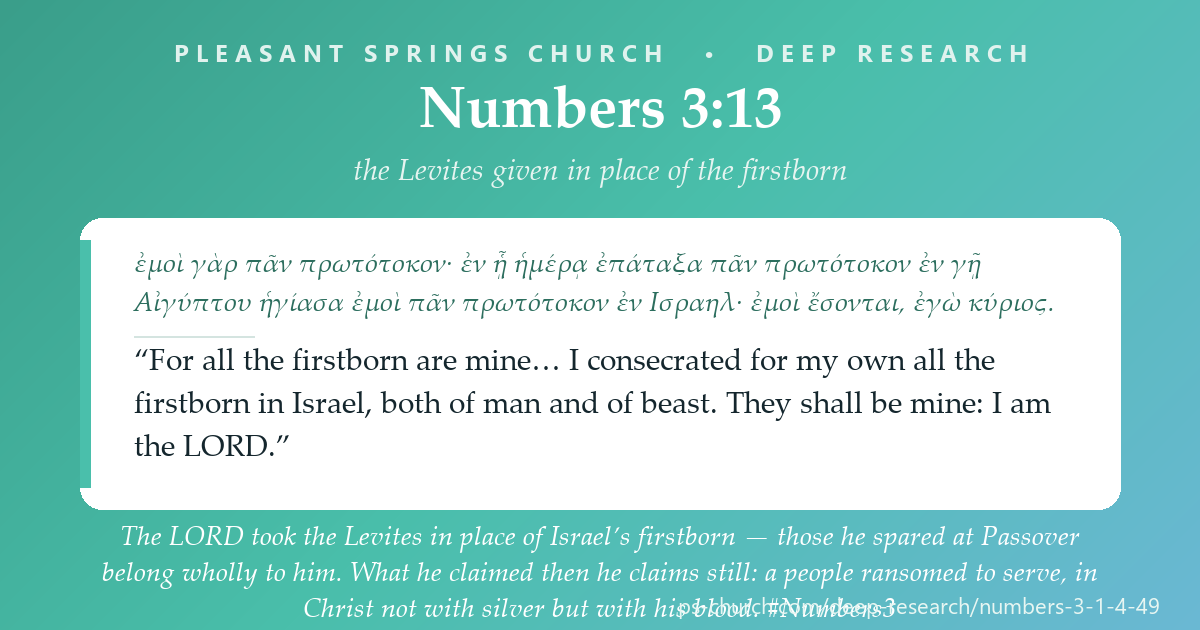
Numbers 3:12–13; 4:15, 20 (selections)
Hebrew · LXX · ESVThe Shape of the Passage
Parallel panelsNumbers (Hebrew Bemidbar, “in the wilderness”) opens at Sinai a year after the exodus: the tabernacle has been built (Exod 40) and its worship given (Leviticus); now the Lord orders the redeemed people for the march, with his dwelling at the center. In the census the Levites are set apart (ch 1–2 number the tribes; see Numbers 1–2) — and chs 3–4 tell why and how.
Author
The Torah of Moses continues its account of the wilderness generation. Having built and filled the tabernacle with glory (Exod 40) and learned how to worship there (Leviticus), Israel must now travel with a holy God in its midst. Numbers 3–4 answers a practical and profound question: who will guard and carry the tabernacle, and on what terms may sinful people move the sacred at all? The answer is the tribe of Levi — set apart, given to Aaron and the priests, and taken by the Lord in place of the firstborn.
A theology worked out in a census. The chapters read like a muster-roll — names, clans, duties, numbers — but every list carries doctrine. The Levites are substituted for the firstborn the Lord spared at Passover; the surplus firstborn are redeemed by silver; and the sacred things are ringed with such care that even those who carry them may not touch or gaze on them. Belonging, redemption, and reverence are written into the very arithmetic.
Audience
Israel — a redeemed people about to march. The Levites are given as a gift to Aaron (3:9) and posted around the tabernacle as a guarding ring, “so that there may be no wrath on the congregation” (1:53; 3:10). The firstborn substitution reaches back to the night the Lord struck Egypt and spared Israel: those spared belong to him, and the Levites now stand in their place.
How they heard it. Two notes sound together. First, comfort: the holy God really dwells among them and travels with them, ordering their life around his presence. Second, sobriety: that presence is not to be trifled with. The refrain “lest they die” (4:15, 19–20) is not divine caprice but the seriousness of the holy — the same seriousness Israel would later forget at the cost of Uzzah (2 Sam 6). To be near God is grace; to presume upon him is deadly.
Orient on the Levites, the priesthood, the firstborn, redemption, and holiness.
Search by topic: Levites, priesthood, firstborn, redemption / ransom, tabernacle, holiness, Kohath / Gershon / Merari, census.
Which articles are relevant?
- Anchor Bible Dictionary — “Levites,” “Priests and Levites,” “Firstborn,” “Redemption,” “Tabernacle.”
- Dictionary of the OT: Pentateuch — “Levites,” “Priests, Priesthood,” “Firstborn,” “Numbers, Book of,” “Holiness.”
- NIDOTTE / TDOT — לֵוִי (lēwî, Levi), בְּכוֹר (bəḵôr, firstborn), פָּדָה (pāḏâ, redeem), קֹדֶשׁ (qōḏeš, holiness), נָשָׂא (nāśāʾ, bear/carry).
Bibliography surfaced:
- Gordon Wenham (TOTC), Timothy Ashley (NICOT), Jacob Milgrom (JPS), Baruch Levine (Anchor) on Numbers.
- Studies of the Levitical clans and their charges; the firstborn-substitution and redemption; the debated large census numbers (ʾelep as “thousand” or “clan / unit”).
- Beale & Carson, Commentary on the NT Use of the OT (redemption; firstborn; 1 Peter).
Sacred personnel, the carrying of the holy, and the danger of God's presence.
Read the Levites’ guarding and carrying against ANE temple practice, weigh the census numbers honestly, then follow the firstborn-substitution to Christ.
Which parallels shed light on religion and worldview?
Graded sacred personnel. Ancient temples across the Near East kept ordered classes of sacred servants — priests, gatekeepers, singers, and lower attendants — with carefully guarded access to the god’s image and inner room. Israel shares the furniture of graded holiness but reframes it: there is no idol at the center, only the covered ark and the invisible Lord enthroned above it; the Levites are not the property of a shrine but a tribe given by God, standing in for the firstborn he redeemed.
Carrying the holy. Mesopotamian and Egyptian processions bore the divine image aloft on poles in public splendor. Israel too carries its sacred things on the shoulder — but wrapped, hidden, and untouchable: the priests must first cover the ark, table, lampstand, and altars (4:5–14), and only then may the Kohathites lift them, “but they must not touch the holy things, lest they die” (4:15), nor look on them “even for a moment” (4:20). The point is not display but reverence: the God who journeys with them is holy.
The large numbers. The census totals (22,000 Levites, 3:39; over 8,500 fit for service, 4:48) sit within the very large figures of the whole muster. Scholars debate the Hebrew אֶלֶף (ʾelep): it can mean “thousand,” but also “clan” or a military “unit.” We note the discussion without resolving it dogmatically; the theological point stands either way — a people multiplied as God promised Abraham, ordered around his dwelling.
- ANE temple-personnel texts (Mesopotamian / Egyptian — witnesses, not Scripture) — graded classes of sacred servants and guarded access to the god: shared cultural furniture, reframed around the invisible Lord.
- Josephus, Antiquities 3–4 (Second-Temple — a witness, not Scripture) — retells the Levites’ charge, the clans, and the census.
- Mishnah, Tamid (rabbinic-era) — preserves the ordered daily service of the sanctuary that the Levitical duties anticipate.
- 2 Samuel 6:6–7 (Uzzah) — later narrative that shows what “lest they die” meant: the ark carried the wrong way, touched, and a man struck down — reverence, not caprice.
The firstborn logic runs straight to the gospel. On the night of Passover the Lord spared Israel’s firstborn and thereby claimed them as his own (Exod 13:2, 15); the Levites are now taken “instead of” them, and the surplus firstborn are ransomed with silver (3:46–51). The New Testament takes up both the belonging and the ransom: “you were ransomed… not with perishable things such as silver or gold… but with the precious blood of Christ, like that of a lamb without blemish” (1 Pet 1:18–19). Luke frames Jesus’ own infancy by this very law: “Every male who first opens the womb shall be called holy to the Lord” (Luke 2:23; cf. Exod 13). The one who is himself the firstborn is presented to God — and becomes the ransom by which a whole people is claimed for God’s own possession. (A devotional reading of the type Scripture itself invites.)
The vocabulary of substitution, firstborn, redemption, and the holy.
Watch taḥat (in place of) join bekor (firstborn) and padah (redeem) into a single logic of belonging, and qodesh (the holy) guarded with awe.
“Levi” — the tribe (LXX Λευίτης). Genesis links the name by sound to lāwâ, “to join / be attached” (Gen 29:34); fittingly, the Levites are the tribe “joined” to Aaron and given wholly to the Lord’s service (3:6–9).
“Instead of / in place of” (LXX ἀντί) — the language of substitution. The Levites are taken taḥat the firstborn; one stands for another, so that the whole may belong to God.
“Firstborn” — the one who “opens the womb” (LXX πρωτότοκος). Claimed by the Lord since the night he spared Israel and struck Egypt (Exod 13); now represented by the Levites, and redeemed where they fall short.
“To redeem / ransom” (LXX λυτρόω) — the 273 firstborn beyond the Levites’ number are redeemed at five shekels each (the pidyôn, redemption price). The ransomed belong to the one who paid for them.
“Holy things / holiness” — the most holy furnishings the Kohathites carry. So charged with God’s presence that they may not be touched (nāḡaʿ, 4:15) or even looked upon (4:20) uncovered: reverence, not superstition.
How the New Testament takes up firstborn, ransom, and service:
- 1 Peter 1:18–19 — “you were ransomed… not with… silver or gold… but with the precious blood of Christ”: the redemption-price of the firstborn fulfilled.
- Luke 2:22–23 — the infant Jesus presented to the Lord under the firstborn law: “Every male who first opens the womb shall be called holy to the Lord.”
- Romans 12:1 — “present your bodies as a living sacrifice… your spiritual worship”: the whole-life consecration the Levites embodied, now asked of all.
- 1 Corinthians 12:4–27; Ephesians 4:11–16 — one body, many members, each with an assigned service — the picture the Levite clans foreshadow.
From the firstborn spared at Passover to the ransom and the ordered body.
Trace the firstborn claim from the exodus, through the Levites’ substitution, to the New Testament’s ransom and its picture of assigned service.
Which cross-references matter?
- Exodus 13:2, 11–15 — “Consecrate to me all the firstborn… it is mine”: the Passover claim the Levites now answer (cf. Exodus 40, the glory that filled the tent they guard).
- Numbers 1:53; 8:5–19; 18:1–7 — the Levites as a guarding ring “that there may be no wrath,” cleansed and given to Aaron, bearing responsibility for the sanctuary.
- Leviticus 10:1–3; 2 Samuel 6:6–7 — Nadab and Abihu, and Uzzah: what “lest they die” guards against — the holy approached on man’s terms, not God’s (see Leviticus 10).
- 1 Peter 1:18–19; Luke 2:23; Romans 12:1 — the ransom in Christ, the firstborn presented, and the living-sacrifice service of the redeemed.
- 1 Corinthians 12; Ephesians 4:11–16 — the body with many members and gifts: every clan’s charge honored, none dispensable.
The three Levite clans are given three charges, and the text lingers over each. Gershon carries the tabernacle’s curtains, coverings, and hangings (4:24–28); Kohath the most holy things — ark, table, lampstand, and altars — on the shoulder, once the priests have veiled them (4:4–15); Merari the frames, bars, pillars, and bases (4:29–33). No clan does another’s work; none is dispensable; the frames matter as truly as the ark’s poles, and both are needed for God to dwell among his people. The New Testament makes the same point of the church: “the body does not consist of one member but of many… God arranged the members… as he chose” (1 Cor 12:14–18), each gift given “to equip the saints for the work of ministry” (Eph 4:12). Assigned service is not lesser service; it is the shape of a people ordered around God’s presence, each one counted, each one given a task. (A devotional reading grounded in the New Testament’s own body-imagery.)
The scholarship on the Levites, the firstborn, and the census.
Wenham and Ashley for Numbers; Milgrom and Levine on the Levitical clans and the firstborn redemption; the ʾelep debate for the numbers; Beale & Carson for the NT use.
Commentaries & studies:
- Gordon J. Wenham, Numbers (TOTC); Timothy R. Ashley, The Book of Numbers (NICOT); Jacob Milgrom, Numbers (JPS); Baruch A. Levine, Numbers 1–20 (Anchor).
- Studies of the Levitical clans (Gershon, Kohath, Merari) and their charges; the firstborn-substitution and the redemption money; the debated meaning of אֶלֶף (ʾelep) in the census.
- G. K. Beale & D. A. Carson, eds., Commentary on the New Testament Use of the Old Testament (firstborn; ransom; 1 Peter).
Interpretation notes worth keeping:
- Substitution and belonging. The Levites stand “in place of” the firstborn (3:12), the surplus firstborn are ransomed (3:46–51): the logic is that the redeemed belong wholly to the God who spared and paid for them — a logic the New Testament carries to Christ’s blood (1 Pet 1:18–19).
- ‘Lest they die’ is reverence, not caprice. The graded access — carriers who may not touch or gaze — guards the seriousness of God’s presence, not a fickle temper; Uzzah (2 Sam 6) shows the cost of forgetting it. The awe is real; so is the grace of a God who dwells among sinners at all.
- The large numbers are genuinely debated. Whether ʾelep means “thousand” or “clan / unit,” the point is a people multiplied per the Abrahamic promise, ordered around God’s dwelling — not a figure to defend or dismiss dogmatically.
- Assigned service is dignified. Every clan has its God-given charge, and the text honors each equally — the New Testament’s picture of the one body with many members (1 Cor 12; Eph 4).
From the claimed and counted people to a life gladly given.
Name what you learned, why it matters, and one concrete response.
What should we carry away — and do?
- You are claimed and counted. The God at the center of the camp knows and numbers his people. The Levites were taken in place of the firstborn; in Christ you were ransomed — not with silver, but with his blood. You belong to him.
- Belonging means glad service. The redeemed are not idle; they are given a charge. “Present your bodies as a living sacrifice” — the whole-life consecration the Levites embodied is now asked, in Christ, of all.
- Approach the holy with reverence — and confidence. “Lest they die” is not caprice but the weight of God’s presence. Through Christ we may now draw near; let it be with awe, never with presumption.
Step in response: name the “charge” God has given you in his people — the ordinary, assigned service that is yours to carry — and do it this week as one who has been ransomed and counted, not out of duty but out of belonging. And when you come to worship, come with the reverence the holy deserves and the confidence the blood of Christ has bought.
Numbers 3:12–13 · to share
LXX + ESVEvery Deep Research page traces its passage across the whole sweep — the Old Testament, the Second-Temple world between the testaments (historical witnesses, not Scripture), and the New Testament. Follow the thread:
Pleasant Springs Church — Deep Research
Research method after Michael S. Heiser’s Bible Research Method (examine dictionaries → ancient literature → important words → textual connections → academic publications → share), with the Pleasant Springs “Author & Audience” foundation. Scripture set in the Hebrew, the Greek editions named on each page and the ESV (Old Testament), and the Greek New Testament and the ESV (New Testament), per the practice of Pleasant Springs Church. Numbers 3–4 research grounded in Wenham, Ashley, Milgrom, and Levine, with Beale & Carson on the New Testament use; ANE temple-personnel background; Second-Temple and rabbinic reception per Josephus and the Mishnah, all read as witnesses, not Scripture. The firstborn-substitution and redemption are read with the New Testament’s own logic of ransom (1 Peter 1:18–19); the “lest they die” holiness as reverence, not caprice; and the large census numbers noted, with the ʾelep debate flagged and not resolved dogmatically.
Scripture quotations marked ESV are from the ESV® Bible (The Holy Bible, English Standard Version®), © 2001 by Crossway, a publishing ministry of Good News Publishers. ESV Text Edition: 2016. Used by permission. All rights reserved. The ESV text may not be quoted in any publication made available to the public by a Creative Commons license, and the ESV may not be translated in whole or in part into any other language. www.esv.org
|
Did this study bless you today? 💚 Give to Support PS Church100% of gifts go to the General Fund — thank you. |