Because the Lord now dwells “in the midst” of the camp (5:3), the whole of Israel’s common life must reflect his holiness. Numbers 5 gathers three laws to that end: the unclean are placed outside the camp (5:1–4); a wrong against a neighbor — named as breaking faith with God — is met by confession and full restitution, a fifth added (5:5–10); and the bitter, private matter of a jealous husband is taken out of his hands and set before God (5:11–31). This study works Numbers 5:1–31 with care — especially the ordeal of jealousy, read not as a weapon against women but as a merciful restraint that shielded the accused and placed hidden things before the God who sees. See the method →
Numbers 5:2–28 (selections)
Hebrew · LXX · ESVThe Shape of the Passage
Parallel panelsNumbers (Hebrew Bemidbar, “in the wilderness”) takes up where Leviticus left off: the glory has filled the tabernacle (Exod 40), Israel has been numbered and camped around it (Num 1–2), the Levites set as a guard (Num 3–4). Chapter 5 asks the next question: if a holy God dwells in the midst of the camp, what must the camp’s life look like?
Author
The Torah of Moses gathers three seemingly unrelated laws under one banner: the purity of the camp where the Lord tents. The unclean are placed outside (5:1–4); a wrong done to a neighbor is confessed and repaid (5:5–10); and the bitter question of a jealous husband is taken from human hands and set before God (5:11–31). The thread is stated in 5:3 — “that they may not defile their camp, in the midst of which I dwell.” Holiness here is not abstract; it reaches skin and discharge and death, the neighbor’s stolen property, and the most private wounds of a marriage.
A law for a hard case. The ordeal of jealousy (5:11–31) is the one “ordeal” in the Torah, and it must be read with care. It addresses a marriage poisoned by suspicion where there is no witness and no proof (5:13) — a situation in which, across the ancient world, a jealous husband held life-and-death power. The law does not hand him a sword; it takes the matter out of his hands and places it before the Lord, whose verdict alone could act through ingredients — water, dust, and ink — that were themselves harmless.
Audience
Israel — a redeemed people learning to live as neighbors around a holy center. To them these laws taught three things at once: that God’s nearness makes the whole camp’s life sacred; that sin against a neighbor is also treachery against God (5:6), healed only by honest confession and real restitution; and that even the hidden things a court could never reach are seen by the God who dwells among them.
Handled with dignity. The jealousy rite is not a text to wield against women, and Scripture does not present it so. In its own world it functioned as a restraint on private vengeance and a presumption of innocence: the accused woman was not to be killed on a jealous man’s word but brought before God, and if innocent she was publicly cleared — “she shall be free and shall conceive children” (5:28). We read it soberly, grieving the double standard of the ancient world it addresses, and following the gospel’s trajectory to the day Jesus stood between an accused woman and the stones (John 8:1–11).
Orient on the camp, uncleanness, restitution, and the jealousy ordeal.
Search by topic: camp, clean and unclean, holiness, restitution / guilt offering, jealousy, ordeal, Sotah, oath.
Which articles are relevant?
- Anchor Bible Dictionary — “Camp,” “Clean and Unclean,” “Ordeal,” “Jealousy, Ordeal of,” “Restitution,” “Oath.”
- Dictionary of the OT: Pentateuch — “Numbers, Book of,” “Holiness,” “Purity and Impurity,” “Sacrifices and Offerings,” “Women.”
- NIDOTTE / TDOT — מַחֲנֶה (maḥăneh, camp), טָמֵא (ṭāmēʾ, unclean), מַעַל (maʿal, break faith), קִנְאָה (qinʾāh, jealousy).
Bibliography surfaced:
- Gordon Wenham (TOTC), Timothy Ashley (NICOT), Dennis Cole (NAC), Jacob Milgrom (JPS) on Numbers.
- Studies of the jealousy ordeal (Sotah): its legal function, the ANE background, and its unusually protective character.
- Beale & Carson, Commentary on the NT Use of the OT; works on Numbers 5 and the holiness of the camp.
Purity of the sacred camp, restitution, and ordeals in the ancient world.
Read the three laws against ANE purity, property, and ordeal law — then weigh the jealousy rite with great care against the harsher codes it stands beside.
Which parallels shed light on religion and worldview?
A sacred camp. Ancient armies and sanctuaries alike were kept ritually pure; impurity, disease, and death were held to profane holy ground. Israel shares the instinct but reframes it: the camp is holy because the Lord himself dwells in its midst (5:3; the verb is שָׁכַן, the root of mishkan, tabernacle). To be put “outside the camp” was temporary and merciful, not a verdict on a person’s worth — the same place, later, where the sin-offering was burned and where “Jesus also suffered” (Heb 13:11–13).
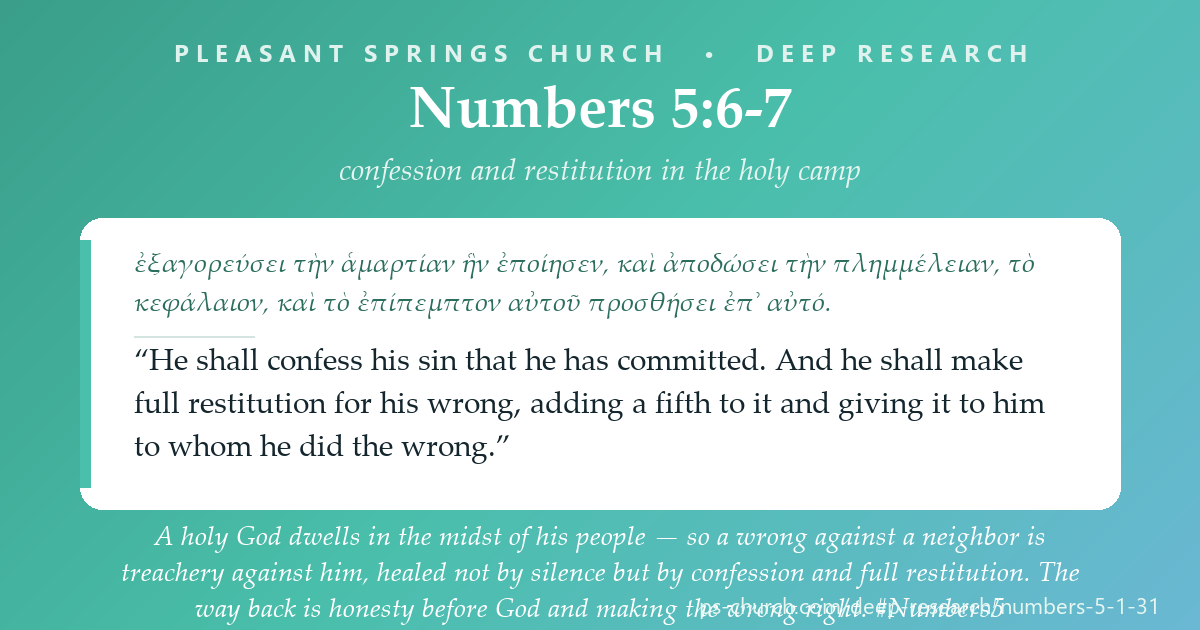
Confession and restitution. ANE law codes required repayment for theft and fraud, often at steep multiples. Israel’s law is strikingly restorative and God-centered: a wrong against a neighbor is breaking faith with the Lord (5:6), and the remedy is spoken confession plus the principal returned plus a fifth to the person wronged (5:7) — the same measured, humane restitution as the guilt offering of Leviticus 6:1–7. Repentance is not merely felt; it is made concrete and given back.
The ordeal — and how mild it is. Ordeals were common in the ancient Near East, and they were brutal. The Code of Hammurabi orders an accused wife to throw herself into the river; she must survive the current to prove innocence, and drowning is the verdict (Laws §132; cf. §2, ANET). Israel’s single ordeal is the near-opposite. The ingredients — holy water, dust from the tabernacle floor, and the ink of the written curse washed into the cup (5:17,23) — are harmless in themselves; only a direct act of God could bring harm. The presumption thus favors the accused: absent God’s intervention she is vindicated, publicly cleared, and blessed with children (5:28). What looks severe to us was, in its world, a shield — taking a wife’s life out of a jealous husband’s hands and placing it before the God who sees.
- Code of Hammurabi §132; §2 (Old Babylonian law — a witness, not Scripture; ANET) — the river-ordeal: an accused wife must plunge into the river and survive to be cleared. The contrast with Numbers 5 is stark — Israel’s ingredients could not themselves harm.
- Middle Assyrian Laws A §17–18 (ANE law — a witness, not Scripture) — the river-ordeal and harsh penalties for a wife accused without witnesses: the surrounding legal world Numbers 5 both echoes and softens.
- Mishnah, Sotah (rabbinic-era — a witness, not Scripture) — the tractate devoted to this rite; it records that the ordeal was discontinued (Sotah 9:9), and preserves its procedure and safeguards.
- Josephus, Antiquities 3.270–273; Philo, On the Special Laws 3.52–62 (Second-Temple — witnesses, not Scripture) — retell the rite, reading it as placing a hidden matter before God’s judgment rather than man’s.
The jealousy rite belongs to a world of suspicion and unequal power that Scripture itself moves beyond. Read as devotional analogy, its deepest instinct — take the accused out of angry human hands and set the matter before God — finds its answer when Jesus stands in the temple between a woman “caught in adultery” and the men holding stones. He does not deny the sin; he strips away the self-righteous accusers “one by one” and then, to the woman, says, “Neither do I condemn you; go, and from now on sin no more” (John 8:1–11). Where the ancient world reached for the river and the stone, the God who dwells in the midst reaches, at last, for mercy — a mercy that neither excuses sin nor destroys the sinner. The camp is kept holy not by crushing the vulnerable but by the presence of the One who is himself holy, and merciful.
The vocabulary of dwelling, uncleanness, treachery, confession, and jealousy.
Watch shakan (dwell) ground everything, maal (break faith) name sin against a neighbor as treachery against God, and hitwaddah (confess) precede restitution.
“To dwell / tent” — “in the midst of which I dwell”; the root of mishkan (tabernacle) and of the later “Shekinah.” God’s dwelling in the camp is the reason its whole life must be holy (LXX καταγίνομαι).
“Unclean” — ceremonially impure through skin disease, discharge, or contact with the dead. Not a moral verdict but a state incompatible with the holy camp; the remedy is time, washing, and return (LXX ἀκάθαρτος).
“Break faith / act treacherously” — the same weighty word used of sacrilege. A wrong against a neighbor is named a betrayal of the Lord himself — which is why it needs confession, not just repayment (LXX πλημμελέω).
“To confess” — the Hitpael of yadah: to acknowledge sin aloud. Restitution follows confession, never replaces it; the tongue that names the wrong precedes the hand that repays it (LXX ἐξαγορεύω).
“Jealousy / zeal” — the “spirit of jealousy” that can seize a husband. The same noun elsewhere describes God’s own zeal for his covenant; here it is human, volatile, and in need of restraint before God (LXX ζήλωσις).
How the New Testament and the wider canon take up these themes:
- 1 John 1:9; James 5:16 — “if we confess our sins, he is faithful… to forgive”; “confess your sins to one another”: the confession of Numbers 5:7 carried into the church.
- Luke 19:8 — Zacchaeus restores fourfold: restitution as the fruit of true repentance, in the spirit of Num 5:7 and Lev 6.
- Hebrews 13:11–13 — the sin-offering burned “outside the camp”; so Jesus “suffered outside the gate” — the place of the unclean becomes the place of atonement.
- John 8:1–11 — the woman accused, the stones refused: mercy that neither denies sin nor destroys the sinner (read as devotional trajectory).
From the holy camp and the guilt offering to confession, restitution, and mercy.
Trace the dwelling God, the restitution law, and the placing of hidden things before God across the canon.
Which cross-references matter?
- Exodus 25:8; 29:45–46; 40:34–35 — “I will dwell in their midst”: why the camp must be holy (see Exodus 40).
- Leviticus 6:1–7 (5:20–26 in Heb.) — the guilt offering: confession, restitution of the principal, plus a fifth — the pattern Numbers 5:6–7 restates (see Leviticus 5:14–6:7).
- Leviticus 13–15; Numbers 12:14–15 — the laws of uncleanness and the “outside the camp” that Numbers 5 applies (Miriam put out seven days).
- Deuteronomy 19:15 — “a matter… established” only by two or three witnesses: the jealousy rite addresses precisely the case where no witness exists (Num 5:13).
- Psalm 32:5; Proverbs 28:13; 1 John 1:9 — the blessing of confessing rather than covering sin.
Numbers 5 is held together by a single fact: the Lord dwells in the midst of his people. That is why the camp’s uncleanness matters, why a hidden wrong against a neighbor is treachery against God, and why even what no court could reach is not hidden from him. The whole trajectory of Scripture presses toward a deeper indwelling: God with us in Christ (Matt 1:23; John 1:14, “the Word became flesh and dwelt among us”), and finally the church and the new creation as his temple (1 Cor 3:16; Rev 21:3, “the dwelling place of God is with man”). A holy God in the midst still calls his people to holiness — not now by camps and cups, but by the Spirit who makes us his temple, and by confession, restitution, and mercy toward the neighbor beside us.
The scholarship on Numbers 5 and the jealousy ordeal.
Wenham, Ashley, Cole, and Milgrom for Numbers; the Sotah studies for the ordeal’s legal function and ANE background.
Commentaries & studies:
- Gordon J. Wenham, Numbers (TOTC); Timothy R. Ashley, The Book of Numbers (NICOT); Dennis T. Cole (NAC); Jacob Milgrom, Numbers (JPS Torah Commentary).
- Studies of the ordeal of jealousy (Sotah): its function as a restraint on private vengeance, its ANE parallels (river-ordeals), and its unusually protective presumption toward the accused.
- G. K. Beale & D. A. Carson, eds., Commentary on the New Testament Use of the Old Testament (Hebrews; the Gospels).
Interpretation notes worth keeping:
- Holiness is the thread. The three laws are not random: uncleanness, neighbor-wrong, and marital suspicion are all held before the God who dwells in the camp’s midst. Holiness reaches the body, the property line, and the marriage bed.
- Confession precedes restitution. Numbers 5:6–7 will not let repentance stay internal or theoretical: the sin is named aloud and the wrong repaid with a fifth added. Repentance costs, and it restores.
- The ordeal, handled with care. Read in context, the rite is a merciful restraint, not a licence: it removes a wife’s fate from an enraged husband and a lynch-mob and places it before God, with harmless ingredients that presume her innocent. It is not an endorsement of trial-by-ordeal, and its double standard belongs to the ancient world Scripture’s own trajectory moves beyond (John 8). Do not sensationalize it, and do not weaponize it against women.
- Milder than its neighbors. Where Hammurabi and the Middle Assyrian laws reach for the river and drowning, Israel’s single ordeal could only harm by a direct act of God — a striking softening of ANE practice.
From a holy camp to a life of confession, restitution, and mercy.
Name what you learned, why it matters, and one concrete response.
What should we carry away — and do?
- God dwells in the midst. His nearness makes ordinary life sacred — body, property, marriage. Holiness is not a corner of life but its whole air, because he is here.
- Confess and make it right. A wrong against a neighbor is treachery against God, healed not by silence but by owning it aloud and repaying it — with a fifth added. Repentance that costs nothing has not yet reached the neighbor.
- Mercy over the stones. Even the hardest, most private matters belong before the God who sees. Read to its end, this chapter’s trajectory is Jesus refusing the stones and offering a way home — sin named, sinner spared.
Step in response: name one wrong you have covered rather than confessed — a debt, a lie, a taken thing — and this week both confess it and make it right, adding back more than you took. Then, where you have held a suspicion or a grievance, refuse the stone: bring it to God rather than wielding it, and ask him for the mercy you have received.
Numbers 5:6–7 · to share
LXX + ESVEvery Deep Research page traces its passage across the whole sweep — the Old Testament, the Second-Temple world between the testaments (historical witnesses, not Scripture), and the New Testament. Follow the thread:
Pleasant Springs Church — Deep Research
Research method after Michael S. Heiser’s Bible Research Method (examine dictionaries → ancient literature → important words → textual connections → academic publications → share), with the Pleasant Springs “Author & Audience” foundation. Scripture set in the Hebrew, the Greek editions named on each page and the ESV (Old Testament), and the Greek New Testament and the ESV (New Testament), per the practice of Pleasant Springs Church. Numbers 5 research grounded in Wenham, Ashley, Cole, and Milgrom, with Beale & Carson on the New Testament use; ANE legal background (the Code of Hammurabi and Middle Assyrian river-ordeals, ANET) and Second-Temple / rabbinic reception (Mishnah Sotah; Josephus; Philo), all read as witnesses, not Scripture. The ordeal of jealousy is handled as a merciful restraint on private vengeance in its ancient context — not an endorsement of trial-by-ordeal or of a double standard, and not a text to wield against women; the gospel’s own trajectory (John 8) is followed toward mercy.
Scripture quotations marked ESV are from the ESV® Bible (The Holy Bible, English Standard Version®), © 2001 by Crossway, a publishing ministry of Good News Publishers. ESV Text Edition: 2016. Used by permission. All rights reserved. The ESV text may not be quoted in any publication made available to the public by a Creative Commons license, and the ESV may not be translated in whole or in part into any other language. www.esv.org
|
Did this study bless you today? 💚 Give to Support PS Church100% of gifts go to the General Fund — thank you. |