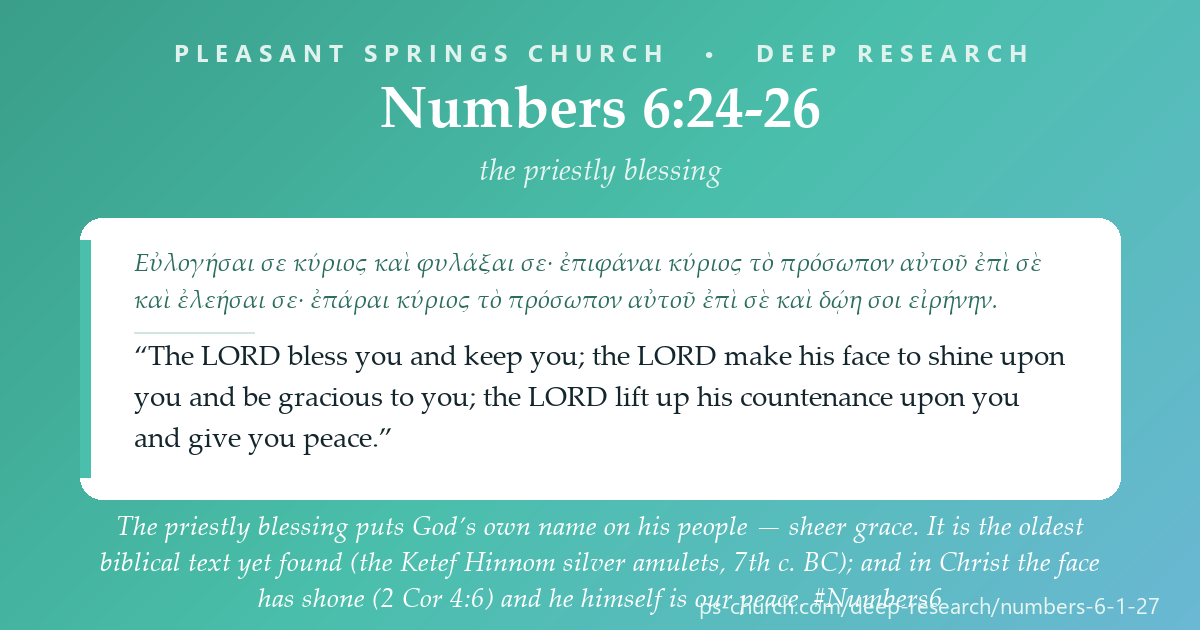
A man or a woman may make a special vow — the vow of a Nazirite — to set themselves apart to the Lord: no wine, no razor on the head, no touching the dead (6:1–21). And then the words the priests are to put on the people: “The Lord bless you and keep you; the Lord make his face to shine upon you and be gracious to you; the Lord lift up his countenance upon you and give you peace” (6:24–26). This study works Numbers 6 — a voluntary whole-life consecration open to all, and the priestly blessing that is the beating heart of Israel’s worship: God putting his name on his people, sheer grace, fulfilled in Christ. See the method →
Numbers 6:2–27 (selections)
Hebrew · LXX · ESVThe Shape of the Passage
Sequence · ascending parallelismNumbers 6 sits in the opening block of the book — the census and camp ordered around God’s dwelling (chs 1–2), the Levites set apart (chs 3–4), and the holiness of the camp (ch 5). Here consecration reaches beyond the priesthood to any Israelite who will vow it, and the chapter closes with the blessing that seals the whole arrangement — God putting his name on his people — just before the leaders bring their offerings (ch 7).
Author
The Torah of Moses gathers, in a single chapter, a striking pair: a law for the voluntary Nazirite vow (6:1–21) and the priestly blessing the sons of Aaron are to speak over Israel (6:22–27). The book of Numbers is organizing a redeemed people around the tabernacle at the camp’s center; having set apart the tribe of Levi to serve, the Torah now opens a door for every Israelite — man or woman — to draw near in a deeper, whole-life consecration, and then puts on the priests’ lips the words that name Israel as blessed and kept.
Two movements, one aim. The Nazirite’s three abstentions (the vine, the razor, the dead) make a walking parable of set-apartness; the blessing makes audible the grace that set-apartness rests upon. Both point past themselves — the total consecration Israel could only picture, and the shining of God’s face they could only ask for, the New Testament finds fulfilled in Christ.
Audience
Israel — the whole congregation, not only the priests. The vow is explicitly open to “a man or a woman” (6:2): consecration is not the preserve of a caste but a devotion any believer may take up. And the blessing is for “the people of Israel” (6:23) — it made the ordinary worshiper the recipient of God’s named favor, the high point of the gathering.
How they heard it. To a people camped in the wilderness, the Nazirite said: holiness is not less than the priesthood but is open to you too, if you will vow it. And the blessing said something even greater — that the God at the center of the camp would shine his face on them and give them peace. It is the oldest biblical text yet recovered (the Ketef Hinnom silver amulets), a sign of how early and how deeply Israel treasured these words.
Orient on the Nazirite vow, consecration, blessing, and the divine name.
Search by topic: Nazirite, vow, consecration / holiness, priestly (Aaronic) blessing, benediction, name of God, peace (shalom).
Which articles are relevant?
- Anchor Bible Dictionary — “Nazirite,” “Vow,” “Blessing,” “Priestly Benediction,” “Name.”
- Dictionary of the OT: Pentateuch — “Nazirite,” “Vows,” “Holiness,” “Blessings and Curses,” “Priests and Levites.”
- NIDOTTE / TDOT — נָזִיר (nāzîr, consecrated one), נֵזֶר (nēzer, consecration/crown), נֶדֶר (neder, vow), בָּרַךְ (bāraḵ, bless), שָׁלוֹם (šālôm, peace).
Bibliography surfaced:
- Gordon Wenham (TOTC), Timothy Ashley (NICOT), Dennis Cole (NAC), Baruch Levine (AB) on Numbers.
- Studies of the Nazirite vow (its three prohibitions and the hair as sign) and of the priestly blessing (structure, and the Ketef Hinnom amulets).
- Beale & Carson, Commentary on the NT Use of the OT (Luke; 2 Corinthians; Galatians; Ephesians).
Vows, uncut hair, and a blessing older than any Bible manuscript.
Read the Nazirite vow against ancient vow-and-consecration practice, weigh the hair as sign, then follow the priestly blessing to the oldest inscription of Scripture and on to Christ.
Which parallels shed light on religion and worldview?
Vows and consecrated hair. The ancient world knew vows of dedication and the leaving of hair uncut as a sign of a person set apart for a god or for a season of devotion. Israel’s Nazirite shares this cultural furniture but reframes it: the vow is made to the Lord alone, it is voluntary and open to any Israelite, and its abstentions carry a moral and symbolic weight — the vine renounced (perhaps as a mark of simplicity and undivided devotion), the uncut hair as the visible נֵזֶר (nēzer, “consecration”) worn on the head, and separation even from the dead, so that the Nazirite’s holiness resembled the high priest’s (cf. Lev 21:11).
The blessing on silver. In two tiny rolled silver amulets found at Ketef Hinnom in Jerusalem (dated to the late seventh / early sixth century B.C., before the exile), archaeologists recovered a version of this very blessing — “the Lord bless you and keep you… make his face shine.” It is the oldest portion of biblical text ever found, centuries older than the Dead Sea Scrolls, worn as a word of protection over a body in the grave — a witness to how early and how personally Israel held these words.
- Ketef Hinnom silver amulets (c. 600 B.C., pre-exilic — archaeological witness) — two inscribed silver scrolls bearing a form of the priestly blessing: the oldest known text of Scripture.
- Mishnah, Nazir (rabbinic-era — a witness, not Scripture) — the whole tractate works out the law of the Nazirite vow; Sotah and Tamid touch the blessing in temple worship.
- Josephus, Antiquities 4.72; 19.294; Philo (Second-Temple — witnesses, not Scripture) — describe Nazirite vows and the shaving-and-offering at their close, still practiced in the first century.
- Dead Sea Scrolls (Second-Temple — witnesses, not Scripture) — preserve Numbers and reflect the priestly blessing in liturgy (e.g. the community’s blessings in 1QS).
The priestly blessing asks God to make his face shine and to give peace — and the New Testament sees both granted in Christ. Paul writes that “God, who said, ‘Let light shine out of darkness,’ has shone in our hearts to give the light of the knowledge of the glory of God in the face of Jesus Christ” (2 Cor 4:6): the shining face of Numbers 6 has a name. He is himself “our peace” (Eph 2:14), the εἰρήνη the blessing pronounced. And the Nazirite’s whole-life set-apartness — consecration open to every Israelite — anticipates the total devotion asked of all God’s people: “present your bodies as a living sacrifice, holy and acceptable to God” (Rom 12:1). In Christ the blessing of Abraham comes at last to all (Gal 3:14). We hold this as the New Testament’s own reading of the shadow — devotional analogy, not a flattening of the plain sense of Numbers.
The vocabulary of consecration, vow, blessing, and the shining face.
Watch nazir (the consecrated one) and his nezer (the crown of hair) in the vow, then barak (bless), panim (face), and shalom (peace) in the benediction.
“Nazirite” — a “consecrated / separated one,” from nāzar, to set apart or dedicate. Not a priest by birth but any Israelite who vows a season (or life) of special devotion; the same root names the untrimmed vine left “consecrated” in the sabbatical year (Lev 25:5,11).
“Consecration / crown” — the very word for the uncut hair, which is the Nazirite’s nēzer upon the head (6:7); the same term names the golden diadem of the high priest and the king’s crown. The hair is worn like a crown of devotion.
“Vow” — a freely-made promise to God (LXX εὐχή). The Nazirite vow is voluntary: no one is born to it or commanded into it; it is devotion offered, not duty imposed.
“To bless” — yəḇāreḵəḵā, “may (the Lord) bless you” (LXX εὐλογέω). The blessing both opens (6:24) and closes (6:27) the benediction: God himself is its source — “I will bless them.”
“Face / countenance” — God’s face is asked to “shine” (6:25) and to be “lifted up” toward the worshiper (6:26; LXX πρόσωπον): idioms for favor, welcome, and personal attention — the opposite of a hidden face.
“Peace / wholeness” — the blessing’s climax (LXX εἰρήνη): not merely absence of conflict but flourishing, completeness, right relation with God — the sum of every good the blessing asks.
How the New Testament takes up these themes:
- Luke 1:15; Acts 18:18; 21:23–24 — John the Baptist set apart from wine like a Nazirite; Paul cuts his hair for a vow and later joins four men completing theirs: the vow still lived in the first century.
- Romans 12:1 — “present your bodies as a living sacrifice, holy and acceptable to God”: the Nazirite’s whole-life consecration asked now of every believer.
- 2 Corinthians 4:6 — God has “shone in our hearts… in the face of Jesus Christ”: the shining face of the blessing, given a name.
- Ephesians 2:14; Galatians 3:14 — Christ “is our peace”; in him “the blessing of Abraham” comes to all — the benediction’s shalom and blessing fulfilled.
From the vow and the blessing across the canon.
Trace the Nazirite through Israel’s history and the priestly blessing from the wilderness to the New Testament’s shining face and peace.
Which cross-references matter?
- Judges 13:2–7 (Samson) · 1 Samuel 1:11 (Samuel) · Amos 2:11–12 — lifelong Nazirites raised up by God; the vow lived out in Israel’s story.
- Leviticus 21:10–12 — the high priest, like the Nazirite, must not go near the dead: the Nazirite’s holiness echoes the priest’s (see Leviticus 21).
- Numbers 3:12–13; 8:14–19 — the Levites taken in place of the firstborn, wholly given to God: consecration and belonging run through these chapters (see Numbers 3–4).
- Psalm 4:6; 67:1; 80:3,7,19; 119:135 — Israel prays the blessing back to God: “let the light of your face shine on us” — the benediction became the heartbeat of her worship.
- 2 Corinthians 4:6; Ephesians 2:14; Galatians 3:14 — the shining face, the peace, and the blessing of Abraham fulfilled in Christ (see Ephesians 2).
The priestly blessing is not magic but grace put into words: three times it names the Lord, and God explains why — “so shall they put my name upon the people of Israel, and I will bless them” (6:27). To bear God’s name is to belong to him and to be under his blessing — a thread the New Testament gathers up when believers are baptized “into the name” and called by it. The blessing’s two great petitions — a shining face and peace — are precisely what the apostles announce as arrived in Christ: the glory of God seen “in the face of Jesus Christ” (2 Cor 4:6), and Jesus himself “our peace” who has broken down the dividing wall (Eph 2:14). The Nazirite, meanwhile, pictured a consecration open to all; in Christ that door stands wide, and the whole people is called to the set-apart life the vow once dramatized (Rom 12:1). What Aaron pronounced, the gospel bestows.
The scholarship on the Nazirite and the priestly blessing.
Ashley, Wenham, Cole, and Levine for Numbers; the Ketef Hinnom studies for the blessing; Beale & Carson for the New Testament use.
Commentaries & studies:
- Timothy R. Ashley, The Book of Numbers (NICOT); Gordon J. Wenham, Numbers (TOTC); Dennis T. Cole (NAC); Baruch A. Levine, Numbers (Anchor).
- Studies of the Nazirite vow and of the priestly blessing’s structure; Gabriel Barkay et al. on the Ketef Hinnom silver amulets (the oldest biblical text).
- G. K. Beale & D. A. Carson, eds., Commentary on the New Testament Use of the Old Testament.
Interpretation notes worth keeping:
- The vow is voluntary and open to all. “A man or a woman” (6:2): the Nazirite is not a clergy class but a lay devotion, freely undertaken — usually for a set time, sometimes (Samson, Samuel) for life. Its point is undivided consecration, not asceticism for its own sake.
- The hair is a sign, not the substance. The uncut hair is the visible nēzer of a vow made to God; at the vow’s end it is shaved and offered (6:18). The New Testament carries forward the consecration, not the ritual (Paul can take or complete a vow, Acts 18:18; 21:23–24, without binding the church to it).
- The blessing is grace, not incantation. Its power is God’s, not the priest’s: “I will bless them” (6:27). The threefold naming of the Lord is read by the church as fitting the Triune God, but the text’s own claim is simpler and sure — God putting his name on his people in sheer favor.
- Handle the Christ-connections as the NT does. The shining face (2 Cor 4:6), our peace (Eph 2:14), and the blessing of Abraham (Gal 3:14) are the apostles’ own readings — devotional fulfillment, held without erasing the plain sense of Numbers 6.
From the vow of the few to the blessing on the many.
Name what you learned, why it matters, and one concrete response.
What should we carry away — and do?
- Consecration is offered, not merely commanded. The Nazirite shows that a deeper devotion to God is open to any believer who will vow it — and the New Testament asks that whole-life set-apartness of us all (Rom 12:1).
- The blessing is sheer grace. “The Lord bless you and keep you…” — God puts his own name on his people and promises, “I will bless them.” We do not earn the shining face; we receive it.
- The face has shone. What Aaron could only ask, the gospel announces as given: the glory of God “in the face of Jesus Christ” (2 Cor 4:6), and Christ himself our peace (Eph 2:14).
Step in response: speak the blessing this week — over your children, your household, a friend — slowly and by name, as a gift you are handing on, not a formula you are reciting. And ask what one area of your life God is calling you to consecrate more fully to him, and take a first concrete step to set it apart.
Numbers 6:24–26 · to share
LXX + ESVEvery Deep Research page traces its passage across the whole sweep — the Old Testament, the Second-Temple world between the testaments (historical witnesses, not Scripture), and the New Testament. Follow the thread:
Pleasant Springs Church — Deep Research
Research method after Michael S. Heiser’s Bible Research Method (examine dictionaries → ancient literature → important words → textual connections → academic publications → share), with the Pleasant Springs “Author & Audience” foundation. Scripture set in the Hebrew, the Greek editions named on each page and the ESV (Old Testament), and the Greek New Testament and the ESV (New Testament), per the practice of Pleasant Springs Church. Numbers 6 research grounded in Ashley, Wenham, Cole, and Levine, with Beale & Carson on the New Testament use; the Ketef Hinnom silver amulets (c. 600 B.C., the oldest biblical text yet found) and Second-Temple / rabbinic witnesses (the Mishnah’s Nazir and Sotah, Josephus, Philo, and the Dead Sea Scrolls), all read as witnesses, not Scripture. The Christ-connections — the shining face (2 Cor 4:6), our peace (Eph 2:14), and the blessing of Abraham (Gal 3:14) — are held as the New Testament’s own devotional readings, without erasing the plain sense of the passage.
Scripture quotations marked ESV are from the ESV® Bible (The Holy Bible, English Standard Version®), © 2001 by Crossway, a publishing ministry of Good News Publishers. ESV Text Edition: 2016. Used by permission. All rights reserved. The ESV text may not be quoted in any publication made available to the public by a Creative Commons license, and the ESV may not be translated in whole or in part into any other language. www.esv.org
|
Did this study bless you today? 💚 Give to Support PS Church100% of gifts go to the General Fund — thank you. |