On the day the tabernacle was set up and anointed, the twelve tribal leaders brought their gifts — first wagons and oxen to carry God’s house, then, over twelve unhurried days, each leader in turn brought the same dedication offering, recorded in full. No tribe greater, none lesser: joyful, ordered, generous giving, and every leader honored alike. And when it was all given, the chapter ends with one quiet sentence — Moses heard the voice, speaking from above the mercy seat, between the cherubim (7:89). This study works Numbers 7:1–89, the longest chapter in the book, whose goal is that God would dwell among his people and speak. See the method →
Numbers 7:1–89 (selections)
Hebrew · LXX · ESVThe Shape of the Passage
Parallel panelsNumbers 7 sits at the dedication of the tabernacle, just after the ordering of the camp (chs 1–2), the Levites who carry it (chs 3–4), the holiness of the camp (ch 5), and the Nazirite vow and priestly blessing (ch 6). The glory has filled the tent (Exod 40); now God’s people bring their gifts — and God speaks.
Author
The Torah of Moses places this chapter at the joyful inauguration of Israel’s worship. The tabernacle Exodus commanded and built has been raised, anointed, and filled with glory (Exod 40:34); Numbers now records the response of the people through their twelve tribal leaders (nesiʾim). The chapter falls out of strict chronology — it looks back to “the day” the tabernacle was set up (7:1; cf. Exod 40:17) — and is placed here, at the head of the wilderness journey, to show a people ordered around God’s dwelling and glad to give to it.
Deliberate, unhurried repetition. The offering of each leader is identical — a silver plate and basin, a gold dish of incense, and animals for burnt, sin, and peace offerings — and the text records all twelve in full, one per day (7:12–83), before totaling them (7:84–88). This is not padding. Every leader’s day mattered and was written down; every tribe is honored with the same careful words. The chapter’s very length is a form of honor.
Audience
Israel — a redeemed people, newly ordered around the tent of meeting, learning what it means that a holy God dwells in their midst. The wagons and oxen are given for a practical, generous end: to carry the tabernacle on the march, distributed to the Levites “according to his service” (7:5–9). The giving comes after redemption and after God’s own initiative in building his house — it is grateful response, not a bargain struck with heaven.
How they heard it. The reader who sits patiently through twelve identical days is meant to feel the equal dignity of every tribe before God — no partiality, no favorite. And the chapter drives toward a single quiet climax: when it is all set up and given, Moses hears a voice (7:89). The point of the tabernacle, the offerings, and the whole ordered camp is that God would dwell among his people and speak with them from the mercy seat — the God who is present, and not silent.
Orient on the tabernacle dedication, the tribal leaders, offerings, and the mercy seat.
Search by topic: tabernacle, dedication, offering / gift, tribal leader (nasi), mercy seat, ark of the covenant, cherubim.
Which articles are relevant?
- Anchor Bible Dictionary — “Tabernacle,” “Ark of the Covenant,” “Mercy Seat,” “Cherubim,” “Sacrifice and Offerings.”
- Dictionary of the OT: Pentateuch — “Numbers, Book of,” “Tabernacle,” “Priests and Levites,” “Sacrifices and Offerings,” “Presence of God.”
- NIDOTTE / TDOT — נָשִׂיא (nāśîʾ, leader/chief), קָרְבָּן (qorbān, offering), חֲנֻכָּה (ḥănukkāh, dedication), כַּפֹּרֶת (kappōreṯ, mercy seat).
Bibliography surfaced:
- Gordon Wenham (TOTC), Timothy Ashley (NICOT), Dennis Cole (NAC), Dennis Olson (Interpretation), and Baruch Levine (AB) on Numbers.
- Studies of the tabernacle and the ark-and-cherubim throne; the kapporet as “place of atonement.”
- Beale & Carson, Commentary on the NT Use of the OT (Romans 3; Hebrews).
Temple dedications, gifts of the leaders, and the enthroned-between-cherubim God.
Read the dedication and its gifts against ancient temple-founding rites and cherub-throne imagery, then follow the mercy seat and the speaking voice to Christ.
Which parallels shed light on religion and worldview?
Dedicating a god’s house. Across the ancient Near East, the founding and dedication of a temple was a great public event, and rulers and notables presented lavish gifts. Israel shares the cultural form — a house for the deity, dedicated with offerings from the leaders — but reframes it: the Lord himself gave the pattern for his dwelling, the gifts are received to serve the tent (7:5), and the twelve tribes give equally, none currying favor above the rest. The giving is response to a God who has already redeemed and drawn near, not a transaction to secure his goodwill.
The throne between the cherubim. Ancient kings and gods were pictured enthroned above winged guardian figures; carved cherubim flanked thrones and sanctuaries across the region (ANE iconography of the cherub-throne). Israel’s ark, with its gold kapporet and two cherubim, uses this visual language — yet there is no image of the deity on the seat. The throne is empty to the eye; the invisible Lord is enthroned “between the cherubim” (cf. 1 Sam 4:4; Ps 80:1), and from that seat he speaks (7:89) — a word, not an idol.
- ANE temple-dedication texts and cherub-throne iconography (ANET — witnesses, not Scripture) — gifts of rulers at a temple’s founding, and gods enthroned above winged guardians: shared cultural furniture, reframed around the imageless, speaking Lord.
- Josephus, Antiquities 3.6–3.8 (Second-Temple — a witness, not Scripture) — describes the tabernacle, the ark and its cover, and the offerings of the tribal leaders at the dedication.
- Philo, On the Life of Moses 2; Questions on Exodus 2 (Second-Temple — a witness, not Scripture) — allegorizes the mercy seat and the two cherubim as God’s powers of mercy and rule meeting where he speaks.
- Mishnah, Tamid (rabbinic-era) — the ordered daily service of the sanctuary; the dedication of the altar (ḥanukkat ha-mizbeḥ) later names the feast of Dedication (1 Macc 4:52–59; John 10:22).
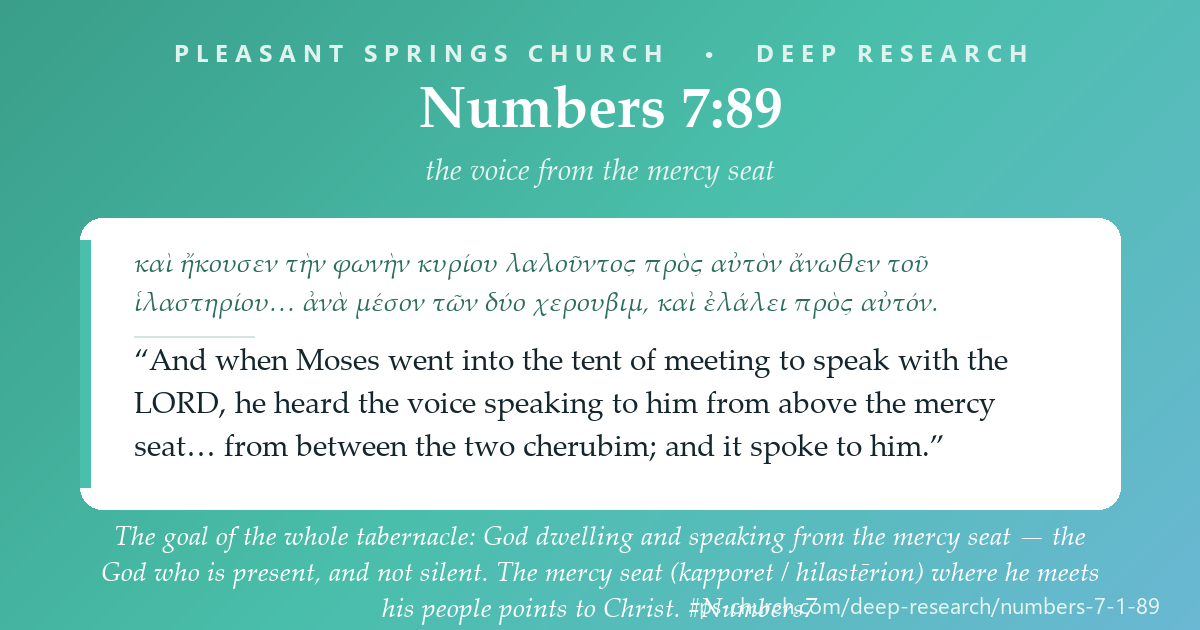
The whole chapter drives toward one sentence: “when Moses went into the tent of meeting to speak with the Lord, he heard the voice… from above the mercy seat… between the two cherubim” (7:89). This is the promise of Exodus kept — “There I will meet with you, and… I will speak with you” from above the mercy seat (Exod 25:22) — the goal of the tabernacle, the offerings, and the ordered camp: that God would dwell and speak. The LXX calls that mercy seat ἱλαστήριον, the same word Paul uses of Jesus — “whom God put forward as a propitiation (ἱλαστήριον) by his blood” (Rom 3:25; cf. Heb 9:5). As a devotional reading grounded in the New Testament’s own words: the place where atoning blood met the presence of God, and from which God spoke, points to Christ — the true meeting-place of God and sinners, and the Word by whom “God… has spoken to us” at last (Heb 1:1–2). The God who is there is not silent.
The vocabulary of the leaders, their gifts, the dedication, and the speaking voice.
Watch the nasi (leader) draw near with a qorban (gift), the chanukkah (dedication) of the altar, and the qol (voice) from the kapporet (mercy seat).
“Leader / chief” — the head of a tribe (LXX ἄρχων). The twelve nesiʾim represent all Israel in giving; each brings the same gift on his own day, so the whole people is honored through its leaders.
“Offering / gift” — from the root “to draw near” (qāraḇ): that which is brought near to God (LXX δῶρον, gift). Worship is coming near with a gift — here, glad and generous.
“Dedication” — the setting-apart of the altar for holy use (LXX ἐγκαινισμός). The same word later names the Maccabean re-dedication and the feast of Dedication / Hanukkah (John 10:22).
“Mercy seat” — the gold cover of the ark where atoning blood was sprinkled (Lev 16); the LXX calls it ἱλαστήριον, the word Paul applies to Christ (Rom 3:25; cf. Heb 9:5). God speaks from above it.
“Voice / sound” — Moses “heard the voice” (LXX τὴν φωνήν) speaking (middabbēr) to him. The tabernacle’s goal is not silence or spectacle but a God who speaks with his mediator.
How the New Testament reuses this chapter’s images:
- Romans 3:24–26 — Jesus “whom God put forward as a propitiation (ἱλαστήριον) by his blood”: the true mercy seat, the LXX’s word for the kapporet of 7:89.
- Hebrews 9:5; 1:1–2 — “above it were the cherubim of glory overshadowing the mercy seat”; and the God who spoke of old “has spoken to us by his Son.”
- 2 Corinthians 9:7; 8:1–5 — “God loves a cheerful giver”: the joyful, generous giving of Numbers 7 as a pattern of grateful worship, not a transaction.
- Acts 10:34; Romans 2:11 — “God shows no partiality”: the equal honor of every tribe in Numbers 7, written large in the gospel.
From the mercy seat and the leaders’ gifts to the God who meets and speaks.
Trace the dwelling-and-speaking of God from Exodus, through the mercy seat of Leviticus 16, to the propitiation of Romans 3 and the Son who speaks in Hebrews.
Which cross-references matter?
- Exodus 25:17–22; 40:34–38 — the mercy seat and the promise “there I will meet with you… I will speak with you,” and the glory that filled the tent (see Exodus 40).
- Exodus 29:42–46 — “I will meet with the people… and I will dwell among the people of Israel and will be their God”: the goal Numbers 7 reaches (see Exodus 29).
- Leviticus 16:2,14–15 — blood sprinkled on the mercy seat on the Day of Atonement: why the kapporet is the place of meeting (see Leviticus 16).
- Romans 3:21–26 — Christ the ἱλαστήριον, the mercy seat where God’s righteous mercy meets sinners (see Romans 3:21–26).
- Hebrews 9:5; 1:1–2 — the cherubim over the mercy seat, and the God who “has spoken to us by his Son” (see Hebrews 1:1–4).
The New Testament reads the kapporet — the mercy seat of 7:89, where atoning blood met the presence of God and from which God spoke — as a God-given picture that Christ fulfills. Paul reaches for the LXX’s own word for it, ἱλαστήριον, and sets Jesus in that place: God put him forward as the propitiation, so that God might be “just and the justifier of the one who has faith in Jesus” (Rom 3:26). Hebrews walks through the same furniture — the ark, the cherubim, the mercy seat (9:5) — and then announces that the God who once spoke from between the cherubim “has spoken to us by his Son” (1:1–2). Held as the New Testament’s own reading, not allegory imposed: Numbers 7 ends where the gospel begins — at the meeting-place of God and sinners, and with a God who breaks the silence to speak.
The scholarship on Numbers 7, the tabernacle, and the mercy seat.
Wenham, Ashley, and Levine for Numbers; the tabernacle and ark-throne studies; Beale & Carson for the New Testament use.
Commentaries & studies:
- Gordon J. Wenham, Numbers (TOTC); Timothy R. Ashley, The Book of Numbers (NICOT); Dennis T. Olson and Baruch Levine (AB) on Numbers.
- Studies of the tabernacle, the ark-and-cherubim throne, and the kapporet / ἱλαστήριον as “place of atonement.”
- G. K. Beale & D. A. Carson, eds., Commentary on the New Testament Use of the Old Testament (Romans; Hebrews).
Interpretation notes worth keeping:
- The repetition is honor, not padding. Recording each of the twelve identical offerings in full (7:12–83) dignifies every tribe equally — God shows no partiality; each leader’s day is written down and remembered.
- Grateful gift, not a bargain. The giving comes after redemption and after God’s own initiative in giving his dwelling; it is joyful, ordered, generous response to grace — the New Testament’s “cheerful giver” (2 Cor 9:7), never a prosperity transaction.
- The empty throne that speaks. Unlike the enthroned idols of the nations, the mercy seat bears no image; the invisible Lord is enthroned between the cherubim and, crucially, speaks (7:89) — presence and word, not spectacle.
- 7:89 as the chapter’s telos. The single verse of narrative after the long list is the point of it all: God dwelling and speaking from the mercy seat, the kapporet the New Testament names of Christ (Rom 3:25; Heb 9:5).
From the leaders’ equal gifts to the voice that still speaks.
Name what you learned, why it matters, and one concrete response.
What should we carry away — and do?
- Every tribe honored the same. Twelve identical offerings, recorded in full — God shows no partiality. Your gift and your day matter to him no less than anyone’s; he counts and remembers each.
- Give as grateful response. The leaders gave after God had redeemed and drawn near, and gave to serve his house. Generous, joyful, ordered giving is worship — a “cheerful giver” answering grace, not buying favor.
- God dwells and speaks. The whole chapter ends with a voice from the mercy seat. The God who is there is not silent — and he has spoken finally in his Son, who is himself our mercy seat (Rom 3:25; Heb 1:1–2).
Step in response: bring a real gift this week — of money, time, or service — not to earn God’s favor but in glad thanks that he has already drawn near. Then go to the true mercy seat: open the Word and let the God who dwells among his people speak to you, as he spoke to Moses.
Numbers 7:89 · to share
LXX + ESVEvery Deep Research page traces its passage across the whole sweep — the Old Testament, the Second-Temple world between the testaments (historical witnesses, not Scripture), and the New Testament. Follow the thread:
Pleasant Springs Church — Deep Research
Research method after Michael S. Heiser’s Bible Research Method (examine dictionaries → ancient literature → important words → textual connections → academic publications → share), with the Pleasant Springs “Author & Audience” foundation. Scripture set in the Hebrew, the Greek editions named on each page and the ESV (Old Testament), and the Greek New Testament and the ESV (New Testament), per the practice of Pleasant Springs Church. Numbers 7 research grounded in Wenham, Ashley, Olson, and Levine, with Beale & Carson on the New Testament use (Romans; Hebrews); ANE temple-dedication and cherub-throne background (ANET); and Second-Temple witnesses (Josephus, Philo, the Mishnah), read as witnesses, not Scripture. Christ-typology is held as the New Testament’s own reading of the mercy seat (Rom 3:25; Heb 9:5) and labeled as such; the giving of the leaders is read as grateful worship, not a prosperity transaction.
Scripture quotations marked ESV are from the ESV® Bible (The Holy Bible, English Standard Version®), © 2001 by Crossway, a publishing ministry of Good News Publishers. ESV Text Edition: 2016. Used by permission. All rights reserved. The ESV text may not be quoted in any publication made available to the public by a Creative Commons license, and the ESV may not be translated in whole or in part into any other language. www.esv.org
|
Did this study bless you today? 💚 Give to Support PS Church100% of gifts go to the General Fund — thank you. |