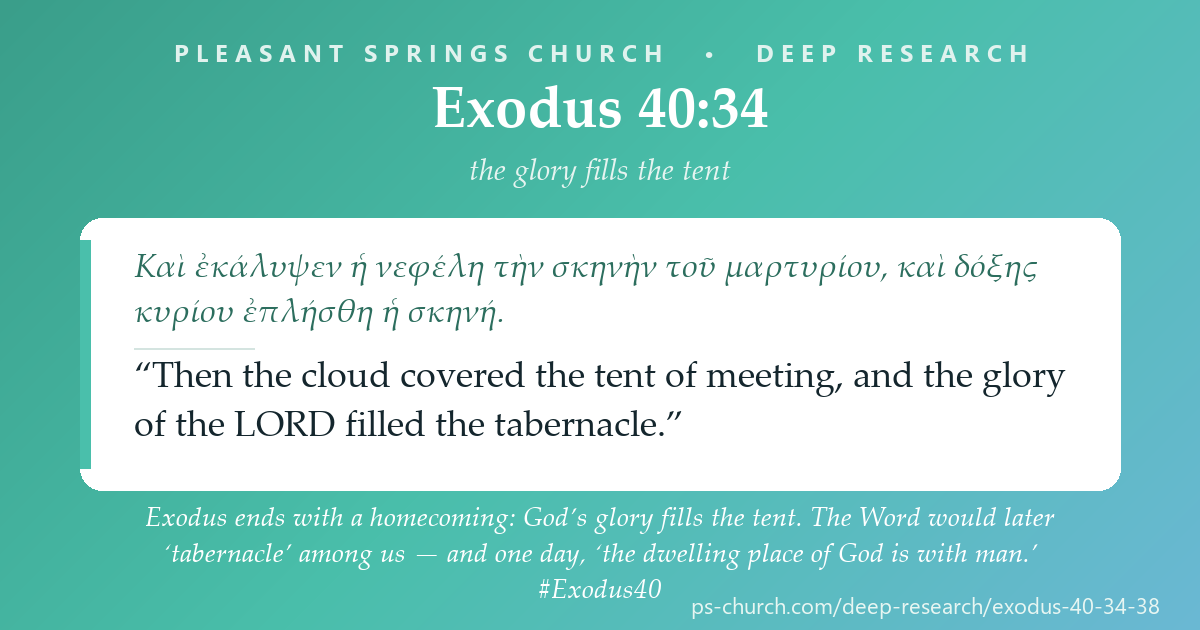
Exodus ends not with a law but with a homecoming: “the cloud covered the tent of meeting, and the glory of the Lord filled the tabernacle.” The God who rescued Israel from Egypt now comes to dwell in their midst. The Hebrew word for tabernacle, mishkan, means “dwelling” — and John will use its very echo for Jesus: the Word “tabernacled among us, and we have seen his glory.” This study works Exodus 40 from the wilderness tent to Revelation’s “the dwelling place of God is with man.” See the method →
Exodus 40:34–38 (selections)
Hebrew · LXX · ESVThe Shape of the Passage
Parallel panelsThe same Author and audience as Exodus 33–34 — and now the prayer “let your presence go with us” is answered: God comes to dwell.
Author
The Torah of Moses brings the book of Exodus to its climax. The tabernacle has been built exactly as commanded (chs. 25–40), and in the final scene the cloud descends and the glory fills it. This is the goal of the whole exodus: not merely rescue from Egypt but rescue to God’s presence. The plot that began in Genesis 3 with humanity driven from God’s presence takes a decisive turn — God moves back in with his people.
A garden, a mountain, a tent. The glory that blazed atop Sinai (24:16–17) now settles over the tent; the presence once confined to the mountain travels with Israel. The tabernacle is a portable Sinai, a mini-Eden, a promise of the day when God’s dwelling will fill not one tent but the whole creation (Rev 21:3).
Audience
Israel — a redeemed, forgiven, covenant people, now given the astonishing gift of God’s abiding presence in their midst. The same cloud that led them from Egypt now rests on the tent at the center of the camp; God is not distant but resident. Even Moses cannot enter while the glory fills it (40:35) — the presence is real, holy, and near.
How they heard it. The cloud by day and fire by night (40:38) meant guidance and companionship for every stage of the journey. To a wilderness people this was everything: the God of Sinai goes with us. Israel would long for that presence to fill the temple (1 Kgs 8), grieve when it departed (Ezek 10), and hope for its return — a hope answered when the Word became flesh and “tabernacled among us.”
Orient on the tabernacle, the glory, and the dwelling of God.
Search by topic: tabernacle, glory (kavod), presence of God, cloud, shekinah.
Which articles are relevant?
- Anchor Bible Dictionary — “Tabernacle,” “Glory (of God),” “Presence, Divine,” “Cloud.”
- Dictionary of the OT: Pentateuch — “Tabernacle,” “Glory,” “Presence of God,” “Sacred Space.”
- NIDOTTE / TDOT — מִשְׁכָּן (miškān, dwelling), שָׁכַן (šāḵan, to dwell), כָּבוֹד (kāḇôḏ, glory), עָנָן (ʿānān, cloud).
Bibliography surfaced:
- Childs (OTL), Durham (WBC), Stuart (NAC) on Exodus.
- G. K. Beale, The Temple and the Church’s Mission; T. D. Alexander, From Eden to the New Jerusalem.
- Frank Moore Cross on the tabernacle; Craig Koester, The Dwelling of God.
Temples, dwelling-gods, and the God who moves in.
Read the tabernacle against ANE temple ideas, then follow the “dwelling” word to its New Testament goal.
Which parallels shed light on religion and worldview?
A god’s house. In the ancient Near East, a temple was a god’s dwelling, where its glory or presence was thought to reside, often marked by cloud, radiance, and an image of the deity in the innermost room. Israel’s tabernacle shares the shape — a holy tent, an innermost Most Holy Place — but with a startling difference: no image stands in the center, only the ark and the mercy seat, for the living God will not be pictured. His real presence, not a statue, fills the tent.
Dwelling with people, not just among things. The point is relationship: the Creator chooses to live with a redeemed people. The Greek translators render “tabernacle” with σκηνή (skēnē, tent); at 40:35 the cloud “overshadowed” it (ἐπεσκίαζεν) — the same verb used at the annunciation, when “the power of the Most High” would overshadow Mary (Luke 1:35), and of the cloud on the mount of Transfiguration (Mark 9:7). The vocabulary of God’s dwelling presence runs straight from the tent to the incarnation.
- ANE temple ideology — the temple as a god’s house and footstool, filled with its glory; the shared shape Israel adopts, minus the idol.
- Sirach 24:4, 8–10 (Apocrypha — a witness, not Scripture) — Wisdom “made her dwelling” on high (κατεσκήνωσα, 24:4) and is told to “encamp in Jacob” (κατασκήνωσον, 24:8), ministering in the holy tent: a striking pre-Christian echo of John 1:14.
- Philo, Life of Moses 2; Questions on Exodus 2 — the tabernacle read as a copy of the cosmos and of heavenly realities (cf. Heb 8:5).
- 1 Kings 8:10–11; 2 Chronicles 5–7 — the same glory-cloud fills Solomon’s temple: the pattern repeated.
Exodus ends with God’s glory filling a tent; John’s Gospel opens by announcing where that glory finally came to rest: “the Word became flesh and dwelt among us” — the Greek ἐσκήνωσεν, “pitched his tent,” “tabernacled” — “and we have seen his glory” (John 1:14). Jesus is the true tabernacle: in him “the whole fullness of deity dwells bodily” (Col 2:9), and the glory once veiled in cloud walks among us in a human life. From there the trajectory runs to the church, “a dwelling place for God by the Spirit” (Eph 2:22), and on to the end, when a great voice announces, “Behold, the dwelling place of God is with man. He will dwell with them” (Rev 21:3). The tent in the wilderness was the first installment of a promise the whole Bible is reaching toward: God, at home with his people forever.
The vocabulary of dwelling, glory, and cloud.
Watch the “dwelling” (mishkan) that becomes John’s “tabernacled,” and the glory that fills it.
“Tabernacle” — lit. “dwelling,” from šāḵan, to dwell; the root behind shekinah. The LXX renders it σκηνή (tent) — the word behind John’s ἐσκήνωσεν (John 1:14).
“The glory of the Lord” — the weighty, radiant presence that filled Sinai (24:16) and now the tent; it will fill Solomon’s temple (1 Kgs 8) and, at last, the whole earth (Num 14:21; Hab 2:14).
“Settled / dwelt” — the cloud settled on the tent. God does not merely visit; he takes up residence with his people.
“Cloud” — the pillar that led Israel from Egypt (13:21) now rests on the tent: guidance and presence, “cloud by day and fire by night.”
How the New Testament reuses the dwelling of God:
- John 1:14 — “the Word became flesh and dwelt (ἐσκήνωσεν, tabernacled) among us, and we have seen his glory”: the true tabernacle.
- Colossians 2:9; Hebrews 8:1–5; 9:11 — in Christ “the whole fullness of deity dwells bodily”; the earthly tent a “copy and shadow” of the true.
- 1 Corinthians 3:16; 2 Corinthians 6:16; Ephesians 2:21–22 — the church as God’s temple, “a dwelling place for God by the Spirit.”
- Revelation 21:3, 22 — “the dwelling place (σκηνή) of God is with man”; in the city there is no temple, “for its temple is the Lord God… and the Lamb.”
From the tent in the wilderness to God dwelling with man forever.
Trace the glory-filled dwelling from Sinai through the temple to the incarnation and the new creation.
Which cross-references matter?
- Exodus 24:16–17; 25:8–9 — the glory on Sinai and the command “let them make me a sanctuary, that I may dwell in their midst” (see Exodus 24).
- 1 Kings 8:10–11; Ezekiel 10; 43:1–5 — the glory fills the temple, departs in judgment, and returns: the presence given, lost, and restored.
- John 1:14; 2:19–21 — the Word “tabernacled,” and Jesus names his own body the true temple.
- Genesis 3:8–24 — humanity driven from God’s presence (see Genesis 3): the exile the tabernacle begins to reverse.
- Revelation 21:1–3, 22–23 — the dwelling of God with man, the whole city his sanctuary, lit by his glory.
G. K. Beale traces a single story from Eden to the New Jerusalem: God intends to dwell with his people and fill the earth with his glory. Eden was the first sanctuary; the tabernacle and temple were portable, provisional installments; the incarnation brought the true dwelling into the world (John 1:14; 2:21); the church became the Spirit’s temple (Eph 2:22); and the end is a city that is a temple, where “the dwelling place of God is with man” and no separate sanctuary is needed, “for its temple is the Lord God the Almighty and the Lamb” (Rev 21:22). Exodus 40 is a hinge in that story: the glory that filled a wilderness tent is the same glory that will one day fill all things — and it has already come near in Christ.
The scholarship on the tabernacle and the dwelling of God.
Beale and Alexander for the Eden-to-temple trajectory; the commentators for the tabernacle; Koester on the dwelling.
Commentaries & studies:
- Brevard Childs (OTL), John Durham (WBC), Douglas Stuart (NAC) on Exodus.
- G. K. Beale, The Temple and the Church’s Mission; T. D. Alexander, From Eden to the New Jerusalem.
- Craig R. Koester, The Dwelling of God: The Tabernacle in the Old Testament, Intertestamental Jewish Literature, and the New Testament.
Interpretation notes worth keeping:
- The book’s destination. Exodus climaxes not at the Red Sea or Sinai but here — God dwelling with his people. Rescue was always for presence.
- No image in the center. Unlike ANE temples, the Most Holy Place holds no idol — only the ark and mercy seat. The living God fills the tent by his own glory, never by a likeness.
- The dwelling word runs to Christ. The LXX σκηνή and John’s ἐσκήνωσεν are the same root: John consciously presents Jesus as the tabernacle where God’s glory now dwells.
From the glory-filled tent to God dwelling with you.
Name what you learned, why it matters, and one concrete response.
What should we carry away — and do?
- Rescue is for presence. God did not free Israel merely to leave Egypt but to bring them to himself and live among them. Salvation’s goal is God with us.
- Jesus is the true tabernacle. The glory that filled the tent now dwells bodily in Christ. To come to him is to come to where God has made his home.
- You are being made a dwelling. By the Spirit, the church is God’s temple (Eph 2:22). The presence that filled the tent now fills a people — and one day, the whole creation.
Step in response: live this week as one indwelt — God is not far off but near, at home in his people by the Spirit. Offer your ordinary space (your home, your work, your body) as a place where his presence is welcomed and made visible, until the day “the dwelling place of God is with man.”
Exodus 40:34 · to share
LXX + ESVEvery Deep Research page traces its passage across the whole sweep — the Old Testament, the Second-Temple world between the testaments (historical witnesses, not Scripture), and the New Testament. Follow the thread:
Pleasant Springs Church — Deep Research
Research method after Michael S. Heiser’s Bible Research Method (examine dictionaries → ancient literature → important words → textual connections → academic publications → share), with the Pleasant Springs “Author & Audience” foundation. Scripture set in the Hebrew, the Greek editions named on each page and the ESV (Old Testament), and the Greek New Testament and the ESV (New Testament), per the practice of Pleasant Springs Church. Exodus 40:34–38 research grounded in Childs, Durham, Stuart, Beale, Alexander, and Koester; ANE temple background; Second-Temple material per Sirach and Philo (read as witnesses, not Scripture).
Scripture quotations marked ESV are from the ESV® Bible (The Holy Bible, English Standard Version®), © 2001 by Crossway, a publishing ministry of Good News Publishers. ESV Text Edition: 2016. Used by permission. All rights reserved. The ESV text may not be quoted in any publication made available to the public by a Creative Commons license, and the ESV may not be translated in whole or in part into any other language. www.esv.org
|
Did this study bless you today? 💚 Give to Support PS Church100% of gifts go to the General Fund — thank you. |