A year out of Egypt, camped at Sinai, Israel is counted. The Lord commands a census — every man twenty and older “able to go to war,” numbered by name, tribe by tribe, 603,550 in all — while the Levites are set apart over the tabernacle (ch 1). Then the whole nation is arranged: twelve tribes by their standards in a fixed square — Judah east, Reuben south, Ephraim west, Dan north — with the tent of meeting and the Levites at the exact center (ch 2). This study works Numbers 1:1–2:34, the opening of Bemidbar (“in the wilderness”): a redeemed people counted, placed, and ordered around the presence of God. See the method →
Numbers 1:2–2:17 (selections)
Hebrew · LXX · ESVThe Shape of the Passage
Parallel panelsNumbers opens the fourth book of the Torah of Moses. The tabernacle has been built and filled with glory (Exodus 40); now, at Sinai, God organizes the redeemed people around that presence for the march to the promised land. The Levites who guard the sanctuary come next (Numbers 3–4), and the blessing God lays on the ordered people follows (Numbers 6).
Author
The Torah of Moses opens its fourth book — Hebrew Bemidbar, “in the wilderness”; Greek Arithmoi, “Numbers” — “in the wilderness of Sinai… on the first day of the second month, in the second year after they had come out of the land of Egypt” (1:1). The book is dated, placed, and ordered. Where Exodus built the dwelling and Leviticus taught how to draw near, Numbers sets the whole nation in motion: first it must be counted and arranged.
A designed order. Chapters 1–2 are deliberately architectural: a census of the twelve tribes (ch 1), the Levites set apart (1:47–53), then a camp laid out in a perfect square — three tribes to each side, standards flying, and the tent of meeting with the Levites at the exact center (ch 2). The repeated refrain seals it: “as the Lord commanded Moses, so they did” (2:33–34). This is not bureaucracy for its own sake; it is a portrait of a people whose entire life is oriented around the presence of God.
Audience
Israel on the threshold of the wilderness march — a redeemed people about to leave Sinai for Canaan, needing to know who they are and how they move. To be counted “by name, head by head” (1:2) told each Israelite that he was known, numbered, and given a place; to be arranged by tribe told the nation it was one host under one God. They are mustered as an army (“able to go to war,” 1:3) — yet an army that marches around a sanctuary, worship and warfare joined.
How they heard it. A former slave-people, freshly delivered, is here shaped into an ordered nation — the fulfillment of the promise that Abraham’s offspring would be as many as the stars (Gen 15:5). The great numbers are a sign of God’s multiplying faithfulness. And the shape of the camp preached a sermon every day: God is not on the edge of their life but at its center, and every tribe — not only the leaders — has a God-given place in his sight.
Orient on census, the tribes, the camp, standards, and the Levites.
Search by topic: census / numbering, tribes of Israel, camp / encampment, standard (degel), tent of meeting, Levites, wilderness.
Which articles are relevant?
- Anchor Bible Dictionary — “Numbers, Book of,” “Census,” “Tribes of Israel,” “Camp,” “Levites.”
- Dictionary of the OT: Pentateuch — “Numbers, Book of,” “Census,” “Tribes,” “Wilderness,” “Levites and Priests.”
- NIDOTTE / TDOT — פָּקַד (pāqaḏ, muster / number), דֶּגֶל (degel, standard), אֶלֶף (ʾelep̲, thousand / clan-unit), עֵדָה (ʿēḏāh, congregation).
Bibliography surfaced:
- Gordon Wenham (TOTC), Timothy Ashley (NICOT), Dennis Cole (NAC), Jacob Milgrom (JPS) on Numbers.
- Studies of the wilderness census and the ’elep problem; the arrangement of the camp and the tribal standards.
- Beale & Carson, Commentary on the NT Use of the OT (Revelation; Hebrews).
Musters, war-camps, and a tent at the center.
Read the census and camp against ancient military practice and the war-camps of the day, weigh the debated numbers, then follow “God at the center” to its horizon.
Which parallels shed light on religion and worldview?
Counting a people, mustering an army. Ancient states took censuses for taxation, labor, and war; the Mari letters (18th c. BC) describe a military muster (tēbibtum) of the tribes, and Egyptian and Mesopotamian kings numbered their fighting men. Israel’s census shares this furniture — men “able to go to war,” organized “company by company” — but its center of gravity is different: the count is taken at God’s command, each man is numbered by name before him, and the host exists to march around his dwelling, not merely to serve a king.
A tent at the heart of the camp. The layout of Numbers 2 — a rectangular camp with the divine tent at the exact center, tribes ranged by their standards on four sides — has a striking parallel in the Egyptian military war-camp, such as Ramesses II’s camp at Kadesh, where the pharaoh’s tent stood at the center of an ordered rectangle of troops. Scholars (e.g. Michael Homan, Kenneth Kitchen) note the resemblance: Israel’s God is enthroned like a warrior-king in the midst of his hosts — but he is the Lord, and the “tent” at the center is a sanctuary, so the camp is at once an army and a congregation at worship.
The large numbers. The total — 603,550 fighting men, implying a nation of perhaps two million — has long been discussed. One line of interpretation notes that the Hebrew אֶלֶף (’elep) can mean “thousand” but also a “clan” or military “unit,” and asks whether some totals count units and their commanders; others read the numbers as full thousands, a miraculous multiplication per the promise to Abraham. The debate is genuine and unresolved, and Scripture itself does not settle the arithmetic for us. The theological point stands either way: God has made a slave-family into a vast host, exactly as he swore (Gen 15:5; Exod 1:7).
- Mari letters (18th c. BC, ANE — a witness, not Scripture) — the tēbibtum, a tribal military census/muster: shared ancient practice of numbering fighting men.
- Egyptian war-camp of Ramesses II at Kadesh (reliefs, 13th c. BC) — a rectangular camp with the royal tent at the center: a striking parallel to the layout of Numbers 2 (Homan, Kitchen).
- Josephus, Antiquities 3.287–292 (1st c. AD — a witness, not Scripture) — retells the Sinai census and the ordered camp with the tabernacle in the midst.
- War Scroll, 1QM 3–5 (Dead Sea Scrolls — a witness, not Scripture) — the eschatological army arrayed by tribe and standard, drawing directly on the camp of Numbers.
The abiding picture of Numbers 1–2 is God at the center of an ordered people. The whole camp faces inward toward the tent of meeting; life is arranged around the Presence. Scripture itself carries this shape forward. In the New Jerusalem the pattern is perfected: “the dwelling place of God is with man… God himself will be with them as their God” (Rev 21:3), and there is no temple, “for its temple is the Lord God the Almighty and the Lamb” (Rev 21:22–23) — God no longer at the center of a camp but the center and light of the whole city. John even sees the redeemed sealed and numbered from the twelve tribes (Rev 7:4–8), an ordered host once more. Read as the New Testament reads it, the mustered, God-centered camp of Sinai is an early sketch of the people among whom God dwells — a people counted, placed, and gathered around himself, now in Christ, who “dwelt (tabernacled) among us” (John 1:14).
The vocabulary of mustering, standards, congregation, and the tent at the center.
Watch paqad (muster) count a ’edah (congregation) that is also an army, each tribe under its degel (standard), all facing the ’ohel mo’ed (tent of meeting).
“To muster / number” — to review, count, and appoint (the passive hoṯpāqḏū, “were listed,” 1:47; LXX ἐπισκέπτομαι). More than arithmetic: to pqd is to take account of, to attend to — each person noticed and placed.
“Thousand” — the counting word behind the totals; the same consonants can also mean a “clan” or military “unit” (cf. אַלּוּף). Hence the honest debate over the census figures — a debate about arithmetic, not about God’s multiplying faithfulness.
“Standard / banner” — the tribal ensign under which each division camped and marched; the LXX renders it τάγμα (“ordered rank, division”). Each tribe had its own place beneath its own standard — ordered, visible, honored.
“Congregation / assembly” — the whole gathered community of Israel (LXX συναγωγή). The people counted are not a mob but a congregation — an army that is also a worshiping assembly.
“Tent of meeting” — the place of appointed meeting between God and Israel (LXX ἡ σκηνὴ τοῦ μαρτυρίου, “tent of witness”). In ch 2 it stands at the dead center of the camp: everything is arranged around the meeting-place of God.
How the theme of the ordered, God-centered people carries forward:
- Revelation 21:2–3, 22–23 — the New Jerusalem: “the dwelling place of God is with man… its temple is the Lord God the Almighty and the Lamb”: God at the center, perfected.
- Revelation 7:4–8 — the redeemed sealed and numbered from the twelve tribes: the ordered host of God, reappearing.
- Ephesians 2:19–22 — the church “a dwelling place for God by the Spirit”: a people built around the Presence (see Ephesians 2).
- 1 Corinthians 14:33,40 — “God is not a God of confusion but of peace… all things should be done decently and in order”: the same God who ordered the camp.
From the mustered camp to the people God dwells among.
Trace God’s presence at the center — from the tent of meeting, through the promise to Abraham, to the city where God is all in all.
Which cross-references matter?
- Exodus 40:34–38 — the glory fills the tabernacle: the Presence the whole camp is built around (see Exodus 40).
- Genesis 15:5; Exodus 1:7 — “so shall your offspring be”: the census as the promised multiplication of Abraham’s seed, now a vast host.
- Numbers 3:5–13; 3:44–51 — the Levites set apart to guard the tabernacle and to stand in for Israel’s firstborn (see Numbers 3–4).
- Numbers 6:22–27 — the Lord puts his name on the ordered people in blessing (see Numbers 6).
- Revelation 21:1–3, 22–23; John 1:14 — God dwelling with his people, the camp’s pattern fulfilled in Christ who “tabernacled among us” and in the city where God is the temple.
The New Testament does not read the Sinai camp as a mere logistical arrangement but as an early form of a single, unfolding reality: God dwelling in the midst of an ordered people. Exodus ends with glory filling the tent; Numbers arranges the nation around that tent; the prophets promise that God will yet dwell with his people forever; and the New Testament announces that in Christ “the Word became flesh and dwelt (tabernacled) among us” (John 1:14), that the church is being built into “a dwelling place for God by the Spirit” (Eph 2:22), and that the last vision is a city with God himself as its temple and light (Rev 21:22–23). The camp’s daily sermon — God at the center, a people counted and placed around him — is answered, not abolished. What Israel pictured in a wilderness square, God performs finally in a new creation: “Behold, the dwelling place of God is with man” (Rev 21:3).
The scholarship on the census and the camp.
Wenham, Ashley, Cole, and Milgrom for Numbers; the studies of the census figures and the war-camp layout; Beale & Carson for the New Testament use.
Commentaries & studies:
- Gordon J. Wenham, Numbers (TOTC); Timothy R. Ashley, The Book of Numbers (NICOT); R. Dennis Cole, Numbers (NAC); Jacob Milgrom, Numbers (JPS).
- Studies of the wilderness census and the ’elep question; Michael M. Homan, To Your Tents, O Israel! (the tabernacle and the ANE military camp); Kenneth A. Kitchen on the Egyptian war-camp.
- G. K. Beale & D. A. Carson, eds., Commentary on the New Testament Use of the Old Testament (Revelation; Hebrews).
Interpretation notes worth keeping:
- The numbers are debated — the point is not. Whether ’elep means “thousand” or “clan/unit” in the census is a genuine, open question; hold it with humility and do not build doctrine on either reading. On any reading God has multiplied a slave-people into a great host, exactly as promised.
- An army that worships. The men are mustered “to go to war,” yet the whole host faces inward to the sanctuary. Warfare and worship are not opposed here; the people march as the Lord’s ordered hosts, with God, not conquest, at the center.
- Order is a mercy, not mere control. Each Israelite is numbered “by name,” each tribe given a place and a standard, none left out or ranked above the others in God’s sight. The order of the camp dignifies every member of the congregation.
- Typology, held with care. The New Testament itself reads the God-in-the-midst camp toward the dwelling of God in Christ and the church and the New Jerusalem (John 1:14; Eph 2:22; Rev 21). This is devotional analogy grounded in the NT’s own reading, not an allegory read into every detail of the tribal lists.
From a counted, ordered people to a life arranged around God.
Name what you learned, why it matters, and one concrete response.
What should we carry away — and do?
- You are known and counted. God had each Israelite numbered “by name, head by head.” He is not lost in the crowd, and neither are you — the God who orders a nation of hundreds of thousands knows and places each one.
- God belongs at the center. The whole camp faced inward to the tent of meeting. A life, a family, a church is ordered rightly when God’s presence is not at the edge of it but at its heart.
- Every place is a God-given place. Judah or Dan, near or far, each tribe had its standard and its honored position. In the body of Christ there are no throwaway members; each has a place around the Presence.
Step in response: ask where God actually sits in the map of your week — at the center, or somewhere on the edge. Then re-arrange one concrete thing this week so that his presence is the point around which the rest is ordered, not an afterthought squeezed into the corners. And take heart: the God who counted Israel by name has counted you, and given you a place among his people.
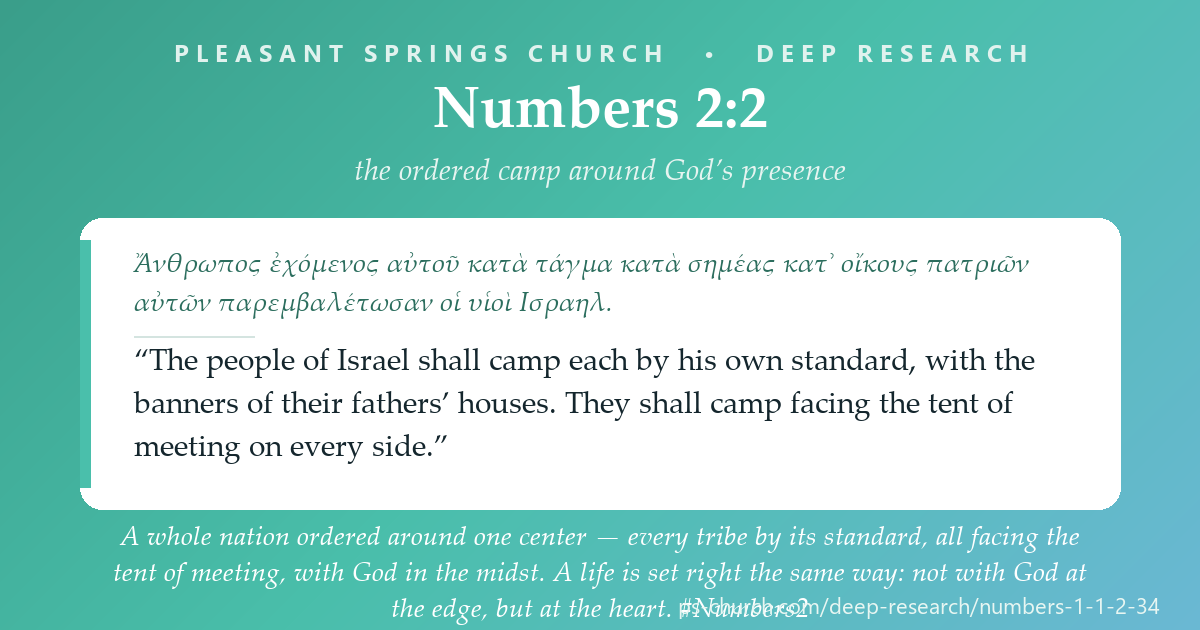
Numbers 2:2 · to share
LXX + ESVEvery Deep Research page traces its passage across the whole sweep — the Old Testament, the Second-Temple world between the testaments (historical witnesses, not Scripture), and the New Testament. Follow the thread:
Pleasant Springs Church — Deep Research
Research method after Michael S. Heiser’s Bible Research Method (examine dictionaries → ancient literature → important words → textual connections → academic publications → share), with the Pleasant Springs “Author & Audience” foundation. Scripture set in the Hebrew, the Greek editions named on each page and the ESV (Old Testament), and the Greek New Testament and the ESV (New Testament), per the practice of Pleasant Springs Church. Numbers 1–2 research grounded in Wenham, Ashley, Cole, and Milgrom, with Beale & Carson on the New Testament use; ANE background from the Mari muster texts and the Egyptian war-camp (Homan, Kitchen); Second-Temple reception per the War Scroll (1QM) and Josephus, read as witnesses, not Scripture. The ’elep (“thousand” / clan-unit) debate over the census figures is noted, not resolved dogmatically; the typology of God dwelling in the midst is held as devotional analogy grounded in the New Testament’s own reading.
Scripture quotations marked ESV are from the ESV® Bible (The Holy Bible, English Standard Version®), © 2001 by Crossway, a publishing ministry of Good News Publishers. ESV Text Edition: 2016. Used by permission. All rights reserved. The ESV text may not be quoted in any publication made available to the public by a Creative Commons license, and the ESV may not be translated in whole or in part into any other language. www.esv.org
|
Did this study bless you today? 💚 Give to Support PS Church100% of gifts go to the General Fund — thank you. |