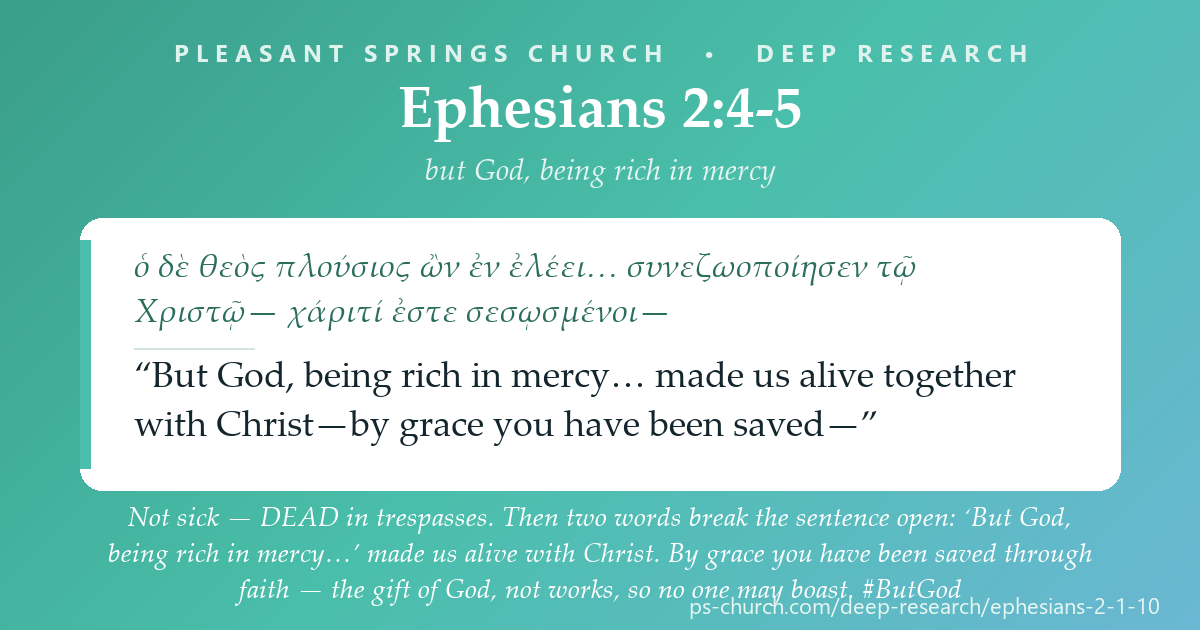
You were dead in the trespasses and sins.” Paul begins in the grave — not sick, not weak, but dead, walking under the powers, children of wrath. Then two words turn everything: “But God, being rich in mercy… made us alive together with Christ.” Salvation is a resurrection done to the dead — so it can only be gift: “by grace you have been saved through faith… not your own doing… so that no one may boast.” And we are his workmanship, created for good works that are grace’s fruit, never its price. This study works Ephesians 2:1–10 — but God. See the method →
Ephesians 2:1, 4–6, 8–10
Greek NT · ESVThe Shape of the Passage
InclusioPaul has just prayed that his readers would know the immeasurable power that raised Christ from the dead and seated him at God’s right hand (1:19–20). Now he says that same power has been at work on them — raising them from spiritual death and seating them, in Christ, in the heavenly places. It is the gospel in miniature: dead, but God, made alive.
Author
Paul writes one of the great sentences of the New Testament. In Greek, 2:1–7 is a single unbroken sentence whose fronted “you… who were dead” (the accusative object) waits all the way to verse 5 for the verb that acts on it — and the verb, when it comes, is God’s: synezōopoiēsen, “he made alive together with.” The delay is the theology. Paul holds us in the grave through three verses — dead in trespasses, walking with the world, driven by the flesh, “children of wrath” — so that the two words that break the sentence open land with full weight: “But God” (ho de theos, 2:4).
Dead, not merely sick. The diagnosis is stark and deliberate: nekrous, “dead,” the word for a corpse. A sick man can call for help; a drowning man can grab a rope; a dead man can do nothing. If our condition were weakness, we might contribute our part; because it is death, salvation must be a resurrection — something God does to us, not with our help. That is why the verbs are all his, and all in the plural of union with Christ: he made us alive with Christ, raised us up with him, seated us with him (three syn- verbs, 2:5–6). What God did in the risen and enthroned Christ (1:20) he has done in us who are joined to him. Our resurrection is already accomplished “in Christ”; our bodies will follow at his coming.
Grace, through faith, unto works. Because the life is God’s gift, Paul draws the conclusion that has anchored the church ever since: “by grace you have been saved through faith. And this is not your own doing; it is the gift of God, not a result of works, so that no one may boast” (2:8–9). Grace is the ground; faith is the hand that receives, not a work that earns. And the aim of it all is not idleness but a new life of good works — “we are his workmanship, created in Christ Jesus for good works, which God prepared beforehand” (2:10). Works are not the root of salvation; they are its fruit and its goal.
Audience
The Ephesians — largely Gentile believers once “far off” (2:13) — and everyone who is tempted to think they brought something to their own rescue. Paul’s “this is not your own doing… so that no one may boast” closes every door to pride. If you were dead and God made you alive, you have nothing to boast of and everything to be thankful for. The same truth that humbles also assures: a salvation that rests on God’s mercy rather than your performance is a salvation you cannot lose by falling short of the performance you never supplied.
‘This is not your own doing’ — what is the gift? The little word “this” (touto, 2:8) is neuter, while “grace” and “faith” are both feminine — so grammatically “this” does not point to “faith” alone but to the whole event: your salvation, grace-through-faith from start to finish, is the gift of God. (That God also grants the faith by which we believe is true — Philippians 1:29 says so plainly — but Paul’s point here is bigger than one word: the entire rescue is gift.) So no one may boast — not in works, and not in faith as though it were our contribution. Even the hand that receives was opened by grace.
Once you walked; now you walk. The paragraph turns on a single verb. You once “walked” in trespasses (2:2); now you are created to “walk” in the good works God prepared (2:10). Same word, opposite direction — the whole manner of a life reversed by grace.
Orient on grace, faith, works, and new creation.
Search by topic: grace, faith, salvation, works, new creation, wrath, the powers.
Which articles are relevant?
- Anchor Bible Dictionary — “Grace,” “Salvation,” “Faith,” “Works.”
- Dictionary of Paul and His Letters — “Grace,” “Salvation,” “Faith,” “Works of the Law,” “Principalities and Powers.”
- NIDNTT / TDNT — χάρις (charis, grace), πίστις (pistis, faith), σῴζω (sōzō, save), κτίζω (ktizō, create).
Bibliography surfaced:
- Harold Hoehner (exegetical), Andrew Lincoln (WBC), Peter O’Brien (Pillar), Frank Thielman (BECNT), Clinton Arnold (ZECNT) on Ephesians.
- John Calvin and John Stott on grace, faith, and works in 2:8–10; studies of the touto referent.
- Beale & Carson, Commentary on the NT Use of the OT (Ephesians).
Resurrection from the dead, the ruling powers, and salvation by grace.
Read the deadness, the “prince of the power of the air,” and the grace-not-works logic against their Old Testament and Second Temple backdrop.
Which parallels shed light on religion and worldview?
The valley of dry bones. When Paul says the dead are made alive by God’s sheer initiative, he is standing on Ezekiel. In the valley of dry bones, Israel is not sick but a heap of skeletons — “Son of man, can these bones live?” — and life comes only when the Lord breathes his Spirit into them (Ezek 37:1–14; see the dry bones). That is exactly the shape of Ephesians 2: a people spiritually dead, raised by God alone. The same God who is “rich in mercy” and full of “great love” (2:4) is the God who revealed himself at Sinai as “merciful and gracious… abounding in steadfast love” (Exod 34:6). The “But God” of the gospel is the character of God from the beginning.
The prince of the power of the air. Paul describes the old life as lived “following the prince of the power of the air, the spirit that is now at work in the sons of disobedience” (2:2). The phrase reflects a real Second Temple worldview: hostile spiritual powers ranged between earth and heaven, ruling the nations and the disobedient. The Dead Sea sect wrote of humanity walking under the dominion of the “Angel of Darkness” and the “spirit of deceit” (the Two Spirits treatise, 1QS 3–4); the idiom “sons of disobedience” is the same Semitic construction as their “sons of light” and “sons of darkness.” These are historical witnesses to the way people pictured the powers, not Scripture — but they show Paul is not speaking metaphorically. There is a real, personal enemy. And Paul’s point is precisely that God has seated believers above those powers, “in the heavenly places in Christ Jesus” (2:6; cf. 1:21).
Grace was not a foreign idea — but this grace is. The Qumran hymns can sound strikingly like Paul: the worshiper confesses himself “a creature of clay,” a “structure of dust,” saved not by his own righteousness but by God’s mercy (1QHodayot). Second Temple Judaism knew that salvation was of grace. What Paul adds is the place of that grace: it is grace “in Christ Jesus” — a salvation accomplished in the death and resurrection of a crucified Messiah, received by faith in him, apart from works of the law. The riches of God’s grace are “immeasurable” (2:7), and they are lodged entirely in his Son.
- Ezekiel 37:1–14; Exodus 34:6; Psalm 103:8–14 — the dead raised by God’s Spirit; the Lord “merciful and gracious… abounding in steadfast love”: the “rich in mercy” of 2:4 (see the dry bones).
- Genesis 1–2 (LXX) — God the sole Creator who forms life from the lifeless: the “created” and “workmanship” of 2:10 as a new Genesis (see the garden).
- 1QS 3–4; 1QHodayot — the dominion of hostile spirits; salvation of the “creature of clay” by God’s mercy: Second Temple witnesses, not Scripture.
Everything in this passage hangs on the two words that begin verse 4. Paul has spent three verses painting the human condition in the darkest colors the language allows — not struggling but dead, not merely misguided but walking in step with the world, the flesh, and the devil, standing under wrath by our very nature. He gives us no ledge to stand on, no reserve of goodness to appeal to, no spark of life to fan into flame. And then: “But God.” The whole gospel turns on that adversative. It is not “but you finally tried harder,” or “but there was some good in you after all,” or “but you reached out at the last moment.” It is God, and God alone, who acts — and the ground of his acting is located entirely within himself: he is “rich in mercy,” moved by “the great love with which he loved us.” He did not find us lovable and respond; he loved us while we were dead and made us alive. This is why the passage can end where it does, with boasting excluded and grace magnified. A drowning man who is thrown a rope may boast a little that he had the sense to grab it; a corpse raised to life can boast of nothing. That is the point of calling us dead. It strips away the last hidden claim of the self and leaves the glory wholly with the God who is rich in mercy. And it is unspeakably good news, because a salvation that began with “But God” does not finally depend on the very self that could contribute nothing to its beginning.
The vocabulary of death, grace, faith, and new creation.
Watch the “dead,” the three “with-Christ” verbs, the perfect “have been saved,” the neuter “this,” and the “workmanship.”
“Dead” — the word for a corpse. The human condition apart from Christ is not weakness or sickness but death; a corpse contributes nothing to its own resurrection, so salvation must be God’s act done to us. The ground of the passage’s grace.
“He made alive together with” — the long-delayed main verb, a rare triple compound (syn- with + zōo- life + poieō make). With synēgeiren (raised with) and synekathisen (seated with), it binds our new life to Christ’s own resurrection and enthronement (cf. 1:20).
“Grace… through faith” — grace is the ground (the instrumental dative), faith the means that receives (dia + genitive). The two are never confused: we are saved by grace through faith — faith is the empty hand, not the payment.
“Having been saved” — a periphrastic perfect (“you are in a state of having been saved”): a completed act with an abiding result, and passive — God is the actor. A settled standing, not a precarious achievement; a cornerstone of assurance.
“This… the gift of God” — “this” is neuter, agreeing with neither “grace” nor “faith” (both feminine): it points to the whole salvation, grace-through-faith, as God’s gift. Paired with “not your own doing… not of works,” it forecloses every ground for boasting.
“Workmanship… created” — poiēma (a thing made; the root of “poem”) + ktisthentes (the LXX verb for God’s creating). Salvation is a new creation; good works are its designed goal (“for good works”), prepared beforehand by God, never its cause.
How the New Testament fills out grace and works:
- Colossians 2:12–13 — “God made you alive together with him (synezōopoiēsen), having forgiven us all our trespasses”: the twin of Ephesians 2, same rare verb (see the supremacy of Christ).
- Romans 3:24–28; 4:2–5; Titus 3:5 — justified by grace as a gift, through faith, apart from works, “so that no one may boast”; “he saved us… according to his own mercy” (see just and the justifier).
- 2 Corinthians 5:17; John 5:24–25 — “if anyone is in Christ, he is a new creation”; “has passed from death to life”: the new-creation engine of 2:10.
- James 2:14–26; Philippians 2:12–13 — faith without works is dead; “work out your salvation… for it is God who works in you”: works as the fruit of grace, in that order.
From the dry bones to the good works prepared beforehand.
Trace the movement from death to life to a new walk, and grace held together with works in the right order.
Which cross-references matter?
- Ezekiel 37:1–14; Genesis 1–2 — God raises the dead by his Spirit; God creates life from the lifeless: the resurrection-and-new-creation shape of 2:5, 10 (see the dry bones).
- Ephesians 1:19–20; Colossians 2:12–13 — the power that raised and seated Christ, now at work in believers; “made alive together with him”: the parallels Paul builds on (see Colossians 1).
- Romans 3:21–28; 4:1–8; Galatians 2:16 — grace, faith, not works, no boasting: Paul’s fullest exposition of the triad compressed here (see Romans 3).
- Philippians 2:12–13; James 2:14–26; Matthew 5:16 — the necessary place of good works as the fruit and goal of grace, never its ground (see the Beatitudes).
- Titus 3:3–7; 1 Peter 2:9–10 — “he saved us… according to his own mercy”; a people called out of darkness: the same mercy-not-merit gospel.
People have often set Paul and James against each other — Paul crying “by grace, not works” and James insisting “faith without works is dead” — as though the two apostles were quarreling. But Ephesians 2:8–10 holds them together in three verses, and the order is everything. Verses 8 and 9 slam every door against works as the ground of salvation: not your own doing, not a result of works, so that no one may boast. And then verse 10 flings a door wide open for works as the goal of salvation: we are his workmanship, created in Christ Jesus for good works. Works are not the root; they are the fruit. They are not the price we pay to be saved; they are the purpose for which we were saved. God does not save us because of good works, and God does not save us without producing them. The same grace that makes a dead man alive sets his newly living feet on a path of good works God has already prepared for him to walk. So the person who says “I am saved by grace, therefore it does not matter how I live” has not understood grace at all — for the grace that saves is the grace that creates a new person for a new walk. Faith alone saves, but the faith that saves is never alone.
The scholarship on Ephesians 2:1-10.
The commentators on Ephesians 2; the studies of the touto referent, “children of wrath,” and the powers.
Commentaries & studies:
- Harold W. Hoehner (exegetical), Andrew T. Lincoln (WBC), Peter T. O’Brien (Pillar), Frank Thielman (BECNT), Clinton E. Arnold (ZECNT) on Ephesians.
- John Calvin, Commentary on Ephesians; John R. W. Stott, God’s New Society; Bruce Metzger, A Textual Commentary.
- G. K. Beale & D. A. Carson, eds., Commentary on the NT Use of the OT.
Interpretation notes worth keeping:
- ‘This’ = the whole salvation. Neuter touto agrees with neither “grace” nor “faith” (both feminine): the gift is the entire grace-through-faith rescue. Affirm that God grants faith too (Phil 1:29), but don’t rest that on 2:8’s grammar.
- Dead means monergism. A corpse contributes nothing to its resurrection (2:1, 5) — regeneration is God’s sovereign act. This coheres with a Molinist frame (God ordains the means, including faith) without making faith a meritorious work.
- ‘Children of wrath.’ Physei (“by nature”) and “like the rest of mankind” name a real, universal, native standing under wrath — the fallen condition, not a forensic transfer of Adam’s personal guilt (ancestral sin, not inherited guilt).
- Perfect tense, assurance. Sesōsmenoi (periphrastic perfect passive) denotes a completed act with abiding result, done by God — strong ground for the preservation of the saints, resting on God’s work, not the believer’s.
- Works, in order. Good works are the God-prepared goal (2:10), not the ground (2:9) — against both legalism and antinomianism.
From the grave to a new walk — and the boasting that is silenced.
Name what you learned, why it matters, and one concrete response.
What should we carry away — and do?
- You were dead; God made you alive. Salvation is a resurrection done to the spiritually dead. You did not help; you were raised. All the verbs are God’s.
- Grace leaves no room to boast — or to despair. A salvation resting on God’s mercy, not your performance, both humbles pride and steadies the anxious. You cannot earn it, and you cannot lose it by failing to earn it.
- Saved for good works, not by them. You are God’s workmanship, created for works he prepared beforehand. Obedience is the fruit and purpose of grace, never its price.
Step in response: preach the two words “But God” to yourself this week. When guilt says “you are too far gone,” answer with the grave and the resurrection: you were dead, and God made you alive by grace. Then go and walk in one of the good works he has prepared for you — not to be saved, but because you are.
Ephesians 2:8–9 · to share
Greek NT + ESVEvery Deep Research page traces its passage across the whole sweep — the Old Testament, the Second-Temple world between the testaments (historical witnesses, not Scripture), and the New Testament. Follow the thread:
Pleasant Springs Church — Deep Research
Research method after Michael S. Heiser’s Bible Research Method (examine dictionaries → ancient literature → important words → textual connections → academic publications → share), with the Pleasant Springs “Author & Audience” foundation. Scripture set in the Hebrew, the Greek editions named on each page and the ESV (Old Testament), and the Greek New Testament and the ESV (New Testament), per the practice of Pleasant Springs Church. Ephesians 2:1–10 research grounded in Hoehner, Lincoln, O’Brien, Thielman, and Arnold, with Calvin and Stott; the neuter touto (2:8) read as the whole grace-through-faith salvation, not “faith” alone (framed as non-agreement with feminine pistis, with faith-as-gift affirmed from Phil 1:29 rather than 2:8’s grammar); nekros as spiritual death grounding monergism (Molinist-compatible, faith not a work); “children of wrath” as the real fallen condition, not inherited personal guilt (ancestral sin); the periphrastic-perfect sesōsmenoi as assurance grounded in God’s completed work; good works as the God-prepared goal (2:10), not the ground (2:9) — against both legalism and antinomianism; the “prince of the power of the air” as a real, subordinate enemy.
Scripture quotations marked ESV are from the ESV® Bible (The Holy Bible, English Standard Version®), © 2001 by Crossway, a publishing ministry of Good News Publishers. ESV Text Edition: 2016. Used by permission. All rights reserved. The ESV text may not be quoted in any publication made available to the public by a Creative Commons license, and the ESV may not be translated in whole or in part into any other language. www.esv.org
|
Did this study bless you today? 💚 Give to Support PS Church100% of gifts go to the General Fund — thank you. |