Long ago God spoke by the prophets — but in these last days he has spoken by his Son. The letter to the Hebrews opens with one soaring sentence, and it is all about the Son: heir of all things, the one through whom God made the worlds, the radiance of his glory, the exact imprint of his nature, upholding the universe by his powerful word. And then the cosmic Son stoops to a cross: he made purification for sins, and sat down at the right hand of the Majesty — the work finished, higher than any angel. This study works Hebrews 1:1–4 — the final Word. See the method →
Hebrews 1:1–4
Greek NT · ESVThe Shape of the Passage
ChiasmThe letter to the Hebrews opens without a greeting — it plunges straight into its theme with one of the most majestic sentences in the New Testament. Before a single argument is made, the Son is set before us in his full glory: the final Word of God, the agent of creation, the radiance of God’s own being, the priest who cleansed our sins and sat down enthroned.
Author
The writer of Hebrews (unnamed, writing to Jewish believers tempted to drift back from Christ) begins with a contrast that governs the whole letter. God spoke — that is the constant; God is not silent. Of old he spoke “in many portions and in many ways” (polymerōs kai polytropōs, 1:1) — piece by piece, through law and vision and prophet, a revelation real but partial, like light coming through many windows. But “in these last days” he has spoken “in a Son” (en huiō, 1:2) — the Greek has no article, stressing the kind of speech: God’s final word is not another message but a Person, his own Son. What the prophets pointed toward, the Son is. This is not the cancelling of the Old Testament but its consummation: the same God, the same voice, now speaking his last and fullest word.
Seven glories in one breath. Verse 3 unfolds who this Son is, and every clause is staggering. He is the heir of all things and the one through whom God “made the worlds” (tous aiōnas) — the agent of creation, so no creature (John 1:3; Col 1:16). He is the apaugasma of God’s glory — the “radiance,” the shining-forth of the light itself, not a lesser reflected gleam: light from light. He is the charaktēr of God’s very substance — the exact imprint, the stamp a die leaves on a coin, sharing the nature it represents. He upholds the universe — the word (pherōn) means actively carrying it along toward its goal, not merely propping it up — “by the word of his power.”
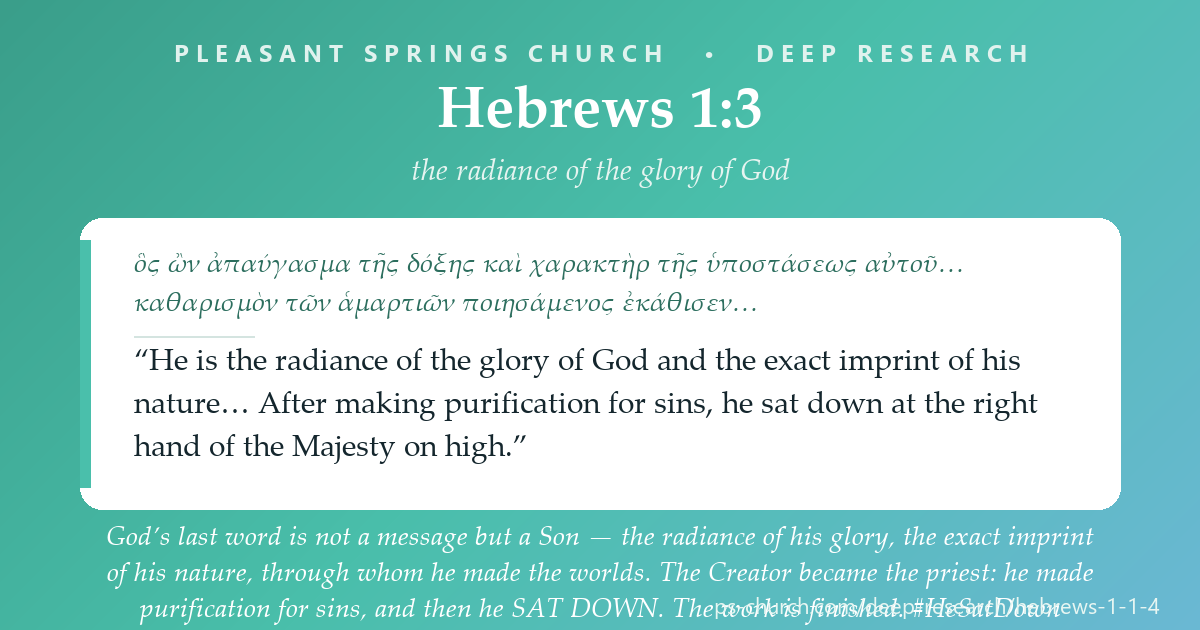
He made purification, and he sat down. Then, without warning, the cosmic Son stoops to a cross: “after making purification for sins” (1:3). The Creator became the priest, and the sacrifice. And the posture that follows is the gospel in a single verb: he “sat down at the right hand of the Majesty on high” — echoing the enthronement of Psalm 110:1. Priests under the old covenant stood daily, their work never done (10:11); this priest sat, because his work was finished. And seated there, he is “as much superior to angels as the name he has inherited is more excellent” — the theme the rest of the chapter will prove.
Audience
Hebrew Christians under pressure to slip back — to the familiar glories of the temple, the priesthood, the angels who mediated the law (2:2). The letter’s whole answer is packed into these four verses: everything you are tempted to return to was a window; the Son is the light. Why go back to the shadow when the substance has come? Why prize the angels who delivered the law when the Son who is “better” (kreittōn — the letter’s keyword) has spoken and sat down enthroned?
The Son is not a creature, nor a mask. The prologue guards the faith at both edges. Against every attempt to make the Son a lesser being — the highest angel, the first creature — it says he is the radiance of God’s glory and the exact imprint of his substance, the maker of all worlds: a creature cannot create the worlds or uphold the universe. And against collapsing the Son into the Father with no distinction, it keeps two persons in view: God speaks by his Son; the Son sits at the right hand of another. Same glory, same substance — distinct persons. Here, in the letter’s first sentence, is the seed of everything the church would confess at Nicaea: true God from true God, light from light, begotten not made.
Orient on the Son, revelation, glory, and the priesthood.
Search by topic: Son of God, Word / revelation, glory (doxa / kabod), image, high priest, right hand of God.
Which articles are relevant?
- Anchor Bible Dictionary — “Hebrews, Letter to,” “Son of God,” “Glory,” “Wisdom.”
- Dictionary of the Later NT — “Christology,” “Priest, High Priest,” “Creation,” “Exaltation.”
- NIDNTT / TDNT — ἀπαύγασμα (apaugasma, radiance), χαρακτήρ (charaktēr, imprint), ὑπόστασις (hypostasis, substance), κρείττων (kreittōn, better).
Bibliography surfaced:
- William Lane (WBC), Harold Attridge (Hermeneia), Paul Ellingworth (NIGTC), F. F. Bruce (NICNT), Gareth Lee Cockerill (NICNT), Peter O’Brien (Pillar) on Hebrews.
- Richard Bauckham, “The Divinity of Jesus Christ in… Hebrews”; Simon Kistemaker on the Psalm citations.
- Beale & Carson, Commentary on the NT Use of the OT (Hebrews).
The radiance of glory, the exact imprint, and the enthroned Son.
Read the Wisdom-language of verse 3 and the enthronement of the Son with care — borrowing the vocabulary of the age while transcending it.
Which parallels shed light on religion and worldview?
‘Radiance of glory’ — the words of Wisdom, applied to the Son. When the writer calls the Son “the radiance (apaugasma) of the glory of God,” he is reaching for language his readers knew. The Wisdom of Solomon had said that divine Wisdom is “a radiance (apaugasma) of eternal light, a spotless mirror of the working of God, and an image of his goodness” (Wis 7:26). Second Temple Judaism spoke this way of God’s Wisdom — personified, present at creation, the shining of God’s light. Hebrews takes every attribute the tradition gave to personified Wisdom and lays it on a real, incarnate, historical Son — one who “made purification for sins” and “sat down.” Wisdom literature is a historical witness to the vocabulary; it is not the measure of the doctrine. What was a poetic personification becomes, in the Son, a Person — and not a created attribute of God but God’s own radiance, the exact imprint of his being.
The coin and the die. The word charaktēr (1:3) is precise and physical: it is the engraved die that strikes an image into a coin or seal, and then the exact impression it leaves. The Son is the charaktēr of God’s hypostasis — the perfect, corresponding stamp of God’s very substance. Not a portrait that resembles, not a copy that approximates, but an exact imprint that shares the nature it bears. And note what the image guards: a stamp is distinct from the die that makes it, yet identical in what it shows. So the Son is distinct in person from the Father, yet identical in nature — two persons, one being. The philosopher Philo had used charaktēr and image-language for God’s Logos; Hebrews shares the milieu but pushes further than Philo ever would, to a Son who is himself God, enthroned.
‘He sat down at the right hand.’ The prologue climaxes with a seated Son, and the seating is loaded with Scripture. It echoes the great enthronement oracle: “The Lord says to my Lord: Sit at my right hand” (Ps 110:1, LXX 109:1; see Psalm 110) — the psalm that will become the backbone of the whole letter (formally quoted at 1:13; its priest-king oath at 5:6; 7:17). To sit at God’s right hand is to share his throne and rule. And the sitting itself preaches: a seated priest is a priest whose sacrifice is accepted and whose work is done. The angels, however exalted in Jewish thought, only ever stand and serve (1:14); the Son sits. That single difference — standing servants, a seated Son — is the argument of Hebrews in one image.
- Psalm 110:1 (LXX 109:1); Psalm 2:7–8; 2 Samuel 7:14 — the Son enthroned at God’s right hand; “you are my Son”; the heir of the nations: the Scriptures behind verses 2–4 (formally quoted at 1:5, 13; see Psalm 110).
- Genesis 1; Psalm 33:6 (LXX 32:6) — God creating by his word; “by the word of the Lord the heavens were made”: the creating and upholding word of verses 2–3 (see Genesis 1:1).
- Wisdom of Solomon 7:25–26; Sirach 24 — personified Wisdom as the radiance of eternal light, present at creation: the vocabulary the Son transcends (a witness, not Scripture).
The opening sentence of Hebrews is really a single, breathtaking claim: God has said his last word, and his last word is a Son. There is a whole theology of revelation folded into the contrast of the first two verses. God spoke to the fathers ‘in many portions and in many ways’ — and both halves of that phrase matter. ‘Many portions’ means the old revelation came piecemeal, a bit here and a bit there, no single prophet holding the whole; ‘many ways’ means it came in dreams, in law, in ritual, in vision, in the strange sign-acts of the prophets — God stooping to speak in every idiom a people could receive. It was true, every word of it, but it was partial, and it was preparatory. It was the sound of someone approaching. And then the footsteps stop at the door, and the door opens, and it is the Son. In him the fragments become a face. God does not merely send another and clearer message; he speaks in the only way that could be final — he speaks a Person, his own Son, who is the radiance of his glory and the exact imprint of his being. This is why the writer will spend thirteen chapters begging his readers not to drift away. To turn from the Son back to the shadows — the temple, the priesthood, the angels — is not to choose an alternative revelation; it is to turn from the last word God will ever speak. There is nothing beyond the Son to wait for. He is not a chapter in the story; he is the end of it, the point to which every earlier word was pointing all along.
The vocabulary of revelation, radiance, imprint, and enthronement.
Watch the “many portions,” the anarthrous “in a Son,” the radiance and the imprint, the dynamic “upholds,” and the seated “better” Son.
“In many portions and in many ways” — the sonorous alliterative opening (both begin poly-). The old revelation came piece by piece and in many modes (law, vision, prophecy) — true but fragmentary. The unspoken contrast: in the Son, God’s word is whole, final, and personal.
“In a Son / in Son-mode” — no article in the Greek, stressing the kind of speech: God’s final word is not another message but a Son, one whose very category is Son over against the servant-prophets.
“Radiance” — a NT hapax, best taken actively: the shining-forth of the light, not a reflected gleam. The Son is God’s glory streaming out — light from light, of one substance (borrowing Wisdom 7:26 and grounding the Nicene “Light from Light”).
“The exact imprint of his nature” — charaktēr is the die-struck stamp on a coin: an exact, corresponding impress; hypostasis is the underlying real being of God. The Son shares, not merely resembles, the Father’s substance — distinct in person, identical in nature.
“Upholding all things” — a present participle, continuous action; pherō means to carry / bear along, not statically prop up. The Son sustains and governs the cosmos moment by moment, actively carrying it toward its goal “by the word of his power” (cf. Col 1:17).
“He sat down… superior” — the seated Son (echoing Ps 110:1, LXX 109:1) signals a finished priestly work (priests stood daily, 10:11–12). Kreittōn (“better/superior”) is the thematic keyword of Hebrews (~13×): the Son is better than the angels, the covenant, the sacrifices — better than all he replaces.
How the New Testament fills out the Son’s glory:
- John 1:1–3, 14, 18; Colossians 1:15–20 — the Word who was God, agent of creation, “the image of the invisible God” who holds all things together: the closest parallels to verses 2–3 (see the Word, Colossians 1).
- Philippians 2:6–11 — the divine Son who humbled himself and was exalted and given the name above every name: the same descent-and-enthronement pattern (see He emptied himself).
- 1 Corinthians 8:6; 2 Corinthians 4:4, 6 — “one Lord… through whom are all things”; “the image of God”; “the glory of God in the face of Christ”: the agent of creation and the radiance of glory.
- Hebrews 1:5–14; 7:26–27; 10:11–14; 12:2 — the Son proved “better than angels” from Scripture; the priest who offered himself once and “sat down”: the prologue unfolded (see the great high priest).
From the prophets to the enthroned Son who is the final Word.
Trace the Son’s glory across creation, revelation, atonement, and enthronement — and guard him from the Arian and adoptionist readings.
Which cross-references matter?
- Psalm 110:1 (LXX 109:1); Psalm 2:7; 2 Samuel 7:14 — the enthroned Son at God’s right hand; “you are my Son”; the Davidic heir: the OT behind the prologue, quoted in the catena of 1:5–13 (see Psalm 110).
- John 1:1–18; Colossians 1:15–20; Philippians 2:6–11 — the Word, the image, the exalted Son: the NT’s high-Christology hymns alongside Hebrews (see Colossians 1, Philippians 2).
- Genesis 1; Psalm 33:6 (LXX 32:6); Proverbs 8:22–31 — creation by God’s word; Wisdom present at creation: the making-and-upholding of verses 2–3 (see Genesis 1:1).
- Hebrews 7–10 — the once-for-all self-offering and heavenly session of the great high priest: “made purification for sins… sat down” expounded (see Hebrews 4).
- Revelation 5:11–14 — the enthroned Lamb worshiped by myriads of angels: the Son’s superiority to angels (1:4) in glory.
It is sometimes said that a ‘high’ view of Christ’s deity developed slowly, late, under Greek influence — that the earliest church knew only a human Jesus and that the church of Nicaea read divinity back into him. The prologue of Hebrews is one of the texts that makes this hard to maintain, because here, in a first-century Jewish document steeped in the Old Testament, the highest things are already said. The Son is the one through whom God made the worlds — and in Jewish monotheism, creation is the exclusive work of the one God; a creature does not create. The Son upholds the universe by his powerful word — and sustaining the cosmos is likewise God’s prerogative alone. He is the radiance of God’s own glory and the exact imprint of God’s very being — not a lesser copy but the shining-forth of the same light. And he sits at God’s right hand, sharing the divine throne, worshiped by the angels who worship God alone. What Hebrews does not do is compromise monotheism: there is still one God, and the Son is not a second deity beside him. Rather, the Son is included within the identity of the one God — distinct from the Father as a person, yet sharing wholly in what it is to be God. This is not philosophy imported from Athens; it is the confession of a Jewish believer reading his own Scriptures in the light of the risen and enthroned Jesus. The doctrine the councils would later define with such care is already here, breathing, in the letter’s first four verses. They did not invent the deity of the Son. They guarded what the apostles had already seen.
The scholarship on Hebrews 1:1-4.
The commentators on the prologue; the studies of the Wisdom background, the “radiance/imprint” Christology, and the Psalm citations.
Commentaries & studies:
- William L. Lane (WBC), Harold W. Attridge (Hermeneia), Paul Ellingworth (NIGTC), F. F. Bruce (NICNT), Gareth Lee Cockerill (NICNT), Peter T. O’Brien (Pillar), Craig Koester (Anchor) on Hebrews.
- Richard Bauckham, “The Divinity of Jesus Christ in the Epistle to the Hebrews”; Simon Kistemaker, The Psalm Citations in… Hebrews; Bruce Metzger, A Textual Commentary.
- G. K. Beale & D. A. Carson, eds., Commentary on the NT Use of the OT.
Interpretation notes worth keeping:
- Not adoptionism. “Appointed heir… became superior… inherited a name” describe the incarnate Son’s mediatorial installation and vindication, NOT the origin of his deity — which verses 2b–3 (agent of creation, radiance of glory, imprint of God’s substance) establish before the exaltation clauses.
- Not Arianism. Apaugasma and charaktēr tēs hypostaseōs affirm same-substance deity (Light from Light, the exact stamp of God’s being); “through whom he made the worlds” makes the Son the agent, not a product, of creation — a primary Nicene text.
- Not modalism. Two distinct persons remain: God speaks by his Son; the Son sits at the right hand of the Majesty. Same substance, distinct persons (a stamp is distinct from the die yet bears its image).
- Echo, not quotation. The “right hand” of 1:3 is an allusion to Ps 110:1; the formal quotation of Ps 110:1 comes at 1:13. The OT catena belongs to 1:5–13, not the prologue.
- Text note. NA28/ESV read simply “after making purification for sins”; the later Majority Text adds “by himself” (di’ heautou) — a scribal expansion; the middle-voice participle already makes Christ the self-offering agent.
From many windows to the one Light — the final Word who sat down.
Name what you learned, why it matters, and one concrete response.
What should we carry away — and do?
- God’s last word is a Son. The prophets were windows; the Son is the light. There is no further revelation to wait for — in Christ the fragments become a face.
- The Creator became the priest. The One through whom the worlds were made is the same One who “made purification for sins.” The hands that flung the stars were pierced for you.
- He sat down. A seated priest is a finished work. Nothing can be added to the purification he made — so rest in it, and do not drift back to the shadows.
Step in response: the whole letter’s plea is “do not drift” (2:1). This week, when you are tempted to anchor your peace in something less than Christ — a ritual, a performance, a lesser mediator — look at the seated Son. He is the radiance of God’s glory, he made purification for your sins, and he sat down. Fix your eyes on him (12:2), and hold fast.
Hebrews 1:3 · to share
Greek NT + ESVEvery Deep Research page traces its passage across the whole sweep — the Old Testament, the Second-Temple world between the testaments (historical witnesses, not Scripture), and the New Testament. Follow the thread:
Pleasant Springs Church — Deep Research
Research method after Michael S. Heiser’s Bible Research Method (examine dictionaries → ancient literature → important words → textual connections → academic publications → share), with the Pleasant Springs “Author & Audience” foundation. Scripture set in the Hebrew, the Greek editions named on each page and the ESV (Old Testament), and the Greek New Testament and the ESV (New Testament), per the practice of Pleasant Springs Church. Hebrews 1:1–4 research grounded in Lane, Attridge, Ellingworth, Bruce, Cockerill, and O’Brien, with Bauckham on the Son’s divinity and Kistemaker on the Psalm citations; apaugasma read in the active sense (radiance / Light from Light, not a reflected gleam); charaktēr tēs hypostaseōs as the exact imprint sharing God’s substance (Nicene same-substance deity, against Arianism) while keeping the persons distinct (against modalism); the “appointed / became / inherited” language as the incarnate Son’s mediatorial installation, not the origin of his deity (against adoptionism); the “right hand” of 1:3 as an echo of Ps 110:1 (the formal quotation is 1:13; the OT catena is 1:5–13, not the prologue); the Wisdom-of-Solomon language as a witness to the vocabulary, not the measure of the doctrine; NA28/ESV reading “after making purification for sins” (the Majority-Text “by himself” a scribal expansion).
Scripture quotations marked ESV are from the ESV® Bible (The Holy Bible, English Standard Version®), © 2001 by Crossway, a publishing ministry of Good News Publishers. ESV Text Edition: 2016. Used by permission. All rights reserved. The ESV text may not be quoted in any publication made available to the public by a Creative Commons license, and the ESV may not be translated in whole or in part into any other language. www.esv.org
|
Did this study bless you today? 💚 Give to Support PS Church100% of gifts go to the General Fund — thank you. |