Hebrews 1 proved the Son greater than the angels. Hebrews 2 turns that argument over and says he was made, for a little while, lower than they are — and that this was the point. The chapter opens with the letter’s first warning (“lest we drift away”), reads out Psalm 8 about man crowned and given dominion, admits in plain words that we do not see it — “but we see Jesus” — and then explains why he came down to where death is: to break the one who held its power and to free people whom the fear of dying had enslaved all their lives. Four of its verses carry some of the deepest verbatim contact with the Greek Old Testament anywhere in the New Testament, and one of them carries a quotation the measurement almost lost. See the method →
Hebrews 2:1–18
Greek NT · ESVVersification — and there are three different answers on one page. Hebrews itself carries no offset: the Greek New Testament and the ESV number Hebrews 2 identically, verses 1 to 18, and there is no Septuagint column here because Hebrews is a New Testament book. The offsets live in the three Old Testament texts this chapter quotes, and no two behave alike. Psalm 8 — the Hebrew and the Greek both count the superscription as verse 1 and English does not, so what the ESV prints as Psalm 8:4–6 stands at MT/LXX Psalm 8:5–7: same chapter, one verse ahead. Psalm 22 — the Greek psalm numbers run one behind the Hebrew from Psalm 9/10 through 147, and the superscription is again verse 1, so ESV Psalm 22:22 = MT 22:23 = LXX 21:23: a different chapter and a different verse. Isaiah 8 — no offset at the verses quoted: 8:17–18 is 8:17–18 in Hebrew, Greek and English alike, and the verses were checked line for line against the Masoretic and CATSS files on this disk before the claim was made. The chapter is not aligned to its end — Hebrew and Greek Isaiah 8 both run to 23 verses and English to 22, because MT/LXX 8:23 is English 9:1 — but that seam falls five verses past the quotation. Three quotations, three renumberings, and only one of them is none.
The Shape of the Passage
Frame and pivot — five panels; NOT a chiasmHebrews 1 proved the Son better than the angels from Scripture. Chapter 2 does two things with that: it draws a warning out of it (2:1–4), and then it turns the whole argument on its head. The Son who is greater than the angels was made, for a little while, lower than they are — and that is the point, not an embarrassment to be explained away.
Author
The writer of Hebrews is unnamed, and this page will not guess. What the text shows is a preacher who argues from Scripture the way a lawyer argues from statute, and who breaks off his argument at intervals to warn. This is the first of those warnings, and it is built as an a fortiori: “if… how much more.” If the word “declared by angels” (di’ angelōn lalētheis logos, 2:2) — the law at Sinai, which Second Temple Judaism held was mediated by angels — proved binding, and every transgression met a just recompense, then how shall we escape if we neglect a salvation that began to be spoken by the Lord himself? The danger named is not apostasy in a blaze but something quieter: παραρυῶμεν, to drift past. It is a boat slipping its mooring while nobody is watching.
Then the ground shifts under the warning. “For it was not to angels that God subjected the world to come” (2:5). The claim needs a text, and he reaches for Psalm 8 — the psalm about man: what is man, that you are mindful of him? You made him a little lower… you crowned him… you put all things under his feet. And then the honest observation that every reader can make for himself: we do not yet see it. All things under the feet of man? Look around. Man is not crowned; man is dying. The dominion of Genesis 1 is a promise the world plainly does not keep.
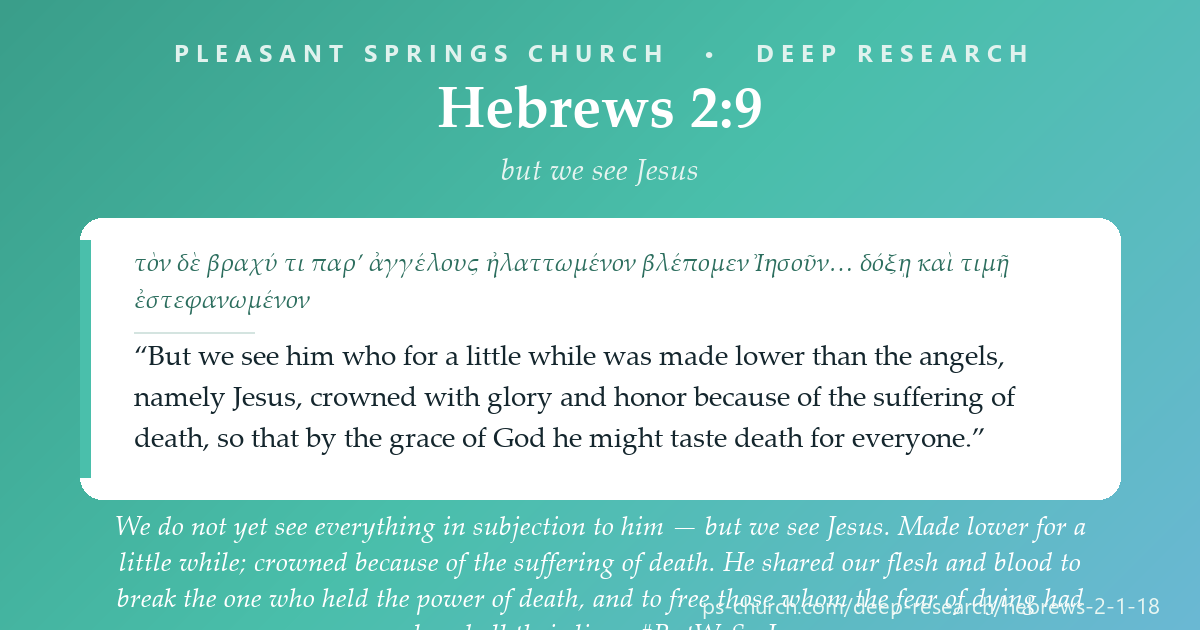
“But we see Jesus.” This is the pivot of the chapter and one of the great sentences of the New Testament. What we do not see in humanity at large we do see in one man: made low, and crowned. And the writer exploits an ambiguity that is genuinely there in the Greek. Brachy ti can mean “a little” in degree (the psalm’s sense: man ranks just below the heavenly ones) or “for a little while” in time. Applied to Jesus, the temporal sense carries the gospel: the lowering was a season, and it was the road to the crown. He was crowned because of the suffering of death — not in spite of it.
And then the reason, stated without flinching. “Since the children share in flesh and blood, he himself likewise partook of the same things” (2:14). The logic is that of a rescue: to break the one who holds the power of death, you have to go where death is. He did not take hold of angels — angels have no flesh to give and no death to die. He took hold of Abraham’s offspring. And the outcome is not merely a rescue but a priest: “he had to be made like his brothers in every respect” (2:17), so that mercy would be real mercy and help would be competent help.
Audience
Believers who were slipping — not renouncing, slipping. The verb of 2:1 tells you the pastoral situation better than any reconstruction of the community can: they were drifting. The remedy offered is not a new experience but closer attention (perissoterōs prosechein) to what they had already heard. Hebrews treats attention as a spiritual discipline and inattention as a mortal danger.
People afraid of dying. Verse 15 is one of the most exact descriptions of the human condition in the Bible: those who “through fear of death were subject to lifelong slavery.” Not at death — lifelong. The fear does its work every day it is not resolved, and it makes slaves of people who would never call themselves slaves. Hebrews says the incarnation was aimed at exactly this: he shared our flesh in order to die our death and empty the threat.
People who needed a priest they could believe in. The chapter ends where the letter will spend its strength: “a merciful and faithful high priest… to make propitiation for the sins of the people” (2:17). Both adjectives matter. Faithful toward God — he does the priestly work properly. Merciful toward us — because “he himself has suffered when tempted” (2:18). The help is not sympathy from a distance. It is help from someone who has stood where you are standing, and who is now crowned.
Orient on the son of man, the angels, death and the devil, and the priesthood.
Search by topic: angels, son of man, Psalm 8, incarnation, death, devil / Satan, high priest, propitiation (hilaskōmai), perfection (teleioō), apostasy and warning passages.
Which articles are relevant?
- Anchor Bible Dictionary — “Hebrews, Letter to,” “Angels,” “Son of Man,” “Devil,” “Atonement.”
- Dictionary of the Later NT & Its Developments — “Christology,” “Death of Christ,” “Priest, High Priest,” “Apostasy,” “Old Testament in Hebrews.”
- NIDNTTE / TDNT — ἄγγελος (angelos), ἀρχηγός (archēgos, founder/pioneer), ἱλάσκομαι (hilaskomai, propitiate), τελειόω (teleioō, perfect/complete), καταργέω (katargeō, nullify).
- Dictionary of Deities and Demons in the Bible (DDD) — “Devil,” “Satan,” “Death” — for the figure who “has the power of death” (2:14).
Bibliography surfaced:
- William L. Lane (WBC), Harold W. Attridge (Hermeneia), Paul Ellingworth (NIGTC), F. F. Bruce (NICNT), Gareth Lee Cockerill (NICNT), Peter T. O’Brien (Pillar), Craig Koester (Anchor) on Hebrews.
- Simon Kistemaker, The Psalm Citations in the Epistle to the Hebrews; Susan Docherty, The Use of the Old Testament in Hebrews.
- G. K. Beale & D. A. Carson, eds., Commentary on the New Testament Use of the Old Testament (Hebrews).
The law given through angels, the psalm about man, and the fear of dying.
Read the angel-mediation of the law, the Second Temple reading of Psalm 8, and the ancient terror of death that verse 15 names.
Which parallels shed light on religion and worldview?
‘The message declared by angels.’ The argument of 2:2 assumes something the readers already believed: that the law came to Israel through angelic mediation. The assumption is not invented by Hebrews. Deuteronomy 33:2 in the Greek has the Lord coming from Sinai with “myriads of Kadesh, at his right hand angels with him”; Stephen says Israel “received the law as delivered by angels” (Acts 7:53), and Paul says it was “put in place through angels by an intermediary” (Gal 3:19). The Book of Jubilees has the angel of the presence dictating to Moses on the mountain, and Josephus has Herod say the Jews learned their holiest laws through angels (Antiquities 15.136). Hebrews does not argue for this; it argues from it, which is how you can tell it was common ground. Second Temple sources are witnesses to what people believed, not a court of appeal above Scripture — but here the belief they witness is exactly what makes the writer’s a fortiori land.
Psalm 8 and ‘a little lower than…’ what? This is the honest crux, and it is a genuine Hebrew/Greek divergence rather than a manufactured one. Measured on this disk: the Masoretic text of Psalm 8:6 reads מֵאֱלֹהִים (mē-ʾĕlōhîm) — “than God,” or possibly “than the divine beings.” The Greek of the same verse reads παρ’ ἀγγέλους, “than angels.” Hebrews 2:7 matches the Greek, word for word for eleven words. We are not going to say which text is prior or that anyone “changed” anything — that is a claim about a history no measurement here can reach. What can be said is this: ʾĕlōhîm in the Hebrew Bible does duty for God and for the heavenly host both, so the Greek rendering is a real reading of the Hebrew word rather than a departure from it; and the whole force of the Hebrews argument — man ranked below the heavenly ones, and the Son ranked below them for a season — works on either. The letter’s argument runs on the Greek wording, and on that wording it is honest work; whether the writer drew it from a Greek Bible in his congregation’s hands is a historical question this page does not settle.
‘Lifelong slavery to the fear of death.’ Ancient readers did not need this explained. The consolation literature of the Greek and Roman world is enormous precisely because the fear was: Epicurus argued that death is nothing to us since where death is, we are not — an argument that has to be repeated because it does not work. Wisdom of Solomon 2:24 says that “through the devil’s envy death entered the world” and that those who belong to his party experience it — strikingly close to the devil who “has the power of death” in 2:14.
⚠️ This paragraph carried a limit, and the limit is gone. It used to read: the Wisdom of Solomon is not among the Greek files held on this disk, so that parallel is quoted from the printed text and has not been machine-screened for verbatim contact the way the Psalms and Isaiah citations were. Greek Wisdom was fetched on 30 August 2026 and Hebrews 2 has been screened against all 435 of its verses by the same method used everywhere else on this page. Here is the result, and it is worth having.
| comparison | run | band | the shared words |
|---|---|---|---|
| Hebrews 2:14 against the whole of Greek Wisdom | 2 | 5 | an article and a pronoun |
| Hebrews 2:14 against Wisdom 2:24 itself | 1 | — | τόν — one word, and it is the article |
| Hebrews 2:14 against Wisdom 2:23 | 1 | — | καί / τόν |
| the deepest run anywhere in Hebrews 2 against Greek Wisdom | 3 | 3 | 2:10 — τὰ πάντα καί, a formula |
The closest known Second Temple parallel to Hebrews 2:14 shares one word with it, and that word is the. Wisdom is a witness, not Scripture, and this page had already said that nothing rested on it. It rests on it less now, not more — and that is a better outcome than a confirmation would have been, because it shows the parallel is a parallel of idea, which is exactly how the paragraph above uses it. One thing the fetch did give. The genitive διαβόλου, of the devil, occurs in the whole Greek Old Testament held here exactly once, at Wisdom 2:24. Everywhere else on this shelf — Job, Zechariah 3, 1 Chronicles 21, Psalm 108, Esther — the word carries the article and means the accuser. Hebrews writes τὸν διάβολον with the article, like the Old Testament and unlike Wisdom.
- Psalm 8:4–6 (MT/LXX 8:5–7) — what is man… a little lower… all things under his feet: the text of 2:6–8, and the Genesis 1 dominion behind it (see Genesis 1:26–31).
- Psalm 22:22 (MT 22:23 · LXX 21:23) — “I will tell of your name to my brothers”: the vow of praise from the far side of the sufferer’s rescue, quoted at 2:12 (see Psalm 22).
- Isaiah 8:17–18 — the prophet waiting on a God who hides his face, and the prophet with his children as signs in Israel: quoted at 2:13.
- Deuteronomy 33:2 (LXX); Acts 7:53; Galatians 3:19; Jubilees 1–2; Josephus, Ant. 15.136 — the law given through angels: the premise of 2:2 (a witness to belief, not Scripture, in the case of Jubilees and Josephus).
- Wisdom of Solomon 2:23–24 — death entering by the devil’s envy: the closest Second Temple parallel to 2:14. Greek Wisdom reached this disk on 30 August 2026 and the comparison HAS now been screened: Hebrews 2:14 shares one word with Wisdom 2:24, and it is the article. A witness, not Scripture, and a parallel of idea rather than of wording.
There is a way of reading the incarnation that treats it as an unfortunate necessity — a humiliation God endured so that he could get on with the saving. Hebrews 2 does not read it that way, and the grammar will not let you. ‘It was fitting,’ the writer says — eprepen, it was becoming, it suited who God is — that in bringing many sons to glory he should perfect the pioneer of their salvation through sufferings. Fitting. Not tolerable, not regrettable but necessary: fitting. The route ran through the suffering because of what was at the end of it, and because of the kind of God who was doing it. And notice what the chapter says he was after. Not just forgiveness — brothers. The sanctifier and the sanctified are ‘all of one,’ and therefore he is not ashamed to call them brothers, and the proof texts he chooses are the words of a man: a sufferer promising to praise God among his brothers, a prophet saying he will trust God, a father standing with the children God gave him. The Son who upholds the universe by the word of his power takes those sentences into his own mouth. He is not condescending to us from a height; he is standing with us in the congregation and singing. That is what the incarnation was for. He came down to where death is, because that is where we were, and there is no other way to take hold of a drowning man than to go into the water.
Drifting, a little while, the pioneer, and the grip that takes hold.
Each count below was run against the corpora on this disk, not quoted from a lexicon: 7,927 verses of Greek New Testament and 30,348 verse units of Greek Old Testament screened out of the 64 CATSS files held here. The Old Testament side was 23,061 units in 44 files until 30 August 2026; every figure below has been re-run on the larger corpus. ⚠️ Held and screened are different numbers on this shelf and the page uses whichever one the sentence means. The 64 files hold 30,637 verse units; 289 of them are the Odes, the liturgical canticles appended to the Greek Psalter, which stay on the disk and are excluded from anything called “the Greek Old Testament” here. 30,637 held, 30,348 screened. Stage 5 says why, and what it cost this page’s headline census.
“Lest we drift away” — measured: a hapax, one occurrence in all 7,927 verses of the Greek New Testament held here. The image is a ring slipping off a finger, or a boat carried past its landing by the current. The danger Hebrews names first is not defection but inattention: nothing has to be decided for a life to be lost.
“A little” — genuinely ambiguous, and the ambiguity is the argument. Of degree in the psalm (man ranks just below the heavenly ones); of duration when applied to Jesus (“for a little while”). Hebrews uses the phrase twice, once inside the quotation and once outside it, and the second use is where the temporal sense takes over.
“That he might taste death” — not a sip. To taste death in this idiom is to experience it fully (cf. Mark 9:1; John 8:52). ὑπὲρ παντός — “for everyone,” or possibly “for everything”; the grammar allows both and the chapter’s reach (2:8, “everything in subjection”) makes the wider sense worth weighing.
“Founder,” “pioneer,” “trailblazer” — one who goes first and opens the way for others to follow. Measured: four occurrences in the Greek New Testament, and all four are of Jesus (Acts 3:15; 5:31; Heb 2:10; 12:2). He is not a guide pointing down a road he has not walked.
“To make perfect” — not moral improvement (Hebrews insists he was without sin, 4:15) but completion for a purpose. In the Greek Old Testament the same verb group is used for consecrating a priest — and this entry no longer has to take that from a lexicon. It used to read: (“filling the hands,” Exod 29:9; Lev 8:33) — that one is from the lexicon and not from this disk, because Exodus and Leviticus are not among the Greek files held here. Both books were fetched on 30 August 2026 and the readings are now off the disk: Exodus 29:9 reads καὶ τελειώσεις τὰς χεῖρας Ἀαρων, and you shall perfect the hands of Aaron, and Leviticus 8:33 τελειώσει τὰς χεῖρας ὑμῶν, he shall perfect your hands — seven days of it. The Greek verb Hebrews uses of the Son at 2:10 is the Pentateuch’s own verb for ordaining a priest, and the shelf can now show that rather than assert it. He was brought, through suffering, to the finished state a priest must reach before he can serve.
“Destroy,” better “render powerless, put out of action.” The devil is not annihilated at the cross; the weapon in his hand is taken away. He held the power of death, and death is what the resurrection has emptied.
“He takes hold of” — a rescuer’s grip, the word for catching hold of a sinking man (Matt 14:31). Measured: both New Testament occurrences of this exact form stand in this one verse, once negated and once affirmed: not angels — Abraham’s offspring.
“To make propitiation” — measured: the ἱλασκ- group stands six times in the Greek New Testament — the verb ἱλάσκομαι at Luke 18:13 and here, ἱλασμός at 1 John 2:2 and 4:10, ἱλαστήριον at Romans 3:25 and Hebrews 9:5 (the related adjective ἵλεως, Matt 16:22 and Heb 8:12, counted separately). Only two of the six are the verb: the tax collector’s prayer and this verse. Sin is dealt with at God’s end, not merely covered over at ours; and the one who does it is our brother.
Four more word chains, counted rather than asserted:
- ἄγγελος stands five times in Hebrews 2 — at 2:2, 2:5, 2:7, 2:9 and 2:16, which is exactly where the argument turns each time. The chapter is framed by angels at both ends and pivots on them in the middle.
- ὑποτάσσω and its kin stand five times — 2:5 and then four times inside verse 8 alone (hypetaxas, hypotaxai, anypotakton, hypotetagmena). The writer will not let the word go until he has wrung the “not yet” out of it.
- θάνατος stands five times — twice in 2:9, twice in 2:14, once in 2:15. Death is the subject of the second half of the chapter as surely as angels are the subject of the first.
- φόβῳ θανάτου (2:15) — measured: this word pair occurs once in the Greek New Testament and not once in the 30,348 verse units of Greek Old Testament screened here. The caveat that used to close this line — Exodus, Leviticus, Numbers, Joshua, Wisdom and several others are not on this disk — is spent: all of them arrived on 30 August 2026, the pair was looked for again in all 64 files, and it is still absent. It is absent from the Odes as well, so withdrawing them from the screen did not touch this line.
Four quotations, measured — and the one the measurement almost missed.
The method: every verse of Hebrews 2 was screened against the 30,348 screened verse units of Greek Old Testament (30,637 held, less the 289 units of the Odes) for the longest contiguous run of identical normalised word forms, with the tie band — how many target verses reach the same depth — reported beside each run. Word forms, never lemmas. Contiguous, so a gap or a reordering breaks the run. This finds verbatim contact; it does not find allusion.
What the screen returned:
Hebrews 2 is one of the deepest chapters of verbatim contact in the New Testament, and its four deep runs each stand alone.
- Heb 2:6 — run of 12, tie band 1 — LXX Psalm 8:5. Twelve consecutive words, and one verse in the whole corpus reaches that depth.
- Heb 2:7 — run of 11, tie band 1 — LXX Psalm 8:6. The entire verse, every word.
- Heb 2:12 — run of 11, tie band 1 — LXX Psalm 21:23 (ESV Psalm 22:22). Eleven verbatim — after one substituted verb.
- Heb 2:13b — run of 10, tie band 1 — LXX Isaiah 8:18. Ten consecutive words.
- Heb 2:8 — run of 6, tie band 1 — LXX Psalm 8:7, and then Hebrews leaves the psalm and starts arguing.
The context that makes those numbers mean something. All 7,927 verses of the Greek New Testament were screened against the same 30,348 verse units of Greek Old Testament. 86 New Testament verses reach a run of ten or more. Four of the eighty-six are in Hebrews 2. Twenty-one of the eighty-six are in Hebrews — a book of 303 verses producing better than a fifth of the New Testament’s deepest verbatim contact with the Greek Old Testament. Nothing in Hebrews 2 comes near the top of that table (Acts 28:27 and Matthew 13:15 both run 24 against LXX Isaiah 6:10, and Hebrews 8:11 runs 23 against LXX Jeremiah 38:34); but four runs of ten-plus in eighteen verses, every one with a tie band of 1, is a chapter built out of other people’s sentences.
⚠️ That census has read 75, then 80, then 96, and now 86, and the page prints every one of them rather than swapping the number in silence. Three separate things moved it, and not one of them is a change in Hebrews.
| the census, as run | NT verses at 10+ | of them in Hebrews | in Hebrews 2 |
|---|---|---|---|
| 44 files, 23,061 units — as first published | 75 | 20 | 4 |
| 44 files, 23,061 units — after the spelling-equivalence fold | 80 | 21 | 4 |
| 64 files, 30,637 units — everything held, 30 August 2026 | 96 | 21 | 4 |
| 64 files less the Odes, 30,348 units — the screened figure | 86 | 21 | 4 |
The first move was the instrument. The two editions spell οὐ / οὐκ and ἐκ / ἐξ differently, and until the comparison layer was taught those equivalences a shared run was cut at any such word. Folding them added five verses to the census and one to Hebrews. The second was the corpus, 44 CATSS files to 64. And sixteen new verses arrived at ten-plus, of which ten must be discounted and the page says so plainly. Ten of them are Luke 1:47–79 and Luke 2:29 matching Odes 9 and 13 — but Odes 9 is the Magnificat and the Benedictus and Odes 13 is the Nunc Dimittis, collected into the Greek Psalter’s appendix out of Luke. That is the New Testament quoted back at itself, not Old Testament contact, and counting it as contact would be a fabrication. The six genuine additions are all Exodus: Acts 4:24 and 14:15 (thirteen words of Exodus 20:11), Acts 7:28, 7:34 and 7:40, and Romans 9:17 against Exodus 9:16. Discounting the Odes, the honest figure is 86, not 96.
⚠️ And on 30 August 2026 the shelf stopped doing that discount by hand and took the Odes out of the screen itself, so the published census here is now 86. The ten rows that came out are Luke 1:47, 1:48, 1:51, 1:55, 1:68, 1:71, 1:72, 1:77, 1:79 and Luke 2:29 — every one of them a Luke verse matching Ode 9 (the Magnificat and the Benedictus, which is Luke 1) or Ode 13 (the Nunc Dimittis, which is Luke 2). Luke 1:48 against Ode 9:48 ran to eighteen consecutive words — deeper than anything in Hebrews, deeper than all but a handful of pairs on the whole shelf — and it was Luke measured against Luke under a Greek Old Testament shelfmark. It is worth the reader knowing that the instrument can do that, and how it was caught: not by the numbers looking wrong, but by asking what file every new hit came out of. A run of eighteen looks like a discovery until you open the file. Nothing in Hebrews came out — Hebrews touches no canticle — so all twenty-one Hebrews rows and all four Hebrews 2 rows stand exactly as first published.
What did not move at any stage is Hebrews 2 itself: four rows at ten-plus, every one with a tie band of 1, in all three columns.
Here is the thing this page was not expecting to find. Hebrews 2:13 contains two quotations, and the writer marks them identically: kai palin — ‘and again’ — before each one. They are the same kind of thing, introduced the same way, in the same breath, in the same verse. The screen returns a run of TEN, tie band 1, for the second of them — ‘Behold, I and the children God has given me,’ ten consecutive words identical to Greek Isaiah 8:18, matched nowhere else in thirty thousand verse units. The screen returns a run of TWO for the first.
Two. And it is not because the words are different. Greek Isaiah 8:17 ends πεποιθὼς ἔσομαι ἐπ’ αὐτῷ — ‘trusting I will be in him.’ Hebrews writes ἐγὼ ἔσομαι πεποιθὼς ἐπ’ αὐτῷ — the same four words, with the first two swapped and an ‘I’ put in front. That single transposition is enough. A run counts contiguous forms, so the moment two words change places the sequence is cut in half and what is left is ἐπ’ αὐτῷ: two words, and a formula at that. We went further and searched the whole corpus for the word pair: πεποιθὼς ἔσομαι stands in exactly three places in the Greek Old Testament held here — 2 Kingdoms 22:3, Isaiah 8:17 and Isaiah 12:2 — and Hebrews’ order, ἔσομαι πεποιθὼς, stands in none of them. Not once in 30,348 verse units. Both counts were re-run on 30 August 2026 over the enlarged 64-file corpus, and again with the Odes withdrawn from the screen: the pair still stands in exactly those three verses, and Hebrews’ order still stands in none. No canticle carries it either, so the finding is the same whether the Odes are in the count or out of it.
So in a single verse of Hebrews we have both halves of the shelf’s standing warning at once. A run of ten with a band of one, which is as clean a signal as this method ever produces — and, four words earlier, a quotation the author himself labels a quotation, which the same method scores at two and would never have surfaced. If you had built this page by ranking runs and writing up the top of the list, you would have printed Isaiah 8:18 and never known Isaiah 8:17 was there. The measurement finds verbatim contact. It does not find citation, and it does not find allusion. It is a very good instrument pointed at a narrow thing, and Hebrews 2:13 is the verse that shows you the edge of what it can see.
Two counter-examples this page prints against itself:
- Heb 2:17 — run of 4, tie band 4. τὰς ἁμαρτίας τοῦ λαοῦ is shared with Daniel 9:20 in both the Old Greek and Theodotion, and τὰ πρὸς τὸν θεόν with Deuteronomy 31:27 and πρὸς τὸν θεὸν εἰς with 1 Kingdoms 10:3. Four words, four verses reaching it, and no citation anywhere in sight. This is priestly boilerplate — the ordinary furniture of cultic Greek. Set it beside the next line and you can see exactly why the band must always be printed.
- Heb 2:9 — run of 4, tie band 1. βραχύ τι παρ’ ἀγγέλους occurs in one other place in the entire corpus: LXX Psalm 8:6. A band of 1 at a depth of only 4 — and yet this is not a citation either. It is the writer picking up the words he quoted two verses earlier and re-using them as his own, which is a third category the screen cannot distinguish from either citation or coincidence.
- Heb 2:1, 2:14, 2:15 and 2:18 — runs of 2, with tie bands of 305, 262, 117 and 33. Most of the chapter shares nothing but function words with the Greek Old Testament. That is the normal state of a New Testament verse and it is worth printing, because it is the baseline against which twelve-with-a-band-of-one means anything at all.
Where the chapter’s threads run in the rest of Scripture:
- Genesis 1:26–28; Psalm 8 — the dominion given to man and visibly not exercised: the “not yet” of 2:8 (see Genesis 1:26–31).
- 1 Corinthians 15:25–28; Ephesians 1:20–22; Philippians 3:21 — Psalm 8 read of the risen Christ elsewhere in the New Testament, with the same “all things under his feet” (see 1 Corinthians 15).
- Philippians 2:6–11 — the descent that is the road to the crown, told as a hymn instead of an argument (see He emptied himself).
- Hebrews 1:1–4, 1:5–14 — the Son proved better than the angels: the premise chapter 2 both warns from and inverts (see Hebrews 1:1–4).
- Hebrews 4:14–16; 5:7–10; 7:26–28 — the merciful and faithful high priest of 2:17–18, unfolded (see The throne of grace).
- Psalm 22 — the sufferer whose vow of praise is quoted at 2:12, and whose opening line Jesus prayed from the cross (see Psalm 22).
The scholarship — and what this page could not check.
This section exists to say where the page is weak. A finding without its limits is not a finding.
Commentaries & studies:
- William L. Lane (WBC 47A), Harold W. Attridge (Hermeneia), Paul Ellingworth (NIGTC), F. F. Bruce (NICNT), Gareth Lee Cockerill (NICNT), Peter T. O’Brien (Pillar), Craig R. Koester (Anchor) on Hebrews 2.
- Simon Kistemaker, The Psalm Citations in the Epistle to the Hebrews; Susan E. Docherty, The Use of the Old Testament in Hebrews; Radu Gheorghita, The Role of the Septuagint in Hebrews.
- Albert Vanhoye, La structure littéraire de l’Épître aux Hébreux — the standard structural analysis of the letter.
- G. K. Beale & D. A. Carson, eds., Commentary on the New Testament Use of the Old Testament; Bruce M. Metzger, A Textual Commentary on the Greek New Testament (on 2:9).
What this page did NOT check, and where it is weakest:
- The English column was not machine-verified. There is no Crossway API key on this machine, so the ESV text here was set by hand against the printed edition rather than pulled and diffed. The Greek column and every measurement on this page were run against files on disk and can be re-derived; the English line cannot, on this run.
- The Greek Old Testament held here is no longer the corpus this page was built on. This limit used to read: 23,061 verse units in 44 CATSS files covering 39 books — but Exodus, Leviticus, Numbers, Joshua, Judith, Tobit, 2–4 Maccabees, Odes, Wisdom of Solomon, Psalms of Solomon, Baruch, the Epistle of Jeremiah, Bel and Susanna are not on this disk. The absence of Greek Wisdom is the one that bites: Wisdom 2:24 is the closest known parallel to 2:14 and could not be screened at all. Every one of those files was fetched on 30 August 2026. The shelf now holds 30,637 verse units in 64 CATSS files, and every “occurs nowhere” on this page has been re-run against them. ⚠️ Held is not screened. Of those 30,637 held units, 289 are the Odes, and on the same day they were withdrawn from the screening corpus — two of the canticles are New Testament text (Ode 9 is Luke 1, Ode 13 is Luke 2) and ten more are second copies of passages already held, so a tie band touching a canticle was being doubled for no textual reason. The screened corpus is 30,348 units; the held corpus is 30,637; this page says which it means every time it prints one. Wisdom was screened and is reported in stage 2: Hebrews 2:14 shares one word with Wisdom 2:24. The limit that is left is narrower and still real — CATSS is a diplomatic digitisation of Rahlfs and not a critical edition, no Aquila or Symmachus is held, Theodotion only for Daniel, and nothing outside the CATSS set was searched. Wisdom, Tobit, Judith, Maccabees, Odes, the Psalms of Solomon, Baruch, Bel and Susanna are witnesses, not Scripture, and are labelled so wherever this page names one.
- The edition question was not settled. The Greek Old Testament here is CATSS/Rahlfs, not the Göttingen critical editions of Psalms and Isaiah. A run measured against Rahlfs is a run against one printed reconstruction; where Göttingen differs, the number could move. Nor were the Qumran Isaiah scrolls consulted at 8:17–18, nor the Psalms manuscripts at Psalm 8.
- 2:9 is genuinely unsettled and we did not settle it. The SBLGNT on this disk reads χωρὶς θεοῦ, “apart from God”; NA28, Westcott–Hort, Tregelles, the Byzantine text and the ESV read χάριτι θεοῦ, “by the grace of God.” Our Greek column and our English column therefore disagree at that word. We print both and flag it rather than quietly conform one to the other, but the page takes no position on which is original.
- The structure diagram is ours, and it is a modest claim. It is built from word chains counted in the text (five occurrences of ἄγγελος, five of ὑποτάσσω and kin, three of ἀδελφός), not from Vanhoye or Attridge, neither of whom was re-read for this page. We have labelled it a frame around a pivot and said explicitly that it is not a chiasm; the A / A′ link rests on sense rather than on a repeated word, and that is the weakest joint in it.
- Direction of influence is never asserted here. That Hebrews 2:7 matches Greek Psalm 8:6 for eleven words is a measurement. That the writer “used the Septuagint,” or that anyone “altered” anything at Psalm 8:6 or Psalm 21:23, is a historical claim this method cannot make and this page does not make.
- Two live exegetical questions are left open. Whether Psalm 8 in Hebrews is read messianically from the start or anthropologically and then applied to Christ; and whether ὑπὲρ παντός in 2:9 is “for everyone” or “for everything.” The commentators divide, the grammar allows both, and no measurement available here decides either.
- The author of Hebrews is unknown. The page says “the writer” throughout and offers no candidate.
We do not yet see everything — but we see Jesus.
Name what you learned, why it matters, and one concrete response.
What should we carry away — and do?
- Nothing has to be decided for a life to be lost. The first danger Hebrews names is drifting — a word that appears once in the whole New Testament. Boats do not need to be steered onto rocks; they only need to be left alone.
- “We do not yet see… but we see Jesus.” The gap between the promise and the world is real, and Hebrews does not paper over it. It answers the gap with a person, not an explanation.
- He went down to where death is on purpose. He took flesh and blood because the children have flesh and blood. The fear that made you a slave every day of your life is the thing he came to empty.
- The help is competent because it is personal. “Because he himself has suffered when tempted, he is able to help.” Not sympathy from the shore — a grip from someone already in the water.
Step in response: take the diagnosis of 2:1 seriously this week. Ask not “have I rejected anything?” but “what have I stopped paying attention to?” Then do the one thing the verse prescribes — go back to what you have already heard and give it closer attention. And when the fear of 2:15 comes, as it does, answer it with 2:9: he tasted death for everyone, and he is crowned.
Hebrews 2:9 · to share
Greek NT + ESVEvery Deep Research page traces its passage across the whole sweep — the Old Testament, the Second-Temple world between the testaments (historical witnesses, not Scripture), and the New Testament. Follow the thread:
Pleasant Springs Church — Deep Research
Research method after Michael S. Heiser’s Bible Research Method (examine dictionaries → ancient literature → important words → textual connections → academic publications → share), with the Pleasant Springs “Author & Audience” foundation. Scripture set in the Hebrew, the Greek editions named on each page and the ESV (Old Testament), and the Greek New Testament and the ESV (New Testament), per the practice of Pleasant Springs Church. Hebrews 2:1–18 research grounded in Lane, Attridge, Ellingworth, Bruce, Cockerill, O’Brien and Koester, with Kistemaker, Docherty and Gheorghita on the letter’s use of the Greek Old Testament. The Greek New Testament here is the SBLGNT via MorphGNT as held on this disk (its reading χωρὶς θεοῦ at 2:9 flagged against the NA28/ESV χάριτι θεοῦ); the Greek Old Testament is CATSS/Rahlfs, not Göttingen. All run lengths and tie bands were measured on those files by dr_tools, exhaustively and without sampling: contiguous identical normalised word forms, never lemmas. The Masoretic mē-ʾĕlōhîm at Psalm 8:6 against the Greek par’ angelous is reported as a divergence between the texts, with no claim about which is prior and no claim that anyone changed anything. The literary-structure diagram is built from word chains counted in Hebrews 2 and is labelled a frame around a pivot, expressly not a chiasm.
Scripture quotations marked ESV are from the ESV® Bible (The Holy Bible, English Standard Version®), © 2001 by Crossway, a publishing ministry of Good News Publishers. ESV Text Edition: 2016. Used by permission. All rights reserved. The ESV text may not be quoted in any publication made available to the public by a Creative Commons license, and the ESV may not be translated in whole or in part into any other language. www.esv.org
|
Did this study bless you today? 💚 Give to Support PS Church100% of gifts go to the General Fund — thank you. |