Some men were unclean, and could not keep the Passover; others were far away on a journey. So they came to Moses — and God made a way: a second Passover, a month later, so that no one who longed to keep the feast would be shut out, native or sojourner alike. Then the cloud settled over the tabernacle, fire by night, and Israel learned to move: they set out and they camped only “at the command of the Lord” — a night, a month, a year. This study works Numbers 9:1–23, two portraits of grace that makes a way and guidance that sets the pace. See the method →
Numbers 9:2–23 (selections)
Hebrew · LXX · ESVThe Shape of the Passage
Parallel panelsNumbers (Hebrew Bəmidbar, “in the wilderness”) picks up where Leviticus left off: the tabernacle stands (Exod 40), the tribes are numbered and arranged (Num 1–2), the Levites set apart (Num 3–4), and the priestly blessing given (Num 6). Chapter 9 is the last stop before the march begins: the people keep the Passover, and the cloud takes its place over the tent to lead them.
Author
The Torah of Moses places Numbers 9 at the hinge between Sinai and the wilderness journey. A year has passed since the exodus (9:1; cf. Exod 40:17), and before Israel breaks camp two things are settled: how they will worship (the Passover kept, and a gracious provision for those who could not keep it) and how they will travel (only as the cloud, the visible presence of the Lord, leads them). The chapter is deliberately paired: grace that makes a way for the excluded, and guidance that asks a people to move only at God’s word.
A narrative of provision. The Passover is not merely re-commanded; a real case arises — men defiled by a corpse who cannot join — and Moses brings it before the Lord (9:8). The answer is a second Passover, a month later, so that no one who longs to keep the feast is turned away. The same generosity reaches the resident foreigner (9:14). Then the camera lifts to the cloud, and the rest of the chapter simply repeats, with patient insistence, that Israel moved and rested “at the command of the Lord.”
Audience
Israel — a redeemed people on the eve of a long, uncertain journey. To them the chapter says two things they will need in the desert. First, that the God who saved them at the first Passover keeps the door open: uncleanness or distance need not shut a willing worshiper out forever; there is a way back. Second, that this God leads, visibly and reliably — a cloud by day, fire by night — and that their part is to watch, wait, and follow, neither running ahead nor lagging behind.
How they heard it. A people about to leave the safety of Sinai learned that their whole life would now be a following: they would strike the tents when the cloud lifted and pitch them when it settled, “whether it was two days, or a month, or a longer time” (9:22). Worship kept them tethered to grace; the cloud kept them tethered to guidance. The wilderness would test both — but here, at the outset, both are given.
Orient on Passover, the second Passover, uncleanness, the sojourner, and the pillar of cloud.
Search by topic: Passover, Pesach Sheni (second Passover), corpse impurity, sojourner / ger, cloud and glory (Shekinah), pillar of cloud and fire, guidance.
Which articles are relevant?
- Anchor Bible Dictionary — “Passover,” “Cloud,” “Glory of God,” “Sojourner,” “Purity and Impurity.”
- Dictionary of the OT: Pentateuch — “Passover,” “Festivals and Feasts,” “Cloud,” “Presence of God,” “Aliens and Strangers,” “Clean and Unclean.”
- NIDOTTE / TDOT — פֶּסַח (pesaḥ, Passover), עָנָן (ʿānān, cloud), גֵּר (gēr, sojourner), מִשְׁמֶרֶת (mišmereṯ, charge / watch).
Bibliography surfaced:
- Gordon Wenham (TOTC), Timothy Ashley (NICOT), Dennis Cole (NAC), Baruch Levine (AB) on Numbers.
- Studies of the second Passover (Pesach Sheni) and corpse impurity; the pillar of cloud / glory (Shekinah) as guidance and presence.
- Beale & Carson, Commentary on the NT Use of the OT (1 Corinthians 5 and 10; John 19).
Passover kept, a second chance provided, and a people led by a cloud.
Read the second-Passover provision against Israel’s festival law and later Jewish practice, then follow the Passover lamb and the guiding cloud into the New Testament.
Which parallels shed light on religion and worldview?
Passover in the wilderness. This is the first Passover kept after the exodus itself — a memorial of deliverance now observed by a people still on the road. Later Judaism worked out the details of both the ordinary Passover and the make-up feast; the Mishnah, Pesaḥim devotes a whole tractate to it, including Pesaḥ Sheni, the “Second Passover” of the second month for those who were unclean or far off (its ninth chapter turns on Numbers 9). Centuries later, Hezekiah kept Passover in the second month precisely because the priests and people were not ready in the first (2 Chron 30:2–3, 15) — the provision of Numbers 9 in action.
Grace that makes a way — not laxity. The striking thing is that the excluded are not simply told “wait till next year.” God opens a door: the unclean, the traveler, and even the resident foreigner may keep the feast — but they keep it God’s way, “according to all the statute for the Passover” (9:12,14). Inclusion, not indulgence: the same lamb, the same rule, the same reverence, only a month’s grace for those who could not come the first time. And a warning stands beside the grace — the one who can keep it and will not is “cut off” (9:13). Mercy for the hindered is not license for the careless.
The cloud and the glory. The pillar of cloud and fire, first seen at the exodus (Exod 13:21–22) and filling the finished tabernacle (Exod 40:34–38), now becomes Israel’s marching-order. Ancient peoples imagined their gods carried at the head of armies on standards and in processions; Israel is led by no image but by the veiled presence of the Lord himself. The Dead Sea community, ordering its own wilderness camp and march in the War Scroll (1QM), drew on this same picture of a holy people arranged and moved by God’s command.
- Mishnah, Pesaḥim (rabbinic-era — a witness, not Scripture) — the law of the Passover and of Pesaḥ Sheni, the second Passover of Numbers 9:6–13.
- Josephus, Antiquities 3.248–251 (Second-Temple — a witness, not Scripture) — his account of the Passover and unleavened bread as kept in Israel.
- 2 Chronicles 30:2–3, 15 (Scripture) — Hezekiah keeps Passover in the second month, the second-Passover provision applied to a whole nation.
- War Scroll, 1QM (Dead Sea Scrolls — a witness, not Scripture) — the ordered wilderness camp and march of a holy people under God’s command.
The New Testament reads Israel’s Passover as a shadow whose substance is Christ. “Cleanse out the old leaven… For Christ, our Passover lamb, has been sacrificed. Let us therefore celebrate the festival” (1 Cor 5:7–8). Numbers 9:12 requires that they “break none of its bones” (cf. Exod 12:46) — a detail John sees fulfilled at the cross: “Not one of his bones will be broken” (John 19:36). And the second-Passover grace — a way opened for the unclean, the far-off, and the foreigner — whispers the gospel: the door is kept open for those who could not come, so that “whoever” will may keep the feast. This is typological reading, held as devotional analogy: the point of Numbers 9 in its own place is God’s provision for Israel, and its generosity foreshadows, without exhausting, the wider welcome of the gospel.
The vocabulary of Passover, impurity, the sojourner, the cloud, and God’s command.
Watch pesach (Passover) kept even by the hindered, the door opened to the ger (sojourner), and the anan (cloud) that moves a people only ʿal-pî YHWH, “at the mouth of the Lord.”
“Passover” — the memorial feast of the exodus (LXX πάσχα), kept “at its appointed time” (9:2). Its rules stand even for the make-up feast: unleavened bread and bitter herbs, none left till morning, no bone broken (9:11–12).
“Unclean by a dead body” — corpse impurity (LXX ἀκάθαρτος ἐπὶ ψυχῇ) that barred a man from the feast; the very case that draws out God’s gracious provision of a second Passover.
“Sojourner / resident alien” — the foreigner living among Israel (LXX προσήλυτος). One who joins the feast keeps it under “one statute” with the native-born: the open door reaches the outsider too.
“Cloud” — the pillar that covered the tabernacle (LXX νεφέλη), “like the appearance of fire” by night: the visible presence of the Lord, leading Israel’s every move.
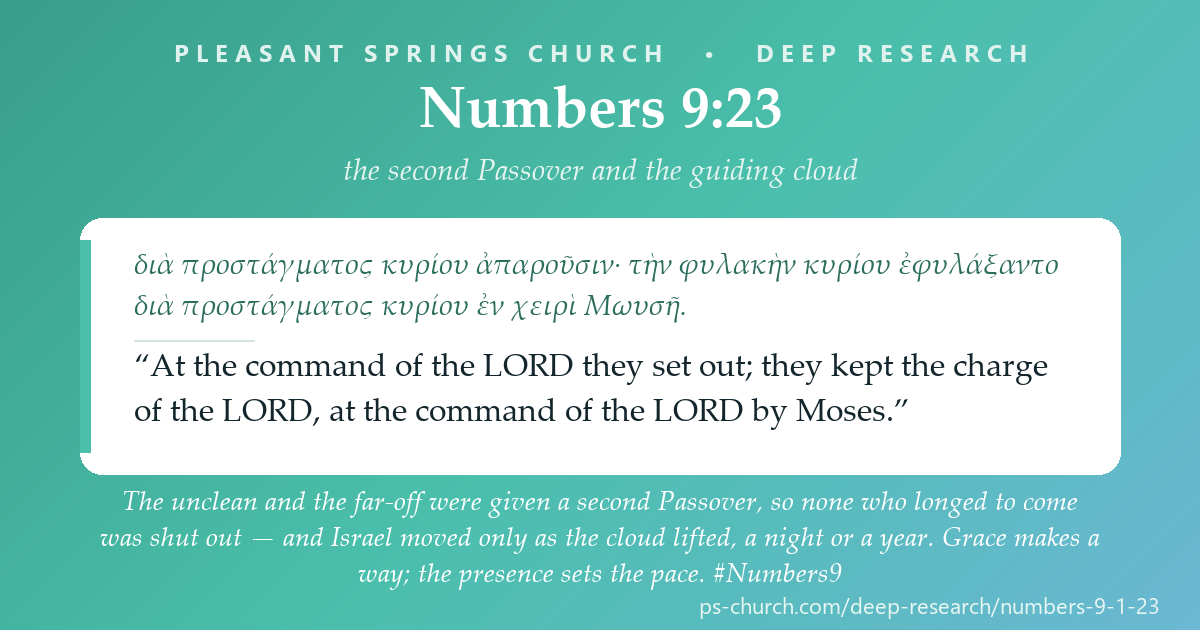
“At the command of the Lord” — literally “at the mouth of the Lord” (LXX διὰ προστάγματος κυρίου). The refrain of the cloud section: Israel set out and camped only as God directed.
How the New Testament reuses the Passover and the cloud:
- 1 Corinthians 5:7–8 — “Christ, our Passover lamb, has been sacrificed. Let us therefore celebrate the festival”: the feast fulfilled.
- John 19:36 — “Not one of his bones will be broken”: the Passover rule (Num 9:12; Exod 12:46) fulfilled at the cross.
- 1 Corinthians 10:1–4 — “our fathers were all under the cloud… and all drank… from the spiritual Rock… and the Rock was Christ”: the wilderness guidance read of Christ.
- Romans 8:14; Galatians 5:16–18 — “all who are led by the Spirit of God are sons of God”: the pilgrim pattern of following the presence (devotional).
From the first Passover and the pillar of cloud to Christ our Passover and life in the Spirit.
Trace the Passover from its institution to its fulfillment, and the guiding cloud from the exodus to the church led by the Spirit.
Which cross-references matter?
- Exodus 12:1–28, 43–49 — the first Passover and its statute (“you shall not break any of its bones”), which Numbers 9 keeps and extends to the second month.
- Exodus 13:21–22; 40:34–38 — the pillar of cloud and fire; the glory filling the tabernacle and leading the march (see Exodus 40:34–38).
- Leviticus 23:4–8 — Passover and Unleavened Bread among the appointed feasts (see Leviticus 23).
- Numbers 10:11–36 — when the cloud lifts, Israel sets out from Sinai; the ark going before them (see Numbers 10; cf. the trumpets that summon the march).
- 2 Chronicles 30:1–27; John 19:36; 1 Corinthians 5:7; 10:1–4 — the second Passover applied; the lamb whose bones are unbroken; Christ our Passover; the fathers under the cloud.
The New Testament does not treat Numbers 9 as a dead ritual but as a picture God was drawing toward Christ. Paul, urging a compromised church to purity, reaches straight for the feast: “Christ, our Passover lamb, has been sacrificed” (1 Cor 5:7), so the whole life of the church becomes a kept festival “with the unleavened bread of sincerity and truth.” John, watching the soldiers leave Jesus’ legs unbroken, hears the Passover statute of Numbers 9:12 answered at Golgotha (John 19:36). And the guiding cloud — the presence that told Israel when to move and when to wait — becomes, for Paul, a figure of the whole wilderness people “under the cloud” and sustained by Christ (1 Cor 10:1–4). The pattern abides for the church that walks by faith: a people redeemed by the Lamb, welcomed even from far off, and led not by sight but by the presence — now the indwelling Spirit — who says, in effect, move and wait. These are the New Testament’s own readings; the ground meaning in Numbers is God’s real provision and real guidance for Israel.
The scholarship on Numbers 9, the second Passover, and the pillar of cloud.
Wenham, Ashley, Cole, and Levine for Numbers; studies of Pesach Sheni and corpse impurity; the cloud / glory as guidance; Beale & Carson for the NT use.
Commentaries & studies:
- Gordon J. Wenham, Numbers (TOTC); Timothy R. Ashley, The Book of Numbers (NICOT); R. Dennis Cole (NAC); Baruch A. Levine, Numbers (Anchor).
- Studies of the second Passover (Pesach Sheni), corpse impurity and the “one statute” for the sojourner; the pillar of cloud and the glory (Shekinah) as presence and guidance.
- G. K. Beale & D. A. Carson, eds., Commentary on the New Testament Use of the Old Testament (1 Corinthians; John).
Interpretation notes worth keeping:
- Grace makes a way — without lowering the bar. The second Passover is inclusion, not laxity: the hindered are welcomed, but the feast is still kept God’s way, and the one who could keep it and refuses is “cut off” (9:13). Mercy for the hindered is not indulgence for the careless.
- One statute for native and sojourner. The open door reaches the resident foreigner (9:14) — the same generous logic the New Testament carries to its end in the welcome of the nations, without erasing the one way of the one Lamb.
- Guidance is a discipline of following. “At the command of the Lord” sounds again and again (9:18–23): Israel neither ran ahead nor lagged behind. The cloud could stay a night or a year; the point was to move only as God moved — a lived picture of walking by the Spirit.
- Typology, labeled. Christ our Passover (1 Cor 5:7), the unbroken bones (John 19:36), and the fathers under the cloud (1 Cor 10:1–4) are the New Testament’s own readings; the ground meaning here is God’s provision and guidance for Israel, held sober and not allegorized past what the text says.
From a second Passover and a guiding cloud to a life of grace received and steps that follow.
Name what you learned, why it matters, and one concrete response.
What should we carry away — and do?
- The door is kept open. The unclean, the traveler, the outsider are given a second Passover — none turned away who longs to come. If you have felt shut out, or missed your moment, there is a way back to the table.
- Grace, not laxity. The feast is still kept God’s way. Welcome and reverence belong together: come as you are, but come to the real Lamb, on his terms.
- Move only at his command. Israel set out and camped as the cloud lifted or settled — sometimes a night, sometimes a year. To follow God is to learn both the going and the waiting, and to trust the presence rather than the schedule.
Step in response: if you have been holding back from God because you felt unclean or too far gone, take the second-Passover invitation this week and come — to confession, to the Table, to the people of God. And name one decision where you are running ahead of God or refusing to wait, and ask him to teach you to move only “at the command of the Lord.”
Numbers 9:23 · to share
LXX + ESVEvery Deep Research page traces its passage across the whole sweep — the Old Testament, the Second-Temple world between the testaments (historical witnesses, not Scripture), and the New Testament. Follow the thread:
Pleasant Springs Church — Deep Research
Research method after Michael S. Heiser’s Bible Research Method (examine dictionaries → ancient literature → important words → textual connections → academic publications → share), with the Pleasant Springs “Author & Audience” foundation. Scripture set in the Hebrew, the Greek editions named on each page and the ESV (Old Testament), and the Greek New Testament and the ESV (New Testament), per the practice of Pleasant Springs Church. Numbers 9 research grounded in Wenham, Ashley, Cole, and Levine, with Beale & Carson on the New Testament use (1 Corinthians; John); Second-Temple and rabbinic reception (Mishnah Pesaḥim; Josephus; the War Scroll), all read as witnesses, not Scripture. The Passover statute and the second-Passover provision are read in their own covenant setting; the fulfillment in Christ our Passover and the pilgrim pattern of following the presence are labeled as the New Testament’s own devotional and typological readings, not leveled with the plain meaning of the text.
Scripture quotations marked ESV are from the ESV® Bible (The Holy Bible, English Standard Version®), © 2001 by Crossway, a publishing ministry of Good News Publishers. ESV Text Edition: 2016. Used by permission. All rights reserved. The ESV text may not be quoted in any publication made available to the public by a Creative Commons license, and the ESV may not be translated in whole or in part into any other language. www.esv.org
|
Did this study bless you today? 💚 Give to Support PS Church100% of gifts go to the General Fund — thank you. |