The year at Sinai is over. God gives Israel two silver trumpets, beaten from single pieces of silver, to summon the congregation, to break camp, to sound the alarm for war — so that they are “remembered before the Lord… and saved” — and to be blown over the feasts (10:1–10). Then the cloud lifts, and the whole ordered host sets out tribe by tribe, the ark going before them to seek their rest (10:11–28). Moses asks Hobab to be their eyes for the wilderness (10:29–32), and over the moving ark he speaks the ancient words: “Arise, O Lord… Return, O Lord” (10:35–36). This study works Numbers 10:1–36 — a people summoned, led, and gathered by the God who goes before them. See the method →
Numbers 10:2–36 (selections)
Hebrew · LXX · ESVThe Shape of the Passage
SequenceNumbers 10 closes the year at Sinai and opens the wilderness journey. It comes after the ordering of the camp (chs 1–2), the Levites who carry the tent (chs 3–4), the leaders’ gifts (ch 7), and the second Passover and guiding cloud (ch 9). Now the trumpet sounds and Israel marches out from the mountain of the law toward the promise.
Author
The Torah of Moses sets this chapter at a hinge of the whole book. Israel has camped at Sinai since Exodus 19; here, in the second year and second month (10:11), the year of instruction ends and the pilgrim journey begins. God first equips his people to be led by his own signal — two silver trumpets, made of one hammered piece, whose calls order every movement of the camp (10:1–10) — and then, when the cloud lifts, the whole ordered host sets out tribe by tribe exactly as the camp was arranged (10:11–28).
Word, signal, and presence. The chapter binds three things together: the trumpet that summons, gathers, and warns; the cloud that lifts and leads; and the ark that goes before. Over the moving ark Moses speaks words older than the march itself (10:35–36) — a couplet so treasured that scribes marked it off in the Hebrew text with inverted nun letters. Israel does not chart its own course; it moves at God’s command and follows God’s presence.
Audience
Israel — a redeemed people on the edge of the wilderness, learning to live as a host on the march under God’s command. The trumpets teach them that they are a summoned people: gathered by a call to assemble, to move, to fight, and to worship. And the alarm carries a promise — when they blow it in battle, “you shall be remembered before the Lord your God, and you shall be saved from your enemies” (10:9). The war is the Lord’s; the victory is his to give.
How they heard it. To leave Sinai was to leave the place of the covenant for the untracked road to the promise — frightening ground. So Moses asks Hobab, who knows the desert, to come as their “eyes” (10:31); yet the true guide goes before them — the ark, and the Lord enthroned above it, seeking out their resting place (10:33). The people hear that the God who dwells among them is also the God who goes ahead of them, scattering his enemies and returning to bless his own.
Orient on trumpets, the cloud, the order of march, the ark, and Hobab.
Search by topic: trumpet (hatsotserah), shofar, cloud / pillar, order of march, ark of the covenant, Hobab / Kenite, holy war.
Which articles are relevant?
- Anchor Bible Dictionary — “Trumpets,” “Music and Musical Instruments,” “Ark of the Covenant,” “Hobab,” “Kenites,” “War, Holy.”
- Dictionary of the OT: Pentateuch — “Numbers, Book of,” “Wilderness Wanderings,” “Ark of the Covenant,” “Presence of God,” “Warfare.”
- NIDOTTE / TDOT — חֲצֹצְרָה (ḥăṣōṣerāh, trumpet), עָנָן (ʻānān, cloud), נָסַע (nāsaʻ, to set out / pull up), אָרוֹן (ʾārōn, ark).
Bibliography surfaced:
- Gordon Wenham (TOTC), Timothy Ashley (NICOT), Dennis Olson (Interpretation), Baruch Levine (AB) on Numbers.
- Studies of the silver trumpets and the order of the wilderness march; the ark-and-presence theology; the “Song of the Ark” (10:35–36).
- Beale & Carson, Commentary on the NT Use of the OT (1 Corinthians; 1 Thessalonians).
Signal-trumpets, the ordered host, and the god who goes before the army.
Read the trumpets and the ordered march against ancient military signaling and processional-ark practice, then follow the summoning word and the ark-that-goes-before toward the New Testament.
Which parallels shed light on religion and worldview?
Signals for a host on the move. Ancient armies and assemblies were marshalled by sound — horns and trumpets to gather, to strike camp, to advance, to sound the alarm. Israel shares this practical world, but reframes it: the trumpets are made by God’s command, entrusted to the priests (10:8), and their alarm is not merely tactical — it is a cry that reaches heaven, so that Israel is “remembered before the Lord… and saved” (10:9). The signal that orders the camp is at the same time a prayer.
The ark that goes before the army. Across the ancient Near East, kings carried the images or emblems of their gods before them into battle and on the march, and returned them to rest in the sanctuary. Israel’s ark uses this processional language — it “went before them… to seek out a resting place” (10:33) — but there is no image on it; the invisible Lord himself is the one who goes before, scatters his foes, and returns to his people. The words of 10:35–36 (“Arise… Return, O Lord”) are the liturgy of that going-out and coming-back — taken up centuries later in the temple procession of Psalm 68:1.
- ANE military and cultic signaling; processional divine emblems (ANET — witnesses, not Scripture) — horns and standards marshalling a host, and gods’ emblems carried before the army: shared cultural furniture, reframed around the imageless, commanding Lord.
- Dead Sea Scrolls, the War Scroll (1QM) (Second-Temple — a witness, not Scripture) — a whole ritual of trumpets for summoning, ordering, advancing, and pursuing in the eschatological war, expanding the signals of Numbers 10.
- Josephus, Antiquities 3.291–294 (Second-Temple — a witness, not Scripture) — describes the two silver trumpets Moses made and their use for assembly and for battle.
- Mishnah, Rosh Hashanah and Taanit (rabbinic-era) — the law of the trumpet-blasts and the alarm sounded in war and distress (Num 10:9), a witness to how Israel later kept the signal.
The New Testament hears the trumpet of Numbers 10 still sounding. Paul writes that “the trumpet will sound, and the dead will be raised” “at the last trumpet” (1 Cor 15:52), and that “the Lord himself will descend from heaven… with the sound of the trumpet of God” (1 Thess 4:16) — the summons that gathers God’s people for the last time. As a devotional reading grounded in the New Testament’s own imagery: the horn that once mustered the wilderness host to assemble, to march, and to be saved becomes the final call that raises and gathers the redeemed. And the couplet over the ark — “Arise, O Lord, and let your enemies be scattered” (10:35) — is prayed again in Psalm 68:1 and answered, the New Testament will say, in the ascension of Christ, who “led a host of captives” (Ps 68:18; Eph 4:8): the Lord still goes before his people, scattering what opposes them and returning to bless.
The vocabulary of the trumpet, the march, the ark, and the cry over it.
Watch the hatsotserah (silver trumpet) of miqshah (hammered work) sound Israel’s nasa (setting-out), the aron (ark) going before, and the cry qumah (“Arise!”) over it.
“Trumpet” — the straight silver trumpet of hammered work (LXX σάλπιγξ), distinct from the ram’s-horn shofar. Blown by the priests to summon, to march, to sound the alarm, and over the offerings — a signal that is also a prayer.
“Hammered work” — beaten from a single piece of silver (LXX ἐλατός, beaten). The same craft as the lampstand (Exod 25:31): the instrument of God’s call is wrought whole, not cast.
“To set out / pull up” — originally to pull up tent-pegs; the verb of the wilderness march (LXX ἐξαίρω). When the cloud lifted, Israel “set out” — a people that moves only at God’s command.
“Ark” — the ark of the covenant (LXX κιβωτός) that “went before them… to seek out a resting place” (10:33). The throne of the invisible Lord, leading the march.
“Arise!” — the cry over the moving ark, “Arise, O Lord” (LXX ἐξεγέρθητι), that God would rise and scatter his foes. Prayed again in Ps 68:1; a summons for God himself to lead and fight.
How the New Testament reuses this chapter’s images:
- 1 Corinthians 15:51–52 — “at the last trumpet… the dead will be raised imperishable”: the summoning horn become the final gathering-call.
- 1 Thessalonians 4:16 — “the Lord himself will descend from heaven… with the sound of the trumpet of God”: the assembly-signal of the redeemed.
- Psalm 68:1; Ephesians 4:8 — “God shall arise, his enemies shall be scattered” (taking up Num 10:35), fulfilled in the ascended Christ who “led a host of captives.”
- Numbers 9:15–23 — the cloud that lifts and settles, at whose signal Israel sets out and camps (see Numbers 9): the presence that leads the march of ch 10.
From the trumpet and the ark-that-goes-before to the last trumpet.
Trace the summoning trumpet, the guiding cloud, and the ark that scatters God’s enemies from Sinai through the Psalms to the New Testament’s final gathering.
Which cross-references matter?
- Numbers 2; 9:15–23 — the order of the camp and the guiding cloud, now set in motion: Israel marches as it camped (see Numbers 1–2 and Numbers 9).
- Exodus 40:34–38 — “whenever the cloud was taken up… the people of Israel would set out”: the pattern this chapter first enacts (see Exodus 40).
- Psalm 68:1 — “God shall arise, his enemies shall be scattered”: the words over the ark (Num 10:35) become a temple-procession hymn, and a picture of the ascended Christ (Eph 4:8).
- Joel 2:1; Zephaniah 1:16 — the trumpet of alarm and the Day of the Lord: the war-signal of 10:9 stretched toward the last day.
- 1 Corinthians 15:52; 1 Thessalonians 4:16; Matthew 24:31 — “the last trumpet” and “the trumpet of God” that gather the redeemed: the summons of Numbers 10 at its horizon.
The New Testament does not allegorize Numbers 10 so much as let its images run to their end. The silver trumpet that summoned, marshalled, and warned Israel — and whose alarm meant they were “remembered… and saved” (10:9) — is heard again as “the last trumpet” and “the trumpet of God,” the call that raises the dead and gathers the church to her Lord (1 Cor 15:52; 1 Thess 4:16). And the couplet over the ark, “Arise, O Lord, and let your enemies be scattered” (10:35), travels from the wilderness into Israel’s worship (Ps 68:1) and, the New Testament claims, into the triumph of the ascended Christ, who “led a host of captives” (Eph 4:8). Held as the Scriptures’ own trajectory, and labeled as devotional where it reaches beyond the text: the God who once went before a pilgrim host, scattering its foes and returning to bless, is the same Lord who leads, guards, and will at last gather his people home.
The scholarship on Numbers 10, the trumpets, and the Song of the Ark.
Wenham, Ashley, and Levine for Numbers; studies of the silver trumpets, the order of march, and the “Song of the Ark” (10:35–36); Beale & Carson for the New Testament use.
Commentaries & studies:
- Gordon J. Wenham, Numbers (TOTC); Timothy R. Ashley, The Book of Numbers (NICOT); Dennis T. Olson and Baruch A. Levine (AB) on Numbers.
- Studies of the silver trumpets and the wilderness order of march; the “Song of the Ark” (10:35–36) and the inverted nun marks; the War Scroll’s trumpet ritual.
- G. K. Beale & D. A. Carson, eds., Commentary on the New Testament Use of the Old Testament (1 Corinthians; 1 Thessalonians).
Interpretation notes worth keeping:
- The signal is also a prayer. The trumpet-alarm of 10:9 is not merely tactical; blown before the Lord, it means Israel is “remembered… and saved.” The victory is God’s to give — the war belongs to him.
- Grace keeps ordering the pilgrim host. Israel marches out exactly as it was camped (10:11–28); the order of chs 1–2 is not abstract but for the road. A people is led by God’s word and signal, not by its own devising.
- Human help and divine leading are not rivals. Moses asks Hobab to be their “eyes” for the wilderness (10:31), even as the ark and the cloud go before (10:33–34). Trusting God’s guidance does not despise a wise guide; both serve the same journey.
- The Song of the Ark frames the march. “Arise… Return, O Lord” (10:35–36), marked off in the Hebrew text, is the liturgy of a God who goes out to fight and comes back to dwell — taken up in Ps 68 and, the New Testament says, in the ascension.
From the trumpet-call to a people summoned, led, and gathered.
Name what you learned, why it matters, and one concrete response.
What should we carry away — and do?
- You are a summoned people. God gathers, moves, warns, and rejoices his people by his own call. To follow him is to listen for the signal and answer it — to assemble, to march, to worship at his word, not our whim.
- The war is the Lord’s. The alarm meant Israel would be “remembered… and saved” (10:9). We do not sound our own strength; we cry out and are remembered. Salvation from our enemies is his to give.
- He goes before you. The ark led the march — “Arise, O Lord” — and the last trumpet will yet gather his people home (1 Cor 15:52). The God who dwells among us also walks ahead of us into every unknown road.
Step in response: name the wilderness you are stepping into this week — a hard road you did not choose — and consciously set out under God’s command rather than your own map. Pray the ancient words over it: “Arise, O Lord…” — and follow the One who goes before you, listening for his call.
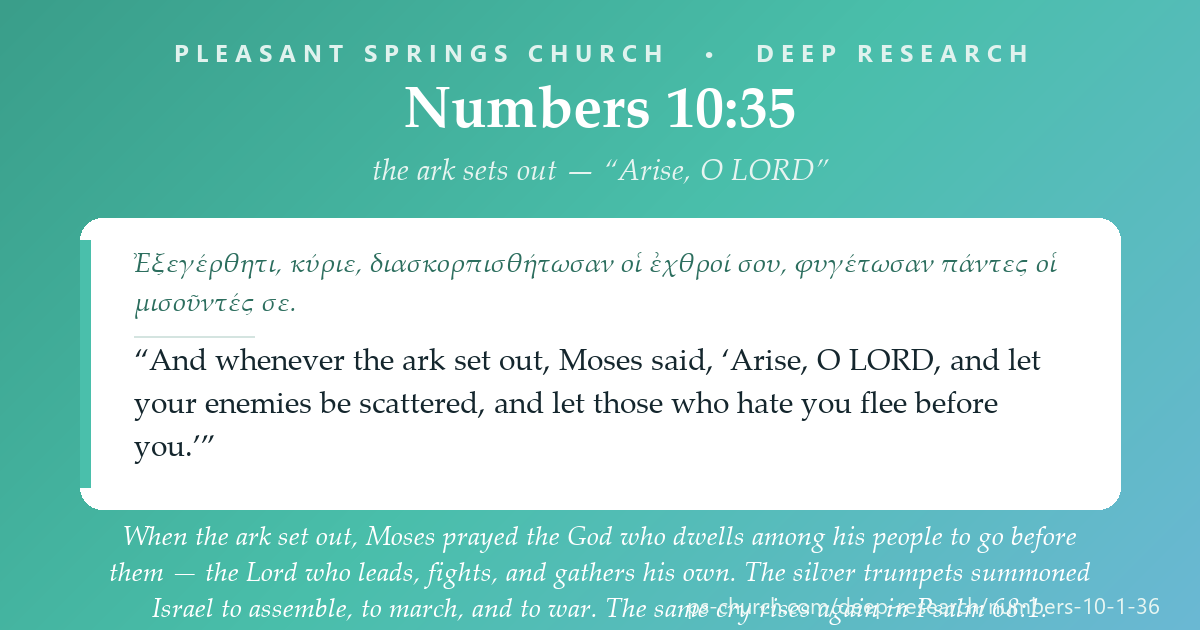
Numbers 10:35 · to share
LXX + ESVEvery Deep Research page traces its passage across the whole sweep — the Old Testament, the Second-Temple world between the testaments (historical witnesses, not Scripture), and the New Testament. Follow the thread:
Pleasant Springs Church — Deep Research
Research method after Michael S. Heiser’s Bible Research Method (examine dictionaries → ancient literature → important words → textual connections → academic publications → share), with the Pleasant Springs “Author & Audience” foundation. Scripture set in the Hebrew, the Greek editions named on each page and the ESV (Old Testament), and the Greek New Testament and the ESV (New Testament), per the practice of Pleasant Springs Church. Numbers 10 research grounded in Wenham, Ashley, Olson, and Levine, with Beale & Carson on the New Testament use (1 Corinthians; 1 Thessalonians); ANE military-signaling and processional-ark background (ANET); and Second-Temple witnesses (the War Scroll 1QM; Josephus; the Mishnah), read as witnesses, not Scripture. The trumpet-as-summons and the ark-that-goes-before are traced to the “last trumpet” and the ascension as the Scriptures’ own trajectory, labeled devotional where it reaches beyond the text.
Scripture quotations marked ESV are from the ESV® Bible (The Holy Bible, English Standard Version®), © 2001 by Crossway, a publishing ministry of Good News Publishers. ESV Text Edition: 2016. Used by permission. All rights reserved. The ESV text may not be quoted in any publication made available to the public by a Creative Commons license, and the ESV may not be translated in whole or in part into any other language. www.esv.org
|
Did this study bless you today? 💚 Give to Support PS Church100% of gifts go to the General Fund — thank you. |