Three days out from Sinai, the road turns hard. The people complain, and fire breaks out at Taberah; then a craving for meat — contempt for the daily manna and a nostalgic longing for “the fish we ate in Egypt that cost nothing” (11:5–6). Moses, crushed, cries, “I am not able to carry all this people alone” (11:14) — and God answers twice: he shares the Spirit on Moses with seventy elders who prophesy, drawing out Moses’ great longing, “would that all the Lord’s people were prophets” (11:29); and he sends the quail, but with a plague, so the place is named Kibroth-hattaavah, “the graves of craving.” This study works Numbers 11:1–35 — the corrosion of discontent, the shared burden of leadership, and the outpoured Spirit answered at Pentecost. See the method →
Numbers 11:1–34 (selections)
Hebrew · LXX · ESVThe Shape of the Passage
Parallel panelsNumbers 11 opens the book’s wilderness-journey section: after the ordered camp (chs 1–2), the set-apart Levites (chs 3–4), the leaders’ offerings (ch 7), and the departure from Sinai (ch 10), the marching people meet their own hearts. Three days out (10:33), the grumbling begins — and it will run all the way to Miriam and Aaron against Moses (ch 12) and the unbelief at Kadesh.
Author
The Torah of Moses turns here from law and order to the story of the road. The tabernacle is built, the tribes are numbered and arranged, the cloud has lifted — and almost at once the redeemed people begin to complain. Chapter 11 is the first of the wilderness murmurings, and it sets the pattern: discontent with God’s provision, a craving that despises the daily gift, and leadership crushed under a weight it was never meant to bear alone.
A twofold answer. To Moses’ cry God gives two gifts at once — he shares the Spirit that rested on Moses with seventy elders, so the burden is carried together; and he grants the craving for meat, but to judgment. The chapter holds mercy and severity in the same hand: the Spirit poured out on the many, and the graves dug for those who despised the manna.
Audience
Israel on the march — a people freshly redeemed, fed with bread from heaven, and yet looking backward to Egypt. The chapter names their sin exactly: not hunger but craving; not need but nostalgia for slavery’s menu (“the fish we ate in Egypt that cost nothing,” 11:5). It is a mirror held up to every generation that receives grace daily and still murmurs.
How they heard it. To Israel this said: your discontent is not a small thing — it is unbelief, a despising of the God who feeds you. And yet the same chapter offers hope: God does not abandon a weary leader, but shares the load; and he does not keep his Spirit to a single man, but pours it out — a foretaste of the day Moses himself longed for, “would that all the Lord’s people were prophets” (11:29).
Orient on complaining, manna and quail, the Spirit, prophecy, and the seventy elders.
Search by topic: murmuring / complaining, manna, quail, Spirit of God, prophecy, elders, Kibroth-hattaavah, Taberah.
Which articles are relevant?
- Anchor Bible Dictionary — “Murmuring,” “Manna,” “Quail,” “Spirit of God,” “Prophecy,” “Elder.”
- Dictionary of the OT: Pentateuch — “Complaint,” “Wilderness Wanderings,” “Spirit of God,” “Prophets and Prophecy,” “Leadership.”
- NIDOTTE / TDOT — לוּן (lûn, murmur/grumble), תַּאֲוָה (taʾăwāh, craving), מָן (mān, manna), רוּחַ (rûaḥ, Spirit/wind), נָבִיא (nāḇîʾ, prophet).
Bibliography surfaced:
- Timothy Ashley (NICOT), Gordon Wenham (TOTC), Dennis Cole (NAC), Baruch Levine (AB) on Numbers.
- Studies of the wilderness murmuring narratives, the seventy elders and the shared Spirit, and the manna / quail traditions.
- Beale & Carson, Commentary on the NT Use of the OT (Acts; 1 Corinthians; Philippians).
Craving, the desert quail, and the Spirit shared among the elders.
Read the murmuring against the reality of desert life, weigh the quail and the seventy elders, then follow Moses’ longing to Pentecost.
Which parallels shed light on religion and worldview?
The desert and its quail. The migratory quail (Coturnix) still cross the Sinai in vast flocks in spring and autumn, exhausted after long flight and easily caught low to the ground — exactly as the text describes, driven in by a wind from the sea and heaped “about two cubits above the ground” (11:31). The narrative is at home in the real wilderness; what is remarkable is not the bird but the timing and the craving that summoned it. Later tradition remembered the episode vividly: the Wisdom of Solomon recalls the quail as a gracious delicacy given to Israel, set against the beasts of wrath sent upon Egypt (Wis 16:1–4; 19:11–12).
The seventy and the shared Spirit. A body of seventy elders reappears through Israel’s life (Exod 24:1,9; and the later Sanhedrin was reckoned at seventy or seventy-two). Here their number is less the point than what happens to them: God takes “some of the Spirit” on Moses and places it on them, and they prophesy — a sign, not a permanent office (“but they did not continue doing it,” 11:25). When Eldad and Medad prophesy in the camp and Joshua wants them silenced, Moses refuses to guard his monopoly: “Are you jealous for my sake? Would that all the Lord’s people were prophets” (11:29). The Spirit is God’s to give, and God delights to give him widely.
- Wisdom of Solomon 16:1–4; 19:11–12 (Apocrypha — a witness, not Scripture in the Protestant canon) — reflects on manna and quail, presenting the quail as a kindness to Israel over against the plagues on Egypt; the deeper point that the same gifts can serve mercy or judgment is our own reflection on Numbers 11.
- Josephus, Antiquities 3.295–299 (Second-Temple — a witness, not Scripture) — retells the craving, the quail, and the plague in the wilderness.
- Sifre on Numbers §§86–95; Mishnah, Sanhedrin 1:6 (rabbinic-era — witnesses, not Scripture) — expound the seventy elders and derive the court of seventy(-one) from Numbers 11:16.
- Targum & later midrash (Second-Temple / rabbinic — witnesses, not Scripture) — identify Eldad and Medad’s prophecy and wrestle with the “fish… for nothing” of Egypt (11:5).
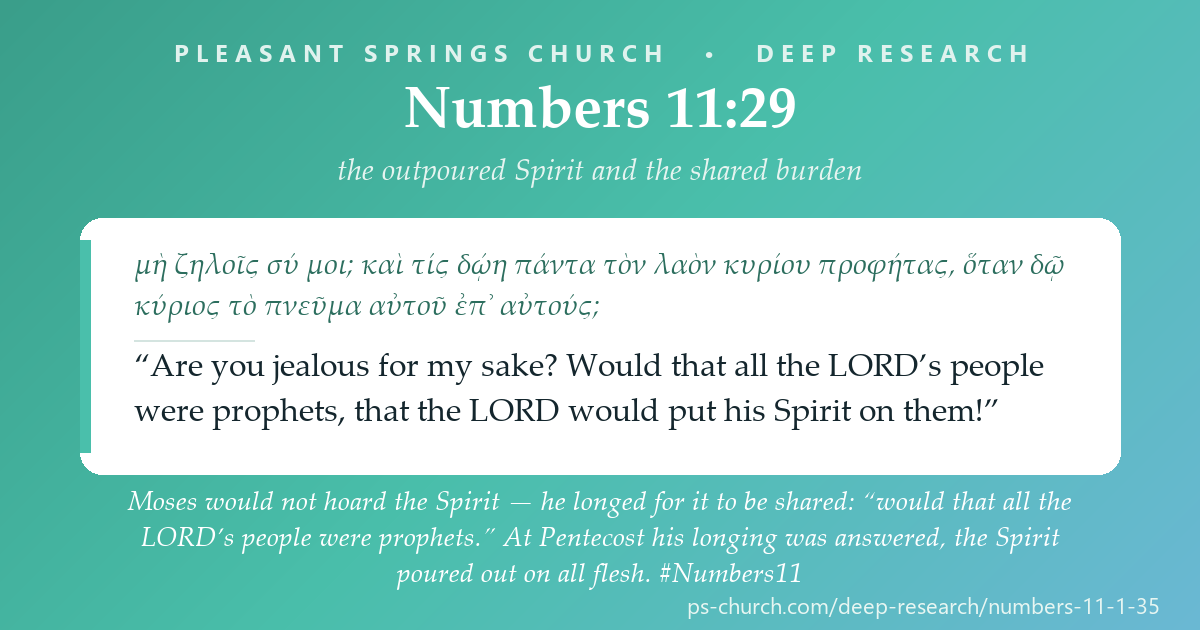
Moses would not hoard the Spirit. When told that others were prophesying, he wished the gift on everyone: “would that all the Lord’s people were prophets, that the Lord would put his Spirit on them!” (11:29). The prophet Joel took up that longing as promise — “I will pour out my Spirit on all flesh; your sons and your daughters shall prophesy” (Joel 2:28–29) — and at Pentecost Peter declared it fulfilled: “this is what was uttered through the prophet Joel” (Acts 2:16–18). What was placed on seventy for a moment is now poured out on all God’s people, sons and daughters, young and old. We hold this as the New Testament’s own reading — Moses’ wish is God’s promise, granted in Christ by the Spirit — a devotional and typological line, not a flattening of the plain sense of Numbers.
The vocabulary of craving, manna, the Spirit, prophecy, and the burden.
Watch taʾawah (craving) that names the graves, man (manna) despised, and ruach (Spirit) shared among the seventy so the massaʾ (burden) is no longer carried alone.
“Craving / lust” — strong desire, here for meat (LXX ἐπιθυμία). It names the place of judgment: Qiḇrôṯ hattaʾăwāh, “the graves of craving” (11:34) — the very word for the sin becomes the word on the tomb.
“Manna” — the daily bread from heaven (LXX μάννα). Once a wonder, now despised: “there is nothing at all but this manna” (11:6). To scorn the daily gift is the heart of the sin — ingratitude that is really unbelief.
“Spirit / wind” — both the Spirit taken from Moses and placed on the seventy (11:17,25) and the wind that drives in the quail (11:31; LXX πνεῦμα). The same God who shares his Spirit sends the wind of judgment.
“Prophet” — one who speaks for God (LXX προφήτης). Moses’ longing that “all… were prophets” (11:29) reaches past the seventy to Joel’s promise and Pentecost’s outpouring on all flesh (Acts 2:17–18).
“Burden / load” — the weight of the people Moses cannot carry alone (11:17). The LXX renders it ὁρμήν (“impulse, rush”); the shared Spirit is God’s way of dividing an unbearable load among many.
How the New Testament takes up Numbers 11:
- Acts 2:16–18 (citing Joel 2:28–29) — “I will pour out my Spirit on all flesh… and they shall prophesy”: Moses’ longing (11:29) become promise and Pentecost’s reality.
- 1 Corinthians 10:6–11 — the wilderness cravings and grumbling written down “as examples… for our instruction”: “do not grumble, as some of them did.”
- Philippians 2:14–15 — “Do all things without grumbling… that you may be blameless”: the wilderness murmuring named and forsworn.
- John 6:31–35, 48–51 — the manna a shadow of the true bread from heaven, Christ himself: what Israel despised points to the One who satisfies.
From the murmuring in the wilderness across the canon.
Trace the two threads — the sin of craving and the gift of the shared Spirit — from Sinai to Pentecost.
Which cross-references matter?
- Exodus 16; Numbers 21:4–9 — the earlier and later murmurings: bread and quail given, then the fiery serpents when the people “loathed” the manna (see Numbers 21:4–9).
- Exodus 24:1,9; Numbers 11:16–17 — the seventy elders who share Moses’ authority; the pattern behind Israel’s later councils (see Numbers 10 and Numbers 12).
- Psalm 78:17–31; 106:13–15 — Israel “tested God… craved” in the desert; “he gave them what they asked, but sent a wasting disease among them”: the sober memory of Kibroth-hattaavah.
- Joel 2:28–29; Acts 2:16–18 — “I will pour out my Spirit on all flesh”: Moses’ wish (11:29) become promise and fulfillment.
- 1 Corinthians 10:6–11; Philippians 2:14–15 — the wilderness grumbling as a warning to the church: do not crave, do not murmur.
The New Testament reads Numbers 11 along both its lines. On the one hand, the craving and the grumbling are held up as a warning: Paul says the wilderness disasters “were written down for our instruction” (1 Cor 10:11), naming grumbling among the sins that fell under judgment, and Philippians answers directly — “do all things without grumbling” (Phil 2:14). To despise the daily provision and idealize the past is not a small fault but a form of unbelief, a turning of the heart back toward ‘Egypt.’ On the other hand, the chapter’s brightest moment — Moses’ refusal to guard the Spirit and his longing that “all… were prophets” (11:29) — becomes, through Joel, the promise Peter proclaims fulfilled at Pentecost (Acts 2:16–18): the Spirit once shared among seventy is now poured out on all flesh. The same passage that warns against the corrosion of discontent points forward to the grace that heals it — a people no longer carrying the burden alone, but filled and led by the Spirit of God.
The scholarship on the wilderness murmurings and the shared Spirit.
Ashley, Wenham, Cole, and Levine for Numbers; the murmuring-narrative and Spirit-and-elders studies; Beale & Carson for the New Testament use.
Commentaries & studies:
- Timothy R. Ashley, The Book of Numbers (NICOT); Gordon J. Wenham, Numbers (TOTC); Dennis T. Cole (NAC); Baruch A. Levine, Numbers (Anchor).
- Studies of the wilderness murmuring cycle, the seventy elders and the sharing of the Spirit, and the manna / quail traditions in later Judaism.
- G. K. Beale & D. A. Carson, eds., Commentary on the New Testament Use of the Old Testament (Acts; 1 Corinthians; Philippians).
Interpretation notes worth keeping:
- The sin is craving, not hunger. Israel is fed daily; the fault is discontent — despising the manna and idealizing Egypt’s table. Treat it soberly, as a warning against ingratitude that is really unbelief (Ps 106:13–15; 1 Cor 10:6), not harshly.
- God grants the craving to judgment. The quail come in answer to the demand — “he gave them what they asked, but sent a wasting disease” (Ps 106:15). A granted desire can be a severe mercy; not every answered prayer is a blessing.
- The shared burden is a gift, not a demotion. The seventy do not diminish Moses; they relieve him. The Spirit-empowered sharing of leadership is God’s provision for a load no one person should carry — a word for weary leaders in every age.
- Handle the Pentecost line as the NT does. Moses’ longing (11:29) → Joel’s promise → Peter’s “this is that” (Acts 2) is the apostles’ own reading — a devotional and typological fulfillment, held without erasing the plain sense of the wilderness account.
From the graves of craving to the Spirit poured out on all.
Name what you learned, why it matters, and one concrete response.
What should we carry away — and do?
- Discontent is not harmless. To despise the daily gift and long for ‘Egypt’ is a quiet unbelief. The manna was a wonder; familiarity made it contempt. Guard your heart against the craving that forgets grace.
- You were not meant to carry it alone. God did not scold Moses for being overwhelmed; he shared the Spirit and the load. Weary leader, the answer to the burden is not to grip it tighter but to let God spread it among the many he has gifted.
- The Spirit is poured out on all. Moses longed for it; Pentecost delivered it. The gift once given to seventy is now given to sons and daughters, young and old — every believer filled and sent.
Step in response: name one daily provision you have begun to despise — a job, a home, a person, God’s ordinary bread — and give thanks for it specifically, turning craving into gratitude. And if you carry a weight alone, ask God this week for the Eldads and Medads he has already gifted, and share the burden he never meant you to bear by yourself.
Numbers 11:29 · to share
LXX + ESVEvery Deep Research page traces its passage across the whole sweep — the Old Testament, the Second-Temple world between the testaments (historical witnesses, not Scripture), and the New Testament. Follow the thread:
Pleasant Springs Church — Deep Research
Research method after Michael S. Heiser’s Bible Research Method (examine dictionaries → ancient literature → important words → textual connections → academic publications → share), with the Pleasant Springs “Author & Audience” foundation. Scripture set in the Hebrew, the Greek editions named on each page and the ESV (Old Testament), and the Greek New Testament and the ESV (New Testament), per the practice of Pleasant Springs Church. Numbers 11 research grounded in Ashley, Wenham, Cole, and Levine, with Beale & Carson on the New Testament use (Acts; 1 Corinthians; Philippians); Second-Temple and rabbinic witnesses (the Wisdom of Solomon, Josephus, the Sifre on Numbers, and the Mishnah’s Sanhedrin on the seventy elders), all read as witnesses, not Scripture. The Pentecost line — Moses’ longing (11:29) through Joel 2:28–29 to Acts 2:16–18 — is held as the New Testament’s own devotional and typological reading, without erasing the plain sense of the wilderness account; the grumbling is handled soberly as a warning (1 Cor 10:10; Phil 2:14), not harshly.
Scripture quotations marked ESV are from the ESV® Bible (The Holy Bible, English Standard Version®), © 2001 by Crossway, a publishing ministry of Good News Publishers. ESV Text Edition: 2016. Used by permission. All rights reserved. The ESV text may not be quoted in any publication made available to the public by a Creative Commons license, and the ESV may not be translated in whole or in part into any other language. www.esv.org
|
Did this study bless you today? 💚 Give to Support PS Church100% of gifts go to the General Fund — thank you. |