Bitten by fiery serpents and dying in the wilderness, Israel is given a strange remedy: a bronze serpent, lifted high on a pole. There is nothing to do but look — and the bitten live. It is salvation by faith’s gaze at God’s appointed sign. And Jesus makes it the picture of his own cross: “as Moses lifted up the serpent in the wilderness, so must the Son of Man be lifted up.” This study works Numbers 21 from the pole in the desert to the cross — where the curse-bearer becomes our healing. See the method →
Numbers 21:4–9 (selections)
Hebrew · LXX · ESVThe Shape of the Passage
Parallel panelsNumbers continues the Torah of Moses: the wilderness generation journeys from Sinai toward the promised land, grumbling and being formed along the way. This episode is one of its sharpest pictures of judgment and mercy.
Author
The Torah of Moses records Israel’s wilderness wanderings in the book of Numbers. Here, near the end of the journey, the people once more grow impatient and, as the text says, “spoke against God and against Moses.” Judgment comes as “fiery serpents”; the people repent; and God provides a strange, gracious remedy — not the removal of the serpents, but a bronze serpent lifted on a pole, which the bitten are to look at and live. The narrative holds sin, judgment, intercession, and a God-given means of rescue in a single tight scene.
A sign, not a charm. The healing is not magic in the bronze; it is God’s mercy received through the obedience of a look. Israel later learned this the hard way: when the bronze serpent itself became an idol, Hezekiah destroyed it (2 Kgs 18:4). The sign always pointed beyond itself.
Audience
Israel — the wilderness generation, weary and complaining, and yet not abandoned. The remedy meets them in their helplessness: there is nothing to do but turn and look to what God has appointed. The proud and the dying are on equal ground; all that is asked is a look of faith.
How they heard it. The episode became a byword for the mercy that saves the undeserving. Later Jewish reflection was careful to say it was not the bronze that healed but God (Wisdom 16:7); the look was faith, not superstition. And it set a pattern the Gospel would seize: the very emblem of the curse, lifted up, becomes the means of life — because the Son of Man would be lifted up on a cross.
Orient on the serpent, the wilderness, healing, and the sign.
Search by topic: bronze serpent, Nehushtan, serpent (symbolism), wilderness wanderings, healing.
Which articles are relevant?
- Anchor Bible Dictionary — “Serpent, Bronze,” “Nehushtan,” “Wilderness,” “Healing.”
- Dictionary of the OT: Pentateuch — “Numbers, Book of,” “Serpent,” “Wilderness Wanderings,” “Complaint.”
- NIDOTTE / TDOT — נָחָשׁ (nāḥāš, serpent), שָׂרָף (śārāp̄, fiery serpent/seraph), נֵס (nēs, pole/standard), נָבַט (nāḇaṭ, look).
Bibliography surfaced:
- Timothy Ashley (NICOT), Dennis Cole (NAC), Gordon Wenham (TOTC) on Numbers.
- Studies of the bronze serpent and Nehushtan; the “lifted up” motif in John.
- Beale & Carson, Commentary on the NT Use of the OT (John 3).
Serpents, healing symbols, and the look of faith.
Read the serpent against ANE symbolism, weigh the sign-not-charm question, then follow the “lifted up” motif to the cross.
Which parallels shed light on religion and worldview?
The serpent’s double meaning. In the ancient world the serpent could stand for death and chaos and also, oddly, for healing (as in the later Greek symbol of Asclepius, a serpent on a staff). Israel had its own memory: the serpent of Eden, the emblem of the curse (Genesis 3). Here the very shape of the curse, lifted up by God’s command, becomes the means of life — a deliberate reversal, not a borrowing of magic.
A sign, not a spell. The bitten are healed not by the bronze but by looking in trust to what God appointed. Second-Temple and later Jewish writers guarded this carefully: it was God who saved, and the look was the turning of the heart to him. When Israel forgot and worshiped the object itself, Hezekiah smashed it and called it “Nehushtan” — merely “a piece of bronze” (2 Kgs 18:4).
- ANE serpent symbolism — the serpent as both threat and (in some cults) healing emblem: shared imagery Israel reframes, with no hint that the bronze had power in itself.
- Wisdom of Solomon 16:5–7 (Apocrypha — a witness, not Scripture) — “the one who turned toward it was saved, not by what he saw, but by you, the Savior of all”: the standard guard against superstition.
- Mishnah, Rosh Hashanah 3:8 (rabbinic-era) — the serpent neither killed nor made alive; when Israel “looked upward and subjected their hearts to their Father in heaven” they were healed.
- 2 Kings 18:4 — Hezekiah destroys the bronze serpent (Nehushtan) once it becomes an idol: the sign must never replace the God it points to.
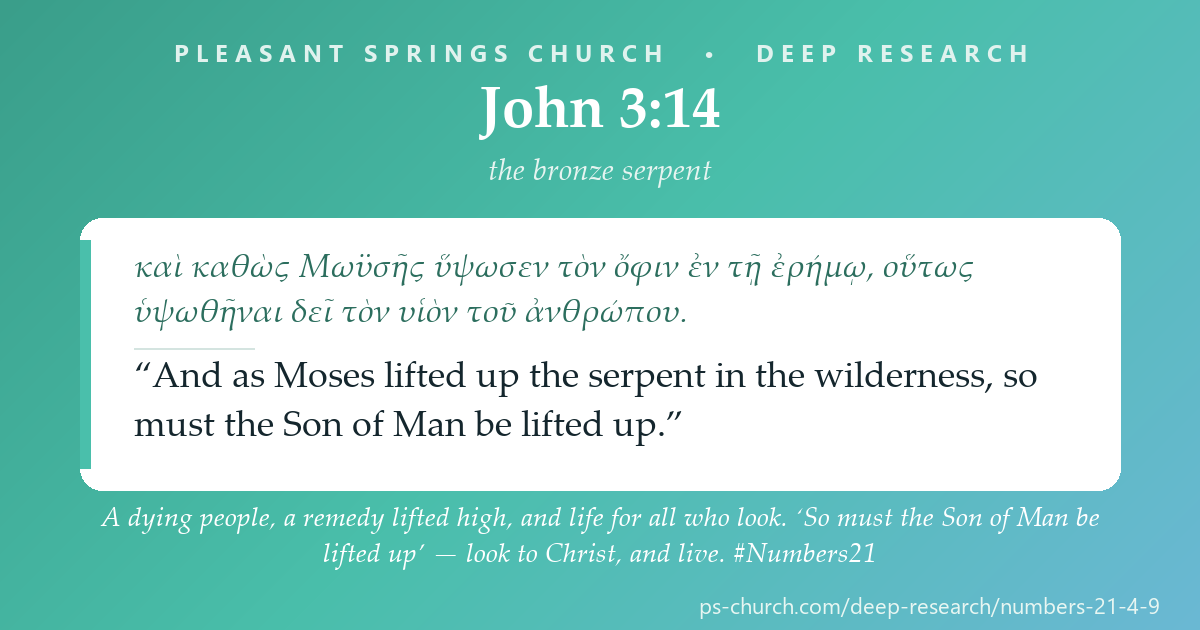
Jesus reaches back to this episode for the deepest picture of his own death: “And as Moses lifted up the serpent in the wilderness, so must the Son of Man be lifted up, that whoever believes in him may have eternal life” (John 3:14–15). The parallel is exact where it counts: a dying people, a God-given remedy raised on a pole, and life for all who simply look in faith. And the image is even richer than it first appears. The serpent was the emblem of the curse; on the cross, Christ was “made… to be sin who knew no sin” (2 Cor 5:21), “becoming a curse for us” (Gal 3:13) — the accursed thing lifted up so that all who look to him might live. John will return to this “lifting up” again and again (John 8:28; 12:32–34): the cross is the moment the Son of Man is raised, and draws the world to himself.
The vocabulary of serpent, pole, and the saving look.
Watch the saraph, the bronze word-play, and the look that heals.
“Fiery serpent” — lit. “burning one” (from the burning of its venom); the same word names the seraphim (Isa 6:2). At 21:8 God says simply “make a saraph.”
“A serpent of bronze” — a deliberate word-play (naḥash / nĕḥoshet). The image of the curse, made of bronze and lifted up, becomes the means of rescue.
“Pole / standard” — a raised banner or signal-pole; the serpent is set up high where all can see and look (LXX σημεῖον, “sign”).
“He would look” — a gaze of trust toward God’s appointed remedy; the whole cure hangs on the look of faith (cf. Isa 45:22, where God calls the whole earth to “turn to me and be saved” — the same orienting of the self to God).
How the New Testament reuses the bronze serpent:
- John 3:14–15 — “as Moses lifted up the serpent… so must the Son of Man be lifted up, that whoever believes in him may have eternal life”: the episode’s fulfillment.
- John 8:28; 12:32–34 — the recurring “lifted up” (ὑψόω): the cross as the Son of Man’s exaltation, drawing all people.
- 1 Corinthians 10:9 — “we must not put Christ to the test, as some of them did and were destroyed by serpents”: Paul reads the wilderness with Christ present.
- Galatians 3:13; 2 Corinthians 5:21 — Christ, “becoming a curse for us,” was “made… to be sin who knew no sin”: why the emblem of the curse becomes the means of life.
From the serpent of Eden to the Son of Man lifted up.
Trace the serpent from the curse of Eden to the pole in the wilderness to the cross, and the saving “look” through Isaiah to the Gospel.
Which cross-references matter?
- Genesis 3:1–15 — the serpent and the curse (see Genesis 3); the emblem of the fall, here reversed into a sign of healing.
- Isaiah 45:22 — “Turn to me and be saved, all the ends of the earth!”: the turn of faith — the same orienting of the self to God as the saving look — widened to the world.
- 2 Kings 18:4 — Nehushtan destroyed: the sign must not become an idol; the object had no power apart from God.
- John 3:14–16; 12:32 — the Son of Man lifted up; “I… will draw all people to myself.”
- Numbers 21:4–9; 1 Corinthians 10:1–11 — the wilderness as warning and instruction “written down for our instruction.”
The New Testament’s use of Numbers 21 is Jesus’ own. In John 3, he draws the analogy himself: as the bronze serpent was raised so the dying could look and live, so the Son of Man must be “lifted up” so that believers have eternal life. The typology is precise and self-limiting: the point of comparison is not that Christ is a serpent, but that a God-appointed remedy is raised up, and rescue comes by faith’s look. John deepens it with his signature double meaning of “lifted up” (ὑψόω) — lifted onto the cross and exalted in glory. And the deepest layer is theological: the serpent, the emblem of sin’s curse since Eden, is the fitting figure for the One who became a curse for us, bearing in himself the very poison he heals — the sinless One who took the serpent’s form of the curse without its venom. Look, and live.
The scholarship on the bronze serpent.
The commentators on Numbers 21; the studies of Nehushtan and the “lifted up” motif; Beale & Carson on John 3.
Commentaries & studies:
- Timothy R. Ashley (NICOT), R. Dennis Cole (NAC), Gordon J. Wenham (TOTC) on Numbers.
- Studies of the bronze serpent, Nehushtan (2 Kgs 18:4), and the Johannine “lifting up” motif.
- G. K. Beale & D. A. Carson, eds., Commentary on the New Testament Use of the Old Testament.
Interpretation notes worth keeping:
- Remedy fits the wound. The cure is shaped like the affliction — a serpent for serpent-bite — a pattern the cross completes: the curse-bearer heals the cursed.
- Salvation by looking, not doing. There is no work to perform, only a look of faith toward God’s appointed sign — the very grammar of the gospel (John 3:15; Isa 45:22).
- Guard the sign. Nehushtan warns that even a true, God-given sign becomes deadly when it is worshiped in place of God; the look must always land on the Lord it points to.
From the pole in the wilderness to your own look of faith.
Name what you learned, why it matters, and one concrete response.
What should we carry away — and do?
- Look and live. When you are bitten by your own sin and dying, the gospel does not say “try harder” but “look” — to Christ lifted up. Salvation comes by faith’s gaze, not by works.
- The curse-bearer heals. The emblem of the curse, lifted up, became life. Christ became a curse for us so that the very thing that condemns could become the means of our rescue.
- Don’t worship the sign. Even good things — symbols, experiences, traditions — become idols when they replace the God they point to. Keep your look on the Lord himself.
Step in response: take the sin or shame you are most tempted to manage on your own, and instead simply look — turn your gaze to Christ lifted up, and trust his finished work. Then help someone else lift their eyes: point a struggling friend past the symbols to the Savior they signify.
John 3:14–15 · to share
Greek + ESVEvery Deep Research page traces its passage across the whole sweep — the Old Testament, the Second-Temple world between the testaments (historical witnesses, not Scripture), and the New Testament. Follow the thread:
Pleasant Springs Church — Deep Research
Research method after Michael S. Heiser’s Bible Research Method (examine dictionaries → ancient literature → important words → textual connections → academic publications → share), with the Pleasant Springs “Author & Audience” foundation. Scripture set in the Hebrew, the Greek editions named on each page and the ESV (Old Testament), and the Greek New Testament and the ESV (New Testament), per the practice of Pleasant Springs Church. Numbers 21:4–9 research grounded in Ashley, Cole, and Wenham, with Beale & Carson on John 3; ANE serpent-symbolism background; Second-Temple material per Wisdom of Solomon and the Mishnah (read as witnesses, not Scripture).
Scripture quotations marked ESV are from the ESV® Bible (The Holy Bible, English Standard Version®), © 2001 by Crossway, a publishing ministry of Good News Publishers. ESV Text Edition: 2016. Used by permission. All rights reserved. The ESV text may not be quoted in any publication made available to the public by a Creative Commons license, and the ESV may not be translated in whole or in part into any other language. www.esv.org
|
Did this study bless you today? 💚 Give to Support PS Church100% of gifts go to the General Fund — thank you. |