A whole chapter of road. A Canaanite king raids the column and takes captives, Israel vows, and the place is named Hormah. The long way around Edom wears the people thin, and the bronze serpent is lifted up. Then a list of campsites — and, in the middle of it, the narrator quotes a book we no longer have: “the Book of the Wars of the Lord” (21:14). Then, at a well called Beer, a people who had complained about water for forty years stand around one and sing: “Spring up, O well!—Sing to it!—” (21:17). And then Sihon at Jahaz and Og at Edrei, and for the first time in the book Israel holds land. This study works Numbers 21:1–35 whole — the patience of a long road, the honesty of a Bible that names its sources, joy in a desert, and the Transjordan conquest reported soberly and fenced exactly where Scripture fences it. See the method →
Numbers 21:1–34 (selections)
Hebrew · LXX · ESVThe Shape of the Passage
InclusioNumbers 21 sits between two deaths and a new beginning. Miriam and Aaron are buried and Edom has refused passage (ch 20); the generation sentenced at Kadesh (chs 13–14) is nearly gone. What follows in this chapter is the first forward movement in forty years — and the next chapter will bring Balak and Balaam (ch 22).
Author
The Torah of Moses tells this chapter the way a traveller keeps a log: a raid, a vow, a name; a stretch of hard road and a plague of serpents; camp names in a row; a snatch of quoted poetry; a song at a well; two kings and two battles. It is not shaped for drama. It is shaped like a journey — which is exactly what it is.
A book that quotes other books. At 21:14 the narrator pauses to cite a source: “it is said in the Book of the Wars of the Lord.” That book is lost; we have only this fragment of it. Scripture does this elsewhere without embarrassment — the Book of Jashar (Josh 10:13; 2 Sam 1:18), the Acts of Solomon (1 Kgs 11:41), the chronicles of the kings, the records of Samuel, Nathan and Gad (1 Chr 29:29) — and Luke opens his Gospel by saying plainly that he consulted the accounts of others (Luke 1:1–4). Inspiration does not mean a writer never used sources; it means that what he wrote is God’s word. Ordinary historical craft and divine authorship are not rivals here.
Audience
Israel on the move, and behind them the readers who inherited the story on the plains of Moab. For the wilderness generation this chapter was the answer to a question they had been asking for forty years: is anything ever going to happen? Something does. The vow at Arad is answered; the water comes; the land east of the Jordan is theirs. For the first time the book records territory, not just campsites.
How they heard it. Later Israel sang these two kings in her worship — “Sihon, king of the Amorites, and Og, king of Bashan” (Ps 135:11; 136:19–20) — and Nehemiah rehearsed them in a prayer of confession (Neh 9:22). Rahab had heard of them in Jericho (Josh 2:10). They became shorthand for a single conviction: the God who brought us out is able to bring us in. And the Song of the Well was remembered too — a people who had complained about water for a generation finally standing around one and singing.
Orient on Arad and Hormah, the herem, lost sources, Beer, and the Transjordan kingdoms.
Search by topic: Arad, Hormah, herem / ban, Book of the Wars of the Lord, Book of Jashar, Beer, Song of the Well, Arnon, King’s Highway, Sihon, Heshbon, Og, Bashan, Edrei, Amorites, Rephaim, Transjordan.
Which articles are relevant?
- Anchor Bible Dictionary — “Arad,” “Hormah,” “Ban (Herem),” “Wars of the Lord, Book of the,” “Jashar, Book of,” “Beer,” “Arnon,” “King’s Highway,” “Sihon,” “Heshbon,” “Og,” “Bashan,” “Edrei,” “Amorites,” “Rephaim.”
- Dictionary of the OT: Pentateuch — “Itineraries,” “Poetry,” “Sources of the Pentateuch,” “War,” “Land,” “Wilderness Wanderings.”
- NIDOTTE / TDOT — חֵרֶם (ḥērem, devoted thing), בְּאֵר (bəʾēr, well), שִׁיר (šîr, sing), מְחֹקֵק (məḥōqēq, ruler’s staff), יָרַשׁ (yāraš, take possession).
Bibliography surfaced:
- Timothy Ashley (NICOT), Gordon Wenham (TOTC), R. Dennis Cole (NAC), Baruch Levine (AB), Jacob Milgrom (JPS), Dennis Olson (Interpretation) on Numbers.
- Studies of the wilderness itineraries, the archaic poetic fragments of the Pentateuch, and the Transjordan (Moabite / Amorite) geography.
- The Mesha Stele (Moabite Stone) and the archaeology of Dibon, Medeba, Heshbon and Jahaz.
Kings’ highways, quoted books, well-songs — and a Moabite stone that names the same towns.
Set the chapter in its own Transjordanian world: the road, the disputed towns, the shared vocabulary of “devoting” a city, and the ordinary ancient habit of quoting older records. Then let the New Testament, not our instincts, say what this means for us.
Which parallels shed light on religion and worldview?
A real road through real kingdoms. The King’s Highway (21:22) is the north–south trunk route of the Transjordan plateau, and every place in this chapter sits on or near it: the Arnon gorge, Heshbon, Dibon, Medeba, Jahaz. That is why Israel had to ask permission at all. Centuries after the settlement, the Mesha Stele — the Moabite Stone, set up by King Mesha of Moab around 830 BC (ANET 320–321) — names the same contested towns and their neighbours: Ataroth, Nebo, Medeba, Dibon, Jahaz, Aroer, and “the highway in the Arnon.” Numbers 21 is not describing an imaginary landscape.
Chemosh, and the vocabulary of ‘devoting.’ The taunt-song quoted at 21:29 addresses Moab as “people of Chemosh” — and Mesha’s inscription is one long report to Chemosh, who (Mesha says) was angry with his land, then told him to go and take Nebo. Mesha even uses Israel’s own word: he took the town and killed its people, “for I had devoted them to destruction for Ashtar-Chemosh.” The חֵרֶם was a category the whole region understood. That does not make Israel’s wars ordinary — the point of Numbers is that this land is given by the God who made it, not seized by a king boasting to his god — but it does mean the text speaks the moral language of its own century, and we should read it there before we read it anywhere else.
Books that quote books. Ancient records were compiled from earlier records; Near Eastern royal annals, king lists and victory songs were copied, excerpted and re-set for generations. The narrator’s aside at 21:14 — “it is said in the Book of the Wars of the Lord” — is that ordinary practice, done under inspiration. The fragment he quotes is so compressed that the Greek translator could no longer parse it (see the codex note). We do not need to pretend it is clear. We are being handed a piece of a very old poem, and told where it came from.
- The Mesha Stele / Moabite Stone (Moabite, c. 830 BC; ANET 320–321, trans. W. F. Albright) — Chemosh, the towns of the Transjordan campaign (Medeba, Dibon and Jahaz are named in Numbers 21; Nebo, Ataroth and Aroer in Numbers 32 / Deut 2), “the highway in the Arnon,” and a Moabite king using the language of herem for his own god.
- Amarna Letters (14th c. BC) — the Late-Bronze world of small kings, contested roads and requests for safe passage that lies behind 21:21–23.
- Josephus, Antiquities 4.5.1–3 (Second-Temple — a witness, not Scripture) — retells the whole Transjordan sequence: Moses offers to buy even the water, Sihon refuses and musters, Og hurries to his ally’s aid and falls; Josephus repeats Deuteronomy’s note about Og’s iron bed at Rabbah. He adds (4.6.2) that Israel “would not meddle with any other country,” God having forbidden it — the boundedness is not a modern apology.
- Philo, On the Life of Moses 1.250–262 (Second-Temple — a witness, not Scripture) — the Canaanite raid and the vow (1.250–254); then, at the well, the people “established choruses and dances in a circle around the well… and sang a new song to God” (1.255–257); then Sihon’s refusal of the embassy (1.258–262).
- b. Ta’anit 9a (rabbinic-era — a witness, not Scripture) — the well is given “in the merit of Miriam,” the cloud in Aaron’s, the manna in Moses’; and it is because the clouds departed at Aaron’s death that “the Canaanite, the king of Arad, heard” and attacked. An old attempt to read chs 20 and 21 as one story.
Hebraists have long noticed that a handful of poems embedded in the Torah and Judges look linguistically older than the prose around them — the Song of the Sea (Exod 15), the Song of Deborah (Judg 5), the Balaam oracles, Jacob’s blessing, and this little Song of the Well. It is four lines long. It has no theology in it at all, strictly speaking: no covenant, no law, no promise. It is a work-song for a desert, the kind of thing you shout in rhythm while the digging goes on — Spring up, O well! Sing to it! — and Israel put it in the Bible. That is worth sitting with. This is the same people who had grumbled about water at Marah, at Rephidim, at Meribah. Now, at Beer, God says simply, “Gather the people together, so that I may give them water” (21:16), and instead of complaining they sing. Nothing miraculous is even reported — no struck rock, no sign. Just a well, and princes with their staffs, and a song. Sometimes the evidence that a people has changed is not a great victory. It is that they finally noticed a kindness and said thank you out loud.
Devoting, the short soul, a lost book, and a song sung to water.
Watch ḥērem and the name it produces; the idiom of a soul grown short; the citation formula at 21:14; and the two imperatives of the well-song.
“A devoted thing” — something handed over irrevocably to God and so withdrawn from ordinary use; the verb heḥĕrîm is what the ESV renders “devote to destruction.” The LXX uses ἀνάθεμα / ἀναθεματίζω. It is not a word for plunder: Israel keeps nothing (cf. Josh 7). Read it as a judicial and cultic category in a bounded moment of redemptive history, not as a policy.
“Hormah” — formed from the same root as ḥērem; the LXX simply translates it, Ἀνάθεμα. The name carries an ache: the last time Israel heard it, they were the ones routed “as far as Hormah” after going up without God (Num 14:45). Judah and Simeon will name a town Hormah again in Judg 1:17.
“The people became impatient” — literally the soul of the people grew short. The LXX has ὠλιγοψύχησεν, “became faint-souled.” It is the idiom for a patience that has run out of length. The detour around Edom is not a moral failure; it is simply long — and long is what wears people down.
“The Book of the Wars of the Lord” — named once in the Bible and nowhere else; the book itself is lost and only this fragment survives. Compare the Book of Jashar (Josh 10:13; 2 Sam 1:18) and the royal chronicles. Scripture citing an older record is ordinary historical writing, and it is no threat to the text’s authority — Luke does the same in his opening sentence.
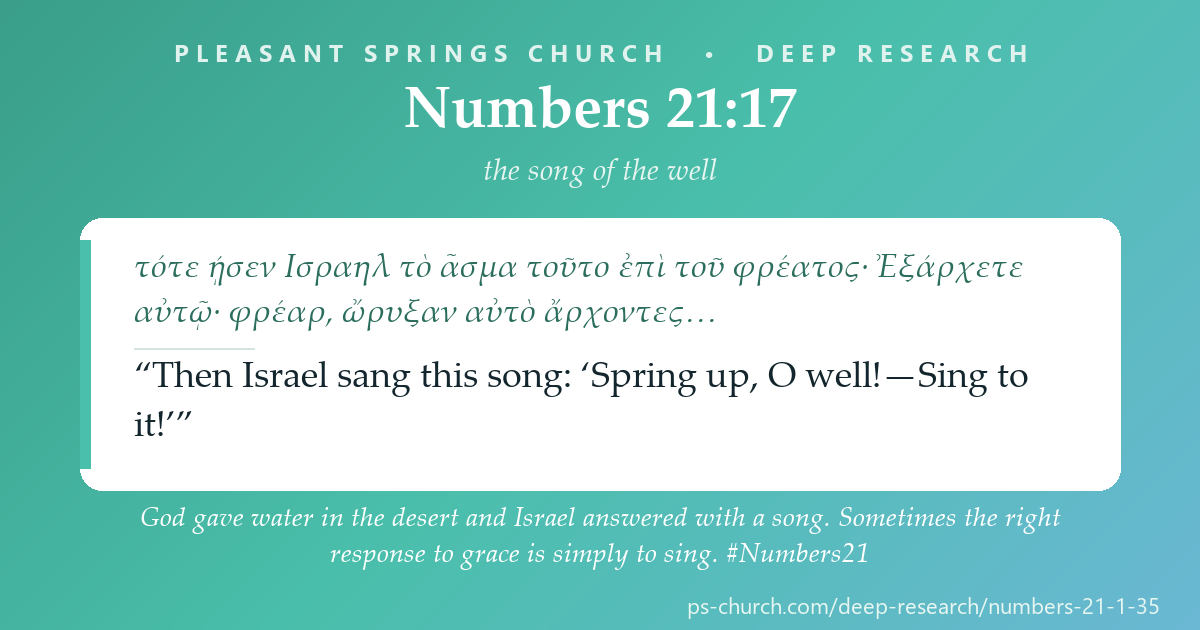
“Spring up, O well!” — an imperative addressed to the water itself, and then ʿĕnû-lāh, “sing to it!” (the verb of antiphonal singing, as in Exod 15:21). Four lines, a desert, and a people who for once are not complaining. The LXX has no “spring up” at all — only Ἐξάρχετε αὐτῷ, “strike up for it.”
“Scepter / ruler’s staff” — the same rare word as the “ruler’s staff from between his feet” in Judah’s blessing (Gen 49:10). The princes dig with the emblems of their office: leadership at work with its sleeves rolled up. The LXX did not read it as a staff at all, but from the root’s sense of decreeing / ruling — ἐν τῇ βασιλείᾳ αὐτῶν, “in their kingdom” (with נְדִיבֵי הָעָם, “the nobles of the people,” becoming βασιλεῖς ἐθνῶν, “kings of the nations”).
Where the New Testament stands in relation to this chapter:
- John 3:14–15 — the one episode in this chapter Jesus himself takes up: the serpent lifted in the wilderness and the Son of Man lifted up. That study lives at Numbers 21:4–9.
- 1 Corinthians 10:1–11 — the wilderness journey “written down for our instruction”; Paul speaks of a spiritual drink and “the Rock… and the Rock was Christ” (10:4). He is reading the wilderness water theologically; he is not endorsing the later legend of a rolling well.
- 2 Corinthians 10:3–4; Ephesians 6:12 — “For the weapons of our warfare are not of the flesh but have divine power to destroy strongholds.” Whatever Numbers 21 authorised in its own moment, it authorises no sword in the church’s hand now.
- Hebrews 3:7–4:11 — the same wilderness road read as a summons to trust and to enter God’s rest (see Hebrews 4:14–16).
Two kings the psalms never forgot, a lost book, and a well.
Follow three threads: the Transjordan victories through Israel’s worship; the quoted sources across the canon; and water — from a desert well to the Gospel’s offer.
Which cross-references matter?
- Numbers 14:45; Judges 1:17 — Hormah both ways: the place of Israel’s rout when they went up without God (see Numbers 13–14), and a name given again in the settlement. The same word can mark a defeat or a deliverance.
- Deuteronomy 2:1–3:11 — Moses’ own retelling, and the crucial limits: do not harass Edom, Moab or Ammon, “for I will not give you any of their land” (2:5, 9, 19). Only Sihon and Og are given (2:24; 3:2). The conquest in this chapter is explicitly fenced — three neighbours are placed off-limits in the same breath.
- Deuteronomy 2:26 — “So I sent messengers… to Sihon the king of Heshbon, with words of peace”: the phrase the LXX also carries at Num 21:21. The battle begins only after the embassy is refused and Sihon marches out (21:23).
- Deuteronomy 3:11; Joshua 12:4; 13:12 — Og “of the remnant of the Rephaim,” his iron bed at Rabbah; the Transjordan giants of the Deuteronomy 32 worldview (see Paul and the Deuteronomy 32 Worldview). Read soberly, without building a mythology on it.
- Joshua 10:13; 2 Samuel 1:18; 1 Kings 11:41; 1 Chronicles 29:29; Luke 1:1–4 — the other books Scripture openly quotes or names as its sources. The Book of the Wars of the Lord is not an anomaly.
- Psalm 135:10–12; Psalm 136:17–22; Nehemiah 9:22; Joshua 2:10; 9:10 — Sihon and Og in Israel’s worship and confession for centuries, and in what Rahab had heard about across the Jordan.
- Exodus 15:1–21; Isaiah 12:3; John 4:13–14; 7:37–38; Revelation 22:17 — songs at water, and “with joy you will draw water from the wells of salvation.” The thread runs from the Song of the Sea (see Exodus 15:1–21) through this desert well to the invitation of the Gospel.
The text must be reported plainly. Israel asked for passage and offered to keep to the road; Sihon refused and came out to fight; Israel defeated him and took his land, and then Og at Edrei, and 21:35 says there was no survivor left. That is what it says, and softening it would be dishonest. Three things belong in the same paragraph, however, and they are all in the Bible itself. First, it is bounded. Deuteronomy 2 has God forbidding Israel to touch Edom, Moab or Ammon in the very same march — three nations off-limits, two kings given. This is not a general licence to take land; it is a specific, limited, divinely-commanded episode within a particular covenant history, and the text draws the fence itself. Second, it is judicial. The Bible frames the dispossession of the Amorites as a long-delayed judgment on a specific wickedness, whose measure was not yet full in Abraham’s day (Gen 15:16) — and it warns Israel in the same breath that she will be treated the same way if she does the same things (Lev 18:24–28; Deut 9:4–5). No nation is being flattered here, least of all Israel. Third, and most importantly for anyone reading this page: it is finished, and it is not ours. Nothing in Numbers 21 licenses violence by any person or nation today. The New Testament does not extend the sword to the church; it takes it away. “The weapons of our warfare are not of the flesh” (2 Cor 10:4); “we do not wrestle against flesh and blood” (Eph 6:12); Jesus tells Peter to put the sword back (Matt 26:52). Anyone who reaches for this chapter to justify harming a neighbour has not misread a detail — he has misread the whole Bible. We hold the difficulty honestly, we do not explain it away, and we do not let it out of the century it belongs to.
The scholarship on the itineraries, the archaic poems, and the Transjordan campaign.
Ashley, Wenham, Cole, Levine, Milgrom and Olson on Numbers; the studies of the wilderness itineraries and the archaic Hebrew poetry; the Transjordan archaeology and the Mesha Stele.
Commentaries & studies:
- Timothy R. Ashley, The Book of Numbers (NICOT); Gordon J. Wenham, Numbers (TOTC); R. Dennis Cole, Numbers (NAC); Baruch A. Levine, Numbers 21–36 (Anchor); Jacob Milgrom, Numbers (JPS); Dennis T. Olson, Numbers (Interpretation).
- Studies of the wilderness itinerary notices and of the archaic poetic fragments embedded in the Pentateuch (the Song of the Sea, the Song of the Well, the Heshbon ballad of 21:27–30).
- Transjordan geography and archaeology: the Arnon, Heshbon, Dibon, Medeba and Jahaz; the Mesha Stele (ANET 320–321).
- G. K. Beale & D. A. Carson, eds., Commentary on the New Testament Use of the Old Testament (John; 1 Corinthians).
Interpretation notes worth keeping:
- The quoted book is not a problem. A lost source named inside Scripture tells us the writer worked like a historian. It says nothing against inspiration, and readers who are told this plainly are better served than readers who are not told at all.
- The fragment is genuinely obscure. “Waheb in Suphah” has no verb, and the LXX translator already could not construe it. Honest commentary says so. Where Scripture gives no reason, we stop.
- The Song of the Well is short and secular-sounding — on purpose. Resist the urge to allegorise it into a sermon on the Holy Spirit. It is a people singing over water. The theology is in the fact that they sang at all.
- Hormah cuts both ways. The reader is meant to hear 14:45 behind 21:3. What the presumptuous generation could not do, the obedient one does — and the same name marks both.
- 21:21–35 is reported, not celebrated. The narrator gives no speech, no exultation and no theology of conquest; the celebration appears only later, in the taunt-song of 21:27–30 that the text attributes to ballad singers, not to Moses. Preach it with the restraint the text itself uses.
- Keep the fence Deuteronomy builds. Any reading of the conquest that ignores Deut 2:5, 9, 19 — Edom, Moab and Ammon explicitly protected — has already gone wrong.
From a long detour to a song in a desert.
Name what you learned, why it matters, and one concrete response.
What should we carry away — and do?
- Long roads are not detours from the life of faith; they are it. “The people became impatient on the way” (21:4) is the most human sentence in the chapter. God did not shorten the road. He walked it with them.
- Sing before the crisis is over. Israel is still in a desert, still years from the Jordan, when they stand around a well and sing. Gratitude that waits for the whole problem to be solved never arrives.
- The Bible is not nervous about its own sources. A lost book is quoted; a fragment is obscure. God gave us a text with real history in it, real seams, and real honesty — and it is still his word. You may hold your questions out loud.
- Read the hard chapters whole. Numbers 21 ends in two battles. It also fences them: Edom, Moab and Ammon are protected in the same march. Do not use Scripture’s wars to license your own; the church’s weapons “are not of the flesh” (2 Cor 10:4).
- “Do not fear him” (21:34). The word to Moses at Edrei was not you are strong but I have given him into your hand. Courage in Scripture is almost never self-confidence; it is a fact about God, spoken over a frightened person.
Step in response: pick the stretch of road you are currently on — the treatment, the job search, the marriage that is slow to heal, the year that will not end — and find the one well God has already given you in it. Then do what Israel did: say it out loud, to him, with somebody else in the room. Sing the small mercy before the big one arrives.
Numbers 21:17–18 · to share
LXX + ESVEvery Deep Research page traces its passage across the whole sweep — the Old Testament, the Second-Temple world between the testaments (historical witnesses, not Scripture), and the New Testament. Follow the thread:
Pleasant Springs Church — Deep Research
Research method after Michael S. Heiser’s Bible Research Method (examine dictionaries → ancient literature → important words → textual connections → academic publications → share), with the Pleasant Springs “Author & Audience” foundation. Scripture set in the Hebrew, the Greek editions named on each page and the ESV (Old Testament), and the Greek New Testament and the ESV (New Testament), per the practice of Pleasant Springs Church. Numbers 21 research grounded in Ashley, Wenham, Cole, Levine, Milgrom and Olson, with Beale & Carson on the New Testament use; Transjordan background from the Mesha Stele (ANET 320–321) and the Amarna Letters; Second-Temple and rabbinic witnesses (Josephus, Antiquities 4.5.1–3; Philo, On the Life of Moses 1.250–262; b. Ta’anit 9a), all read as witnesses, not Scripture. Rahlfs agrees with the Hebrew and English versification throughout the chapter. The bronze serpent (21:4–9) is treated in its own study. The Transjordan campaign is reported plainly and held within the limits Scripture itself sets (Deut 2:5, 9, 19), and is in no sense a warrant for violence today — the church’s weapons are not of the flesh (2 Cor 10:4).
Scripture quotations marked ESV are from the ESV® Bible (The Holy Bible, English Standard Version®), © 2001 by Crossway, a publishing ministry of Good News Publishers. ESV Text Edition: 2016. Used by permission. All rights reserved. The ESV text may not be quoted in any publication made available to the public by a Creative Commons license, and the ESV may not be translated in whole or in part into any other language. www.esv.org
|
Did this study bless you today? 💚 Give to Support PS Church100% of gifts go to the General Fund — thank you. |