Twelve men went out to spy the land, and forty days later they came back carrying a single cluster of grapes on a pole — proof that everything God had promised was true. “It flows with milk and honey, and this is its fruit” (13:27). And then ten of them said one more word: “However” (13:28). Walls. Giants. “We seemed to ourselves like grasshoppers” (13:33). Caleb answered, “we are well able”; Joshua and Caleb pleaded, “the Lord is with us” (14:9) — and the congregation reached for stones. This study works Numbers 13:1–14:45 — the hinge of the book: faith and unbelief looking at the same giants, Moses’ intercession on God’s own name, the pardon that is real (14:20) and the forty years that are also real, and the presumption at Hormah. Hebrews and Paul make it the church’s own summons to trust. See the method →
Numbers 13:27–14:44 (selections)
Hebrew · LXX · ESVThe Shape of the Passage
SequenceNumbers 13–14 is the hinge of the whole book. Everything before it moves toward the land — the ordered camp (chs 1–2), the Passover kept in the wilderness (ch 9), the departure from Sinai (ch 10). Then come the grumbling (ch 11) and the challenge to Moses (ch 12) — and at Kadesh the people refuse to go in. Everything after it is the long detour: the laws given to a generation that will die on the way (ch 15), Korah’s revolt (chs 16–17), and at last Meribah and Aaron’s death (ch 20).
Author
The Torah of Moses tells this story with unusual care, because everything turns on it. The reconnaissance itself is commanded (13:1–2); Moses’ own retelling adds that the people had asked for it (Deut 1:22). The spies do their work well — forty days, the Negeb to Lebo-hamath, a cluster of grapes carried on a pole between two men (13:21–25). The failure is not in the intelligence. All twelve saw the same land, the same walls, the same tall men of Anak. Ten drew one conclusion and two drew another, and the difference was whether God was counted in the sum.
A chapter that holds two things at once. The narrative refuses to be simplified. God really does forgive — “I have pardoned, according to your word” (14:20) — and that generation really does die in the wilderness (14:22–23, 29). Moses’ intercession is answered, and the consequence stands. Numbers will not let us choose between a God who forgives and a God who is not mocked; it hands us both in the same breath.
Audience
Israel at Kadesh — one march from everything promised to Abraham. They had seen the plagues, the sea, Sinai, the cloud, the manna. And when the report came back they wept all night, spoke of appointing a leader to take them back to Egypt (14:4), and picked up stones against the two men who believed God (14:10). This is the audience Numbers addresses: not pagans who had never heard, but a redeemed people at the edge of the gift.
How they heard it. To the next generation — the children the spies had called “a prey” (14:3, 31), now standing on the plains of Moab — this account said: your parents were not stopped by giants; they were stopped by unbelief. The land is still there. The Lord who was with Caleb is still with you. The question at Kadesh is the question at the Jordan, and it is only ever one question: will you trust him?
Orient on the spies, Kadesh-barnea, the Anakim and Nephilim, unbelief, and intercession.
Search by topic: spies / reconnaissance, Kadesh-barnea, Eshcol, Anak and the Anakim, Nephilim, faith and unbelief, intercession, wilderness wanderings, Hormah.
Which articles are relevant?
- Anchor Bible Dictionary — “Kadesh-barnea,” “Eshcol,” “Anak, Anakim,” “Nephilim,” “Hormah,” “Caleb,” “Joshua.”
- Dictionary of the OT: Pentateuch — “Spies,” “Wilderness Wanderings,” “Faith,” “Rebellion,” “Intercession,” “Land.”
- NIDOTTE / TDOT — תּוּר (tûr, explore/spy out), אָמַן (ʾāman, believe/trust), מָאַס (māʾas, despise/reject), סָלַח (sālaḥ, forgive), נְפִילִים (Nephilim).
Bibliography surfaced:
- Timothy Ashley (NICOT), Gordon Wenham (TOTC), R. Dennis Cole (NAC), Baruch Levine (AB), Jacob Milgrom (JPS) on Numbers.
- Studies of the Kadesh tradition, the spy narrative and its Deuteronomic retelling (Deut 1:19–46), and the Anakim / Nephilim question.
- Beale & Carson, Commentary on the NT Use of the OT (Hebrews; 1 Corinthians).
A good land, walled cities, tall men — and the day Israel wept.
Read the report against what the Late-Bronze Levant actually looked like, weigh how Second-Temple and rabbinic readers remembered the night of weeping, then let the New Testament set the terms.
Which parallels shed light on religion and worldview?
The land as the ancient world described it. The spies’ language is not a fairy tale. The Egyptian Story of Sinuhe praises a Levantine district called Yaa in almost the same terms: “It was a good land… Figs were in it, and grapes… Plentiful was its honey, abundant its olives” (ANET 19; the tale runs ANET 18–22). And their fear is not fantasy either: the Amarna Letters (ANET 483–490) show us Late-Bronze Canaan as a patchwork of small city-states with fortified acropolises, quarrelsome kings, and garrisons — exactly “cities… fortified and very large” (13:28). Both halves of the majority report were accurate. What the ten left out was God.
Anakim and ‘Nephilim.’ The “sons of Anak” are remembered elsewhere as an unusually tall population around Hebron (Deut 2:10–11; 9:2; Josh 11:21–22), and Hebron’s antiquity is noted in the text itself (13:22). Numbers 13:33 adds the loaded word נְפִילִים — the term of Genesis 6:1–4, which the LXX likewise renders γίγαντες. Read carefully: 13:33 stands inside the bad report the ten spread (13:32) — דִּבָּה (dibbāh), slander (13:32; cf. 14:36–37) — so called not because the walls and the tall men were invented, but because of what the report did with them. Whatever the Anakim were, the sentence that follows is the real confession: “we seemed to ourselves like grasshoppers.” They measured themselves against the giants instead of measuring the giants against God.
- Story of Sinuhe (Egyptian, c. 20th c. BC; ANET 18–22, the description of Yaa at 19) — a good Levantine land of figs, grapes, honey and olives: the very picture of 13:27.
- Amarna Letters (ANET 483–490) — the fortified Canaanite city-states of the Late Bronze Age, in their own words; background to “the cities are fortified and very large” (13:28).
- Josephus, Antiquities 3.300–314; 4.1–10 (Second-Temple — a witness, not Scripture) — retells the sending of the twelve, the report, the revolt and the forty-year sentence (3.300–314), and then the defeat at Hormah (4.1–10).
- Philo, On the Life of Moses 1.220–238 (Second-Temple — a witness, not Scripture) — presents the reconnaissance as prudent leadership and locates the fault squarely in disbelieving “the word of God.”
- Damascus Document (CD) col. III (ll. 5–10) (Dead Sea Scrolls — a witness, not Scripture) — recalls Kadesh: God said “Go up and possess the land,” and they “hearkened not unto the voice of their Maker… and murmured in their tents” (cf. Ps 106:25).
- Mishnah, Sanhedrin 10:3; Ta’anit 4:6; b. Sotah 34b–35a; b. Ta’anit 29a (rabbinic-era — witnesses, not Scripture) — the spies and the wilderness generation debated; the night of weeping (14:1) dated to the Ninth of Av, with the saying that a weeping “for nothing” became a weeping for generations. Sotah also preserves the famous reading of Caleb’s speech: he quiets the crowd by beginning where they agreed, then names what Moses has already done in God’s hand — Egypt, the sea, the manna — and lands on “we should go up at once.”
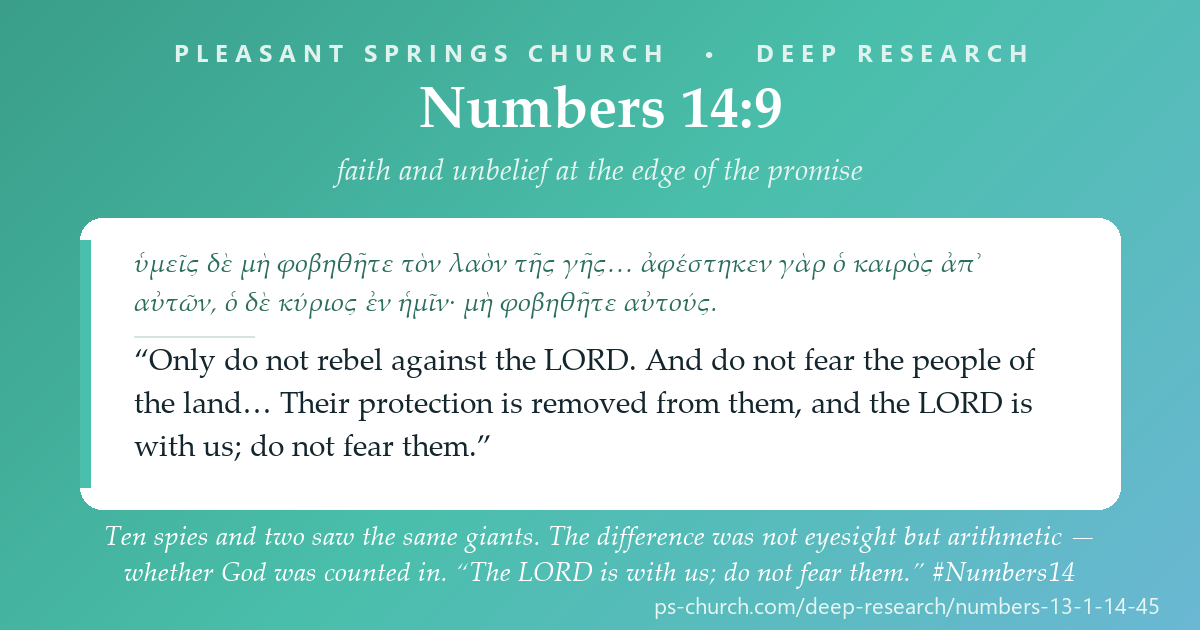
It is worth saying plainly: the ten were not lying about the giants. The walls were high and the men were tall. Caleb and Joshua never denied a single fact; they added the one fact the others had dropped. “Their protection is removed from them, and the Lord is with us” (14:9). That is the whole difference between the two reports — not better eyesight, but a bigger God in the equation. Unbelief here is not ignorance; it is a way of counting that leaves God off the page. And it works backward as well as forward: once God is subtracted, the self shrinks too, until grown men describe themselves as insects. The size of your God determines the size of you.
The vocabulary of spying out, the fatal “however,” pardon, and presumption.
Watch tur (spy out) — commanded, not sinful; the hinge word ʾepes (“however”); the self-verdict chagav (grasshopper); God’s own salachti (“I have pardoned”); and ʿaphal, the presumption that goes up after God has said no.
“To explore / spy out” — to go through a land and take its measure (LXX κατασκέπτομαι). It is a neutral word: God himself commands it (13:2). The mission was not the sin. The same root returns in the sentence — “the days in which you spied out the land” (14:34) — and, poignantly, in the tassels of the next chapter, warning Israel not to “follow after” (tur) their own heart and eyes (15:39).
“However / only” — a small word of limitation, and the hinge of the whole book. Everything before it is true and good; everything after it is fear. The LXX turns it into a blunt ἀλλ᾽ ἢ ὅτι, “except that…” One conjunction can undo a whole confession of God’s goodness.
“Nephilim” — the rare term of Genesis 6:4, rendered by the LXX here and there alike as γίγαντες, “giants.” It appears in Numbers only on the lips of the ten, inside the “bad report” (13:32) — a detail worth holding lightly and soberly, without building a mythology on it.
“Grasshopper / locust” (LXX ἀκρίς) — “we seemed to ourselves like grasshoppers, and so we seemed to them.” Note the order: first in their own eyes, and only then (they assume) in the giants’. No Canaanite ever said it. Fear wrote the line and put it in someone else’s mouth.
“To pardon / forgive” — in the Old Testament this verb has only one subject: God. Moses asks (“please pardon,” 14:19) and God answers with a single word, sālaḥtî, “I have pardoned” (14:20; LXX ἵλεως αὐτοῖς εἰμι). Real forgiveness — spoken before, and not instead of, the sentence that follows.
“To presume / push ahead” — a rare verb for heedless self-assertion (LXX διαβιάζομαι, “to force one’s way”); Deuteronomy’s retelling names the same act with a different word — going up “presumptuously” (זוּד, Deut 1:43). The same root stands behind Habakkuk’s “his soul is puffed up” — the opposite of “the righteous shall live by his faith” (Hab 2:4). Unbelief and presumption are twins: both act without God.
How the New Testament takes up Numbers 13–14:
- Hebrews 3:7–19 (quoting Psalm 95:7–11) — “Take care, brothers, lest there be in any of you an evil, unbelieving heart” (3:12); “So we see that they were unable to enter because of unbelief” (3:19).
- Hebrews 4:1–11 — “the promise of entering his rest still stands”; “Let us therefore strive to enter that rest, so that no one may fall by the same sort of disobedience” (4:11). Kadesh becomes the church’s own warning — and its own invitation (see Hebrews 4:14–16).
- 1 Corinthians 10:1–12 — “Now these things happened to them as an example, but they were written down for our instruction” (10:11); “let anyone who thinks that he stands take heed lest he fall” (10:12).
- Jude 5 — “Jesus, who saved a people out of the land of Egypt, afterward destroyed those who did not believe.” The New Testament names the wilderness failure by its right name: unbelief.
From Kadesh across the canon — and into the church’s own hearing.
Trace three threads: the report and the refusal; the intercession that appeals to God’s revealed character; and the two men who believed.
Which cross-references matter?
- Exodus 34:6–7 — the words Moses quotes back to God in 14:18 are God’s own self-revelation on Sinai: “slow to anger and abounding in steadfast love” (see Exodus 33:12–34:9). Intercession is not persuading God to be someone else; it is holding him to who he has said he is (cf. Neh 9:16–17).
- Deuteronomy 1:19–46 — Moses’ own retelling: “Yet in spite of this word you did not believe the Lord your God” (1:32), and the presumptuous march that ended “as far as Hormah” (1:43–44).
- Numbers 32:11–12; Joshua 14:6–14 — Caleb, forty-five years later and eighty-five years old, still asking for the hill country of the Anakim: “It may be that the Lord will be with me.” Faith outlasts a generation.
- Psalm 95:7–11; Psalm 106:23–27 — “They shall not enter my rest”; “Then they despised the pleasant land, having no faith in his promise” — and Moses “stood in the breach before him, to turn away his wrath.”
- Numbers 15; Numbers 21:4–9 — the very next chapter gives land-laws to a generation that will not see the land (see Numbers 15), and the wilderness road runs on to the bronze serpent (Numbers 21:4–9).
- Hebrews 3:7–4:11; 1 Corinthians 10:1–12 — the New Testament’s own application of Kadesh to the church.
Both apostolic writers reach for Numbers 13–14, and both read it the same way. Hebrews takes Psalm 95 — itself already a meditation on the wilderness — and presses it on the church as a word spoken “today”: the wilderness generation heard good news just as we have, “but the message they heard did not benefit them, because they were not united by faith with those who listened” (Heb 4:2). The diagnosis is precise: “they were unable to enter because of unbelief” (3:19). Paul makes the same move in 1 Corinthians 10 — cloud, sea, bread, drink, and then, “with most of them God was not pleased” — and draws the pastoral conclusion, “let anyone who thinks that he stands take heed lest he fall” (10:12). Neither writer is trying to frighten believers out of their assurance; both are calling a people into a rest that is still open. Hebrews does not end with the corpses in the wilderness but with a throne of grace — “let us then with confidence draw near” (4:16). Kadesh is set before the church not as a threat over the shoulder but as a road sign at a fork: the promise still stands, and the door is still open today.
The scholarship on the spy narrative, Kadesh, and the theology of unbelief.
Ashley, Wenham, Cole, Levine and Milgrom for Numbers; the Kadesh and spy-narrative studies; Beale & Carson for Hebrews and 1 Corinthians.
Commentaries & studies:
- Timothy R. Ashley, The Book of Numbers (NICOT); Gordon J. Wenham, Numbers (TOTC); R. Dennis Cole, Numbers (NAC); Baruch A. Levine, Numbers 1–20 (Anchor); Jacob Milgrom, Numbers (JPS).
- Studies of the spy narrative and its Deuteronomic retelling (Deut 1:19–46), the Kadesh-barnea traditions, and the Anakim in the conquest accounts.
- G. K. Beale & D. A. Carson, eds., Commentary on the New Testament Use of the Old Testament (Hebrews; 1 Corinthians).
Interpretation notes worth keeping:
- The failure is trust, not intelligence. All twelve saw the same land. The majority report is factually accurate and theologically empty. Guard against reading the ten as cowards and the two as daredevils: Caleb and Joshua reckoned with the same walls — and with God.
- Intercession appeals to revealed character. Moses does not offer God a better plan; he quotes God’s own words back to him (14:17–18 // Exod 34:6–7) and pleads for the honor of God’s name among the nations (14:13–16). That is the shape of biblical prayer.
- Forgiveness and consequence can coexist. “I have pardoned” (14:20) is not undone by “they shall not see the land” (14:23). The relationship is not severed; the generation still bears the wilderness. Pastorally this is enormous — and it must be preached without turning God capricious or forgiveness thin.
- Do not over-read 13:33. The “Nephilim” line belongs to a report the narrator calls bad (13:32). The text’s own emphasis falls on “we seemed to ourselves” — a verdict about the spies, not a survey of Canaanite anthropology.
- Presumption is unbelief’s twin. The morning march (14:40–45) looks like repentance and courage. But the ark stayed in the camp and so did Moses (14:44). Going up when God has not sent is the same sin wearing the opposite face: acting without him.
From the grasshopper report to “the Lord is with us.”
Name what you learned, why it matters, and one concrete response.
What should we carry away — and do?
- Count God into the sum. The giants were real. So was God. Unbelief is not usually a denial of facts; it is a habit of leaving one Fact out. Before you decide what is impossible, finish the arithmetic.
- Beware the word ‘however.’ The ten began with a true confession of God’s goodness and then spent it all on one conjunction (13:27–28). Listen for that word in your own prayers.
- You are not a grasshopper. The spies’ smallest moment is the sentence about themselves. A shrunken view of God always produces a shrunken view of you — and it is not humility.
- Forgiven, and still walking it out. God pardons genuinely; consequences may still run their course. Do not read the wilderness as proof that you were never forgiven — and do not read forgiveness as a promise that nothing will cost you anything.
- The rest is still open — today. Hebrews does not use Kadesh to frighten Christians out of assurance but to call them in: “let us therefore strive to enter that rest” (Heb 4:11), and “let us then with confidence draw near to the throne of grace” (Heb 4:16).
Step in response: name the one “however” you keep adding to God’s promises this week — the diagnosis, the debt, the person, the fear — and say Joshua and Caleb’s sentence over it out loud: the Lord is with us. Then take one concrete step you have been putting off until the giants shrink. They will not shrink. He does not need them to.
Numbers 14:9 · to share
LXX + ESVEvery Deep Research page traces its passage across the whole sweep — the Old Testament, the Second-Temple world between the testaments (historical witnesses, not Scripture), and the New Testament. Follow the thread:
Pleasant Springs Church — Deep Research
Research method after Michael S. Heiser’s Bible Research Method (examine dictionaries → ancient literature → important words → textual connections → academic publications → share), with the Pleasant Springs “Author & Audience” foundation. Scripture set in the Hebrew, the Greek editions named on each page and the ESV (Old Testament), and the Greek New Testament and the ESV (New Testament), per the practice of Pleasant Springs Church. Numbers 13–14 research grounded in Ashley, Wenham, Cole, Levine and Milgrom, with Beale & Carson on the New Testament use (Hebrews; 1 Corinthians); ANE background from the Story of Sinuhe and the Amarna Letters (ANET 18–22, 483–490); Second-Temple and rabbinic witnesses (Josephus, Philo, the Damascus Document, the Mishnah’s Sanhedrin and Ta’anit, and b. Sotah / b. Ta’anit), all read as witnesses, not Scripture. Hebrew, LXX and English agree in versification throughout Numbers 13–14. The passage is handled as a summons to trust, not a fear text: God’s pardon in 14:20 is real, and so is the wilderness — and Hebrews itself moves from the warning to the throne of grace (Heb 4:16).
Scripture quotations marked ESV are from the ESV® Bible (The Holy Bible, English Standard Version®), © 2001 by Crossway, a publishing ministry of Good News Publishers. ESV Text Edition: 2016. Used by permission. All rights reserved. The ESV text may not be quoted in any publication made available to the public by a Creative Commons license, and the ESV may not be translated in whole or in part into any other language. www.esv.org
|
Did this study bless you today? 💚 Give to Support PS Church100% of gifts go to the General Fund — thank you. |