Israel has just refused the land. The sentence has fallen — forty years, and a generation buried in the desert. And the very next thing God says is: “When you come into the land you are to inhabit, which I am giving you” (15:2). The promise is not cancelled; it is carried to the children. What follows is a chapter of grace with a hard edge — offerings for the land they will one day plow, one statute binding the native and the sojourner alike, atonement for sin done in ignorance, the sober contrast of the raised, defiant hand, a wood-gatherer held in custody until God ruled, and finally a thread of blue on the corner of every garment: “look at it and remember all the commandments of the Lord” (15:39). This study works Numbers 15:1–41 — grace after failure, the stranger brought near, and remembrance you can hold between your fingers. See the method →
Numbers 15:2–41 (selections)
Hebrew · LXX · ESVThe Shape of the Passage
Parallel panelsNumbers 15 sits deliberately between two disasters: the refusal of the land at Kadesh (chs 13–14) and Korah’s rebellion (chs 16–17). Read in place, it is not a random file of legislation dropped into a story — it is God’s answer to a people who have just forfeited a generation.
Author
The Torah of Moses arranges its material with purpose. Chapter 14 ends with the failed, presumptuous attempt to take the hill country anyway and the defeat at Hormah. Chapter 15 opens with no transition, no rebuke, no epilogue — only: “When you come into the land you are to inhabit, which I am giving you.” The placement is the argument. God legislates for a future he has just delayed but never withdrawn.
A chapter of four movements. First, worship in the land — the grain and drink offerings that will accompany every sacrifice, with one statute binding native and sojourner alike (15:1–21). Second, the provision for sin done in ignorance, with its opposite named plainly: the sin of the raised, defiant hand (15:22–31). Third, a single sober case — a man gathering wood on the Sabbath, held in custody until God ruled (15:32–36). Fourth, the tassels: a thread of blue on the corner of every garment, a daily, wearable act of remembrance (15:37–41).
Audience
Israel under sentence — the wilderness generation and, over their shoulders, the children who will actually cross. Every “when you come into the land” in this chapter was heard by parents who would not see it and by children who would. It is grace addressed to a people who had just proved they did not deserve it, and it names the sojourner (גֵּר) in the same breath as the native — the foreigner living among them is not a second-class worshiper but stands “alike before the Lord” (15:15).
How they heard it. Israel heard, first, that the future was still open. Then they heard that sin is not all of one kind: there is the stumble, the oversight, the thing done without knowing — and God has made a way for it, with atonement and the plain word “he shall be forgiven.” And there is the raised fist, the settled contempt that despises the word of the Lord — and that is another matter entirely. Finally they heard the remedy for drifting: not vigilance alone but memory, tied to a blue thread they would see a hundred times a day.
Orient on offerings, the sojourner, unintentional sin, the Sabbath, and the tassels.
Search by topic: grain offering, drink offering, firstfruits / dough offering, sojourner (ger), sin (unintentional), high-handed sin, karet (cutting off), Sabbath, tassels / fringes, tekhelet (blue).
Which articles are relevant?
- Anchor Bible Dictionary — “Sacrifice and Sacrificial Offerings,” “Sojourner,” “Sin, Sinners (OT),” “Excommunication (karet),” “Sabbath,” “Fringes,” “Dye and Dyeing.”
- Dictionary of the OT: Pentateuch — “Offerings and Sacrifices,” “Aliens and Strangers,” “Atonement,” “Sabbath,” “Holiness,” “Numbers, Book of.”
- NIDOTTE / TDOT — גֵּר (gēr, sojourner), שְׁגָגָה (šəgāgāh, inadvertence), כָּרַת (kāraṯ, cut off), צִיצִת (ṣîṣiṯ, tassel), תְּכֵלֶת (təḵēleṯ, blue/violet), תּוּר (tûr, explore / follow after).
Bibliography surfaced:
- Timothy Ashley (NICOT), Gordon Wenham (TOTC), Dennis Cole (NAC), Baruch Levine (AB), Jacob Milgrom (JPS) on Numbers.
- Studies of the resident alien (ger) in Israelite law; of shegagah and the “high hand”; and of tzitzit and tekhelet in text, archaeology, and later Jewish practice.
- Beale & Carson, Commentary on the NT Use of the OT (Matthew; Ephesians; Hebrews).
Hems, blue thread, resident aliens, and a court that waited on God.
Read the tassel against the ancient meaning of a garment’s corner, the blue against the cost of the dye, and the wood-gatherer against the judicial care of the account itself.
Which parallels shed light on religion and worldview?
The corner of a garment carried a person’s identity. In Mesopotamian practice the hem of a robe (Akkadian sissiktu) could stand for the person who wore it: pressed into wet clay it served in place of a seal, and a garment’s corner was a marker of rank — the fringed and tasseled hems on Assyrian and Syro-Palestinian reliefs belong to men of standing. Israel is told to put a thread on that corner. The כָּנָף (kānāṗ, “wing / corner”) of the garment — the place that said who you were — now says whose you are.
Why blue. תְּכֵלֶת (təḵēleṯ) was a violet-blue derived from a marine mollusk, laborious and costly — a color of royalty and of the sanctuary. It is the color of the tabernacle curtains (Exod 26:1) and of the high priest’s robe (Exod 28:31), and it is the color of the cord God commands on every Israelite’s garment. A common man walking a field wore a thread the same color as the veil. Israel is a “kingdom of priests” (Exod 19:6), and the tassel says so at the hem.
The resident alien. The גֵּר was a non-Israelite who had left his own kin-group and settled among Israel — in the ancient world a person with almost no legal standing anywhere. Israel’s law is remarkable precisely here: not merely protection for the ger, but the same statute, the same atonement, the same access. “You and the sojourner shall be alike before the Lord” (15:15).
A court that waited. The wood-gatherer is one of only four places in the Torah where a case is brought and Moses does not rule — the man is put in custody “because it had not been made clear what should be done to him” (15:34; cf. Lev 24:12; Num 9:8; Num 27:5). The narrative is deliberately unsensational: witnesses, arrest, custody, an inquiry of God, then a ruling. Later Jewish law made that caution a principle of its own — a court that executed even rarely was called destructive.
- Mesopotamian garment-hems; the Mari letters (ANET 482; the hair-and-hem texts at 623–632) — the world in which the hem (sissiktu) of a robe could stand in for the person and mark his standing: cultural furniture that makes the command in 15:38 legible.
- Mishnah, Menachot 4:1 (rabbinic-era — a witness, not Scripture) — on the tassel: the absence of the blue does not invalidate the white, nor the white the blue; the tractate preserves the ongoing practice and the debates around tekhelet.
- Sifre on Numbers §115 (rabbinic-era — a witness, not Scripture) — the classical midrashic exposition of the tassel passage (15:37–41), including its link to seeing, remembering, and doing.
- Mishnah, Sanhedrin 6; Makkot 1:10 (rabbinic-era — witnesses, not Scripture) — the procedural care surrounding capital cases, with the famous verdict on a court that executes even once in seven years: “destructive.” Later Judaism read Israel’s own criminal law with extreme restraint.
- Josephus, Antiquities 4.212–213 (Second-Temple — a witness, not Scripture) — describes Israel’s daily discipline of remembrance, with God’s benefits recalled morning and evening and signs inscribed and worn: the same instinct the tassels serve.
- Dead Sea Scrolls & Judean Desert textiles — 4Q365 (Reworked Pentateuch) preserves Numbers material, and dyed textile fragments recovered from the desert caves witness to the dyeing craft behind tekhelet; historical witnesses, not Scripture.
The Greek word the LXX chose for the tassel is κράσπεδον (15:38–39) — and that is precisely the word the Gospels use of Jesus’ own clothing. The woman with the discharge of blood “came up behind him and touched the fringe (κρασπέδου) of his garment” (Matt 9:20); at Gennesaret the sick “implored him that they might only touch the fringe of his garment” (Matt 14:36). Jesus of Nazareth kept Numbers 15. His one word against tassels was not against wearing them but against wearing them for show: the scribes and Pharisees “make their phylacteries broad and their fringes long” to “be seen by others” (Matt 23:5). The aid to memory can be turned into a costume — and the moment it is worn for the eyes of men, it has stopped doing the one thing God gave it to do.
The vocabulary of the sojourner, the mistake, the raised hand, and the thread of blue.
Watch ger (sojourner) folded into the one statute, shegagah (the mistake) answered by atonement, beyad ramah (the raised hand) set against it, and tur tying the tassel back to the spies.
“Sojourner / resident alien” — the outsider living among Israel (LXX προσήλυτος, whence English “proselyte”). Numbers 15 repeats him relentlessly: same offering, same atonement, same statute. “You and the sojourner shall be alike before the Lord” (15:15).
“Inadvertence, mistake” — sin committed without knowing, whether by the whole congregation or one person (LXX ἀκουσίως, “unwillingly”). For this there is a prescribed offering and a plain verdict: “and he shall be forgiven” (15:28).
“With a high hand” — literally a raised hand: the gesture of open defiance (LXX ἐν χειρὶ ὑπερηφανίας, “with a hand of arrogance”). The same idiom describes Israel marching out of Egypt “defiantly” (Exod 14:8) — a fist in the air. Here it is raised against the Lord himself.
“To explore, scout — to follow after.” The spies were sent to scout (wəyāṯurû, 13:2; the infinitive lāṯûr from 13:16 on) the land; now Israel is told lōʾ-tāṯurû — do not go scouting after your own heart and eyes (15:39). One verb ties the tassel directly back to the failure of chapter 13. The wordplay lives only in Hebrew; the LXX uses different verbs in the two places.
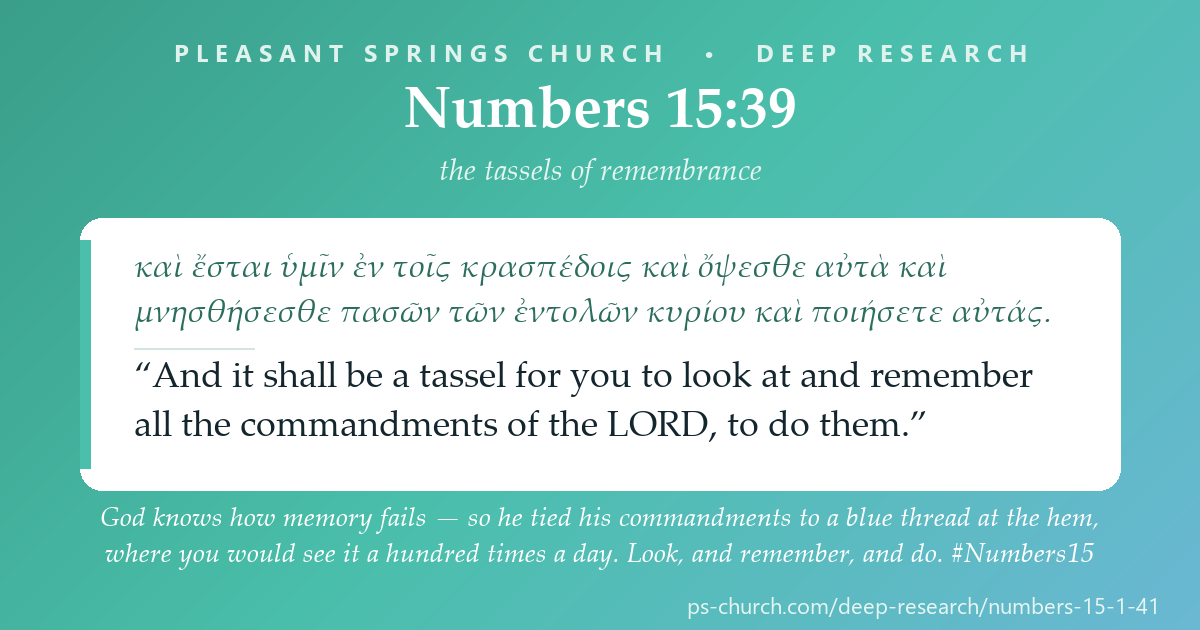
“Tassel” — a twisted tuft on the כָּנָף (“wing / corner”) of the outer garment (LXX κράσπεδον). Not decoration but a memory device: “you shall see it and remember… and do them” (15:39). The command is repeated in Deut 22:12, though with a different noun (גְּדִלִים, gədilim, ‘twisted cords’).
“Blue / violet” — the costly marine dye of the tabernacle curtains and the priestly robe (Exod 26:1; 28:31; LXX ὑακίνθινος). A single thread of sanctuary-color at the hem of an ordinary garment: the holy place, carried into the field.
How the New Testament takes up Numbers 15:
- Matthew 9:20; 14:36 — the κράσπεδον of Jesus’ garment: the tassel of Numbers 15:38 on the Lord himself, and the desperate reaching out to touch it.
- Matthew 23:5 — “they make… their fringes long”: not the command critiqued, but the display.
- Ephesians 2:11–22 — the ger theme carried home: those once “strangers to the covenants of promise” are now “no longer strangers and aliens, but… fellow citizens with the saints” (see Ephesians 2).
- 1 Timothy 1:13; Acts 3:17; Luke 23:34 — the language of sin done in ignorance: “I received mercy because I had acted ignorantly in unbelief”; “you acted in ignorance”; “Father, forgive them, for they know not what they do.”
- Hebrews 10:26–29 — the New Testament’s own analogue to the “high hand”: sinning deliberately, trampling the Son of God underfoot — a description of settled apostasy, addressed as a warning to be heeded, not a scale for measuring a struggling believer’s failures.
From one statute and a blue thread across the canon.
Trace three threads — the sojourner brought near, the mistake atoned for, and remembrance tied to something you can see.
Which cross-references matter?
- Numbers 9:14; Exodus 12:48–49; Leviticus 19:33–34 — the sojourner keeps the Passover, and “one law” covers native and stranger; “you shall love him as yourself” (see Numbers 9 and Leviticus 19).
- Leviticus 4:1–5:13 — the fullest law of the sin offering for what is done unintentionally; Numbers 15 restates it for life in the land (see Leviticus 4–5), and Leviticus 16 gathers the year’s guilt into one day.
- Psalm 19:12–13 — the two categories side by side: “Declare me innocent from hidden faults. Keep back your servant also from presumptuous sins.” Numbers 15 in a prayer.
- Deuteronomy 6:4–9; 22:12 — bind them on your hand, write them on your doorposts, put tassels on the four corners: God gives his people physical aids to memory (see Deuteronomy 6).
- Numbers 13–14 → Numbers 15:39 — the spies who went to scout (tûr) the land, and the warning not to go scouting after heart and eyes: the chapter answers the sin that precedes it (see Numbers 13–14).
- Matthew 9:20; 14:36; 23:5 — the fringe of Jesus’ garment, and his one warning about wearing it for show.
Numbers 15 says something the ancient world rarely said: the outsider who lives among the people of God worships on the same terms as the native — “one law and one rule shall be for you and for the stranger who sojourns with you” (15:16). The New Testament picks that thread up and pulls. Paul tells Gentile believers to remember that they were once “alienated from the commonwealth of Israel and strangers to the covenants of promise” — and then: “now in Christ Jesus you who once were far off have been brought near by the blood of Christ… So then you are no longer strangers and aliens, but you are fellow citizens with the saints and members of the household of God” (Eph 2:12–13, 19). The apostolic council at Jerusalem works out the same logic in practice (Acts 15), and Paul states it flatly: “there is no distinction between Jew and Greek; for the same Lord is Lord of all” (Rom 10:12). The gospel’s welcome is not an innovation against the Torah; it is the flowering of a seed Moses planted in a chapter written for a people who had just failed.
The scholarship on Numbers 15 — and the pastoral care it requires.
Ashley, Wenham, Cole, Levine, and Milgrom on Numbers; the ger, shegagah, and tzitzit studies; Beale & Carson on the New Testament use.
Commentaries & studies:
- Timothy R. Ashley, The Book of Numbers (NICOT); Gordon J. Wenham, Numbers (TOTC); Dennis T. Cole (NAC); Baruch A. Levine, Numbers (Anchor); Jacob Milgrom, Numbers (JPS).
- Studies of the resident alien in Israelite law; of inadvertent sin and the karet penalty; of tzitzit and tekhelet in text, archaeology, and later Jewish practice.
- G. K. Beale & D. A. Carson, eds., Commentary on the New Testament Use of the Old Testament (Matthew; Ephesians).
Interpretation notes worth keeping:
- The placement is the point. Nothing in 15:1–16 is intelligible apart from chapter 14. God speaks land-laws to a generation that will die in the desert. Read the chapter as grace speaking first — discipline is real, and the promise is not withdrawn.
- ‘With a high hand’ is not the ‘unforgivable sin,’ and it is not a threat to the believer’s assurance. The phrase describes a settled, contemptuous posture — one who “has despised the word of the Lord” and “has broken his commandment” (15:31) — deliberate covenant-repudiation, not the weakness, relapse, or failure of a struggling saint. The very anxiety that you might have committed it is evidence of a heart that has not. Those kept by God are kept (Rom 8:38–39); the warnings are among the means by which he keeps them.
- The wood-gatherer belongs to Israel’s theocratic criminal law (15:32–36) — a covenant nation with God as its immediate King, in which a public, defiant breach of the covenant sign was answered by God’s own ruling that the man be stoned outside the camp (15:35–36). It is not a template for the church, and not a template for any modern state. The church wields no sword (2 Cor 10:4), and Christ is Lord of the Sabbath (Mark 2:27–28; Col 2:16–17). Note what the text itself emphasizes: witnesses, arrest, custody, and a pause “because it had not been made clear” — a judicial process that waited on God rather than a mob.
- The tassel is a mercy, not a burden. God knows how memory fails, and so he ties his commandments to something you can see and touch a hundred times a day. He does not merely command us to remember; he gives us the means. That principle runs on into the church’s bread and cup — “do this in remembrance of me.”
- Do not over-allegorize the blue. The color’s link to the sanctuary and the priesthood is in the text (Exod 26:1; 28:31), and it is worth naming; anything further — sky, heaven, numerological readings of the threads — belongs to later devotion, not to Numbers 15, and should be labeled as such if used at all.
From a promise that outlived a failure to a thread you can touch.
Name what you learned, why it matters, and one concrete response.
What should we carry away — and do?
- Grace speaks first. The generation had just refused the land — and God’s next word was “when you come into the land.” Your failure has consequences; it has not cancelled his promise. He is already legislating for a future you have not yet seen.
- There is one statute. Native or foreigner, insider or newcomer, “you and the sojourner shall be alike before the Lord” (15:15). The gospel’s welcome of the outsider is not a departure from the Torah — it was written into it.
- God has provided for what you did not even know you did. The offering for the shegagah ends with four of the best words in the chapter: “and he shall be forgiven” (15:28). Bring the sins you can name; trust him for the ones you cannot.
- Memory is a discipline, and God supplies the aids. Drift does not begin with a decision; it begins with forgetting. The tassel was God’s answer — something in the corner of your eye, all day, saying: remember, and do them.
Step in response: put one visible thing where you cannot miss it this week — a card with a verse on the dashboard, an alarm at the same hour, a note inside your wallet — and let it do what the tassel did: pull your eyes back before your heart wanders. Then do the second half of the verse: pick one commandment you have been slow to obey, and do it. And if there is a “sojourner” on the edge of your church — new, foreign, unsure of the customs — go stand beside them, because before the Lord you are alike.
Numbers 15:39 · to share
LXX + ESVEvery Deep Research page traces its passage across the whole sweep — the Old Testament, the Second-Temple world between the testaments (historical witnesses, not Scripture), and the New Testament. Follow the thread:
Pleasant Springs Church — Deep Research
Research method after Michael S. Heiser’s Bible Research Method (examine dictionaries → ancient literature → important words → textual connections → academic publications → share), with the Pleasant Springs “Author & Audience” foundation. Scripture set in the Hebrew, the Greek editions named on each page and the ESV (Old Testament), and the Greek New Testament and the ESV (New Testament), per the practice of Pleasant Springs Church. Numbers 15 research grounded in Ashley, Wenham, Cole, Levine, and Milgrom, with Beale & Carson on the New Testament use (Matthew; Ephesians; Hebrews); ANE garment-hem background and Second-Temple / rabbinic witnesses (Josephus, the Sifre on Numbers, and the Mishnah’s Menachot, Sanhedrin, and Makkot), all read as witnesses, never leveled with Scripture. The “high hand” of 15:30–31 is handled as settled, contemptuous covenant-repudiation — not a proof text for an “unforgivable sin” and no threat to the assurance of those kept by God; the wood-gatherer of 15:32–36 is handled soberly as the criminal law of the Old Testament theocracy, not a template for the church or for any modern state.
Scripture quotations marked ESV are from the ESV® Bible (The Holy Bible, English Standard Version®), © 2001 by Crossway, a publishing ministry of Good News Publishers. ESV Text Edition: 2016. Used by permission. All rights reserved. The ESV text may not be quoted in any publication made available to the public by a Creative Commons license, and the ESV may not be translated in whole or in part into any other language. www.esv.org
|
Did this study bless you today? 💚 Give to Support PS Church100% of gifts go to the General Fund — thank you. |