Korah the Levite, with Dathan, Abiram, and 250 chiefs, confronts Moses and Aaron with a half-truth: “all in the congregation are holy… why then do you exalt yourselves?” (16:3). Moses falls on his face and lets God decide — censers, incense, and “the man whom the Lord chooses shall be the holy one” (16:7). What follows is grave, and it is not the whole story: Moses and Aaron plead for the very people attacking them (16:22), and when a plague breaks out Aaron runs into the middle of it and “stood between the dead and the living, and the plague was stopped” (16:48). Then twelve dead staffs are laid before the Lord, and by morning one has budded, blossomed, and borne ripe almonds (17:8). This study works Numbers 16:1–17:13 — the grasping of a calling God did not give, the mediator who stands in the breach, and the quiet sign that God chooses. See the method →
Numbers 16:3–17:13 (selections)
Hebrew · LXX · ESVThe Shape of the Passage
Parallel panelsThese two chapters stand between the unbelief at Kadesh (chs 13–14) and the laws that follow (ch 15), and they answer the terrified question of 17:12–13 in the very next chapter, where the priests are given charge of the sanctuary (chs 18–19). The Levites’ own calling was already spelled out at Numbers 3–4 and ch 8; Aaron’s priesthood at Exodus 29. ⚠ A versification offset runs through this passage: English 16:36–50 = Hebrew/LXX 17:1–15, and English 17:1–13 = Hebrew/LXX 17:16–28.
Author
The Torah of Moses tells this story with terrible restraint. After Israel refuses the land, the wilderness generation turns on the leadership God gave it. The complaint is dressed in theology — “all in the congregation are holy” (16:3) — and the sentence is true as far as it goes (Exod 19:6). What is false is the conclusion drawn from it: that because all are consecrated, no one has been set apart, and the mediation God appointed may be seized by whoever wants it.
The shape of the account. Two rebellions are braided together: Korah the Levite, who wants the priesthood (16:8–11), and Dathan and Abiram the Reubenites, who want Moses’ authority gone (16:12–14). Both are answered not by argument but by God’s own choosing — first in judgment, then, when the smoke has cleared, in a far quieter sign: a dead stick that blossoms overnight. The narrative is grave, never gleeful; the writer lingers longer on Moses falling on his face and on Aaron running with a censer than on the deaths themselves.
Audience
Israel in the wilderness — a people learning, at great cost, that approaching a holy God is not a matter of personal ambition. They had already seen Nadab and Abihu die for offering “unauthorized fire” (Lev 10:1–3). Now they see the same lesson written across a whole faction. And they hear the terrified cry that closes the section: “Behold, we perish… Are we all to perish?” (17:12–13).
How they heard it. Two things at once. First: God chooses — the priesthood is a gift, not a prize, and contempt for God’s ordering is contempt for God. Second, and just as loudly: God is merciful inside the judgment. He warns before he acts. Moses and Aaron intercede for the very people attacking them (16:22). Aaron’s censer — the very priesthood under challenge — is what stops the plague (16:47–48). And Numbers itself records that “the sons of Korah did not die” (Num 26:11); their descendants would one day lead Israel’s worship (the Korahite psalms, Pss 42; 44–49; 84–85; 87–88). Judgment did not have the last word over that family.
Orient on Korah, the Levites and the priesthood, censers and incense, plague and atonement, and the rod.
Search by topic: Korah, Dathan and Abiram, Levites, priesthood, censer, incense, plague, intercession, rod / staff, almond. And check any reference work’s note on the chapter-and-verse offset between the Hebrew/Greek and English texts of Numbers 16–17.
Which articles are relevant?
- Anchor Bible Dictionary — “Korah,” “Dathan,” “Abiram,” “Levites,” “Priests and Levites,” “Censer,” “Incense,” “Rod.”
- Dictionary of the OT: Pentateuch — “Rebellion,” “Priests and Priesthood,” “Levites,” “Holiness,” “Intercession,” “Wilderness Wanderings.”
- NIDOTTE / TDOT — בָּחַר (bāḥar, choose), קָדוֹשׁ (qādōš, holy), כָּפַר (kāp̄ar, make atonement), מַגֵּפָה (maggēp̄āh, plague), מַטֶּה (maṭṭeh, staff/tribe).
Bibliography surfaced:
- Timothy Ashley (NICOT), Gordon Wenham (TOTC), Dennis Cole (NAC), Baruch Levine (AB) on Numbers.
- Studies of the Korah narrative and the Levite/priest distinction; the censer rite; the rod that budded and its place in the ark (Heb 9:4).
- Beale & Carson, Commentary on the NT Use of the OT (Jude; Hebrews).
Censers, ordeals, an almond staff — and how later readers remembered Korah.
Read the censer test against the real furniture of Israel’s worship, then follow the memory of Korah through the Second-Temple and rabbinic witnesses — and note carefully what those witnesses do not agree on.
Which parallels shed light on religion and worldview?
The censer as an ordeal. Moses does not out-argue Korah; he proposes a test that only God can decide. Each claimant takes a fire-pan (מַחְתָּה), lays coals and incense on it, and stands before the Lord. Incense was the most intimate act of the sanctuary — and the most dangerous: Nadab and Abihu had already died offering “unauthorized fire” (Lev 10:1–3), and Aaron alone entered with a censer on the Day of Atonement (Lev 16:12–13). Two hundred and fifty men holding censers is not a debate about equality; it is 250 men doing what God had assigned to one house. The bronze of those censers is then beaten into altar plating as a permanent warning sign (16:38–40) — the instrument of the sin becomes the memorial against it.
The almond staff. A מַטֶּה is both a shepherd’s staff and a tribe — the same word. Twelve dead sticks, one per ancestral house, are laid before the testimony overnight; one of them wakes up alive. The almond (שָׁקֵד) is the first tree in the land to break dormancy, blossoming while everything else is still bare — the tree Jeremiah is shown when God says he is watching over his word (שֹׁקֵד, Jer 1:11–12), and the shape stamped into the lampstand (Exod 25:33–34). That the rod runs the whole cycle in one night — bud, blossom, ripe fruit — is not a botanical curiosity but a signature.
- Sirach 45:18–19 (Apocrypha — a witness, not Scripture in the Protestant canon) — remembers “Dathan and Abiram and their followers and the company of Korah” conspiring against Aaron in the wilderness, and God consuming them; the earliest sustained retelling.
- Josephus, Antiquities 4.2–3 (Second-Temple — a witness, not Scripture) — two long chapters on “the sedition of Korah… concerning the priesthood,” expanded with speeches; Josephus reads the revolt as demagoguery driven by envy, a reading shaped as much by his own experience of faction as by the text.
- Philo, De vita Mosis 2.174–179, 275–287; De fuga 145 (Second-Temple — a witness, not Scripture) — treats the episode as a conflict of principle about priesthood; strikingly, Philo names Korah only once in his whole corpus.
- Pseudo-Philo, Biblical Antiquities 16 (Second-Temple — a witness, not Scripture) — retells the rebellion, tying it to the tassels of Numbers 15:37–41, the command that immediately precedes it.
- Mishnah, Sanhedrin 10:3 (rabbinic-era — a witness, not Scripture) — debates whether “the assembly of Korah” has a share in the world to come: R. Akiva says no (reading 16:33), while R. Eliezer disagrees, citing 1 Samuel 2:6 — the Lord “brings down to Sheol and raises up.” Even the rabbis would not close that door unanimously.
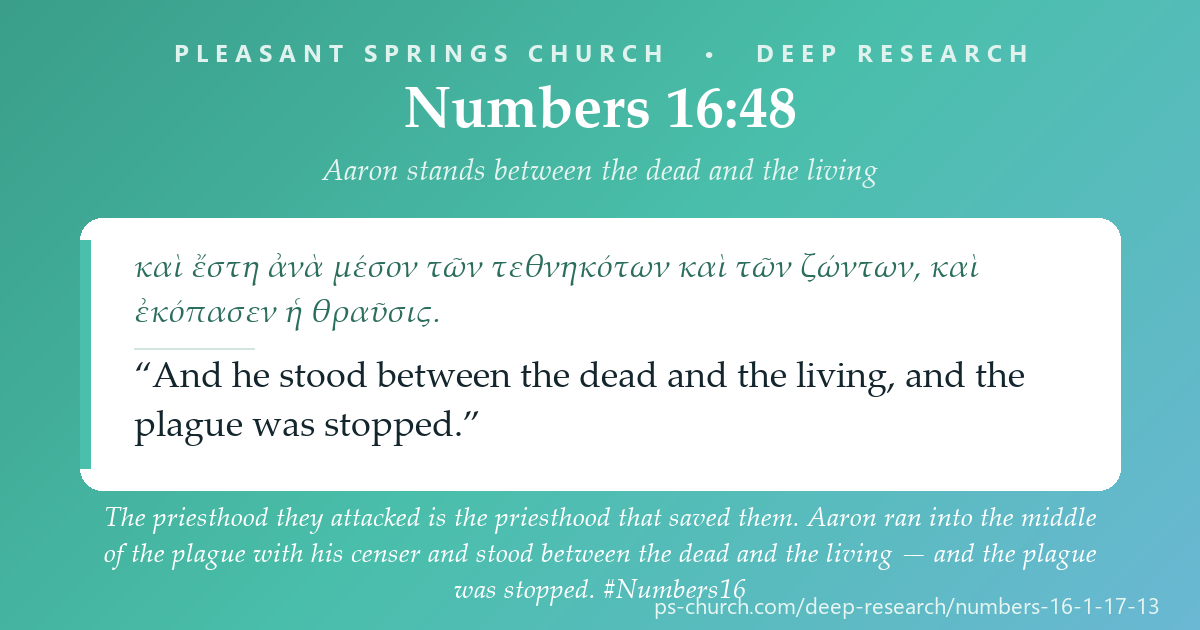
Hold the plain sense first: Aaron is Israel’s high priest, and the censer he carries is the ordinary equipment of the office Korah had just tried to seize. That is what makes 16:47–48 so arresting. The priesthood under attack is the priesthood that saves the attackers. Aaron does not stand at a safe distance; he runs into the middle of a plague, and “stood between the dead and the living, and the plague was stopped.” Moses does the same with words: “shall one man sin, and will you be angry with all the congregation?” (16:22).
Christians have long heard the gospel’s cadence in that picture, and we name it plainly as a devotional analogy rather than a claim the text itself makes: a Mediator who does not stay clear of the dying but steps into the middle of them, whose priesthood is not self-taken but God-given (“no one takes this honor for himself,” Hebrews 5:4–5 — which cites Aaron by name), and who stands between death and his people. The analogy earns its keep only because Hebrews itself works this ground: our great high priest intercedes for us. It is not a substitute for reading Numbers 16 as the sober history it is.
The vocabulary of overreach, choosing, atonement, and the almond.
Watch two phrases boomerang — rab-lakem (“you have gone too far”) and ham-meʾat (“is it too small a thing?”) — then follow bachar (“choose”) from the censer test to the sprouting rod.
“You have gone too far!” — literally “enough for you,” the rebels’ opening shot at Moses (16:3; LXX ἐχέτω ὑμῖν). Moses hands the same phrase straight back in 16:7 — “you have gone too far, sons of Levi” (LXX ἱκανούσθω ὑμῖν). The charge of overreach belongs to the ones reaching.
“Is it too small a thing?” (LXX μὴ μικρόν). Moses asks Korah whether the Levite’s nearness to God is too small a gift (16:9); Dathan and Abiram fire the identical formula back about the exodus (16:13). The same three words expose both sins: a calling despised because it is not the calling someone wanted.
“To choose” (LXX ἐκλέγομαι). The hinge of the whole passage: “the man whom the Lord chooses shall be the holy one” (16:7), and “the staff of the man whom I choose shall sprout” (17:5). Election here is God’s prerogative, exercised for service, not status.
“To make atonement” (LXX ἐξιλάσκομαι). What Aaron does in the middle of the plague is priestly work, named with the Day of Atonement’s own verb (Lev 16). The censer is not a talisman; it is the appointed means by which a mediator stands before God for a guilty people.
“Plague / blow” (LXX θραῦσις, a “shattering”). Twice the text says it “was stopped” (וַתֵּעָצַר / נֶעֱצָרָה, both from עָצַר; LXX ἐκόπασεν both times, “abated”) — a verb of restraint, not of exhaustion. The judgment did not simply run its course; it was halted.
“Almond” — the first tree to blossom after winter (LXX renders the fruit κάρυα, “nuts”). Its shape is worked into the lampstand (Exod 25:33–34), and Jeremiah’s almond branch puns on שֹׁקֵד, God “watching” over his word (Jer 1:11–12). Dead wood in bud, blossom, and ripe fruit in a single night.
How the New Testament takes up Numbers 16–17:
- Jude 11 — false teachers “perished in Korah’s rebellion” (τῇ ἀντιλογίᾳ τοῦ Κόρε): the church’s own warning label, aimed at those who despise authority for gain, not at ordinary questions.
- Hebrews 9:4 — “Aaron’s staff that budded” kept in the ark alongside the manna and the tablets: the sign was preserved, not discarded.
- Hebrews 5:4–5 — “no one takes this honor for himself, but only when called by God, just as Aaron was”: the New Testament’s own summary of what Korah got wrong — and of how Christ’s priesthood is given, not seized.
- 2 Timothy 2:19 — “The Lord knows those who are his”: a near-quotation of the LXX of Numbers 16:5 (ἔγνω … τοὺς ὄντας αὐτοῦ), applied to the church.
From the censers and the rod across the canon.
Trace three threads — the seizing of a calling, the mediator who intercedes, and the sign that God chooses — and let the New Testament set the pace.
Which cross-references matter?
- Leviticus 10:1–3 — Nadab and Abihu and the “unauthorized fire”: the same lesson in miniature, one generation earlier (see Leviticus 10).
- Exodus 29; Numbers 3–4; 8 — the priesthood given to Aaron’s house and the Levites set apart to serve it: what Korah already had, and what he wanted instead (see Exodus 29, Numbers 3–4, Numbers 8).
- Numbers 12:1–16; 14:5, 13–20 — earlier challenges to Moses, and his earlier intercession: he pleads for his accusers every time (see Numbers 12 and Numbers 13–14).
- Numbers 18:1–7; 25:6–13 — God’s answer to the panic of 17:12–13: the priests will “bear iniquity connected with the sanctuary” so the people need not perish; later Phinehas likewise stops a plague (see Numbers 18–19).
- Numbers 26:9–11; Psalms 42; 44–49; 84–85; 87–88 — “But the sons of Korah did not die”; their line becomes a guild of temple singers. Mercy survives the judgment.
- Deuteronomy 11:6; Psalm 106:16–18 — Israel’s own liturgical memory of the event, sober and brief: “the earth opened and swallowed up Dathan.”
- Jude 11; Hebrews 5:4–5; 9:4 — the New Testament’s three uses: a warning, a definition of true calling, and the rod preserved in the ark.
Jude reaches for three Old Testament figures — Cain, Balaam, Korah — to describe teachers who have made their way into the church “for the sake of gain” (Jude 11). The Korah reference is precise, and it is worth respecting its precision. Jude is not warning against people who ask hard questions of their leaders; Scripture is full of those, and God answers them (Moses himself argues with God repeatedly). Jude’s targets are people who despise the order God established in order to take something for themselves — exactly Korah’s move, which Numbers itself defines as wanting the priesthood on top of the Levitical calling already given (16:9–10).
Read the other direction, Hebrews turns the same episode into a statement about Christ: “no one takes this honor for himself, but only when called by God, just as Aaron was” (Heb 5:4–5). The budding rod is the picture of that sentence. And Hebrews 9:4 notes, almost in passing, that the staff was kept in the ark — God did not want the sign forgotten. It sat beside the manna and the tablets: provision, covenant, and the quiet proof that he chooses.
The scholarship on Korah, the censers, and the rod.
Ashley, Wenham, Cole, and Levine for Numbers; the Korah-narrative and priesthood studies; Beale & Carson for the New Testament use.
Commentaries & studies:
- Timothy R. Ashley, The Book of Numbers (NICOT); Gordon J. Wenham, Numbers (TOTC); R. Dennis Cole, Numbers (NAC); Baruch A. Levine, Numbers 1–20 (Anchor).
- Studies of the Korah/Dathan-Abiram narrative and its two strands; the Levite–priest distinction in the Pentateuch; the censer rite and the bronze altar plating.
- G. K. Beale & D. A. Carson, eds., Commentary on the New Testament Use of the Old Testament (Jude; Hebrews).
- Reference notes on the Hebrew/Greek–English versification divergence in Numbers 16–17 (BHS and Rahlfs–Hanhart against the ESV/KJV chapter divisions).
Interpretation notes worth keeping:
- Mind the verse numbers. Hebrew and LXX Numbers 16 ends at 16:35. English 16:36–50 = MT/LXX 17:1–15; English 17:1–13 = MT/LXX 17:16–28. Commentaries, lexicons, and Greek editions will cite the Hebrew numbers — convert before you conclude that a source has misquoted the text.
- The sin is self-appointment, not inquiry. Korah’s stated principle (“all… are holy”) is half a truth borrowed from Exodus 19:6; his aim, which Numbers states outright, is the priesthood (16:10). This passage is not a rebuke to those who raise honest concerns about leaders, and it must never be used to shield leaders from accountability — Scripture itself holds Moses and Aaron to account (Num 20:12), and God hears Israel’s complaints often enough to prove that questions are not the problem.
- Read the judgment with gravity, not relish. The text refuses spectacle: it reports what happened and moves immediately to intercession and to a plague being stopped. God’s holiness is his purity, not caprice; he warns before he acts (16:5–7, 16–24, 26), and Moses and Aaron plead for the very people attacking them (16:22).
- Mercy is inside the judgment, not merely after it. The warning is given; the intercession is heard; the censer stops the plague; and Numbers 26:11 records that “the sons of Korah did not die.” Later, Korahites sing in the temple. Guilt is not treated as hereditary — consistent with this library’s reading of ancestral sin rather than inherited guilt.
- The rod is grace as well as vindication. God’s final word on the dispute is not another death but a blossom. Twelve dead staffs, one alive by morning — the answer to “who is chosen?” comes as fruit, and the sign is kept, not destroyed (17:10; Heb 9:4).
- Keep the Christ-ward line clearly labeled. Aaron between the dead and the living is a devotional analogy, offered because Hebrews itself grounds the comparison (Heb 5:4–5; 4:14–16). It is an analogy laid on top of the plain sense, never a replacement for it.
From the censers to the blossom — what to carry away.
Name what you learned, why it matters, and one concrete response.
What should we carry away — and do?
- Wanting a calling God did not give is not zeal. Korah already stood nearer to God than almost anyone in Israel, and it was “too small a thing.” Discontent with your assignment is the seedbed of this whole story. Ask for the grace to want your work.
- Questions are not the sin here. Scripture never asks you to be silent about wrong; it asks you not to seize what belongs to God to give. Hold leaders accountable — and refuse the contempt that treats God’s ordering as an obstacle to your ambition.
- The one they attacked is the one who saved them. Aaron ran toward the plague. Intercession is what a mediator does with an accusation: he prays for the accuser. That is the hardest and most Christlike instinct in this passage.
- God answers with life from dead wood. The last word is not the fire but the blossom — bud, flower, and ripe almonds by morning. God’s choosing is proved by fruit he gives, not by anything we can take.
Step in response: name one place where you have been quietly discontent with the calling God actually gave you — a role, a season, a limit — and thank him for it by name. Then take Aaron’s step: pick one person who has opposed or criticized you, and pray for them this week by name, standing between them and harm rather than waiting to be vindicated.
Numbers 16:48 · to share
LXX + ESVEvery Deep Research page traces its passage across the whole sweep — the Old Testament, the Second-Temple world between the testaments (historical witnesses, not Scripture), and the New Testament. Follow the thread:
Pleasant Springs Church — Deep Research
Research method after Michael S. Heiser’s Bible Research Method (examine dictionaries → ancient literature → important words → textual connections → academic publications → share), with the Pleasant Springs “Author & Audience” foundation. Scripture set in the Hebrew, the Greek editions named on each page and the ESV (Old Testament), and the Greek New Testament and the ESV (New Testament), per the practice of Pleasant Springs Church. Numbers 16–17 research grounded in Ashley, Wenham, Cole, and Levine, with Beale & Carson on the New Testament use (Jude; Hebrews); Second-Temple and rabbinic witnesses (Sirach 45, Josephus’ Antiquities 4.2–3, Philo’s De vita Mosis, Pseudo-Philo 16, and Mishnah Sanhedrin 10:3), all read as witnesses, not Scripture. Verse numbers follow the English/ESV text; Hebrew and LXX Numbers 16 ends at 16:35, so English 16:36–50 = MT/LXX 17:1–15 and English 17:1–13 = MT/LXX 17:16–28. The judgment is handled soberly, as the text handles it — never as a weapon against honest questions of leadership, and always alongside the mercy inside it: the warning given, the intercession heard, the plague stopped, and “the sons of Korah did not die” (Num 26:11). The Christ-ward reading of Aaron standing between the dead and the living is labeled a devotional analogy, grounded in Hebrews’ own use of Aaron (Heb 5:4–5).
Scripture quotations marked ESV are from the ESV® Bible (The Holy Bible, English Standard Version®), © 2001 by Crossway, a publishing ministry of Good News Publishers. ESV Text Edition: 2016. Used by permission. All rights reserved. The ESV text may not be quoted in any publication made available to the public by a Creative Commons license, and the ESV may not be translated in whole or in part into any other language. www.esv.org
|
Did this study bless you today? 💚 Give to Support PS Church100% of gifts go to the General Fund — thank you. |