Chapter 17 ended with a scream: “Everyone who comes near… shall die. Are we all to perish?” God’s answer is order and provision. Priests and Levites are stationed to “bear iniquity” at the sanctuary so that wrath never again breaks out on the people (18:1–7); the Levites are called a gift; and to Aaron comes the richest sentence in the book — “You shall have no inheritance in their land… I am your portion and your inheritance” (18:20). Then chapter 19: a red heifer taken outside the camp and burned whole, its ashes kept for the water that cleanses anyone defiled by a dead body — a statute whose reason God never gives, and which cleanses the unclean while defiling the clean. This study works Numbers 18:1–19:22, and lets Hebrews make its own connection: “the ashes of a heifer… how much more the blood of Christ” (Heb 9:13–14). See the method →
Numbers 18:1–19:11 (selections)
Hebrew · LXX · ESVThe Shape of the Passage
Sequence · LeitwortThese two chapters answer the terror at the close of Numbers 16–17. Korah had grasped at a calling God did not give; the budding rod had settled who God chose; and the people cried out that anyone who came near the tabernacle would die. Chapters 18–19 are God’s reply — a guarded sanctuary (building on the Levite roles of chs 3–4 and ch 8), a provided priesthood, and a way to be cleansed from the deepest defilement of all. Then the road resumes at Kadesh and Mount Hor.
Author
The Torah of Moses sets these chapters exactly where a frightened people needed them. The question raised by Korah’s rebellion — who may come near? — and the question screamed at the end of chapter 17 — are we all to perish? — both receive an answer in the form of structure. Aaron’s house will “bear iniquity in connection with the sanctuary” (18:1): they stand as the appointed guard so that the holy does not break out on the unprepared, and so that “there may never again be wrath on the people of Israel” (18:5).
Provision, not merely regulation. The Levites are not conscripts but a gift — “I have taken your brothers the Levites… They are a gift to you” (18:6). The priests are provided for out of the offerings; the Levites out of the tithe; and the Levites in turn give a tenth of what they receive (18:26). Then chapter 19 supplies what no amount of order can supply on its own: a remedy for the contamination of death itself, so that a people who live among graves may still draw near to the living God.
Audience
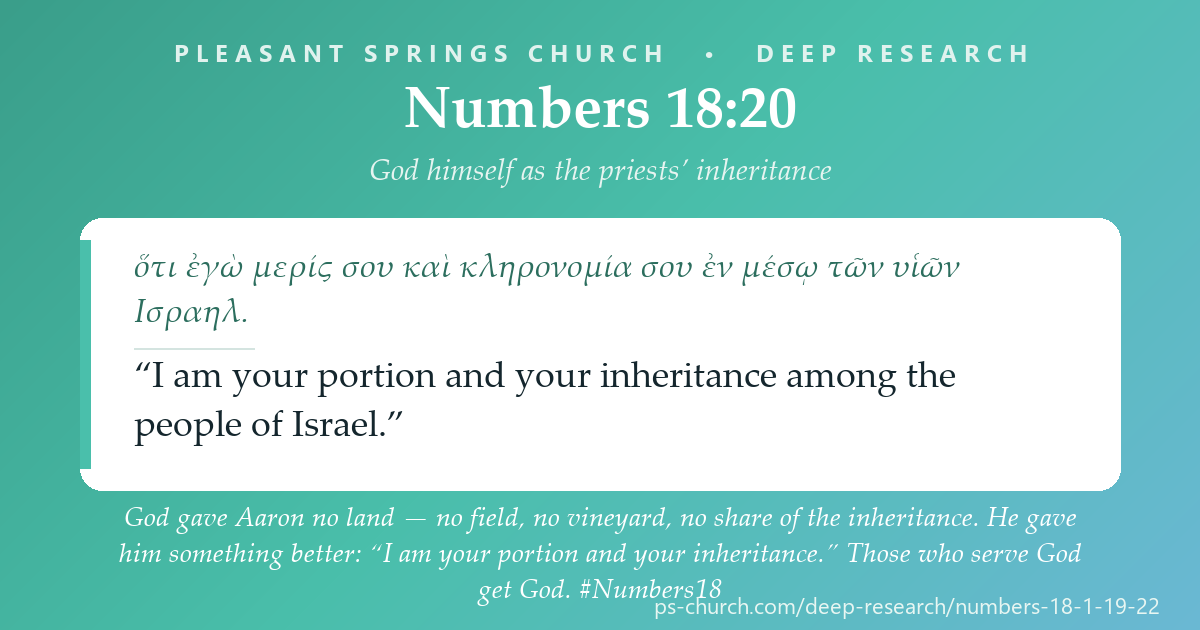
Israel in the wilderness — and, within Israel, two audiences at once. To the congregation, chapter 18 says: the sanctuary is guarded, and the guarding is for your sake. To Aaron and the Levites, it says something harder and better: you will get no field, no vineyard, no tribal territory. “You shall have no inheritance in their land… I am your portion and your inheritance” (18:20). Every other tribe would one day point to land and say that is ours. Levi could point only to God.
How they heard it. Chapter 19 addressed a very ordinary and very heavy problem: people die, and the living touch them — in the tent, in the open field, at the grave. Israel was not told to pretend death is clean, nor to abandon the dead. They were given a rite that acknowledged death as the deepest defilement and provided cleansing on the third and seventh day (19:12). It is called a חֻקָּה (ḥuqqāh), a statute — and its inner logic is never explained.
Orient on priesthood and Levites, tithes and priestly dues, corpse impurity, and the red heifer.
Search by topic: priesthood, Levites, tithe, priestly dues / terumah, clean and unclean, corpse impurity, red heifer, purification, inheritance.
Which articles are relevant?
- Anchor Bible Dictionary — “Priests and Levites,” “Tithe,” “Firstfruits,” “Clean and Unclean,” “Purification,” “Red Heifer.”
- Dictionary of the OT: Pentateuch — “Priests, Priesthood,” “Levites,” “Tithes,” “Clean and Unclean,” “Sacrifices and Offerings,” “Land.”
- NIDOTTE / TDOT — חֵלֶק (ḥēleq, portion), נַחֲלָה (naḥălāh, inheritance), מַעֲשֵׂר (maʿăśēr, tithe), נִדָּה (niddāh, impurity), טָמֵא / טָהוֹר (ṯāmēʾ / ṯāhōr, unclean / clean).
Bibliography surfaced:
- Timothy Ashley (NICOT), Gordon Wenham (TOTC), Dennis Cole (NAC), Baruch Levine (AB) on Numbers.
- Jacob Milgrom on purity and corpse defilement; studies of the red heifer rite and of the priestly dues and tithe system.
- Beale & Carson, Commentary on the NT Use of the OT (Hebrews).
Temple personnel without land, and the ancient world’s dread of the corpse.
Weigh a landless priesthood against ANE temple economies, read corpse impurity against ancient purification rites, then let the New Testament make its own connection.
Which parallels shed light on religion and worldview?
A priesthood without an estate. Temples across the ancient Near East were landholders: sanctuaries owned fields, herds and workshops, and their personnel were supported from temple estates. Israel’s arrangement is deliberately different. Levi holds no tribal territory (Josh 13:14, 33); the priests eat from what is offered, and the Levites live from the tithe. The result is a class whose livelihood is bound not to soil but to the worship of God — and a theology stated outright: “I am your portion and your inheritance” (18:20; cf. Deut 18:1–2).
Death, the deepest defilement. Ancient peoples widely feared corpse contamination and developed elaborate purifications; Hittite ritual texts prescribe washings, burnings and the removal of impurity from person and place (see ANET 346–351). Numbers 19 shares the cultural furniture and reframes it: there is no appeasing of the dead and no magic, only a rite the Lord commands. The heifer is taken outside the camp (19:3), burned whole with cedarwood, hyssop and scarlet yarn (19:6), and its ashes stored for the water for impurity (19:9), applied on the third and seventh day (19:12). Death is treated as real and as ruinous to nearness — and as answerable.
A statute whose reason is withheld. Numbers 19:2 calls this חֻקַּת הַתּוֹרָה, “the statute of the law.” Later Judaism made it the example of a חֹק (ḥōq) — a command whose rationale is not given. The Mishnah devotes a whole tractate, Parah (“Heifer”), to it, and remembers that only a handful of heifers were ever prepared (Parah 3:5). The Qumran document 4QMMT argues that everyone who slaughters, burns, gathers and sprinkles must be pure at sunset — a real Second-Temple dispute the Mishnah answers from the other side (Parah 3:7). And the midrash preserves the frank rabbinic admission that the reason is not disclosed.
- Josephus, Antiquities 4.79–81 (Second-Temple — a witness, not Scripture) — retells the red-heifer rite: an unblemished red heifer that had never been yoked, slaughtered outside the camp, blood sprinkled seven times, burned with cedar, hyssop and scarlet wool, the ashes kept for purification.
- Philo, On the Special Laws 1.261–272 (Second-Temple — a witness, not Scripture) — discusses the purifications by ash and water, reading them as moral instruction about the worshipper’s inward state.
- 4QMMT (4Q394) B 13–17 (Dead Sea Scrolls — a witness, not Scripture) — insists that those who slaughter, burn, gather and sprinkle must be pure at sunset; Mishnah, Parah 3:7 records the opposite ruling. Evidence that the rite was fiercely debated, not simply performed.
- Mishnah, Parah (rabbinic-era — a witness, not Scripture) — twelve chapters on the heifer’s selection, the rite on the Mount of Olives, and the water; Parah 3:5 counts the heifers prepared from Moses to the destruction of the temple.
- Bamidbar Rabbah 19:3 (rabbinic-era — a witness, not Scripture) — the tradition that even Solomon said of this chapter, “I said, I will be wise, but it was far from me” (Eccl 7:23). Pesikta de-Rav Kahana 4:7 and Bamidbar Rabbah 19:8 — Yoḥanan ben Zakkai’s answer to his students, that a corpse does not defile and water does not purify, but “I instituted a statute, issued a decree; you are not permitted to violate My decree.” We take these as honest confessions of mystery, not as doctrine.
- Hittite purification rituals (ANET 346–351) — the wider ancient world’s rites for removing impurity from person, house and place: shared cultural furniture, reframed in Numbers around the command of the Lord.
We do not have to invent a Christian meaning for this chapter; the New Testament supplies one. Hebrews names the rite explicitly: “For if the blood of goats and bulls, and the sprinkling of defiled persons with the ashes of a heifer, sanctify for the purification of the flesh, how much more will the blood of Christ, who through the eternal Spirit offered himself without blemish to God, purify our conscience from dead works to serve the living God” (Heb 9:13–14). The Greek is close enough to feel: the LXX of Numbers 19:9 speaks of τὴν σποδὸν τῆς δαμάλεως and ὕδωρ ῥαντισμοῦ; Hebrews writes σποδὸς δαμάλεως ῥαντίζουσα. And the argument is a fortiori, not allegorical: if ashes could restore an Israelite to the camp, how much more the blood of Christ to the conscience. Note the phrase Hebrews chooses — from dead works — the very death-defilement theme of Numbers 19. The same letter picks up the other detail the text stresses: the sin-offering bodies are “burned outside the camp,” and “so Jesus also suffered outside the gate” (Heb 13:11–12). We hold this as the New Testament’s own devotional and typological reading — and we stop where it stops. Scripture does not tell us why the heifer must be red, or unyoked, or why cedar, hyssop and scarlet go into the fire. Those details are not invitations to invention.
The vocabulary of portion and inheritance, gift and tithe, heifer and cleansing water.
Watch cheleq and nachalah (portion / inheritance) exchanged for God himself, mattanah (gift) for the Levites, and mei niddah (water for impurity) carrying the ashes of the parah adummah.
“Portion, share” — normally one’s allotted piece of land or spoil (LXX μερίς). Aaron is told he will have none — and then given the astonishing substitute: “I am your portion.” The same word carries Psalm 16:5, “the Lord is my chosen portion” (LXX Ps 15:5 κύριος ἡ μερὶς τῆς κληρονομίας μου).
“Inheritance” — the permanent family holding in the land (LXX κληρονομία). Levi receives the tithe “for an inheritance” (18:21) and God himself as inheritance (18:20); Joshua repeats it — “the Lord God of Israel is their inheritance” (Josh 13:33).
“Gift” — the Levites are given to Aaron (LXX δόμα δεδομένον, “a gift, given”), and the priesthood itself is called a gift, a “service of gift” (18:7). Ministry in this chapter is never a seized right; it is granted.
“Tithe” — a tenth (LXX ἐπιδέκατον). Israel tithes to the Levites; the Levites lift out מַעֲשֵׂר מִן־הַמַּעֲשֵׂר, “a tithe of the tithe,” for the priests (18:26). No one in the chain is only a recipient.
“Red heifer” — a young cow, δάμαλις πυρρά in the LXX, unblemished and never yoked. Scripture states the requirements and never explains them; the honest reading names the mystery rather than filling it in.
“Water for impurity” — ashes mixed with fresh water, sprinkled on the third and seventh day. The LXX calls it ὕδωρ ῥαντισμοῦ, “water of sprinkling” — the phrase Hebrews echoes with ῥαντίζουσα (Heb 9:13).
How the New Testament takes up Numbers 18–19:
- Hebrews 9:13–14 — “the sprinkling of defiled persons with the ashes of a heifer… how much more will the blood of Christ… purify our conscience from dead works to serve the living God”: the explicit New Testament use of Numbers 19.
- Hebrews 13:11–13 — the sin-offering bodies burned “outside the camp”; “so Jesus also suffered outside the gate… let us go to him outside the camp” (cf. 19:3; and Leviticus 16:27).
- 1 Corinthians 9:13–14 — “those who serve at the altar share in the sacrificial offerings”: Paul grounds the support of gospel workers in the priestly-portion principle of Numbers 18.
- Hebrews 4:14–16; 7:26–28 — the priesthood that guards and intercedes is taken up by a High Priest who needs no successor (see Hebrews 4:14–16).
From the guarded sanctuary and the ashes to the whole canon.
Trace two threads — God as the portion of those who serve him, and the cleansing of death-defilement — from the wilderness to the New Testament.
Which cross-references matter?
- Numbers 16–17 — the rebellion and the budding rod that provoke this answer; the cry “are we all to perish?” (17:13) is what chapter 18 replies to (see Numbers 16:1–17:13).
- Deuteronomy 10:9; 18:1–2; Joshua 13:14, 33; Ezekiel 44:28 — the same arrangement restated: Levi has no inheritance, because “the Lord is their inheritance.”
- Psalm 16:5; 73:26; 119:57; Lamentations 3:24 — what was said to Aaron becomes the confession of the ordinary believer: “The Lord is my chosen portion and my cup”; “God is the strength of my heart and my portion forever”; “‘The Lord is my portion,’ says my soul.”
- Leviticus 11–15; 21:1–4 — the clean/unclean system this chapter completes, and the priest’s special restriction regarding the dead (see Leviticus 11, Leviticus 15, Leviticus 21).
- Psalm 51:7; Ezekiel 36:25 — “purge me with hyssop…”; “I will sprinkle clean water on you, and you shall be clean”: the prophets turn the rite into a prayer for the heart.
- Hebrews 9:13–14; 13:11–13 — the ashes of a heifer and the place outside the camp, taken up by the New Testament itself.
Hebrews 9 does not read Numbers 19 as a code to be decoded. It reasons from the lesser to the greater. The old rite really worked at its own level — it “sanctified for the purification of the flesh,” restoring a defiled Israelite to the camp and the sanctuary. The argument is that a rite so effective at the outward level points to something greater at the inward level: the blood of Christ “purifies our conscience from dead works to serve the living God” (9:14). Two things in that verse deserve notice. First, the contrast is not clean-versus-dirty but flesh-versus-conscience: the deep problem is not ritual residue but guilt. Second, the phrase dead works is chosen with Numbers 19 in view — the chapter about contact with the dead becomes the chapter about a conscience contaminated by works that lead to death. Hebrews then presses one more detail, the location: what was burned outside the camp answers to the One who “suffered outside the gate” (13:12), and the readers are called to join him there. Beyond these connections, the letter is silent — and so are we.
The scholarship on priestly dues, corpse impurity, and the red heifer.
Ashley, Wenham, Cole and Levine for Numbers; Milgrom on purity and corpse defilement; Beale & Carson for the New Testament use.
Commentaries & studies:
- Timothy R. Ashley, The Book of Numbers (NICOT); Gordon J. Wenham, Numbers (TOTC); Dennis T. Cole (NAC); Baruch A. Levine, Numbers (Anchor).
- Jacob Milgrom on the purity system and corpse contamination; studies of the priestly dues and the Levitical tithe; monographs and articles on the red-heifer rite and its Second-Temple disputes.
- G. K. Beale & D. A. Carson, eds., Commentary on the New Testament Use of the Old Testament (Hebrews).
Interpretation notes worth keeping:
- “Bear iniquity” is an office, not a curse. The priests and Levites carry legal responsibility for offenses at the sanctuary (18:1; and the Levites, 18:23) so the congregation does not (18:22). This is the dignity and the danger of guarding the holy — a burden accepted on behalf of others.
- Read 18:20 as gift, not deprivation. The verse begins with a loss (no land, no portion) and ends with the greatest possible gain. Preach it that way. It is a word for anyone who has given something up for God — and it is misused if it becomes a way of underpaying those who serve.
- Everyone gives. The Levites, whose entire living is the tithe, tithe it (18:26). The chapter refuses to let anyone be merely a recipient. Grace received is meant to flow on.
- The heifer is a genuine חֹק. Scripture gives the procedure and withholds the reason. Later Judaism made this the standing example of a statute beyond explanation, and even the midrash confesses it. The disciplined response is to hold the mystery, not to allegorize the color, the yoke, or the cedar, hyssop and scarlet.
- The paradox belongs to the mystery. The ashes cleanse the unclean, while everyone who prepares and handles them — the priest, the burner, the gatherer, the sprinkler — becomes unclean until evening (19:7–10, 21). Proposals abound; the text offers none. What can be said soberly is that the rite makes those who administer it bear something of the defilement they remove — a resonance the letter to the Hebrews picks up not in its argument from the ashes (Heb 9:13–14, which reasons only from lesser to greater) but when it sends the reader outside the gate to the One who suffered there (Heb 13:11–13). Beyond that the text is silent, and so are we.
- Corpse impurity is not sin. Burying the dead was a duty, and contact was often unavoidable and even loving. Numbers 19 is not a shaming of mourners; it is a provision for them.
From a landless priesthood to a cleansed conscience.
Name what you learned, why it matters, and one concrete response.
What should we carry away — and do?
- Those who serve God get God. Aaron was handed no deed and no field — and then handed everything: “I am your portion and your inheritance.” If you have given something up to follow Christ, this verse is aimed at you. The psalmists made it their own (Ps 16:5; 73:26; Lam 3:24), and so may you.
- Guarding the holy is a burden carried for others. The priests “bear iniquity” so that wrath does not fall on the congregation (18:1, 5). Honor those who carry that weight in your church, and pray for them — it is a real weight, not a privilege.
- No one is only a recipient. The Levites, living entirely on the gifts of others, still gave a tithe of the tithe (18:26). Grace that stops with you has stopped too soon.
- Death does not have the last word on nearness. Numbers 19 treats mortality itself as the deepest defilement — and then provides for it, so that a people living among graves could still approach the living God. Hebrews takes that up and goes further: the blood of Christ cleanses the conscience “from dead works to serve the living God” (Heb 9:14).
Step in response: write down, honestly, what you have been treating as your real portion — a salary, a house, a career, a reputation — and then pray Numbers 18:20 back to God as a confession rather than a complaint. Then do one thing this week that passes the gift on: give a tithe of what you have received, in money or in time, to someone who cannot repay you.
Numbers 18:20 · to share
LXX + ESVEvery Deep Research page traces its passage across the whole sweep — the Old Testament, the Second-Temple world between the testaments (historical witnesses, not Scripture), and the New Testament. Follow the thread:
Pleasant Springs Church — Deep Research
Research method after Michael S. Heiser’s Bible Research Method (examine dictionaries → ancient literature → important words → textual connections → academic publications → share), with the Pleasant Springs “Author & Audience” foundation. Scripture set in the Hebrew, the Greek editions named on each page and the ESV (Old Testament), and the Greek New Testament and the ESV (New Testament), per the practice of Pleasant Springs Church. Numbers 18–19 research grounded in Ashley, Wenham, Cole and Levine, with Milgrom on the purity system and Beale & Carson on the New Testament use (Hebrews); Second-Temple and rabbinic witnesses (Josephus, Ant. 4.79–81; Philo, Spec. 1.261–272; 4QMMT B 13–17; the Mishnah tractate Parah; Pesikta de-Rav Kahana 4:7 and Bamidbar Rabbah 19), all read as witnesses, never leveled with Scripture; ANE purification comparanda per ANET 346–351. The Christ-connection is stated as the New Testament’s own reading (Heb 9:13–14; 13:11–13) and deliberately goes no further: the heifer’s color, its unyoked state, and the cedar, hyssop and scarlet are left unexplained, as Scripture leaves them. Versification note: Numbers 18–19 has no MT/LXX/English offset.
Scripture quotations marked ESV are from the ESV® Bible (The Holy Bible, English Standard Version®), © 2001 by Crossway, a publishing ministry of Good News Publishers. ESV Text Edition: 2016. Used by permission. All rights reserved. The ESV text may not be quoted in any publication made available to the public by a Creative Commons license, and the ESV may not be translated in whole or in part into any other language. www.esv.org
|
Did this study bless you today? 💚 Give to Support PS Church100% of gifts go to the General Fund — thank you. |