Miriam dies at Kadesh, and the chapter gives her one line. Then the water fails, the people quarrel, and God tells Moses to take the staff and speak to the rock. Moses — grieving, provoked, forty years tired — says, “Hear now, you rebels: shall we bring water for you out of this rock?” and strikes it twice. The water comes out abundantly anyway. But the word to Moses and Aaron is sober: “because you did not believe in me, to uphold me as holy in the eyes of the people of Israel” (20:12). The place is named Meribah, “quarreling.” Edom refuses Israel the King’s Highway, and Israel turns away from a brother rather than fight. And on Mount Hor, Aaron’s garments are lifted off him and placed on his son, and all Israel weeps thirty days. This study works Numbers 20:1–29 — the wilderness generation passing, the seriousness of speaking for God, and the grace that keeps flowing anyway. See the method →
Numbers 20:1–29 (selections)
Hebrew · LXX · ESVThe Shape of the Passage
InclusioNumbers 20 stands at the hinge of the book. Behind it lie the murmuring (ch 11), Miriam and Aaron’s challenge to Moses (ch 12), the unbelief at Kadesh (chs 13–14), Korah’s rebellion (chs 16–17), and the priestly charge and the cleansing from death (chs 18–19). Ahead lies the road to Moab and the bronze serpent (ch 21). Here the generation that came out of Egypt begins, quietly, to die.
Author
The Torah of Moses tells this story against itself. The narrator does not protect his own leader: the man who spoke with God face to face is here recorded losing his temper, disobeying a plain word, and hearing a sentence he will carry to his grave. That candour is one of the marks of the Pentateuch — Israel’s founders are never airbrushed.
A chapter of endings. The chapter is framed by two graves. It opens with Miriam’s (20:1) and closes with Aaron’s (20:28–29); between them Moses receives his own sentence (20:12). Nearly forty years have passed since Kadesh, and the wilderness generation is passing away exactly as God said it would. The promise does not die with them — it is handed on, and the handing-on is made visible when Aaron’s garments are lifted off him and placed on his son.
Audience
Israel on the edge of the land — the children of the men and women who refused to go in. They are hearing why their parents’ generation is buried behind them, and why even Moses and Aaron will not cross over. It is a sober word for a people about to inherit a promise they did not earn.
How they heard it. To Israel this said several things at once. God’s provision does not depend on the perfection of his servants — the water flowed for a grumbling people through a leader under judgment. But God’s holiness is not a decoration; those who speak for him are answerable for how they represent him. And leadership is a trust that outlives the leader: Miriam, Aaron, and Moses all die outside the land, and the promise walks on without them, into the next generation’s hands.
Orient on Meribah, Kadesh, holiness, Edom, Mount Hor, and the succession of the priesthood.
Search by topic: Meribah, Massah, Kadesh-barnea, rock, holiness (qadosh), Edom / Esau, King’s Highway, Mount Hor, Miriam, Aaron, Eleazar, priestly vestments.
Which articles are relevant?
- Anchor Bible Dictionary — “Meribah,” “Kadesh-barnea,” “Edom,” “King’s Highway,” “Hor, Mount,” “Miriam,” “Aaron,” “Eleazar.”
- Dictionary of the OT: Pentateuch — “Wilderness Wanderings,” “Holiness,” “Moses,” “Aaron,” “Priests and Levites,” “Edom, Edomites.”
- NIDOTTE / TDOT — רִיב (rîḇ, contend/quarrel), מְרִיבָה (mərîḇāh, Meribah), קדשׁ (qdš, be holy / treat as holy), אמן (ʾmn, be firm / believe), סֶלַע (selaʿ, rock/crag).
Bibliography surfaced:
- Timothy Ashley (NICOT), Gordon Wenham (TOTC), Dennis Cole (NAC), Baruch Levine (AB) on Numbers.
- Studies of the Meribah traditions (Exod 17 and Num 20 compared), the geography of Kadesh and the Transjordan routes, and the succession of the high priesthood.
- Beale & Carson, Commentary on the NT Use of the OT (1 Corinthians; Hebrews).
Kadesh and the desert well, a brother-king’s letter, and the mountain where a high priest is unrobed.
Read the quarrel against the reality of desert water, the Edom appeal against ANE royal correspondence, and Aaron’s unrobing against what priestly vestments meant — then weigh how later Jewish writers retold it.
Which parallels shed light on religion and worldview?
Water in the wilderness of Zin. Kadesh sits at a cluster of springs on the northern edge of the Sinai — the one place in that country where a large group could stay put. Water there is not a luxury but the difference between a people and a graveyard, which is why the failure of it produces panic rather than mere grumbling. The people’s cry is not invented piety: “Would that we had perished when our brothers perished before the Lord” (20:3) — they are remembering the graves of the last forty years. The narrative takes their fear seriously even as it refuses to excuse the quarrel.
‘Thus says your brother Israel.’ The message to Edom (20:14–17) is a formal diplomatic letter, and it follows the ancient pattern exactly: the messenger formula (“thus says…”), a kinship address, a historical recital of hardship, and a narrowly defined request — passage on the highway, no fields, no vineyards, no wells. Kings of the Late Bronze world addressed one another as “my brother” when they claimed equal standing — the great-king letters of the Amarna archive (EA 1–44) are full of it — while vassals wrote “to the king, my lord… thy servant.” The Palestinian letters of that same archive (ANET 483–490) show the fixed opening formula that stands behind Numbers 20:14. What is striking is Israel’s response to the refusal: they turn away. Edom is Esau’s people, and Deuteronomy explains the restraint — “Do not contend with them, for I will not give you any of their land… because I have given Mount Seir to Esau as a possession” (Deut 2:5).
Unrobing a high priest. Aaron’s vestments were not a costume; they were his office, made “for glory and for beauty” and put on him at his ordination (see Leviticus 8). To strip them off in the sight of the whole congregation and place them on Eleazar is a public, deliberate act of succession — the priesthood continues, the priest does not. Josephus retells the scene almost as Numbers does: Aaron went up the mountain “in the sight of the whole army,” put off his pontifical garments and delivered them to Eleazar his son, and died while the multitude looked on.
- Amarna Letters (ANET 483–490) — Late-Bronze Syro-Palestinian correspondence showing the fixed opening formula of a diplomatic letter: the idiom behind Numbers 20:14. (The parity address “my brother” belongs to the great-king letters, EA 1–44, which this ANET selection does not include.)
- Josephus, Antiquities 4.4.6–7; 4.5.1 (Second-Temple — a witness, not Scripture) — Miriam’s death and public burial with thirty days of mourning; Aaron’s ascent of the mountain near Petra, the handing of the priestly garments to Eleazar, and the people’s thirty days of mourning. Notably, Josephus passes over the striking of the rock and Moses’ sentence altogether — a reticence he often shows toward Israel’s heroes.
- Philo, Allegorical Interpretation 2.86 (Second-Temple — a witness, not Scripture) — reads the desert rock allegorically: “the abrupt rock is the wisdom of God… of it he gives drink to the souls that love God.” A Jewish reading of the rock as divine wisdom already circulating before Paul writes 1 Corinthians 10.
- Babylonian Talmud, Taʿanit 9a (rabbinic-era — a witness, not Scripture) — the tradition of “Miriam’s well”: three gifts given through Moses, Aaron, and Miriam, and “when Miriam died the well disappeared,” reasoning from the very sequence of Numbers 20:1–2. A later inference, not the claim of the text — but it shows how early readers felt the joint of these two verses.
Paul, warning the Corinthians with the wilderness story, writes that our fathers “all drank the same spiritual drink. For they drank from the spiritual Rock that followed them, and the Rock was Christ” (1 Cor 10:4). This is the New Testament reading the episode devotionally and typologically, and we take it as such: water struck out of stone for a grumbling people is a picture of grace — unearned, abundant, given to complainers. A long line of Christian preachers has pressed the picture further, noting that at Rephidim the rock was struck once (Exod 17:6) while here it was only to be spoken to, and reading that as Christ crucified once and thereafter approached by a word. It is a beautiful thought and an old one, and it may be held loosely — but it is not what Numbers 20 is about, and it should never be preached as the plain sense of the passage. What the text says is simpler and harder: God said speak, Moses struck, and God still gave the water.
The vocabulary of quarreling, belief, holiness, and being gathered.
Watch merivah (quarreling) name the place, heʾemantem (you did not believe) name the sin, lehaqdisheni (to treat me as holy) name the stakes, and yeʾasef (be gathered) soften the grave.
“Meribah” — literally “quarreling, contention,” from רִיב (rîḇ, to contend, bring a suit). The name is a verdict engraved on a map: “where the people of Israel quarreled with the Lord” (20:13). The LXX declines to transliterate and simply translates it — ὕδωρ ἀντιλογίας, “water of contradiction.”
“You did not believe” — hiphil of אמן (ʾmn, to be firm, to trust; LXX ἐπιστεύσατε). The same root gives us “amen.” The charge is not clumsiness but a failure of trust — the identical word used of the generation that would not go in at Kadesh.
“To treat me as holy” — hiphil of קדשׁ (LXX ἁγιάσαι με). Not to make God holy but to show him holy before watching people. The chapter answers itself: they failed to sanctify him, and so “he showed himself holy” (wayyiqqāḏêš, 20:13) among them anyway.
“You rebels” — from מרה (mārāh, to be defiant; LXX οἱ ἀπειθεῖς, “the disobedient”). True of them — but spoken in anger, and paired with “shall we bring water,” it puts the messenger in the place of the giver.
“Rock, crag” (LXX πέτρα) — a different word from the צוּר (ṣûr) of Exodus 17. In Israel’s poetry both become names for God himself: “my rock and my fortress” (Ps 18:2 · LXX 17:3).
“Let him be gathered” (to his people) — niphal of אסף; LXX προστεθήτω, “let him be added.” The Bible’s gentle idiom for a covenant death: not annihilation but a joining of company. It is said of Abraham, of Isaac, of Jacob — and now of Aaron.
How the rest of Scripture reads this chapter:
- Psalm 106:32–33 — “They angered him at the waters of Meribah, and it went ill with Moses on their account, for they made his spirit bitter, and he spoke rashly with his lips.” The one inspired commentary on Moses’ state of mind — provoked, embittered, hasty of speech. It neither excuses him nor pretends the people were innocent.
- Deuteronomy 32:51 — God’s own summary: “because you broke faith with me… and because you did not treat me as holy in the midst of the people of Israel.” Numbers 27:14 says the same: “failing to uphold me as holy at the waters before their eyes.”
- Deuteronomy 1:37; 3:23–27 — Moses’ own retelling: “Even with me the Lord was angry on your account,” and his unanswered plea, “Please let me go over and see the good land.” He does not blame God, and he does not stop loving the land.
- Psalm 95:8–9 — “do not harden your hearts, as at Meribah”: the place becomes a permanent warning in Israel’s worship, and then in the church’s (Heb 3:7–19).
- 1 Corinthians 10:1–11 — “they drank from the spiritual Rock that followed them, and the Rock was Christ” (10:4); the whole wilderness account “written down for our instruction” (10:11).
Two rocks, two graves, and a promise that outlives its bearers.
Compare Exodus 17 with Numbers 20; follow Miriam, Aaron, and Moses to their ends; then ask what happened to the promise they carried.
Which cross-references matter?
- Exodus 17:1–7 — the first water-from-the-rock, at Rephidim: there God says, “you shall strike the rock, and water shall come out of it.” Thirty-eight years later the instruction changes to speak — which is what makes the disobedience visible, though the sentence God gives names something deeper (20:12).
- Exodus 15:20–21; Micah 6:4; Numbers 12 — Miriam the prophetess who led the song at the sea, named by God among the three he sent before Israel (“Moses, Aaron, and Miriam”), and earlier disciplined for challenging Moses. Numbers 20:1 gives her a single line; the rest of Scripture will not let her be forgotten.
- Numbers 27:12–14; 33:38–39; Deuteronomy 34:1–8 — Aaron dies on Mount Hor in the fortieth year, aged 123; Moses is later shown the land from Pisgah and dies in Moab, and God himself buries him, “but no one knows the place of his burial to this day.”
- Deuteronomy 2:4–5 — why Israel turns away from Edom rather than fighting: “the people of Esau… Do not contend with them, for I will not give you any of their land.” Restraint toward a brother nation is obedience, not weakness. (Later prophets will still hold Edom accountable for its own hostility — Obadiah; Amos 1:11.)
- Leviticus 8; Hebrews 4:14–16; 7:23–25 — the garments that ordained Aaron are lifted onto Eleazar; the old priesthood is a relay of mortal men, “prevented by death from continuing in office,” until one arrives who “holds his priesthood permanently.”
- James 3:1 — “Not many of you should become teachers… for you know that we who teach will be judged with greater strictness.” The New Testament’s own statement of the principle at work in 20:12.
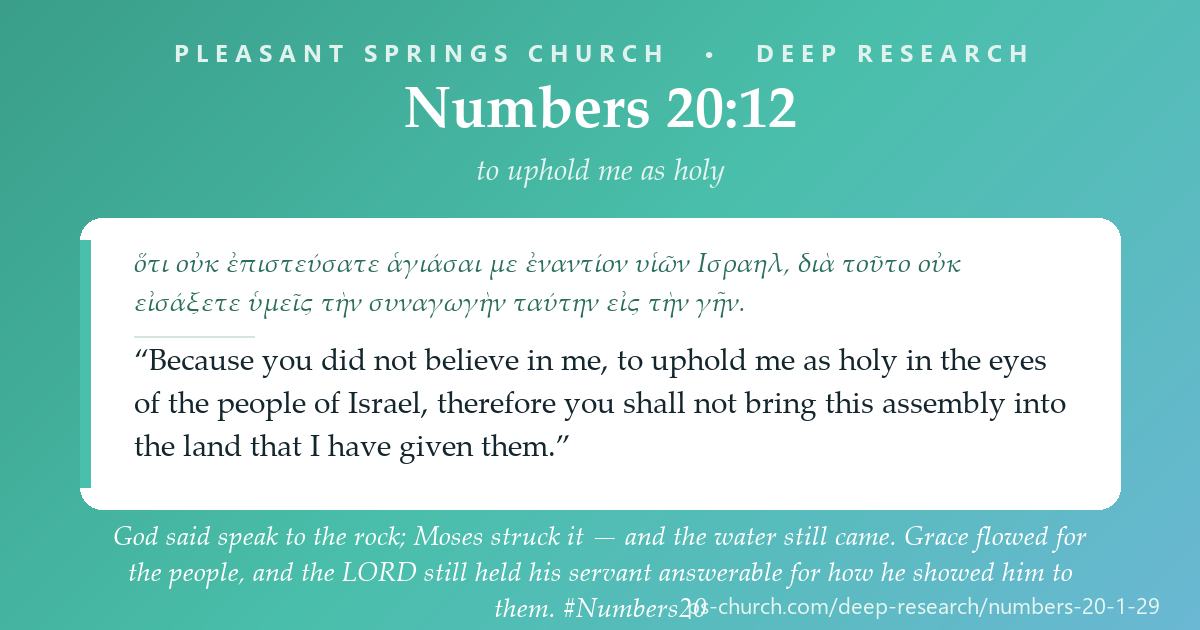
God said speak to the rock; Moses struck it, twice. But the sentence God gives is not “because you used the wrong method.” It is “because you did not believe in me, to uphold me as holy in the eyes of the people of Israel” (20:12), and Deuteronomy 32:51 repeats it. Three things came together. There was the anger — Psalm 106 says the people “made his spirit bitter, and he spoke rashly with his lips,” which is honest about the provocation and honest about the failure. There was the word “shall we bring water for you out of this rock?” — the servant standing for a moment where only the Giver belongs. And there was the plain disobedience of a plain command, done publicly, in front of the whole congregation, by the man whose whole calling was to show Israel what their God is like. That last is the weight of it: God was about to display sheer generosity, and his spokesman displayed exasperation instead.
Two things must be said alongside it. First, the water still came — abundantly (20:11). God met the need of a quarreling people through a leader under judgment, because the supply was never running on Moses’ merit. Second, the judgment is not abandonment. Moses remains “the servant of the Lord” to the end (Deut 34:5); God shows him the whole land with his own eyes, buries him with his own hand (Deut 34:6), and speaks of him afterward as the prophet like no other. And there is a last, quiet mercy many have seen here: the man barred from Canaan appears on the mountain of Transfiguration, talking with Jesus (Luke 9:30–31). Discipline in the hand of God is never the end of the story.
The scholarship on Meribah, the Edom itinerary, and the priestly succession.
Ashley, Wenham, Cole, and Levine for Numbers; the Meribah-tradition and Transjordan-route studies; Beale & Carson for 1 Corinthians 10 and Hebrews.
Commentaries & studies:
- Timothy R. Ashley, The Book of Numbers (NICOT); Gordon J. Wenham, Numbers (TOTC); R. Dennis Cole, Numbers (NAC); Baruch A. Levine, Numbers 1–20 and 21–36 (Anchor).
- Studies comparing the two water-from-the-rock accounts (Exod 17:1–7 and Num 20:1–13) and surveying the many proposals for Moses’ offence; treatments of Kadesh-barnea, the King’s Highway, and the candidates for Mount Hor (Jebel Harun near Petra, following Josephus, or a site nearer Kadesh).
- G. K. Beale & D. A. Carson, eds., Commentary on the New Testament Use of the Old Testament (1 Corinthians; Hebrews).
Interpretation notes worth keeping:
- Do not caricature Moses. He is not the villain of this chapter and God is not petty in it. Psalm 106:32–33 makes the provocation part of the record. Read the scene as a tired, grieving, badly provoked man failing at a real point of obedience — which is far closer to home, and far more useful, than a cartoon.
- The offence is representational. The text names it precisely: a failure to trust that showed itself as a failure to display God’s holiness “in the eyes of the people.” Those who speak for God carry his reputation in their mouths (cf. Jas 3:1). That is a call to reverence in leaders, not a lever for congregations to use against them.
- Grace and consequence can stand together. Moses is barred and still beloved; the water flows and the sentence holds. Scripture routinely refuses the choice between the two (cf. Numbers 14:20–23).
- Keep the “struck once / spoken to after” reading in its place. Paul’s “the Rock was Christ” (1 Cor 10:4) is the New Testament’s own devotional and typological reading and may be preached as such; the finer allegory built on Exodus 17 versus Numbers 20 is a later homiletical flourish. Hold it loosely, label it plainly, and never let it replace the plain sense.
- Deuteronomy 10:6 places Aaron’s death at Moserah, while Numbers 20:22–29 and 33:38 name Mount Hor — possibly two names for the same stage of one itinerary, though Numbers 33 itself lists Moseroth (33:30–31) and Mount Hor (33:37–38) as separate stations. Note the difficulty honestly; it does not disturb the substance of the account.
From a struck rock and two graves to the promise carried on.
Name what you learned, why it matters, and one concrete response.
What should we carry away — and do?
- How we represent God matters. Moses gave the people water and gave them a false impression of God in the same minute. Anyone who teaches, leads, parents, or simply speaks for Christ to someone who is watching should feel the weight of 20:12 — and then rest in the mercy that kept calling Moses “my servant” afterward.
- God’s grace is not hostage to your failure. The water came out abundantly. If you are waiting to be worthy before God will provide for the people in your care, read verse 11 again.
- Honour the ones who went before. Miriam gets half a verse; Aaron gets thirty days of tears. Both had failed and both had served. The next generation inherits the promise because someone carried it through a desert they never got to leave.
- Turn away from a fight with a brother. Edom refused a brother in need and Israel still turned aside. Not every refusal has to be answered.
Step in response: think of one place where you speak for God — a class, a table, a text thread, a child’s bedside — and ask honestly whether the picture of him you are painting there is generous, holy, and true. Then name one person from the generation before you who carried the faith to you, and thank God for them out loud this week.
Numbers 20:12 · to share
LXX + ESVEvery Deep Research page traces its passage across the whole sweep — the Old Testament, the Second-Temple world between the testaments (historical witnesses, not Scripture), and the New Testament. Follow the thread:
Pleasant Springs Church — Deep Research
Research method after Michael S. Heiser’s Bible Research Method (examine dictionaries → ancient literature → important words → textual connections → academic publications → share), with the Pleasant Springs “Author & Audience” foundation. Scripture set in the Hebrew, the Greek editions named on each page and the ESV (Old Testament), and the Greek New Testament and the ESV (New Testament), per the practice of Pleasant Springs Church. Numbers 20 research grounded in Ashley, Wenham, Cole, and Levine, with Beale & Carson on the New Testament use (1 Corinthians; Hebrews); Second-Temple and rabbinic witnesses (Josephus, Antiquities 4.4.6–7 and 4.5.1; Philo, Allegorical Interpretation 2.86; the Babylonian Talmud, Taʿanit 9a on “Miriam’s well”) and the Amarna letters (ANET 483–490) for the diplomatic idiom of 20:14, all read as witnesses, not Scripture. Moses is handled with dignity: the sin at Meribah is stated as the text states it (20:12; Deut 32:51) and weighed with Psalm 106:32–33, without caricature and without making God capricious. Paul’s “the Rock was Christ” (1 Cor 10:4) is held as the New Testament’s own devotional and typological reading; the later “struck once, spoken to after” allegory is noted as a homiletical tradition held loosely, not as the plain sense.
Scripture quotations marked ESV are from the ESV® Bible (The Holy Bible, English Standard Version®), © 2001 by Crossway, a publishing ministry of Good News Publishers. ESV Text Edition: 2016. Used by permission. All rights reserved. The ESV text may not be quoted in any publication made available to the public by a Creative Commons license, and the ESV may not be translated in whole or in part into any other language. www.esv.org
|
Did this study bless you today? 💚 Give to Support PS Church100% of gifts go to the General Fund — thank you. |