The challenge to Moses came from inside his own family. Miriam and Aaron spoke against him “because of the Cushite woman” — but the real grievance was a claim to equal standing: “Has the Lord spoken only through Moses? Has he not spoken through us also?” (12:2). The narrator pauses to note that “Moses was very meek, more than all people” (12:3), and the Lord himself steps in to vindicate his servant — and to strike Miriam with leprosy, until Moses cries, “O God, please heal her” (12:13). This study works Numbers 12:1–16 — the sin of jealousy against God-appointed leadership, the meekness of Moses, and discipline that is severe yet merciful. See the method →
Numbers 12:1–13 (selections)
Hebrew · LXX · ESVThe Shape of the Passage
LeitwortNumbers 12 follows the crisis of the previous chapter, where the burden of leadership was shared and the Spirit came on the seventy elders (see Numbers 11): now the challenge to Moses comes not from the crowd but from his own brother and sister, and God himself answers it.
Author
The Torah of Moses sets this episode on the wilderness march, just after Israel leaves Sinai. It is a strikingly candid family story: the two who stood closest to Moses — Aaron the high priest and Miriam the prophetess (Exod 15:20) — turn against him. The complaint is voiced “because of the Cushite woman” Moses had married (12:1), but the chapter immediately exposes the deeper motive: a claim to equal standing — “Has the Lord spoken only through Moses?” (12:2). That a book so devoted to Moses records his own siblings’ sin, and pauses to call him the meekest of men (12:3), reads not as self-promotion but as sober, God-centered testimony.
What the chapter is really about. The narrative will not let the reader stop at the surface grievance. God’s response says nothing about the Cushite wife and everything about Moses’ standing: he alone speaks with God “mouth to mouth” (12:8). The issue is the challenge to Moses’ unique prophetic mediation — and behind it, the corrosion of jealousy and pride. The wife is the pretext; the office is the target.
Audience
Israel — a people learning to live under the God-appointed leadership that would carry them to the land. The lesson is pointed: even the highest and most gifted are not free to grasp at another’s calling, and the Lord himself defends his servant. Later Israel is told, “Remember what the Lord your God did to Miriam” (Deut 24:9) — the event became a standing warning about reckless speech against those God has set apart.
A word of care. The mention of the Cushite (Ethiopian) wife is not the text’s verdict against Moses’ marriage, and this passage must never be read to sanction racial or ethnic prejudice. If anything, the objection is rebuked: God vindicates Moses, not his critics, and strikes the one who spoke. Miriam is to be honored with dignity — a prophetess and one of the three the Lord sent to lead Israel out of Egypt (Mic 6:4). The discipline that falls is severe, but it is not the end of her: she is healed and restored, and the whole camp waits for her return (12:15).
Orient on prophecy, meekness, leprosy, Miriam, and the office of Moses.
Search by topic: Miriam, Aaron, prophet / prophecy, Moses, meekness / humility, leprosy (tsara’at), leadership, jealousy.
Which articles are relevant?
- Anchor Bible Dictionary — “Miriam,” “Aaron,” “Moses,” “Prophecy,” “Leprosy,” “Cush / Cushite.”
- Dictionary of the OT: Pentateuch — “Miriam,” “Aaron,” “Moses,” “Prophets and Prophecy,” “Leadership,” “Diseases.”
- NIDOTTE / TDOT — עָנָו (ʿānāw, meek/humble), נָבִיא (nāḇîʾ, prophet), עֶבֶד (ʿeḇeḏ, servant), תְּמוּנָה (təmûnāh, form/likeness), צָרַעַת (ṣāraʿaṯ, skin-disease).
Bibliography surfaced:
- Gordon Wenham (TOTC), Timothy Ashley (NICOT), Dennis Cole (NAC), R. Dennis Cole and Ronald Allen on Numbers.
- Studies of Miriam as prophetess and leader; the “prophet like Moses” theme; the office of the Mosaic mediator.
- Beale & Carson, Commentary on the NT Use of the OT (Hebrews on Numbers 12:7).
Prophecy, honor, and the disease that put one ‘outside the camp.’
Read the quarrel against ancient ideas of prophecy and honor, weigh what “leprosy” meant socially, and hear how Second-Temple and rabbinic writers remembered Miriam — then follow Moses’ meekness and intercession toward Christ.
Which parallels shed light on religion and worldview?
Dreams, visions, and direct speech. Across the ancient Near East, the gods were thought to speak through dreams, omens, and ecstatic prophets — mediated, coded, needing interpretation. Numbers 12 grants that this is how God ordinarily speaks even to true prophets: “in a vision… in a dream” (12:6). But it sets Moses apart: with him God speaks directly — “mouth to mouth… not in riddles” (12:8). The claim is not that Moses is more than human but that his mediation is uniquely unmediated; this is the honor Miriam and Aaron trespassed against.
‘Outside the camp.’ The skin-disease Miriam suffers (Hebrew צָרַעַת, ṣāraʿaṯ; the biblical term is broader than modern leprosy) rendered a person ritually unclean and required separation from the camp (Lev 13–14). Her seven days “shut outside” (12:14–15) rest on the shame analogy the Lord himself gives — “If her father had but spit in her face, should she not be shamed seven days?” (12:14) — alongside the law that placed the unclean outside the camp (Lev 13–14); but the mercy is that the march itself halts and the whole people wait for her. Discipline does not become abandonment.
How later writers remembered it. Josephus retells the wilderness leadership disputes and Moses’ forbearance; Philo makes Moses the very pattern of the meek, self-forgetful ruler and prophet; and the rabbis read the sin as lashon hara — the “evil tongue” of slander — citing “Remember what… God did to Miriam” (Deut 24:9) as the great warning against it. These are witnesses to how the passage was heard, not additions to Scripture; and they tend, rightly, to locate the fault in the speaking-against, not in Moses’ wife.
- Josephus, Antiquities 3–4 (Second-Temple — a witness, not Scripture) — retells the wilderness challenges to Moses’ leadership and his patience under them.
- Philo, Life of Moses 1–2 (Second-Temple — a witness, not Scripture) — Moses as the archetypal meek prophet-king, ruling without self-seeking.
- Sifre on Numbers §99–106 (rabbinic midrash) — reads 12:1–2 as lashon hara (evil speech) and treats Miriam’s affliction as measure-for-measure; cf. Deut 24:8–9.
- Mishnah / later halakhah on ṣāraʿaṯ (rabbinic-era) — the purity law of the skin-disease and the seven-day separation “outside the camp” (Lev 13–14; Num 12:14–15).
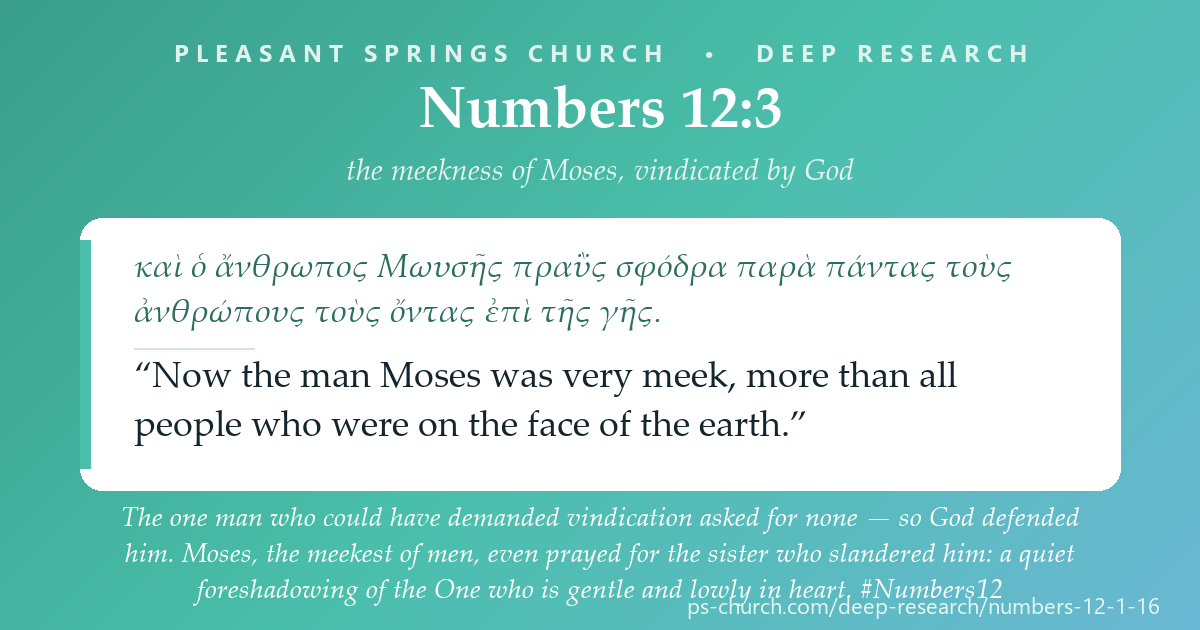
The chapter’s startling center is the aside of 12:3: “the man Moses was very meek” — the Greek translators wrote πραῢς σφόδρα, “exceedingly gentle.” Meekness here is not weakness but strength surrendered to God: Moses does not defend himself, and so God defends him. It is the same word Jesus takes on his own lips — “I am πραΰς, gentle and lowly in heart” (Matt 11:29) — and the same posture Paul commends when he says Christ “humbled himself” (see Philippians 2:5–11). As a devotional pattern, not an allegory, Moses foreshadows the greater Mediator: the meek servant who will not grasp at his own vindication, who is silent before accusers (see Isaiah 53), and who prays for those who wrong him. That the meekest man is also the most direct hearer of God quietly answers the whole quarrel: God draws near to the lowly.
The vocabulary of meekness, servanthood, direct revelation, and healing.
Watch ʿānāw (meek) and ʿeḇeḏ (servant) define Moses, peh el-peh (mouth to mouth) define his office, and rāp̄āʾ (heal) define his prayer for his accuser.
“Meek / humble” — “the man Moses was very ʿānāw” (LXX πραῢς). Not timid but un-self-assertive, leaving his cause with God; the very word Jesus claims — “I am gentle (πραΰς)” (Matt 11:29).
“Servant” — “my servant Moses… faithful in all my house” (LXX θεράπων). Hebrews 3:5 takes up this very phrase: Moses faithful “as a servant,” but Christ faithful “as a son” over the house.
“Mouth to mouth” — the directness of Moses’ revelation (LXX στόμα κατὰ στόμα): God speaks with him plainly, “not in riddles,” unlike the dreams and visions given to other prophets (12:6).
“Form / likeness” — Moses “beholds the form of the Lord.” The LXX, guarding God’s invisibility, renders it the “glory” (δόξα) — what Moses saw was the manifest presence, not a visible shape (cf. Deut 4:12,15).
“Heal” — Moses’ whole intercession is one cry: “O God, please heal her” (LXX ἴασαι). He prays for the sister who wronged him — and appeals to the Lord who calls himself Israel’s healer (Exod 15:26).
How the New Testament reuses Numbers 12:
- Hebrews 3:1–6 — quoting 12:7, “Moses was faithful in all God’s house… as a servant,” but Christ “as a son”: Jesus is counted worthy of more glory than Moses.
- Matthew 11:29 — “I am gentle (πραΰς) and lowly in heart”: the meekness of Moses (12:3, LXX πραῢς) fulfilled in Christ (devotional).
- Philippians 2:5–11 — Christ “humbled himself”; the servant who does not grasp, and is exalted by God, not himself (see Philippians 2).
- Deuteronomy 18:15–18; 34:10 — the promised “prophet like Moses,” and the testimony that “there has not arisen a prophet… whom the Lord knew face to face” (see Deuteronomy 18).
From Moses the faithful servant to Christ the faithful Son.
Trace the unique mediator and his meekness from the call at the bush, through the prophet-like-Moses promise, to the greater-than-Moses of Hebrews.
Which cross-references matter?
- Exodus 33:11; Deuteronomy 34:10 — “the Lord used to speak to Moses face to face”: the unique nearness Numbers 12:8 defends (see the call in Exodus 3).
- Exodus 15:20; Micah 6:4 — Miriam the prophetess, and one of the three — “Moses, Aaron, and Miriam” — the Lord sent to lead Israel: her dignity, even in her fault.
- Deuteronomy 24:8–9 — “Remember what the Lord your God did to Miriam”: this event becomes Israel’s standing warning against reckless speech.
- Deuteronomy 18:15–18 — the “prophet like Moses” whom God will raise up: the office defended here, fulfilled in Christ (see Deuteronomy 18).
- Hebrews 3:1–6; 4:14–16 — Christ greater than Moses, the faithful Son over the house, our great high priest who intercedes (see Hebrews 4).
The clearest New Testament use of this chapter is Hebrews 3:1–6, which lifts a single line — “faithful in all my house” (Num 12:7) — and builds an argument on it. Moses was gloriously faithful, the writer grants, but “as a servant (θεράπων)”; Christ is faithful “as a son” over the same house, “worthy of more glory than Moses as much as the builder of a house has more honor than the house.” God’s own defense of Moses in Numbers 12 — no one speaks against my servant — thus becomes, in the New Testament, an a fortiori: if Moses the servant was to be honored, how much more the Son. And the meekness of Moses (12:3) and his intercession for Miriam (12:13) are, as devotional pattern, taken up and surpassed by the one who is “gentle and lowly” (Matt 11:29), who is silent before his accusers (Isa 53:7), and who prays, “Father, forgive them” (Luke 23:34). The servant who would not defend himself and prayed for those who wronged him points beyond himself to the Mediator who does the same, once for all.
The scholarship on Numbers 12 and the office of Moses.
Ashley, Wenham, and Cole for Numbers; studies of Miriam and of prophecy; Beale & Carson for the Hebrews use of 12:7.
Commentaries & studies:
- Timothy R. Ashley, The Book of Numbers (NICOT); Gordon J. Wenham, Numbers (TOTC); R. Dennis Cole, Numbers (NAC).
- Studies of Miriam as prophetess and leader; the “prophet like Moses” motif; the meaning of ʿānāw (meekness) and the uniqueness of the Mosaic mediation.
- G. K. Beale & D. A. Carson, eds., Commentary on the New Testament Use of the Old Testament (Hebrews).
Interpretation notes worth keeping:
- The Cushite wife is the pretext, not the point. God’s answer never touches Moses’ marriage; it defends his prophetic standing. Reading these verses to justify racial or ethnic prejudice inverts the text, which vindicates Moses and rebukes his critics.
- The real sin is grasping at another’s calling. “Has he not spoken through us also?” (12:2) exposes jealousy and pride against God-appointed leadership — the abiding warning of the chapter.
- Moses’ meekness is his strength. Precisely because he will not defend himself (12:3), the Lord defends him. Self-vindication is surrendered to God’s vindication.
- Discipline is severe yet merciful. Miriam is struck, but healed and restored; the camp waits for her (12:15). She keeps her dignity as prophetess (Exod 15:20; Mic 6:4). Judgment here aims at restoration, not rejection.
From the meekest man to the meek and interceding Christ.
Name what you learned, why it matters, and one concrete response.
What should we carry away — and do?
- Guard against grasping. The sin that fell on Miriam and Aaron was resenting another’s calling and reaching for standing that was not theirs. Jealousy of a brother or sister’s gifting is a quiet, respectable, and dangerous sin.
- Let God be your defender. Moses did not answer his accusers; he left his cause with God, and God spoke for him. Meekness is not weakness — it is strength that trusts God to vindicate.
- Pray for the ones who wrong you. Moses’ whole response to the sister who slandered him was, “O God, please heal her.” The mark of a Christlike heart is intercession for the offender — the pattern the greater Mediator perfected (Luke 23:34).
Step in response: name one person whose gifting or place you have envied or spoken against — and instead of defending your own standing, pray for them by name, asking God to bless and (where needed) to heal. Then leave your own vindication with the God who defends the meek.
Numbers 12:3 · to share
LXX + ESVEvery Deep Research page traces its passage across the whole sweep — the Old Testament, the Second-Temple world between the testaments (historical witnesses, not Scripture), and the New Testament. Follow the thread:
Pleasant Springs Church — Deep Research
Research method after Michael S. Heiser’s Bible Research Method (examine dictionaries → ancient literature → important words → textual connections → academic publications → share), with the Pleasant Springs “Author & Audience” foundation. Scripture set in the Hebrew, the Greek editions named on each page and the ESV (Old Testament), and the Greek New Testament and the ESV (New Testament), per the practice of Pleasant Springs Church. Numbers 12 research grounded in Ashley, Wenham, and Cole, with Beale & Carson on the Hebrews use of 12:7; Second-Temple and rabbinic reception (Josephus; Philo, Life of Moses; Sifre on Numbers) read as witnesses, not Scripture. The mention of the Cushite wife is not treated as the text’s fault and is never read to sanction ethnic prejudice; Miriam is honored as a prophetess (Exod 15:20; Mic 6:4), and the chapter’s discipline is read as severe yet aimed at healing and restoration. Christ-typology is drawn only where the New Testament itself reads Moses forward, and is labeled as devotional analogy.
Scripture quotations marked ESV are from the ESV® Bible (The Holy Bible, English Standard Version®), © 2001 by Crossway, a publishing ministry of Good News Publishers. ESV Text Edition: 2016. Used by permission. All rights reserved. The ESV text may not be quoted in any publication made available to the public by a Creative Commons license, and the ESV may not be translated in whole or in part into any other language. www.esv.org
|
Did this study bless you today? 💚 Give to Support PS Church100% of gifts go to the General Fund — thank you. |