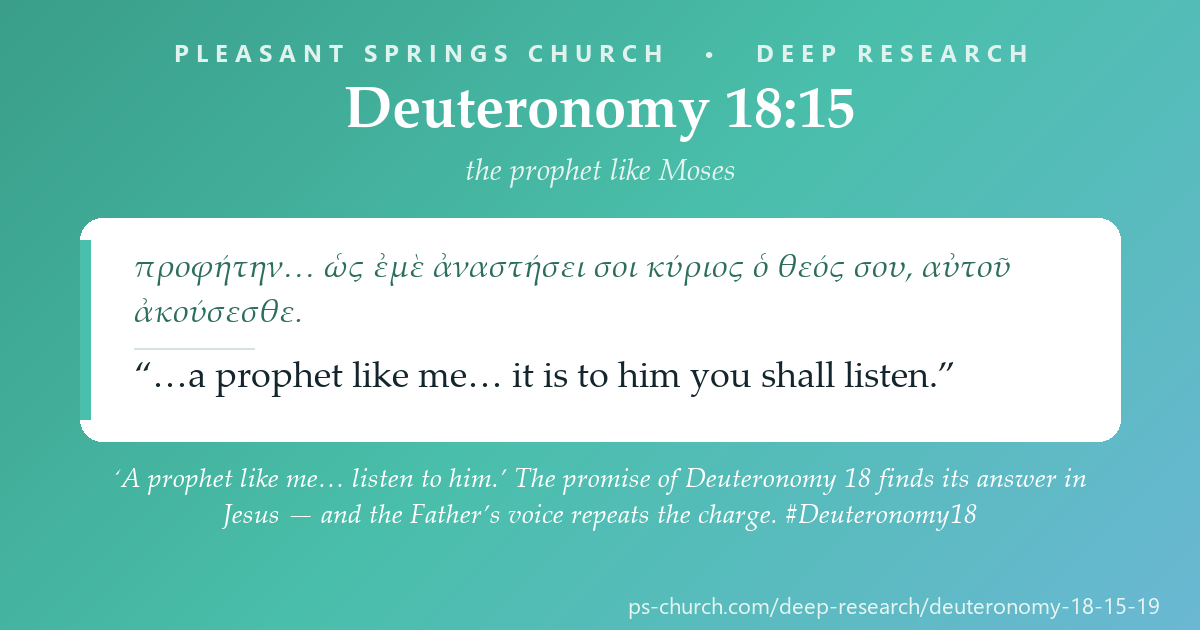
Moses gives Israel a promise to carry through the centuries: “The Lord your God will raise up for you a prophet like me… it is to him you shall listen.” Prophet after prophet came — yet none matched Moses, and the promise leaned forward, unfulfilled. Then Peter, Stephen, and a wondering crowd point to one man; and on a mountain the Father’s own voice repeats the charge: “listen to him.” This study works Deuteronomy 18 from the promise to its answer in Christ, God’s final word. See the method →
Deuteronomy 18:15–19 (selections)
Hebrew · LXX · ESVThe Shape of the Passage
Parallel panelsDeuteronomy is Moses’ covenant renewal on the plains of Moab (see the Shema). Amid laws about leaders — kings, priests, prophets — comes this promise of a prophet to come.
Author
The Torah of Moses sets this promise within Deuteronomy’s charter for Israel’s leaders. Over against the divination and sorcery of the nations (18:9–14), God provides his own channel of guidance: a prophet who speaks not his own mind but God’s words. The promise is generational — God will keep raising up such prophets — and yet the singular language (“a prophet like me”) and the towering standard of Moses (Deut 34:10, “there has not arisen a prophet since… like Moses”) leave the promise leaning forward, unfulfilled, toward one still greater.
God’s words in a human mouth. The test of a true prophet is that God has put his words in the prophet’s mouth (18:18; cf. 18:20–22). This is the office Jesus claims when he says he speaks only what the Father gives him (John 12:49–50) — the Prophet who is also the Word.
Audience
Israel — a people forbidden the occult arts of Canaan and given instead a living voice: prophets who bring God’s word. They are commanded to listen — and warned that to refuse the true prophet is to answer to God himself (18:19).
How they heard it. As the centuries passed and the prophets fell silent, the promise sharpened into expectation: Israel began to await the Prophet. The Qumran community listed this text among its messianic hopes; Samaritans awaited a Moses-like restorer; the priests and Levites sent to John the Baptist asked, “Are you the Prophet?” (John 1:19, 21). When Jesus fed the five thousand, they said, “This is indeed the Prophet who is to come into the world!” (John 6:14).
Orient on prophecy, the prophet like Moses, and messianic expectation.
Search by topic: prophet, prophecy, prophet like Moses, messianic expectation, Deuteronomy.
Which articles are relevant?
- Anchor Bible Dictionary — “Prophet,” “Prophet like Moses,” “Messiah,” “Deuteronomy.”
- Dictionary of the OT: Pentateuch — “Prophets and Prophecy,” “Moses,” “Deuteronomy,” “Divination.”
- NIDOTTE / TDOT — נָבִיא (nāḇîʾ, prophet), קוּם (qûm, raise up), שָׁמַע (šāmaʿ, listen/obey), דָּבָר (dāḇār, word).
Bibliography surfaced:
- Peter Craigie (NICOT), Daniel Block (NIVAC), J. G. McConville (Apollos) on Deuteronomy.
- Studies of the “prophet like Moses” and its reception at Qumran and in the Gospels and Acts.
- Beale & Carson, Commentary on the NT Use of the OT (Acts 3; 7).
True word versus divination, and the growing hope for the Prophet.
Read the prophetic office against ANE divination, then trace the “prophet like Moses” hope into the Second-Temple world and the Gospels.
Which parallels shed light on religion and worldview?
A word you can trust. The nations sought guidance through omens, mediums, and the dead (Deut 18:9–14). Against all of it, God gives a prophet who speaks his own words — not manipulated knowledge but revelation freely given. The mark of the true prophet is not technique but that God has put his word in the prophet’s mouth, and that the word comes true (18:21–22).
Awaiting the Prophet. After the last of the writing prophets, Israel lived in expectation. Some looked for Elijah’s return (Mal 4:5); some, drawing on Deuteronomy 18, awaited a Moses-like prophet. These hopes were not always tidy or unified, but they were real — and they framed the questions people asked about John the Baptist and Jesus.
- ANE divination and prophecy (Mari letters, omen texts) — the surrounding cultures’ ways of seeking the divine will, which Deuteronomy forbids in favor of the prophetic word.
- 4Q175 (Testimonia); 1QS 9:11 (Dead Sea Scrolls — witnesses, not Scripture) — Qumran cites Deut 18:18–19 and awaits “a prophet and the Messiahs of Aaron and Israel.”
- 1 Maccabees 4:46; 14:41 (Apocrypha — a witness, not Scripture) — decisions deferred “until a trustworthy prophet should arise”: the live expectation of a coming prophet.
- Samaritan expectation of the Taheb — a Moses-like restorer (cf. John 4:19, 25): the “prophet like Moses” hope outside Judaism too.
The New Testament identifies Jesus as the prophet Deuteronomy promised. Peter, preaching in the temple, quotes it directly: “Moses said, ‘The Lord God will raise up for you a prophet like me from your brothers. You shall listen to him in whatever he tells you’” (Acts 3:22) — and Stephen repeats it (Acts 7:37). John records the crowd’s recognition: “This is indeed the Prophet” (John 6:14). Above all, at the Transfiguration the Father’s own voice echoes Deuteronomy’s charge: “This is my beloved Son… listen to him” (Mark 9:7) — Moses and Elijah themselves standing by as the promise passes to the Son. Yet Jesus is more than another prophet in the line: where prophets carried God’s word, he is the Word (John 1:1, 14), and God’s final speech — “in these last days he has spoken to us by his Son” (Heb 1:1–2).
The vocabulary of prophet, God’s word, and the charge to listen.
Watch the prophet “like Moses,” God’s words in his mouth, and the command to listen.
“Prophet” — one called and sent to speak for God; not a fortune-teller but a mouthpiece of the divine word (Exod 7:1–2 makes Aaron Moses’ navi).
“Like me / like you” — a prophet on the pattern of Moses: the mediator who speaks with God and brings his word to the people (cf. Deut 34:10).
“I will put my words in his mouth” — the defining mark of the true prophet; the words are God’s, not the prophet’s own (cf. Jer 1:9; John 12:49).
“You shall listen” — to hear is to heed; the Father echoes this charge over the Son at the Transfiguration (“listen to him”).
How the New Testament reuses the promise:
- Acts 3:22–23; 7:37 — Peter and Stephen quote Deut 18:15,18–19 of Jesus: the prophet to be heeded on pain of judgment.
- John 1:21, 25; 6:14; 7:40 — the expectation of “the Prophet,” recognized in Jesus.
- Mark 9:7; Matthew 17:5; Luke 9:35 — the Transfiguration’s “listen to him,” echoing Deut 18:15.
- Hebrews 1:1–2; John 12:49–50 — God’s final word spoken in the Son, who speaks only what the Father commands.
From Moses to the prophets to the Son who is the Word.
Trace the prophetic office from Moses through the line of prophets to its fulfillment in Christ, God’s final word.
Which cross-references matter?
- Deuteronomy 34:10–12 — “there has not arisen a prophet since in Israel like Moses”: the promise still awaiting its greater fulfillment.
- Exodus 3–4; Jeremiah 1:9 — Moses and the prophets called and given God’s words in their mouths (see Exodus 3).
- Acts 3:22–26; 7:37 — the apostolic proclamation that Jesus is the promised Prophet.
- Mark 9:2–8 — the Transfiguration: Moses and Elijah with Jesus, and “listen to him.”
- Hebrews 1:1–3; 3:1–6 — the Son greater than Moses; God’s final and fullest word.
In Acts, the apostles read Deuteronomy 18 as a direct prophecy of Jesus. Peter’s temple sermon (Acts 3) and Stephen’s defense (Acts 7) both cite it, and both press its warning: the one who will not “listen to” this Prophet will be “destroyed from the people” (Acts 3:23). The point is not that Jesus merely joins the prophetic line, but that he is its climax: Deuteronomy itself concedes no prophet had yet matched Moses (34:10), leaving the promise open; and Jesus surpasses even Moses, for Moses was “faithful… as a servant” while Christ is faithful “as a son” over God’s house (Heb 3:5–6). The prophets spoke God’s words; the Son is the Word made flesh. So the Father’s command at the Transfiguration — “listen to him” — is Deuteronomy 18 fulfilled: the final Prophet has come, and all authority to be heard is his.
The scholarship on the prophet like Moses.
The commentators on Deuteronomy; the studies of the “prophet like Moses” at Qumran and in the NT; Beale & Carson on Acts.
Commentaries & studies:
- Peter C. Craigie (NICOT), Daniel I. Block (NIVAC), J. G. McConville (Apollos) on Deuteronomy.
- Studies of Deut 18 in Second-Temple expectation (4Q175; 1QS 9:11) and in Luke-Acts.
- G. K. Beale & D. A. Carson, eds., Commentary on the New Testament Use of the Old Testament.
Interpretation notes worth keeping:
- Both/and, not either/or. Deuteronomy 18 first establishes the ongoing office of true prophets; the singular language and Moses’ unmatched stature (34:10) then leave it leaning toward one final Prophet — whom the New Testament names as Jesus.
- The test of a prophet (18:20–22) is God’s word truly spoken and fulfilled — the safeguard against the false prophet, and the credential the NT claims for Jesus (John 12:49).
- “Listen to him.” The Transfiguration’s command deliberately echoes 18:15: the authority once given to Moses’ word now rests, finally, on the Son’s.
From the promised Prophet to your own listening.
Name what you learned, why it matters, and one concrete response.
What should we carry away — and do?
- God has spoken — finally, in his Son. The long line of prophets pointed to one who does not merely carry God’s word but is it. To hear Jesus is to hear God.
- “Listen to him.” The Father’s command at the Transfiguration is the whole of discipleship in three words. Everything hangs on heeding the Son.
- Beware counterfeit words. Deuteronomy forbade the occult and the false prophet; we too must test every claimed word against the One God has authenticated in Christ.
Step in response: give the Son the listening Deuteronomy commands — take one thing Jesus plainly says in the Gospels that you have been sidestepping, and obey it this week. To “listen to him” is not to admire but to heed.
Deuteronomy 18:15 · to share
LXX + ESVEvery Deep Research page traces its passage across the whole sweep — the Old Testament, the Second-Temple world between the testaments (historical witnesses, not Scripture), and the New Testament. Follow the thread:
Pleasant Springs Church — Deep Research
Research method after Michael S. Heiser’s Bible Research Method (examine dictionaries → ancient literature → important words → textual connections → academic publications → share), with the Pleasant Springs “Author & Audience” foundation. Scripture set in the Hebrew, the Greek editions named on each page and the ESV (Old Testament), and the Greek New Testament and the ESV (New Testament), per the practice of Pleasant Springs Church. Deuteronomy 18:15–19 research grounded in Craigie, Block, and McConville, with Beale & Carson on Acts; ANE prophecy/divination background; Second-Temple material per the Dead Sea Scrolls (4Q175; 1QS) and 1 Maccabees (read as witnesses, not Scripture).
Scripture quotations marked ESV are from the ESV® Bible (The Holy Bible, English Standard Version®), © 2001 by Crossway, a publishing ministry of Good News Publishers. ESV Text Edition: 2016. Used by permission. All rights reserved. The ESV text may not be quoted in any publication made available to the public by a Creative Commons license, and the ESV may not be translated in whole or in part into any other language. www.esv.org
|
Did this study bless you today? 💚 Give to Support PS Church100% of gifts go to the General Fund — thank you. |