In the Hebrew Bible, the words every man under his vine and under his fig tree stand in exactly two verses of the 23,204 held here: 1 Kings 5:5, the peace of Solomon’s reign, and Micah 4:4, the prophet’s promise for the latter days. When the eulogy of Simon the Hasmonean uses the same picture at 1 Maccabees 14:12, it would be natural to hear Micah in it. Measured in Greek, the eulogy’s words stand with Kings. The Greek of the two canonical verses does not agree, and Simon’s line shares six consecutive words with the Greek of Solomon’s peace — which among the 30,348 Greek Old Testament units screened here is the only other place they stand — and three, his and not, with Micah. These five chapters close the book: Jonathan’s letters to Rome and to Sparta, and an older Spartan letter that claims kinship through Abraham, and Jonathan’s capture; Simon’s rule, opened and closed by an eleven-word sentence about his family that stands nowhere else in that Greek corpus; the bronze decree that makes him high priest until a trustworthy prophet should arise; and his murder at a banquet. The page ends with the whole book’s footprint in the New Testament, all 924 rows of it. 1 Maccabees is not Scripture for us: it is filed with the Apocrypha as a witness, and nothing taught here rests on it. There is no Hebrew 1 Maccabees on this disk and no ESV of it, and the page says what that costs. Previous study: 1 Maccabees 9:1–11:74 → See the method →
1 Maccabees is a history of the Hasmonean family, from Mattathias’s refusal to sacrifice to the accession of his grandson John, written in the manner of the older histories of Israel. It is canonical in the Roman Catholic and Orthodox churches, was printed among the Apocrypha in the Protestant Bibles of the Reformation era, and is absent from the Hebrew Bible. It is not Scripture for us. We read it as a Second-Temple witness — for these chapters, an account of how Judea came to be ruled by priest-princes in the century before the New Testament — and we test everything by the canon.
The distinction is old. Jerome, in his preface to the books of Solomon: As, then, the Church reads Judith, Tobit, and the books of Maccabees, but does not admit them among the canonical Scriptures, so let it read these two volumes for the edification of the people, not to give authority to doctrines of the Church. (NPNF translation, 1893). Pleasant Springs is not bound by Jerome; the sentence is printed because it states the line this library walks.
⚠️ What this page can and cannot measure — read this first.
HELD: the CATSS Greek 1 Maccabees (924 rows, every label parsing) and the rest of the CATSS Greek Old Testament — 30,348 verse units screened, the Odes excluded by house convention, 29,424 of them outside 1 Maccabees; the Greek New Testament (7,927 verses, SBLGNT); the King James Apocrypha of 1769 (924 verses of 1 Maccabees); the Clementine Vulgate (929 verses); the Masoretic Hebrew (23,204 verses), used here only for canonical parallels; and the Greek of Josephus’s Jewish Antiquities in Niese’s edition (Perseus Digital Library).
NOT HELD: any Hebrew 1 Maccabees — Jerome wrote that he had found one (see below); none is on this disk; an ESV of this book, which does not exist for this shelf; a critical apparatus — the Göttingen edition of 1 Maccabees is not held, so no Greek variant on this page is checked against the manuscripts.
CONSEQUENCE: every Hebrew-side screen this shelf owns cannot be run on 1 Maccabees at all. Hebrew appears on this page only for canonical verses (1 Kings 5:5, Micah 4:4, Zechariah 3:10), and any statement about a Semitic original behind the Greek is reported from outside and labelled as such, never measured here.
1 Maccabees 12:1–16:24 — eight verses
Greek: CATSS 1 Maccabees · English: King James Apocrypha (1769) · Latin: Clementine VulgateThe Spartan king’s claim, as 1 Maccabees gives his letter: Spartans and Jews are brothers, of the stock of Abraham. The three words ἐκ γένους Αβρααμ stand in one unit of the 30,348 Greek Old Testament units screened here, this one, and in none of the 7,927 New Testament verses. Josephus’s form of the same letter (Ant. 12.226) says it with other words: ἐκ τῆς πρὸς Ἄβραμον οἰκειότητος. What the page reports is the text’s claim. Whether any Spartan ever made it is a historian’s question — see Stage 2.
VULGATE 12:21 Inventum est in scriptura de Spartiatis, et Judæis, quoniam sunt fratres, et quod sunt de genere Abraham.
Simon’s first words as leader. The eleven words ἐγὼ καὶ οἱ ἀδελφοί μου καὶ ὁ οἶκος τοῦ πατρός μου stand in two units of the 30,348 — here, and in Simon’s last speech at 16:2. That is the frame of the structure diagram below.
VULGATE 13:3 et adhortans dixit : Vos scitis quanta ego, et fratres mei, et domus patris mei, fecimus pro legibus et pro sanctis, prælia, et angustias quales vidimus :
The eulogy opens with the formula of Judges. καὶ ἡσύχασεν ἡ γῆ — and the land had rest — closes four deliverances in each Greek Judges text (3:11, 3:30, 5:31, 8:28). 1 Maccabees uses it five times, and in the three that are about the land of Judah the rest grows longer each time: ἡμέρας ὀλίγας at 7:50, ἔτη δύο at 9:57, πάσας τὰς ἡμέρας Σιμωνος here.
VULGATE 14:4 Et siluit omnis terra Juda omnibus diebus Simonis, et quæsivit bona genti suæ : et placuit illis potestas ejus et gloria ejus omnibus diebus.
Eight consecutive words with Leviticus 26:4 — τὰ γενήματα αὐτῆς καὶ τὰ ξύλα τῶν πεδίων — the covenant blessing, the land shall yield its produce and the trees of the field their fruit (our gloss of the Greek). Tie band 1 among the 29,424 Greek Old Testament units outside 1 Maccabees.
VULGATE 14:8 Et unusquisque colebat terram suam cum pace : et terra Juda dabat fructus suos, et ligna camporum fructum suum.
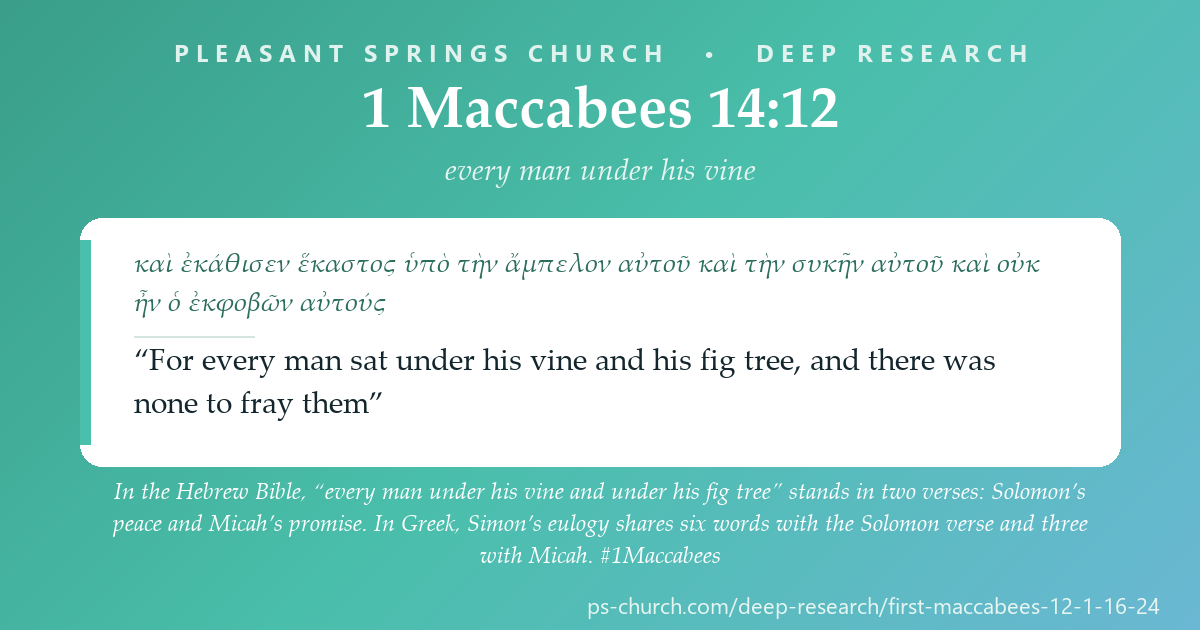
The page’s finding. ἕκαστος ὑπὸ τὴν ἄμπελον αὐτοῦ καὶ: six consecutive words with 3 Kingdoms 2:46g, the Greek of Solomon’s peace, and with no other unit (band 1); three with Micah 4:4; one with Zechariah 3:10. The clause after it, καὶ οὐκ ἦν ὁ ἐκφοβῶν, past tense, stands elsewhere only at Nahum 2:12. To fray is the KJV’s word for to frighten. See Stage 4.
VULGATE 14:12 Et sedit unusquisque sub vite sua, et sub ficulnea sua : et non erat qui eos terreret.
Until a trustworthy prophet should arise (our gloss; the KJV reads a faithful prophet). ἕως τοῦ ἀναστῆναι προφήτην πιστὸν — each three-word piece of it stands in this unit alone among the 30,348. Against Deuteronomy 18:15 the run is one word (προφήτην). The Latin: donec surgat propheta fidelis. The page measures the clause; it identifies no one.
VULGATE 14:41 et quia Judæi et sacerdotes eorum consenserunt eum esse ducem suum, et summum sacerdotem in æternum, donec surgat propheta fidelis :
Simon’s last speech, to his sons — the same eleven words as 13:3. ἐγὼ καὶ οἱ ἀδελφοί μου καὶ ὁ οἶκος τοῦ πατρός μου. Fourteen verses later he is dead. The Latin carries the echo too: ego, et fratres mei, et domus patris mei stands in its 13:3 and its 16:2.
VULGATE 16:2 Et vocavit Simon duos filios seniores, Judam et Joannem, et ait illis : Ego, et fratres mei, et domus patris mei expugnavimus hostes Israël ab adolescentia usque in hunc diem : et prosperatum est in manibus nostris liberare Israël aliquoties.
The book ends on the closing formula of a king, given to a high priest. ἰδοὺ ταῦτα γέγραπται ἐπὶ βιβλίῳ stands in two units of the 30,348: here and 4 Kingdoms 8:23. The book it names, βιβλίῳ ἡμερῶν ἀρχιερωσύνης αὐτοῦ, is named nowhere else: even βιβλίῳ ἡμερῶν stands in one unit.
VULGATE 16:24 ecce hæc scripta sunt in libro dierum sacerdotii ejus, ex quo factus est princeps sacerdotum post patrem suum.
On the columns. No ESV of 1 Maccabees exists for this shelf to print, and none is named for it. The English under every Greek row is the King James Apocrypha, standardised 1769 text, public domain, quoted verbatim from the verse-per-line file held on this disk, KJV spelling and all — and the self-check compares every English line to that file character for character. It is quotation, not a licensed parallel measured against the Greek, and where the KJV reads something the Greek file does not, the page says so (Stage 5). The Latin is the Clementine Vulgate, a fourth witness with its own verse count, never a source for the English.
Versification — stated, as on every page here, and here it is the third state: no Masoretic text and no ESV exist for this book, so there is no MT/LXX/ESV offset to report. What exists is three witnesses, and every count below was made on the files.
• Greek (CATSS 1 Maccabees): 924 verse rows in 16 chapters; this passage is 220 rows — 53 / 53 / 49 / 41 / 24. Every label is a plain chapter:verse.
• English (KJV Apocrypha, 1769): 924 verses, the same count as the Greek in all sixteen chapters.
• Latin (Clementine Vulgate): 929 verses. In this passage it has 54 in chapter 12 and 54 in chapter 13 where the Greek has 53 and 53: it divides Greek 12:53 into two verses (12:53–54) and Greek 13:52 into two (13:52–53), so Vulgate 13:54 = Greek 13:53. Chapters 14–16 agree in count. (Outside this passage it also differs in chapter 1, 67 against 64.)
⚠️ Equal counts are not equal divisions. Aligned by content, the KJV puts a clause on the other side of a verse boundary from the Greek in four places here: 14:26/27 (the bronze tablets set up on Mount Zion close Greek 14:26 and open KJV 14:27), 14:27/28 (the place-name Asaramel closes Greek 14:27; KJV 14:28 opens “At Saramel”), 14:42/43 (the repeated clause about the sanctuary opens Greek 14:43 and closes KJV 14:42), and 15:35/36 (“Athenobius answered him not a word” opens Greek 15:36 and closes KJV 15:35). The Latin agrees with the Greek at the first three and with the KJV at the fourth, and has seams of its own at 14:19/20, 14:24/25, 14:28/29 and 15:40/41. Every verse quoted on this page was checked for its own alignment; the eight in the panel above sit wholly inside their labels in all three witnesses.
Canonical comparison verses carry their own offsets, stated where they occur: Greek 3 Kingdoms 2:46g carries the line of Hebrew 1 Kings 5:5 (English 4:25); Greek Nahum 2:12 is English Nahum 2:11; Greek Psalm 71 is English Psalm 72; Greek Psalm 105:31 is English Psalm 106:31; and Old Greek Daniel 4:29 (after twelve months, the king walking) answers by content to Aramaic Daniel 4:26, English 4:29.
The Shape of the Passage
Inclusio (measured) around a sequenceThis is NOT offered as a chiasm. Nothing pairs the deeds of chapter 13 with the letters of chapter 15, or the eulogy with the decree; the inside of the frame is a sequence, labelled 1–6 as a sequence. What the text does mark inside it is documents: the greeting χαίρειν closes the salutation of six letters in these five chapters (12:6, 12:20, 13:36, 14:20, 15:2, 15:16), and the decree of 14:27–45 makes a seventh document without one.
⚠️ Where this page sits. 1 Maccabees is canonical in the Roman Catholic and Orthodox churches, printed among the Apocrypha in the older Protestant Bibles, and absent from the Hebrew Bible. This library reads it as a Second-Temple witness and files it under Apocrypha / Deuterocanon. Nothing taught at Pleasant Springs rests on it.
Author
Anonymous, and with wording the Greek Kingdoms also carries. The book’s last two verses carry the regnal formula of Kingdoms and Chronicles (καὶ τὰ λοιπὰ τῶν λόγων, 35 units of the 30,348, all but this one in Kingdoms or Chronicles), and its line and the land had rest is the formula of Judges. Measured as wording; what the writer meant by it is not measurable.
Close to the family. The book ends with John succeeding his murdered father and points to the book of the days of his high priesthood for the rest. It is commonly read as written under John or soon after him, late in the second century BC; nothing on this page tests that date.
Perhaps in Hebrew first. Jerome, in the preface printed before Samuel and Kings: Macchabeorum primum librum hebraicum repperi, secundus graecus est, quod et ex ipsa frasin probari potest. — “The first book of Maccabees I have found to be Hebrew, the second is Greek, as can be proved from the very style.” (NPNF, 1893). No such Hebrew is held here, so every word measured on this page is Greek.
Audience
Judeans living under the new house. The decree of 14:27–45 is set before the reader as a public document — bronze tablets on Mount Zion, copies laid up in the treasury so that Simon and his sons might have them (14:49). The book prints its documents: the noun ἀντίγραφον, copy, stands twelve times in 1 Maccabees and 21 times in the whole screened Greek Old Testament.
Readers who knew their Scriptures. The eulogy of 14:4–15 shares runs of five to eight words with Leviticus 26, the Greek Kingdoms, a psalm headed for Solomon, Isaiah 49 and the Old Greek of Daniel 4 — each with exactly one other unit of the Greek Old Testament (Stage 4). That is a fact about wording. Whether a first reader heard those passages is not something a screen can tell.
And readers who knew how it ended. Simon was killed at a feast by his own son-in-law (16:16). The book tells it in four plain verses and does not dwell on it, and neither does this page.
Orient on the book, on Simon, and on the Spartan letters.
Search by topic: 1 Maccabees; Simon (Maccabee); Jonathan (Maccabee); Hasmoneans; Sparta and the Jews; Areus; Tryphon; Antiochus VII Sidetes; John Hyrcanus; ethnarch.
Which articles are relevant?
- Anchor Bible Dictionary — the entries on the books of Maccabees, on Simon and Jonathan, on the Hasmoneans, and on Sparta.
- Eerdmans Dictionary of Early Judaism — the entries on 1 Maccabees, the Hasmoneans and John Hyrcanus.
- Dictionary of New Testament Background (IVP) — the entries on the Maccabean literature and on the Hasmoneans.
- On the Spartan letters — any article that keeps three things apart: what 1 Maccabees says the letters said, what Josephus says they said, and what a historian thinks happened. This page measures the first two and reports the third.
Bibliography surfaced:
- Jonathan A. Goldstein, I Maccabees (Anchor Bible 41, 1976).
- John R. Bartlett, The First and Second Books of the Maccabees (Cambridge Bible Commentary, 1973).
- Erich Gruen, “The Purported Jewish–Spartan Affiliation” (1996) — on the letters of 1 Maccabees 12 and 14. Named as the place to start; its argument is not summarised here because it was not read for this page.
- NETS (A New English Translation of the Septuagint) — 1 Maccabees. Not the English quoted on this page; named as the obvious next step for a reader who wants a modern rendering of the Greek printed here.
Josephus tells the same story in other words, and some details of his are not in 1 Maccabees at all.
Josephus’s Jewish Antiquities, books 12–13, in Niese’s Greek: 867 sections (the book-level summaries excluded). Every 1 Maccabees row of this passage was screened against all of them, with the same run engine and the same normaliser as every other screen on this page.
Josephus, measured:
He tells the same events, and almost never in the same words. Against the 867 sections, the 220 rows of 12:1–16:24 give: 214 reach two, 119 reach three, 31 reach four, two reach five, one reaches six, and nothing reaches seven — and the one six, 15:5, οἱ πρὸ ἐμοῦ βασιλεῖς καὶ ὅσα (the kings before me, and whatever), meets that phrase in another king’s letter, at 13.128, not in Josephus’s account of Antiochus son of Demetrius.
The Spartan letter of 12:20–23 and Josephus’s form of it (Ant. 12.225–227) share at most two consecutive words. Jonathan’s letter (12:6–18 against Ant. 13.166–170) reaches four. Josephus’s version of the Spartan king’s letter carries three things 1 Maccabees does not: a bearer, Δημοτέλης ὁ φέρων τὰ γράμματα; a note that the writing is square; and a seal, ἀετὸς δράκοντος ἐπειλημμένος — an eagle gripping a serpent. And he dates it: he sets the letter in the reign of Σέλευκος ὁ Σωτὴρ ἐπικαλούμενος υἱὸς ὢν Ἀντιόχου τοῦ μεγάλου (12.223), under an Onias who had succeeded his father Simon (12.224–225).
He carries neither the eulogy nor the decree in their words. The twelve rows of 14:4–15 reach at most three against Josephus; the decree and its adoption, 14:27–49, reach at most four. But he has their substance in his own words: Σίμων δὲ κατασταθεὶς ἀρχιερεὺς ὑπὸ τοῦ πλήθους — Simon, appointed high priest by the people (13.213) — and, of Simon’s time, εὐτύχησαν γὰρ ἐπʼ αὐτοῦ σφόδρα καὶ τῶν ἐχθρῶν τῶν περιοίκων ἐκράτησαν — for they prospered greatly under him, and overcame the enemies round about (13.214; both glosses ours). In books 12–13 there is no fig tree at all — the one word that begins like it is the place-name Sycaminum (13.332) — and the vine appears in three sections, all in book 12 and none in his account of Simon. There is no “trustworthy prophet”.
But Josephus does say something about John and prophecy. Of John Hyrcanus — the John with whom 1 Maccabees ends — he writes that God judged him worthy of three things: ἀρχῆς τοῦ ἔθνους καὶ τῆς ἀρχιερατικῆς τιμῆς καὶ προφητείας — rule of the nation, the high-priestly honour, and prophecy (Ant. 13.299). The page sets that sentence beside 14:41 and draws no line between them. They are two writers’ statements about one family, and neither cites the other.
Which other parallels shed light on the world of the text?
- 2 Maccabees 5:9 — the deposed high priest Jason flees πρὸς Λακεδαιμονίους ἀναχθεὶς ὡς διὰ τὴν συγγένειαν τευξόμενος σκέπης — to the Lacedaemonians, hoping for shelter on account of the kinship (our gloss). The only Lacedaemon- word in the 30,348 screened units. 1 Maccabees calls the city and its people Sparta and Spartans, ten times, and no other book of the screened Greek Old Testament uses either word. Two Greek books, two names for one people, one claim of kinship.
- Kinship as diplomacy. Claims of shared descent between cities and peoples are commonly read as a familiar Hellenistic diplomatic courtesy, and the Spartan letters as an instance of it. Reported, not measured.
- Areus. The king of 12:7 and 12:20 is commonly identified with Areus I of Sparta, usually dated 309–265 BC. That identification and Josephus’s dating cannot both be right — Josephus sets the letter in the reign of a Seleucus son of Antiochus the Great, well over half a century later. The page reports the conflict and does not choose.
- The Kingdoms histories. The closing formula of 16:23–24 and the land-rest formula of 14:4 are measured in Stage 4; the battle-and-burial idiom of the earlier chapters is on the previous study.
The text says it plainly. In the letter 1 Maccabees gives to the Spartan king, it has been found in writing concerning the Spartans and the Jews that they are brothers and that they are of the stock of Abraham (12:21). Jonathan’s own letter calls them brothers and asks to renew the brotherhood (12:10, 12:17), and the Spartans’ reply to Simon greets the Jews as brothers (14:20).
The page does not say whether the claim is true, who made it first, or why. No writing that makes Spartans descendants of Abraham is held here or quoted anywhere in these chapters; the letter says only that one was found. Historians have argued it several ways, and Stage 1 names where to read them.
Brothers, Spartans, the one who terrifies, a trustworthy prophet, and the titles.
Every count below is over the files held on this disk — 30,348 Greek Old Testament verse units, the Odes excluded, and the 7,927 verses of the Greek New Testament — on normalised word forms. It is not a count over “the Septuagint”, and the page says so each time.
Seven occurrences in the screened Greek Old Testament: two in 1 Maccabees (12:10, 12:17), both in Jonathan’s letter to Sparta, and the rest in 4 Maccabees. In the Greek New Testament it stands two times, both in 1 Peter (2:17, 5:9), of the church. A diplomatic word in one book, a family word in another.
Ten occurrences of Sparta and Spartans in the screened Greek Old Testament, every one in 1 Maccabees. 2 Maccabees uses the other name, Lacedaemonians, one time (5:9). Zero in the Greek New Testament. The KJV prints Lacedemonians in all eight verses where the Greek has Spartans, and Sparta only where the Greek names the city (14:16).
The one who terrifies with its article stands in eight units of the screened Greek Old Testament. In four it is a promise, there shall be none, in the same four words (Micah 4:4, Zephaniah 3:13, Ezekiel 34:28, 39:26), and Leviticus 26:6 promises it with you between. In two it is past, there was none, in four words — Nahum 2:12, of a lions’ den, and 1 Maccabees 14:12, of Judea under Simon — and Judith 16:25, the last verse of Judith, has the past with any longer between. The Hebrew at the same place in Micah 4:4, וְאֵין מַחֲרִיד, stands in twelve verses of the Masoretic text. Zero in the Greek New Testament.
The two words stand together in one unit of the screened Greek Old Testament, 14:41, and in no New Testament verse. The word prophet stands in four rows of 1 Maccabees: 4:46 (the defiled altar stones put away until a prophet should come), 9:27 (distress such as had not been since the day a prophet ceased to appear to them), 9:54 (the works of the prophets, which Alcimus pulls down along with the wall of the inner court), and 14:41.
Three occurrences in the screened Greek Old Testament, all in 1 Maccabees (14:47, 15:1, 15:2) — Simon’s title. The Greek New Testament has it one time: 2 Corinthians 11:32, the ethnarch under King Aretas who guarded Damascus to seize Paul. In Josephus’s books 12–13 it stands one time, of Simon (13.214).
13 occurrences in the screened Greek Old Testament: five in 1 Maccabees, the rest in 2 and 4 Maccabees — and the last verse of 1 Maccabees names a book after it: the book of the days of his high priesthood. Zero in the Greek New Testament, which speaks of high priests a great deal and never uses this word for the office.
Counted here, not assumed:
- The greeting χαίρειν closes the salutation of six letters in these five chapters and ten in the whole book — 10 of the 26 in the screened Greek Old Testament. The Greek New Testament has the word seven times, and three of them open a letter (Acts 15:23, 23:26; James 1:1). No other book of the screened Greek Old Testament has as many; 2 Maccabees comes next with seven.
- καὶ τοῦτο τὸ ἀντίγραφον — and this is the copy — stands in five units of the screened Greek Old Testament, all of them 1 Maccabees (8:22, 12:5, 12:19, 14:20, 14:27).
- τὰ βιβλία τὰ ἅγια — the holy books — stands in one unit, 12:9, where Jonathan tells the Spartans the Jews need no allies, having for encouragement the holy books that are in our hands. No New Testament verse has the phrase.
- The three verses about an absent prophet barely share a word. 14:41 against 4:46: one; 14:41 against 9:27: one; 4:46 against 9:27: two, in the. Each verse puts its own words round the absence: μέχρι τοῦ παραγενηθῆναι προφήτην (until a prophet should come), οὐκ ὤφθη προφήτης αὐτοῖς (a prophet was not seen among them), ἕως τοῦ ἀναστῆναι προφήτην πιστὸν.
Under whose vine? Then the frame, the prophet, the formula — and the New Testament, for the whole book.
Every row of 12:1–16:24 was screened against the 29,424 Greek Old Testament units outside 1 Maccabees and against all 7,927 verses of the Greek New Testament. Contiguous runs of whole word forms; the tie band — how many target verses reach the same depth — is printed beside every run, and for the New Testament runs the band is given both ways: how many New Testament verses the 1 Maccabees row reaches, and how many Greek Old Testament units the New Testament verse reaches. The two target corpora are not the same size, so the two distributions below are not a like-for-like comparison.
Under whose vine? The line in Hebrew, in Greek, and in 1 Maccabees:
In Hebrew, Kings and Micah carry the line identically. The five words אִישׁ תַּחַת גַּפְנוֹ וְתַחַת תְּאֵנָתוֹ stand in two of the 23,204 verses of the Masoretic text held here — 1 Kings 5:5, of Solomon’s reign, and Micah 4:4, of the latter days. Zechariah 3:10 has the same picture in other grammar.
In Greek they part. Greek Micah puts the vine in the genitive under ὑποκάτω, with no article. Greek Kingdoms puts it in the accusative under ὑπὸ τὴν, with the article — and it does so not at 5:5, where the Hebrew has the verse, but among the lettered rows that close chapter 2 (2:46a–l): the CATSS file of 3 Kingdoms, numbered like the Hebrew, has no row 4:20 and no rows 5:5–8 (English 4:20 and 4:25–28), and the line stands at 2:46g, with the same from Dan to Beersheba, all the days of Solomon that the Hebrew 5:5 has.
| verse | the line | English | run with 1 Macc 14:12 |
|---|---|---|---|
| 1 Kings 5:5 Hebrew; English 4:25 | אִישׁ תַּחַת גַּפְנוֹ וְתַחַת תְּאֵנָתוֹ | each under his vine and under his fig tree (our gloss) | — (Hebrew) |
| Micah 4:4 Hebrew | אִישׁ תַּחַת גַּפְנוֹ וְתַחַת תְּאֵנָתוֹ | the same five words | — (Hebrew) |
| 3 Kingdoms 2:46g the Greek of 1 Kings 5:5 | ἕκαστος ὑπὸ τὴν ἄμπελον αὐτοῦ καὶ ὑπὸ τὴν συκῆν αὐτοῦ | each under his vine and under his fig tree (our gloss) | 6 · band 1 |
| Micah 4:4 Greek | ἕκαστος ὑποκάτω ἀμπέλου αὐτοῦ καὶ ἕκαστος ὑποκάτω συκῆς αὐτοῦ καὶ οὐκ ἔσται ὁ ἐκφοβῶν | ESV: but they shall sit every man under his vine and under his fig tree, and no one shall make them afraid, for the mouth of the Lord of hosts has spoken. | 3 |
| Zechariah 3:10 Greek | ὑποκάτω ἀμπέλου καὶ ὑποκάτω συκῆς | ESV: In that day, declares the Lord of hosts, every one of you will invite his neighbor to come under his vine and under his fig tree.” | 1 |
| 4 Kingdoms 18:31 · Isaiah 36:16 Greek; the Rabshakeh’s offer | τὴν ἄμπελον αὐτοῦ καὶ | his vine and (our gloss) — 4 Kingdoms: a man will drink his vine; Isaiah: you will eat, each, his vine (our glosses), an enemy’s promise | 4 each |
| Nahum 2:12 Greek; English 2:11 | καὶ οὐκ ἦν ὁ ἐκφοβῶν | ESV 2:11: Where is the lions' den, the feeding place of the young lions, where the lion and lioness went, where his cubs were, with none to disturb? | 5 |
| 1 Maccabees 14:12 | καὶ ἐκάθισεν ἕκαστος ὑπὸ τὴν ἄμπελον αὐτοῦ καὶ τὴν συκῆν αὐτοῦ καὶ οὐκ ἦν ὁ ἐκφοβῶν αὐτούς | KJV: “For every man sat under his vine and his fig tree, and there was none to fray them:” | — |
And 1 Maccabees 14:12 stands with Kingdoms. ἕκαστος ὑπὸ τὴν ἄμπελον αὐτοῦ καὶ: six consecutive words with 3 Kingdoms 2:46g, band 1 among the 29,424 Greek Old Testament units outside 1 Maccabees, and across the whole screened corpus ὑπὸ τὴν ἄμπελον αὐτοῦ stands in exactly two units, these two. Zero in the New Testament. Against Micah 4:4 the run is three, and the three words are αὐτοῦ καὶ οὐκ — his and not. Against Zechariah 3:10 it is one.
The second half goes the other way. καὶ οὐκ ἦν ὁ ἐκφοβῶν αὐτούς — and there was none to terrify them. That is the prophets’ idiom (Stage 3), and in the past tense, word for word, it stands at only one other place (Judith 16:25 has it with any longer inside it), Nahum 2:12 — a run of five. So on the measurement, the first half of Simon’s line has the words of Kings and the second has the idiom of the prophets.
⚠️ What this cannot show. The difference between a Kings-like and a Micah-like line exists only in Greek: in Hebrew the two verses are identical. So whatever produced the Greek wording of 14:12, the difference this page measures belongs to the Greek, and the page cannot say how it came about. It does not say whose vine Simon’s people sat under. It says where else in the screened Greek corpora the words of 14:12 stand.
The eulogy’s other partners — and the page’s counter-example:
Twelve rows, 14:4–15. Five of them share a run of five or more words with exactly one other unit of the Greek Old Testament outside 1 Maccabees.
- 14:8 → Leviticus 26:4 — eight words, band 1. τὰ γενήματα αὐτῆς καὶ τὰ ξύλα τῶν πεδίων — the covenant blessing.
- 14:12 → 3 Kingdoms 2:46g — six words, band 1. Solomon’s peace (above).
- 14:10 → Psalm 71:19 (English 72:19) — five words, band 1. τὸ ὄνομα τῆς δόξης αὐτοῦ — the name of his glory, said in the psalm of God, in a psalm the Greek heads εἰς Σαλωμων, for Solomon; in 1 Maccabees, said of Simon.
- 14:14 → Isaiah 49:13 — five words, band 1. τοὺς ταπεινοὺς τοῦ λαοῦ αὐτοῦ — the humble of his people, whom in Isaiah God comforts; in 1 Maccabees, whom Simon strengthens.
- 14:5 → Daniel 4:29 (Old Greek) — five words, band 1. μετὰ πάσης τῆς δόξης αὐτοῦ — with all his glory, of Nebuchadnezzar walking on the walls of the city, shortly before his fall.
- And 14:4 opens on a formula, not a partner: thirteen units carry and the land had rest — five in 1 Maccabees and eight in the two Greek Judges texts. The row’s tie band of 21 is not the formula alone: eight of the 21 are those Judges units, one is 2 Chronicles 13:23 (the land of Judah had rest, in Asa’s days), ten share his … all the days, and two reach four on the words of and his glory.
Is that a lot? Across the other 208 rows of these five chapters, 23 reach five or more at band 1, so the eulogy holds five of the passage’s 28 in twelve of its 220 rows. That is a count, not a statistical test, and the page does not dress it as one. Two of the five partners stand in passages about Solomon (3 Kingdoms 2:46g, and a psalm headed for him), and two speak of God where the eulogy speaks of Simon; the page reports both facts and asserts no intention behind either.
⚠️ The counter-example. 13:24 shares six words with Exodus 18:27, band 1: καὶ ἀπῆλθεν εἰς τὴν γῆν αὐτοῦ — and he went away into his own land. Tryphon going home after killing Jonathan; Moses’s father-in-law going home after a visit. The six words stand in three units (1 Maccabees 10:13, 13:24, Exodus 18:27). A band-1 run of six that means nothing at all — printed so that the eulogy’s runs are not read as more than they are.
The frame — one sentence about a family:
The deepest Greek Old Testament run anywhere in these chapters is ten words, band 2: 14:26, the people’s third-person sentence just before the copy of the decree, against 1 Kingdoms 22:1 (David’s brothers and his father’s house come down to him at Adullam) and Judges 16:31 in the B text (Samson’s brothers and his father’s house come down to bury him). Next come 13:3 and 16:2, nine words each against Genesis 46:31, band 1. Three runs of nine or ten, all of them the same family phrase.
Simon’s own eleven-word form stands in two units of the 30,348 — 13:3 and 16:2 — and in no New Testament verse. That is the frame of the structure diagram. Its nine-word core is shared with Joseph’s words at Genesis 46:31; the eleven words as Simon says them stand nowhere else.
The trustworthy prophet (14:41) — measured, and nothing identified:
Every three-word piece of ἕως τοῦ ἀναστῆναι προφήτην πιστὸν stands in 14:41 alone among the 30,348 units, and the row’s deepest run against the Greek Old Testament outside 1 Maccabees is three words, band 338 — and that band is almost entirely two common phrases: 296 of the 338 units meet it at for ever and 36 at and the priests.
Against Deuteronomy 18:15 the run is one word, προφήτην; against 18:18, also one: prophet again, which opens that verse too. Acts 3:22 and 7:37 do quote Deuteronomy 18:15 — Acts 3:22 opens Μωϋσῆς μὲν εἶπεν ὅτι, Moses said — and they share three words with it; with 1 Maccabees 14:41 they share one.
A high priest “for ever”. 14:41 makes Simon ἀρχιερέα εἰς τὸν αἰῶνα, and Hebrews 6:20 calls Jesus ἀρχιερεὺς γενόμενος εἰς τὸν αἰῶνα. The run is three, for ever — a phrase in 300 of the 30,348 screened Greek Old Testament units and 27 New Testament verses. The idea is nearer than the words, and the page does not connect them.
The church’s view, labelled as such: Pleasant Springs reads the prophet like Moses through the New Testament’s own citations of Deuteronomy 18 (Acts 3:22; 7:37), and reads the high priest for ever through Psalm 110 as Hebrews cites it. 1 Maccabees 14:41 is part of neither reading. It records what Simon’s people decided and the limit they set on it, and this page leaves it there.
The closing formula — Judas’s deeds “not written”, John’s “written”:
16:23 opens with the regnal formula καὶ τὰ λοιπὰ τῶν λόγων, which stands in 35 units of the screened Greek Old Testament — this one and 34 in Kingdoms and Chronicles. 16:24 closes with ἰδοὺ ταῦτα γέγραπται ἐπὶ βιβλίῳ, in two units: here and 4 Kingdoms 8:23, of Joram of Judah (a run of five, band 1). The commoner form, all but one of them in Kingdoms (the other is 2 Chronicles 36:8), οὐκ ἰδοὺ ταῦτα γεγραμμένα, are they not written, stands in 17.
The previous study’s chapter has the same formula turned inside out. 9:22, after Judas falls: καὶ τὰ περισσὰ τῶν λόγων … οὐ κατεγράφη πολλὰ γὰρ ἦν σφόδρα — the rest… was not written, for it was very much. Its word for the rest makes a phrase found in one unit of the 30,348, 9:22 itself; 16:23 against 9:22 is a run of three, and of the wars. Judas’s deeds are too many to write; John’s are written, in a book named after his priesthood.
The New Testament — these five chapters, both ways:
220 rows against 7,927 verses: 217 reach two, 168 reach three, 44 reach four, three reach five, one reaches six, and nothing reaches seven. Against the 29,424 Greek Old Testament units outside 1 Maccabees the same rows give, counting each depth or deeper, 217 at two, 203 at three, 112 at four, 39 at five, 13 at six, five at seven, four at eight, three at nine and one at ten.
The deepest: 16:21 → Mark 3:31, six words, band 1. ὁ πατὴρ αὐτοῦ καὶ οἱ ἀδελφοὶ αὐτοῦ καὶ — his father and his brothers and, of Simon and his murdered sons; ἡ μήτηρ αὐτοῦ καὶ οἱ ἀδελφοὶ αὐτοῦ καὶ — his mother and his brothers and, standing outside the house. And from the other side the band is also 1: Mark 3:31’s deepest run with any unit of the screened Greek Old Testament is this one, and the six words stand in one Greek Old Testament unit and one New Testament verse.
⚠️ It is unique on both sides, and five of its six words are grammar. The shared words are his, and, the, brothers, his, and; the one noun is brothers, and the depth comes from the two his on either side of a common phrase — one belongs to a father, the other to a mother. Drop the first his and the five words left stand in 11 Greek Old Testament units. Uniqueness is not meaning. This is the page’s second counter-example, and the more instructive of the two.
- 12:52 → Mark 5:40 — five words, band 1 (and those with him and); from Mark’s side, band 2 — 1 Maccabees 9:60 and 12:52.
- 14:26 → Mark 3:31 and Luke 8:19 — five words, band 2 (and his brothers and) — a phrase in 11 Greek Old Testament units, six of them in 1 Maccabees. From Luke 8:19’s side the deepest Greek Old Testament run is five words, band 11, the same 11 units; Mark 3:31’s deepest is 16:21 (above).
- 14:12, the vine and fig tree — three words at most, band 6. Against John 1:48, where Nathanael is seen ὑπὸ τὴν συκῆν, under the fig tree, the run is two: under the.
- 12:21, the stock of Abraham — two words at most, band 49. One of the 49 is Acts 13:26, υἱοὶ γένους Ἀβραὰμ, sons of the stock of Abraham, Paul’s address in the synagogue at Pisidian Antioch. From the other side, Acts 13:26’s deepest Greek Old Testament run is three words, band 13, and 12:21 is not among them.
- The whole eulogy, 14:4–15 — four words at most, and the fours are everyday phrases: upon the earth and (14:11, 14:13; 45 screened Greek Old Testament units, six New Testament verses), and at 14:13 also in those days (53 and six) and of the earth and the (four and two). None of the five partner phrases the eulogy shares with the Greek Old Testament stands in any New Testament verse.
The whole book against the New Testament — the closing summary for 1 Maccabees:
All 924 rows against all 7,927 verses: 913 reach two, 675 reach three, 191 reach four, 29 reach five and three reach six (each count includes the deeper rows) — no row stops at seven or at eight; one of the three goes on to nine.
| 1 Maccabees | rows | reach four | reach five | deepest |
|---|---|---|---|---|
| 1–4 | 255 | 50 | 7 | 6 — 2:69 → Acts 13:36 |
| 5–8 | 213 | 48 | 9 | 5 — nine rows tie |
| 9–11 | 236 | 49 | 10 | 9 — 11:1 → Hebrews 11:12 |
| 12–16 (this page) | 220 | 44 | 3 | 6 — 16:21 → Mark 3:31 |
| whole book | 924 | 191 | 29 | 1 row reaches nine; no row stops at seven or eight |
The nine: 11:1 → Hebrews 11:12, band 1 both ways. ὡς ἡ ἄμμος ἡ παρὰ τὸ χεῖλος τῆς θαλάσσης — as the sand by the lip of the sea — of an Egyptian army in 1 Maccabees, of Abraham’s descendants in Hebrews. The nine words stand in one unit of each corpus. The depth is grammar: the core παρὰ τὸ χεῖλος τῆς θαλάσσης stands in five Greek Old Testament units, and the promise to Abraham at Genesis 22:17 has the sand in the accusative, so Hebrews 11:12 meets Genesis at five words and meets 1 Maccabees at nine because both put it in the nominative. The previous study measures this in full.
The six-word runs: 2:69 → Acts 13:36 (and he was added to his fathers, band 1; from Acts’ side band 2, with Bel 1 in Theodotion’s text) and 16:21 → Mark 3:31 (above). The one row with a citation on the New Testament side: 2:52 → Romans 4:3, Galatians 3:6, James 2:23 — five words, band 3. Romans 4:3 opens τί γὰρ ἡ γραφὴ λέγει — what does the Scripture say? — and from Romans’ side its deepest Greek Old Testament partner is Genesis 15:6, at seven words, band 1, and so it is for Galatians 3:6 and James 2:23. The citation points to Genesis, and so does the measurement from Romans’ side. From 1 Maccabees’ side it does not choose: 2:52’s deepest Greek Old Testament run, five words, ties at band two between Genesis 15:6 and Psalm 105:31 (English 106:31, of Phinehas), and 2:52 carries no citation formula.
On this corpus, with this screen, no New Testament verse reads as a citation of 1 Maccabees. Across all 924 rows the deepest contacts are a nominative simile, a death idiom, a family phrase that is five-sixths grammar, and a clause Romans cites from Genesis 15:6, which 1 Maccabees 2:52 shares equally with Genesis 15:6 and Psalm 105:31. It does not settle that the book was unread. A screen for verbatim contact cannot see a shared memory: John 10:22 names τὰ ἐγκαίνια, the Feast of Dedication, which is commonly identified with the feast 1 Maccabees 4:59 sets up — and the two verses share two words, in the. The connection is visible to a reader, not to a run engine.
What this page could not check, where it is weakest, and what the KJV reads that the Greek does not.
This is the section that makes the shelf trustworthy. It is long because the honest list is long.
⚠️ What this page could NOT check:
- Any Hebrew 1 Maccabees. Jerome reports one; none is held. So the central finding — that the Greek of 14:12 stands with Kingdoms rather than Micah — cannot be traced behind the Greek. In Hebrew the two canonical verses are identical, and the page says so beside the finding.
- The manuscripts. The CATSS file is Rahlfs’s text. The Göttingen edition of 1 Maccabees and its apparatus are not held, so no Greek variant is checked — including at 12:7 and 12:19, where the KJV reads names the Greek file does not (below).
- Which Greek the 1611 translators read. Not held. The KJV readings listed below are reported as readings, with no explanation offered for them.
- Whether the Spartan letters are genuine, who first claimed the kinship, and whether Areus I is meant. Reported from outside, and the conflict between that identification and Josephus’s dating is printed rather than resolved.
- Josephus beyond books 12–13. Only Niese’s Greek of those two books was screened. His Jewish War was not.
- Allusion. The screen finds verbatim contact. A run of one is not proof that a writer did not know a text, and a run of six is not proof that one did.
⚠️ What the KJV reads that the Greek file does not — reported, not explained:
- 12:7 — Greek παρὰ Ἀρείου, Latin ab Ario; the KJV: from Darius.
- 12:19 — Greek ὧν ἀπέστειλαν Ονια, which they sent to Onias; Latin quod miserat Oniæ; the KJV: which Oniares sent — and the KJV’s next verse has the letter going from Areus to Onias.
- 13:43 — Greek ἐπὶ Γαζαρα; the KJV and the Latin: Gaza. Elsewhere in these chapters the KJV has Gazera.
- 14:35 — Greek καὶ εἶδεν ὁ λαὸς τὴν πίστιν τοῦ Σιμωνος, the people saw the faithfulness of Simon; Latin vidit populus actum Simonis; the KJV: the people therefore sang the acts of Simon.
- 16:8 — Greek καὶ ἐσάλπισαν ταῖς σάλπιγξιν, they sounded the trumpets; the KJV holy trumpets and the Latin sacris tubis both have the adjective the Greek file lacks.
- 15:23 — the KJV’s list of cities names Aradus twice and has no Phaselis; the Greek file names Phaselis and Aradus once each.
- And one the Latin reads alone: at 13:23 the Greek and the KJV say Jonathan was buried there; the Latin says Tryphon killed Jonathan and his sons there.
⚠️ Where this page is weakest:
- The thesis rests on one verse and one Greek preposition. It is measured, and both runs carry their bands; but a single line is a small base, and the page does not generalise it into a claim about the book.
- The eulogy’s density is a count of five, not a test.
- The English column is quotation, not a measured parallel, and at four seams in this passage it divides the text differently from the Greek (see the versification note).
- The structure diagram claims only what it counts: the frame sentence. The sequence inside is labelled a sequence.
- Dates and identifications — the date of writing, Areus, Seleucus — are taken from the sources named and are not tested here.
⚠️ Tool notes from building this page — reported, not patched:
- The run engine and the phrase search fold Greek differently. A pair or book screen reports the shared text in the cross-corpus folded form, which writes ouk as ou; feed that string to the phrase search, which does not fold, and it finds nothing. The Nahum phrase on this page returns zero units in the folded spelling and two in the corpus spelling. Every phrase count on this page was taken in the corpus spelling.
- A naive search for fig in Josephus finds a fig. The only word in books 12–13 that begins like sykē is the place-name Sycaminum. Counted on the normalised form, and then read.
Commentaries & studies:
- Jonathan A. Goldstein, I Maccabees (Anchor Bible 41, 1976).
- John R. Bartlett, The First and Second Books of the Maccabees (Cambridge Bible Commentary, 1973).
- Erich Gruen, “The Purported Jewish–Spartan Affiliation” (1996).
- Josephus, Jewish Antiquities 12–13, Greek text of B. Niese (1885–1890), Perseus Digital Library digitisation, CC BY-SA 4.0 — the edition screened here.
- Jerome, prefaces to the Vulgate — Latin from The Latin Library; English from the Nicene and Post-Nicene Fathers, second series, vol. 6 (1893).
A family sentence, the Greek of Solomon’s peace, and a prophet who had not come.
Name what you learned, why it matters, and one concrete response.
What should we carry away — and do?
- Old words for a new man. The Greek of Simon’s eulogy shares its words with what the screened Greek Old Testament reads of Solomon, of covenant blessing, and of God — and, once, of Nebuchadnezzar (Daniel 4:29 in the Old Greek). It is worth noticing whenever anyone — a nation, a movement, a leader — is described in the language Scripture keeps for God’s own promises.
- The people knew their limit. They made Simon high priest for ever and in the same breath wrote until a trustworthy prophet should arise. Whatever else the decree is, it admits that the last word was not theirs.
- A family begins and ends it. Simon took up the work saying I and my brothers and the house of my father, and handed it on with the same sentence. Fourteen verses later he was killed at his son-in-law’s table. The book does not moralise it; it records it.
- Measure before you repeat. The deepest New Testament contact in these chapters is six words, five of them grammar. The deepest in the whole book is a grammatical case. A number is a reason to look, not a conclusion.
- One concrete response. Read Micah 4:1–5 this week, one of the passages the vine and fig tree belong to in the canon — nations streaming to the mountain of the Lord, swords beaten into ploughshares — and pray it for a place where people are still afraid.
1 Maccabees 14:12 · to share
Greek · KJV Apocrypha (1769) · LatinVULGATE 14:12 Et sedit unusquisque sub vite sua, et sub ficulnea sua : et non erat qui eos terreret.
Every Deep Research page traces its passage across the whole sweep — the Old Testament, the Second-Temple world between the testaments (historical witnesses, not Scripture), and the New Testament. Follow the thread:
Pleasant Springs Church — Deep Research
Research method after Michael S. Heiser’s Bible Research Method (examine dictionaries → ancient literature → important words → textual connections → academic publications → share), with the Pleasant Springs “Author & Audience” foundation. Scripture set in the Hebrew, the Greek editions named on each page and the ESV (Old Testament), and the Greek New Testament and the ESV (New Testament), per the practice of Pleasant Springs Church. ⚠️ Status: 1 Maccabees is not part of the Protestant canon. It is canonical in the Roman Catholic and Orthodox churches, was printed among the Apocrypha in the Reformation-era Protestant Bibles, and is absent from the Hebrew Bible. This study is filed under Apocrypha / Deuterocanon and nothing taught at Pleasant Springs rests on it. Greek text: the CATSS morphologically analysed Septuagint (1Macc.mlxx, Rahlfs’s text), quoted at verse level with attribution; every run, band and count was re-derived from the corpus files for this study. English: the King James Apocrypha, standardised 1769 text, public domain (the verse-per-line edition held here with its provenance), quoted verbatim and checked character for character by the page’s self-check. No ESV of 1 Maccabees is printed or named; the ESV on this page is quoted only for the canonical verses Micah 4:4, Zechariah 3:10 and Nahum 2:11. Latin: the Clementine Vulgate (public domain), a fourth witness with its own verse count. Hebrew: the Masoretic text (Sefaria, Miqra according to the Masorah), for canonical verses only. Josephus: Greek text of B. Niese (1885–1890), Perseus Digital Library digitisation, CC BY-SA 4.0. Jerome: The Latin Library; NPNF second series vol. 6 (1893), via CCEL. ⚠️ NOT HELD: any Hebrew 1 Maccabees, the Göttingen apparatus, and the Greek text the 1611 translators used. Direction of influence is nowhere asserted, and no person is identified with the prophet of 14:41. Scholarship after Goldstein, Bartlett and Gruen.
Scripture quotations marked ESV are from the ESV® Bible (The Holy Bible, English Standard Version®), © 2001 by Crossway, a publishing ministry of Good News Publishers. ESV Text Edition: 2016. Used by permission. All rights reserved. The ESV text may not be quoted in any publication made available to the public by a Creative Commons license, and the ESV may not be translated in whole or in part into any other language. www.esv.org
|
Did this study bless you today? 💚 Give to Support PS Church100% of gifts go to the General Fund — thank you. |