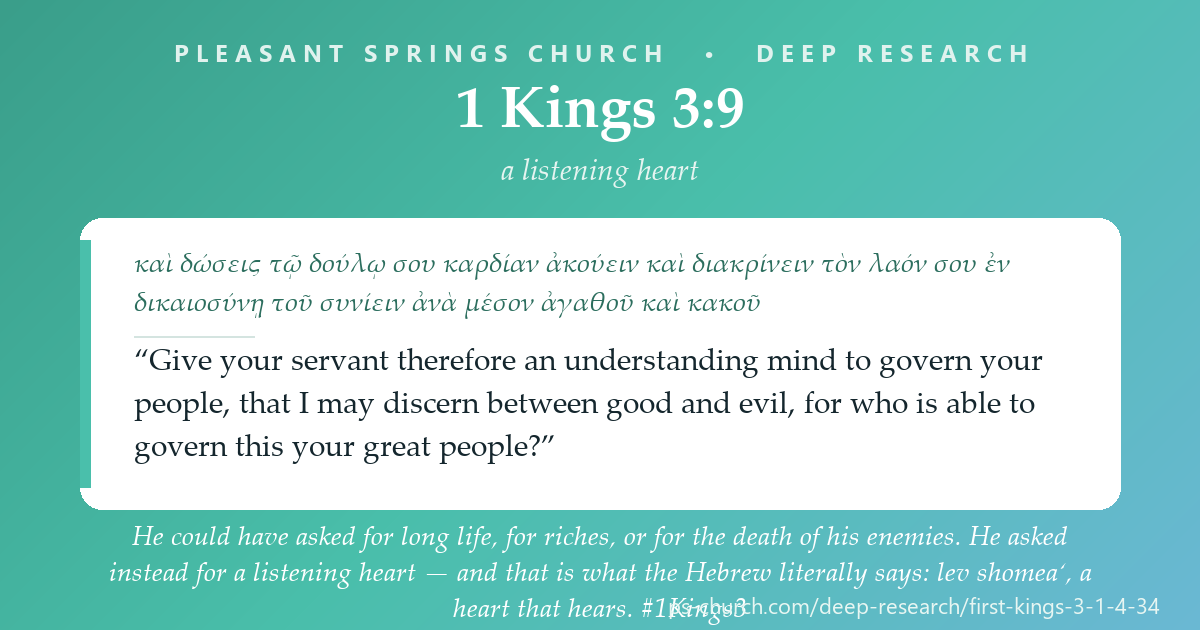
A young king who has just finished securing a throne makes a marriage alliance with Egypt, and goes up to Gibeon to sacrifice, because there is no temple yet and the narrator says so. There God meets him with the most dangerous question in Scripture: “Ask what I shall give you” (3:5). What Solomon says back begins not with a request but with an admission — “I am but a little child. I do not know how to go out or come in” — and then asks for one thing: “Give your servant therefore an understanding mind to govern your people, that I may discern between good and evil” (3:9). The Hebrew there is lēḇ shōmēaʿ, literally a listening heart, and the Septuagint renders it word for word — καρδίαν ἀκούειν, “a heart to hear.” God’s reply names the three things he did not ask for: long life, riches, the life of his enemies. Then the text proves the gift on the smallest possible stage — two prostitutes, one living baby, one sword — and the mother is identified not by evidence but by her body: “because her heart yearned for her son” (3:26). The people’s verdict is the chapter’s own definition: “they perceived that the wisdom of God was in him to do justice” (3:28). After that, the same wisdom becomes an administration — officers, districts, a month of provisions each, a nation as many as the sand by the sea, eating and drinking and rejoicing — and a mind that ran from the cedar of Lebanon to the hyssop in the wall. This study works 1 Kings 3:1–4:34 line by line in Hebrew, Septuagint and ESV. The Greek here is 3 Kingdoms in its Old Greek section, and it differs from the Hebrew in order as well as wording — there is no 3:1 and no 4:20 in the Greek at all. All of it is reported below rather than smoothed. See the method →
1 Kings 3:1–4:34 (selections)
Hebrew · LXX 3 Kingdoms (Rahlfs) · ESVThe Shape of the Passage
InclusioBehind this passage stands the promise to David that his son would sit on his throne (2 Samuel 7), the law that tells a king what he may not accumulate (Deuteronomy 17:14–20), and the command to worship at the place the Lord chooses (Deuteronomy 12). In front of it stand a temple, seven hundred wives, and a divided kingdom.
Author
A historian who reports and then, very sparingly, evaluates. Watch him work in 3:2–3. He says the people were sacrificing at the high places — and immediately supplies the reason, “because no house had yet been built for the name of the Lord.” Then he says Solomon loved the Lord — and immediately adds “only he sacrificed and made offerings at the high places.” Two sentences, two qualifications, in opposite directions. He is not hiding the problem and he is not making it the whole story. The same restraint governs 3:1: the marriage alliance with Pharaoh is reported flatly, with no verdict attached — and the reader who knows chapter 11 is coming has to wait for it.
He proves things instead of asserting them. He could have written “and Solomon was very wise” and moved on. Instead he gives one court case, told in full, with the speeches, and lets the crowd draw the conclusion in the last verse of the chapter. That is the technique Robert Alter calls the predominance of dialogue: biblical narrative reports action sparely and speech at length, and a character’s words are the characterization. Nearly the whole of 3:16–28 is people talking.
And he is a Deuteronomist in his bones. The vocabulary of 3:14 — “walk in my ways, keeping my statutes and my commandments” — is the language of Deuteronomy 6, and the conditional attached to it (“if you will walk… then I will lengthen your days”) is the hinge on which the whole of Kings will eventually turn. The gift in this chapter is unconditional; the length of days is not. He tells you the terms in advance and then spends twenty chapters showing you what was done with them.
Audience
People who had lost the thing this chapter celebrates. Kings ends with Jerusalem burned and a king eating at a Babylonian table. Whoever first read this account of a full treasury, a fed nation and a king the world came to hear, read it knowing how it ended. That does not make the chapter ironic — the text plainly means the gift and the glory — but it does mean the first audience was being asked a question: this was given; what happened?
People under a king, wondering what a king is for. Deuteronomy’s law of the king (Deut 17:14–20) forbids multiplying horses, wives and silver and commands the king to keep a copy of the law and read it all his life. Chapter 3 opens with a foreign wife and chapter 4 counts the horses. The narrator never cites the law. He counts, and leaves the arithmetic to a reader who has read Deuteronomy — and this study will not do the arithmetic louder than he does.
And ordinary people who would never see a throne room. The demonstration of royal wisdom in this chapter is not a treaty or a battle. It is two prostitutes and a baby — the two least protected adults and the one wholly unprotected child in the kingdom — getting a hearing from the king in person. Whatever else the audience was meant to learn about Solomon, they were meant to learn that.
Orient on Solomon, Gibeon and the high places, wisdom and the sage, kingship and justice, and the Greek of 3 Kingdoms.
Search by topic: Solomon; Gibeon; high place (bamah); dream and incubation; wisdom (hokmah); heart (leb) in Hebrew anthropology; justice (mishpat); king, kingship, and the royal judge; prostitution in ancient Israel; district and corvée administration; scribe, recorder, secretary; Egypt and Israel in the tenth century; 3 Kingdoms / 3 Reigns; kaige recension; Antiochene (Lucianic) text.
Which articles are relevant?
- Anchor Bible Dictionary — “Solomon,” “Kings, Books of,” “Gibeon,” “High Place,” “Wisdom in the OT,” “Dreams,” “Justice,” “Prostitution,” “Taxation and Tribute,” “Septuagint.”
- Dictionary of the OT: Historical Books (IVP) — “Solomon,” “Kings, Books of,” “Wisdom,” “Royal Administration,” “Justice and Righteousness,” “Text and Textual Criticism.” The last of these is the one to read before arguing from the Greek of this book.
- NIDOTTE / TDOT — לֵב (lēḇ, heart), שָׁמַע (shāmaʿ, hear), שָׁפַט / מִשְׁפָּט (shāphaṭ / mishpāṭ), חָכְמָה (ḥoḵmāh), בִּין / תְּבוּנָה (bîn / təḇûnāh), רַחֲמִים (raḥămîm, compassion — from רֶחֶם, womb), בָּמָה (bāmāh, high place).
- On the Greek — the two “To the Reader” essays for 3 Reigns in NETS, by Paul D. McLean (the kaige portion) and Bernard A. Taylor (the Old Greek portion, which is this passage). NETS is also where you can see the Miscellanies printed with their English cross-references in the margin — “(4.20)” at 2:46a, “(3.1)” at 2:35c and 5:14a — which is how the mapping in the codex note above was checked.
Bibliography surfaced:
- Mordechai Cogan, I Kings (Anchor Bible); Simon J. DeVries, 1 Kings (WBC); Marvin A. Sweeney, I & II Kings (OTL); Iain W. Provan, 1 and 2 Kings (NIBC); Paul R. House, 1, 2 Kings (NAC); Donald J. Wiseman, 1 and 2 Kings (TOTC); Walter Brueggemann, 1 & 2 Kings (Smyth & Helwys).
- Emanuel Tov, Textual Criticism of the Hebrew Bible, and Natalio Fernández Marcos, The Septuagint in Context, on 3 Kingdoms, the kaige revision and the Antiochene text; Dominique Barthélemy, Les Devanciers d’Aquila (1963), for the section theory itself.
- Robert Alter, The Art of Biblical Narrative, for the reading tools used in the structure block above. (Alter reads these texts as literature and does not share the church’s confession; we take the tools, not the metaphysics.)
A god who appears in a dream and asks a king what he wants; a king whose job is the widow’s case; and what the ancient retellings did with the two women.
First the world: what an incubation dream at a sanctuary was, why “wisdom” in the ancient Near East was a judicial word before it was an intellectual one, and what a high place actually was. Then the retellings — Josephus, Chronicles, Sirach — because what they add, drop and relocate tells you which parts of this chapter people could not leave alone.
Which parallels shed light on the world of this passage?
A god appears to a king in a dream and offers him a gift; the king refuses wealth and asks for something else. That is not only 1 Kings 3. It is also the opening of the Ugaritic Legend of King Keret, from Late Bronze Age Ras Shamra — four centuries or so before Solomon and about two hundred miles up the coast. Keret weeps himself to sleep and “in his dream El descends, in his vision the Father of Man,” and asks him what ails him; the offer of “silver and yellow-glittering gold” is made, and Keret answers, “What need have I of silver and yellow-glittering gold…? Grant I may beget children” (ANET 143). The shape is the same and the content is not, and both halves of that sentence are worth having. Solomon is doing a recognisable ancient thing in a recognisable ancient place; what he asks for is not recognisable at all.
“Wisdom” for a king meant the widow’s case, not the philosopher’s question. In the Ugaritic Tale of Aqhat, the good king Danel — whose name means “God judges” — is found “upright, sitting before the gate, beneath a mighty tree on the threshing floor, judging the cause of the widow, adjudicating the case of the fatherless” (ANET 151). And in the Keret cycle the king’s own son demands the throne with precisely this charge: “Thou judgest not the cause of the widow, nor adjudicat’st the case of the wretched… Descend from the kingship—I’ll reign” (ANET 149). In that world a king who will not hear the powerless has forfeited the office. Set 1 Kings 3:16–28 against that and the choice of demonstration stops looking sentimental and starts looking constitutional.
And the law-giving king said the same thing about himself. The epilogue of the Code of Hammurabi, four centuries before Solomon: “Let any oppressed man who has a cause come into the presence of the statue of me, the king of justice” (ANET 178). Hammurabi wanted that sentence carved in stone about himself. In 1 Kings 3 two prostitutes simply walk in.
The high places, plainly. A בָּמָה (bāmāh) was a local open-air worship site, and before the temple there was nothing irregular about using one — Samuel had presided at exactly such a place (1 Samuel 9:12–25). The narrator says so himself in 3:2. What makes them a problem later is not that they are rural but that they compete with the one place Deuteronomy 12 insists on, and Kings will measure every subsequent king by whether he removed them.
- The Legend of King Keret, Ugaritic, 14th c. BC (ANET 142–149; the dream and the refusal of silver and gold at 143; the son’s charge at 149) — an ancient witness, not Scripture. The closest known parallel to the form of 1 Kings 3:5–14.
- The Tale of Aqhat, Ugaritic (ANET 149–155; Danel judging at the gate, 151) — a witness, not Scripture. The king-as-judge-of-the-widow motif in its home setting.
- The Code of Hammurabi, epilogue (ANET 178) — a witness, not Scripture. “The king of justice” invites the oppressed man to his statue; Israel’s king is handed two of them in person.
- Josephus, Antiquities 8.21–35, 40–44 (= Whiston 8.2.1–5) (Second-Temple — a witness, not Scripture) — and he is full of surprises here. He sends Solomon to Hebron, not Gibeon: “He now resolved to go to Hebron, and sacrifice to God upon the brazen altar that was built by Moses.” That is not what 1 Kings says, and this page reports it rather than quietly correcting it; whether the reading goes back to Josephus or to a copyist is a question for the critical editions of Josephus and not for a summary. His Solomon asks for “a sound mind, and a good understanding, whereby I may speak and judge the people according to truth and righteousness” — and “according to… righteousness” is the plus the Greek has at 3:9 and the Hebrew does not. In the court case he adds two things the Bible does not have: “all the people privately laughed at the king, as no more than a youth,” and a sentence on the second woman — he “condemned the other as a wicked woman.” Scripture condemns nobody in that room. And on the songs he counts with the Hebrew against the Greek: “a thousand and five.”
- Sirach 47:12–18 (Second-Temple — a witness, not Scripture; non-canonical by the church’s ratified position, and read here as a witness only) — Ben Sira’s praise of Solomon takes its cue from exactly this passage: “ὡς ἐσοφίσθης ἐν νεότητί σου καὶ ἐνεπλήσθης ὡς ποταμὸς συνέσεως” — how wise you were in your youth, and you were filled like a river with understanding (47:14) — and then, four verses later, turns: “you gathered gold like tin and multiplied silver like lead” (47:18). The oldest Jewish reading of Solomon already holds both halves at once.
- 2 Chronicles 1:1–13 (Scripture, and a parallel witness) — the same night at Gibeon told differently, and the differences are not trivial. Chronicles explains Gibeon: “the tent of meeting of God, which Moses the servant of the LORD had made in the wilderness, was there,” and “the bronze altar that Bezalel… had made” (1:3–5). Kings says only “the great high place.” Chronicles has Solomon ask for “wisdom and knowledge to go out and come in before this people” (1:10) — folding into the request the very phrase Kings uses for what Solomon cannot do (1 Kgs 3:7). Chronicles has no listening heart. And Chronicles has no two women at all. The house rule applies: report the difference; do not harmonise it.
Line them up and one pattern runs through every ancient handling of this chapter: the silences get filled.
(1) Why Gibeon? Kings says only that it was “the great high place” and has already told you the reason high places were in use at all (3:2). Chronicles supplies the tent of meeting and Bezalel’s bronze altar. Josephus supplies a different place entirely and Moses’ altar with it. Neither is a correction of Kings; both are answers to a question Kings does not answer.
(2) Was the marriage alliance wrong? 3:1 reports it without a verdict. Chapter 11 will give a verdict about foreign wives, in a different register and about a different scale of thing. This page will not import chapter 11’s verdict into chapter 3’s silence — and will not pretend the silence is approval either. The narrator put those two facts in that order on purpose, and left the reader holding both.
(3) Was the second woman wicked? Josephus says yes. Scripture does not. It reports her words — “He shall be neither mine nor yours; divide him” — and stops. That is enough to decide the case and not enough to write her biography, and the restraint is deliberate.
(4) Why prostitutes? The text says what they were, once, and never mentions it again — not in the verdict, not in the crowd’s reaction. Every attempt to make their profession the point of the story (a lesson about sin, a lesson about tolerance) is adding a theme the narrator declined to add. What the profession supplies is a legal fact: two women with no husband, no household and no witnesses, which is exactly why nobody but the king could settle it.
The rule for these pages is the one Ruth and Judges taught us: report what the text approves, report what it merely reports, report what it condemns, and leave the gaps open.
Two words that are the whole passage, one root repeated five times, one word made of a womb, and a simile used twice.
Start with lev shomea and hold the three columns side by side without choosing between them. Then count shama and mishpat yourself — and notice which look-alikes are names. Then ask what it costs the English that לֵב becomes “mind” three times in this passage while the Greek keeps saying καρδία.
“A listening heart.” Two words, and they are the passage. לֵב in Hebrew is not the seat of the emotions over against the head — it is the whole inner person: mind, will, memory, courage and affection together, which is why the ESV can reasonably render it “mind.” And שֹׁמֵעַ is the participle of the ordinary verb to hear. Solomon does not ask for information, or for a legal code, or for authority. He asks for the capacity to take in another person. What the Greek does: nothing at all — and that is the point. Rahlfs has καρδίαν ἀκούειν, “a heart to hear,” morpheme for morpheme, and NETS translates it that way. On this verse the Septuagint is the literal column and the English is the interpretive one, which is a useful thing for a congregation to see once.
The Leitwort. Five occurrences, and they run the whole arc: Solomon asks for a heart that hears (3:9); God summarises the request as understanding to hear judgment (3:11); all Israel hears the verdict (3:28); and the nations come to hear his wisdom, having heard of it (4:34). The word that begins as a private petition ends as an international traffic report. Do not count שִׁמְעִי at 4:18 — that is Shimei, a district officer, and the resemblance is only in the letters. The Greek carries the thread with ἀκούω and its compounds throughout.
“Judgment, justice, the right verdict, a legal case” — and the noun and its verb שָׁפַט occur seven times in this passage. 3:28 stacks three of them in one sentence: Israel heard the judgment the king judged… because the wisdom of God was in him to do judgment. That last phrase is the verse’s definition of wisdom, and it is not an intellectual definition. The Greek breaks the frame: κρίμα … ἔκρινεν for the first two and then δικαίωμα for the third, so a Greek reader hears a judgment done and a Hebrew reader hears one word three times.
“Compassion” — and the singular of this plural, רֶחֶם (reḥem), is womb. The verb with it, נִכְמְרוּ, is used of something growing hot. The ESV’s “her heart yearned for her son” is a fair English sentence for a Hebrew idiom that is frankly anatomical, and the same word-family is what Scripture uses of God’s own compassion (Exod 34:6; Ps 103:13; Isa 49:15). The Greek keeps the body: ἐταράχθη ἡ μήτρα αὐτῆς, “her womb was stirred.” The mother is identified in this story not by evidence but by what her insides did when the sword came out.
“A little child” — but נַעַר covers everything from a young boy to a servant to a soldier’s attendant, and with קָטֹן it means something like the junior one, the inexperienced one. Solomon was not an infant; he had just executed three men. This is a confession of inadequacy, not a statement of age — and the clause that follows makes it precise: “I do not know how to go out or come in,” a Hebrew idiom for conducting the ordinary business of leadership (cf. Num 27:17). The Greek is equally literal, παιδάριον μικρόν. Ben Sira later reads it as praise: “how wise you were in your youth” (Sirach 47:14 — a witness, not Scripture).
“Wisdom” — in Hebrew first a skill: it is what the craftsmen of the tabernacle have (Exod 35:31) and what a sailor and a scribe have. Applied to a king it means competence in the actual job, which 3:28 spells out as doing justice, and 4:33 extends to knowing the natural world. The Greek splits it: Rahlfs mostly uses σοφία but reaches for φρόνησις, practical discernment, at the two decisive points — 3:28 (“φρόνησις θεοῦ was in him”) and 4:29 / MT 5:9. That is a translator’s judgement about what kind of wisdom this is, and it is a good one.
“High place” — an elevated local worship site, three times in three verses and then never again in this passage. Kings will use this word as a measuring stick for the next four hundred years of kings, but here the narrator suspends judgement twice over: the people used them because there was no temple yet, and Solomon “loved the Lord” and used them anyway. The Greek does not transliterate it; it says τὰ ὑψηλά, “the high (places),” which is exactly as flat and descriptive.
“Like the sand.” Twice, nine verses apart, and the second use is the surprising one. First the people are as many as the sand by the sea — the Abrahamic promise language (Gen 22:17) reported as fulfilled. Then the king’s heart is given breadth “like the sand on the seashore.” The measure of the nation becomes the measure of the room inside one man. Two other words in these chapters contain the same letters and are not this word: Abel-meholah (4:12) and Mahol (MT 5:11). The Greek has ἡ ἄμμος both times, so the pairing survives translation.
Two things about the wording worth reporting rather than tidying:
- “Mind” three times for a word that says “heart.” The ESV renders לֵב as “mind” at 3:9 (“an understanding mind”), 3:12 (“a wise and discerning mind”) and 4:29 (“breadth of mind”). It is defensible — in Hebrew anthropology the lēḇ really does do most of what English assigns to the mind, and “heart” in modern English has drifted toward the emotions alone. But the Septuagint made the opposite decision, keeping καρδία in all three places, and NETS follows it (“a heart to hear,” “a prudent and wise heart,” “volume of mind” only at 5:9). Both translations are interpretations of one Hebrew word, and this page prints the Hebrew so you can see what is being decided.
- “This your great people” is, in Hebrew and in Greek, “this heavy people.” The adjective at the end of 3:9 is הַכָּבֵד (hakkāḇēḏ), from the root for weight and heaviness — the same root behind kāḇōḏ, “glory,” which is literally weightiness, and which turns up two verses later in what God gives him anyway (3:13, “riches and honor”). Rahlfs keeps the metaphor: τὸν λαόν σου τὸν βαρὺν τοῦτον, and NETS renders it “this your weighty people.” Solomon is not paying the nation a compliment; he is saying it is a great deal to carry.
The promise this prayer stands on, the law the numbers are being measured against, and where the New Testament takes it.
Trace four threads: the Davidic promise Solomon quotes back to God in 3:6; Deuteronomy’s law of the king, which the narrator never cites and keeps counting against; the wisdom literature that grew up around this chapter; and the two places the New Testament actually goes with it.
Which cross-references matter?
- 2 Samuel 7:1–17 — the ground of the whole prayer. Solomon’s first sentence to God is a citation: “you have kept for him this great and steadfast love and have given him a son to sit on his throne this day” (3:6). That is Nathan’s oracle, and Solomon is not asking for a new thing but for the equipment to do a thing already given. He begins by rehearsing God’s faithfulness to his father and only then asks for anything.
- Deuteronomy 17:14–20 — the law of the king, and the standing cross-link for all of Solomon’s reign. He shall not multiply horses “or cause the people to return to Egypt”; he shall not multiply wives, “lest his heart turn away”; he shall not greatly multiply silver and gold; and he shall write out a copy of the law and read it all his life. Then read 3:1 (a wife from Egypt), 4:26 (forty thousand stalls of horses), 4:22–23 (the daily table) and 4:21 (tribute). The narrator never cites the law and never accuses. He counts. Do not preach the accusation louder than he does — and do not pretend the counting is accidental either.
- Deuteronomy 12 — “the place that the Lord your God will choose,” the standard against which every high place in Kings is finally measured. 3:2 tells you why the standard could not yet be met, which is the fairest thing the narrator could have said.
- Joshua 9 — Gibeon, and how it got into Israel in the first place: by a treaty obtained under false pretences, honoured anyway. The great high place where Israel’s wisest king meets God is a town Israel was tricked into sparing. 2 Samuel 21 adds a darker chapter to the same town’s file. Kings mentions none of it.
- 1 Kings 1–2 — what happens immediately before this, and the reason 3:6–9 lands the way it does. A man who has just presided over three executions says “I do not know how to go out or come in.” Whether that is humility, exhaustion or both, the text does not say.
- 1 Samuel 8 — Samuel’s warning about what a king will do: he will take your sons, your daughters, your fields, and a tenth of everything, and appoint commanders and cooks and bakers. Then read 1 Kings 4:1–28, which is a list of exactly those officers and exactly that provisioning, reported as glory. Both readings are in the canon and neither is cancelled.
- Genesis 22:17 and Genesis 15:5 — “as the sand that is on the seashore.” When 4:20 says Judah and Israel were as many as the sand by the sea, it is reporting a promise kept, and the phrase is doing the work of a footnote.
- 1 Kings 5–8 and 9–11 — where this goes. The temple that 3:2 says did not yet exist; and then chapter 11, where the foreign wives reported without comment in 3:1 become a stated cause of the kingdom’s division. The issue there is covenant loyalty and not ethnicity, and the text says so.
- Proverbs 1–9 and Ecclesiastes 1:1 — the literature that gathered around this chapter. “The fear of the LORD is the beginning of wisdom” is the same conviction 1 Kings 3 dramatises: wisdom is a gift received in the presence of God, not a technique acquired. 1 Kings 4:32 says he spoke three thousand proverbs, which is more than Proverbs contains, and the relation between the man and the book is a real question that this page does not settle.
- Matthew 12:42 · Luke 11:31 (no page in this library yet; cited in text) — the one place Jesus takes up this passage directly: “The queen of the South… came from the ends of the earth to hear the wisdom of Solomon, and behold, something greater than Solomon is here.” That sentence is built on 4:34 — the coming to hear — and it is the New Testament’s own use of the chapter.
- James 1:5 (cited in text) — “If any of you lacks wisdom, let him ask God, who gives generously to all without reproach, and it will be given him.” James does not mention Solomon. He does not have to; the sentence is 1 Kings 3 turned into a standing offer, and it is the most pastorally usable link in the chapter.
We have made 3:16–28 a story about cleverness. A riddle, a trick, a neat solution. The people who were there did not read it that way, and the narrator gives us their reading in the last verse so that we do not have to guess: “they perceived that the wisdom of God was in him to do justice” (3:28).
Look at what the wisdom actually consisted of. It was not deduction — there was no evidence to deduce from, and the king says so by the way he proceeds. It was not authority — he had that already and it was useless. It was the construction of a situation in which love would have to speak. The sword is not a threat; it is a question, and the only person in the room who can answer it is the one whose body answers before her mouth does. The king’s wisdom is that he knew what to listen for. He asked for a listening heart and then used it.
And notice who it was used on. Not a treaty dispute, not a land case between clans, not a matter of state. Two women without husbands or households or witnesses, and a baby. In the Ugaritic material a king who does not judge the widow’s cause is told to get off the throne (ANET 149); in Deuteronomy God “executes justice for the fatherless and the widow” (Deut 10:18). The first exercise of the wisdom of Solomon is spent entirely on people who could give him nothing.
A word about the child, since we usually skip past him. The narrator calls him הַיָּלוּד הַחַי — “the living one, the born one” — and the Greek calls him “the suckling.” He is the only wholly innocent party present and the only one with nothing to say. The chapter’s verdict is that the wisdom of God protects him. Where Scripture gives no further reason, we stop there; but that much it gives plainly.
The commentaries, the arrangement question in 3 Kingdoms, the historical debate about the empire, and how to preach a chapter that reports without commenting.
Cogan, DeVries, Sweeney, Provan, House, Wiseman and Brueggemann on Kings; Barthélemy, Tov and Fernández Marcos on the Greek. Then the three live questions: which arrangement of 1 Kings is earlier, how large the tenth-century kingdom actually was, and what to do with a narrator who reports a marriage alliance and says nothing.
Commentaries & studies:
- Mordechai Cogan, I Kings (Anchor Bible) — the fullest on the administrative lists of chapter 4 and on the ANE background of the dream; Simon J. DeVries, 1 Kings (WBC), for form and structure; Marvin A. Sweeney, I & II Kings (OTL), for the composition question.
- Iain W. Provan, 1 and 2 Kings (NIBC); Paul R. House, 1, 2 Kings (NAC); Donald J. Wiseman, 1 and 2 Kings (TOTC) — three careful evangelical readings that differ from each other about how negatively chapters 3–4 are meant to be heard, which is itself the evidence that the text does not say.
- Walter Brueggemann, 1 & 2 Kings (Smyth & Helwys) — the sharpest on 4:1–28 as an economy with a cost, and worth reading precisely because he will not let the reader enjoy the inventory without noticing who paid for it. Read him alongside House, not instead of.
- Dominique Barthélemy, Les Devanciers d’Aquila (1963); Emanuel Tov, Textual Criticism of the Hebrew Bible; Natalio Fernández Marcos, The Septuagint in Context — for the kaige sections, the Antiochene text, and the Miscellanies.
- NETS, 3 Reigns, tr. Paul D. McLean (kaige) and Bernard A. Taylor (Old Greek), with the two “To the Reader” essays — the accessible English window onto the Greek arrangement, and the source of the marginal cross-references used above.
Interpretation notes worth keeping:
- Which arrangement of 1 Kings is earlier — and this page does not decide. The facts are not in doubt: Rahlfs’s 3 Kingdoms has no 3:1 and no 4:20 where the Hebrew has them; it carries that material in the Miscellanies at 2:35a–o and 2:46a–l; it has a second, quite different Jeroboam narrative at 12:24a–z; and it reverses the Hebrew’s chapters 20 and 21. What those facts mean is contested. One line of scholarship reads the Greek as preserving an older Hebrew arrangement that the Masoretic tradition later reorganised; another reads the Miscellanies as a secondary Greek gathering of stray material, sometimes doubling verses that already stand elsewhere in the same Greek book — and the doublets are real (compare 2:35a with 5:9, and 2:46i’s forty thousand horses with 10:26’s four thousand). The honest position is that the question is open, that both texts are ancient, and that a study page has no business pronouncing on it. What we owe the reader is the map, which is in the codex note above, drawn from Rahlfs and checked against NETS — and the reasoning behind that policy is set out at the texts we print.
- The 40,000 stalls, and an ESV footnote worth following. At 4:26 (MT 5:6) the Hebrew says forty thousand stalls of horses; 2 Chronicles 9:25 says four thousand. The ESV footnotes the difference and points to “Septuagint of 1 Kings 10:26” — and that is exactly right: Rahlfs at 10:26 reads τέσσαρες χιλιάδες, four thousand. But the Greek carries both numbers, because its Miscellany at 2:46i reads τεσσαράκοντα χιλιάδες, forty thousand, agreeing with the Hebrew. So the Greek is not a witness against the Hebrew here so much as a witness to both readings existing early. That is the kind of thing a footnote cannot say and a study page should.
- How large was the kingdom of 4:21–24? The debate is real and nothing here depends on it. The tenth century in the southern Levant is one of the most contested periods in the archaeology of the region, and estimates of the scale of a Solomonic state range from a substantial regional power to something considerably smaller than the chapter’s language suggests. We name the debate and do not adjudicate it, and we notice that the text’s own interest is not in square mileage: it spends four verses on the empire and thirteen on a baby.
- Is chapter 3 praising Solomon or setting him up? The commentaries divide, and the division is the evidence. One reading takes 3:1 and 3:3 as advance warnings deliberately planted — the foreign marriage and the high places, both flagged before the gift is given — so that chapter 11 reads as a fulfilment. Another takes 3:1–3 as sober scene-setting, with the “only” in 3:2 explicitly excusing the practice, and reads chapters 3–10 as straightforward praise that chapter 11 then reverses. Both readings are advanced by serious and believing scholars, and the text supports both because the narrator declines to say. The discipline here is the one this library has practised since Judges: the absence of a verdict is not a verdict.
- The two women: what the story is not about. It is not a story about the reliability of maternal instinct in general, and it is not a story about prostitution. It is a hard case with no witnesses, decided by a device that produces the one piece of evidence a court cannot subpoena. Ancient and modern retellings have wanted to make one woman a villain (Josephus condemns her; the folk tradition does worse), and Scripture does not. It is also worth knowing that the “disputed child, threatened division” motif turns up in other literatures, which some have used to argue the story is a migrating folk tale. The house position is that this is reported history told with high art; the artistry of a narrative is not evidence against its truth, and a widely-attested motif is at least as likely to be widely attested because such cases actually arise.
- Where Scripture gives no reason, we stop. The text never explains why God chose to appear at Gibeon rather than Jerusalem, why the gift came before any obedience was demonstrated, or what became of either woman. It also never says whether the marriage in 3:1 was sin. We report the silences as silences.
A young king with too much to carry, one honest sentence, and a heart that could hear.
Name what you learned, why it matters, and one concrete response.
What should we carry away — and do?
- He told the truth about himself first. Before the request comes the confession: “I am but a little child. I do not know how to go out or come in.” That is a man with a throne, an army and a treasury saying out loud that he is not up to the job. Everything he receives comes after that sentence and not before it.
- What he asked for was a listening heart. Not strategy, not a longer life, not victory, not money. לֵב שֹׁמֵעַ — the capacity to take in another person and tell the difference between good and evil. Ask yourself honestly which of the four things on God’s list in 3:11 you would actually have reached for.
- Wisdom, in this chapter, is what you do for someone who cannot pay you. “They perceived that the wisdom of God was in him to do justice” (3:28). The demonstration is two women with no standing and one child with no voice. Any definition of wisdom that would let you walk past that room is not this chapter’s definition.
- The mother was known by her compassion. Not by proof, not by argument — by רַחֲמִים, a word made out of the word for womb, and by a willingness to lose the child rather than see him harmed. Love that would rather lose than destroy is the evidence the chapter accepts.
- And the same wisdom knew what a hyssop was. Cedar to hyssop, beasts and birds and reptiles and fish. This is not two kinds of wisdom, a spiritual one and a curious one. The God who gives a heart to judge a custody case is the God who made the weed in the wall, and attention is one thing.
- “Eating and drinking and rejoicing.” That is the narrator’s summary of what good government produced (4:20). Not conquest — dinner, and gladness, from Dan to Beersheba. Keep it in view when you decide what to pray for on behalf of the people who govern you.
A word about typology, clearly labelled. Three things, kept distinct. (1) What this text says: God gave a king wisdom, and the king used it to save a child. 1 Kings 3 does not announce itself as a picture of anyone. (2) What the New Testament itself does with it: exactly one thing, and it is worth more than a dozen of our own — Jesus says “the queen of the South came from the ends of the earth to hear the wisdom of Solomon, and behold, something greater than Solomon is here” (Matthew 12:42; Luke 11:31), which takes up 4:34 and says the traffic should now be coming to him. That is the canon’s own move and it is safe ground. (3) What we see from this side of the cross: a wise king who is given wisdom rather than achieving it, who saves a child by offering to put a sword between the claimants, and whom the nations come to hear — and Christians have read that toward Christ, “in whom are hidden all the treasures of wisdom and knowledge” (Colossians 2:3; cf. Colossians 1:15–20), “the wisdom of God” (1 Corinthians 1:24, 30). That reading is legitimate and expected — Luke 24:27 has Christ himself doing this with Moses and all the Prophets — and it is ours, not the text’s. Say both halves: the Old Testament does not claim it, and we are meant to see it. What is ruled out is only putting our seeing into the narrator’s mouth.
Step in response: two things this week. First, pray 3:9 as it stands, without improving it — give your servant a listening heart — and then go and use it on one person you have been managing rather than hearing. Second, find the case in your own reach that nobody is going to take because there is nothing in it: the neighbour with no advocate, the child with no voice, the person whose account of things nobody has actually sat down and listened to. That is where this chapter says the wisdom of God shows up. And read it again in a month; Ben Sira read it and saw a river, and then saw the gold, and the second reading did not cancel the first.
1 Kings 3:9 · to share
Hebrew + LXX 3 Kingdoms (Rahlfs, Old Greek) + ESVEvery Deep Research page traces its passage across the whole sweep — the Old Testament, the Second-Temple world between the testaments (historical witnesses, not Scripture), and the New Testament. Follow the thread:
Pleasant Springs Church — Deep Research
Research method after Michael S. Heiser’s Bible Research Method (examine dictionaries → ancient literature → important words → textual connections → academic publications → share), with the Pleasant Springs “Author & Audience” foundation. Scripture set in the Hebrew, the Greek editions named on each page and the ESV (Old Testament), and the Greek New Testament and the ESV (New Testament), per the practice of Pleasant Springs Church. 1 Kings 3–4 research grounded in Cogan (Anchor), DeVries (WBC), Sweeney (OTL), Provan (NIBC), House (NAC), Wiseman (TOTC) and Brueggemann (Smyth & Helwys), with Barthélemy’s Les Devanciers d’Aquila (1963), Tov and Fernández Marcos on the Greek, and Alter for the narrative tools used in the structure block. Book name: in the Septuagint this is 3 Kingdoms (Βασιλειῶν Γʹ) — 1–2 Samuel and 1–2 Kings are one continuous four-volume work, 1–4 Kingdoms. (Worth noticing once: our English names for the books of the Torah are the Septuagint’s names, while these books keep Hebrew-derived naming — so an English Bible already mixes both traditions on its contents page.) Kaige: the kaige sections of these books are 2 Samuel 11:2–1 Kings 2:11 and 1 Kings 22–2 Kings 25. This passage falls between them and is Old Greek, so Vaticanus here is not a revision toward a proto-Masoretic Hebrew and the usual ambiguity of “the LXX reads X” in these books is, for once, not in force; the Antiochene text remains the witness to consult where an Old Greek reading is disputed. NETS marks the seam in its running heads and divides 3 Reigns between two translators, Paul D. McLean (kaige) and Bernard A. Taylor (Old Greek). The section boundary was verified rather than assumed: καί γε occurs exactly four times in Rahlfs’s 3 Kingdoms — 1:6, 1:48, 2:5 (all before 2:11) and 22:22 — and not once in chapters 3–21; within this passage the Hebrew גַּם at 3:13 (three times) and 3:26 is rendered by plain καί and μήτε. Arrangement: 3 Kingdoms differs from the Masoretic Text in order as well as wording. Rahlfs carries the “Miscellanies” at 2:35a–o and 2:46a–l, an alternate Jeroboam narrative at 12:24a–z, and the Hebrew’s chapters 20 and 21 in reverse order (his ch. 20 is Naboth, 29 verses; his ch. 21 the Ben-hadad wars, 43 — the same totals as the Hebrew, swapped). Touching this passage: there is no 3:1 and no 4:20 in the Greek; the Pharaoh’s-daughter notice stands at 2:35c and again at 5:14a, and 4:20 stands at 2:46a; English 4:21, 4:25 and 4:26 stand at 2:46k/2:46b, 2:46g and 2:46i; Greek 5:1 = English 4:27–28, Greek 5:2–4 = English 4:22–24, Greek 5:9–14 = English 4:29–34, and there is no Greek 5:5–8; and the last three district officers stand in a different order (Rahlfs: Benjamin, Gad, Issachar; Hebrew: Issachar, Benjamin, Gilead), with Rahlfs’s 4:18 transliterating נְצִיב as nasiph and adding “in the land of Ioudas.” Whether the Greek or the Hebrew arrangement is earlier is a live scholarly question and this page deliberately does not adjudicate it; the mapping is drawn from Rahlfs and checked against the marginal cross-references NETS prints in the Miscellanies. Numbering: Hebrew, Greek and English agree through 4:20; from English 4:21 the English runs one chapter behind — English 4:21–34 = MT and LXX 5:1–14 (the ESV footnotes it), and every affected row above carries both. Chapter 3 has no offset, and that was counted, not assumed. Divergences in the verses printed, all of them: 3:2 (Greek “burning incense” for “sacrificing,” “until now” for “until those days”); 3:4 (Greek “highest and great” for “the great high place,” adds “in Gabaon,” lacks “the king”); 3:5 (Greek lacks “at Gibeon,” moved to 3:4; reads κύριος for Hebrew אֱלֹהִים; “ask some request for yourself” for “ask what I shall give you”); 3:7 (“you gave” for “you made king”); 3:8 (one verb where the Hebrew has two, and no “for multitude”); 3:9 (Greek adds “in righteousness”; otherwise a word-for-word rendering of לֵב שֹׁמֵעַ as καρδίαν ἀκούειν); 3:11 (κύριος for אֱלֹהִים again); 3:12 (“prudent and wise” for “wise and discerning”); 3:13 (Greek lacks “all your days”); 3:15 (Greek adds “the altar which is before” and “in Sion”); 3:16 (Greek “appeared” for “came”); 3:27 (a Greek plus, “to the one who said, ‘Give it to her…’”, and no “living”); 3:28 (φρόνησις θεοῦ for “the wisdom of God,” ἐν αὐτῷ for “in his midst,” and a third word δικαίωμα that breaks the Hebrew’s threefold מִשְׁפָּט frame); 4:29 / MT 5:9 (the doublet at 2:35a says πλάτος καρδίας where 5:9 says χύμα καρδίας); 4:30 / MT 5:10 (“ancient people” for “sons of the east”); 4:31 / MT 5:11 (Greek lacks “and his fame was in all the surrounding nations”); 4:32 / MT 5:12 (Greek five thousand songs against the Hebrew’s a thousand and five — Josephus agrees with the Hebrew); 4:34 / MT 5:14 (a Greek plus, “and he would receive gifts”). Where the columns agree, this page says so — 3:3, 3:16 (on the word “prostitutes”), 3:26 (the womb word, kept in both) and the whole of 4:33 / MT 5:13 stand word for word. The divine name: at 3:10 and 3:15 the Hebrew reads אֲדֹנָי, not the Tetragrammaton, and the ESV accordingly prints “the Lord” without small capitals in those two verses; this is reported rather than passed over. 2 Chronicles 1:1–13 is treated as a parallel witness and its differences from 1 Kings 3 — the tent of meeting and Bezalel’s altar supplied, the request reworded, the two women absent — are reported and not harmonised, as is the 40,000 / 4,000 discrepancy at 4:26 against 2 Chronicles 9:25. ANE parallels are cited only from the locally verifiable range of ANET: the Legend of King Keret (143), the Tale of Aqhat (151) and the Keret cycle’s charge against a king who will not judge the widow (149), and the Code of Hammurabi’s epilogue (178) — witnesses, never levelled with Scripture, as are Josephus and Sirach, the latter tagged non-canonical at first mention. Pastoral handling: the marriage alliance of 3:1 is reported as the narrator reports it, without importing chapter 11’s verdict and without calling the silence approval; the high places carry the narrator’s own qualification from 3:2; the two women’s profession is stated once and never made the point, and the later tradition that vilifies the second woman is named and declined; and the Deuteronomy 17 arithmetic is left where the narrator left it. The typology is labelled in three parts per the house position: what the text says, what the New Testament itself draws (Matthew 12:42 / Luke 11:31 on 4:34), and what we see from this side of the cross — named as ours and not undersold.
Scripture quotations marked ESV are from the ESV® Bible (The Holy Bible, English Standard Version®), © 2001 by Crossway, a publishing ministry of Good News Publishers. ESV Text Edition: 2016. Used by permission. All rights reserved. The ESV text may not be quoted in any publication made available to the public by a Creative Commons license, and the ESV may not be translated in whole or in part into any other language. www.esv.org
|
Did this study bless you today? 💚 Give to Support PS Church100% of gifts go to the General Fund — thank you. |