A book that ends with Jerusalem in flames begins with an old man who cannot get warm. “Now King David was old and advanced in years. And although they covered him with clothes, he could not get warm” — and a fourth son does the arithmetic. “Now Adonijah the son of Haggith exalted himself, saying, ‘I will be king.’” Chariots, horsemen, fifty men to run before him — the same equipment, in the same four Hebrew words, that Absalom assembled before him. And then the narrator adds one sentence, the only comment he will make on David in two chapters: “His father had never at any time displeased him by asking, ‘Why have you done thus and so?’” Then a plan: Nathan to Bathsheba, Bathsheba to the king, Nathan in after her to confirm it — and an oath the reader has never been told about until she quotes it. Solomon goes down to Gihon on the king’s own mule, Zadok takes the horn of oil from the tent and anoints him, the trumpet sounds, and “the earth was split by their noise” — and half a mile away a feast stops mid-course. Adonijah runs for the horns of the altar and is sent home alive. Then David’s last charge, and this study reports it whole: it begins “Be strong, and show yourself a man, and keep the charge of the Lord your God,” and it ends “do not let his gray head go down to Sheol in peace” and “you shall bring his gray head down with blood to Sheol.” The narrator sets the two halves side by side without a word of comment, and that juxtaposition is the text. What follows is Adonijah, Abiathar deposed — “thus fulfilling the word of the Lord… concerning the house of Eli in Shiloh” — Joab clinging to the horns of the same altar in the same four words, and Shimei. This study works 1 Kings 1:1–2:46 in Hebrew, Septuagint and ESV, and it names the text-critical situation instead of hiding it: 1:1–2:11 lies inside the kaige section and 2:12 begins Old Greek, and the Greek Bible carries two blocks of text here — the Miscellanies at 2:35a–o and 2:46a–l — that the Hebrew does not have. See the method →
1 Kings 1:1–2:46 (selections)
Hebrew · LXX (Rahlfs, 3 Kingdoms) · ESV⚠️ This page straddles a recension boundary, and the boundary falls inside chapter 2. Dominique Barthélemy showed in Les Devanciers d’Aquila (1963) that the Greek of Kingdoms is not one translation. Long stretches are a later kaige revision — a first-century pull of an older Greek text back toward a proto-Masoretic Hebrew, named for its stereotyped rendering of Hebrew גַּם (gam, “also”) by καί γε. In Thackeray’s section letters: 2 Kingdoms 11:2 → 3 Kingdoms 2:11 (βγ) is kaige, and 3 Kingdoms 22 → 4 Kingdoms 25 (γδ) is kaige; everything between them is Old Greek. So on this page: 1:1 through 2:11 is inside the kaige section, and from 2:12 the Greek reverts to Old Greek. (The precise starting point of βγ is debated — some would begin it at 2 Samuel 10:1 — but its end at 3 Kingdoms 2:11 is the standard division.)
What that means, said plainly. Inside a kaige section, Codex Vaticanus is a revision, not the oldest Greek — and Rahlfs’s text of Kingdoms leans on Vaticanus. The Antiochene (Lucianic) manuscripts frequently preserve an older Greek reading in exactly those stretches. So in 1:1–2:11 the sentence “the Septuagint reads X” is ambiguous until you say which Greek; from 2:12 on, the Greek above is the old translation itself. This page prints Rahlfs’s Septuaginta (CATSS digitization; punctuation editorial, proper names unaccented), names it in the column heading, and cites no Antiochene reading, because we have not consulted the critical edition — that is Fernández Marcos and Busto Saiz, El texto antioqueno de la Biblia griega II, and a reader who wants those readings should go there rather than to a summary. There is as yet no Göttingen edition of 3 Kingdoms; the fuller apparatus is Brooke–McLean’s larger Cambridge Septuagint. On why this library prints what it prints, see the texts we print.
You can watch the seam yourself, and we counted it rather than assumed it. In the whole of 3 Kingdoms in the Rahlfs/CATSS text, καί γε occurs exactly four times: at 1:6, 1:48 and 2:5 — all three inside the kaige section — and then not once in the twenty chapters from 2:12 to 21:43, until it reappears at 22:22, in the first chapter of the second kaige section. And the other classic Hebraism of this revision, ἐγώ εἰμι stapled in front of a finite verb to represent אָנֹכִי, occurs in 3 Kingdoms once: at 2:2, the first line of David’s charge. (Three other verses have ἐγώ εἰμι doing ordinary Greek work with a predicate — 3:7, 19:4, 21:4 — and are not instances of it.) For comparison, 1 Kingdoms, which lies wholly outside the kaige sections, has no καί γε at all, and 2 Kingdoms has twenty-eight, twenty-six of them from 11:2 on. These counts are ours and can be checked.
⚠️ And 3 Kingdoms is not merely worded differently. It is arranged differently — and two of the extra blocks sit in this passage. Here is what Rahlfs actually prints, verified rather than repeated. After 2:35 the Greek carries fourteen extra sub-verses, 2:35a–o (lettered a–i then k–o; there is no j), roughly three hundred Greek words; after 2:46 it carries eleven more, 2:46a–l, roughly two hundred and sixty. These are the so-called “Miscellanies.” Their contents are not new stories: they are Solomon material that the Hebrew has elsewhere. 2:35a–b is his wisdom “as the sand by the sea” (Hebrew 5:9–10 = English 4:29–30); 2:35c is his marriage to Pharaoh’s daughter and her entry into the city of David, which is Hebrew 3:1 — and Rahlfs’s 3 Kingdoms has no 3:1 at all; 2:35d–i is the forced labour, the bronze sea and pillars, the Akra, the three annual sacrifices, and the store cities; and 2:35l–o is a second copy of David’s charge about Shimei, a doublet of 2:8–9. Then 2:46a–l gathers Solomon’s wisdom and dominion, the daily provision of his table, his officials, his forty thousand mares, and the peace in which “Judah and Israel dwelt… every man under his vine and under his fig tree, from Dan to Beersheba” — which is Hebrew 5:5. And Rahlfs’s chapter 5 does not have verses 5–8. That is not an inference from a handbook; it is what the edition prints, and it was checked verse by verse. (Elsewhere in the book the same thing happens on a larger scale: an alternate Jeroboam narrative at 12:24a–z, twenty-four further sub-verses the Hebrew does not have, and Hebrew chapters 20 and 21 standing in the reverse order — Rahlfs’s 20 is Naboth’s vineyard and his 21 is Ben-hadad’s siege. See 1 Kings 12–16 and 20–22.) Which arrangement is earlier is a live scholarly dispute and this page does not settle it. D. W. Gooding argued that the Miscellanies are a later Greek rearrangement with an exegetical agenda; others, working from the Qumran evidence for multiple Hebrew editions, hold that the Greek reflects an older Hebrew form of the book. Both cases are set out in Stage 5. What is not in dispute is that the blocks are there, and that a reader who has only been told “the Septuagint of Kings is a bit different” has been told far too little.
Numbering. There is no chapter- or verse-offset in this passage. Rahlfs’s 3 Kingdoms has 53 verses in chapter 1 and 46 in chapter 2, numbered exactly as the Hebrew and the English are — counted, not assumed — plus the twenty-five lettered sub-verses described above, and no line printed here needed a double reference. (An offset does begin two chapters later, and it is worth knowing because the Miscellanies point there: English 1 Kings 4:21–34 is Hebrew and Greek 5:1–14, and English 5:1–18 is Hebrew and Greek 5:15–32. The Hebrew chapter 4 has twenty verses; the English has thirty-four.)
The Shape of the Passage
Parallel panelsBehind these two chapters stands the whole of Samuel — the word against the house of Eli at one end and the covenant with David at the other — and behind that, the law that tells a king not to multiply horses (Deuteronomy 17:14–20). In front of them stand a temple, a divided kingdom, and an exile.
Author
A narrator who reports and does not editorialize — until he does. Across these two chapters he tells you what people said and did and almost never what he thinks of it. Then, twice, he steps forward: “his father had never at any time displeased him by asking, ‘Why have you done thus and so?’” (1:6), and “thus fulfilling the word of the Lord that he had spoken concerning the house of Eli in Shiloh” (2:27). Those two sentences are the only evaluations in ninety-nine verses, and they are worth their weight: one is a quiet indictment of a father, and the other says that a political purge in Jerusalem was the last stroke of an oracle spoken to a priest in Shiloh generations earlier. Everything else he leaves to you.
He works by exact repetition and expects you to hear it. Adonijah “made for himself… and fifty men to run before him” — word for word what Absalom did (2 Samuel 15:1), and the same verse then adds that he was “born next after Absalom.” Two men take hold of the horns of the altar in the same four Hebrew words (1:50; 2:28) and only one of them walks away. Solomon is brought down to a spring to be made king, and two men are to be brought down to Sheol. This is Leitwort technique — Buber and Rosenzweig’s name for a key word threaded deliberately through a narrative — and Robert Alter’s rule holds: if you can name the repeated word, you have the theme.
And he is finishing a story, not starting one. Since Leonhard Rost, most readers have taken 1 Kings 1–2 as the ending of the long court narrative that runs from 2 Samuel — which is exactly what the Greek tradition already says by refusing to put a book division here at all. The question the chapters answer is the question 2 Samuel left open: who will sit on David’s throne? The answer costs four men their lives, and the narrator neither hides that nor complains about it.
Audience
People living under the house of David, or remembering it. The book is addressed to readers for whom “the throne of David” is not a metaphor. They have heard the promise of 2 Samuel 7 — “your throne shall be established forever” — and here they watch it come down to an old man’s bedroom, a priest with a horn of oil, and a mule. Solomon will quote that very promise back at them in 2:45. The eternal covenant arrives through a rushed, contested, thoroughly political night.
People who knew how the story ends. Kings closes with Jerusalem burned and a Judean king eating at a Babylonian table. Whoever first read chapter 1 already knew that. So the establishing of Solomon’s kingdom is not read as a happy ending; it is read as the beginning of a reign that this same book will later charge with the loss of ten tribes (1 Kings 11). The narrator plants the seed here without comment: chariots and horsemen in 1:5, and Solomon on a mule.
And people who would have to make hard decisions with dirty hands. An audience of governors, elders and heads of houses read 2:1–9 knowing what a new administration costs. The text does not tell them whether David was right. It tells them what he said, and then it tells them what happened, and it lets those two things sit next to each other for the rest of the book.
Orient on Kingdoms and the kaige recension, the Succession Narrative, anointing and accession rites, Gihon, altar asylum, and the office of the queen mother.
Search by topic: Kings, Books of; Kingdoms, Books of (Greek); kaige recension; Lucianic / Antiochene text; Succession Narrative; Adonijah; Abishag; Bathsheba; queen mother (gebirah); Nathan (prophet); Zadok; Abiathar; Joab; Benaiah; Shimei; Cherethites and Pelethites; Gihon spring; anointing; accession and coronation rites; mule; asylum and the horns of the altar; Sheol; testament / last words genre.
Which articles are relevant?
- Anchor Bible Dictionary — “Kings, Books of,” “Septuagint,” “Kaige Recension,” “Lucianic Recension,” “Succession Narrative,” “Adonijah,” “Abishag,” “Bathsheba,” “Solomon,” “Zadok,” “Abiathar,” “Joab,” “Benaiah,” “Shimei,” “Gihon,” “Anointing,” “Asylum,” “Altar,” “Sheol.”
- Dictionary of the OT: Historical Books (IVP) — “Kings, Books of,” “Solomon,” “David’s Family,” “Royal Family,” “Prophets and Prophecy,” “Priests and Levites,” “Text and Textual Criticism.” The last of these is where a reader should start if the codex note above was new information.
- NIDOTTE / TDOT — מָלַךְ (mālaḵ, be king), כִּסֵּא (kissēʾ, throne), מָשַׁח (māšaḥ, anoint), חָזַק (ḥāzaq, be strong / take hold), יָרַד (yāraḏ, go down), שְׁאוֹל (šəʾōl), שֵׂיבָה (śêḇāh, gray head), כּוּן (kûn, be established), נָשָׂא hitpael (hiṯnaśśēʾ, exalt oneself).
- On the Greek — Paul D. McLean, “3 Reigns: To the Reader,” in NETS, and Bernard A. Taylor on 1 Reigns in the same volume; and the entry “Kaige Recension” in ABD. Between them they set out the section theory, the status of the Antiochene text, and the Miscellanies — and they are where the description in the codex note should be checked.
Bibliography surfaced:
- Mordechai Cogan, I Kings (Anchor Yale Bible); Simon J. DeVries, 1 Kings (WBC); Marvin A. Sweeney, I & II Kings (OTL); Iain W. Provan, 1 and 2 Kings (NIBC); Paul R. House, 1, 2 Kings (NAC); Donald J. Wiseman, 1 and 2 Kings (TOTC); A. Graeme Auld, Kings Without Privilege and I & II Samuel (OTL); Walter Brueggemann, 1 & 2 Kings (Smyth & Helwys).
- Robert Alter, The David Story (which translates and annotates through 1 Kings 2) and The Art of Biblical Narrative, for the literary tools used in the structure block above. (Alter reads these texts as literature and does not share the church’s confession; we take the tools, not the metaphysics.)
- Emanuel Tov, Textual Criticism of the Hebrew Bible; Natalio Fernández Marcos, The Septuagint in Context; D. W. Gooding, Relics of Ancient Exegesis: A Study of the Miscellanies in 3 Reigns 2.
How a throne actually changed hands in the Iron Age — and what every ancient retelling of this passage could not leave alone.
First the world: what an aging king’s failing body meant politically, why a coronation happened at a spring, and what it meant to grab an altar. Then watch what Chronicles, Ben Sira, Josephus and the rabbis do with these chapters — because what they add, move, or delete tells you exactly which parts they could not bear to leave alone.
Which parallels shed light on the world of these chapters?
An aging king’s body was a public document. The first thing the book tells you is not that David was ill but that he could not get warm and did not know the woman brought to him. In a monarchy without a written constitution, the king’s vigour was the constitution, and courtiers who could see it failing had to choose sides before it failed altogether. That is why chapter 1 is a list of names in two columns: Joab and Abiathar with Adonijah; Zadok, Benaiah, Nathan and the gibbōrîm not with him. About Abishag this page says only what the text says — she is sought, found, brought, called very beautiful, and she attends the king, and “the king knew her not.” She is given no recorded word in the whole book. That silence is worth noticing rather than filling: the narrative treats her as an instrument of court policy, and the reader is not obliged to.
Dynastic succession was normal, and legitimating it in public was normal too. On the Moabite Stone the king of Moab opens his own royal inscription exactly this way: “I (am) Mesha, son of Chemosh-[…], king of Moab, the Dibonite—my father (had) reigned over Moab thirty years, and I reigned after my father” (ANET 320, Albright’s translation). That is a neighbouring, non-Israelite king in the ninth century saying in stone what Bathsheba is asking David to say out loud in 1 Kings 1:20 — “who shall sit on the throne of my lord the king after him.” Note what Israel’s version adds: a prophet in the room, and an oath sworn by the Lord. Note also what it does not have: primogeniture. Adonijah is the eldest surviving son and says so (2:15), and the book never once says he was wrong about that.
Why a spring, a mule and a horn of oil. Gihon was Jerusalem’s water source, in the valley below the city — hence “bring him down” — and a coronation there was a coronation the whole city could hear, which is the point of 1:41. The mule is the king’s own animal, and to ride it is to make a claim (compare the mishnaic ruling below). The horn of oil comes “from the tent,” that is from the sanctuary, so the act is priestly and not merely political: the same verb מָשַׁח that made Saul and David kings (1 Samuel 10:1; 16:13). And the trumpet plus the acclamation “Long live King Solomon!” is the accession formula, shouted, in earshot of a rival’s dinner party.
And the altar was a real legal institution, with a real limit. Both Adonijah and Joab run to the horns of the altar because Israel’s own law made the altar a place of refuge — and made it explicitly not a refuge for one crime: “if a man wilfully attacks another to kill him by cunning, you shall take him from my altar, that he may die” (Exodus 21:14). Solomon’s stated ground for killing Joab is precisely that (2:31–33: the blood of Abner and Amasa, shed “without cause”). Whether that verdict was rendered in good faith or found in good time, the narrator does not say, and neither will we.
- The Moabite Stone (Mesha Stele), c. 840–830 BC, ANET 320–321 (a royal inscription — a witness, not Scripture; verified in the local scan) — a neighbouring king’s own account of his succession and his wars, opening with the dynastic formula “and I reigned after my father.” The nearest thing we have to hearing an Iron Age Transjordanian throne legitimate itself in its own words.
- The Gezer Calendar, ANET 320 (verified in the local scan) — a schoolboy’s agricultural mnemonic in early Hebrew that Albright dates “about 925 b.c. in round numbers,” which is to say the end of Solomon’s reign. It tells you nothing about this passage and everything about its world: this is the handwriting of the generation the chapter produces.
- “Suppiluliumas and the Egyptian Queen,” ANET 319 (a Hittite royal annal — a witness, not Scripture; verified in the local scan) — a widowed queen writes to a foreign king, “My husband died and I have no son… If you were to send me one of your sons, he might become my husband. I am loath to take a servant of mine and make him my husband.” The Hittite king’s response is astonishment: “Since of old such a thing has never happened before me.” A succession crisis in a neighbouring empire, and a reminder how much was at stake in the sentence Bathsheba is asking David to speak.
- 1 Chronicles 23:1; 28:1–29:25 (Scripture, and a parallel witness — reported here, not harmonized) — the same succession, told a second time, and the differences are enormous. Chronicles gives the whole of 1 Kings 1 one verse: “When David was old and full of days, he made Solomon his son king over Israel” (23:1). There is no Adonijah, no Abishag, no Nathan and Bathsheba, no Gihon, no feast collapsing at the sound of a trumpet. David’s last charge in Chronicles is a public assembly about building the temple (28:9–10, 20–21), and it contains not one word about Joab or Shimei; the executions of 1 Kings 2 are simply absent. One trace of the older account survives, and it is a strange one: “they made Solomon the son of David king a second time” (29:22). Two inspired books, two accounts, and this page prints both rather than blending them into a third that is in neither.
- Sirach 47:11–22 (Deuterocanonical / non-canonical for this church — a witness, never levelled with Scripture) — Ben Sira’s praise of the fathers moves from David, to whom the Lord “gave… a covenant of kingship and a glorious throne in Israel” (47:11), straight to Solomon’s wisdom and wealth and his later folly. Adonijah, Joab and Shimei are not there. Neither is the charge. A second-century-BC Jerusalem sage writing a hall of fame simply does not have a use for 1 Kings 2:5–9.
- Josephus, Antiquities 7.14.4–5; 7.15.1–2; 8.1.1–5 (Whiston’s numbering; Second Temple — a witness, not Scripture) — and he is doing three interesting things at once. First, he follows a Greek text. At 7.14.4 he writes that when David saw Adonijah’s display “he did not reprove him, nor restrain him from his purpose: nor did he go so far as to ask wherefore he did so” — which is the Septuagint’s ἀπεκώλυσεν, “restrain,” not the Hebrew’s “grieve”; and at 8.1.1 he calls Solomon “but a youth in age,” which is the Greek plus at 2:12. Second, he keeps the hard charge but files the teeth off it. At 7.15.1 David does mention Joab and Shimei — but there is no gray head, no Sheol, no “in peace,” no “with blood.” It becomes “whose death do thou avenge, as shall seem good to thee” and “seek out for some just occasion, and punish him” — and Josephus adds an excuse the Bible does not give, that Joab “hath been too hard for me, and more potent than my self; and so hath escaped punishment hitherto.” Third, he closes the gap the narrator left open. Where Scripture reports and declines to judge, Josephus rules: David is “of an excellent character… nor was he guilty of any offence in the exercise of so great an authority, but in the business of the wife of Uriah” (7.15.2).
- m. Sanhedrin 2:5 and b. Sanhedrin 22a (rabbinic — witnesses, not Scripture) — the Mishnah rules that “one may not ride on the king’s horse, and one may not sit on his throne, and one may not use his scepter,” grounding it in Deuteronomy 17:15. The Gemara applies it to this very passage: Rabbi Yoḥanan holds that Abishag was permitted to Solomon and forbidden to Adonijah, because “a king may use the scepter of a king” and Adonijah was not one. That is the legal logic behind Solomon’s explosion at 2:22 — ask for him the kingdom also — and it is genuinely illuminating. (The same folio contains a coarse aggadic expansion about David and Bathsheba which this page does not repeat and does not commend.)
Line them up and the pattern is unmistakable, and it is the same pattern this library found in Ruth 1. The Hebrew of these chapters withholds three things, and every ancient retelling supplies at least one of them.
(1) Whether David was right. The text gives the charge and then the funerals and says nothing in between. Chronicles deletes the charge entirely. Ben Sira never mentions it. Josephus keeps it and softens every word — “as shall seem good to thee,” “some just occasion” — and then supplies the political excuse Scripture withholds. Three ancient readers, three different ways of not leaving 2:5–9 alone.
(2) Whether Solomon was right. The narrator lets Solomon give his own reasons (2:23–24, 2:31–33, 2:42–44) and never once endorses them in his own voice. He endorses exactly one thing in the whole purge, and it is not a judgment on Solomon: the deposition of Abiathar “fulfilled the word of the Lord… concerning the house of Eli” (2:27). That single sentence has been made to carry the whole chapter by readers in both directions — as divine approval of everything Solomon did, or as the narrator carefully approving one thing so that you notice he approved nothing else. The text supports the reading that it approves one thing. It does not say the rest was wrong either.
(3) Why Adonijah asked for Abishag. The Bible does not tell you his motive. Solomon supplies one instantly and lethally (2:22); the rabbis supply a legal frame (b. Sanhedrin 22a); Josephus has him swear he is content and merely in love. The narrator says only that he asked, that Bathsheba carried the request, and that he was dead before the day was out.
The rule for these pages: report what the text approves, report what it merely reports, report what it condemns, and leave the gaps open. The ancient witnesses are worth reading precisely because you can watch them closing gaps — which is the standing temptation of anyone who loves a story enough to want it tidy.
One root that ties an altar to a deathbed, one verb that goes two directions, and the word for a crown of glory used as a death sentence.
Count ḥzq yourself — three, and one of them is the charge. Then count hōrîḏ — four, and two of them end at Sheol. Then hold śêḇāh, “gray head,” beside Proverbs 16:31 and decide what 2:6 costs.
“Be strong; take hold, grip.” Exactly three occurrences in these two chapters, and the arrangement is the whole passage in miniature. Adonijah, terrified, grips the horns of the altar (1:50). David tells his son, “be strong” (2:2, wəḥāzaqtā). Joab, terrified, grips the horns of the altar (2:28). The command to be a man stands between two men holding on for their lives. The same root is what Israel is told at the Jordan and what Joshua hears three times in Joshua 1. Note the Greek honestly: Rahlfs uses three different verbs — ἐπελάβετο, ἰσχύσεις, κατέσχεν — so a Greek reader cannot hear this at all, and this page prints the loss rather than quietly arguing from a Hebrew word its own Greek column does not have.
“Bring down” — the causative of yāraḏ, “go down.” Four occurrences, and they split two and two. Twice it is the machinery of a coronation: bring Solomon down to Gihon (1:33), and bring Adonijah down from the altar (1:53). Twice it is the machinery of an execution: do not bring his gray head down to Sheol in peace (2:6), and you shall bring his gray head down with blood to Sheol (2:9). One verb, one royal household, two destinations. The Greek keeps three of the four with κατάγω (1:33; 2:6; 2:9) and uses καταφέρω at 1:53, so most of the thread survives in translation.
“Gray hair, old age.” Everywhere else in the Old Testament it is a blessing and a crown — “gray hair is a crown of glory” (Prov 16:31), “a good old age” (Gen 15:15). Here it is what David wants sent to Sheol. The word is chosen and not accidental: it is the same word the narrator has just used, in effect, of David himself, who is “old and advanced in years” in verse one. A dying old man, in the last speech of his life, gives instructions about two other old men’s gray heads. The Greek keeps it exactly: τὴν πολιάν, “the gray head.”
Sheol — the realm of the dead, where all Israel’s dead go, without moral sorting, in the Old Testament’s ordinary usage. It is not yet the New Testament’s doctrine of final judgment and this page will not smuggle that in: “do not let his gray head go down to Sheol in peace” is about how and when a man dies, not about where his soul spends eternity. The Greek renders it εἰς ᾅδου, “to Hades” — the same equivalence the Septuagint uses throughout, and the reason the English word “hell” in older Bibles carries freight the Hebrew does not.
“Throne.” Twenty occurrences in ninety-nine verses — 1:13, 17, 20, 24, 27, 30, 35, 37 (twice), 46, 47 (twice), 48; 2:4, 12, 19 (twice), 24, 33, 45 — which is to say roughly one every five verses, in a narrative that is about a piece of furniture. Two of them are not Solomon’s: at 2:19 a second throne is brought in for the king’s mother and she sits at his right hand, which is the highest political moment any woman reaches in this book. And the last one (2:45) is a quotation of 2 Samuel 7:16, almost word for word: “the throne of David shall be established before the Lord forever.”
“Be firm, be established, be set right.” Three occurrences, all of them in the last third of the passage, and together they close it: Solomon sits on the throne and “his kingdom was firmly established” (2:12, tikkōn); “the throne of David shall be established… forever” (2:45, nāḵōn); “and the kingdom was established in the hand of Solomon” (2:46, nāḵōnāh). It is the covenant verb of 2 Samuel 7:16. Where the Greek is concerned this is one of the places the columns part: Rahlfs has ἡτοιμάσθη at 2:12 and ἔσται ἕτοιμος at 2:45, but at 2:46 it has no equivalent clause at all — it says something close to it back at 2:35 instead.
“Exalting himself” — a reflexive of nāśāʾ, “to lift up.” The narrator’s first word about Adonijah is that he lifted himself, and the verb tells you the verdict before the quotation does. The same reflexive is used of the arrogance the prophets denounce, and of the Lord who alone is rightly exalted. What follows is the giveaway: chariots, horsemen, and fifty runners — the exact equipment Deuteronomy 17:16 tells a king of Israel not to accumulate, and the exact equipment Absalom assembled in 2 Samuel 15:1. Greek: ἐπῄρετο, the same reflexive sense.
“To pain, to hurt, to grieve.” The narrator’s one sentence of comment on David as a father: “his father had never pained him from his days, saying, Why have you done thus?” It is not the word for indulgence or permission; it is the word for causing hurt, and the sentence is built so that asking your son a hard question is the hurt he was spared. And the Greek does not say this: Rahlfs reads οὐκ ἀπεκώλυσεν, “he never restrained him” — the same complaint about David’s parenting, but a different observation about what he failed to do. Josephus, following a Greek text, has “did not reprove him, nor restrain him.” Both readings are ancient and both are in front of you.
Two features of the Hebrew here, reported rather than tidied:
- The oath formula at 2:8, and what the ESV has to do with it. David quotes his own oath to Shimei as אִם־אֲמִיתְךָ בֶּחָרֶב — literally “if I put you to death with the sword.” That is the surviving half of a self-curse whose other half (“may God do so to me and more also…”) is left unspoken, so the idiom means the strongest possible negative. The ESV rightly renders it “I will not put you to death with the sword,” and the Greek reproduces the particle rather than the idiom (εἰ θανατώσω σε), exactly as it does at Ruth 1:17. Which makes 2:8–9 a harder sentence, not an easier one: David is not revoking the oath. He kept it — he never killed Shimei. He is handing the matter to someone who never swore.
- Adonijah’s claim is never contradicted, and the narrator lets it stand. “You know that the kingdom was mine, and that all Israel fully expected me to reign” (2:15) — and no one in the book, including the narrator, ever says otherwise. What the narrator does say is that Adonijah exalted himself (1:5), that he excluded Nathan, Benaiah, the mighty men and Solomon from his feast (1:10), and that David had sworn an oath (1:17, 1:30). A right of birth and a promise of God are both on the table, and the book decides for the promise without ever calling the birthright a lie. Where a text declines to settle something, we decline with it.
The son who did this before, the farewell that is quoted, the oracle that is finally fulfilled, and the covenant Solomon quotes back.
Trace four threads: Absalom, quoted verbatim in 1:5; Joshua’s farewell, quoted in 2:2; the house of Eli, named in 2:27; and 2 Samuel 7, quoted in 2:45. Then read the law of the king beside 1:5 and the law of the altar beside 2:28–34.
Which cross-references matter?
- 2 Samuel 15:1–6 — the same four Hebrew words. “Absalom got himself a chariot and horses, and fifty men to run before him”; “And he prepared for himself chariots and horsemen, and fifty men to run before him” (1 Kgs 1:5). Then 1:6 finishes the sentence for you: “he was born next after Absalom.” The narrator is not making an allusion; he is filing a precedent. One son already tried this, one father already failed to ask the question, and one of them is already dead.
- Joshua 23:14 — the words David borrows. “And now I am about to go the way of all the earth” — Joshua’s farewell, and the same Hebrew idiom David uses in 2:2. Both are old men handing a nation on; both follow it immediately with a charge to keep the law of Moses (Josh 23:6; 1 Kgs 2:3). Read them side by side and 2:2–3 is a deliberate echo of the best farewell in the Old Testament — which is one reason 2:5–9 lands the way it does.
- 1 Samuel 2:27–36 and 3:11–14 — the oracle closed at 2:27. An unnamed man of God told Eli that his house would be cut off and that God would raise up “a faithful priest”; the boy Samuel was given the same word to carry. Four books later, in a paragraph about court politics, the narrator reaches back and shuts the file: “thus fulfilling the word of the Lord that he had spoken concerning the house of Eli in Shiloh.” This is the single most theologically loaded sentence in the passage, and it is about a priest nobody was thinking about.
- 2 Samuel 7:12–16 — the covenant, quoted back. “Your throne shall be established forever” (7:16) is nearly word for word what Solomon says at 2:45: “the throne of David shall be established before the Lord forever.” And the covenant verb kûn is the verb that closes both chapters here (2:12, 2:45, 2:46). The promise is being invoked in a room where a man has just been executed, and the narrator neither blesses nor blocks the quotation. Do not read past that.
- Deuteronomy 17:14–20 — the law of the king, and the checklist Adonijah fails. The king “must not acquire many horses for himself” (17:16); Adonijah’s first act is chariots and horsemen. The king must write out and read the law “all the days of his life” (17:19); David’s charge tells Solomon to keep what “is written in the Law of Moses” (2:3). The measure is already in the book, and the reader is expected to be holding it. (Keep it for 1 Kings 10–11, where Solomon fails the same checklist item by item.)
- Exodus 21:12–14 — the law of the altar. The altar is a refuge for the man who killed without intent; it is explicitly not a refuge for the man who killed by cunning — “you shall take him from my altar, that he may die.” That law is the ground Solomon stands on at 2:31–33, and it is why Joab’s grip on the horns does not save him and Adonijah’s does. See also the cities of refuge and the blood-guilt legislation in Numbers 35:9–34 and Deuteronomy 19:1–13, where the demand that innocent blood be purged from the land is stated in almost the words of 1 Kings 2:31.
- Genesis 49 — the deathbed-testament form. Jacob gathers his sons and speaks last words that are part blessing and part verdict, including two sons whose violence he names and will not bless (49:5–7). The genre is old, and it is not sentimental. A dying patriarch’s last speech in Israel is expected to settle accounts as well as hand on a promise, and 1 Kings 2:1–9 is exactly that shape: a charge to keep the law, provisions for a friend’s sons (2:7), and two names to be dealt with.
- Psalm 2; Psalm 110; Hebrews 1:1–4 — where the throne language goes. A son installed, a king enthroned, a right hand. Matthew 1:6–7 runs the line straight from David and Solomon to Christ, and Luke 1:32–33 promises Mary’s son “the throne of his father David… and of his kingdom there will be no end.” See the note on typology in Stage 6: the New Testament makes that move, and it makes it about the throne and the line, not about Solomon’s character.
- 1 Kings 3–4 and 1 Kings 9–11 — forward, immediately. The next thing that happens to the man who has just executed three people is that God appears to him at night and offers him anything, and he asks for a listening heart. And the last thing that happens to him is 1 Kings 11. Both of those are in the same book as 1 Kings 2, and any account of Solomon that uses only one of the three is not reading the book.
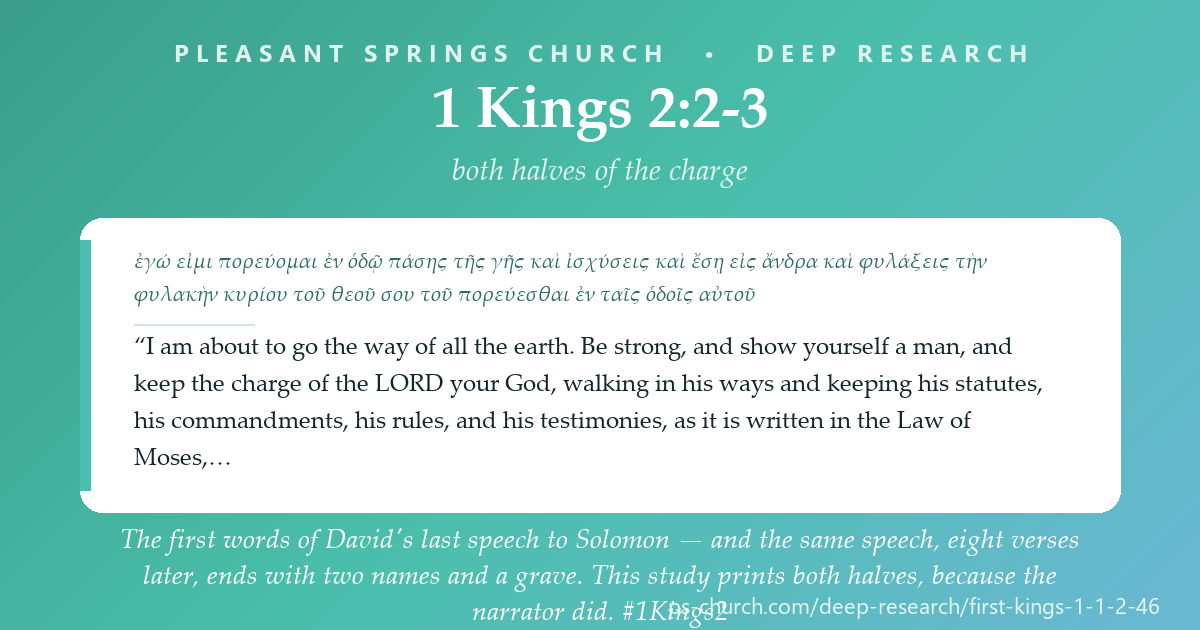
These are the same speech. Not two speeches, not an early David and a late David: one deathbed, one son in the room, nine verses. It begins as high covenant theology — go the way of all the earth, be strong, be a man, keep the charge of the Lord your God, walk in his ways, keep what is written in the Law of Moses, so that the promise to David’s house may stand (2:2–4). It ends with two names, a gray head, and Sheol (2:5–9). And the narrator sets them side by side and says absolutely nothing.
Readers have wanted him to for three thousand years. Chronicles solves it by deleting the second half. Ben Sira solves it by never mentioning it. Josephus solves it by blunting every phrase and adding an excuse. Christian preaching has often solved it by treating 2:1–4 as the “spiritual” part and 2:5–9 as regrettable ancient realpolitik we may skip. All four are solutions to a problem the text does not admit to having.
What can honestly be said. Four things, and no more. First, the charge is reported as David’s speech, not as God’s. Nothing in the passage says the Lord told David to say any of 2:5–9, and nothing in the passage says he was wrong to. Second, the reasons David gives are legal reasons and the book has already shown them to be true: Joab did kill Abner and Amasa in peacetime, and the blood-guilt legislation of Israel really does require that innocent blood be purged (Numbers 35:33). It is a demand for justice, unpaid for twenty years, and it is also a demand that his son pay it. Third, David swore an oath to Shimei and did not break it — and 2:8–9 is a plain instruction to have the thing done by a man who did not swear. The text does not excuse that and neither will we; it is the single hardest sentence in the passage and it stands. Fourth, the narrator gave us one sentence of comment on David in these chapters, and it was not flattering: he never asked his son a hard question (1:6). A man who could not confront a living son is now, dying, arranging the deaths of two other men through a third.
Where Scripture gives no verdict, we give none. This page will not tell you David was a monster and it will not tell you he was justified, because the book does neither, and a study that supplies the missing sentence has added to the word of God. What the book does do is refuse to protect its hero. Reading it whole is not a concession to critics; it is the reverence the text asks for. The Bible does not hand us a David we would have written. It hands us the one there was, and then it keeps its promise to him anyway — which is, in the end, the only kind of grace that would be of any use to us.
The commentaries, the kaige boundary, the Miscellanies debate, and the two questions this passage does not answer.
Cogan, Sweeney, DeVries, Provan, House and Wiseman on Kings; Alter, Auld and Brueggemann on the narrative; Barthélemy, Thackeray, Tov, Fernández Marcos and Gooding on the Greek. Then the two live questions — which arrangement of 3 Kingdoms is earlier, and what the narrator is doing when he approves exactly one thing.
Commentaries & studies:
- Mordechai Cogan, I Kings (Anchor Yale Bible) — the fullest recent treatment in English on the historical and epigraphic side; Marvin A. Sweeney, I & II Kings (OTL), strong on the literary shaping of the book as a whole; Simon J. DeVries, 1 Kings (WBC), for form and text.
- Iain W. Provan, 1 and 2 Kings (NIBC); Paul R. House, 1, 2 Kings (NAC); Donald J. Wiseman, 1 and 2 Kings (TOTC) — three evangelical treatments that differ from each other, usefully, on how much moral evaluation the narrator intends in chapter 2.
- A. Graeme Auld, Kings Without Privilege, on the relationship between Samuel–Kings and Chronicles; Walter Brueggemann, 1 & 2 Kings, for the political reading; Robert Alter, The David Story, whose translation and notes run through 1 Kings 2 and are the best single place to see the artistry of these chapters in English.
- Dominique Barthélemy, Les Devanciers d’Aquila (VTSup 10, 1963) — the book that established the kaige recension; H. St J. Thackeray, “The Greek Translators of the Four Books of Kings,” JTS 8 (1907), where the αβγδ section letters used in the codex note come from.
- Emanuel Tov, Textual Criticism of the Hebrew Bible; Natalio Fernández Marcos, The Septuagint in Context: Introduction to the Greek Version of the Bible, and (with J. R. Busto Saiz) El texto antioqueno de la Biblia griega II: 1–2 Reyes, the critical edition of the Antiochene text this page declines to quote at second hand.
- D. W. Gooding, Relics of Ancient Exegesis: A Study of the Miscellanies in 3 Reigns 2 (SOTS Monograph 4, 1976) — the standard study of the two blocks described in the codex note, and the strongest statement of the case that they are a later Greek rearrangement; Percy S. F. van Keulen, Two Versions of the Solomon Narrative (VTSup 104, 2005), a book-length comparison that reaches different conclusions.
Interpretation notes worth keeping:
- Which arrangement of 3 Kingdoms is earlier is genuinely unsettled, and this page does not settle it. Two serious positions. (1) The Greek rearranged. Gooding argued that the Miscellanies and the transpositions are secondary Greek work with a discernible exegetical agenda — grouping Solomon’s achievements, protecting his reputation, tidying a chronology. On this reading the Hebrew order is original. (2) The Greek translates an older Hebrew. Others — working from the Qumran discovery that several biblical books circulated in more than one Hebrew edition — hold that 3 Kingdoms renders a different and in places earlier Hebrew form of Kings, and that the Masoretic arrangement is the revision. What decides between them is not available to us: there is no Hebrew manuscript of a book of Kings arranged the Greek way, and the Qumran fragments of Kings are too slight to adjudicate. So the honest report is the one this page gives: here is what each text prints, and here is what is at stake, and the question is open.
- A caution about arguing from agreement in 1:1–2:11. Because those verses lie inside the kaige section, agreement between Rahlfs and the Masoretic Text is weak evidence that the oldest Greek agreed — the reviser’s whole purpose was to produce that agreement. Disagreements in that stretch (“restrained” at 1:6, “dancing” at 1:40, the three terms at 2:3, “the camps” at 2:8) are therefore more interesting than the agreements, because they survived a revision aimed at removing them. From 2:12 the situation inverts: there the Greek is the old translation, and its pluses — “a son of twelve years,” the Miscellanies — are evidence of something, even if scholars disagree about what. And a claim of the form “the Septuagint reads X here” still needs one more word before it means anything: which Septuagint. On the Antiochene text this page is silent by choice, not by oversight; see the texts we print.
- The narrator approves exactly one thing, and the argument is about what that means. 2:27 is the only sentence in the chapter in which the narrator himself says an act of Solomon’s did what God said. Some readers (House, Wiseman) take the whole purge as narratively endorsed, the necessary consolidation of a divinely chosen throne. Others (Brueggemann, and much of the literary reading) take the placement of that single endorsement as pointed: the narrator blesses the deposition of a priest and conspicuously does not bless the three deaths on either side of it. Both readings are readings. The text says what it says, once, about Abiathar. Everything else it reports.
- Chronicles and Kings are not to be blended, and the difference is not embarrassing. 1 Chronicles 23:1 compresses this entire night into one clause; 1 Chronicles 28–29 gives David a completely different last charge, delivered publicly, about the temple; 1 Chronicles 29:22 has Solomon made king “a second time,” which is the Chronicler’s only visible acknowledgement that there was a first. Two books, two purposes, two selections from the same events. A harmony that stitches them into one seamless narrative produces a text that neither author wrote. Report the difference; do not dissolve it.
- On Solomon’s age, say only what can be said. The Greek plus at 2:12 makes him twelve. Josephus calls him a youth. The Hebrew gives no figure anywhere. Since Rehoboam is forty-one at Solomon’s death after a forty-year reign (1 Kings 14:21), an accession at twelve creates an obvious difficulty, and various expedients have been proposed for it. This page reports the plus and the difficulty and proposes nothing. That is what the material supports.
- The date and composition of Kings are debated and nothing here turns on the outcome. The book’s last event is Jehoiachin’s release, about 561 BC, so it reached its present form no earlier than the exile; whether there was an earlier Josianic edition, and how the court narrative of 2 Samuel–1 Kings 2 relates to it, has been argued since Rost and is argued still. We name the positions and do not adjudicate. The claim these chapters make on a reader does not move with the date.
A cold king, a mule, a spring, a trumpet — and a last speech that has to be read whole.
Name what you learned, why it matters, and one concrete response.
What should we carry away — and do?
- The kingdom of God arrived through a very ordinary bad night. An old man in a cold bed, a son throwing a party, two people making a careful plan, a priest running for the oil, and a boy on a borrowed mule. Nothing about it looks like providence while it is happening. It looks like a palace coup that went the other way. The covenant of 2 Samuel 7 is being kept in that room, and no one in the room can see it.
- The one indictment the narrator makes is about parenting. “His father had never at any time displeased him by asking, ‘Why have you done thus and so?’” Out of ninety-nine verses, that is the sentence the narrator chose to add. The unasked question is the whole charge. Not cruelty, not neglect — a father who never once made his son uncomfortable, and a son who therefore never learned that anyone could tell him no.
- Read the last charge whole or do not read it. “Be strong, and show yourself a man, and keep the charge of the Lord your God” — and eight verses later, “do not let his gray head go down to Sheol in peace.” One speech. The Bible sets them next to each other and does not explain. If your Bible study has to remove one of the two halves before it can be used, the study is the problem.
- Two men grabbed the same altar in the same four words, and only one of them lived. Adonijah went home; Joab did not. The difference was not the strength of the grip. Israel’s own law said the altar shelters the man who killed without intent and not the man who killed by cunning (Exodus 21:14). Sanctuary was never a technique.
- A sentence about a priest nobody was watching closed a file opened four books earlier. “Thus fulfilling the word of the Lord that he had spoken concerning the house of Eli in Shiloh” (2:27). Between the oracle and its fulfilment lie roughly a hundred years, three kings, a lost ark and a civil war. God’s word does not expire because we stopped watching for it.
- And the differences between the columns are a gift, not a footnote. On this one page a reader can watch the Greek Bible change character in the middle of a chapter, count the four occurrences of καί γε that mark it, and see two blocks of text that exist in one Bible and not the other. That is not a threat to Scripture; it is the visible history of how Scripture reached the world, and this church would rather you saw it than were protected from it. See the texts we print.
A word about typology, clearly labelled. Three things, kept distinct. (1) What this text says: it does not announce itself as a picture of anything. It says a son of David was anointed by a priest, acclaimed by the people, seated on his father’s throne, and that the kingdom was established in his hand. (2) What the New Testament itself draws: Matthew 1:6–7 puts Solomon in the genealogy of Jesus Christ, and Luke 1:32–33 tells Mary that her son will receive “the throne of his father David… and of his kingdom there will be no end” — which is the promise Solomon quotes at 2:45, now given to someone else. That is the canon’s own move and it is solid ground. (3) What we see from this side of the cross: an anointed son brought down to a spring outside the city, acclaimed until the earth split with the noise, and a rival’s feast falling silent at the sound — and, later, a greater Son of David riding into the same city on a borrowed animal to shouting, whose throne was established by a death and not by one. The Old Testament does not say that; we are meant to see it. Both halves of that sentence are true and neither may be dropped. What we may not do is put our seeing into the text’s mouth, or make Solomon a figure of Christ in his character — the man who says “do not hold him guiltless” is not our high priest, and the book itself will spend chapter 11 telling you why.
Step in response: two things this week. First, ask somebody the question David never asked. Not an accusation — a question: why did you do that? Asked in love, early, it is one of the cheapest gifts there is, and 1 Kings 1:6 is what it costs not to ask it. Second, take one passage you have been skipping — the half of a chapter you never teach, the verse you hurry past — and read it out loud, whole, without a solution. Then sit with it. The book of Kings is in the Bible partly so that you know you are allowed to.
1 Kings 2:2–3 · to share
Greek (Rahlfs, 3 Kingdoms — kaige section) + ESVEvery Deep Research page traces its passage across the whole sweep — the Old Testament, the Second-Temple world between the testaments (historical witnesses, not Scripture), and the New Testament. Follow the thread:
Pleasant Springs Church — Deep Research
Research method after Michael S. Heiser’s Bible Research Method (examine dictionaries → ancient literature → important words → textual connections → academic publications → share), with the Pleasant Springs “Author & Audience” foundation. Scripture set in the Hebrew, the Greek editions named on each page and the ESV (Old Testament), and the Greek New Testament and the ESV (New Testament), per the practice of Pleasant Springs Church. 1 Kings 1–2 research grounded in Cogan (Anchor Yale), Sweeney (OTL), DeVries (WBC), Provan (NIBC), House (NAC), Wiseman (TOTC), Auld and Brueggemann, with Alter (The David Story) for the literary reading used in the structure block. ⚠️ The texts. The Greek Old Testament calls this book 3 Kingdoms (Βασιλειῶν Γʹ), the third part of a single four-book work, and puts no book division where an English Bible starts 1 Kings; the Greek column above is Rahlfs’s Septuaginta in the CATSS digitization, punctuation editorial, proper names unaccented. This page straddles a recension boundary. 2 Samuel 11:2 to 1 Kings 2:11 is the kaige section (Thackeray’s βγ; Barthélemy, Les Devanciers d’Aquila, 1963), so 1:1–2:11 above is a first-century revision toward a proto-Masoretic Hebrew and NOT the oldest Greek, while from 2:12 the Greek reverts to Old Greek — Vaticanus, on which Rahlfs’s Kingdoms text chiefly rests, is the revision in the kaige stretches, and the Antiochene (Lucianic) text frequently preserves an older reading there. The precise start of βγ is debated (some place it at 2 Samuel 10:1); its end at 3 Kingdoms 2:11 is standard. No Antiochene reading is cited, because the critical edition (Fernández Marcos and Busto Saiz, El texto antioqueno de la Biblia griega II) was not consulted; there is as yet no Göttingen 3 Kingdoms, and the fuller apparatus is Brooke–McLean. The kaige character is demonstrated from the text rather than asserted: in the whole of 3 Kingdoms καί γε occurs four times — 1:6, 1:48, 2:5 (all inside the section) and 22:22 (inside the second kaige section) — and not once in the twenty chapters between; and ἐγώ εἰμι stands before a finite verb for אָנֹכִי exactly once, at 2:2. These counts are ours and can be checked. On the policy, the texts we print. The rearrangement of 3 Kingdoms was verified against Rahlfs rather than repeated from a handbook, and only what was verified is reported: the Miscellanies at 2:35a–o (fourteen sub-verses, lettered a–i then k–o) and 2:46a–l (eleven), twenty-five in all; the absence of 3:1 from Rahlfs and the appearance of its content at 2:35c; the absence of 5:5–8 from Rahlfs and the appearance of that content at 2:46g and 2:46i; the alternate Jeroboam narrative at 12:24a–z; and Hebrew chapters 20 and 21 in reverse order. Which arrangement is earlier is a live dispute (Gooding on one side, van Keulen and the multiple-editions case on the other) and is deliberately not adjudicated here. Every divergence in the verses printed is enumerated in the codex line-notes — “grieved”/“restrained” at 1:6, the plus “O king” at 1:17, pipes/dancing at 1:40, four terms against three and the different final clause at 2:3, Mahanaim as “the camps” at 2:8, the plus “a son of twelve years” at 2:12, Absalom/Solomon and the plus “son of Zeruiah” at 2:28, and the plus “Solomon” with the missing closing clause at 2:46 — and where the columns agree (1:1, 1:5, 1:11, 1:33, 1:39, 1:50, 2:6, 2:9, 2:11, 2:27) that is said rather than left to silence. Two further divergences outside the printed verses are reported because they bear on 2:46: the Greek plus at 2:35 (“and the kingdom was set right in Jerusalem”; “first priest”) and the Greek plus “of the covenant” at 2:26. Numbering: there is no offset in this passage — Rahlfs has 53 verses in chapter 1 and 46 in chapter 2, exactly as the Hebrew and English do, counted rather than assumed, plus the twenty-five lettered sub-verses; the offset that begins at English 4:21 (= Hebrew and Greek 5:1) is stated because the Miscellanies point there. Chronicles is treated as a parallel witness and not harmonized: 1 Chronicles 23:1 reduces 1 Kings 1 to a clause, 1 Chronicles 28–29 gives a different last charge with no mention of Joab or Shimei, and 1 Chronicles 29:22 has Solomon made king “a second time”; the internal difference between 2 Samuel 5:5 (“seven years and six months”) and 1 Kings 2:11 (“seven years”) is likewise reported, not smoothed. ANE material is cited only where verified in the local scan of ANET: the Moabite Stone (ANET 320–321), the Gezer Calendar (ANET 320) and “Suppiluliumas and the Egyptian Queen” (ANET 319). Second-Temple and rabbinic witnesses (Sirach 47:11–22; Josephus, Ant. 7.14.4–5, 7.15.1–2, 8.1.1–5 in Whiston’s numbering; m. Sanhedrin 2:5; b. Sanhedrin 22a) are read as witnesses and never levelled with Scripture, and the Deuterocanon is tagged non-canonical at first mention. Pastoral fences. Abishag is reported exactly as the text reports her, without embellishment, and the narrative’s silence about her is named rather than filled. David’s charge is printed whole — both 2:2–3 and 2:5–9 — without moralizing, without excusing, and without omission, and the ancient retellings that delete or soften the second half are named as doing so. The deaths of Adonijah, Joab and Shimei are reported plainly and briefly and no share card is taken from them. Where the narrator gives no verdict, none is supplied: the page states that he endorses exactly one act (2:27) and reports the two main readings of that fact without choosing between them. The typology at Matthew 1:6–7 and Luke 1:32–33 is attributed to the New Testament; what the page sees from this side of the cross is labelled as such, neither undersold nor put into the Old Testament’s mouth, and is explicitly not extended to Solomon’s character. Solomon’s age at accession, and the date and composition of Kings, are reported with the positions named and deliberately not adjudicated.
Scripture quotations marked ESV are from the ESV® Bible (The Holy Bible, English Standard Version®), © 2001 by Crossway, a publishing ministry of Good News Publishers. ESV Text Edition: 2016. Used by permission. All rights reserved. The ESV text may not be quoted in any publication made available to the public by a Creative Commons license, and the ESV may not be translated in whole or in part into any other language. www.esv.org
|
Did this study bless you today? 💚 Give to Support PS Church100% of gifts go to the General Fund — thank you. |