Moses my servant is dead. The Torah closes with a funeral on a mountain, a grave nobody can find, and a promise still unkept — and then the Bible turns the page and God says the hardest true thing out loud and keeps going: “Moses my servant is dead. Now therefore arise, go over this Jordan” (1:2). This is the first page of the Historical Books, and it is a commissioning: the territory promised (1:3–4), the presence guaranteed — “just as I was with Moses, so I will be with you; I will not leave you or forsake you” (1:5) — and then the charge, three times and rising: be strong and courageous; only be strong and very courageous; have I not commanded you? Be strong and courageous (1:6, 7, 9). At the centre of the charge stands the strangest instruction ever given to a general on the eve of a campaign: read. “This Book of the Law shall not depart from your mouth, but you shall meditate on it day and night” (1:8) — and the Hebrew word for meditate means to mutter. Then Joshua speaks, the eastern tribes keep the promise they made in Numbers 32, and the people hand the command back to their commander: “Only be strong and courageous” (1:18). This study works Joshua 1:1–18. See the method →
Joshua 1:1–18 (selections)
Hebrew · LXX · ESVThe Shape of the Passage
InclusioJoshua opens the Historical Books and the block often called the Deuteronomistic History (Joshua–Kings) — the story told with Deuteronomy’s theology in its ear. Chapter 1 is the hinge: everything before it is Deuteronomy 34, and everything after it is the land.
Author
The book does not name its writer, and the honest answer is that we do not know who set it down. It reports events from inside the land and names sources it did not write (“the Book of Jashar,” 10:13). Jewish tradition (b. Bava Batra 14b–15a) assigns most of it to Joshua himself with the closing verses added later; modern scholarship reads it as the opening panel of a longer historical work. Neither of those is a doctrine, and this page does not need to settle it. What the page does need is the craft: whoever wrote chapter 1 built it out of three speeches and one repeated command, and put a book at the centre of it.
Notice what kind of opening this is. It is not “in the days of” and it is not a genealogy. It is a Hebrew narrative convention — וַיְהִי (wayhî, “and it came to pass”) — the join that makes a new scroll the continuation of an old one. Joshua begins mid-sentence, grammatically speaking, because the story is mid-sentence. Five books have been building toward a river, and here is the river.
And notice who is missing. Moses is named eleven times in this chapter and is dead in the first line of it. Every title he carries here is honorific — “the servant of the " + SC + "” (1:1, 13, 15), “my servant” (1:2, 7) — and every one of them is past tense. Joshua’s own title in 1:1 is not “prophet” or “leader” but מְשָׁרֵת מֹשֶׁה (məšārēt mōšeh), Moses’ assistant — the man who carried the bags (Exod 24:13; 33:11). He is introduced by the job he is about to stop doing.
Audience
A generation that has never had another leader. Everyone listening has spent their whole life under one man’s authority, and that man is gone, and the burial place is deliberately unknown — there is no shrine to go back to. Deuteronomy 34:10 says the succession will not be a replacement: “there has not arisen a prophet since in Israel like Moses, whom the " + SC + " knew face to face.” The new man is not the old man. That is stated, not hidden.
So what carries over? Two things, and the chapter names both. First, a presence: “just as I was with Moses, so I will be with you” (1:5) — continuity in God, not in the man. Second, a book: “all the law that Moses my servant commanded you” (1:7–8). Israel is being taught, at the very first opportunity, that its life will run on a text and a promise rather than on a personality. That is why this is the right first page for the Historical Books — and why the whole rest of the Old Testament can be read as the story of a people with a book they keep forgetting to read.
They have failed at this exact spot before. Forty years earlier a previous generation stood at the same border, heard the same report of fortified cities and giants, and refused (Numbers 13–14). Joshua was one of the two men who said go. The first audience of this chapter is a people who know exactly what a failure of nerve costs, because they buried the generation that had one.
Orient on Joshua, succession and commissioning, the Torah scroll, meditation, and the land promise.
Search by topic: Joshua (person and book), succession and installation of a leader, Deuteronomistic History, book of the law / Torah scroll, meditation, land promise and boundaries, Jordan, Transjordan tribes, herem and holy war (for later chapters).
Which articles are relevant?
- Anchor Bible Dictionary — “Joshua, Book of,” “Joshua (person),” “Deuteronomistic History,” “Jordan River,” “Land, Concept of,” “Torah.”
- Dictionary of the OT: Historical Books — “Joshua, Book of,” “Conquest,” “Leadership,” “Land,” “Law,” “Rest.”
- NIDOTTE / TDOT — חָזַק (ḥāzaq, be strong), אָמַץ (ʾāmaṣ, be firm/bold), הָגָה (hāgāh, mutter/meditate), שָׂכַל (śāḵal, have insight/succeed), עָבַר (ʿāḇar, cross over), נוּחַ (nûaḥ, rest).
Bibliography surfaced:
- Richard S. Hess (TOTC), David M. Howard Jr. (NAC), Trent C. Butler (WBC), Robert G. Boling (Anchor), Marten H. Woudstra (NICOT), L. Daniel Hawk (Berit Olam) on Joshua.
- Emanuel Tov and Leonard J. Greenspoon on the Greek text of Joshua — the standard starting point for the shorter Old Greek.
- Norbert Lohfink on the “installation” genre behind Deut 31 / Joshua 1 (encouragement formula + description of the task + assurance of divine assistance).
How the ancient world installed a successor — and what Israel put at the centre of the charge.
Read chapter 1 against the ANE installation of an official, then against the ancient practice of walking a boundary, then against how Second-Temple readers remembered Joshua.
Which parallels shed light on religion and worldview?
There was a genre for this. Ancient states installed new officials with a set piece: a charge, an encouragement, a statement of the task, and an assurance of backing. We have one from Egypt from the Eighteenth Dynasty, within a couple of centuries of the setting of this chapter on any of the usual datings. In the tomb of the vizier Rekh-mi-Re, appointed by Thut-mose III, the vizier records the pharaoh’s words at his summoning: the king “charged me very much: ‘Gather thyself together; be strong in action; do not flag’” (ANET 213). The formal installation text on the same tomb wall goes further, and the resemblance is startling: “Look thou to this office of vizier. Be vigilant over everything that is done in it… see to it for thyself that all things are done according to that which conforms to law… Behold, it is the official’s place of refuge to act in conformance with the regulations” (ANET 213). A new leader; a command to be strong; and a written norm named as the thing that will keep him safe. Joshua 1 is recognizably that kind of document.
And then watch what Israel changes. The vizier’s refuge is the regulations, and his backing is the king’s favour, which is exactly as durable as the king. Joshua’s refuge is a book he is told to keep in his mouth, and his backing is the sentence no Egyptian official was ever given: “I will not leave you or forsake you” (1:5). The genre is borrowed; the guarantor is not. Norbert Lohfink’s form-critical study of the “installation” pattern — encouragement, task, assurance of divine help — traces the same three beats through Deuteronomy 31 and Joshua 1, and it is worth noticing that in Israel the third beat is always God and never the crown.
Walking the land. “Every place that the sole of your foot will tread upon I have given to you” (1:3) is not a figure of speech about effort. In the ancient world a grant of land was taken up by traversing it: the boundary was walked, and the walking made the claim visible. The same idiom is given to Abraham (“Arise, walk through the length and the breadth of the land,” Gen 13:17) and repeated to Israel almost word for word at Deuteronomy 11:24. The tense is the point: I have given (perfect) — the deed is already signed; the walking is possession, not purchase. (The Greek reads a future here, ὑμῖν δώσω αὐτόν, “I will give it to you” — the promise is the same, but the Hebrew has already closed on it.)
The boundaries in 1:4 are the largest ones ever named — wilderness to Lebanon, the Euphrates to the Mediterranean — and they are not what the book goes on to describe Israel occupying. Joshua 1 states a horizon; the rest of the book, and the honest summaries in it (13:1, “there remains yet very much land to possess”), state a reality. The tension is in the text, and the text is not embarrassed by it.
- “The Installation of the Vizier” and the autobiography of Rekh-mi-Re (ANET 212–214; 18th Dynasty, under Thut-mose III) (Egyptian documents — witnesses, not Scripture) — the closest available parallel to Joshua 1:6–9: a new official installed with a charge to be strong and a written norm named as his refuge.
- Hittite suzerainty treaties (ANET 199–206) (ANE documents — witnesses, not Scripture) — the treaty world in which a granted territory is described by its boundaries and a vassal is charged to keep a written text; the same conventions Deuteronomy uses.
- Sirach 46:1 (Second-Temple — a witness, not Scripture) — Κραταιὸς ἐν πολέμοις Ἰησοῦς Ναυη καὶ διάδοχος Μωυσῆ ἐν προφητείαις: “Joshua son of Nun was mighty in war, and was the successor of Moses in the prophetic office” — and then the wordplay on the name, “who became, according to his name, great in the saving of God’s elect.”
- Josephus, Antiquities 5.1–19 (Second-Temple — a witness, not Scripture; = Whiston 5.1.1–2, and the words quoted here are Whiston’s) — his retelling opens exactly here: Joshua orders the army to prepare, sends the spies to Jericho, and summons the Reubenites, Gadites and half-Manasseh, reminding them “what they had promised Moses.”
- 4Q379 (“Apocryphon of Joshua”) and its use in 4Q175 (Testimonia) (Dead Sea Scrolls — witnesses, not Scripture) — evidence that Joshua traditions were still being written and quoted in the Second-Temple period; the Testimonia sheet quotes the Apocryphon’s curse on the rebuilder of Jericho (cf. Josh 6:26) alongside its messianic proof-texts.
The most theologically loaded thing in this chapter is a gap. Moses had the burning bush, the plagues, the sea, the mountain, the face-to-face. Joshua gets none of that. Numbers 27:18–21 had already set the terms of the handover, and they are strikingly reduced: Joshua is to stand before Eleazar the priest, who will inquire for him by the Urim, and he is given “some of” Moses’ authority — not all of it. Deuteronomy 34:10 then says the quiet part out loud: no prophet like Moses has arisen since.
So Israel enters the land under a leader who is explicitly not the equal of the founder. And the chapter is entirely calm about it, because it has already told you what will carry the nation instead: a promise (“I will be with you”) and a scroll (“this Book of the Law”). This is the moment Israel’s religion becomes portable. It no longer depends on one irreplaceable man; it depends on a word that can be copied, carried, read aloud, and obeyed by anyone. Every generation since — including yours — has lived on that arrangement.
Two imperatives, a growled book, and a word for success that the Greek read as understanding.
Watch chazaq ve-ematz run four times through the chapter; then hagah, which means to mutter; then taskil, where the whole prosperity argument lives.
“Be strong and courageous” — two imperatives, not two adjectives. חָזַק is to hold firm, to grip; אָמַץ is to be firm, resolute, unyielding. Neither word describes a feeling; both describe a stance you take. The Greek renders the pair ἴσχυε καὶ ἀνδρίζου, “be strong and play the man.” Note the Greek Joshua puts the two in the opposite order from the Greek Deuteronomy, which always reads ἀνδρίζου καὶ ἴσχυε (Deut 31:6, 7, 23) — a small fingerprint of a different translator, though the Hebrew pair is identical in both books.
“Meditate” — and the root means to mutter, growl, moan. It is what a lion does over its prey (Isa 31:4) and what a mourning dove does (Isa 38:14). This is not silent reflection; it is reading aloud under your breath, over and over, until the words are worn into you. It is the same verb as Psalm 1:2, and the Greek uses the same word and the same phrase in both places: μελετήσεις… ἡμέρας καὶ νυκτός.
“The Book of the Law” (LXX ἡ βίβλος τοῦ νόμου) — a physical scroll, already written, already handed over (Deut 31:9, 24–26). The first thing the new commander is told to do with it is keep it in his mouth. Israel’s leaders are readers before they are anything else — the same demand is laid on the king at Deuteronomy 17:18–20, who must write out his own copy and read it “all the days of his life.”
“You will have good success” (ESV) — but the root שָׂכַל means to have insight, act wisely, deal prudently, and only by extension to prosper. The Greek translator heard the first sense and not the second in this word: ἵνα συνῇς (1:7) and καὶ τότε συνήσεις (1:8) — “that you may understand… and then you will understand.” He did render the other verb of 1:8, תַּצְלִיחַ, with the language of prospering (εὐοδωθήσῃ… εὐοδώσεις τὰς ὁδούς σου) — so the Greek keeps both halves and refuses to collapse them into one. Before this word is made to promise anyone a return, it should be allowed to promise what its oldest translators thought it promised: sense.
“I will not leave you” — literally I will not let go slack of you, from רָפָה, to sink, drop, relax the hand. Paired with וְלֹא אֶעֶזְבֶךָּ, “and I will not abandon you.” The image is a grip that does not loosen, not merely a companion who stays. Rahlfs renders it οὐκ ἐγκαταλείψω σε οὐδὲ ὑπερόψομαί σε, “I will not forsake you nor overlook you.”
“Cross over” — the verb that will run through the next three chapters and give the crossing its name. It is also the root behind עֵבֶר, the “other side” (1:14–15), and the word from which “Hebrew” is usually derived. A people defined by having come across is told, again, to come across.
“Giving you rest” (LXX κατέπαυσεν) — the goal of the whole campaign, stated before a single battle. Rest here is a settled land, not a mood. Watch the two tenses: a participle at 1:13 (κατέπαυσεν, already done) and an imperfect at 1:15 (יָנִיחַ, ἕως ἂν καταπαύσῃ, not yet). The New Testament takes the word up and says Joshua never finally delivered it: “if Joshua had given them rest, God would not have spoken of another day later on” (Hebrews 4:8–9; see Hebrews 4:14–16).
The Greek spells Joshua’s name Ἰησοῦς — the same six letters the New Testament uses for Jesus. יְהוֹשֻׁעַ means “the Lord saves.” Ben Sira already plays on it (Sirach 46:1, “great according to his name in the saving of his elect”), and Hebrews trades on it openly at 4:8. That is a fact about the language, not an allegory read into the story.
1:8 and the prosperity reading — what the verse says, and what it does not:
“Then you will make your way prosperous, and then you will have good success” is one of the most-quoted verses in Christian publishing, and it is regularly read as a general law: input Scripture, output money and outcomes. That reading does not survive contact with the verse.
- The success is named, and it is not yours. The context defines it two verses earlier: “you shall cause this people to inherit the land that I swore to their fathers” (1:6). The promised outcome is a specific commission given to a specific man — get Israel into the land God swore to Abraham. The verse is not a formula; it is a job description with an assurance attached.
- The means is a book, and the verb is do. “That you may be careful to do according to all that is written in it” (1:8; the same phrase in 1:7). Obedience, not recitation, is what the promise is fastened to. Any reading that keeps the outcome and drops the obedience has kept the wrong half.
- The oldest translators did not hear ‘prosperity’ in taskil. The Greek renders תַּשְׂכִּיל twice with συνίημι, “understand” — “and then you will understand.” (It does hear it in the other verb: תַּצְלִיחַ becomes εὐοδωθήσῃ … εὐοδώσεις τὰς ὁδούς σου. So the Greek keeps both halves and refuses to collapse them into one.) The Hebrew root genuinely carries both insight and success; the Septuagint translator picked insight both times he met it.
- The same book says the opposite is also true. The covenant this scroll contains attaches loss and exile to disobedience just as firmly as it attaches blessing to obedience (Deuteronomy 28). Take 1:8 as a mechanism for wealth and you must take chapter 28 as one for ruin — and neither is how a covenant works.
- And the New Testament’s own leaders were promised something else. The apostles were told to expect suffering, and Hebrews holds up people who “did not receive what was promised” in this life (Hebrews 11:39). A gospel that guarantees returns has to erase most of the New Testament to do it.
But do not empty the promise to be safe from it. The verse does say that God fastens outcome to obedience here, and the book goes on to say he kept his word: “Not one word of all the good promises that the Lord had made to the house of Israel had failed; all came to pass” (Josh 21:45). What is denied is the mechanism, not the faithfulness. The right way to preach 1:8 is the way it is written: here is what I have called you to do; here is the book that tells you how; keep it in your mouth day and night, and I will be with you while you do it.
From Deuteronomy’s charge to Hebrews’ quotation — and to a rest Joshua never gave.
Trace three threads: the “be strong and courageous” charge backwards into Deuteronomy; the promise of 1:5 forwards into Hebrews 13:5; and “rest” forwards into Hebrews 3–4.
Which cross-references matter?
- Deuteronomy 31:1–8, 23 — the same charge, four times, before Moses dies: “Be strong and courageous… he will not leave you or forsake you” (31:6), spoken to the nation, then to Joshua in front of everyone (31:7), then by God himself (31:23). Joshua 1 is God repeating in private what Moses had said in public.
- Numbers 27:12–23 — the commissioning proper: hands laid on, authority given, and the Urim named as the channel. Read it alongside Deuteronomy 1:38 (“encourage him, for he shall cause Israel to inherit it”) and Deuteronomy 34:9 (“full of the spirit of wisdom, for Moses had laid his hands on him”).
- Numbers 32:16–32 — the pledge Joshua calls in at 1:12–15. Reuben, Gad and half-Manasseh had asked for land east of the Jordan and promised to cross over armed ahead of their brothers and not go home until the others had their inheritance. Chapter 1 is that promise being collected, and 1:16–18 is them honouring it.
- Deuteronomy 11:24–25 — “Every place on which the sole of your foot treads shall be yours… no one shall be able to stand against you”: 1:3–5 is quoting the sermon almost word for word. See also Genesis 13:14–17 and Genesis 15:18–21 for the same boundaries promised to Abraham.
- Deuteronomy 17:18–20 — Israel’s king must write out his own copy of this law and read it all his days. The instruction given to Joshua in 1:8 is the one Israel’s leaders will be measured by from here to the exile — and the moment a lost scroll is found again is treated as a national emergency (2 Kings 22).
- Psalm 1:1–3 — the same verb (הָגָה), the same phrase (“day and night”), the same Greek (μελετήσει ἡμέρας καὶ νυκτός), and the same promise of prospering. What Joshua 1 says to one commissioned man, Psalm 1 opens to every reader — and Psalm 1 sits at the front of the Psalter for the same reason 1:8 sits at the centre of this chapter.
- Numbers 13–14 — the failure this chapter is quietly answering. “Do not be frightened, and do not be dismayed” (1:9) is addressed to the man who watched a nation lose its nerve at this border and spend forty years paying for it.
- Exodus 14 — the sea; and the Jordan crossing to come (Joshua 3–4) is told deliberately in its language. God bookends the wilderness with two crossings.
Hebrews 13:5 steadies a congregation about money with a quotation: “for he has said, Οὐ μή σε ἀνῶ οὐδ᾽ οὐ μή σε ἐγκαταλίπω” — “I will never leave you nor forsake you.” It is worth being exact about where those words come from, because it is not as simple as a footnote makes it look.
Set the Greek side by side. Joshua 1:5 (Rahlfs) reads οὐκ ἐγκαταλείψω σε οὐδὲ ὑπερόψομαί σε — God speaking in the first person, but with ὑπεροράω (“overlook”) as the second verb. Deuteronomy 31:6 reads οὐ μή σε ἀνῇ οὔτε μή σε ἐγκαταλίπῃ, and 31:8 οὐκ ἀνήσει σε οὐδὲ μὴ ἐγκαταλίπῃ σε — exactly the pair of verbs Hebrews uses (ἀνίημι + ἐγκαταλείπω), but in the third person, because there Moses is talking about God, not as him. Hebrews has the verbs of Deuteronomy 31 and the person of Joshua 1:5, and matches neither exactly. So the careful thing to say is that Hebrews is taking up a promise that stands in a stream of texts, in a Greek form close to one of them, rather than quoting a single verse flat.
One more datum, and it is a good one: Philo of Alexandria quotes the promise in precisely Hebrews’ wording — οὐ μή σε ἀνῶ οὐδ᾽ οὐ μή σε ἐγκαταλίπω — in On the Confusion of Tongues 166, decades before Hebrews was written. Two Greek-speaking Jewish writers cite the sentence in the same fixed form — whether independently or from a shared Alexandrian stock is debated. That is the sort of evidence that suggests the promise circulated as a saying in Greek-speaking synagogues, already worn smooth by use, before either of them reached for it. Which is rather the point of the promise.
The commentators on Joshua, the Greek text of the book, and the questions this chapter opens.
Hess, Howard, Butler, Boling, Woudstra and Hawk on Joshua; Tov and Greenspoon on the Old Greek; Lohfink on the installation genre.
Commentaries & studies:
- Richard S. Hess, Joshua (TOTC); David M. Howard Jr., Joshua (NAC); Trent C. Butler, Joshua (WBC); Robert G. Boling, Joshua (Anchor); Marten H. Woudstra, The Book of Joshua (NICOT); L. Daniel Hawk, Joshua (Berit Olam) — the last especially on the book’s literary shaping.
- Emanuel Tov, “The Growth of the Book of Joshua in the Light of the Evidence of the LXX Translation” (repr. in The Greek and Hebrew Bible) — the standard argument that the shorter Greek reflects a shorter Hebrew Vorlage rather than a translator’s abridgement.
- Leonard J. Greenspoon, Textual Studies in the Book of Joshua — on the Greek Joshua and its later revisions.
- Norbert Lohfink’s study of the “installation of a leader” form (Deut 31; Josh 1; 1 Chr 22, 28), taken up by Hess and Howard.
- G. K. Beale & D. A. Carson, eds., Commentary on the New Testament Use of the Old Testament (Hebrews).
Interpretation notes worth keeping:
- The Greek Joshua is a different-length book, and this chapter shows it. Roughly 4–5 percent shorter overall — and in 1:1–9 alone, four clauses of the Hebrew have no Greek counterpart (see the codex note). Tov’s case is that the translator was rendering a genuinely shorter Hebrew manuscript. That is a live scholarly debate, not a settled result, and it should not unsettle anyone: the church has read Joshua in both forms since the beginning, and nothing doctrinal turns on the missing phrases here.
- Courage is commanded, which means it is not primarily a feeling. Every occurrence of the charge is an imperative, and the ground given is never Joshua’s temperament but God’s presence (1:5, 9, 17). You cannot order someone to feel brave. You can order them to act, and tell them who is with them while they do — which is what the text does, four times.
- 1:18 must be reported, not skipped. “Whoever rebels against your commandment… shall be put to death.” This is the eastern tribes proposing military discipline for a nation on campaign, and it is severe. It is worth saying plainly that it is their sentence, not God’s command in this chapter, and that the very next clause is “only be strong and courageous” — but that observation softens nothing about the sentence itself, and the page will not pretend otherwise.
- This chapter commissions the taking of a land, so the fence belongs here too. What follows in chapters 6–12 is divinely commanded warfare, and it must be handled the way this library handles it: as a bounded, judicial act at a unique moment in redemptive history, on nations whose iniquity Genesis 15:16 says was “not yet complete” four centuries earlier — and under the same standard, since the same book promises Israel the same judgment for the same sins (Deut 28; and, in the event, the exile). The difficulty is real and this page does not dissolve it with a slogan. Say plainly what must be said: this text licenses no violence, coercion, or ethnic hostility by anyone today. It has been misused — repeatedly, in real history — to bless conquest and dispossession, and no reader of this page may use it that way. The church does not wrestle against flesh and blood (Eph 6:12); its weapons are not of the flesh (2 Cor 10:4); its Lord rebuked the disciples who wanted fire from heaven (Luke 9:54–55) and told Peter to put the sword away (Matt 26:52). The conquest chapters are taken up in Joshua 6 and Joshua 7–8.
- The boundaries of 1:4 and the “land that remains” of 13:1 sit in the same book. Commentators read the relation variously — a horizon of promise versus a record of possession; an ideal extent realized only briefly under David and Solomon; a deliberate narrative tension the book never resolves. It is honest to say the text states both and does not explain the gap.
- Joshua 21:43–45 is the book’s own verdict on chapter 1 — “not one word… had failed” — and it sits in the same book as 13:1 and Judges 1. Reading them together, rather than choosing one, is the beginning of reading Joshua honestly.
From “Moses my servant is dead” to “be strong and courageous.”
Name what you learned, why it matters, and one concrete response.
What should we carry away — and do?
- God speaks first, and he speaks past the grave. The Torah ends in a funeral and an unkept promise. The next sentence is not a eulogy; it is a commission. Whatever ending you are standing in, it is not the last sentence.
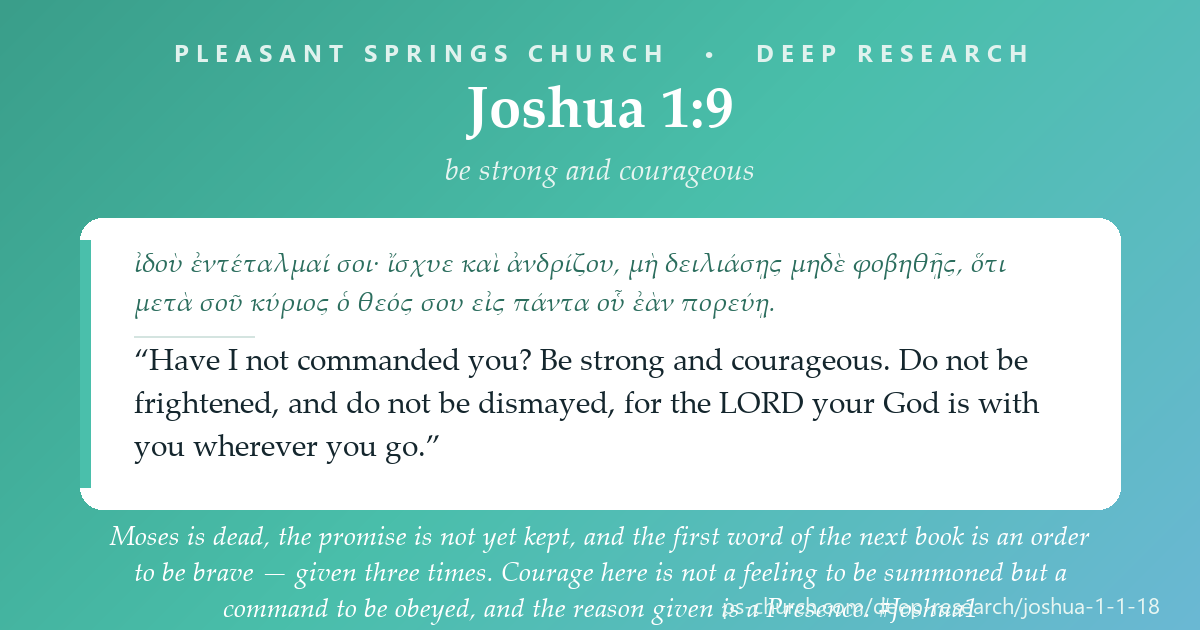
- Courage is a command, not a mood. You are not asked to feel brave before you obey. You are asked to obey, on the ground that someone is with you — “the Lord your God is with you wherever you go” (1:9). That is the whole argument, and it is enough.
- The successor is handed a book, not a personality. Joshua is not Moses and is never told he is. What carries over is a promise and a scroll — which is exactly what has been handed to you. A church that has understood Joshua 1 is not looking for another Moses.
- Meditation is muttering. הָגָה is a low, repeated, out-loud kind of reading. Not a technique — a habit. Day and night, until the words are in your mouth before they are needed.
- 1:8 is not a formula for getting what you want. The success it names is the job God gave; the means is obedience to a book; and the promise is that he will be with you while you do it. Keeping the outcome and dropping the obedience is not faith in the verse — it is not reading the verse.
- Keep the word you gave. The last third of the chapter is two and a half tribes honouring a promise made years earlier, at real cost, for the sake of people who did not need them. That is the only thing in this chapter the people do, and the narrator puts it right after the charge on purpose.
Step in response: pick the thing you have been avoiding because you do not feel brave enough for it — the conversation, the apology, the obedience — and do it this week anyway, on the strength of 1:9 rather than on the strength of your nerve. And put one short passage in your mouth: read it aloud, under your breath, morning and night, every day until Sunday. Not to master it. To be worn smooth by it.
Joshua 1:9 · to share
LXX + ESVEvery Deep Research page traces its passage across the whole sweep — the Old Testament, the Second-Temple world between the testaments (historical witnesses, not Scripture), and the New Testament. Follow the thread:
Pleasant Springs Church — Deep Research
Research method after Michael S. Heiser’s Bible Research Method (examine dictionaries → ancient literature → important words → textual connections → academic publications → share), with the Pleasant Springs “Author & Audience” foundation. Scripture set in the Hebrew, the Greek editions named on each page and the ESV (Old Testament), and the Greek New Testament and the ESV (New Testament), per the practice of Pleasant Springs Church. Joshua 1:1–18 research grounded in Hess, Howard, Butler, Boling, Woudstra and Hawk, with Tov and Greenspoon on the Old Greek of Joshua and Lohfink on the installation-of-a-leader form. ANE background from the Egyptian “Installation of the Vizier” and the autobiography of Rekh-mi-Re (ANET 212–214) and the Hittite treaties (ANET 199–206); Second-Temple and later witnesses (Sirach 46:1, Josephus Ant. 5.1–19, Philo On the Confusion of Tongues 166, 4Q379 with 4Q175, and b. Bava Batra 14b–15a on authorship) read as witnesses, not Scripture. Numbering: Joshua 1 carries no chapter- or verse-offset — MT, Rahlfs and English all read 1:1–18 alike; Psalm 1, cited here, likewise agrees in all three (the Psalter’s LXX/MT offset begins at Ps 9/10). Text: Greek from Rahlfs, verified against Swete’s Vaticanus-based edition, with the divergences printed rather than smoothed; the Old Greek of Joshua is roughly 4–5 percent shorter than the Masoretic Text, and the four minuses in this chapter are flagged in the codex note rather than padded from the Hebrew. Joshua 1:8 is preached as it stands and the prosperity-gospel reading is ruled out explicitly without emptying the promise; 1:18 is reported rather than skipped; and the conquest to come is fenced as bounded, judicial and unrepeatable, and never as a warrant for any nation, ethnicity or church today.
Scripture quotations marked ESV are from the ESV® Bible (The Holy Bible, English Standard Version®), © 2001 by Crossway, a publishing ministry of Good News Publishers. ESV Text Edition: 2016. Used by permission. All rights reserved. The ESV text may not be quoted in any publication made available to the public by a Creative Commons license, and the ESV may not be translated in whole or in part into any other language. www.esv.org
|
Did this study bless you today? 💚 Give to Support PS Church100% of gifts go to the General Fund — thank you. |