You have not passed this way before. Five books have been walking toward this river, and the Torah ended with Moses on a mountain looking at a land he would not enter. Now the camp moves down to the water and waits three days, and the officers come through with one instruction — not a battle plan, a marching order for a procession: when you see the ark, follow it, and stay two thousand cubits back, “in order that you may know the way you shall go, for you have not passed this way before” (3:4). Then: “Consecrate yourselves, for tomorrow the Lord will do wonders among you” (3:5). The Jordan is at flood. Nothing moves until the priests’ feet are wet — and then the water coming down from above stands and rises “in a heap very far away, at Adam, the city that is beside Zarethan” (3:16), and the priests stand firm on dry ground in the middle of the riverbed until all the nation finished passing over — the word “finished” drummed five times in thirteen verses. And then twelve men carry twelve stones out of the riverbed on their shoulders, and Joshua sets them up at Gilgal — and gives the reason twice, and the reason is a child: “When your children ask in time to come, ‘What do those stones mean to you?’ then you shall tell them” (4:6–7). This study works Joshua 3:1–4:24. See the method →
Joshua 3:1–4:24 (selections)
Hebrew · LXX · ESVThe Shape of the Passage
Fivefold refrainThis is the second movement of Joshua. Chapter 1 is the commission — “arise, go over this Jordan” (Joshua 1); chapter 2 is the reconnaissance and Rahab’s confession (Joshua 2); chapters 3–4 are the crossing itself, told at about a tenth of the speed a military report would need. Then Gilgal — circumcision, Passover, the manna stopping (Joshua 5) — and only then a city (Joshua 6).
Author
The book is anonymous. It never names its writer. The old rabbinic baraita on who wrote which book says plainly, “Joshua wrote his own book and eight verses in the Torah” (b. Bava Batra 14b–15a) — a tradition worth knowing and worth reporting as a tradition. The text itself gives a different kind of evidence: twice in these two chapters it looks back from a later vantage. The stones in the riverbed “are there to this day” (4:9), and Joshua is remembered as feared “all the days of his life” (4:14) — a sentence only a later writer can write; the crossing is being told to people who can go and look. Where Scripture does not name an author we do not manufacture one.
What kind of writing this is. Not a campaign log. A campaign log would say: the army forded the Jordan at flood stage and encamped at Gilgal. That is one sentence, and this narrator spends forty-one verses. He stops to record the marching order, the two-thousand-cubit gap, the day of the month, the exact wording of an instruction given to officers and then given again to priests and then carried out. He repeats himself on purpose. What he is describing is a procession, and he is describing it the way liturgy is described — because the crossing was remembered, and probably re-enacted, as worship. The one thing he does not describe is a mechanism. The water stops; he says who stopped it and when, and that is all.
The narrator’s two favourite devices are both here. He threads a single word through the passage until you cannot miss it (finished, five times), and he tells the same speech twice with the second version enlarged. Reticence is the other half of the technique: he never tells us what the priests felt standing in a riverbed with a wall of water upstream. The gap is deliberate, and it is where the reader is invited in.
Audience
A generation that was not there. Everyone crossing this river was either a child at Kadesh or not yet born. Their parents saw the sea open and died in the wilderness anyway (Numbers 13–14). So God does it again. That is the plainest thing in the passage and the easiest to miss: the Red Sea was forty years ago and belonged to other people, and this generation is given its own crossing, with the same verb (hōbîš, “dried up”) used of both in one sentence (4:23). Nobody here has to live on a borrowed memory.
And a generation after that one. The stones are not for the people who carried them. Twice the text says why they exist, and both times the audience is a child who will one day walk past a pile of river rock at Gilgal and ask about it. That is a strange way to build a monument. Most monuments explain themselves — an inscription, a name, a date. This one explains nothing. It is designed to be unintelligible without a parent, which means the memory can only travel by conversation. Compare the Passover, built the same way (“when your children say to you, ‘What do you mean by this service?’” — Exod 12:26; 13:14) and the great catechism of Deuteronomy 6:20–25: “When your son asks you in time to come… then you shall say.” Israel’s faith is transmitted by leaving questions lying around.
And, at the far edge, everybody else. The last verse widens past Israel entirely: “so that all the peoples of the earth may know that the hand of the Lord is mighty” (4:24). The stones are for the children; the crossing is for the world. Both audiences are named in the text and neither is optional.
Orient on the ark, the Jordan, Gilgal, standing stones, memorial and sign, and the geography of the crossing.
Search by topic: ark of the covenant, Jordan River, Gilgal, Adam (city) and Zarethan, Shittim, standing stones (matstsebah) and memorial, sign and memorial (oth, zikkaron), consecration / sanctification, priesthood and Levites, holy war and procession, Jericho.
Which articles are relevant?
- Anchor Bible Dictionary — “Ark of the Covenant,” “Jordan River,” “Gilgal,” “Adam (place),” “Zarethan,” “Shittim,” “Pillar, Cultic (Massebah),” “Joshua, Book of.”
- Dictionary of the OT: Historical Books — “Joshua, Book of,” “Ark of the Covenant,” “Jordan,” “Gilgal,” “Memory and Memorial,” “Priests and Levites,” “Land.”
- NIDOTTE / TDOT — עָבַר (ʿāḇar, cross over), תָּמַם (tāmam, be finished), נֵד (nēḏ, heap), אָרוֹן (ʾārōn, ark), אוֹת (ʾōṯ, sign), זִכָּרוֹן (zikkārōn, memorial), קָדַשׁ (qāḏaš, consecrate).
- Bible atlases for the fords of the Jordan, the location of Adam (usually identified with Tell ed-Damiyeh, some 26 km upstream) and the still-unsettled site of Gilgal.
Bibliography surfaced:
- Richard S. Hess (TOTC), David M. Howard Jr. (NAC), Trent C. Butler (WBC), Marten H. Woudstra (NICOT), Robert G. Boling (AB), L. Daniel Hawk (Berit Olam) on Joshua.
- Emanuel Tov and Leonard J. Greenspoon on the Greek Joshua; Eugene Ulrich and Kristin De Troyer on the Qumran Joshua manuscripts.
- Robert Alter, The Art of Biblical Narrative, for Leitwort and for repetition with variation.
- Klaus Bieberstein, Josua—Jordan—Jericho (OBO 143), on the archaeology, history and theology of Joshua 1–6.
A king’s memorial stone and a father’s answer; a river at flood; and what the ancient readers did with the miracle.
Read the stones against the ANE habit of erecting a monument to a god’s deliverance; read the flooded Jordan against what is known of the river; then watch Josephus shrink the miracle and the rabbis enlarge it, and notice that Ben Sira leaves the crossing out altogether.
Which parallels shed light on religion and worldview?
The ancient world was full of memorial stones — and they all say the same thing about the man who put them up. The best-preserved example from Israel’s immediate neighbourhood is the Moabite Stone, set up by King Mesha of Moab in the ninth century (ANET 320–321). It begins: “I (am) Mesha, son of Chemosh-[…], king of Moab, the Dibonite… I made this high place for Chemosh in Qarhoh… because he saved me from all the kings and caused me to triumph over all my adversaries.” A god delivered; a king raises a stone; the stone carries the king’s name in the first word and his campaign record for thirty-four lines. That is the genre. Now read Joshua 4 against it. Twelve unshaped stones out of a riverbed. No inscription. No name — not Joshua’s, not anyone’s. And the mechanism by which the monument is supposed to work is not reading but asking: a child sees the pile, does not understand it, and has to be told. Mesha’s stone is designed so that no one has to ask. Joshua’s stones are designed so that somebody must.
The river. The narrator notes almost in passing that this was the worst possible season: “the Jordan overflows all its banks throughout the time of harvest” (3:15) — spring, the barley harvest, the snowmelt off Hermon. The Greek makes it “the days of wheat harvest” (ἡμέραι θερισμοῦ πυρῶν). The Jordan in the lower valley runs through a soft marl gorge, and landslips upstream near Tell ed-Damiyeh — the usual identification of the Adam of 3:16 — are reported to have blocked the river temporarily on several occasions in the medieval and modern periods, the 1927 earthquake being the case most often cited in the commentaries. That is background worth knowing and it is worth stating exactly what it is: a description of what the Jordan can do, not an explanation of what the text says happened. Scripture gives no mechanism. It gives a time — the moment the priests’ feet touched the water — and an agent. Both a naturalistic reconstruction and a triumphalist one go past the sentence the narrator actually wrote.
Josephus makes the miracle smaller. Retelling the crossing for a Greco-Roman readership, he has Joshua worried about bridges and ferry-boats, and then: “as soon as the priests had entered the river first, it appeared fordable, the depth of the water being restrained and the sand appearing at the bottom” (Ant. 5.16–20 / 5.1.3–4). No heap, no wall, no upstream city. And then something that matters for this page: Josephus says Joshua built an altar out of the twelve stones taken from the riverbed and offered sacrifice on it — the first altar in the land, right there at the crossing. Hold on to that; it comes back in Stage 5.
The rabbis make it larger. In b. Sotah 34a the discussion begins exactly where the text does — that the water only moved once the priests’ feet were in it — and then asks how high the heap stood. R. Yehuda says twelve mil, the width of the camp; R. Elazar son of R. Shimon objects that water moves faster than people and the camp would have drowned; the conclusion offered is “heaps upon heaps” more than three hundred mil high, “until all the kings of the East and West saw it” — reasoning straight from 4:24, that all the peoples of the earth should know. The same page reports that Abba Ḥalafta and two colleagues once stood on those very stones at Gilgal and weighed them at about forty se’ah apiece.
And Ben Sira leaves it out. Sirach 46:1–8 is the Second-Temple hymn to Joshua: “mighty in war,” the successor of Moses, the sun standing still, the hailstones, the wars of the Lord. The crossing of the Jordan is not in it. It is a small thing and it is worth noticing: the moment the book of Joshua slows down for two whole chapters is the moment a later admirer skips, because what Ben Sira wanted from Joshua was a warrior. The book itself gives its first two chapters in the land to a procession and a pile of rocks.
- The Moabite Stone (Mesha Inscription), ANET 320–321 (ANE royal inscription — a witness, not Scripture) — a god “saved me from all the kings,” so a king raises an inscribed monument with his own name at the head of it. The genre against which Joshua’s uninscribed, anonymous, question-shaped memorial should be read.
- Josephus, Antiquities 5.16–20 (5.1.3–4) (Second-Temple — a witness, not Scripture) — the river merely “fordable”; and the twelve stones from the riverbed built into an altar on which Joshua sacrifices, immediately after the crossing.
- Sirach 46:1–8 (Second-Temple — a witness, not Scripture) — the praise of Joshua: war, the sun standing still, hailstones. The Jordan crossing is absent.
- b. Sotah 34a (rabbinic-era — a witness, not Scripture) — the dispute over the height of the standing water (twelve mil vs. “heaps upon heaps” over three hundred), argued from 4:24 and 5:1; and the tradition that the Gilgal stones were later measured at about forty se’ah each.
- b. Bava Batra 14b–15a (rabbinic-era — a witness, not Scripture) — the baraita on the writing of the books: “Joshua wrote his own book and eight verses in the Torah.”
It is worth sitting with how little this narrator explains. He tells you the season, so you know the river was impassable. He tells you the distance upstream, so you know the water piled somewhere real. He tells you the day of the month. He tells you where every man was standing. And on the one question a modern reader most wants answered — how — he is silent, and the silence is not an oversight, because he is otherwise the most detail-obsessed writer in the chapter.
Two kinds of reader lose the passage here in opposite directions. One reaches for the landslide and feels relieved; the other reaches for the landslide and feels attacked. Both have quietly changed the subject, because the text’s subject is not the water’s behaviour but its timing and its owner: it stopped when the ark reached it, and it started again when the ark came out (4:18). That is what a child at Gilgal was to be told — not a mechanism but a name.
And notice the same restraint in the famous detail: nothing happens until the priests’ feet are wet (3:15–16). It is tempting to make a slogan of that, and the slogan is usually about us. The text does not make one. It reports an order of events — the water moved after the feet went in — and moves on to the next verse. The priests are not praised for courage; they are not described at all. Say what the text says and let it stand.
Crossing, finishing, the heap, the ark, and the two words for a monument.
Watch ʿabar (cross) run through both chapters; count tamam (finish) five times; then follow ned (heap) back to Exodus 15 and out to Psalm 78, and yabbashah (dry ground) into the sentence a parent is told to say.
“Pass over, cross” — the verb of the whole passage, hammered from the first verse (“before they passed over”) to the last speech (“until you passed over… until we passed over,” 4:23). The LXX answers with διαβαίνω just as relentlessly. Note that the same root gives the noun for the far side and the region “beyond the Jordan”; this book is about a people defined, for two chapters, entirely by an act of crossing.
“Be finished, be complete” — the Leitwort, five times in thirteen verses, and the ESV renders it variously (“completely cut off,” “finished passing over,” “until everything was finished”), so an English reader can easily miss the drumbeat. The Greek keeps it with συντελέω at four of the five; at 3:16, where the subject is the water, it uses ἐξέλιπε, “it failed.” What is “finished” first is the water (3:16); after that it is always the people, and the priests are standing still through all of it.
“Heap” — a rare word, used of standing water and almost only of this and one other event. Exodus 15:8: “the floods stood up in a heap”; Psalm 78:13 (LXX Ps 77:13): “made the waters stand like a heap.” The Greek translators handled it three different ways — at Josh 3:16 πῆγμα ἓν (“one congealed mass”), at Exod 15:8 the matching verb ἐπάγη (“congealed”), and at Ps 77:13 ὡσεὶ ἀσκόν, “like a wineskin,” reading the consonants as nōḏ. Use of this word is the narrator saying Red Sea without saying it.
“Ark” (LXX κιβωτός) — the subject of these chapters as much as Joshua is. It goes first, which is a shift from the wilderness march — where the ark’s place is not reported consistently: Num 10:21 with Num 2:17 puts the ark and the holy things in the middle of the marching order, while Num 10:33–36 has it going out ahead, and Numbers itself does not harmonise the two. Here it leads, and it stops the water, and the water returns the moment it comes out (4:18). Its title in 3:11, 13 is unusual and enormous: אֲדוֹן כָּל־הָאָרֶץ, “the Lord of all the earth” — a claim about jurisdiction, said at a border.
“Consecrate yourselves” (LXX ἁγνίσασθε) — the word from the foot of Sinai (Exod 19:10, 14). The night before the most dangerous morning of their lives, the order given is not sharpen your swords but make yourselves holy. Joshua uses it once more, and the second time it is because something has gone wrong (Josh 7:13).
“Wonders” (LXX θαυμαστά) — the exodus vocabulary again, the word for what God did in Egypt (Exod 3:20; Ps 78:11–12 / LXX Ps 77:11–12). Its force here is the tense: “tomorrow the Lord will do wonders among you.” The wonders are not only in the archive.
“Sign” / “memorial” (LXX σημεῖον / μνημόσυνον) — the two words Exodus uses for the Passover itself (Exod 12:13–14; 13:9). A sign points away from itself; a memorial holds something for later. Twelve stones are asked to do both jobs at once, and the mechanism for both is a question asked out loud.
“Dry ground” — two different Hebrew words in these chapters, and the Greek flattens both to ξηρά. The second one, yabbāšāh, is the exact word of Exodus 14:22, and it is the one Joshua puts in the parents’ mouths in 4:22 — so the sentence a child is taught to say is, word for word, a sentence about the Red Sea.
“The hand of the Lord” — the phrase the whole crossing exists to publish, and the note on which the passage ends: “that all the peoples of the earth may know that the hand of the Lord is mighty” (חֲזָקָה, the same adjective as the “mighty hand” that brought Israel out of Egypt). The Greek declines the anthropomorphism and writes ἡ δύναμις τοῦ Κυρίου, “the power of the Lord” — a small, visible act of translation.
Where the New Testament and the Psalms take this up:
- Psalm 114:3 (LXX Ps 113:3 — the Greek psalter joins MT 114 and 115 into one psalm) — “The sea looked and fled; Jordan turned back” (ἡ θάλασσα εἶδε καὶ ἔφυγεν, ὁ ᾿Ιορδάνης ἐστράφη εἰς τὰ ὀπίσω). The Red Sea and the Jordan set side by side in one couplet, exactly as Joshua 4:23 sets them — and the psalm asks the river the question a child asks the stones: “What ails you, O sea, that you flee? O Jordan, that you turn back?”
- Psalm 78:13 (LXX Ps 77:13) — “made the waters stand like a heap”: the same rare noun, inside a psalm whose whole subject is this passage’s subject — telling the next generation (78:4–7) so “they should not be like their fathers.”
- Acts 7:44–45 — Stephen’s summary: the tent of witness “our fathers in turn brought it in with Joshua when they dispossessed the nations…” The New Testament’s own one-line account of this crossing puts the ark and the tent at the centre of it, exactly as Joshua 3–4 does.
- Hebrews 4:8–9 — “For if Joshua had given them rest, God would not have spoken of another day later on. So then, there remains a Sabbath rest for the people of God.” The New Testament’s considered verdict on the entry into the land: it happened, and it was not the last word. (See Hebrews 4:14–16 for where that argument lands.)
- 1 Corinthians 10:1–5 — Paul reads the sea-crossing of the exodus generation as a warning rather than a guarantee: “nevertheless, with most of them God was not pleased.” Worth holding beside Joshua 4, because the generation that finally crossed the Jordan was the one raised on that warning.
The sea and the river; the stones and the law; and the catechism of the child’s question.
Trace three threads: the deliberate replaying of the exodus; the stones of Joshua 4 beside the stones Deuteronomy 27 commands for the same day; and the biblical pattern of teaching by monument-and-question, from Passover to Deuteronomy 6 to Gilgal.
Which cross-references matter?
- Exodus 14 — the sea (see Exodus 14:1–31). The correspondences are the text’s own, not ours: dry ground, waters standing, the people passing over, and God “exalting” the leader so the people fear him as they feared Moses (Josh 3:7; 4:14; cf. Exod 14:31). Joshua 4:23 makes the comparison explicit — “as the Lord your God did to the Red Sea.”
- Exodus 15:8 — the Song of the Sea (see Exodus 15:1–21). “The floods stood up in a heap” — נֵד, the word Joshua 3:13 and 3:16 reach for. A poem written on the far side of one water supplies the vocabulary for the prose of the other.
- Deuteronomy 27:1–8 — large stones, set up “on the day you cross over the Jordan,” plastered and written on with the words of the law (see Deuteronomy 27). Two sets of stones, one day, two purposes: Joshua’s carry no writing and provoke a question; Moses’ carry the whole law and answer one. The book brings the second set to Ebal at 8:30–35.
- Deuteronomy 6:20–25 — “When your son asks you in time to come, ‘What is the meaning of the testimonies?’… then you shall say to your son, ‘We were Pharaoh’s slaves in Egypt’” (see Deuteronomy 6). Joshua 4 is that catechism given a physical object to hang on. Compare also the Passover question, Exodus 12:26; 13:14.
- Deuteronomy 31:9–13, 24–26 — the ark, the Levitical priests who carry it, and the law read out “that their children, who have not known it, may hear” (see Deuteronomy 31). The personnel and the purpose of Joshua 3–4 are both set up there.
- Joshua 1 and 2 — “arise, go over this Jordan” and “as I was with Moses, so I will be with you” (Joshua 1) are cashed out at 3:7 and 4:14; and Rahab has already told the spies why the crossing matters — “we have heard how the Lord dried up the water of the Red Sea” (Joshua 2:10). The nations were already talking about the first water.
- Joshua 5 — the stones are set up at Gilgal on the tenth day of the first month (4:19), which is the day the Passover lamb is chosen (Exod 12:3); four days later they keep the Passover in the land (Joshua 5:10). The crossing is timed to land inside Passover week.
- Numbers 13–14 — the reason there had to be a second generation at all (see Numbers 13–14), and the reason 4:23 has to say “dried up… for you” before it says “as he did to the Red Sea.”
- 2 Kings 2:8, 14–15 — Elijah and Elisha divide the same river at the same place with a rolled-up cloak, and the sons of the prophets say, “The spirit of Elijah rests on Elisha.” The Jordan becomes, in Israel’s memory, the place where succession is authenticated — which is exactly what 3:7 and 4:14 say it was for.
Set the two sets of stones from that single day side by side and the difference is the whole lesson. Moses commands stones covered in plaster with the law written on them “very plainly” (Deut 27:8): a text, permanent, self-explaining, readable by a stranger. Joshua sets up twelve river rocks with nothing on them at all. The first monument transmits by reading. The second cannot transmit by any means except a conversation between a parent and a child — and the text says so twice, in almost identical words, which in Hebrew narrative is how a writer shouts.
It is worth being honest about how uncomfortable that is. A faith carried in unwritten answers is one generation from silence. Judges 2:10 records exactly that failure — “there arose another generation after them who did not know the Lord or the work that he had done for Israel” — and it is set, pointedly, in the years right after this book ends. The stones did not fail; the conversation did.
So the practical shape of this passage is unglamorous. Somebody has to keep the object in view and somebody has to answer the question when it finally comes. Notice too that the answer Joshua scripts is not a doctrine but a sentence of narrative in the first person plural: Israel passed over this Jordan on dry ground — and then, immediately, as he did to the Red Sea, which he dried up for us until we passed over (4:23). “For us.” The child is being handed a memory he did not have, in the first person, and told it is his.
The Greek Joshua, the Qumran manuscripts, the geography, and the hard verse in this passage.
Hess, Howard, Butler, Woudstra, Boling and Hawk for the commentary; Tov, Greenspoon, Auld, Ulrich, De Troyer and van der Meer for the text of Joshua; Bieberstein on Joshua 1–6; Alter for the literary reading.
Commentaries & studies:
- Richard S. Hess, Joshua (TOTC); David M. Howard Jr., Joshua (NAC); Trent C. Butler, Joshua (WBC); Marten H. Woudstra, The Book of Joshua (NICOT); Robert G. Boling, Joshua (Anchor Bible); L. Daniel Hawk, Joshua (Berit Olam).
- Emanuel Tov, “The Growth of the Book of Joshua in the Light of the Evidence of the LXX Translation” (1986; repr. in The Greek and the Hebrew Bible, VTSup 72) and “The Septuagint and the Deuteronomists” (Textus 23, 2007), where he concludes of the Greek Joshua that the translator “more likely… found an often-shorter text.”
- A. Graeme Auld, “Joshua: The Hebrew and Greek Text” (VTSup 30, 1979) — the count of short pluses chapter by chapter, including Joshua 1–4.
- Eugene Ulrich, “47. 4QJosha”, and Emanuel Tov, “48. 4QJoshb”, in Qumran Cave 4.IX: Deuteronomy to Kings (DJD 14, 1995); Ulrich, “4QJosha and Joshua’s First Altar in the Promised Land” (STDJ 15, 1994).
- Kristin De Troyer, “Building the Altar and Reading the Law: The Journeys of Joshua 8:30–35” (2005) and “Reconstructing the Older Hebrew Text of the Book of Joshua” (Textus 26, 2016) — the case against Ulrich’s reconstruction, and a survey of the whole question.
- Michael N. van der Meer, Formation and Reformulation: The Redaction of the Book of Joshua in the Light of the Oldest Textual Witnesses (VTSup 102, 2004); Klaus Bieberstein, Josua—Jordan—Jericho (OBO 143, 1995); Leonard J. Greenspoon on the Qumran Joshua fragments.
- Robert Alter, The Art of Biblical Narrative (rev. 2011), for Leitwort and for repetition-with-variation as structural signals.
Interpretation notes worth keeping:
- The Greek Joshua is a genuinely shorter book, and this passage shows it. The Old Greek runs roughly 4–5% shorter than the Masoretic Text overall, and Auld’s survey found about twice as many short pluses in the Hebrew of Joshua 1–4 as in the Greek. On this page you can watch it: 3:13 has no “one heap” in Greek, 4:2 has no “twelve,” 4:10 has no “according to all that Moses had commanded Joshua.” Whether the translator shortened his Hebrew or found a shorter Hebrew is exactly the debated question — Tov leans to the second, van der Meer argues for deliberate streamlining by the translator. It is not settled, and a reader deserves to know that rather than to be handed a verdict.
- 4QJoshb touches this very passage. The fragment is small and reads with the Masoretic Text far more often than with the Greek — Lange’s tally in the Handbuch der Textfunde is eighteen agreements with M against eight disagreements. But the material reconstruction of fragments 2–3 lines 7–9, which cover Joshua 4:1–3, suggests that at just this point the scroll carried the short text known from the Greek. That is a reconstruction, and it should be reported as one; but it means that at 4:1–3 a Hebrew manuscript from Qumran may line up against the received Hebrew and with the Septuagint.
- 4QJosha, Josephus, and the first altar. The scroll appears to place the altar-and-reading-of-the-law episode (Masoretic Joshua 8:30–35) at a different point in the narrative from either the Masoretic Text or the Greek. Ulrich, editing it, spoke of “a sequence of the narrative that is at variance with, and probably prior to, that found in the received text of Joshua,” and thought it possible that “4QJosha and Josephus retain the original story.” Josephus is the relevant witness because, as Stage 2 showed, he has Joshua build his first altar out of the twelve stones immediately after the crossing. De Troyer has argued against Ulrich’s reconstruction. The question is open; what a reader should take away is not a conclusion but the fact that the earliest witnesses to Joshua do not all tell the story in the same order.
- Adam and Zarethan, and where the Greek went. The Hebrew names two places upstream; the Greek names a different one (“as far as the region of Kariathiarim”), which does not fit the geography at all — Kiriath-jearim lies in the hill country west of Jerusalem. Something has happened in transmission on one side or the other, and the honest thing is to print both and say so. Adam is generally identified with Tell ed-Damiyeh; the site of Gilgal itself has never been securely identified, despite a long search and several candidate sites east of Jericho. That is a real gap in our knowledge, and it does not touch the text’s claim.
- 3:10 belongs to this passage and must be faced. “He will without fail drive out from before you the Canaanites…” — and the Greek is harder still, “destroying he will destroy.” This page is a page about worship and memory, but it would be dishonest to let that stand as the whole of the passage. Joshua narrates a divinely-commanded dispossession. The house discipline on it is fixed and applies here as it will at Jericho and Ai: report it plainly; locate it precisely — a bounded judgment at a unique moment in redemptive history, on nations whose iniquity Genesis 15:16 says was “not yet complete” four centuries earlier, and under which Israel is placed in identical terms and eventually falls (Lev 18:28; Deut 8:19–20); acknowledge the difficulty rather than dissolving it with a slogan, and where Scripture gives no reason, say so and stop. It is also worth noting, hedged, that ancient Near Eastern conquest language is characteristically sweeping and formulaic — the Merneptah Stele’s “Israel is laid waste, his seed is not” is the standard example — which is a caution about register and not an escape hatch.
- And it authorizes nothing today. This text has been used in later history to bless conquest and dispossession, and that use is a misuse. No reader may take it that way. The church’s warfare is not of this kind (2 Cor 10:4; Eph 6:12); the disciples who wanted fire from heaven were rebuked for it (Luke 9:54–55); and the last word on the subject in the Gospels is “put your sword back into its place” (Matt 26:52). Joshua 3–4 gives no one a river to cross with an army.
- The priests’ wet feet are a sequence, not a slogan. The narrator reports that the water stood after the soles were dipped (3:15–16), and the rabbis noticed the same order (b. Sotah 34a). He does not say the priests were brave, or that God was waiting on their faith, or that the lesson is to step out. Preaching that converts 3:15 into a rule about ourselves has added a sentence the text withheld. What the text emphasizes is the ark: the water goes when it arrives and returns when it leaves (4:18).
- The two piles of stones in chapter 4 are not a contradiction to be smoothed. Twelve stones come out of the river and go to Gilgal (4:8, 20); twelve stones are set up in the river where the priests stood, and “are there to this day” (4:9). The Greek adds “other” and settles it as two sets; the Hebrew leaves it open, and some read 4:9 as a parenthetical flashback (the ESV footnote offers “Joshua had set up”). Commentators divide. Either way the effect is the same: a memorial where nobody can see it, and a memorial where everybody can.
From “you have not passed this way before” to “what do these stones mean?”
Name what you learned, why it matters, and one concrete response.
What should we carry away — and do?
- You have not passed this way before — and that is the reason for the instruction, not an excuse for panic. The unfamiliarity of the road is exactly why the ark goes first and why the people are told to keep back and watch it. New ground is navigated by keeping your eyes on the thing that has been going ahead of you all along.
- The night before the hard morning, the order was “consecrate yourselves.” Not strategy. Not courage. Holiness — and then, “tomorrow the Lord will do wonders among you.” It is worth asking what you actually do the night before the thing you are dreading.
- God repeated himself so a new generation could have its own crossing. Nobody in Joshua 3 was at the Red Sea. Nobody had to live on a borrowed story. If your faith is entirely made of what God did for people who are now dead, this passage is at least a reminder that the God who acted then is the same God now — and that the children in 4:23 are taught to say “for us” about a sea they never saw.
- Build things that make children ask. The most deliberate act in these chapters is the setting up of an object that explains nothing. Israel’s memory was designed to require a conversation. A house with no unexplained stones in it — no odd habits, no marked days, no objects a child has to ask about — has removed the mechanism.
- And be ready with the answer. Joshua scripts it, and it is short, and it is a story rather than an argument: Israel passed over this Jordan on dry ground… as he did to the Red Sea. Judges 2:10 shows what happens when the object survives and the answer does not.
- The point of the whole thing is not Israel. The last verse says the reason is “so that all the peoples of the earth may know that the hand of the Lord is mighty.” The private mercy is for the public knowledge of God. That is worth remembering before we make our own rescues small.
And the answer a Christian parent finally gives is not only about a river: the God who dried up one water to bring a people in has crossed a deeper one himself, and the memorial he left is a table, not a pile of rocks.
Step in response: put one stone somewhere your family will trip over it. Literally, if you like — a rock on the shelf, a date on the wall, a bowl on the table. Then write down, in one or two sentences, the answer you will give when somebody asks what it is; and make the answer a story about what God did, with a name and a date, not a principle. Then tell it once this week to somebody younger than you, unprompted, before they ask.
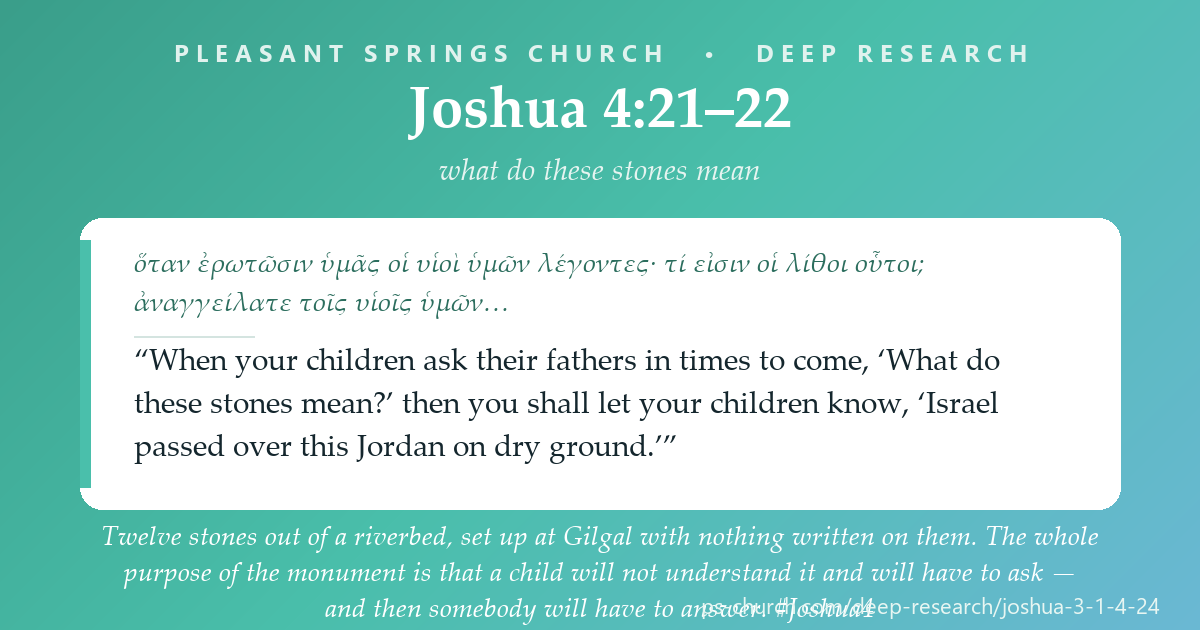
Joshua 4:21–22 · to share
LXX + ESVEvery Deep Research page traces its passage across the whole sweep — the Old Testament, the Second-Temple world between the testaments (historical witnesses, not Scripture), and the New Testament. Follow the thread:
Pleasant Springs Church — Deep Research
Research method after Michael S. Heiser’s Bible Research Method (examine dictionaries → ancient literature → important words → textual connections → academic publications → share), with the Pleasant Springs “Author & Audience” foundation. Scripture set in the Hebrew, the Greek editions named on each page and the ESV (Old Testament), and the Greek New Testament and the ESV (New Testament), per the practice of Pleasant Springs Church. Joshua 3–4 research grounded in Hess (TOTC), Howard (NAC), Butler (WBC), Woudstra (NICOT), Boling (Anchor) and Hawk (Berit Olam), with Bieberstein’s Josua—Jordan—Jericho on chapters 1–6 and Alter’s Art of Biblical Narrative for the Leitwort and the doubled speech. ANE background from the Moabite Stone (ANET 320–321); Second-Temple and rabbinic witnesses from Josephus, Antiquities 5.16–20, Sirach 46:1–8, b. Sotah 34a and b. Bava Batra 14b–15a, all read as witnesses and never leveled with Scripture. Numbering: Joshua 3–4 carries no chapter- or verse-offset — MT, LXX and English agree throughout 3:1–17 and 4:1–24; where a psalm is cited the Septuagint number is given (Ps 114:3 = LXX Ps 113:3, the Greek psalter joining MT 114 and 115; Ps 78:13 = LXX Ps 77:13). Text: the Old Greek of Joshua is roughly 4–5% shorter than the Masoretic Text and the divergences on this page are itemized in the codex rather than smoothed over; Greek quoted from the Apostoliki Diakonia (Elpenor) Septuagint and collated at every printed verse against Swete’s Vaticanus text, a departure from the house Rahlfs base text that is noted where it matters. The Qumran evidence (4QJosha, 4QJoshb) is reported with its reconstructions labelled as reconstructions, following Ulrich (DJD 14), Tov, Auld, van der Meer and De Troyer, and the disagreement between them is left standing. The dispossession announced at 3:10 is reported plainly, located as a bounded and unrepeatable judgment, and fenced: it licenses no violence, coercion or ethnic hostility by anyone today.
Scripture quotations marked ESV are from the ESV® Bible (The Holy Bible, English Standard Version®), © 2001 by Crossway, a publishing ministry of Good News Publishers. ESV Text Edition: 2016. Used by permission. All rights reserved. The ESV text may not be quoted in any publication made available to the public by a Creative Commons license, and the ESV may not be translated in whole or in part into any other language. www.esv.org
|
Did this study bless you today? 💚 Give to Support PS Church100% of gifts go to the General Fund — thank you. |