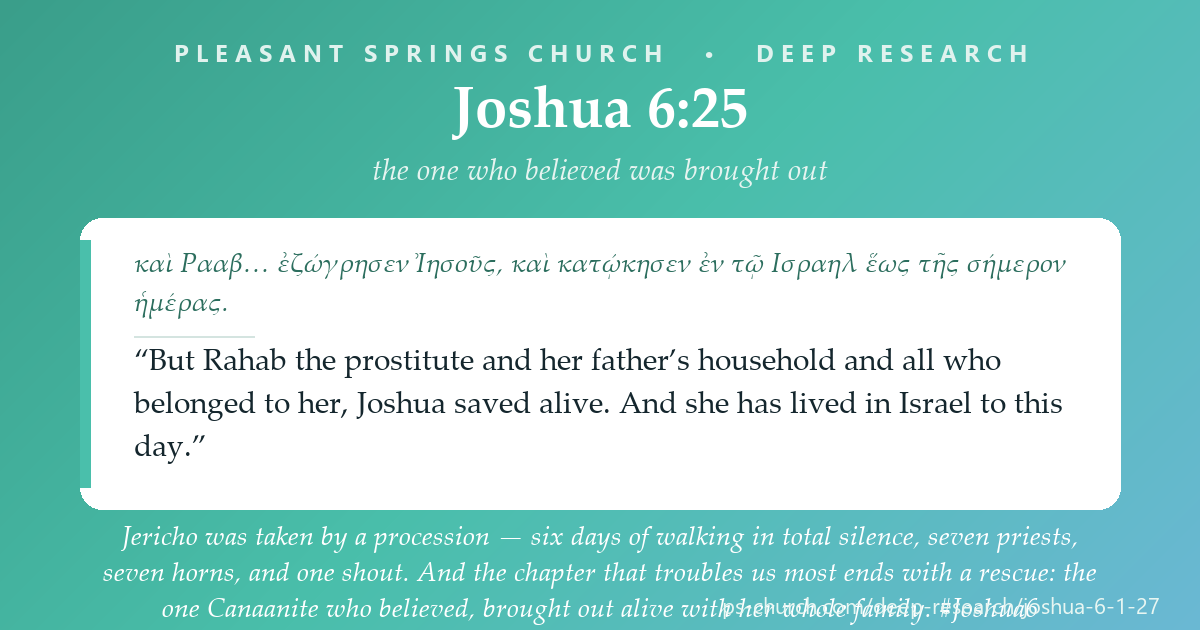
The first city in the land is taken by a church service. Jericho is sealed — “none went out, and none came in” (6:1) — and the orders Joshua receives contain no tactics whatsoever: walk around it once a day for six days, seven priests carrying seven rams’ horns in front of the ark, and on the seventh day walk around it seven times, and when the long blast sounds, everybody shouts (6:3–5). Between the order and the shout stands the sentence the whole chapter turns on: “You shall not shout or make your voice heard, neither shall any word go out of your mouth, until the day I tell you to shout” (6:10). An army walking a fortified wall in complete silence, six days running. Then the seventh circuit, the shout, and the wall down flat (6:20). And then the verse we do not skip: the city and everything in it devoted to destruction (6:17, 21) — reported here plainly, located where Scripture puts it, owned where it is hard, and fenced so that no reader can carry it anywhere it must not go. Against it the narrator sets his own answer, and he gives it the last word: “But Rahab the prostitute and her father’s household and all who belonged to her, Joshua saved alive. And she has lived in Israel to this day” (6:25). This study works Joshua 6:1–27. See the method →
Joshua 6:1–27 (selections)
Hebrew · LXX · ESVThe Shape of the Passage
Sevenfold sequenceJoshua 6 sits at the exact hinge of the book. Behind it lie the commission (ch 1), the spies and Rahab’s confession (ch 2), the crossing and the twelve stones (chs 3–4), and Gilgal — circumcision, Passover, the manna stopping, and the commander of the army of the Lord with a drawn sword (ch 5). Ahead lies Achan, the defeat at Ai, and the law read on Mount Ebal (chs 7–8). Read the chapter as the first thing the new generation does in the land — and notice that what they do is walk in a procession.
Author
The book does not name its author. It reports that Joshua “wrote these words in the Book of the Law of God” (24:26), and the rabbinic tradition credits him with the book — b. Bava Batra 14b–15a states flatly, “Joshua wrote his own book,” adding that the closing verses about his death were finished by Eleazar and Phinehas. That is a tradition worth reporting and worth reporting as a tradition; the book itself makes no such claim.
The narrator, however, tells you when he is writing. He uses the narrator’s formula “to this day” at 6:25, where Rahab’s family are still living in Israel as he writes — one of a string of such notes across the book (4:9; 5:9; 7:26; 9:27). He is standing at some remove from the events and looking back at a household that is still there. That is a historian’s note, not a storyteller’s flourish, and it is the kind of note that invites checking.
And he is a deliberate artist. Chapter 6 could have been told in six verses. Instead the narrator slows the pace to a walking speed, repeats the same procession three times over in almost the same words (6:6–9, 6:12–14, 6:15), and withholds the one sound the reader is waiting for until 6:20. Repetition-with-variation and calculated delay are the tools of Hebrew narrative art, and this chapter is a display case for both. He also tells you what he thinks the story is about by what he counts: sevens, circuits, and the ark.
Audience
Israel in the land, reading about how they got there. The first readers were not the marchers; they were people who lived among the ruins of Jericho and could point at them, and who knew Rahab’s descendants by name. The chapter is written to a settled people about an unsettled moment — and the point it presses on them is not their competence. In the whole chapter Israel does exactly two things: they walk, and they shout. Everything decisive is done to them or for them.
Which is why the orders are liturgy and not tactics. Priests, horns, the ark, a seven-day cycle, and an absolute prohibition on speech: every element of this belongs to the sanctuary rather than the siege works. If you handed these orders to a general he would resign. The first battle in the land is staged as a service of worship, and the audience is meant to draw from it exactly the conclusion Deuteronomy had already forced on them — that the land is a gift and not an achievement (Deut 9:4–6).
And they were meant to be troubled by chapter 6 as well as encouraged by it. The same text that gives them Rahab gives them 6:21. The narrator does not apologise for it and does not gloat over it: two verses for the city (6:21, 24) and three for the household (6:22–23, 25), with the rescue given the last word. That proportion is itself a form of comment, and it is the proportion this study tries to keep.
Orient on Jericho, the ark in war, the shofar and the jubilee horn, the herem, and Rahab.
Search by topic: Jericho (Tell es-Sultan), ark of the covenant, holy war / Yahweh war, herem (ban, devoted thing), shofar and yobel, teruah (shout, alarm), Rahab, Canaan and the Canaanites, city walls and fortification in the Bronze Age, curse formulas.
Which articles are relevant?
- Anchor Bible Dictionary — “Jericho,” “Joshua, Book of,” “Ark of the Covenant,” “War, Holy,” “Ban,” “Rahab (person),” “Music and Musical Instruments,” “Curse.”
- Dictionary of the OT: Historical Books — “Joshua, Book of,” “Conquest and Settlement,” “Herem,” “Warfare,” “Ark of the Covenant,” “Archaeology of the Land.”
- NIDOTTE / TDOT — חֵרֶם (ḥērem), שׁוֹפָר (šôp̄ār), יוֹבֵל (yôḇēl), תְּרוּעָה (tərûʿāh), סָבַב (sāḇaḇ), יָצָא (yāṣāʾ), זוֹנָה (zônāh).
- New Bible Dictionary / IVP Bible Background Commentary — the topography of the Jordan valley, Bronze Age city size (Jericho was small — a few acres, not a metropolis), and the practice of processing around a place to claim it.
Bibliography surfaced:
- Richard S. Hess, Joshua (TOTC); David M. Howard Jr., Joshua (NAC); Trent C. Butler, Joshua (WBC); Robert G. Boling, Joshua (Anchor Bible); Marten H. Woudstra, The Book of Joshua (NICOT); L. Daniel Hawk, Joshua (Berit Olam).
- Emanuel Tov and Leonard J. Greenspoon on the Greek Joshua — the standard entry point for the shorter Old Greek text.
- Studies of herem in the Hebrew Bible and its single extra-biblical attestation on the Mesha Stele.
- Reports and reassessments of the Tell es-Sultan excavations: Garstang, Kenyon, Bryant Wood, Piotr Bienkowski, and the radiocarbon work of Bruins and van der Plicht.
Six days and the seventh, a horn that transfers land, a word for total devotion — and a mound with a contested date.
Read the chapter first against the ANE convention of the six-day/seventh-day sequence, then against the one non-biblical text that uses the word herem, then against how Second-Temple, rabbinic and early Christian readers handled Jericho and Rahab — and finally against the archaeology, honestly.
Which parallels shed light on religion and worldview?
Six days, and on the seventh. The pattern is a known convention of Canaanite narrative, and the standard example is the Ugaritic Legend of King Keret: “March a day and a second; a third, a fourth day; a fifth, a sixth day — Lo! at the sun on the seventh: Thou arrivest at Udum the Great” (ANET 144). What follows is startling in this context. Keret is told to sit outside the city and do nothing for six days — “Thine arrows shoot not into the city, (Nor) thy hand-stones flung headlong” — and “at the sun on the seventh,” the king inside sends out messengers to sue for terms. A six-day siege in which no missile is fired, resolved on the seventh: the form of Joshua 6 was legible to anyone in that world. Robert Alter’s rule for conventional scenes applies — the meaning lies in the deviation. Keret’s six days of restraint are a siege tactic that produces a negotiation. Israel’s six days are worship that produces a collapse, and the seventh day ends with a wall on the ground rather than an ambassador at the gate.
The one other text in the world that uses this word. חֵרֶם has a single clear attestation outside the Hebrew Bible, on the Moabite Stone (the Mesha Inscription, c. 830 BC). Mesha king of Moab records taking Nebo from Israel and “slaying all… men, boys, women, girls and maid-servants, for I had devoted them to destruction for (the god) Ashtar-Chemosh” (ANET 320; the inscription runs to 321). Two things follow, and both matter. First, this is not a peculiarly Israelite atrocity or a peculiarly Israelite idea; it is a shared category in that world, and Israel’s neighbours used the same root for the same act toward their own gods. Second, the parallel is a witness and not a defence. It tells you what the word meant to the people who first heard it. It does not settle a single moral question, and this study does not use it to.
Conquest accounts in that world are sweeping by convention. Royal inscriptions habitually totalize — the Merneptah Stele (c. 1208 BC), the earliest mention of Israel outside the Bible, says “Israel is laid waste, his seed is not,” of a people who plainly continued to exist. It is fair to note that Joshua uses the same rhetorical register as its neighbours, and unfair to turn that observation into an escape hatch. The register does not make 6:21 say nothing. It is a caution about how ancient reports of totality are worded, and it should be held that lightly.
The archaeology of Jericho is genuinely unsettled, and we are not going to settle it. The mound is Tell es-Sultan. John Garstang (excavating 1930–36) dated the destruction of “City IV” to around 1400 BC, which suited a fifteenth-century conquest. Kathleen Kenyon (1952–58), working with far better stratigraphic method, redated that destruction to roughly 1550 BC, the end of the Middle Bronze Age, and reported no substantial walled city on the site at the later date — the position that has held the field for most of the last seventy years. Bryant Wood argued in 1990, from a fresh reading of Kenyon’s own pottery, that Garstang had been right; Piotr Bienkowski replied in defence of Kenyon in the same year; and radiocarbon dating of charred grain from City IV published by Hendrik Bruins and Johannes van der Plicht in 1995 pointed to the late seventeenth or the sixteenth century, favouring Kenyon. Those are the positions. This page reports them and does not adjudicate between them — that is a job for people working with the material, not for a Bible study. What we will say plainly is that triumphalism (“archaeology proves the Bible”) and dismissal (“archaeology disproves it”) are both bad readings of an open question, and that Christian faith has never rested on a stratum. It rests on a risen Christ.
- The Legend of King Keret (ANET 142–149; the marching and siege sequence at 144) (Ugaritic literature — a witness, not Scripture) — “a fifth, a sixth day — Lo! at the sun on the seventh”: the six-plus-one convention, including six days of deliberately withheld attack.
- The Moabite Stone / Mesha Inscription (ANET 320–321) (Moabite royal inscription — a witness, not Scripture) — the only clear non-biblical use of the root חרם: Mesha “devoted” the people of Nebo to Ashtar-Chemosh.
- Merneptah Stele (c. 1208 BC; ANET, Egyptian historical texts — the page falls outside our local scan, so no page number is given) (Egyptian royal inscription — a witness, not Scripture) — “Israel is laid waste, his seed is not”: the earliest extra-biblical mention of Israel, and a specimen of how totally such reports are worded.
- 4QTestimonia (4Q175), lines 21–30, with 4Q379 (“Apocryphon of Joshua”) frag. 22 (Dead Sea Scrolls — witnesses, not Scripture) — the fourth and last citation in Qumran’s little anthology of expected figures is Joshua 6:26, the curse on the rebuilder of Jericho, quoted and then applied through the Joshua Apocryphon to a contemporary enemy. A community reading its own moment through this chapter, two centuries before Christ.
- 4QJosha, 4QJoshb (Dead Sea Scrolls — witnesses, not Scripture) — the Qumran Joshua fragments, which are part of the evidence in the question of why the Greek Joshua is shorter than the Hebrew.
- Sirach 46:1–8 (Second-Temple — a witness, not Scripture) — Ben Sira’s roll of the fathers reaches Joshua son of Nun straight after Moses, Aaron and Phinehas: “mighty in war,” the successor of Moses.
- Josephus, Antiquities 5.1.5–8 (Second-Temple — a witness, not Scripture) — he retells the siege for a Greco-Roman readership and cannot resist commenting on how strange it is: the priests went round “and when the Priests had only blown with the trumpets, for they did nothing more at all, they returned to the camp,” and on the seventh day the wall fell “while no instruments of war, nor any other force was applied to it.” He does not soften the destruction. He also adds that Joshua gave Rahab “certain lands immediately; and had her in great esteem ever afterwards” — and throughout calls her house an inn, an interpretation of her trade that later readers have often borrowed from him.
- b. Megillah 14b–15a (rabbinic-era — a witness, not Scripture) — the sages take 6:25 as far as it will go: eight prophet-priests are said to descend from Rahab, including Jeremiah and Baruch; R. Yehuda adds Huldah, punning on the tiqvat (“cord”) of the scarlet thread; and Rav Nahman resolves the dispute by saying Rahab converted and married Joshua. History or homily, the instinct is sound: the tradition could not leave that Canaanite woman outside the family.
- 1 Clement 12 (early Christian, c. AD 96 — a witness, not Scripture) — “For her faith and hospitality Rahab the harlot was saved,” and the scarlet cord is read as a sign of “redemption unto all them that believe and hope on God” through the blood of Christ. Cite it for what it is: an early Christian devotional reading of the cord, offered as such, not the meaning Joshua 2 or 6 states for itself.
Strip Joshua 6 of everything decorative and look at what is actually commanded. Walk. Carry the ark. Blow horns. Say nothing. Walk again. Do it six more times on the seventh day. Then shout. There is no ram, no ladder, no mine under the wall, no feint, no night assault — and nothing anyone is told to carry that could hurt anybody. Armed men are in the column, but they are described as walking, and the sword is not named until 6:21, after the wall is already down. The verbs of chapter 6 belong to a liturgy: bear, go before, blow, go around, shout.
The instruments make the same point twice over. These are not war trumpets but שׁוֹפְרוֹת הַיּוֹבְלִים — literally “jubilee horns.” The same horn, sounded on the Day of Atonement, is what proclaims the year of jubilee in which every field goes back to the family it belonged to (Lev 25:9–10). The horn that brings Jericho down is the horn of land returning to its rightful owner — and in Israel’s reckoning the owner is God, who says so in as many words: “the land is mine” (Lev 25:23). Which is exactly why the plunder is not Israel’s to take (6:18–19), and why Achan’s hand in the next chapter is such a catastrophe.
So the chapter is not teaching a technique. It is making a claim about who takes cities. Israel’s two contributions are obedience and noise; and the six days of silence are there to make sure nobody could mistake the noise for the cause.
The ban, the jubilee horn, the shout that is also a war cry, and the verb that runs from a shut city to an open door.
Watch herem hold together the silver in the treasury and the sword in the street; shofar ha-yobel turn a siege instrument into a jubilee horn; teruah refuse to separate worship from warfare; and yatsa run from “none going out” (6:1) to “bring out the woman” (6:22).
The “devoted thing” or “ban.” The root means to separate off absolutely — to put something permanently beyond human use by handing it over to God. In Leviticus the same word covers a field or a person irrevocably dedicated to the sanctuary (Lev 27:28–29), which is why 6:19 can put the silver and gold into the treasury in the same breath as 6:21: both are the same act, this is not yours. The LXX renders it ἀνάθεμα — a word the New Testament will use for being cut off (Rom 9:3; 1 Cor 16:22). Its only clear extra-biblical attestation is Moabite (Mesha Stele, ANET 320).
The ram’s horn, and specifically the jubilee horn: שׁוֹפְרוֹת הַיּוֹבְלִים, “horns of the jubilees” (6:4, 6, 8, 13). It is not a battle instrument but a cultic and legal one — it announces the theophany at Sinai (Exod 19:16, 19), the new year and the Day of Atonement, and above all the jubilee, when land reverts to its original holders (Lev 25:9). The LXX flattens the distinction to σάλπιγξ, “trumpet,” and at 6:8 calls them σάλπιγγας ἱεράς, “holy trumpets” — the translator, at least, heard it as sanctuary equipment.
The shout — and in Hebrew it is one word for two things that we keep apart: the war-cry and the liturgical acclamation. The same noun names the alarm blown when Israel goes to war, “that you may be remembered before the Lord your God, and you shall be saved from your enemies” (Num 10:9), and the festival day of the seventh month (Lev 23:24), and the shout with which God ascends his throne: “God has gone up with a shout, the Lord with the sound of a trumpet” (English Ps 47:5 · MT 47:6 · LXX 46:6). That psalm verse puts the two Jericho words side by side in Greek — ἀνέβη ὁ θεὸς ἐν ἀλαλαγμῷ, κύριος ἐν φωνῇ σάλπιγγος — and Joshua 6:20 uses both: ἀλαλαγμῷ μεγάλῳ at the shout, σάλπιγξ at the horn. At Jericho all three senses are in play at once.
“Go out.” Follow it and you have the chapter. Jericho is sealed so that “none goes out” (6:1). Israel is sealed so that “no word shall go out of your mouth” (6:10) — the same verb, now applied to an army rather than a city. And when the wall is down the verb turns causative and positive: bring out the woman (6:22), and they brought out Rahab, and brought out all her relatives (6:23). A shut city, shut mouths, and one household led out.
“Go around, encircle.” The verb of the whole action, and the reason Hebrews 11:30 can compress the chapter into a single participle, κυκλωθέντα, “having been encircled.” Encircling a place is an act of claim in the ancient world, and Israel does it thirteen times — once a day for six days, seven times on the seventh — before a hand is lifted. The Greek uses a family of κύκλῳ words, and at 6:20 says the wall fell κύκλῳ, “all round.”
“He kept alive” — the causative of the verb to live, and the exact counterweight to הֶחֱרִים, “he devoted to destruction,” four verses earlier. The narrator sets the two causatives side by side deliberately: in 6:21 they caused to be devoted; in 6:25 Joshua caused to live. The Greek picks a vivid word for it, ἐζώγρησεν — literally “took alive,” the term for sparing a captive rather than killing him (the same verb behind “you will be catching men,” Luke 5:10 — ζωγρῶν, literally “taking alive”).
The Greek for herem. The two spellings ἀνάθημα and ἀνάθεμα are variants of one word meaning “something set up / handed over,” and Greek usage came to keep the first for a temple offering (so Luke 21:5, of the gifts adorning the temple) and the second for what is handed over under a ban. By the New Testament the second means to be cut off: Paul wishes himself ἀνάθεμα for the sake of his kinsmen (Rom 9:3). The trajectory is worth noticing. The word that here falls on a city ends up in the New Testament as something an apostle offers to take onto himself.
How the New Testament takes up Joshua 6:
- Hebrews 11:30 — Πίστει τὰ τείχη Ἰεριχὼ ἔπεσαν κυκλωθέντα ἐπὶ ἑπτὰ ἡμέρας, “By faith the walls of Jericho fell down after they had been encircled for seven days.” This is the New Testament’s own reading of the chapter, and it is worth weighing what it selects: not the sword, not the spoil, not the wall — but the seven days. What Hebrews calls faith is the six days of walking in silence when nothing whatever was happening.
- Hebrews 11:31 — “By faith Rahab the prostitute did not perish with those who were disobedient, because she had given a friendly welcome to the spies.” The very next verse. Hebrews puts the fall of the city and the survival of the Canaanite in the same breath, in that order, and so does Joshua 6.
- James 2:25 — “And in the same way was not also Rahab the prostitute justified by works when she received the messengers and sent them out by another way?” Hebrews commends her faith; James commends her works; both call her what Joshua calls her.
- Matthew 1:5 — Rahab appears in the genealogy of Jesus Christ, as the mother of Boaz. The rescue of 6:25 turns out to be load-bearing.
- Romans 9:3; 1 Corinthians 16:22; Galatians 1:8–9 — ἀνάθεμα, the LXX word for the ban of 6:17, carried into apostolic Greek. Note where it lands: on false gospel, and on the apostle’s own willingness to be cut off in place of others.
- 2 Corinthians 10:3–5; Ephesians 6:12 — “the weapons of our warfare are not of the flesh”; “we do not wrestle against flesh and blood.” The New Testament does not hand this chapter forward as a military precedent. It hands forward the trumpet and the silence, and explicitly withdraws the sword (see the fence in Stage 5).
From the ark at the Red Sea to a household led out of a ruin — the canon’s own trajectory.
Trace four threads: the ark that goes before the people; the sevenfold and Sabbath shape; the herem law and its limits; and Rahab, who is the only person in the chapter the New Testament names.
Which cross-references matter?
- Joshua 2 — the spies, the house on the wall, the scarlet cord and Rahab’s confession that “the Lord your God, he is God in the heavens above and on the earth beneath”. Chapter 6 is where the oath of chapter 2 is kept, and neither chapter can be read honestly without the other — see Joshua 2:1–24.
- Joshua 3–4 — the ark going first into the Jordan and standing there until all the nation had passed over; the twelve stones set up so children would ask. The same ark now leads the same people around a city (Joshua 3:1–4:24).
- Joshua 5:13–15 — the commander of the army of the Lord with a drawn sword, and “take off your sandals… the place where you are standing is holy.” Chapter 6 begins immediately after; the reader has just been told whose army is actually approaching Jericho (Joshua 5:1–15).
- Numbers 10:1–10, 35–36 — the trumpets sounded so Israel would “be remembered before the Lord”, and the ark setting out with “Arise, O Lord, and let your enemies be scattered.” Joshua 6 is that ritual walked around a city (Numbers 10).
- Exodus 14; Exodus 19:16–19 — “The Lord will fight for you, and you have only to be silent” (Exod 14:14), and the trumpet blast at Sinai that made the people tremble. Silence and horn: Jericho puts them together (Exodus 14, Exodus 19).
- Leviticus 25:8–13; Leviticus 23:23–25 — the jubilee horn and the day of teruah. The instruments at Jericho are the instruments of land-return and of festival (Leviticus 25; Leviticus 23).
- Leviticus 27:28–29; Deuteronomy 7:1–6; 20:10–18 — the law of the herem and the war law, including the requirement to offer terms of peace to a distant city, which is what makes the Canaanite cities a stated exception rather than a norm (Leviticus 27; Deuteronomy 7; Deuteronomy 20).
- Genesis 15:16; Leviticus 18:24–28; Deuteronomy 9:4–6 — the moral frame the Torah itself supplies: four centuries of forbearance because “the iniquity of the Amorites is not yet complete”; a land that vomits out whoever defiles it, Israel included; and no claim of Israelite merit whatsoever (Genesis 15; Leviticus 18; Deuteronomy 9).
- Joshua 7:1–26 — “keep yourselves from the things devoted to destruction… and bring trouble upon it” (6:18) is a fuse, and it is lit in the very next verse of the book. The verb the ESV renders “bring trouble” (עכר) is the one that names the valley where Achan dies (Joshua 7–8).
- 1 Kings 16:34 — “In his days Hiel of Bethel built Jericho. He laid its foundation at the cost of Abiram his firstborn, and set up its gates at the cost of his youngest son Segub, according to the word of the Lord, which he spoke by Joshua the son of Nun.” The oath of 6:26 collected five hundred years later — and, as the codex foot notes, the Greek of Joshua 6:26 has already pulled that notice back into this chapter.
- Matthew 1:5; Hebrews 11:30–31; James 2:25 — the New Testament remembers exactly two things from Jericho: the seven days, and Rahab.
It is possible to read Joshua 2 as a charming interlude and Joshua 6 as the grim main event. That is not how the book is put together. The oath in chapter 2 is unresolved for four chapters, and it is discharged here, at length, with a formality the narrator does not extend to anything else in the story: Joshua speaks to the two spies (6:22), the spies go in (6:23), the family is brought out (6:23), they are placed outside the camp (6:23), and then the whole rescue is summarized again in a verse of its own (6:25). Three verses for one household (6:22–23, 25), against two for the city (6:21, 24) — and the household has the last word. The narrator is not hiding 6:21. He is telling you where to look.
And note what the text says her rescue was for: “because she hid the messengers” — said twice, at 6:17 and again at 6:25. Nothing about her ethnicity changed. She was a Canaanite of Jericho on the day the wall fell and a Canaanite of Israel the day after. What changed was that she had heard what God had done and had thrown in her lot with him, which is precisely what Hebrews 11:31 calls faith. That is the doorway the whole conquest narrative leaves standing open, and the book knows it: the very next chapter has an Israelite family destroyed for taking what belonged to God, and this chapter has a Canaanite family preserved for hiding the people of God. The line in Joshua does not run between ethnic groups. It runs between those who fear the Lord and those who do not.
The scholarship on Joshua 6, the shorter Greek text, the herem — and the fence this church puts round the whole subject.
Hess, Howard, Butler, Boling, Woudstra and Hawk on Joshua; Tov and Greenspoon on the Greek; the excavation reports and their critics on the mound; and, because this chapter has been misused for centuries, an explicit statement of what it does and does not license.
Commentaries & studies:
- Richard S. Hess, Joshua: An Introduction and Commentary (TOTC) — careful, accessible, and unusually good on the Bronze Age background and on the size of the site.
- David M. Howard Jr., Joshua (NAC); Marten H. Woudstra, The Book of Joshua (NICOT) — conservative, thorough, attentive to the theology of the ark and the ban.
- Trent C. Butler, Joshua (WBC); Robert G. Boling, Joshua (Anchor Bible) — the critical mainstream, and useful precisely because they press the questions differently.
- L. Daniel Hawk, Joshua (Berit Olam) — a literary reading that takes the Rahab and Achan panels as the book’s deliberate commentary on itself.
- Emanuel Tov, on the Greek Joshua and the shorter text; Leonard J. Greenspoon, Textual Studies in the Book of Joshua — the standard route into why the Old Greek runs some 4–5% shorter than the MT.
- John Garstang, The Story of Jericho; Kathleen M. Kenyon, Digging Up Jericho; Bryant G. Wood, “Did the Israelites Conquer Jericho? A New Look at the Archaeological Evidence,” Biblical Archaeology Review 16/2 (1990), with Piotr Bienkowski’s reply in BAR 16/5 (1990); H. J. Bruins and J. van der Plicht, on the radiocarbon dates from City IV (1995).
Interpretation notes worth keeping:
- The genre of the orders is liturgy, and that is an exegetical observation, not a devotional one. Priests, ark, horns, a seven-day cycle, an absolute silence, and a shout: every element belongs to Israel’s worship. The chapter reports a military outcome achieved by a processional means, and it reports the means at four times the length of the outcome.
- The silence is the hinge (6:10). Six days of walking a hostile wall without a word is the most demanding thing Israel is asked to do in the chapter, and the narrator attributes it to Joshua rather than reporting it from the divine speech of 6:2–5. Whatever else it accomplishes, it makes it impossible for anyone afterwards to say the shout was a battle cry that worked. The shout comes only when it is commanded, and the wall comes down at the shout, not at the sword.
- The Greek text is genuinely shorter here, and the shortest place is exactly the liturgy. Rahlfs has no 6:4, and 6:3 is five words. Whether the Hebrew expanded or the Greek contracted is an open question in Septuagint scholarship, and honest readers hold it open. What we do not do is quietly print a smooth composite and let the reader think the two traditions agree.
- Jericho was small. This is not a deflation of the miracle but a correction of the picture most readers carry. Bronze Age Jericho occupied a few acres, not a plain; a circuit of its wall was a walk of minutes, not hours, which is what makes seven circuits in one morning physically ordinary and the whole procedure liturgically pointed.
- The archaeological question is open and this study does not close it. Garstang (c. 1400 BC), Kenyon (c. 1550 BC and no late walled city), Wood (Garstang again, on Kenyon’s pottery), Bienkowski (Kenyon), and the 1995 radiocarbon work (Kenyon’s range). Those are the positions; the material is not ours to adjudicate. And it is worth saying plainly that a reader whose faith would collapse if one of these datings prevailed has been taught to trust the wrong thing.
- Herem is a category of dedication before it is a category of destruction. 6:19 and 6:21 are the same command. The metals go to the treasury; the city goes to God; the one thing forbidden throughout is that any of it should end up serving Israel. That does not make 6:21 easier. It does mean the chapter is not about acquisition, and it is why chapter 7 happens.
- Rahab is the chapter’s own commentary and the narrator gives her the last word. Two verses for the city (6:21, 24), three for the household (6:22–23, 25), and a closing note that she is still there “to this day.” The New Testament follows that emphasis exactly (Heb 11:31; Jas 2:25; Matt 1:5).
The hard verses, and the fence around them:
1. What the text says. “And the city and all that is within it shall be devoted to the Lord for destruction” (6:17). “Then they devoted all in the city to destruction, both men and women, young and old, oxen, sheep, and donkeys, with the edge of the sword” (6:21). That is the verse. It is not a metaphor, it includes non-combatants, and no summary on this page is written as if it were absent. If you have read a study of Jericho that never quoted 6:21, you have read a study that was managing you.
2. Where it stands in Scripture. This is a bounded, divinely commanded judgment at a unique point in redemptive history, on specific cities, under a command given to one generation and never generalized. The Torah itself supplies the frame and does it in a way that removes every comfortable handle: the judgment falls only after four centuries of forbearance, because “the iniquity of the Amorites is not yet complete” (Gen 15:16); it is explicitly not because Israel is righteous, “for you are a stubborn people” (Deut 9:4–6); and the same standard is turned on Israel, who will be expelled from the same land for the same defilement (Lev 18:24–28) — which is exactly what happens. Israel is not the exception to the judgment. Israel is its next object.
3. What remains hard. The frame explains why the judgment falls. It does not explain why it falls in this form, and Scripture does not tell us. The text gives no reason for including children and gives no comfort about them, and anyone who supplies one is supplying it from somewhere other than the text. It is honest to say that this is one of the places where a Christian reader stands in front of something he cannot resolve, holds it beside the character of God revealed at the cross, and waits. Where Scripture gives no reason, we say so and stop. A slogan here — on either side — would be worse than the silence.
4. What it licenses today: nothing. This must be said without hedging, because this chapter has an ugly history. Joshua 6 has been quoted to justify crusade, colonial conquest, dispossession and massacre, by people who cast themselves as Israel and their neighbours as Canaanites. That reading is a lie about the text and about the God of the text, and its fruits have been evil. The New Testament closes the door from both sides: “the weapons of our warfare are not of the flesh” (2 Cor 10:4); “we do not wrestle against flesh and blood” (Eph 6:12); when James and John proposed calling down fire on a village, Jesus turned and rebuked them (Luke 9:54–55); and “all who take the sword will perish by the sword” (Matt 26:52). No nation, no ethnicity, no church and no individual may take this text as a warrant for violence, coercion, hostility or contempt toward anybody, ever. If reading Joshua leaves you readier to despise someone, you have read it wrong.
5. And do not linger over it. The narrator does not. He gives it two verses (6:21, 24) and three to a rescue, and lets the rescue have the last word. Preaching this chapter with relish, or with body counts used as rhetoric, is a sin against the text as well as against the hearer. One further note, held lightly: conquest reports across the ancient Near East are characteristically sweeping and formulaic — the Merneptah Stele says of Israel “his seed is not,” of a people who went on existing — and Joshua writes in that register. That is a genuine observation about how such reports were worded. It is not an escape hatch, it does not make 6:21 say nothing, and this page does not use it as one.
From six days of silence to a household brought out alive.
Name what you learned, why it matters, and one concrete response.
What should we carry away — and do?
- The six days are the point. Hebrews 11:30 does not say the walls fell by faith when they shouted; it says they fell “after they had been encircled for seven days.” The faith in view is the walking — the part where nothing visible happens, repeated until it feels absurd. Most obedience is day three.
- Silence is a discipline, not an absence. Israel’s hardest order was to say nothing (6:10). There is a kind of talking — about the wall, about how long this is taking, about whether the plan is any good — that God simply forbade for six days. Try one day of it.
- The horn was a jubilee horn. What brought Jericho down was the instrument that announces land going back to its owner (Lev 25:9). Nothing in this chapter belongs to Israel: not the city, not the silver, not the credit.
- Read 6:21 and do not look away, and do not use it. It is in your Bible. Report it honestly, hold it where Scripture puts it, admit what remains hard, and never let it out of that fence — because “we do not wrestle against flesh and blood” (Eph 6:12), and because the Lord rebuked the disciples who wanted fire (Luke 9:54–55).
- And notice who the narrator ends on. Not the ruin. A Canaanite woman, her parents, her brothers, and everyone belonging to her, standing outside the camp alive, and still in Israel when the book was written. If God kept that oath, in that chapter, he is not looking for a reason to leave you out.
Step in response: pick the thing you have been circling — a prayer, a marriage, a person, a habit — that has produced no visible result. Give it a stretch of quiet obedience without discussing it with anyone, and remember what the chapter is actually claiming — not that silence brings walls down, but that God does. Then do the one thing you already know God has told you to do. And this week, find the person in your life who is on the outside of your congregation the way Rahab was on the outside of Israel, and bring them in by name.
Joshua 6:25 · to share
LXX + ESVEvery Deep Research page traces its passage across the whole sweep — the Old Testament, the Second-Temple world between the testaments (historical witnesses, not Scripture), and the New Testament. Follow the thread:
Pleasant Springs Church — Deep Research
Research method after Michael S. Heiser’s Bible Research Method (examine dictionaries → ancient literature → important words → textual connections → academic publications → share), with the Pleasant Springs “Author & Audience” foundation. Scripture set in the Hebrew, the Greek editions named on each page and the ESV (Old Testament), and the Greek New Testament and the ESV (New Testament), per the practice of Pleasant Springs Church. Joshua 6 research grounded in Hess (TOTC), Howard (NAC), Butler (WBC), Boling (Anchor), Woudstra (NICOT) and Hawk (Berit Olam), with Tov and Greenspoon on the Greek Joshua. ANE background from the Ugaritic Legend of King Keret and its six-day/seventh-day siege sequence (ANET 142–149, at 144) and the Moabite Stone, the only clear non-biblical use of the root חרם (ANET 320–321); the Merneptah Stele is cited without a page number because it falls outside our local scan. Second-Temple, rabbinic and early Christian witnesses (4QTestimonia 4Q175 with 4Q379 frag. 22; 4QJosha/4QJoshb; Sirach 46:1–8; Josephus, Ant. 5.1.5–8; b. Megillah 14b–15a; 1 Clement 12) are reported as witnesses, never leveled with Scripture, and 1 Clement’s scarlet-cord reading is labelled as an early Christian devotional reading rather than the meaning Joshua states for itself. Numbering: Joshua carries no chapter offset — MT, LXX and English all read chapter 6 — but the verse numbering diverges, because the Old Greek of Joshua runs roughly 4–5% shorter than the Masoretic Text; in this chapter Rahlfs prints no verse 4 (6:3, then 6:5), and the divergences at 6:1, 6:15, 6:17, 6:20, 6:21, 6:22 and 6:26 are each flagged in the codex foot rather than smoothed. Greek from Rahlfs; where Brenton’s Vaticanus-based text differs materially (6:15) that is noted, not followed. The archaeology of Tell es-Sultan is reported as an open question — Garstang, Kenyon, Wood, Bienkowski and the 1995 radiocarbon work are named and not adjudicated, and faith is not made to depend on the outcome. The herem of 6:17–21 is reported plainly, located as a bounded and unrepeatable judgment under the Torah’s own frame (Gen 15:16; Deut 9:4–6; Lev 18:24–28), acknowledged as unresolved where Scripture gives no reason, and fenced without qualification: it licenses no violence, coercion or ethnic hostility by anyone today (2 Cor 10:4; Eph 6:12; Luke 9:54–55; Matt 26:52).
Scripture quotations marked ESV are from the ESV® Bible (The Holy Bible, English Standard Version®), © 2001 by Crossway, a publishing ministry of Good News Publishers. ESV Text Edition: 2016. Used by permission. All rights reserved. The ESV text may not be quoted in any publication made available to the public by a Creative Commons license, and the ESV may not be translated in whole or in part into any other language. www.esv.org
|
Did this study bless you today? 💚 Give to Support PS Church100% of gifts go to the General Fund — thank you. |