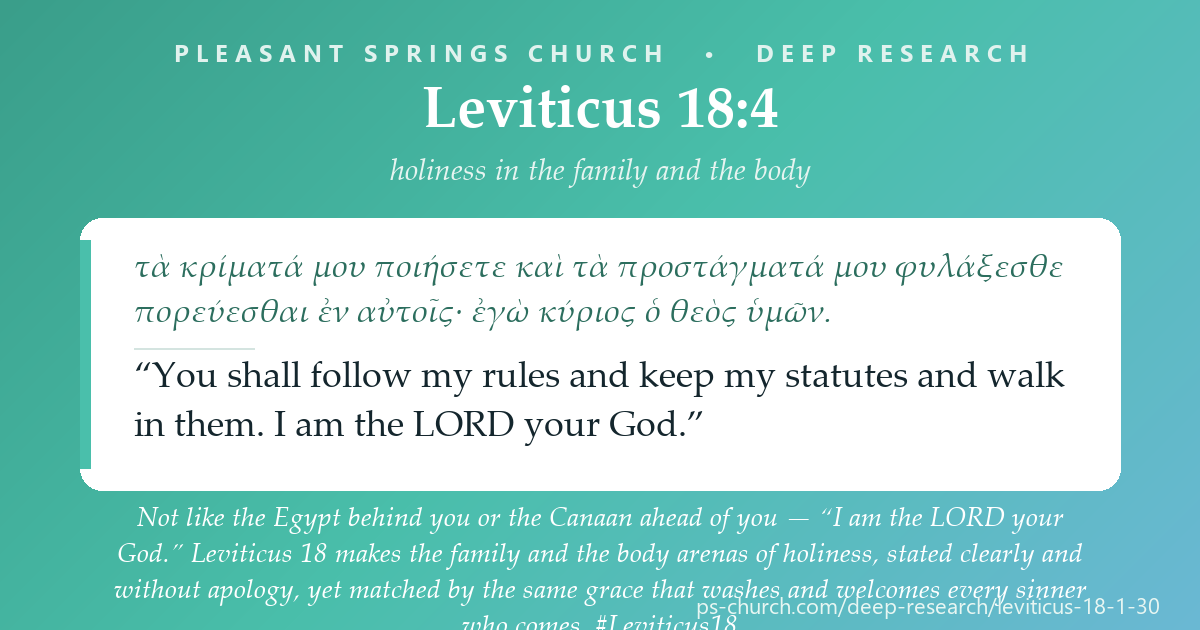
Israel was to live like neither the Egypt behind it nor the Canaan ahead of it. Leviticus 18 — the opening chapter of the Holiness Code — names the family and the body as arenas of holiness: the forbidden degrees of kin, adultery, the giving of children to Molech (18:21), and violations of the created order of man and woman. Its frame is the Lord’s own name (“I am the Lord your God”), and its warning is that such practices defiled the nations until the land “vomited out its inhabitants.” This study works the whole chapter — the ethic held clearly and without apology, grounded in creation and God’s good design, and matched by the same grace the gospel extends to every sinner. See the method →
Leviticus 18:3–30 (selections)
Hebrew · LXX · ESVThe Shape of the Passage
InclusioLeviticus 18 opens the Holiness Code (chs 17–26): after the blood-and-altar laws of chapter 17 come the arenas of everyday holiness — and the first is the family and the body. Its twin, the penalties of chapter 20, belongs to Israel’s theocratic civil law, not to the church.
Author
The Torah of Moses places this chapter at the head of the Holiness Code, and gives it a deliberate frame. It opens and closes not with rules but with the Lord’s own name and character: “I am the Lord your God” (18:2, 4, 30). Between those bookends stands the reason Israel must live differently from Egypt behind them and Canaan before them — not tribal custom, not squeamishness, but holiness: belonging to the God who redeemed them. The recurring euphemism “to uncover nakedness” (gillâ ʿerwâ, 18:6–18) marks the forbidden degrees of kinship; adultery (18:20), child-sacrifice to Molech (18:21), and violations of the created order of male and female (18:22–23) complete the list.
The land as a moral agent. What makes this chapter distinctive is its climax: sexual sin is not merely private but defiling — and the defilement reaches the land itself, which “vomited out” the nations who did such things (18:24–28). Holiness, in Leviticus, is never a matter of the individual alone; it is the health of a people and a place before a holy God. The chapter grounds its ethic in creation and in God’s character, not in the passing consensus of any culture.
Audience
Israel — a redeemed people set down between two pagan worlds. Egypt (where they had lived) and Canaan (where they were going) both practiced what this chapter forbids; Israel was to be visibly, bodily different, because it belonged to the Lord. The sexual ethic is framed as God’s good and protective design — guarding the family, the vulnerable, and above all the children whom the nations burned to Molech. This is not the raising of one sin above others but the naming of a whole realm — the body and the family — as an arena of worship.
How the church hears it. The moral heart of the chapter abides: the New Testament reaffirms the biblical sexual ethic grounded in creation (Matt 19:4–6; 1 Cor 6–7). Yet two things must be said plainly. First, the civil death penalties attached to these sins (ch 20) were the criminal law of the Old Testament theocracy — they are not a template for the church or any modern state; the church disciplines by exhortation and, at most, exclusion from the Table, not the sword (Jesus in John 8 refuses to cast the stone). Second, the same gravity Scripture gives to sin it matches with the same grace — “and such were some of you. But you were washed… sanctified… justified” (1 Cor 6:11). The chapter’s call is to holiness; its accent, held with the whole Bible, is a mercy wide enough for every sinner.
Orient on holiness, sexuality, the forbidden degrees, Molech, and defilement.
Search by topic: Holiness Code, marriage and sexuality, incest / forbidden degrees, Molech, abomination, purity and defilement, the land.
Which articles are relevant?
- Anchor Bible Dictionary — “Holiness Code,” “Sex and Sexuality,” “Molech,” “Marriage,” “Purity.”
- Dictionary of the OT: Pentateuch — “Holiness,” “Sexuality,” “Marriage,” “Canaanite Religion,” “Ethics.”
- NIDOTTE / TDOT — עֶרְוָה (ʿerwâ, nakedness), תּוֹעֵבָה (tôʿēḇâ, abomination), טָמֵא (ṭāmēʾ, defile), מֹלֶךְ (mōleḵ).
Bibliography surfaced:
- Gordon Wenham (NICOT), Jacob Milgrom (AB, Leviticus 17–22), Mark Rooker (NAC), John Hartley (WBC) on Leviticus.
- Studies of the Holiness Code (chs 17–26); the forbidden degrees of Lev 18; the Molech cult and child sacrifice.
- Beale & Carson, Commentary on the NT Use of the OT (Paul’s use of Lev 18:5 in Rom 10 and Gal 3).
Sexuality, the land, and the children the nations burned.
Read the chapter against Canaanite religion and ANE family law, weigh the Molech evidence soberly, then follow the ethic to its creation ground and the grace of the gospel.
Which parallels shed light on religion and worldview?
A people between two worlds. Egypt and Canaan are named at the outset (18:3) because Israel knew both. Ancient Near Eastern law codes did regulate sex and family — the Laws of Hammurabi and the Hittite and Middle Assyrian Laws address incest, adultery, and bestiality — but Leviticus grounds its ethic uniquely: not in social order or a king’s honor but in the holiness of the Lord and the goodness of his creation. The body and the family are not autonomous zones; they belong to God, and are arenas in which a redeemed people either reflects or defaces his character.
Molech and the sanctity of children. At the very center of the chapter (18:21) stands its darkest horror: giving one’s children “to Molech.” Whether mōleḵ names a deity or a type of sacrifice, the biblical and archaeological witness points to child sacrifice — the practice later denounced at the Valley of Hinnom (Jer 7:31; 2 Kgs 23:10) and attested at Punic tophet precincts in the western Mediterranean. Leviticus places it among the sexual sins because it too is a violation of the created order of the family: the God who forms children in the womb utterly condemns their destruction, and calls the profaning of his name what it is. Here the chapter’s protective intent is unmistakable.
The land that vomits. The closing frame (18:24–28) gives Israel a category the surrounding cultures lacked: moral defilement of the land itself. Sin is not only against a neighbor; it pollutes the place, and the land, like a body rejecting poison, “vomits out” its inhabitants. Israel is warned that covenant privilege grants no immunity — the same holiness that expelled the Canaanites can expel them.
- Laws of Hammurabi · Hittite Laws · Middle Assyrian Laws (ANE law — a witness, not Scripture) — incest, adultery, and bestiality regulated across the ancient world; Leviticus shares the subject but grounds it in holiness (see the ANET collection).
- Philo, Special Laws 3 (Second-Temple — a witness, not Scripture) — an early exposition of the Levitical sexual laws as the protection of the family and the training of the soul.
- Temple Scroll (11QT) · Damascus Document (CD) (Qumran — witnesses, not Scripture) — a stricter Second-Temple reading of the forbidden degrees, extending Lev 18 (e.g. forbidding uncle–niece marriage).
- Mishnah, Sanhedrin · Sifra on Leviticus (rabbinic-era) — the working-out of the forbidden relations and the (theocratic) penalties; Josephus, Antiquities 3 summarizes the laws for a Greco-Roman readership.
Leviticus 18 states the biblical sexual ethic without apology — and it is important to hear why. The chapter does not treat the body as shameful or sex as suspect; the opposite is true. It frames sexuality as a good gift with a God-given shape, rooted in creation, “male and female he created them… and the two shall become one flesh” (Gen 1:27; 2:24) — the very ground Jesus returns to (Matt 19:4–6). The prohibitions are protective: they guard the family, the vulnerable, and the children a Molech-worshiping world was willing to burn. To call these boundaries God’s design is not culture-war rhetoric; it is to confess that our Maker knows what our bodies and our families are for. And Leviticus does not single out one sin: adultery, incest, and idolatrous child-sacrifice stand together under the one word defilement. Every one of us stands somewhere within this chapter’s reach — which is exactly why the gospel meets us here. Paul, after listing sins that overlap this chapter, writes the most hopeful sentence in the New Testament for anyone who has failed: “And such were some of you. But you were washed, you were sanctified, you were justified in the name of the Lord Jesus Christ and by the Spirit of our God” (1 Cor 6:11). The gravity of the law and the welcome of the cross are not rivals. Holiness is God’s good design; grace is his open door; and Christ holds out both, to every sinner, without exception.
The vocabulary of nakedness, abomination, Molech, defilement, and life.
Watch the euphemism ʿerwâ (nakedness), the covenantal tôʿēḇâ (abomination), the spreading stain of ṭāmēʾ, and the single word ḥāyâ (“live”) that Paul lifts from 18:5.
“Nakedness” — the chapter’s recurring euphemism, “to uncover nakedness” (gillâ ʿerwâ), for illicit sexual union, mostly within the forbidden degrees of kin (LXX ἀσχημοσύνη, “shame / indecency”). The delicacy of the phrase itself honors what is being guarded.
“Abomination” — what is detestable to the Lord (LXX βδέλυγμα). The word frames the whole chapter’s close (18:26–30): these are “abominable customs” that defile a people — a covenantal category, not merely a cultural distaste.
“Molech” — the deity or rite to whom children were given (“made to pass over”) in fire; here it profanes God’s name. The LXX reads the consonants as “a ruler” (ἄρχοντι); the MT and later Scripture (Jer 7:31) point to child sacrifice — the horror at the chapter’s center.
“Defile / become unclean” — here moral defilement (LXX μιαίνω) that spreads from the act to the person to the land itself, which “vomits out” those who defile it. Sin is never merely private; it pollutes a place and a people.
“Live” — “the one who does them shall live by them” (wāḥay bāhem; LXX ζήσεται). Paul quotes this line in the law-and-faith discussion (Rom 10:5; Gal 3:12), setting “the righteousness based on the law” beside the righteousness of faith.
How the New Testament reuses Leviticus 18:
- Romans 10:5; Galatians 3:12 — Paul quotes Lev 18:5, “the person who does the commandments shall live by them,” to distinguish law-righteousness from the righteousness of faith — not to demean the law, but to show its terms.
- Matthew 19:4–6; Mark 10:6–9 — Jesus grounds the sexual ethic in creation: “from the beginning… male and female… the two shall become one flesh.”
- 1 Corinthians 6:9–11; 6:18–20 — sins that overlap Lev 18 named seriously — and answered with grace: “and such were some of you. But you were washed.”
- Acts 15:20, 29 — the apostolic letter asks Gentile believers to abstain from “sexual immorality” (πορνεία) and things linked to idolatry — echoing the Holiness Code’s concerns.
From the created order to the holiness of the body in Christ.
Trace the sexual ethic back to creation and forward to the New Testament’s call to bodily holiness — distinguishing the abiding moral core from Israel’s theocratic civil penalties.
Which cross-references matter?
- Genesis 1:27; 2:24 — “male and female he created them”; “the two shall become one flesh”: the creation ground of the whole ethic, to which Jesus returns (see Genesis 1:1).
- Leviticus 20:10–21 — the penalties for these same sins: Israel’s theocratic civil law, not a template for the church or the state (see Leviticus 20).
- Leviticus 19:2; 20:26 — “you shall be holy, for I… am holy”; “I have separated you from the peoples, that you should be mine”: the Holiness Code’s refrain (see Leviticus 19).
- Deuteronomy 18:9–12; Jeremiah 7:31; 2 Kings 23:10 — the abominations of the nations, and the child-sacrifice of Molech at the Valley of Hinnom, denounced.
- Romans 10:5; Galatians 3:12; 1 Corinthians 6:9–11 — Lev 18:5 in Paul’s law-and-faith argument, and the sexual ethic held together with the grace of the gospel.
When Paul quotes Leviticus 18:5 — “the one who does them shall live by them” — he is not sneering at the law but stating its own terms exactly. In Romans 10:5 he sets “the righteousness that is based on the law” (Lev 18:5) beside “the righteousness based on faith” (Deut 30); in Galatians 3:12 he writes, “the law is not of faith, rather ‘the one who does them shall live by them.’” The point is that the law promises life to perfect obedience — and precisely there it exposes our need, for “all have sinned” (Rom 3:23). Christ then does what the law could not: he keeps its terms and bears its curse (Gal 3:13), so that its righteous requirement is fulfilled in those who walk by the Spirit (Rom 8:4; see Romans 8). The holiness Leviticus 18 demands is not abolished in the gospel; it is finally made possible — written now on the heart, in a people washed and set apart. The chapter’s ethic and the cross’s grace meet in the one Lord who is both our righteousness and our sanctification (1 Cor 1:30).
The scholarship on the Holiness Code, sexuality, and Molech.
Wenham and Milgrom for Leviticus; the Molech and land-defilement studies; Beale & Carson for Paul’s use of 18:5.
Commentaries & studies:
- Gordon J. Wenham, The Book of Leviticus (NICOT); Jacob Milgrom, Leviticus 17–22 (Anchor); Mark F. Rooker (NAC); John E. Hartley (WBC).
- Studies of the Holiness Code (chs 17–26); the forbidden degrees; the Molech cult and child sacrifice (with the Punic tophet evidence).
- G. K. Beale & D. A. Carson, eds., Commentary on the New Testament Use of the Old Testament (Lev 18:5 in Rom 10; Gal 3).
Interpretation notes worth keeping:
- The ethic is grounded in creation and holiness, not culture. Leviticus repeatedly refuses the standard of Egypt and Canaan (18:3) and appeals instead to the Lord’s own character (18:2,30) and the created order (18:22–23; cf. Gen 1–2). This is why the church reads its moral core as abiding.
- The civil penalties (ch 20) are theocratic, not a template. The death penalties belonged to the criminal law of OT Israel as a covenant nation. The church is not a state and does not wield the sword; it disciplines by exhortation and, at most, exclusion from the Table (Matt 18; 1 Cor 5) — and Jesus himself refuses to cast the stone (John 8:7,11).
- No sin is singled out. Adultery, incest, and child-sacrifice stand together under one verdict — defilement. The chapter levels the ground: all have sinned, and the same grace is held out to all (1 Cor 6:11).
- Molech is condemned outright. Whatever the philology of mōleḵ, the sacrifice of children is named an abomination and a profaning of God’s name — a clear witness to the sanctity of children.
From the two nations behind and ahead to a people who belong to the LORD.
Name what you learned, why it matters, and one concrete response.
What should we carry away — and do?
- Holiness reaches the body and the family. Sexuality is not a private zone of autonomy but an arena of worship — God’s good design, given for our protection and his glory.
- The gravity and the grace are equal. Leviticus takes sin seriously and levels the ground — and the gospel meets every sinner there: “such were some of you. But you were washed” (1 Cor 6:11).
- The church is not the state. The abiding truth is God’s holiness and the seriousness of sin; the civil penalties were Israel’s theocratic law. Christ’s people call sinners home, not to the stone (John 8:11).
Step in response: receive the sexual ethic of Scripture as God’s good and protective design rather than a burden — and, if you have failed here or fear you cannot measure up, hear the chapter’s deepest word: the same Lord who says “be holy” also washes, sanctifies, and justifies. Bring one area of your body-and-family life under his lordship this week, and extend to another struggler the very welcome Christ extends to you.
Leviticus 18:4 · to share
LXX + ESVEvery Deep Research page traces its passage across the whole sweep — the Old Testament, the Second-Temple world between the testaments (historical witnesses, not Scripture), and the New Testament. Follow the thread:
Pleasant Springs Church — Deep Research
Research method after Michael S. Heiser’s Bible Research Method (examine dictionaries → ancient literature → important words → textual connections → academic publications → share), with the Pleasant Springs “Author & Audience” foundation. Scripture set in the Hebrew, the Greek editions named on each page and the ESV (Old Testament), and the Greek New Testament and the ESV (New Testament), per the practice of Pleasant Springs Church. Leviticus 18 research grounded in Wenham, Milgrom (Leviticus 17–22), Rooker, and Hartley, with Beale & Carson on Paul’s use of Lev 18:5 (Rom 10; Gal 3); ANE family-law background (Hammurabi, Hittite and Middle Assyrian Laws) and the Molech / child-sacrifice evidence held soberly; Second-Temple material per Philo (Special Laws 3), the Temple Scroll and Damascus Document, Josephus, the Mishnah (Sanhedrin), and the Sifra, read as witnesses, not Scripture. The biblical sexual ethic is stated clearly and grounded in creation (Gen 1–2) and God’s holiness, framed as his good and protective design, without singling out one sin or condemning persons; the civil death penalties of ch 20 are treated as the criminal law of OT theocratic Israel — not a template for the church or any modern state — while the grace of the gospel (1 Cor 6:11) is held out to every sinner.
Scripture quotations marked ESV are from the ESV® Bible (The Holy Bible, English Standard Version®), © 2001 by Crossway, a publishing ministry of Good News Publishers. ESV Text Edition: 2016. Used by permission. All rights reserved. The ESV text may not be quoted in any publication made available to the public by a Creative Commons license, and the ESV may not be translated in whole or in part into any other language. www.esv.org
|
Did this study bless you today? 💚 Give to Support PS Church100% of gifts go to the General Fund — thank you. |