“You shall be holy, for I the Lord your God am holy” (19:2) — and then Leviticus 19 shows what holiness looks like. Leave the gleanings for the poor and the sojourner; pay the worker before nightfall; do not curse the deaf or trip the blind; show no partiality in court; do not hate your brother in your heart. And at the summit: “you shall love your neighbor as yourself” (19:18) — and love the stranger too, “for you were strangers in the land of Egypt” (19:34). This study works Leviticus 19:1–37, the ethical heart of the Holiness Code and the verse Jesus named the second great commandment. See the method →
Leviticus 19:2–36 (selections)
Hebrew · LXX · ESVThe Shape of the Passage
Parallel panelsLeviticus 19 stands at the heart of the Holiness Code (chs 17–26), between the blood laws of ch 18 and the penalties of ch 20: here the refrain “be holy, for I am holy” (first heard in ch 11) becomes a whole way of life — worship, justice, mercy, and love of neighbor and stranger.
Author
The Torah of Moses places Leviticus 19 at the literary summit of the book. Where earlier chapters governed sacrifice and purity, this chapter answers a larger question: what does it mean, day to day, that a redeemed people belongs to a holy God? The answer is startling in its range — it moves in a single sweep from the Sabbath and idolatry to farm-labor, wages, the courts, disability, the elderly, and the immigrant. Many read it as a re-issue of the Ten Commandments (reverence for parents, no idols, no theft, no false witness, no coveting), re-set now in the key of holiness and fused with concrete mercy.
Holiness made practical. The chapter’s genius is that it will not let “holy” float free of the neighbor. To be holy like God is to leave the corners of your field unharvested so the poor can eat (19:9–10), to pay the day-laborer before nightfall (19:13), to refuse to exploit the deaf or the blind (19:14), to judge without partiality (19:15), and to love — both the brother (19:18) and the outsider (19:34). The vertical (“be holy”) and the horizontal (“love your neighbor”) are welded together and stamped, fifteen times over, with “I am the Lord.”
Audience
Israel — the whole congregation, not just the priests (19:2). This is holiness for the field, the market, the courtroom, and the home. The motive clause is never mere command but memory and grace: love the sojourner “for you were strangers in the land of Egypt” (19:34). A people who were once oppressed aliens are formed into a people who protect the alien; remembered mercy becomes practiced mercy.
Ceremonial and moral, held apart with care. Alongside its timeless moral core, the chapter contains boundary-markers given to Israel as signs of separation — not mixing kinds of seed, cloth, or cattle (19:19), not rounding the hair or cutting the flesh or tattooing for the dead (19:27–28), no divination or mediums (19:26,31). The Christian reads these as ceremonial signs that marked Israel off from Canaanite religion and mourning-cults; their moral kernel (do not court the occult; do not disfigure the body God made in grief without hope) abides, while the specific ritual form was for that people and time. The moral heart of the chapter — justice, mercy, honesty, love of neighbor and stranger — the New Testament affirms and deepens (Matt 22:39; Rom 13:9; Jas 2:8).
Orient on holiness, love of neighbor, gleaning, justice, and the sojourner.
Search by topic: holiness, love, neighbor, gleaning / poor, sojourner / stranger, justice, weights and measures, ceremonial vs. moral law.
Which articles are relevant?
- Anchor Bible Dictionary — “Holiness,” “Love,” “Neighbor,” “Poor,” “Sojourner (Ger),” “Weights and Measures.”
- Dictionary of the OT: Pentateuch — “Holiness,” “Ethics,” “Love,” “Poor and Poverty,” “Aliens and Strangers,” “Law.”
- NIDOTTE / TDOT — קָדוֹשׁ (qāḏôš, holy), אָהַב (ʾāhaḇ, love), רֵעַ (rēaʿ, neighbor), גֵּר (gēr, sojourner), צֶדֶק (ṣeḏeq, justice/right).
Bibliography surfaced:
- Gordon Wenham (NICOT), Jacob Milgrom (AB), Mark Rooker (NAC) on Leviticus.
- Studies of Leviticus 19 as the “ethical center” of the Holiness Code; the neighbor-love command and its New Testament reception.
- Beale & Carson, Commentary on the NT Use of the OT (the Gospels; Romans; Galatians; James).
Justice, charity, and love of neighbor in the ancient world.
Read the chapter’s social ethics against ANE law and later Jewish reception, weigh the ceremonial markers, then follow “love your neighbor” to its place on Jesus’ lips.
Which parallels shed light on religion and worldview?
Justice and mercy in the ANE. Ancient law codes cared about honest weights, protection of the vulnerable, and impartial judgment. The epilogue of the Code of Hammurabi claims to protect “the widow and the orphan” so that “the strong might not oppress the weak,” and Egyptian and Mesopotamian texts condemn false balances. Israel’s law shares this moral furniture — but reframes it: the ground is not the king’s honor or social order but the holiness of the Lord (“I am the Lord”), and the reach is wider — extending explicit, active love to the resident foreigner (19:34), which the surrounding cultures did not.
Gleaning and the poor. Leaving the edges of the field and the fallen grapes for the poor and the alien (19:9–10) became a whole body of practice; the Mishnah devotes a tractate, Pe’ah (“corner”), to it, and the book of Ruth shows it in action. Second-Temple Judaism prized almsgiving and care for the poor as the heart of piety (Tobit; Ben Sira), and the same word for the resident alien, גֵּר (gēr), stands behind the Greek προσήλυτος (“proselyte”) that later named the Gentile who joined Israel.
The boundary-markers. The prohibitions on mixed kinds (19:19), rounding the hair or gashing and tattooing the body for the dead (19:27–28), and divination or consulting mediums (19:26,31) belong to Israel’s separation from Canaanite religion and mourning-rites; the Damascus Document and later halakhah worked out such purity and sexual law in detail. These are ceremonial signs — not the moral summit of the chapter, which is love; the New Testament does not carry the ritual markers forward, though their moral kernel (shun the occult; do not despair like those without hope) endures.
- Code of Hammurabi, epilogue (ANE law — a witness, not Scripture) — the king’s claim to shield the widow and orphan and give right judgment: shared moral concern, differently grounded.
- Mishnah, Pe’ah (rabbinic-era) — the detailed law of the harvest “corner” and gleanings left for the poor (Lev 19:9–10; 23:22).
- Sifra, Kedoshim (rabbinic midrash on Leviticus) — on 19:18, Rabbi Akiva’s famous verdict: “‘Love your neighbor as yourself’ — this is a great principle of the Torah.”
- Tobit 4; Sirach 7:32–35 (Apocrypha — witnesses, not Scripture in the Protestant canon) — almsgiving and care for the poor as covenant piety; the social ethic of Leviticus 19 lived out.
- Philo, On the Virtues; Josephus, Against Apion 2.211–214 (Second-Temple — witnesses, not Scripture) — praise of the Mosaic law’s humanity: leaving harvest for the needy, kindness to the stranger and the beast.
When a lawyer asked Jesus for the greatest commandment, he joined two texts: “You shall love the Lord your God” (Deut 6:5) and — “the second is like it” — “You shall love your neighbor as yourself” (Lev 19:18); “on these two commandments depend all the Law and the Prophets” (Matt 22:37–40; Mark 12:29–31). Paul says the commandments “are summed up in this word: ‘You shall love your neighbor as yourself’” (Rom 13:9; Gal 5:14), and James calls it “the royal law” (Jas 2:8). Jesus even reached past the letter of 19:18 — which spoke of “the sons of your own people” — to the chapter’s own wider horizon in 19:34: love is owed to the stranger too, and so, in the parable of the Good Samaritan, to the one across every boundary (Luke 10:25–37). The command was never abolished; it was set on a lampstand, and the whole moral law was gathered under it.
The vocabulary of holiness, love, neighbor, sojourner, and justice.
Watch qadosh (holy) become concrete in ahav (love) toward the rea (neighbor) and the ger (sojourner), and in tsedeq (justice) that reaches the scales.
“Holy” — set apart, belonging to God. The programmatic command “you shall be holy, for I… am holy” (LXX ἅγιοι ἔσεσθε) governs the whole chapter; in Leviticus 19 holiness is spelled out not as ritual alone but as justice, mercy, and love.
“To love” — “you shall love (wəʾāhaḇtā) your neighbor… and love (the stranger)” (LXX ἀγαπήσεις). Not mere sentiment but active, covenantal good-will — the same verb Deuteronomy uses for loving God (Deut 6:5).
“Neighbor / fellow” — the person beside you (LXX πλησίον). In 19:18 it is paired with “the sons of your own people”; 19:34 stretches the same love to the gēr, the resident foreigner — the horizon Jesus makes explicit.
“Sojourner / resident alien” — the immigrant living among Israel (LXX προσήλυτος). To be loved “as yourself,” grounded in memory: “you were gērîm in the land of Egypt” (19:34).
“Justice / righteousness” — “in righteousness shall you judge” (19:15) and “just (ṣeḏeq) balances… a just ephah” (19:36; LXX δίκαιος). Holiness reaches the courtroom and the scales: honest measures are an act of worship.
How the New Testament reuses Leviticus 19:18:
- Matthew 22:39; Mark 12:31; Luke 10:27 — “the second is like it: You shall love your neighbor as yourself”: the greatest commandments, God and neighbor together.
- Romans 13:8–10; Galatians 5:14 — “the whole law is fulfilled in one word: ‘You shall love your neighbor as yourself.’”
- James 2:8 — “If you really fulfill the royal law according to the Scripture, ‘You shall love your neighbor as yourself,’ you are doing well.”
- 1 Peter 1:15–16 — “be holy… for I am holy”: the Holiness Code’s call (Lev 11:44–45; 19:2) laid on the church.
From the holy God to the love that fulfills the law.
Trace holiness and love from the Ten Words, through Leviticus 19, to the twin great commandments and the “royal law.”
Which cross-references matter?
- Exodus 20:1–17; Deuteronomy 5:6–21 — the Ten Commandments, which Leviticus 19 re-applies (parents, idols, theft, false witness, coveting) in the key of holiness.
- Deuteronomy 6:5; 10:19 — “you shall love the Lord your God” and “love the sojourner”: the two loves Jesus joins to Lev 19:18 (see Deuteronomy 6:4–9).
- Leviticus 11:44–45; 20:26 — “be holy, for I am holy… I have separated you from the peoples, that you should be mine”: the frame of the whole code (see Leviticus 11 and Leviticus 20).
- Matthew 22:34–40; Romans 13:8–10; Galatians 5:14; James 2:8 — “love your neighbor as yourself” as the second great commandment and the law’s summary.
- Luke 10:25–37 — the Good Samaritan: “who is my neighbor?” answered from the wide horizon of Lev 19:34.
The New Testament does not treat Leviticus 19 as an antique code to be shelved but as the living moral will of God, gathered and intensified in Christ. Jesus lifts 19:18 from the middle of a chapter about wages and scales and courtrooms and sets it beside the Shema (Deut 6:5) as the hinge of the whole Law and Prophets (Matt 22:40). Paul, precisely because he teaches that the ceremonial markers are fulfilled in Christ, insists that the moral substance is not loosened but concentrated: “the one who loves another has fulfilled the law… it is summed up in this word” (Rom 13:8–9). James names it “the royal law” and refuses to let it float free of the poor man in the assembly (Jas 2:1–9). And the chapter’s own reach beyond kin to the stranger (19:34) becomes, on Jesus’ lips, a Samaritan kneeling by a wounded Jew — love that crosses the very boundary the hearer would have drawn. What the holiness laws pictured in separation, love now performs in embrace, without erasing the holiness: a people belonging wholly to God, and therefore wholly given to the neighbor.
The scholarship on Leviticus 19 and neighbor-love.
Wenham and Milgrom for Leviticus; studies of the Holiness Code’s ethics; Beale & Carson for the New Testament use.
Commentaries & studies:
- Gordon J. Wenham, The Book of Leviticus (NICOT); Jacob Milgrom, Leviticus (Anchor); Mark F. Rooker (NAC).
- Studies of Leviticus 19 as the ethical heart of the Holiness Code; the history of interpretation of “love your neighbor” (Akiva, Hillel, Jesus, Paul).
- G. K. Beale & D. A. Carson, eds., Commentary on the New Testament Use of the Old Testament (Matthew; Mark; Romans; Galatians; James).
Interpretation notes worth keeping:
- Holiness is love made practical. The chapter refuses to separate worship of God from justice to the neighbor: the same “I am the Lord” seals both the Sabbath and the day-laborer’s wage. Piety that neglects the poor, the worker, the disabled, or the stranger is not the holiness Leviticus 19 means.
- ‘As yourself’ is not self-love commanded but assumed. The measure of neighbor-love is the ordinary care each person already takes for their own life and welfare — extended outward, and then (19:34) past the boundary of kin to the immigrant.
- Distinguish moral from ceremonial with care. The love-commands, justice, honesty, and mercy of Leviticus 19 are the abiding moral law, affirmed and deepened in the New Testament. The boundary-markers (mixed kinds, hair/tattoo, 19:19,27–28) were ceremonial signs for Israel; do not level the two, and do not weaponize the ceremonial verses against the chapter’s own summit, which is love.
- Remembered mercy grounds love of the outsider. “You were strangers in the land of Egypt” (19:34): the gospel logic runs from grace received to grace given — the same logic Paul presses on the church (Eph 2:11–22).
From “be holy” to a life that loves the neighbor and the stranger.
Name what you learned, why it matters, and one concrete response.
What should we carry away — and do?
- Holiness has a neighbor. To be holy like God is not to withdraw from people but to turn toward them — the poor at the field’s edge, the worker at day’s end, the deaf, the blind, the aged, the immigrant. Holiness that has no neighbor is not the holiness of Leviticus 19.
- Love your neighbor as yourself. Jesus called this the second great commandment and hung the whole law on it with the first. It is the measure of a holy life — and it reaches, by the chapter’s own word, all the way to the stranger.
- Remembered grace makes room for others. “You were strangers in Egypt.” Because we have received undeserved mercy, we extend it — especially to the one our instincts would keep at arm’s length.
Step in response: pick one commandment from this chapter that names a real person in your life — a wage owed, a grudge held, a stranger unwelcomed, an aged face unhonored — and do the concrete thing love requires this week. Then let it teach you the shape of holiness: not less than worship, but never without the neighbor.
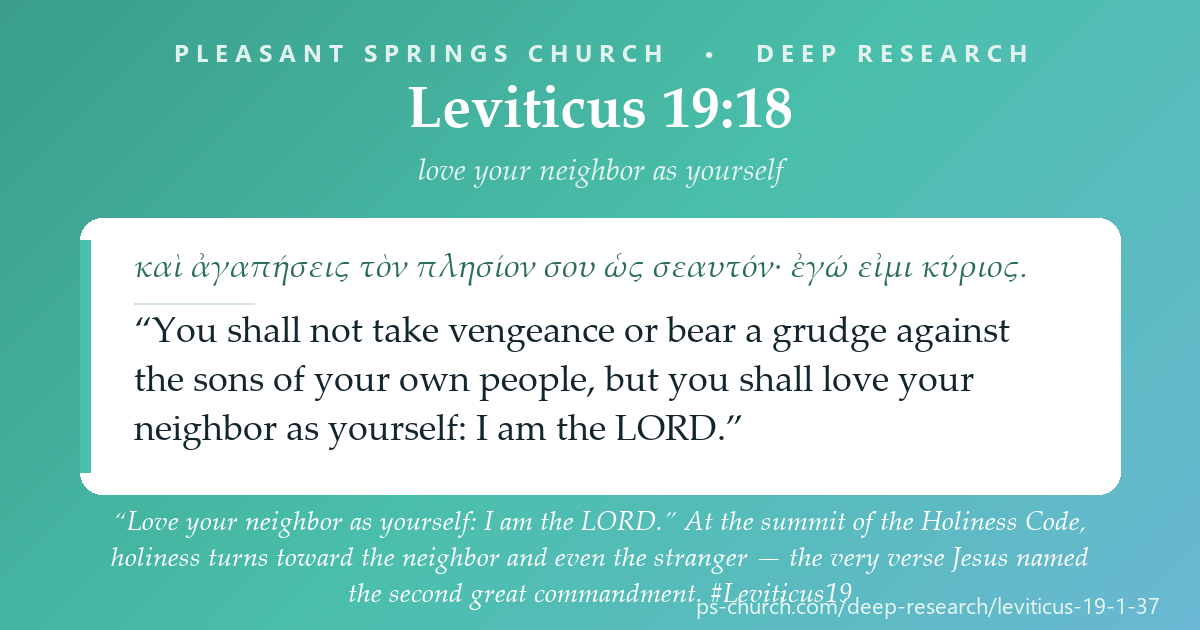
Leviticus 19:18 · to share
LXX + ESVEvery Deep Research page traces its passage across the whole sweep — the Old Testament, the Second-Temple world between the testaments (historical witnesses, not Scripture), and the New Testament. Follow the thread:
Pleasant Springs Church — Deep Research
Research method after Michael S. Heiser’s Bible Research Method (examine dictionaries → ancient literature → important words → textual connections → academic publications → share), with the Pleasant Springs “Author & Audience” foundation. Scripture set in the Hebrew, the Greek editions named on each page and the ESV (Old Testament), and the Greek New Testament and the ESV (New Testament), per the practice of Pleasant Springs Church. Leviticus 19 research grounded in Wenham, Milgrom, and Rooker, with Beale & Carson on the New Testament use (the Gospels; Romans; Galatians; James); ANE legal background (Code of Hammurabi) and Second-Temple / rabbinic reception (Mishnah Pe’ah; Sifra Kedoshim; Tobit and Sirach; Philo and Josephus), all read as witnesses, not Scripture. The chapter’s moral core — justice, mercy, honesty, and love of neighbor and stranger — is held as the abiding, New Testament-affirmed law; its ceremonial boundary-markers (mixed kinds, hair/tattoo, 19:19,27–28) are distinguished with care as signs given to Israel; and the civil order of ancient Israel is not read as a template for church or state.
Scripture quotations marked ESV are from the ESV® Bible (The Holy Bible, English Standard Version®), © 2001 by Crossway, a publishing ministry of Good News Publishers. ESV Text Edition: 2016. Used by permission. All rights reserved. The ESV text may not be quoted in any publication made available to the public by a Creative Commons license, and the ESV may not be translated in whole or in part into any other language. www.esv.org
|
Did this study bless you today? 💚 Give to Support PS Church100% of gifts go to the General Fund — thank you. |