Chapter 20 is the hard, judicial twin of chapter 18: it attaches penalties to the worst betrayals of covenant life — giving children to Molech, turning to mediums and necromancers, cursing father or mother, the sexual sins of the Holiness Code. It is sober reading. But it does not end in threat; it ends in a claim: “you shall be holy to me… I have separated you from the peoples, that you should be mine” (20:26). This study works Leviticus 20:1–27 — the seriousness of sin, the sanctity of children, and a people set apart — holding its gravity together with the gospel’s grace, for the God who wields no stone in Christ still separates a people to belong to him. See the method →
Leviticus 20:2–27 (selections)
Hebrew · LXX · ESVThe Shape of the Passage
ConcentricChapter 20 is the penalty-list that answers the prohibitions of chapter 18, wrapped around the same great summons as chapter 19: a holy people belonging to a holy God (see also “be holy, for I am holy,” ch 11).
Author
The Torah of Moses pairs Leviticus 20 with chapter 18: chapter 18 lists the sins Israel must not commit; chapter 20 attaches the consequences under Israel’s covenant law. Between them stands chapter 19, the great charter of neighbor-love — so the penalties are framed, on both sides, by the call to holiness and love. The chapter opens with the gravest case, Molech worship — giving one’s child to the fire (20:2–5) — and moves through the occult (20:6, 27), the honoring of parents (20:9), and the sexual sins of the Holiness Code, closing where it aims: “you shall be holy to me… I have separated you from the peoples, that you should be mine” (20:26).
Criminal law for a theocracy. These are the penalties of the Old Testament theocracy — the civil and criminal code of a particular nation, Israel, living under God’s direct rule. They treat these acts as capital because, in that covenant order, they struck at the life of the whole community before a holy God: child-killing, covenant betrayal through the occult, the unraveling of the family and of marriage. The gravity is real and abiding; the specific civil penalty belonged to that theocracy and, as the New Testament makes plain, is not carried over to the church or to any modern state (see the Audience note, and Stage 2).
Audience
Israel — a redeemed people set among the nations of Canaan whose worship included child sacrifice and the cult of the dead (20:23). The refrain drives the point home: they were “separated” (haḇdil) from those peoples to belong to the Lord (20:24–26). To sit under this law was to know that sin is not trivial, that children are sacred and not to be sacrificed, and that Israel’s God claims the whole of life — worship, family, and marriage-bed alike.
How the church hears it. The abiding word of Leviticus 20 is the holiness of God, the seriousness of sin, and God’s setting apart of a people for himself — a truth Peter and Paul lay directly on the church: “a people for his own possession” (1 Pet 2:9; Titus 2:14). But the method changes with the covenant. The theocracy wielded the sword; the church does not. Jesus refused to stone the woman caught in adultery (John 8:7–11), and Paul disciplines the Corinthian sinner not by execution but by loving exclusion from the Lord’s Table, “that his spirit may be saved” (1 Cor 5:5). And to every sin named here the gospel answers: “such were some of you. But you were washed… in the name of the Lord Jesus Christ” (1 Cor 6:11).
Orient on Molech, the occult, capital law, holiness, and separation.
Search by topic: Molech, child sacrifice, medium / necromancer, capital punishment in the Old Testament, holiness, election, the Holiness Code.
Which articles are relevant?
- Anchor Bible Dictionary — “Molech,” “Sacrifice, Child,” “Magic and Divination,” “Death Penalty,” “Holiness.”
- Dictionary of the OT: Pentateuch — “Holiness,” “Molech,” “Magic, Divination and Sorcery,” “Crimes and Punishments,” “Election.”
- NIDOTTE / TDOT — מֹלֶךְ (mōleḵ), אוֹב (ʾōḇ, medium), יִדְּעֹנִי (yiddəʿōnî, necromancer), בָּדַל (bāḏal, separate), קָדוֹשׁ (qāḏôš, holy).
Bibliography surfaced:
- Gordon Wenham (NICOT), Jacob Milgrom (AB), Mark Rooker (NAC) on Leviticus.
- Studies of the Holiness Code (Lev 17–26); the Molech question; capital law in Israel and the ancient Near East.
- Beale & Carson, Commentary on the NT Use of the OT (1 Peter; the church’s discipline vs. the theocracy’s sword).
Child sacrifice, the cult of the dead, and the criminal law of a theocracy.
Read the penalties against Canaanite worship and ancient law codes, weigh how Second-Temple Judaism handled capital law, then hear the New Testament’s change of method under the same God.
Which parallels shed light on religion and worldview?
Molech and the fire. Israel’s neighbors practiced child sacrifice: the Old Testament repeatedly condemns “passing children through the fire” to Molech (Lev 18:21; 20:2–5; 2 Kgs 23:10; Jer 32:35), and Phoenician-Punic sites (the Carthaginian tophet) preserve infant burials that ancient writers linked to such rites. Against this, Leviticus 20 sets the sanctity of the child in the sharpest terms — the God of Israel is not fed with children; he redeems them. The LXX heard מֹלֶךְ not as a proper name but as “a ruler” (ἄρχων, 20:2), reading it as giving one’s seed to an idolatrous authority.
The cult of the dead. Consulting the dead through אוֹב and יִדְּעֹנִי (mediums and necromancers) was widespread in the ancient world — the same practice Saul turns to at Endor (1 Sam 28), having himself banned it. Leviticus frames it not as harmless folk-religion but as covenant betrayal: to “whore after” the dead is to turn from the living God (20:6).
Capital law in the ancient world — and how it was hedged. Ancient law codes (Hammurabi, the Hittite and Middle Assyrian laws) also assigned death for a range of offenses; Israel’s theocratic code stands within that world while grounding its penalties in the holiness of God rather than the honor of a king. By the Second-Temple and rabbinic period, Jewish courts had surrounded capital cases with evidentiary safeguards so demanding — two eyewitnesses, prior warning, an unhurried court — that the Mishnah (Makkot 1:10) could call a court that executed once in seven (or, in one rabbi’s words, seventy) years “destructive.” The gravity of the law was kept; its execution was hedged with mercy and awe.
- Mishnah, Sanhedrin (rabbinic-era — a witness, not Scripture) — the “four deaths” and the near-impossible evidentiary standards that hedged capital punishment; the court reluctant to execute.
- Temple Scroll (11Q19) & Damascus Document (Qumran — witnesses, not Scripture) — the sectarian working-out of the Holiness-Code purity and sexual law.
- Sifra (rabbinic midrash on Leviticus — a witness, not Scripture) — the classic Jewish commentary on chapters 18–20.
- Punic tophet inscriptions; Diodorus Siculus 20.14 (Greco-Roman witness) — ancient testimony to Carthaginian child sacrifice: the cultural horror Leviticus 20 forbids.
These death penalties were the criminal law of a particular nation, Old Testament Israel, under God’s direct rule — not a template handed to the church or to any modern state. Two things must be held together. First, the seriousness is real and permanent: child sacrifice, the occult, the assault on family and marriage are grave before a holy God, and the penalties measure that gravity. Second, the method changed with the covenant. When men brought Jesus a woman caught in the very act the Holiness Code condemns, he did not deny the law’s gravity — he refused the stone: “Let him who is without sin among you be the first to throw a stone at her… Neither do I condemn you; go, and from now on sin no more” (John 8:7, 11). The New Testament church disciplines not by execution but by exhortation and, at the last, by loving exclusion from the Lord’s Table — and even that aims at restoration, “that his spirit may be saved in the day of the Lord” (1 Cor 5:5). The abiding truth of Leviticus 20 is the holiness of God and the deadly seriousness of sin; its abiding offer, in Christ, is cleansing to every sinner — for “such were some of you. But you were washed” (1 Cor 6:11).
The vocabulary of Molech, the occult, separation, and holiness.
Watch Molech and the pair ʾōḇ / yiddəʿōnî (medium / necromancer), then the separating verb bāḏal that turns penalty into purpose — a holy people set apart to belong to God.
“Molech” — the god (or the rite) to whom children were “given” / passed through the fire; the gravest case in the chapter. The LXX read it as ἄρχων, “a ruler,” hearing idolatrous allegiance. Leviticus sets against it the sanctity of the child.
“Medium” — one who consults the spirits of the dead (the “ghost” or the practitioner; LXX ἐγγαστρίμυθος). Paired with the necromancer, it names the cult of the dead as covenant betrayal — a turning from the living God.
“Necromancer / familiar spirit” — from yāḏaʿ, “to know”: one claiming forbidden knowledge from the dead (LXX ἐπαοιδός). To “seek” such is to “whore after” them (20:6).
“To separate / set apart” — God “separated” Israel from the peoples to be his (wāʾaḇdil, 20:26; LXX ἀφορίζω). The same verb divides light from darkness in Genesis 1:4: holiness is God-shaped separation, and it grounds election.
“Holy” — set apart, belonging to God. The chapter’s penalties are bracketed by the summons “be holy… for I the Lord am holy” (20:7, 26), quoted over the church in 1 Peter 1:16.
How the New Testament takes up the chapter’s themes:
- 1 Peter 2:9; Titus 2:14 — “a people for his own possession”: the language of Leviticus 20:26 (separation to belong to God) laid on the church — now gathered by the blood of Christ, not the sword.
- 1 Peter 1:15–16 — “you shall be holy, for I am holy”: the bracketing summons of 20:7, 26 pressed on Christians.
- John 8:3–11 — Jesus, faced with a Holiness-Code capital case, refuses the stone: “neither do I condemn you; go, and from now on sin no more.”
- 1 Corinthians 5:1–5; 6:9–11 — the church disciplines by exclusion, not execution, aiming at salvation; “such were some of you. But you were washed.”
From the penalties of a theocracy to a people set apart in Christ.
Trace the sanctity of children, the ban on the occult, and above all the separation of a holy people, from Leviticus through the prophets to the New Testament church.
Which cross-references matter?
- Leviticus 18:1–30 — the prohibitions this chapter enforces; both are framed by “I am the Lord” and the holiness of God (see Leviticus 18).
- Leviticus 19:2, 18 — “you shall be holy” and “love your neighbor as yourself”: the penalties of ch 20 serve the holiness and love of ch 19 (see Leviticus 19).
- Genesis 1:4 — God “separated” (haḇdil) light from darkness: the creation-verb behind “I have separated you from the peoples” (20:26; see Genesis 1:1).
- 2 Kings 23:10; Jeremiah 32:35; 1 Samuel 28 — Molech and the medium of Endor: how Israel later fell into the very things Leviticus 20 forbids.
- 1 Peter 2:9; Titus 2:14; 1 Peter 1:16 — the church as a people separated to belong to God, called to holiness — the abiding heart of Leviticus 20 (see Ephesians 2).
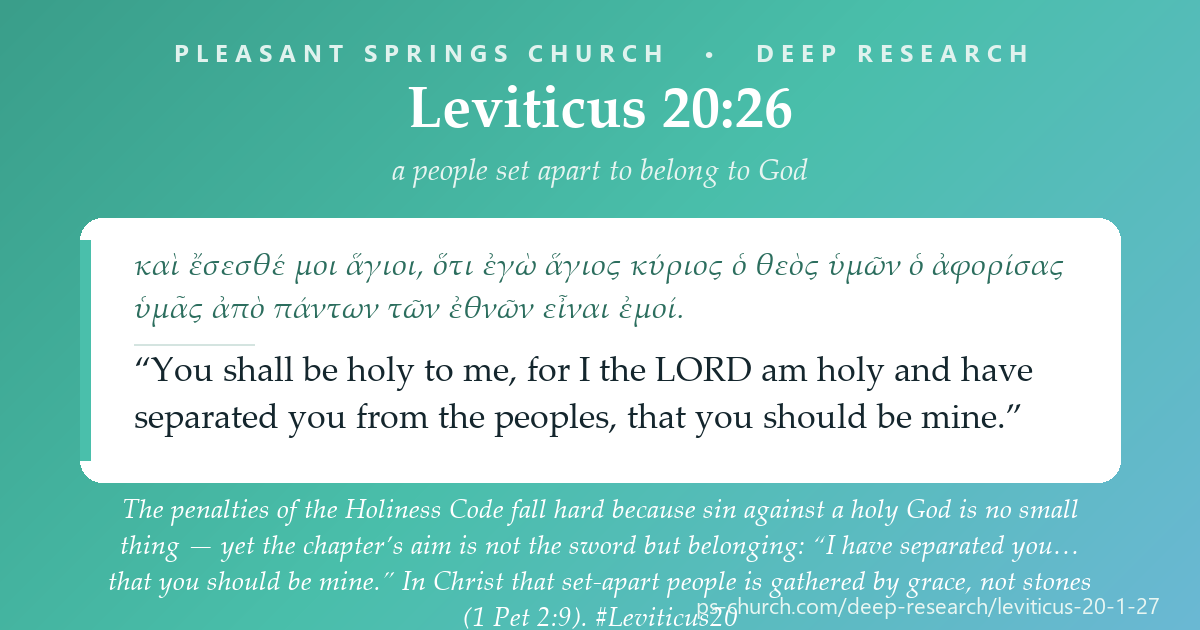
Leviticus 20 turns, at its end, from penalty to purpose: “you shall be holy to me, for I the Lord am holy and have separated you from the peoples, that you should be mine” (20:26). That single sentence is the deepest logic of the whole Holiness Code — the penalties exist because this people belongs to God, set apart by his own choosing (the verb is bāḏal, the creation-word for making distinctions). The New Testament reaches straight back into this language and lays it on the church: “you are a chosen race, a royal priesthood, a holy nation, a people for his own possession” (1 Pet 2:9); Christ “gave himself for us… to purify for himself a people for his own possession” (Titus 2:14). What has changed is not that God has stopped setting apart a holy people — he has not — but how that people is formed and kept. Israel’s theocracy guarded its holiness with civil penalties; the church is set apart by the blood of Christ and kept by grace, disciplined not with the sword but with the patient call to repent (1 Cor 5), and welcoming home every sinner who was “washed… sanctified… justified” (1 Cor 6:11). The seriousness of sin is not softened; the way of dealing with the sinner is the cross.
The scholarship on the Holiness Code’s penalties.
Wenham and Milgrom for Leviticus; the Molech and capital-law studies; Beale & Carson for the New Testament’s change of method under the same holy God.
Commentaries & studies:
- Gordon J. Wenham, The Book of Leviticus (NICOT); Jacob Milgrom, Leviticus (Anchor); Mark F. Rooker (NAC).
- Studies of the Holiness Code (Lev 17–26); the Molech debate (deity vs. type of offering); capital punishment in Israel and the ANE; the rabbinic hedging of the death penalty.
- G. K. Beale & D. A. Carson, eds., Commentary on the New Testament Use of the Old Testament (1 Peter).
Interpretation notes worth keeping:
- Chapter 20 is chapter 18 with penalties. The two chapters are a matched pair — prohibition and consequence — wrapped around chapter 19’s holiness and neighbor-love. Read them together, and the penalties serve the covenant’s life, not cruelty.
- Theocratic civil law, not a church-or-state manual. The death penalties belonged to Israel’s national covenant. The New Testament neither re-enacts them nor treats the underlying sins as trivial; it changes the method — church discipline, not the sword (John 8; 1 Cor 5) — while keeping the gravity.
- Handle with gravity, never cruelty. This is not culture-war ammunition. The same chapter that names these sins names the God who separates a people to himself in mercy; the same gospel that calls sin serious offers cleansing to all who were once caught in it (1 Cor 6:11).
- 20:26 is the point. The penalties are penultimate; the purpose is a holy people belonging to God. That is what the New Testament carries forward — “a people for his own possession” (1 Pet 2:9; Titus 2:14).
From the weight of the penalties to the wonder of belonging.
Name what you learned, why it matters, and one concrete response.
What should we carry away — and do?
- Sin is serious — and children are sacred. Leviticus 20 will not let us treat sin as trivial or children as expendable. The God of Israel is not fed with children; he redeems them.
- The gravity abides; the sword does not. The theocracy’s death penalties are not the church’s tools or the state’s mandate. Jesus refused the stone (John 8); the church corrects to restore (1 Cor 5) — holding sin’s seriousness together with grace.
- You were set apart to belong. The chapter’s climax is not a threat but a claim: “I have separated you… that you should be mine” (20:26) — carried over the church as “a people for his own possession” (1 Pet 2:9).
Step in response: receive the weight and the welcome of this chapter together. Name honestly whatever sin you have been treating as small, and bring it to the One who says “neither do I condemn you; go, and from now on sin no more” — not to be stoned, but to be washed (1 Cor 6:11). Then live this week as one who belongs: a person God has set apart for himself, and so free to be holy, and to guard the sanctity of the vulnerable — the child above all.
Leviticus 20:26 · to share
LXX + ESVEvery Deep Research page traces its passage across the whole sweep — the Old Testament, the Second-Temple world between the testaments (historical witnesses, not Scripture), and the New Testament. Follow the thread:
Pleasant Springs Church — Deep Research
Research method after Michael S. Heiser’s Bible Research Method (examine dictionaries → ancient literature → important words → textual connections → academic publications → share), with the Pleasant Springs “Author & Audience” foundation. Scripture set in the Hebrew, the Greek editions named on each page and the ESV (Old Testament), and the Greek New Testament and the ESV (New Testament), per the practice of Pleasant Springs Church. Leviticus 20 research grounded in Wenham, Milgrom, and Rooker, with the Holiness-Code, Molech, and capital-law studies, and Beale & Carson on the New Testament use (1 Peter). The chapter’s death penalties are read as the criminal law of the Old Testament theocracy of Israel — grave and abiding in what they reveal of God’s holiness and the seriousness of sin, but not a template for the church or any modern state, which disciplines by exhortation and, at most, exclusion from the Table, not the sword (John 8; 1 Cor 5), with cleansing offered to every sinner (1 Cor 6:11); the chapter’s climax — a holy people separated to belong to God (20:26) — carried over the church (1 Pet 2:9; Titus 2:14). Second-Temple and rabbinic material per the Mishnah (Sanhedrin), the Temple Scroll and Damascus Document, and the Sifra, read as witnesses, not Scripture.
Scripture quotations marked ESV are from the ESV® Bible (The Holy Bible, English Standard Version®), © 2001 by Crossway, a publishing ministry of Good News Publishers. ESV Text Edition: 2016. Used by permission. All rights reserved. The ESV text may not be quoted in any publication made available to the public by a Creative Commons license, and the ESV may not be translated in whole or in part into any other language. www.esv.org
|
Did this study bless you today? 💚 Give to Support PS Church100% of gifts go to the General Fund — thank you. |