At every meal, Israel was to remember whose it was. Leviticus 11 sorts the animal world into clean and unclean — land creatures that chew the cud and split the hoof, water creatures with fins and scales, clean and unclean birds and insects — not for health but for holiness: “be holy, for I am holy” (11:44–45), the refrain Peter would one day quote over the church. This study works Leviticus 11:1–47, from the separated table to the day Jesus “declared all foods clean” and the wall between clean and unclean came down — while the call to holiness abides. See the method →
Leviticus 11:2–47 (selections)
Hebrew · LXX · ESVThe Shape of the Passage
Parallel panels · inclusioLeviticus 11 begins the great block of purity laws (chs 11–15) that follows the priesthood’s ordination (ch 8–10): now the whole people, not just the priests, learns to live as a holy nation before a holy God.
Author
The Torah of Moses places the dietary laws right after the fire that fell on Aaron’s sons (ch 10): having shown that approaching God is a matter of life and death, Leviticus now teaches Israel to discern — “to distinguish between the holy and the common, and between the unclean and the clean” (10:10). Chapter 11 is the first application: a taxonomy of clean and unclean creatures, land, sea, and air, ending not with a hygiene lecture but with the theological ground of the whole thing — “be holy, for I am holy” (11:44–45).
Holiness as separation. The chapter is built on a single verb — haḇdîl, “to separate” (11:47) — the very word for God’s dividing light from darkness in Genesis 1. Because the Lord is holy (set apart), his people must be set apart; and the dietary code makes that abstraction concrete three times a day. A clarification the text itself invites: “clean” and “unclean” are ceremonial categories about fitness to approach the sanctuary — not a claim that unclean animals are evil, nor that the eater is morally guilty. The pig is not wicked; it is simply on the far side of a boundary that taught Israel, at every meal, that it belonged to God.
Audience
Israel — a redeemed people summoned to be different from the nations around them. The dietary laws were a daily, edible catechism in identity: to sit at the table was to remember the exodus (“I am the Lord who brought you up out of the land of Egypt,” 11:45) and to embody a calling. Scholars have proposed several rationales — hygiene, symbolic association with death or wholeness, boundary-marking from the nations — and these are worth holding with humility; but the text’s own reason is stated plainly and only once: holiness, belonging to the Lord.
How the church hears it. The New Testament teaches that the food-laws themselves are fulfilled and set aside for Christians: Jesus “declared all foods clean” (Mk 7:19), Peter is told “what God has made clean, do not call common” (Acts 10:15), and Paul refuses to let anyone judge the church over food (Col 2:16–17; Rom 14). Yet the call the laws embodied abides — Peter quotes this very chapter to the church: “be holy, for I am holy” (1 Pet 1:16). The outward wall between clean and unclean came down; the holiness it taught moved inward, to the heart, and outward, to gather the nations (Eph 2:14).
Orient on clean/unclean, holiness, the dietary laws, and purity.
Search by topic: clean and unclean, dietary / food laws, holiness, purity and impurity, abomination, kashrut.
Which articles are relevant?
- Anchor Bible Dictionary — “Clean and Unclean,” “Dietary Laws,” “Holiness,” “Purity.”
- Dictionary of the OT: Pentateuch — “Clean and Unclean,” “Food,” “Holiness,” “Sacrifice and Offerings.”
- NIDOTTE / TDOT — קָדוֹשׁ (qāḏôš, holy), טָהוֹר / טָמֵא (ṭāhôr / ṭāmēʾ, clean / unclean), בָּדַל (bāḏal, separate), שֶׁקֶץ (šeqeṣ, detestable thing).
Bibliography surfaced:
- Gordon Wenham (NICOT), Jacob Milgrom (AB), Mark Rooker (NAC) on Leviticus.
- Mary Douglas, Purity and Danger (the symbolic-wholeness reading); studies of the “holiness = separation” theology of Leviticus 11.
- Beale & Carson, Commentary on the NT Use of the OT (Mark 7; Acts 10; 1 Peter 1).
Food, holiness, and the boundary that marked a people.
Read the dietary code against ancient food custom and the debated rationales, then follow the boundary to its New Testament transformation.
Which parallels shed light on religion and worldview?
Food as identity in the ancient world. Every ancient culture had food taboos, and shared meals sealed alliances, families, and covenants. Israel’s dietary code works within that world — but its stated aim is unique: not the honor of a clan or the appeasement of a god, but holiness, belonging to the Lord who redeemed them (11:45). By the Second-Temple period these laws had become a badge of Jewish identity so central that Antiochus IV tried to abolish them and faithful Jews died rather than eat swine’s flesh (1 Macc 1:47–63; 2 Macc 6–7).
The debated rationale. Why these creatures? Three main readings are held, and none is certain: (1) hygiene — some unclean animals carry disease; but the text never says so, and many clean animals are no safer, so this cannot be the primary key. (2) symbolic wholeness (Mary Douglas) — clean creatures are those that fully fit their sphere (land animals that both chew the cud and split the hoof; water creatures with fins and scales), while boundary-crossing or “incomplete” creatures are unclean; the categories teach order and wholeness. (3) association with death — predators, scavengers, and creatures linked to corpses are excluded, so the dietary laws keep Israel’s table on the side of life. Each has merit; all should be held with scholarly humility. What the chapter itself asserts is not a mechanism but a purpose: be holy, for I am holy.
- 1 Maccabees 1:47–63; 2 Maccabees 6–7 (Apocrypha — a witness, not Scripture in the Protestant canon) — martyrdom rather than eating unclean food: the dietary laws as the front line of covenant faithfulness.
- Letter of Aristeas 128–171 (Second-Temple — a witness, not Scripture) — an early allegorical rationale: the food-laws train the reasoning soul in virtue and mark Israel off from the nations.
- Mishnah, Ḥullin (rabbinic-era) — the detailed working-out of clean and unclean slaughter and food.
- Mark 7:1–23; Acts 10:1–16; 15:1–29 (New Testament) — the food-laws re-read in the light of Christ and the ingathering of the nations.
The dietary laws drew a line through the animal kingdom, and that line was a picture of a deeper one — between Israel and the nations, holy and common, near and far off. Then Jesus, teaching that defilement comes from the heart and not the stomach, was heard to have “declared all foods clean” (Mk 7:19); Peter, shown a sheet of unclean animals, was told, “What God has made clean, do not call common” (Acts 10:15) — and understood at once that the vision was about people, not pork: “God has shown me that I should not call any person common or unclean” (Acts 10:28). Paul draws the conclusion for the church: “let no one pass judgment on you in questions of food… these are a shadow of the things to come, but the substance belongs to Christ” (Col 2:16–17; cf. Rom 14:14, 17). The outward boundary had done its work and its time was fulfilled; the wall between clean and unclean, Jew and Gentile, was “broken down” in the cross (Eph 2:14). What abides is the holiness the laws embodied — now written on the heart and stretched wide enough to gather every nation: for the God who says “be holy, for I am holy” still says it, and says it now to the church (1 Pet 1:15–16).
The vocabulary of holiness, clean and unclean, and distinction.
Watch qadosh (holy), the pair tahor / tame (clean / unclean), and badal — the separating verb that runs from creation to the table.
“Holy” — the governing word of Leviticus: set apart, belonging to God, distinct from the common. The refrain “be holy, for I am holy” (LXX ἅγιοι… ἅγιος) grounds every purity law and is quoted over the church (1 Pet 1:16).
“Clean / unclean” — ceremonial categories of fitness to approach the sanctuary, not moral guilt or a verdict on the animal (LXX καθαρός / ἀκάθαρτος). To be unclean is to be temporarily unfit for holy space, not to be a sinner.
“To separate / make a distinction” — the verb of the whole chapter’s purpose (ləhaḇdîl, 11:47; LXX διαστεῖλαι). The same word divides light from darkness in Genesis 1:4: holiness is God-shaped distinction.
“Detestable thing” — the term for unclean water creatures, birds of prey, and swarming things; stronger than merely “unclean.” It marks what Israel must not eat or touch as food — a boundary, not a curse.
“Chews the cud” — paired with mafreseṯ parsâ, “parts the hoof”: the twofold sign of a clean land animal. Both marks are required — the camel, rock badger, hare, and pig each fail on one count (11:4–8).
How the New Testament reuses Leviticus 11:
- 1 Peter 1:14–16 — “As he who called you is holy, you also be holy… since it is written, ‘You shall be holy, for I am holy’”: Leviticus 11:44–45 (with 19:2) applied directly to the church.
- Mark 7:1–23 — “Thus he declared all foods clean” (7:19): defilement is from the heart, not the diet.
- Acts 10:1–16, 28; 15:1–29 — Peter’s vision: “What God has made clean, do not call common” — the dietary boundary lifted to welcome the nations.
- Colossians 2:16–17; Romans 14:14, 17 — food-laws a “shadow… the substance belongs to Christ”; “the kingdom of God is not a matter of eating and drinking.”
From the separated table to the holiness of the heart.
Trace holiness and separation from creation, through the priestly charge, to the church gathered from the nations.
Which cross-references matter?
- Genesis 1:4, 6–7 — God “separated” (haḇdîl) light from darkness and waters from waters: the dietary code is a liturgy of the same creation-verb (see Genesis 1:1).
- Leviticus 10:10; 20:24–26 — “distinguish between the holy and the common, the clean and the unclean… I have separated you from the peoples to be mine”: the dietary laws as identity (see Leviticus 10).
- Deuteronomy 14:1–21 — the parallel dietary list, framed by “you are a people holy to the Lord your God.”
- Mark 7:19; Acts 10:15; 15:1–29 — the food-laws fulfilled and set aside; the boundary reopened to the nations.
- 1 Peter 1:15–16; Ephesians 2:14–16; Colossians 2:16–17 — holiness internalized, the dividing wall broken down, the shadow yielding to Christ (see Ephesians 2).
The New Testament does not treat Leviticus 11 as an embarrassment to be discarded but as a God-given shadow whose substance has come. The dietary laws taught Israel, meal by meal, that it belonged to a holy God and was distinct from the nations; that lesson was never abolished. What changed is the boundary marker. Mark records that Jesus, by locating defilement in the heart rather than the stomach, “declared all foods clean” (7:19) — the ceremonial code reaching its intended goal in the purity of the heart it always pointed toward. Peter’s rooftop vision makes explicit what was implicit: the unclean-animal chart was, at the deepest level, about the nations kept at arm’s length — and now “God shows no partiality” (Acts 10:34–35), so the sheet of unclean creatures descends precisely to send Peter to a Gentile’s house. Paul completes the logic: the food-laws were “a shadow of the things to come, but the substance belongs to Christ” (Col 2:17), so no Christian is to be judged over diet (Rom 14). And yet, in the same breath, Peter reaches back into this very chapter and lays its imperative on the church: “be holy, for I am holy” (1 Pet 1:16). The distinction the laws drew on the plate is now to be drawn in the life — holiness of heart, in a people gathered from every nation the old wall once excluded.
The scholarship on the dietary laws and holiness.
Wenham and Milgrom for Leviticus; Douglas for the symbolic reading; Beale & Carson for the NT use.
Commentaries & studies:
- Gordon J. Wenham, The Book of Leviticus (NICOT); Jacob Milgrom, Leviticus (Anchor); Mark F. Rooker (NAC).
- Mary Douglas, Purity and Danger and Leviticus as Literature (the wholeness / boundary reading); studies of “holiness as separation.”
- G. K. Beale & D. A. Carson, eds., Commentary on the New Testament Use of the Old Testament (Mark 7; Acts 10–15; 1 Peter).
Interpretation notes worth keeping:
- The text’s own reason is holiness, not hygiene. Every proposed rationale (health, wholeness, death-avoidance) is inference; the chapter states only one purpose — belonging to a holy God (11:44–45). Hold the mechanisms loosely and the purpose firmly.
- Clean/unclean is ceremonial, not moral. An unclean animal is not evil; an unclean person is not a sinner but temporarily unfit for holy space. Leviticus 11 is about approaching the sanctuary, not about shame — the body and its foods are God’s good creation.
- Abrogation and abiding call. The food-laws themselves are fulfilled and set aside for Christians (Mk 7:19; Acts 10; Col 2:16–17; Rom 14) — this is New Testament teaching, not mere opinion. But the holiness they embodied abides and is pressed on the church (1 Pet 1:16).
- Peter’s vision is about people. Acts 10 reads the clean/unclean line as, finally, the wall between Jew and Gentile — taken down in Christ (Eph 2:14). The dietary law’s deepest fulfillment is the ingathering of the nations.
From the separated table to a holy, welcoming people.
Name what you learned, why it matters, and one concrete response.
What should we carry away — and do?
- Holiness is belonging. The dietary laws made an ordinary meal a reminder: you are not your own, you belong to a holy God. Holiness is less a list of foods than a life set apart for him.
- The food-laws are fulfilled; the call is not. Christians are free at the table (Mk 7:19; Rom 14) — but not free from “be holy, for I am holy.” The distinction moved from the plate to the heart.
- The wall came down. The line that once kept the nations at a distance is broken in Christ (Eph 2:14). A holy people is now a welcoming people — called to no partiality (Acts 10:34).
Step in response: ask where God is calling you to be genuinely set apart — not in diet, but in the things Jesus located in the heart (Mk 7:21–23): honesty, purity, generosity, speech. Name one, and consecrate it to him this week. Then, remembering Peter’s vision, welcome someone your instincts would keep at arm’s length — for the holy God who says “be holy, for I am holy” is the same God who says “do not call common what I have made clean.”
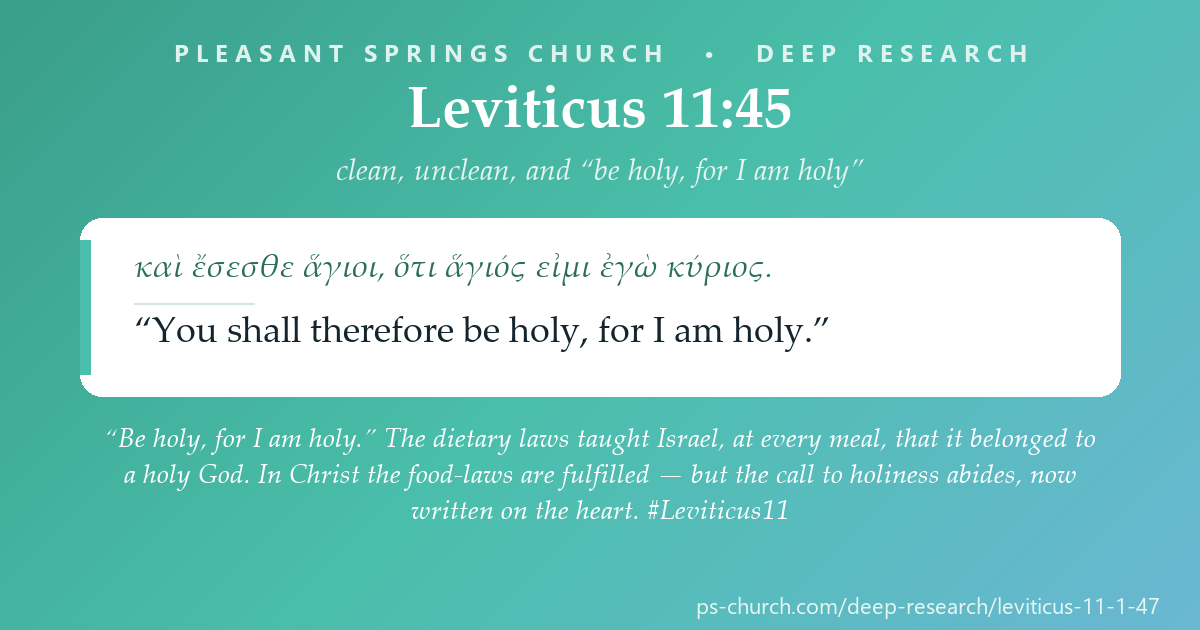
Leviticus 11:45 · to share
LXX + ESVEvery Deep Research page traces its passage across the whole sweep — the Old Testament, the Second-Temple world between the testaments (historical witnesses, not Scripture), and the New Testament. Follow the thread:
Pleasant Springs Church — Deep Research
Research method after Michael S. Heiser’s Bible Research Method (examine dictionaries → ancient literature → important words → textual connections → academic publications → share), with the Pleasant Springs “Author & Audience” foundation. Scripture set in the Hebrew, the Greek editions named on each page and the ESV (Old Testament), and the Greek New Testament and the ESV (New Testament), per the practice of Pleasant Springs Church. Leviticus 11 research grounded in Wenham, Milgrom, and Rooker, with Mary Douglas on the symbolic/boundary reading and Beale & Carson on the New Testament use (Mark 7; Acts 10–15; 1 Peter 1); the proposed rationales (hygiene, wholeness, death-avoidance) held with scholarly humility while the text’s own stated purpose — holiness and belonging (11:44–45) — is kept central; clean/unclean read as ceremonial rather than moral categories; the food-laws’ abrogation for Christians (Mk 7:19; Acts 10; Col 2:16–17; Rom 14) affirmed as New Testament teaching, with the abiding call to holiness (1 Pet 1:16) and the ingathering of the nations (Eph 2:14). Second-Temple material per the Letter of Aristeas and 1–2 Maccabees, read as witnesses, not Scripture.
Scripture quotations marked ESV are from the ESV® Bible (The Holy Bible, English Standard Version®), © 2001 by Crossway, a publishing ministry of Good News Publishers. ESV Text Edition: 2016. Used by permission. All rights reserved. The ESV text may not be quoted in any publication made available to the public by a Creative Commons license, and the ESV may not be translated in whole or in part into any other language. www.esv.org
|
Did this study bless you today? 💚 Give to Support PS Church100% of gifts go to the General Fund — thank you. |