After a child is born, Leviticus 12 gives the mother a season of ceremonial purifying and then a glad return to worship with an offering. It is one of Scripture’s most misread chapters: “unclean” here is a ceremonial category about approaching the holy sanctuary and the mystery of birth-blood — not a claim that childbirth, the body, or a woman is sinful or shameful. Childbearing is the first blessing of Eden. And the chapter’s tender center is grace to the poor: “if she cannot afford a lamb… two turtledoves or two pigeons” (12:8) — the very offering Mary brought at Jesus’ presentation (Luke 2:24). This study works Leviticus 12:1–8. See the method →
Leviticus 12:2, 6–8 (selections)
Hebrew · LXX · ESVThe Shape of the Passage
Parallel panelsLeviticus 12 sits inside the purity laws (chs 11–15) that follow the priesthood’s inauguration (chs 8–10). Its subject is the holiness of the sanctuary and the tender grace of God — not the shaming of women or the body.
Author
The Torah of Moses places this chapter in Leviticus’ great section on clean and unclean (chs 11–15). The tabernacle stands filled with glory (Exod 40), the priesthood has been ordained and the first fire has fallen (Lev 8–10), and now Israel is taught how an ordinary life — food, birth, disease, discharge — is lived near a holy God without profaning his dwelling. Chapter 12 takes up childbirth: a seven- or fourteen-day period of ceremonial uncleanness, then a longer span of “the blood of her purifying,” and finally an offering at the tent of meeting.
A ceremonial, not a moral, category. It is vital to read “unclean” (טָמֵא, ṭāmēʾ) rightly. In Leviticus, clean and unclean are cultic categories about fitness to approach the sanctuary — overwhelmingly not statements of sin or guilt. Childbearing is nowhere called sinful or shameful; it is the very first blessing God speaks over humanity (“be fruitful and multiply,” Gen 1:28; cf. Ps 127:3–5). The uncleanness here is tied to blood and to the boundary of life and death — the same holy weight Leviticus attaches to blood everywhere (17:11). The body is God’s good creation; the law guards the sanctuary’s holiness, not a mother’s worth.
Audience
Israel — and in this chapter, especially the new mother. After the days were fulfilled she came to the Lord’s house not in disgrace but with a gift, and went home clean, restored to the full worship of her people. The law dignified her: it named the season, set its bounds, and gave it a joyful end at the altar.
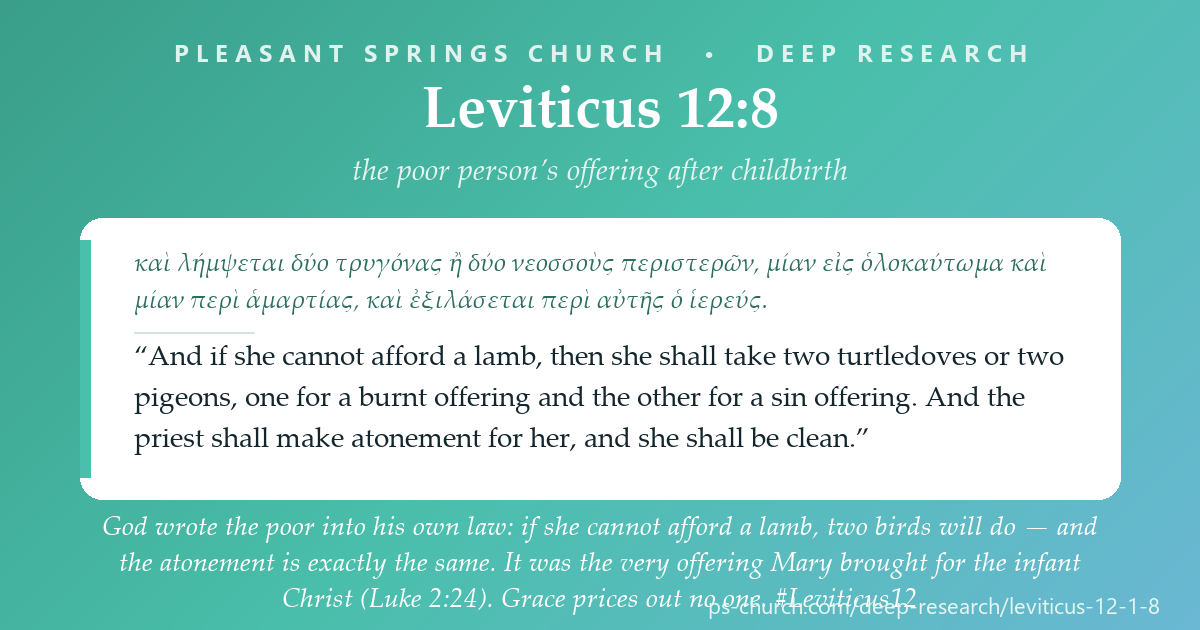
Grace scaled to the poor. The chapter’s pastoral heart is verse 8. The lamb was the ordinary offering; but “if she cannot afford a lamb” — literally, “if her hand does not reach enough for a lamb” — then two birds suffice, and the atonement and cleansing are exactly the same. God writes the poor into his own law so that no woman is shut out of worship by poverty. Israel heard: the sanctuary is holy, and it is open — even to the empty-handed. Centuries later a young mother in Nazareth would bring precisely this offering (Luke 2:24), and heaven would count the King’s own family among the humble poor.
Orient on purity, childbirth, blood, and the offerings.
Search by topic: clean and unclean, purity laws, childbirth, blood, sin offering, burnt offering, atonement, poverty and offerings.
Which articles are relevant?
- Anchor Bible Dictionary — “Clean and Unclean,” “Purity,” “Blood,” “Sacrifice,” “Birth.”
- Dictionary of the OT: Pentateuch — “Purity and Impurity,” “Holiness,” “Sacrifices and Offerings,” “Women.”
- NIDOTTE / TDOT — טָמֵא (ṭāmēʾ, unclean), טָהֵר (ṭāhēr, be clean/purify), כָּפַר (kāp̄ar, atone), חַטָּאת (ḥaṭṭāʾt, sin/purification offering).
Bibliography surfaced:
- Gordon Wenham (NICOT), Jacob Milgrom (AB), Mark Rooker (NAC) on Leviticus.
- Studies of ritual purity and the “blood of purifying”; the chatta’t as a purification offering; the graded/“scaled” offering for the poor.
- Beale & Carson, Commentary on the NT Use of the OT (Luke 2).
Birth-blood, the sanctuary’s boundary, and grace to the poor.
Read the childbirth law against ancient purity notions, guard against misreading it as shame, then follow the poor woman’s two birds to Bethlehem and to Christ.
Which parallels shed light on religion and worldview?
Purity, blood, and the holy. Many ancient cultures treated birth-blood and bodily flows as bearing a kind of ritual charge that had to be resolved before approaching a temple. Leviticus works within that shared world of purity boundaries — but reframes it entirely: the categories are set by the Lord, they attach to the holiness of his sanctuary, and they are drained of superstition. There is no hostile power to placate, no notion that the mother is polluted in her person. The recurring key is blood, which Leviticus everywhere treats as holy because “the life… is in the blood” (17:11): birth stands at the threshold of life, and that threshold is handled with reverence, not revulsion.
Not a verdict on the body, sex, or childbirth. This must be said plainly, because the chapter has often been misread. Nothing here calls childbearing sinful, the female body shameful, or motherhood defiling. The chatta’t (“sin offering”) at verse 6 is better heard as a purification offering — it cleanses the effect of ritual impurity so the mother may re-enter worship; it does not accuse her of wrongdoing (she is asked to bring a sin offering for a wholly natural, God-blessed event, which is proof enough that chatta’t here is about cleansing, not condemnation). Childbearing remains the first blessing of Eden (Gen 1:28; Ps 127). The law dignifies the season and gives it a glad end at the altar.
Grace scaled to the poor. Verse 8 is the tender center: the lamb was standard, but the poor bring “two turtledoves or two pigeons” — and receive the identical atonement and cleansing. This is a recurring mercy in the offerings (cf. Lev 5:7–13; 14:21–22): God builds a sliding scale into his own holiness so that worship is never priced out of a poor believer’s reach. When Luke tells us Mary brought exactly this offering (Luke 2:24), he is quietly telling us the Messiah was born into a poor family — and that the law’s open door for the poor swung wide for the mother of the Lord herself.
- Mishnah, Keritot & Niddah (rabbinic-era) — later Jewish discussion of the childbirth offering and the laws of ritual impurity: how the Second-Temple world worked out the practice (a witness, not Scripture).
- Jubilees 3:8–14 (Pseudepigrapha — a witness, not Scripture) — ties Leviticus 12’s very periods (7/33 and 14/66 days) to Adam and Eve entering Eden after forty and eighty days: a Second-Temple reading of this chapter.
- Luke 2:22–24 (New Testament) — Mary’s purification and Jesus’ presentation; the family brings “a pair of turtledoves, or two young pigeons” — the poor woman’s offering of Leviticus 12:8.
Leviticus keeps the holy and the unclean carefully apart: uncleanness could not enter the sanctuary, and the holy did not go out to the unclean. The Gospels announce the reversal. When a woman with a twelve-year flow of blood — ceremonially unclean, cut off from the temple — touched the fringe of Jesus’ garment, the ordinary logic would say her impurity passed to him; instead his wholeness passed to her, and he called her “Daughter” and sent her away healed (Mark 5:25–34). When he touched a leper, he was not defiled; the leper was cleansed (Mark 1:40–45). In Christ the holiness that once had to be guarded now moves outward, cleansing what it touches (held as devotional analogy grounded in the Gospels’ own scenes). And the mother of this Lord had herself come with the offering of the poor (Luke 2:24) — the King’s family among the humble, so that the empty-handed might know the sanctuary is open to them in him.
The vocabulary of purity, birth-blood, atonement, and the poor.
Watch tame’ and tohorah as ceremonial (not moral) terms, the reverent “fountain of blood,” and the idiom that names — and provides for — the poor.
“Unclean” — a ceremonial/cultic category of unfitness to approach the sanctuary (LXX ἀκάθαρτος). In chs 12 and 15 it is not a charge of sin or a verdict on the body; it marks a temporary state, resolved by time and offering.
“Purifying / cleansing” — the “blood of her purifying”; from טָהֵר (ṭāhēr, be clean; LXX κάθαρσις / καθαρίζω). The season ends in cleanness and restored worship, not in disgrace.
“The fountain of her blood” — the source/flow of birth-blood (LXX ἡ πηγὴ τοῦ αἵματος). Blood is holy in Leviticus because “the life is in the blood” (17:11); birth stands at life’s threshold and is treated with reverence.
“Make atonement” — to purge/cover so the worshiper is restored (LXX ἐξιλάσκομαι). Even a joyful event is brought under atonement — the same verb that governs the whole sacrificial system (see the Day of Atonement).
“Enough for a lamb” — in “if her hand does not find enough for a lamb.” The idiom for poverty; God scales the offering to two birds so worship is never priced out of the poor’s reach (cf. Lev 5:7).
“Sin / purification offering” — here best heard as a purification offering that cleanses ritual impurity, not an accusation of wrongdoing; paired with the עֹלָה (ʻōlāh, burnt offering; see Lev 1).
How the rest of Scripture fills out the scene:
- Leviticus 5:7–13; 14:21–22 — the graded offering for the poor across Leviticus: God’s holiness scaled to a believer’s means (see Lev 5–6).
- Leviticus 15:19–30; 17:11 — the wider laws of blood and discharge, and why blood is holy (see Lev 15 and the clean and unclean).
- Luke 2:22–24, 39 — Mary’s purification and the poor family’s two birds; the Law kept in full over the infant Christ.
- Mark 1:40–45; 5:25–34 — Jesus touches leper and hemorrhaging woman: the holy going out to cleanse the unclean.
From the blood of purifying to the presentation of Christ.
Trace the offering, the purifying, and the poor woman’s two birds through the Gospels to the cleansing we have in Christ.
Which cross-references matter?
- Genesis 1:28; Psalm 127:3–5 — childbearing as blessing, not shame: the frame that forbids reading Leviticus 12 as a verdict on the body (see Genesis 1).
- Leviticus 1; 4; 16 — the burnt offering, the sin/purification offering, and atonement that stand behind this chapter’s two birds (see Lev 4 and the law of the offerings).
- Luke 2:22–24 — “a pair of turtledoves, or two young pigeons”: the Messiah’s family brings the poor woman’s offering of Leviticus 12:8.
- Mark 5:25–34; Matthew 8:1–3 — the flow of blood and the leper: Christ’s holiness flows outward to cleanse rather than being defiled.
- Hebrews 4:14–16; 7:26–27 — our great High Priest, holy and undefiled, through whom we are truly purified and draw near (see Hebrews 4).
Two things must be held together. First, the ritual impurity of Leviticus 12 is not sin. In the priestly system, impurity is a matter of ritual state — contagious, temporary, and resolved by washing, waiting, and offering — and it attaches to entirely blameless, even blessed, realities: birth, death-contact, ordinary bodily life. To bring a ‘sin offering’ after childbirth is not to confess that the child, or the bearing of the child, was wrong; the offering purges the sanctuary of the ritual effect of impurity so that the worshiper may return. The Gospels confirm the reading: the Law is kept in full over the infant Jesus (Luke 2:22–24, 39) with no hint that anything sinful is being addressed. Second, and just as important, is the mercy stitched into verse 8. The lamb was the norm; the birds were for those whose hand could not reach a lamb — and Scripture is careful to say the atonement and the cleansing are exactly the same. God does not offer the poor a lesser standing before him, only a smaller bill. That is the door through which the mother of the Lord walked, offering of the poor in hand — and it is a standing rebuke to every religion, ancient or modern, that prices access to God beyond the reach of the humble.
The scholarship on the purity laws and the childbirth offering.
Wenham and Milgrom on Leviticus and ritual purity; the studies of impurity and the graded offering; Beale & Carson on Luke’s use of Leviticus 12.
Commentaries & studies:
- Gordon J. Wenham, The Book of Leviticus (NICOT); Jacob Milgrom, Leviticus (Anchor); Mark F. Rooker (NAC).
- Studies of ritual purity and impurity in the priestly law; the “blood of purifying”; the graded/scaled offering for the poor.
- G. K. Beale & D. A. Carson, eds., Commentary on the New Testament Use of the Old Testament (Luke 2).
Interpretation notes worth keeping:
- ‘Unclean’ is ceremonial, not moral. The great danger is to hear condemnation where the text speaks of ritual state. Childbirth is blessed (Gen 1:28); the law guards the sanctuary’s holiness and the boundary of blood, and dignifies the mother with a named season and a glad return to worship.
- The ‘sin offering’ is a purification offering. The chatta’t here cleanses ritual impurity so the mother may draw near again; it does not accuse her. Reading it as a confession of sin misconstrues the whole priestly category.
- Why longer for a daughter? The doubled period for a female child (12:5) is not stated to be a comment on worth; ancient and modern readers have proposed several explanations, and Scripture leaves the reason unstated. What the chapter does stress is the same offering, the same atonement, the same clean standing for either child.
- Verse 8 and the poor. The graded offering is a deliberate, repeated mercy in Leviticus (5:7–13; 14:21–22). The New Testament makes it luminous: the incarnate Lord is presented under the offering of the poor (Luke 2:24).
From the blood of purifying to the open door of grace.
Name what you learned, why it matters, and one concrete response.
What should we carry away — and do?
- ‘Unclean’ is not ‘sinful.’ Leviticus 12 is about approaching a holy sanctuary, not about shaming women, sex, or the body. Childbearing is a blessing; the body is God’s good creation. Let no one weaponize this chapter against the dignity of mothers.
- God writes the poor into his law. “If she cannot afford a lamb… two turtledoves” — and the atonement is identical. Worship is never priced beyond the reach of the humble; grace excludes no one.
- The King came poor. Mary brought the offering of Leviticus 12:8 (Luke 2:24). The Lord of glory was presented by a poor family — and in him the holy now goes out to cleanse the unclean (Mark 5:25–34).
Step in response: if you have ever heard this chapter as a shaming of the body or of motherhood, lay that misreading down and receive instead its tenderness — a named season, a glad return, an open door for the poor. Then imitate the God of verse 8: make the way to worship, welcome, and belonging in your church cheaper, never costlier, for the humble and the empty-handed. And bring your own uncleanness to the One whose touch cleanses, and draw near with confidence (Heb 4:16).
Leviticus 12:8 · to share
LXX + ESVEvery Deep Research page traces its passage across the whole sweep — the Old Testament, the Second-Temple world between the testaments (historical witnesses, not Scripture), and the New Testament. Follow the thread:
Pleasant Springs Church — Deep Research
Research method after Michael S. Heiser’s Bible Research Method (examine dictionaries → ancient literature → important words → textual connections → academic publications → share), with the Pleasant Springs “Author & Audience” foundation. Scripture set in the Hebrew, the Greek editions named on each page and the ESV (Old Testament), and the Greek New Testament and the ESV (New Testament), per the practice of Pleasant Springs Church. Leviticus 12:1–8 research grounded in Wenham, Milgrom, and Rooker, with Beale & Carson on Luke’s use of the Old Testament; the “clean/unclean” read as a ceremonial category of fitness to approach the sanctuary — not a verdict on the body, sex, or childbirth (childbearing a blessing, Gen 1:28); the chatta’t heard as a purification offering; verse 8’s graded offering as God’s deliberate provision for the poor (cf. Lev 5:7–13; 14:21–22), luminous in Mary’s offering (Luke 2:24); Second-Temple material per Jubilees 3 and the Mishnah (read as witnesses, not Scripture); and the Gospel scenes of Christ cleansing the unclean (Mark 1; 5) held as devotional analogy.
Scripture quotations marked ESV are from the ESV® Bible (The Holy Bible, English Standard Version®), © 2001 by Crossway, a publishing ministry of Good News Publishers. ESV Text Edition: 2016. Used by permission. All rights reserved. The ESV text may not be quoted in any publication made available to the public by a Creative Commons license, and the ESV may not be translated in whole or in part into any other language. www.esv.org
|
Did this study bless you today? 💚 Give to Support PS Church100% of gifts go to the General Fund — thank you. |