Two long chapters give the priest a strange office — not to heal, but to look: to examine a spreading skin disease, to quarantine and pronounce a person clean or unclean, and to send the unclean “outside the camp,” crying “Unclean, unclean” (13:45–46). Yet the law does not end in exile. When God heals — and only God can heal this — there is a rite of homecoming: two birds, one slain and one dipped in its blood and let go “into the open field” (14:7); washing, offerings, and blood on the ear, thumb, and toe, the very marks of a priest. And when the Gospels open, Jesus touches the leper — and is not defiled: “I will; be clean.” This study works Leviticus 13:1–14:57. See the method →
Leviticus 13:3, 45–46; 14:7, 14 (selections)
Hebrew · LXX · ESVThe Shape of the Passage
Parallel panelsLeviticus continues the Torah of Moses: with the priesthood ordained (Lev 8) and the clean/unclean animals taught (Lev 11), chapters 13–14 hand the priest the daily, hands-on work of guarding the camp’s holiness — and of welcoming the healed back in.
Author
The Torah of Moses sets these chapters inside the purity laws (Lev 11–15) that follow the priesthood’s ordination and the death of Nadab and Abihu (Lev 10). The question is practical: with a holy God dwelling at the center of the camp, how does an ordinary Israelite know whether he may approach the sanctuary — and what happens when disease marks him out? The answer is a remarkably detailed diagnostic manual. The Hebrew term צָרַעַת (ṣāraʿaṯ) is broader than modern “leprosy” (Hansen’s disease): it covers a range of chronic, spreading skin conditions — and, strikingly, mold or fungus in garments (13:47–59) and in the plaster of houses (14:33–57). What binds them is not a single pathogen but a visible, spreading corruption that must be examined, contained, and — where possible — cleansed.
The priest as diagnostician, not healer. The chapters are built on a verb of seeing: “the priest shall examine” (וְרָאָה, 13:3, and dozens of times over). His task is to look, to distinguish צָרַעַת from a harmless rash, to quarantine for seven days and look again, and then to pronounce — clean or unclean (13:3, 13, 17). Nowhere is the priest asked to cure; he cannot. Only God heals this (2 Kgs 5:7 — “Am I God, to kill and to make alive?”). So when a leper was healed and came for cleansing (14:2–3), everyone knew a mercy had come from heaven. The priest simply certified what God had done — and reopened the door home.
Audience
Israel — a redeemed people encamped around a holy dwelling, learning to be “holy, for I am holy” (11:44–45). Uncleanness here is a ceremonial category, not primarily a moral one: to be “unclean” was to be temporarily unfit to enter the sanctuary, not necessarily guilty of sin. The isolation of the leper (13:46) was for the whole camp’s protection and for the holiness of the sacred space — it was never a verdict that the sufferer was worse than his neighbors. Scripture is careful and compassionate here, and so must we be: disease is not divine punishment for personal sin (John 9:1–3), and these laws must never be turned into a stigma against the sick.
How they heard it. Israel heard a hard mercy. Sin and defilement really do isolate — they cut a person off from the community and from the presence of God — and the laws made that visible so it could be dealt with rather than hidden. But the same chapters that send the leper “outside the camp” also chart, in patient detail, the road back in: examined, sprinkled, washed, shaved, atoned for, and marked on ear, hand, and foot like a priest. The last word of the law of the leper is not exclusion but “he shall be clean” (14:8–9, 20). Every year’s exclusions whispered that a deeper cleansing — one that could reach the unclean and make them clean — was still to come.
Orient on leprosy, purity, the priest’s role, and the two-bird rite.
Search by topic: leprosy / skin disease (tsara'at), clean and unclean, purity and impurity, priest, atonement, outside the camp.
Which articles are relevant?
- Anchor Bible Dictionary — “Leprosy,” “Clean and Unclean,” “Purity,” “Disease and Healing,” “Priests and Levites.”
- Dictionary of the OT: Pentateuch — “Leprosy,” “Clean and Unclean,” “Holiness,” “Sacrifice and Offerings.”
- NIDOTTE / TDOT — צָרַעַת (ṣāraʿaṯ, skin disease), טָמֵא (ṭāmēʾ, unclean), טָהֵר (ṭāhēr, clean/cleanse), נֶגַע (neḡaʿ, mark/plague).
Bibliography surfaced:
- Gordon Wenham (NICOT), Jacob Milgrom (AB), Mark Rooker (NAC) on Leviticus.
- Studies of biblical “leprosy” and impurity; the semantics of tsara'at (why it is broader than Hansen’s disease).
- Beale & Carson, Commentary on the NT Use of the OT (the Gospels on Jesus and lepers).
Purity, the isolating disease, and the God who alone heals.
Read the diagnostic laws against ancient medicine and purity systems, weigh the compassion the text intends, then follow the “unclean” made clean to Christ.
Which parallels shed light on religion and worldview?
Ancient diagnosis, a different theology. The ancient world had its own medical and omen literature — Mesopotamian diagnostic handbooks read skin lesions as signs of a god’s displeasure or a demon’s touch, and healing was sought through incantation. Leviticus shares the world’s categories of purity and contagion but reframes them entirely: the priest is no magician or exorcist; he is a certifier. He casts no spell and offers no cure; he looks, waits, and pronounces. The disease is not a demon to be bribed but a condition to be examined honestly — and, above all, the Lord alone is the one who heals it (Exod 15:26; 2 Kgs 5).
Clean and unclean — a ceremonial category, handled with care. It is vital to say plainly what these chapters do and do not mean. “Unclean” (טָמֵא) is a cultic status — unfit to approach the holy sanctuary — not a synonym for “sinful” or “shameful.” A person could become unclean by perfectly innocent, even good, means (childbirth, Lev 12; the ordinary functions of the body, Lev 15). The leprosy laws are not a judgment on the sick, and Scripture forbids reading disease as proof of personal guilt (Job’s friends are rebuked for it; Jesus rejects it flatly, John 9:1–3). The body is God’s good creation. What the laws taught was a lesson in holiness — that the God at the camp’s center is pure, and that his people were to be a set-apart people (11:44–45).
Sin’s enacted parable. And yet the picture is not accidental. Of all the impurities, צָרַעַת’s effects most vividly dramatize what sin does: it is visible, it spreads, it corrupts what it touches, and it isolates — cutting a person off from the community and the sanctuary, sending him “outside the camp” (13:46). Read as a God-given object lesson — not as a slur on the ill — the leper’s plight enacts the isolating power of defilement, and the leper’s cleansing enacts the joy of being brought home.
- Mesopotamian diagnostic and omen texts (e.g. the Sakikkû series) — skin lesions read as signs of divine anger or demonic attack: the cultural furniture Leviticus deliberately de-mythologizes.
- Josephus, Antiquities 3.11.3–4 and Philo, Special Laws 1.80–81 — Second-Temple Jewish handling of the priestly purity laws and the leper (witnesses, not Scripture).
- Mishnah, tractate Negaʿim (rabbinic-era) — the whole tractate devoted to the examination and stages of tsara'at, preserving how the diagnosis was worked out in practice.
- Dead Sea Scrolls purity texts (e.g. 4Q274 Tohorot; 4QMMT) — a Second-Temple community intensifying the purity laws (witnesses, not Scripture).
Under the law, contact ran one way: touch the unclean and you became unclean. Defilement was contagious; holiness had to be guarded behind quarantine and washing. Then the Gospels open, and the current reverses. “A leper came to him, imploring him… ‘If you will, you can make me clean.’ Moved with pity, he stretched out his hand and touched him and said, ‘I will; be clean’” (Mark 1:40–41). By every rule of Leviticus 13, Jesus should have contracted the man’s uncleanness. Instead his holiness proves the stronger contagion: the leprosy leaves, and Jesus walks away clean — the outcast made whole by a touch no one else would give. And Jesus keeps the law even as he transcends it: “go, show yourself to the priest, and offer… what Moses commanded, for a proof to them” (Mark 1:44; Matt 8:4) — sending the healed man to Leviticus 14’s very rite, so the priest could certify the mercy of God. The One who alone can heal (2 Kgs 5) had come in the flesh, and the holiness of God now flowed toward the unclean to cleanse them. Held as the Gospels’ own reading — devotional and yet exact — this is where the two chapters have been pointing all along.
The vocabulary of diagnosis, defilement, and cleansing.
Watch the broad word tsara'at, the ceremonial tame' (unclean) answered by taher (clean), the loneliness of “he shall live alone,” and the living bird set free.
“Leprous disease” — a broad term for chronic, spreading skin conditions (not modern Hansen’s disease alone), extended even to mold in cloth (13:47) and houses (14:34). The LXX renders it λέπρα. What unites the cases is a visible, spreading defilement.
“Unclean” — a ceremonial status of unfitness to approach the holy, not a synonym for “sinful” or shameful; LXX ἀκάθαρτος. The leper’s doubled cry, ṭāmēʾ ṭāmēʾ, warns others for their sake, not to shame him.
“To be clean / cleanse” — the goal of chapter 14 (ham-miṭṭahēr, “the one being cleansed”); LXX καθαρίζω. The word the leper longed to hear, and the word Jesus speaks: “be clean” (καθαρίσθητι, Mark 1:41).
“He shall live alone” — the isolation of the unclean, “outside the camp”; the same word for Israel’s desolation (Lam 1:1). Sin’s deepest wound is the loneliness of being cut off — which Christ enters, suffering “outside the gate” (Heb 13:12).
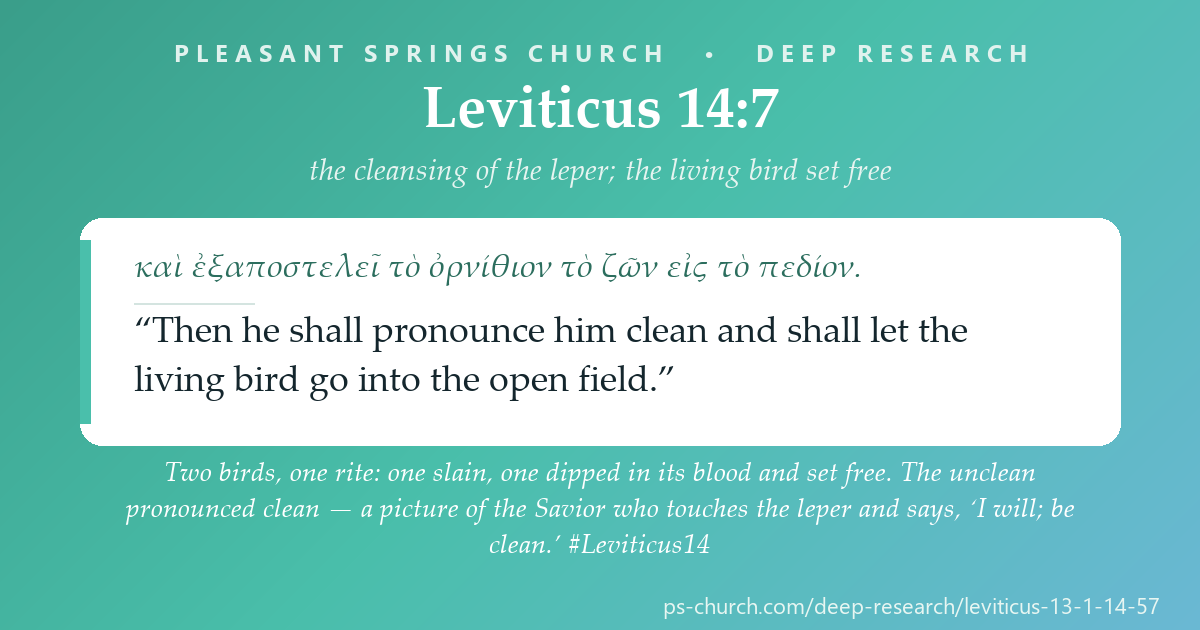
“The living bird” — dipped in the blood of the slain bird and released “into the open field”; LXX τὸ ὀρνίθιον τὸ ζῶν. Two birds, one rite: death and life — the picture (devotional analogy) of blood shed and life set free.
How the New Testament takes up leprosy and cleansing:
- Mark 1:40–45; Matthew 8:1–4; Luke 5:12–16 — Jesus touches the leper and cleanses him, then sends him to the priest “for a proof” (Lev 14).
- Luke 17:11–19 — the ten lepers cleansed at a distance, sent to show themselves to the priests; one returns to give thanks.
- Mark 5:25–34 — the woman with a discharge (an “unclean” condition, Lev 15) touches Jesus and is healed, not defiling him but healed by him.
- Hebrews 13:11–12 — Jesus “suffered outside the gate”: the place of the unclean becomes the place of the Savior.
From the camp’s edge to the touch that makes clean.
Trace the priestly ordination-marks, the isolating disease, and the cleansing rite through the canon to the Gospels.
Which cross-references matter?
- Exodus 29:20; Leviticus 8:23–24 — blood on the priest’s ear, thumb, and toe at ordination; the cleansed leper is marked the same way (14:14): restored to full standing, consecrated afresh.
- Leviticus 16:20–22 — the Day of Atonement’s live goat sent away bearing sin: a second creature released into the wild, near neighbor to the living bird of 14:7.
- Numbers 12:9–15; 2 Kings 5:1–14; 2 Chronicles 26:16–21 — Miriam, Naaman, and Uzziah: leprosy in the narrative — only God heals it (Naaman), and it is no simple index of guilt.
- Isaiah 53:3–4 — the Servant “despised and rejected,” from whom men hid their faces, who “has borne our griefs”: the outcast’s place taken up by the Redeemer.
- Mark 1:40–45; Matthew 8:1–4 — the holiness of Christ flowing outward: he touches, and the leper is clean.
The Gospel writers know Leviticus 13–14 intimately, and they set Jesus against it deliberately. When Mark records that Jesus “stretched out his hand and touched” the leper (1:41), every detail of the old law is in view: this is the one contact the law forbade, the surest way to contract uncleanness. The shock is the point. Jesus does not keep the disease at arm’s length behind quarantine and washing; he closes the distance the law had opened, and the flow of contagion runs backward — not defilement into Jesus, but cleansing out of him. Then, tellingly, he does not abolish the priestly system but honors it: “show yourself to the priest, and offer… what Moses commanded, for a proof to them” (1:44) — the man is sent to perform the very rite of chapter 14, so that Israel’s priesthood would have to certify that a leper had been made clean, something they could ordinarily only certify after God had healed. In one act Jesus fulfills and transcends the law: he is the priest who diagnoses, the God who heals, and the sacrifice whose holiness cleanses the unclean by touch — and he will make that mercy final by going himself to the leper’s place, suffering “outside the gate” (Heb 13:12) to bring the outcast home.
The scholarship on the purity laws and biblical “leprosy.”
Wenham and Milgrom on Leviticus and the purity system; the studies of tsara'at; Beale & Carson on the Gospels’ use.
Commentaries & studies:
- Gordon J. Wenham, The Book of Leviticus (NICOT); Jacob Milgrom, Leviticus (Anchor); Mark F. Rooker (NAC).
- Studies of biblical impurity and of tsara'at (its range beyond Hansen’s disease; the “garment” and “house” cases as mold/fungus).
- G. K. Beale & D. A. Carson, eds., Commentary on the New Testament Use of the Old Testament (the Synoptic leper accounts).
Interpretation notes worth keeping:
- Not modern leprosy. Tsara'at is a symptom-defined ceremonial category, not a modern diagnosis; that it can afflict cloth and walls shows the concern is ritual defilement and visible corruption, not a single microbe.
- Ceremonial, not moral guilt. Uncleanness barred a person from the sanctuary; it did not brand him a sinner. These chapters must be read with compassion, never as a stigma against the ill or a claim that disease equals divine punishment (John 9:1–3).
- The two birds. One bird killed over “living” (fresh) water, the other dipped in its blood and released (14:4–7): a rite of release like the Day of Atonement’s live goat — read by the church, as devotional analogy, for death and life, blood shed and life set free.
- Fulfilled in Christ, holiness abiding. The ceremonial purity laws are set aside for Christians in Christ, who “declared all foods clean” (Mark 7:19; Acts 10:15; Col 2:16–17) — yet the call to holiness they embodied abides (1 Pet 1:15–16), and the leper-cleansing points straight to the Savior who makes the unclean clean.
From “Unclean, unclean” to “I will; be clean.”
Name what you learned, why it matters, and one concrete response.
What should we carry away — and do?
- Only God heals; the priest certifies. A cleansed leper was living proof of divine mercy. Where God has worked, the church’s task is to recognize and welcome — to reopen the door home.
- Sin isolates; grace restores. Defilement cuts off; but Leviticus 14 charts the whole road back — examined, washed, atoned for, marked like a priest. The last word of the law of the leper is “he shall be clean.”
- Christ touches the untouchable. Where the law feared contagion, Jesus reversed it: he touched the leper and was not defiled — the man was cleansed. His holiness is the stronger power, flowing outward to make the unclean clean.
Step in response: refuse two errors this week — do not read anyone’s illness or hardship as God’s verdict on them, and do not keep at arm’s length the person the world calls “unclean.” Move toward them as Jesus moved toward the leper. And bring your own hidden defilement — the thing that isolates you — to the One who says, “I will; be clean,” and let him restore you to his people.
Leviticus 14:7 · to share
LXX + ESVEvery Deep Research page traces its passage across the whole sweep — the Old Testament, the Second-Temple world between the testaments (historical witnesses, not Scripture), and the New Testament. Follow the thread:
Pleasant Springs Church — Deep Research
Research method after Michael S. Heiser’s Bible Research Method (examine dictionaries → ancient literature → important words → textual connections → academic publications → share), with the Pleasant Springs “Author & Audience” foundation. Scripture set in the Hebrew, the Greek editions named on each page and the ESV (Old Testament), and the Greek New Testament and the ESV (New Testament), per the practice of Pleasant Springs Church. Leviticus 13:1–14:57 research grounded in Wenham, Milgrom, and Rooker, with Beale & Carson on the Gospels’ use; the priest read as diagnostician not healer (only God heals, 2 Kgs 5); “clean/unclean” handled as a ceremonial category, never a stigma on the sick (John 9:1–3); the two-bird rite and the ear-thumb-toe marks (14:7, 14) tied to priestly ordination (Exod 29; Lev 8); Second-Temple material per Josephus, Philo, the Mishnah Negaʿim, and the Dead Sea Scrolls purity texts (read as witnesses, not Scripture); and the Gospel fulfillment — Christ touching the leper and cleansing him (Mark 1:40–45; Matt 8:1–4) — held as the Gospels’ own reading.
Scripture quotations marked ESV are from the ESV® Bible (The Holy Bible, English Standard Version®), © 2001 by Crossway, a publishing ministry of Good News Publishers. ESV Text Edition: 2016. Used by permission. All rights reserved. The ESV text may not be quoted in any publication made available to the public by a Creative Commons license, and the ESV may not be translated in whole or in part into any other language. www.esv.org
|
Did this study bless you today? 💚 Give to Support PS Church100% of gifts go to the General Fund — thank you. |