Leviticus 15 is frank and clinical about the body — discharges from men and women, normal and abnormal — and easy to misread. Its “clean” and “unclean” are ceremonial categories about fitness to approach a holy God, tied to blood and the fluids of life, not a shaming of the body or of sexuality. The reason is stated plainly: God dwells in the midst, so the people must not defile “my tabernacle” (15:31). This study works Leviticus 15:1–33 — and follows the clean/unclean line to the Gospel, where Jesus, touched by the woman with the twelve-year flow of blood, is not defiled but heals her: the current of holiness now running outward. See the method →
Leviticus 15:2, 19, 30–31
Hebrew · LXX · ESVThe Shape of the Passage
ConcentricLeviticus 15 closes the great purity block (chs 11–15) — food, childbirth, skin disease, and now discharges — and it does so with a reason that governs the whole: God is present, and the people must be fit to draw near. See the priesthood begun in Leviticus 8 and the fire of God in Leviticus 9–10.
Author
The Torah of Moses gathers in chapters 11–15 the laws of the clean and the unclean, and Leviticus 15 completes them with the most intimate: discharges from the body. The order is deliberate — a symmetry of four cases: a man’s abnormal discharge (15:2–15), his normal emission (15:16–18), a woman’s normal menstruation (15:19–24), and her abnormal flow (15:25–30). The chapter is clinical, unembarrassed, and even-handed between men and women. Its remedy is gentle and graded: time, washing, and — only for the abnormal, prolonged cases — a pair of birds and atonement (15:14–15, 29–30).
Not a shaming of the body. It is vital to hear what these laws are and are not. “Clean” and “unclean” here are ceremonial categories about fitness to approach the holy sanctuary — not moral guilt, and not a claim that the body, sex, or a woman’s cycle is sinful or dirty. The body is God’s good creation (Gen 1:31). What renders one temporarily unclean is the flux of mortal life, especially where the fluids of life and death — blood, seed — are involved, in a world east of Eden marked by death. The laws made every household constantly conscious that the Holy One dwelt in their midst.
Audience
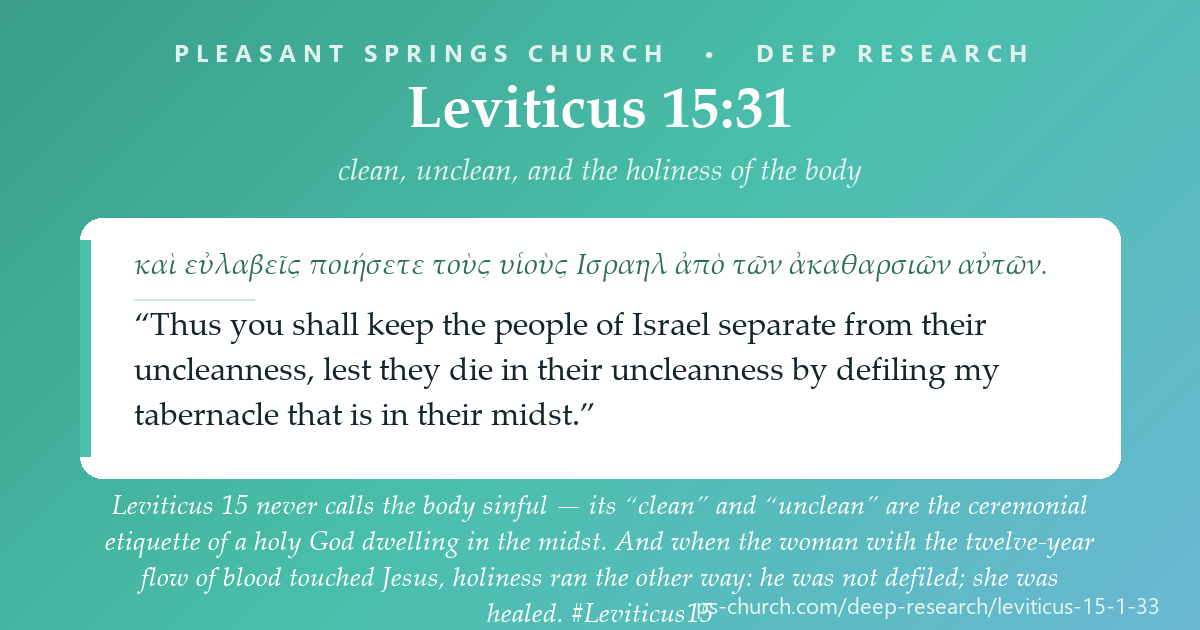
Israel — a people camped around the tabernacle, whose ordinary bodily life kept intersecting the demands of the holy. The point is stated in the chapter’s own summary: “keep the people of Israel separate from their uncleanness, lest they die in their uncleanness by defiling my tabernacle that is in their midst” (15:31). Because a holy God had come to dwell in the midst of the camp, every approach was raised in seriousness — not to terrify, but to teach that his presence is real and his holiness is his purity, not cruelty.
How they heard it. These laws taught Israel that all of life — not only the altar — is lived before God, and that even the most private mortal processes matter in his presence. They also taught grace: the remedies are humane, the required offering is modest and within reach of everyone (two turtledoves or pigeons, 15:14, 29), and restoration is always available. Above all they trained a longing: for a cleansing that reaches deeper than water, and for a holiness that could flow the other way — out to touch the unclean and make them clean.
Orient on ritual purity, uncleanness, and the holiness of the sanctuary.
Search by topic: clean and unclean, ritual purity, discharge, menstruation, niddah, holiness, tabernacle.
Which articles are relevant?
- Anchor Bible Dictionary — “Clean and Unclean,” “Purity,” “Menstruation,” “Holiness.”
- Dictionary of the OT: Pentateuch — “Clean and Unclean,” “Purity,” “Holiness,” “Sacrifice and Offerings.”
- NIDOTTE / TDOT — טָמֵא (ṭāmēʾ, unclean), טָהֵר (ṭāhēr, clean), זוֹב (zôᵀ, discharge), נִדָּה (niddāh, menstrual impurity).
Bibliography surfaced:
- Gordon Wenham (NICOT), Jacob Milgrom (AB), Mark Rooker (NAC) on Leviticus.
- Studies of the purity system: Milgrom on impurity as the domain of death; Mary Douglas on holiness and wholeness.
- Beale & Carson, Commentary on the NT Use of the OT (Mark; Hebrews).
Purity, blood, and the presence of the Holy One.
Read the discharge laws against ancient purity systems and Israel’s distinctive theology, then follow the clean/unclean line to Jesus and the woman with the flow of blood.
Which parallels shed light on religion and worldview?
Purity was ancient common ground — reframed. Every ancient culture had notions of the clean and the unclean, and rites of washing to restore fitness for the sacred. Israel shares the furniture — discharges, washing, waiting until evening — but the frame is unique: there is one holy God, uncleanness is not a hostile magical force to be warded off but a state of unfitness to approach his presence, and the categories are tied to life and death. Blood and seed are the fluids of life; their loss or flux touches mortality, and mortality cannot casually approach the Living One. Impurity here is largely the domain of death pressing on a people called to life.
Not moral, and not a shaming of women. The chapter is scrupulously even-handed — a man’s emission and a woman’s menstruation are treated in parallel, both natural, neither sinful. Menstrual impurity (נִדָּה, niddāh) is a ceremonial status, not a verdict on a woman’s worth; the “normal” cases require no offering at all, only time and washing. Later tradition elaborated the details — the Mishnah’s tractates Zavim (discharges) and Niddah (menstruation), and the Dead Sea community’s intense purity concern (the Temple Scroll; 4QMMT) — but Leviticus itself is restrained and humane, asking of everyone alike only a modest, affordable offering (two birds, 15:14, 29).
- Mishnah, tractates Zavim & Niddah (rabbinic-era) — the developed halakhah of discharges and menstruation; a later witness to how the chapter was applied, not Scripture.
- Dead Sea Scrolls — the Temple Scroll (11QT); 4QMMT; 4Q Toharot — the Qumran community’s heightened purity rules: a Second-Temple witness to the seriousness of these laws.
- Josephus, Antiquities 3.11; Philo, Special Laws 1 & 3 — first-century Jewish descriptions of the purity laws and their rationale (witnesses, not Scripture).
- ANE purification rituals — shared washing-and-waiting culture, reframed around the presence of the one holy God.
The purity system runs in one direction: the unclean must not touch the holy, lest the holy be defiled and the unclean die. Touch the person with a discharge, and you become unclean until evening (15:19, 27). This is the world Leviticus 15 assumes — contagion moving from the impure to the clean. Then comes the Gospel, and the current reverses. A woman who has had a discharge of blood for twelve years — twelve years unclean under this very chapter, cut off from the sanctuary and, by the logic of contagion, from ordinary touch — presses through a crowd and touches the fringe of Jesus’ garment. By every rule of Leviticus 15 she should have made him unclean. Instead, “immediately the flow of blood dried up” (Mark 5:29): his holiness flows outward and cleanses her. He does not recoil; he calls her “daughter” and sends her in peace: “your faith has made you well” (Mark 5:34). Held as devotional analogy on the text’s own pattern, this is the deep answer Leviticus 15 was longing toward: in Christ the holy is no longer merely fragile before the unclean; it is stronger than defilement, and it goes out to make the unclean clean (cf. Mark 1:40–45).
The vocabulary of discharge, uncleanness, water, and the dwelling God.
Watch zov (discharge) and tameʾ (unclean) as ceremonial — not moral — terms, and the mishkan whose nearness explains the whole chapter.
“Discharge” / “one who has a discharge” — the flux of the body, whether a man’s abnormal flow or a woman’s. The word is clinical, not condemning; the LXX renders it ῥύσις (a flowing).
“Unclean” — ceremonially unfit to approach the sanctuary; not guilty or morally impure. A temporary status, tied to the fluids of life and death, removed by time and washing (LXX ἀκάθαρτος).
“Menstrual impurity” — the woman’s monthly ceremonial separation. A natural state, not a sin and not a shame; the LXX uses ἄφεδρος. The prophets later borrow the image for the removal of sin (Zech 13:1).
“Fresh water” — literally “living water,” running spring water, in which the healed man bathes to be clean; the phrase Jesus lifts to himself in John 4:10; 7:38.
“Tabernacle / dwelling” — the reason for the whole chapter: God dwells in the midst. His presence is why uncleanness matters; his nearness raises the stakes of every approach (LXX σκηνή).
“Make atonement” — for the abnormal, prolonged discharges the priest offers a sin offering and a burnt offering “before the Lord”: grace restores the one long cut off (LXX ἐξιλάσκομαι).
How the New Testament takes up the clean and the unclean:
- Mark 5:25–34 — the woman with a twelve-year discharge of blood touches Jesus and is healed, not condemned: “Daughter, your faith has made you well.” The contagion of Leviticus 15 runs backward.
- Mark 7:19; Acts 10:15; Colossians 2:16–17; Romans 14:14 — in Christ the ceremonial clean/unclean laws are fulfilled and set aside for his people; the call to holiness they embodied abides.
- Hebrews 10:19–22 — because of Jesus we “draw near with a true heart in full assurance of faith… our bodies washed with pure water”: the water of Leviticus deepened to the cleansing of the heart.
- 1 Peter 1:15–16 (quoting Lev 11:44–45) — “You shall be holy, for I am holy”: the holiness the purity laws taught, now over the church.
From the discharge laws to the touch that cleanses.
Trace uncleanness, water, and the dwelling presence through the canon to the Christ who touches the unclean and makes them whole.
Which cross-references matter?
- Leviticus 11–14 — the purity block this chapter completes: food (Lev 11), childbirth (Lev 12), and skin disease (Lev 13–14); the priesthood that guards them (Lev 8).
- Leviticus 17:11; 16:1–34 — “the life… is in the blood” and the Day of Atonement that cleanses the sanctuary defiled by Israel’s impurities (see Leviticus 16).
- Numbers 5:1–4; 2 Samuel 11:4 — the unclean sent outside the camp; the purity laws worked out in Israel’s narrative life.
- Zechariah 13:1; Ezekiel 36:25–27; Psalm 51:2, 7 — the prophets and psalmist take up washing and niddah as images for the cleansing of sin: the outward rite reaching toward the heart.
- Mark 5:25–34; Hebrews 10:19–22 — the touch that cleanses instead of defiling, and the drawing near of hearts sprinkled clean and bodies washed with pure water.
Why should the most natural bodily processes — a man’s seed, a woman’s cycle, the loss of blood — make a person unfit to worship? Not because they are sinful; the text nowhere calls them sin, and requires no offering for the ordinary cases. The clue is that these discharges all touch the boundary of life and death. Blood and seed are the very fluids of life; their flux is a small ebbing of vitality, a reminder that this is a mortal world under the shadow of the grave. And the God of Israel is the living God, holiness itself, who has done the astonishing thing of coming to dwell “in the midst” of a dying people. The purity laws are the etiquette of that impossible nearness: they keep death and the sanctuary of the Living One apart, and in doing so they preach, in the grammar of ritual, that mortality and the Holy cannot simply mingle — something must be done. What Leviticus stages as separation, the Gospel resolves as reunion: the Living One steps into the midst of death, is touched by the unclean and the dying, and instead of contracting their impurity he pours out his life and heals. ‘Keep them separate… lest they die’ (15:31) is answered by the One who came near precisely so they would not.
The scholarship on the purity laws.
Wenham and Milgrom for Leviticus and the purity system; Douglas on holiness and order; Beale & Carson for the New Testament use.
Commentaries & studies:
- Gordon J. Wenham, The Book of Leviticus (NICOT); Jacob Milgrom, Leviticus (Anchor); Mark F. Rooker (NAC).
- Mary Douglas, Purity and Danger and Leviticus as Literature; Milgrom on impurity as the domain of death.
- G. K. Beale & D. A. Carson, eds., Commentary on the New Testament Use of the Old Testament (Mark; Hebrews).
Interpretation notes worth keeping:
- Ceremonial, not moral. Uncleanness in Leviticus 15 is a state of ritual unfitness, removed by time and water — not sin, guilt, or shame. To read it as a condemnation of the body, sex, or women misreads the whole system.
- Even-handed and humane. Men and women, normal and abnormal, are treated in careful parallel; the remedies are gentle, and the offering required of all is modest — two birds, within reach of everyone (15:14, 29). Grace excludes no one.
- Blood, life, and death. The common thread is the fluids of life and the boundary of mortality — why blood is central here as at the altar (17:11), and why the living God’s nearness raises the stakes (15:31).
- The devotional fulfillment. Jesus touching the unclean and cleansing them (Mark 1; 5) is read as devotional analogy grounded in the text’s own contagion logic, not as the chapter’s literal sense — the house discipline for typology in this library.
From the etiquette of the holy to the touch that heals.
Name what you learned, why it matters, and one concrete response.
What should we carry away — and do?
- The body is not the problem. These laws never call the body, sex, or a woman’s cycle sinful. They are the ceremonial etiquette of drawing near to a holy God — and the body remains God’s good creation.
- God’s nearness raises the stakes. “Lest they die… by defiling my tabernacle that is in their midst” (15:31). Holiness is his purity, not cruelty; his presence makes all of life sacred ground.
- In Christ the current reverses. The One who could not be defiled took our uncleanness into himself; touched by the woman with the flow of blood, he healed her. His holiness now flows outward to cleanse us.
Step in response: bring to Jesus the thing that makes you feel unclean, cut off, or unfit to draw near — the private shame you assume disqualifies you — and reach out to touch the hem of his garment. He does not recoil from the unclean; he calls them “daughter,” “son,” and heals. Then, with a heart sprinkled clean and your body washed with pure water, “draw near” this week (Heb 10:22) — and treat no one as untouchable whom Christ would touch.
Leviticus 15:31 · to share
LXX + ESVEvery Deep Research page traces its passage across the whole sweep — the Old Testament, the Second-Temple world between the testaments (historical witnesses, not Scripture), and the New Testament. Follow the thread:
Pleasant Springs Church — Deep Research
Research method after Michael S. Heiser’s Bible Research Method (examine dictionaries → ancient literature → important words → textual connections → academic publications → share), with the Pleasant Springs “Author & Audience” foundation. Scripture set in the Hebrew, the Greek editions named on each page and the ESV (Old Testament), and the Greek New Testament and the ESV (New Testament), per the practice of Pleasant Springs Church. Leviticus 15:1–33 research grounded in Wenham, Milgrom, and Rooker, with Douglas on holiness and order and Beale & Carson on the New Testament use; the clean/unclean laws read as ceremonial categories about drawing near to the holy God — tied to blood and the fluids of life and death, not a shaming of the body or of sexuality; Second-Temple application per the Mishnah (Zavim, Niddah) and the Qumran purity texts (read as witnesses, not Scripture); and the fulfillment where Christ, touched by the unclean, cleanses rather than contracts defilement (Mark 1; 5) held as devotional analogy on the text’s own contagion logic, per the house discipline for typology.
Scripture quotations marked ESV are from the ESV® Bible (The Holy Bible, English Standard Version®), © 2001 by Crossway, a publishing ministry of Good News Publishers. ESV Text Edition: 2016. Used by permission. All rights reserved. The ESV text may not be quoted in any publication made available to the public by a Creative Commons license, and the ESV may not be translated in whole or in part into any other language. www.esv.org
|
Did this study bless you today? 💚 Give to Support PS Church100% of gifts go to the General Fund — thank you. |