On the eighth day, after seven days of ordination, Aaron steps to the altar and the whole system of worship begins. He offers the sin offering and the burnt offering — first for himself, then for the people — and Moses names the aim of it all: “that the glory of the Lord may appear to you.” Aaron lifts his hands and blesses the people; the glory appears; and fire comes out from before the Lord and consumes the offering — God’s own acceptance — while the people shout and fall on their faces. This study works Leviticus 9:1–24. See the method →
Leviticus 9:6, 7, 22–24
Hebrew · LXX · ESVThe Shape of the Passage
InclusioThe tabernacle has been built and filled with glory (Exod 40); the priests have been ordained (Lev 8). Now, on the eighth day, the whole machinery of worship is switched on — and the aim of every part is that God’s glory would appear.
Author
The Torah of Moses has been building toward this moment. Exodus ended with the glory of the Lord filling the newly-built tabernacle (Exod 40:34–35); Leviticus 1–7 taught the offerings; Leviticus 8 ordained Aaron and his sons over seven days. Now “on the eighth day” (9:1) — a new beginning after the sabbatical seven — the priesthood actually begins its work. The chapter is carefully symmetrical: Aaron offers first for himself (a sinful priest must be atoned before he can mediate, 9:8–14), then for the people (9:15–21), and only then does he bless them. Everything is done exactly “as the Lord commanded” (a refrain running through the chapter), because worship on God’s terms is the whole point.
The goal is glory. Moses states the purpose plainly: “This is the thing that the Lord commanded you to do, that the glory of the Lord may appear to you” (9:6). The offerings are not a religious performance to be admired; they are the God-appointed way for a holy God to come and dwell with an atoned people. The chapter climaxes when heaven answers the obedient altar with fire (9:24) — God’s own visible acceptance. This sets up, by sharp contrast, the tragedy of the very next scene, where two of Aaron’s sons offer “unauthorized fire” (Lev 10).
Audience
Israel — a redeemed people gathered at Sinai around a brand-new tabernacle, watching their worship begin. What they saw taught them the shape of drawing near: sin dealt with first (even the priest needs atonement), the whole congregation represented, the mediator lifting his hands to bless (9:22; the priestly blessing of Num 6:24–26 stands close by), and then — not automatically, but graciously — the glory appearing and fire falling. Their response is the right one: “they shouted and fell on their faces” (9:24) — joy and awe together.
How they heard it. This was the answer to Israel’s deepest hope and deepest fear: could a holy God really dwell in their midst without consuming them? The eighth day says yes — through atonement, obedience, and a mediating priest. The fire that consumed the sacrifice (rather than the worshippers) was mercy in flame: God accepting what was offered in his own appointed way. Every later generation read Leviticus 9 as the pattern of true worship — its aim the manifest presence of God, its posture reverent joy, its ground a priest who first makes atonement and then blesses.
Orient on the eighth day, the priesthood inaugurated, glory, blessing, and holy fire.
Search by topic: priesthood, ordination, glory (kabod), the Aaronic blessing, sacrifice, theophany / holy fire, tabernacle.
Which articles are relevant?
- Anchor Bible Dictionary — “Priesthood,” “Glory of God,” “Blessing,” “Sacrifice,” “Tabernacle.”
- Dictionary of the OT: Pentateuch — “Priests and Levites,” “Aaron,” “Glory,” “Sacrifice and Offerings,” “Theophany.”
- NIDOTTE / TDOT — כָּבוֹד (kāḇôḏ, glory), בָּרַךְ (bārak, bless), אֵשׁ (ʾēš, fire), כָּפַר (kāp̄ar, atone).
Bibliography surfaced:
- Gordon Wenham (NICOT), Jacob Milgrom (AB), Mark Rooker (NAC) on Leviticus.
- Studies of Leviticus 8–10 as a unit (ordination → inauguration → the sin of Nadab and Abihu), and of the “glory” theophany at the tent.
- Beale & Carson, Commentary on the NT Use of the OT (Hebrews on the priesthood).
The aim of worship, the priest’s lifted hands, and the fire that accepts.
Read the inauguration against ancient temple-dedication rites, then follow the blessing and the fire toward their New Testament fulfillment (labeled devotional analogy).
Which parallels shed light on religion and worldview?
Dedicating a house for a god. Across the ancient Near East, a newly-built temple was inaugurated with sacrifices, priestly rites, and the hoped-for arrival of the deity to take up residence. Leviticus 9 shares that cultural shape — first offerings, a mediating priesthood, the manifestation of the god’s presence — but reframes it entirely: there is no image to animate, no god to feed or bribe. The Lord is not summoned by ritual technique; he freely comes to a people he has redeemed, on the ground of atonement, when they obey his own word. The point is never the ceremony; it is that “the glory of the Lord may appear” (9:6).
The lifted hands of blessing. Aaron “lifted up his hands toward the people and blessed them” (9:22) — the priest as mediator, channeling God’s favor to the congregation. The words are almost certainly those of Numbers 6:24–26 (“the Lord bless you and keep you…”), the oldest blessing in Israel’s worship. Later Second-Temple memory treasured the scene: Ben Sira paints the high priest Simon finishing the offerings and “lifting up his hands over the whole congregation… to give the blessing of the Lord with his lips” (Sir 50:20–21). The gesture became the enduring picture of the priest who stands between God and people to bless.
Fire that comes down. When “fire came out from before the Lord and consumed the burnt offering” (9:24), Israel saw God’s own acceptance made visible — not destruction of the worshippers but of the sacrifice in their place. The same sign recurs at the great turning-points of Israel’s worship: fire falls and glory fills the temple at Solomon’s dedication (2 Chr 7:1–3), and fire falls on Elijah’s altar on Carmel so “all the people… fell on their faces” and said, “The Lord, he is God” (1 Kgs 18:38–39). Holy fire is God saying yes.
- Exodus 29:43–46 — the promise this chapter fulfills: “there I will meet with the people… and it shall be sanctified by my glory… and I will dwell among the people of Israel” (see the ordination commanded).
- 2 Chronicles 7:1–3; 1 Kings 18:38–39 — fire from the Lord consuming the offering, glory appearing, the people on their faces: the same theophanic sign.
- Sirach 50:20–21 (Ben Sira — a witness, not Scripture) — the high priest lifting his hands to bless the assembly: how the Second-Temple world remembered the Aaronic blessing.
- Josephus, Ant. 3.8; Philo, Special Laws 1 — first-century descriptions of the priesthood and its consecration.
The New Testament reads the Aaronic priesthood as a shadow whose substance is Christ. Aaron had first to make atonement for his own sin before he could offer for the people (9:7) — a limit Hebrews marks precisely: the old high priests were “beset with weakness” and had to sacrifice “first for his own sins and then for those of the people” (Heb 5:2–3; 7:27). Jesus, our great High Priest, is “holy, innocent, unstained” and needs no atonement of his own (Heb 7:26–27); he entered the true sanctuary once for all (see Heb 4:14–16). And the picture of Aaron with lifted hands, blessing the people after the sacrifice, finds a striking echo at the ascension: Jesus, “lifting up his hands… blessed them” and “was carried up into heaven” (Luke 24:50–51) — the true Priest completing the offering of himself and blessing his people as he goes. Held as devotional analogy grounded in Hebrews’ own reading, the shape is unmistakable: the goal of the priest’s work is that God’s glory would appear and his blessing rest on his people.
The vocabulary of the eighth day: glory, blessing, fire, and atonement.
Watch kāḇôḏ (the glory that is the goal), the priest’s bārak (blessing with lifted hands), the ʾēš (fire that accepts), and the kāp̄ar the priest still needs.
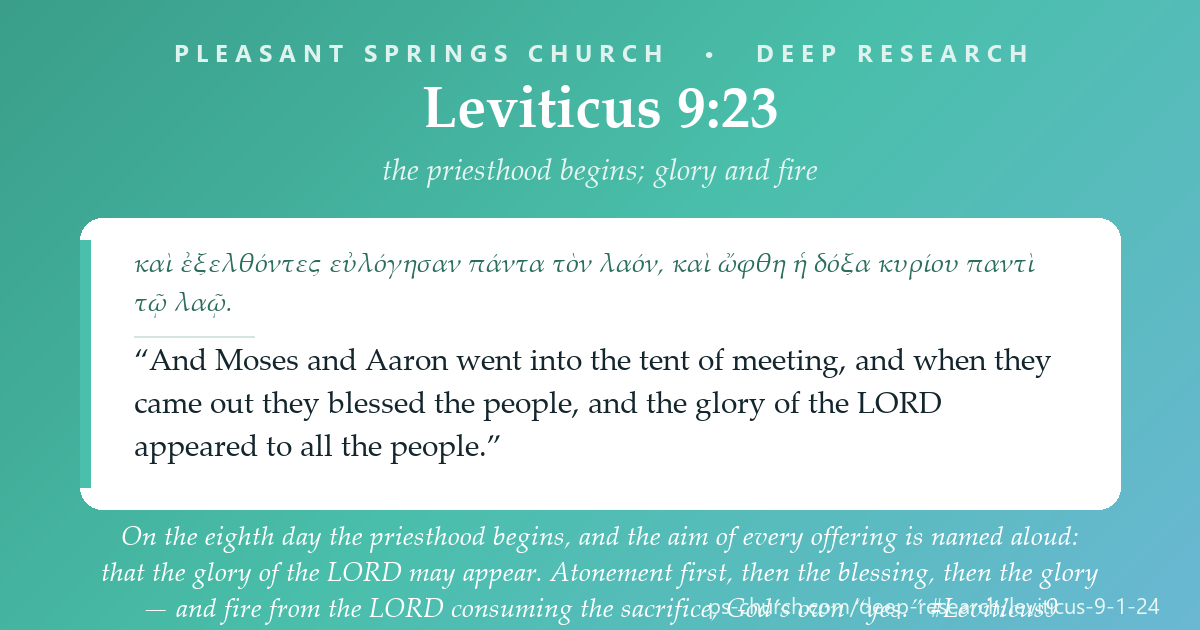
“Glory” — the manifest, weighty presence of God; LXX δόξα. The whole aim of the offerings is “that the glory of the Lord may appear” (9:6) — and it does (9:23). Worship’s goal is God himself, not the ritual.
“The eighth day” — after the seven days of ordination (Lev 8:33–35), a new beginning: the priesthood starts its actual ministry. The number that in Scripture often marks fresh starts and consecration.
“To bless” — Aaron “lifted up his hands… and blessed” (LXX εὐλόγησεν); the priestly blessing, almost certainly Numbers 6:24–26. The mediator channels God’s favor to the people (cf. Luke 24:50).
“Fire” — “fire came out from before the Lord” (LXX πῦρ παρὰ κυρίου) and consumed the offering: God’s own acceptance made visible. The same sign at Carmel (1 Kgs 18:38) and Solomon’s temple (2 Chr 7:1).
“To make atonement” — even the priest must be atoned for before he can mediate (LXX ἐξιλάσκομαι). Aaron offers first for himself, then for the people — a weakness fulfilled in the sinless High Priest (Heb 7:27).
“They shouted for joy” (from rānan) — with “fell on their faces”: joy and awe together, the fitting response to God’s glory. The LXX reads instead “they were amazed” (ἐξέστη).
How the New Testament takes up the priesthood and the blessing:
- Hebrews 5:1–4; 7:26–28 — the old high priest offered “first for his own sins” (Lev 9:7); Christ, sinless, has no such need — a High Priest “holy, innocent, unstained.”
- Luke 24:50–51 — the risen Jesus, “lifting up his hands… blessed them” and ascended: the priestly blessing of Leviticus 9:22, fulfilled.
- Numbers 6:22–27 — the Aaronic blessing Aaron almost certainly spoke: “The Lord bless you and keep you… and give you peace.”
- 1 Peter 2:9 — the church “a royal priesthood”: the priestly calling extended to all God’s people in Christ.
From the fire on the first altar to the glory of God in the face of Christ.
Trace the glory, the priestly blessing, and the holy fire across the canon toward their fulfillment.
Which cross-references matter?
- Exodus 40:34–38; 29:43–46 — the glory fills the tent, the promise that God will dwell and be “sanctified by my glory”: Leviticus 9 is the day that promise is kept (see the glory fills the tabernacle).
- Leviticus 1:1–17; 4:1–5:13 — the burnt offering and the sin offering Aaron now presents (see the burnt offering and the sin offering).
- Leviticus 10:1–20 — the very next scene: “strange fire” and the deadly seriousness of worshipping God his way (see Nadab and Abihu).
- 2 Chronicles 7:1–3; 1 Kings 18:38–39; Acts 2:1–4 — fire from the Lord at the temple, at Carmel, and (as devotional resonance) the fire of Pentecost: God’s accepting, indwelling presence.
- Hebrews 4:14–16; 7:26–28; Luke 24:50–51 — Christ our High Priest who needs no atonement of his own and blesses his people with lifted hands (see the great high priest).
It is easy to read Leviticus 9 as a catalog of ritual and miss its single, blazing point — a point Moses states out loud so no one can miss it: all of this is done “that the glory of the Lord may appear to you” (9:6). The offerings are not ends in themselves; they are the means to the end for which Israel was redeemed and the tabernacle built — that God himself would come and dwell among his people, visibly, gloriously, in acceptance rather than wrath. That is why the chapter moves so deliberately: atonement first (even for the priest), then the people’s offerings, then blessing, and only then the glory and the fire. Worship is not a technique for producing an experience; it is obedient drawing-near on the ground of blood, answered by the free grace of a God who chooses to appear. The New Testament carries the same trajectory to its end: the glory that once filled a tent, and would fill a temple, is finally seen “in the face of Jesus Christ” (2 Cor 4:6) — and the fire that accepted the sacrifice is answered by the Spirit poured out on a people who have become, in him, a temple and a priesthood. The eighth day teaches the church what to want most in worship: not the machinery, but the manifest presence — and to seek it exactly where Israel found it, at an altar of atonement, under the blessing of the Priest.
The scholarship on Leviticus 9 and the inauguration of worship.
Wenham, Milgrom, and Rooker on Leviticus; the studies of chapters 8–10 as a unit and of the “glory” theophany; Beale & Carson for the NT use of the priesthood.
Commentaries & studies:
- Gordon J. Wenham, The Book of Leviticus (NICOT); Jacob Milgrom, Leviticus 1–16 (Anchor); Mark F. Rooker (NAC).
- Studies of Leviticus 8–10 as a narrative unit — ordination, inauguration, and the sin of Nadab and Abihu — and of the tabernacle “glory” theophany.
- G. K. Beale & D. A. Carson, eds., Commentary on the New Testament Use of the Old Testament (Hebrews).
Interpretation notes worth keeping:
- The eighth day. After the seven days of ordination (8:33–35), the “eighth day” marks the first true day of ministry — a fresh beginning, worship now fully operational.
- Atonement before mediation. Aaron offers for himself first (9:7–14). This is not incidental; it exposes the built-in limit of the Levitical priesthood that Hebrews will contrast with the sinless Christ (Heb 7:27).
- The fire is grace, not cruelty. The fire consumes the sacrifice, not the worshippers — God’s holiness expressed as acceptance. Read against chapter 10, the difference is obedience: God accepts what he commanded, not what men devise.
- Joy and awe belong together. “They shouted and fell on their faces” (9:24). The right response to God’s manifest presence is not casual familiarity nor cringing terror, but reverent joy.
From the eighth day to worship whose aim is the glory of God.
Name what you learned, why it matters, and one concrete response.
What should we carry away — and do?
- The goal of worship is God himself. “That the glory of the Lord may appear” (9:6). Not the performance, not the feeling — his manifest presence. Aim your worship there.
- Atonement comes first, then blessing. Even the priest was atoned before he could bless. We come near not on our merit but on the blood of Christ — and from that ground receive his blessing with lifted hands.
- The fire is God’s yes. He consumed the offering, not the people. In Christ, God has already said his decisive yes to those who come by faith — and answers with his indwelling Spirit.
Step in response: before your next act of worship — gathered or private — name its real aim out loud: not to perform, not to feel, but “that the glory of the Lord may appear.” Come first to the altar of Christ’s atonement, then lift your face to receive his blessing, and let your response be Israel’s — reverent joy, shouting and bowed low together.
Leviticus 9:23 · to share
LXX + ESVEvery Deep Research page traces its passage across the whole sweep — the Old Testament, the Second-Temple world between the testaments (historical witnesses, not Scripture), and the New Testament. Follow the thread:
Pleasant Springs Church — Deep Research
Research method after Michael S. Heiser’s Bible Research Method (examine dictionaries → ancient literature → important words → textual connections → academic publications → share), with the Pleasant Springs “Author & Audience” foundation. Scripture set in the Hebrew, the Greek editions named on each page and the ESV (Old Testament), and the Greek New Testament and the ESV (New Testament), per the practice of Pleasant Springs Church. Leviticus 9 research grounded in Wenham, Milgrom, and Rooker, with Beale & Carson on the New Testament use of the priesthood; chapters 8–10 read as a unit (ordination → inauguration → strange fire); the glory theophany traced from Exod 40 and 29:43–46 to 2 Chr 7 and 1 Kgs 18; the Aaronic blessing (Num 6:24–26) and Sirach 50:20–21 on the high priest’s lifted hands; and the priesthood’s fulfillment in the sinless Christ (Heb 5; 7:26–28; Luke 24:50–51) held as devotional analogy on Hebrews’ own reading, not the literal sense — per the house discipline for typology.
Scripture quotations marked ESV are from the ESV® Bible (The Holy Bible, English Standard Version®), © 2001 by Crossway, a publishing ministry of Good News Publishers. ESV Text Edition: 2016. Used by permission. All rights reserved. The ESV text may not be quoted in any publication made available to the public by a Creative Commons license, and the ESV may not be translated in whole or in part into any other language. www.esv.org
|
Did this study bless you today? 💚 Give to Support PS Church100% of gifts go to the General Fund — thank you. |