If anyone sins — even unintentionally — guilt is real, and it defiles. Leviticus 4:1–5:13 gives Israel the sin offering: a graded rite that scales with responsibility (priest, congregation, leader, common person) and scales down to the poor (a lamb, two birds, a handful of flour). Its blood is placed where sin’s pollution reached; the body is carried “outside the camp.” And over every case falls the refrain of grace: “the priest shall make atonement… and he shall be forgiven.” This study works the passage from the weight of unwitting guilt to its fulfillment in Christ, our sin offering, who “suffered outside the gate.” See the method →
Leviticus 4:2–5:13 (selections)
Hebrew · LXX · ESVThe Shape of the Passage
Parallel panelsLeviticus opens its offerings with a sobering premise: even sin nobody meant to commit still defiles — and God, in grace, provides a way to be cleansed and forgiven.
Author
The Torah of Moses continues from Exodus 40, where the glory filled the tabernacle. Leviticus 1–3 has already given the offerings a worshiper brings freely — the burnt, grain, and peace offerings. Now, at 4:1, the tone changes: “If anyone sins…” These are the offerings sin requires. The sin offering (chapters 4:1–5:13) answers a problem the earlier chapters raised but did not solve — how does a sinful people keep the sanctuary, and themselves, clean enough for a holy God to dwell among them?
A structured, graded rite. The chapter is built as a descending ladder of accountability: the anointed priest (4:3–12), the whole congregation (4:13–21), a leader (4:22–26), a common person (4:27–35). The higher the office, the costlier the offering and the deeper the blood is carried — for priest and congregation, blood is sprinkled before the veil and daubed on the horns of the incense altar, and the body is burned “outside the camp” (4:12, 21); for a leader or commoner, blood goes on the horns of the bronze altar. Then 5:1–13 turns to specific cases — failure to testify, touching what is unclean, a rash oath — and scales the offering down to the offerer’s means. The design itself preaches: sin is serious, responsibility is real, and grace reaches all the way down.
Audience
Israel — a redeemed people camped around the tabernacle, learning that redemption from Egypt did not end their need for cleansing. The passage presses a truth a casual age resists: guilt is real even when the sin was unwitting (“sins unintentionally… and realizes his guilt,” 4:27). Sin is not merely a bad choice to be excused by good intentions; it is a contamination that must be dealt with. Yet the same passage hands Israel its greatest comfort — the refrain “he shall be forgiven” (4:20, 26, 31, 35; 5:10, 13), repeated until it is unmistakable that God wants to cleanse them.
How they heard it. A worshiper laid a hand on the animal’s head (4:4, 29) — identifying with it — and watched its blood placed where sin’s pollution had reached. They heard the ladder of accountability and understood that the priest and the whole nation, sinning, endangered everyone (“bringing guilt on the people,” 4:3) — much given, much required (cf. Lk 12:48). And the poorest Israelite heard, with relief, that if a lamb was beyond reach, two birds would do; if birds too, then flour (5:7, 11) — God’s provision shuts no one out. Every repeated offering also whispered its own insufficiency: the same sins, the same blood, year upon year, awaiting a better sacrifice.
Orient on the sin offering, atonement, uncleanness, and graded liability.
Search by topic: sin offering / purification offering, atonement, sacrifice, uncleanness and purity, forgiveness, “outside the camp.”
Which articles are relevant?
- Anchor Bible Dictionary — “Sacrifice and Offerings,” “Sin Offering,” “Atonement,” “Purity and Impurity.”
- Dictionary of the OT: Pentateuch — “Sacrifices and Offerings,” “Atonement,” “Sin, Guilt,” “Holiness,” “Priests and Levites.”
- NIDOTTE / TDOT — חַטָּאת (ḥaṭṭāʾṯ, sin/purification offering), כָּפַר (kāp̄ar, atone), סָלַח (sālaḥ, forgive), שְׁגָגָה (šəḡāḡāh, inadvertence).
Bibliography surfaced:
- Gordon Wenham (NICOT), Jacob Milgrom (AB), Mark Rooker (NAC), John Hartley (WBC) on Leviticus.
- Studies of the ḥaṭṭāʾṯ as “purification offering” (Milgrom) — whether it purges the sanctuary, the sinner, or both.
- Beale & Carson, Commentary on the NT Use of the OT (Hebrews; Romans 3; 2 Corinthians).
Blood, pollution, and a graded ladder of responsibility.
Read the sin offering against ancient purification rites and Israel’s theology of holiness, then follow blood and “outside the camp” to Christ.
Which parallels shed light on religion and worldview?
Sin as pollution, not only as choice. Ancient Near Eastern cultures knew rites to cleanse a temple of impurity, imagining sin and defilement almost as a substance that clings to sacred space. Leviticus shares that instinct — sin defiles, and the defilement gathers at the sanctuary — but transforms it: the pollution is moral, measured against the commands of the Lord (4:2), and the remedy is not magic but a God-given sacrifice whose blood is placed exactly where the defilement reached (the horns of the altar, before the veil). Even the sin “done unintentionally” leaves real pollution — a sobering correction to any age that measures guilt only by intent.
A ladder of accountability. The rite is deliberately unequal. When the anointed priest sins he brings “guilt on the people” (4:3) and must offer a bull, its blood carried into the Holy Place; the whole congregation’s sin costs the same; a leader brings a male goat; a common person a female goat or lamb; the poor, two birds or a little flour. The more one represents others before God, the graver the sin and the costlier the cleansing — the Bible’s own version of “to whom much was given… much will be required” (Lk 12:48). Yet the ladder runs down as well as up: it reaches the poorest hand.
Blood and ‘outside the camp.’ Two motifs from this passage the New Testament will seize. First, blood is central: “the life of the flesh is in the blood… it is the blood that makes atonement” (Lev 17:11). Second, for the priest’s and congregation’s sin offerings the animal’s body is carried outside the camp and burned (4:12, 21) — away from the holy center, in the place of the unclean. Both details are handled soberly in Leviticus, never gorily; both become, in Hebrews, a map of the cross.
- Hittite and Mesopotamian purification texts — temple-cleansing and elimination rites: shared cultural furniture, reframed morally in Leviticus.
- Mishnah, Zevachim (rabbinic-era, a witness) — the sacrificial procedure preserved in detail; Josephus, Antiquities 3.230–232 describes the sin offering for Roman-era readers.
- Philo, Special Laws 1.226–246 (a witness, not Scripture) — an allegorizing Second-Temple reading of the offerings; the offerer’s inner disposition matters, not the ritual alone.
- Leviticus 16 · 17:11 — the same blood-and-atonement logic gathered up on the Day of Atonement.
The New Testament reads the sin offering as a shadow whose substance is Christ — and it does so precisely from this passage’s two motifs. Blood: “without the shedding of blood there is no forgiveness of sins” (Heb 9:22), yet “it is impossible for the blood of bulls and goats to take away sins” (Heb 10:4) — so the endless repetition of Leviticus 4 pointed beyond itself to one who “offered for all time a single sacrifice for sins” (Heb 10:12). Outside the camp: “the bodies of those animals whose blood is brought into the holy places… are burned outside the camp. So Jesus also suffered outside the gate in order to sanctify the people through his own blood” (Heb 13:11–12; cf. Lev 4:12, 21). And the very category — a sin offering — Paul applies to him: “For our sake he made him to be sin who knew no sin, so that in him we might become the righteousness of God” (2 Cor 5:21; the Greek ἁμαρτία is the LXX’s own word for the sin offering, as in 4:21, 24, 25 — “it is a sin offering”). The graded ladder that reached the poorest Israelite reaches all the way to us: one offering, sufficient for priest and pauper alike. Held as the New Testament’s own devotional reading of these types, not as the chapter’s literal sense.
The vocabulary of purification, atonement, and forgiveness.
Watch ḥaṭṭāʾṯ (sin/purification offering), bišgāgāh (unintentionally), kāp̄ar (atone), and the closing nislaḥ — “he shall be forgiven.”
“Sin offering” — also, and perhaps better, “purification offering” (Milgrom): the same noun means both “sin” and “the offering that deals with it.” Its blood purges the pollution sin brings to the sanctuary (LXX περὶ ἁμαρτίας; the word Paul turns on Christ, 2 Cor 5:21).
“Unintentionally” — by inadvertence or mistake (LXX ἀκουσίως). The passage insists that even unwitting sin leaves real guilt to be cleansed; intention lessens culpability but does not erase defilement (contrast the high-handed sin, Num 15:30).
“To make atonement” — to cover / wipe clean / ransom (LXX ἐξιλάσκομαι). Atonement is God’s gracious provision, not the sinner’s bribe: “I have given it to you… to make atonement” (Lev 17:11).
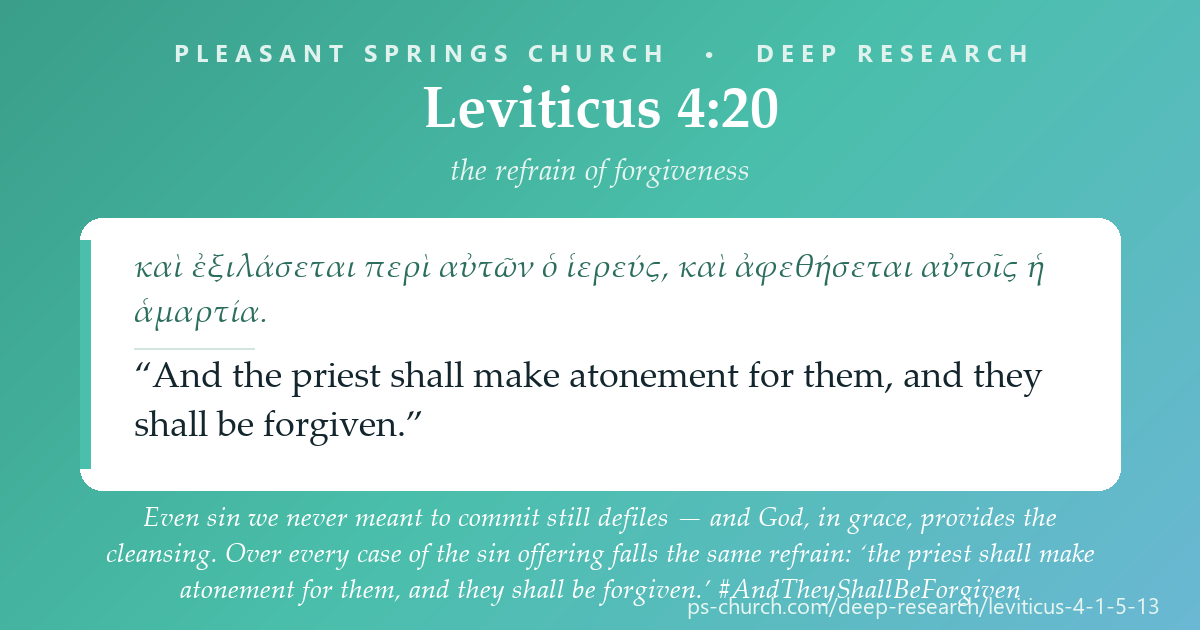
“He shall be forgiven” — the niphal wə-nislaḥ (LXX ἀφεθήσεται). God alone is ever the subject of this verb in the Old Testament: forgiveness is his act. The refrain of grace that closes every case.
“He shall confess” — the hitpael of yāḏāh (LXX ἐξαγορεύσει): to acknowledge and name the sin. Atonement is not automatic; it moves through owned, confessed guilt (cf. Ps 32:5, LXX 31:5; 1 Jn 1:9).
“To incur / realize guilt” — to become liable, and to feel it. Here it is the awakening of conscience (“and realizes his guilt”), distinct from the אָשָׁם reparation offering that follows (5:14ff., the next study).
How the New Testament reuses the sin offering:
- Hebrews 9:22; 10:1–14 — “without the shedding of blood there is no forgiveness”; the repeated offerings could not “take away sins,” but Christ “offered for all time a single sacrifice.”
- Hebrews 13:11–12 — the sin-offering bodies burned “outside the camp” (Lev 4:12, 21); so “Jesus also suffered outside the gate… to sanctify the people through his own blood.”
- 2 Corinthians 5:21 — “he made him to be sin (ἁμαρτία)” — the LXX’s word for the sin offering, applied to Christ.
- Romans 8:3 — God, sending his Son “for sin” (περὶ ἁμαρτίας, the sin-offering phrase), “condemned sin in the flesh” (see Romans 8).
From blood on the horns to the One who suffered outside the gate.
Trace the sin offering forward: the blood, the confession, and “outside the camp” toward the New Testament’s single sacrifice.
Which cross-references matter?
- Exodus 29:10–14; 29:36–37 — the sin offering already at the priests’ ordination, purifying the altar; the blood on the horns first appears here.
- Leviticus 16:1–34; 17:11 — the sin-offering logic gathered up on the Day of Atonement: “it is the blood that makes atonement.”
- Isaiah 53:10–12 — the Servant whose “soul makes an offering for guilt,” who “bore the sin of many” (see the Suffering Servant).
- Numbers 15:22–31 — the same distinction between sin “unintentionally” and sin “with a high hand”: the sin offering covers the first, not defiant rebellion.
- Hebrews 9–10, 13; Romans 3:25; 2 Corinthians 5:21 — the sin offering fulfilled in Christ, the single sufficient sacrifice (see Romans 3).
The New Testament does not treat Leviticus 4 as a discarded relic but as a God-given template whose lines the cross fills in. Hebrews reasons from the very repetition of the sin offering — if it truly cleansed, “would they not have ceased to be offered?” (10:2) — that its purpose was always to expose sin and to point beyond itself: “in these sacrifices there is a reminder of sins every year” (10:3). The passage’s two most physical details become the epistle’s theology. The blood daubed on the horns says forgiveness costs a life (9:22); Christ brings not the blood of goats but “his own blood” (9:12). The body burned outside the camp — in the unclean place, bearing the sin it carried — is answered exactly: “Jesus also suffered outside the gate” (13:12), the holy One made sin (2 Cor 5:21) in the place of the accursed, that the unclean might be sanctified. Even the grace that scaled the offering to the poor is kept: the one offering of Christ excludes no one for want of means. This is the house discipline throughout the library — typology read where the New Testament itself reads it (Hebrews, 2 Corinthians, Isaiah 53), never invented, always confessing that the shadow’s worth is the substance it foretold.
The scholarship on the sin (purification) offering.
Wenham and Milgrom for Leviticus; the debate over what the ḥaṭṭāʾṯ purifies; Beale & Carson for the New Testament use.
Commentaries & studies:
- Gordon J. Wenham, The Book of Leviticus (NICOT); Jacob Milgrom, Leviticus 1–16 (Anchor); John E. Hartley (WBC); Mark F. Rooker (NAC).
- The Milgrom debate: is the ḥaṭṭāʾṯ a “purification offering” cleansing the sanctuary from the pollution of sin, rather than a “sin offering” cleansing the sinner — or both together?
- G. K. Beale & D. A. Carson, eds., Commentary on the New Testament Use of the Old Testament (Hebrews; 2 Cor 5:21).
Interpretation notes worth keeping:
- Not works-righteousness. The offering is God’s gracious provision, not a payment that earns favor: “I have given it to you upon the altar to make atonement” (Lev 17:11). Atonement is received, not purchased.
- Unintentional, not trivial. That the sins are “unintentional” does not make them small; it makes the point that guilt outruns intention. Defiant, “high-handed” sin needed a different remedy (Num 15:30–31) — ultimately repentance and the mercy of God.
- Graded, and scaled to the poor. The ladder of 4:3–35 grades responsibility; 5:7–13 scales the offering to means. Together they teach both accountability (much given, much required) and inclusion (grace shuts no one out for poverty).
- Typology under discipline. The Christ-readings (Heb 9–10, 13; 2 Cor 5:21) are the New Testament’s own; hold them as fulfillment of real textual patterns — blood, confession, “outside the camp” — not as allegory imposed on the text.
From the weight of guilt to the refrain of grace.
Name what you learned, why it matters, and one concrete response.
What should we carry away — and do?
- Guilt is real, even unintended. Sin is not just a bad choice excused by good intentions; it is a defilement to be dealt with. That is sobering — and it is why the cleansing is such good news.
- Much given, much required. The higher the trust, the graver the sin and the costlier the cleansing. Leaders, parents, teachers — the offering scaled up with responsibility (Lk 12:48).
- ‘He shall be forgiven.’ The refrain over every case — priest to pauper — is grace. And it is fulfilled in Christ, the sin offering who suffered “outside the gate” to sanctify us by his own blood (Heb 13:12).
Step in response: do what 5:5 requires — stop excusing and confess. Name one specific sin you have been softening with “I didn’t mean to,” and bring it honestly to God, trusting the once-for-all offering of Christ. Then live as one forgiven — not paying God back, but offering the “spiritual sacrifices” the cleansed now bring: praise, self-giving, and mercy (Rom 12:1; Heb 13:15–16; 1 Pet 2:5).
Leviticus 4:20 · to share
LXX + ESVEvery Deep Research page traces its passage across the whole sweep — the Old Testament, the Second-Temple world between the testaments (historical witnesses, not Scripture), and the New Testament. Follow the thread:
Pleasant Springs Church — Deep Research
Research method after Michael S. Heiser’s Bible Research Method (examine dictionaries → ancient literature → important words → textual connections → academic publications → share), with the Pleasant Springs “Author & Audience” foundation. Scripture set in the Hebrew, the Greek editions named on each page and the ESV (Old Testament), and the Greek New Testament and the ESV (New Testament), per the practice of Pleasant Springs Church. Leviticus 4:1–5:13 research grounded in Wenham, Milgrom, Hartley, and Rooker, with Beale & Carson on the New Testament use; the ḥaṭṭāʾṯ read as the “purification offering” whose blood purges the pollution of sin — even unintentional sin (bišgāgāh) — graded by the offender’s standing (4:3–35) and scaled to the poor (5:7–13); the refrain wə-nislaḥ, “he shall be forgiven” (4:20, 26, 31, 35; 5:10, 13), understood as God’s gracious provision (Lev 17:11), not works-righteousness; ANE purification-rite background weighed and reframed morally; Second-Temple material per the Mishnah (Zevachim), Josephus, and Philo (read as witnesses, not Scripture); and the sin offering fulfilled in Christ — the single sacrifice “outside the gate” (Heb 9–10, 13; 2 Cor 5:21) — held as the New Testament’s own devotional typology, per the house discipline.
Scripture quotations marked ESV are from the ESV® Bible (The Holy Bible, English Standard Version®), © 2001 by Crossway, a publishing ministry of Good News Publishers. ESV Text Edition: 2016. Used by permission. All rights reserved. The ESV text may not be quoted in any publication made available to the public by a Creative Commons license, and the ESV may not be translated in whole or in part into any other language. www.esv.org
|
Did this study bless you today? 💚 Give to Support PS Church100% of gifts go to the General Fund — thank you. |