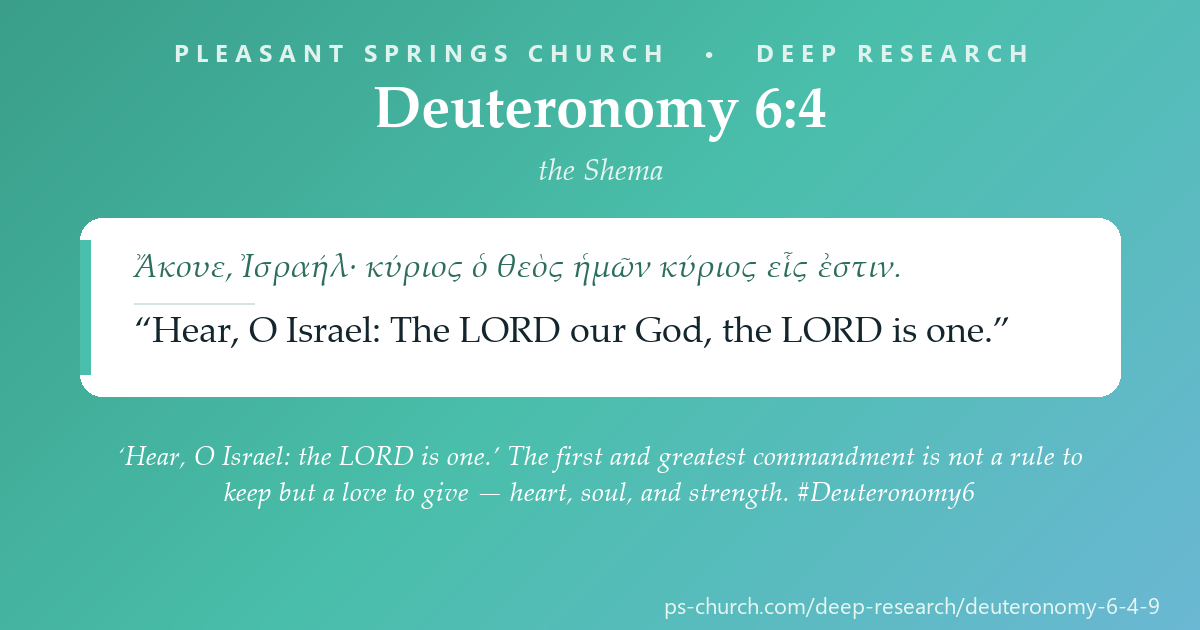
Hear, O Israel: the Lord our God, the Lord is one.” With these words — the Shema — Israel confessed its faith morning and evening, taught it to its children, and bound it to hand and doorpost. Jesus called it the first and greatest commandment: to love the one Lord with all your heart, soul, and strength. This study works Deuteronomy 6 from Israel’s bedrock creed to the church’s astonishing confession of Jesus as the one Lord. See the method →
Deuteronomy 6:4–9 (selections)
Hebrew · LXX · ESVThe Shape of the Passage
SequenceDeuteronomy is Moses’ covenant renewal on the plains of Moab — the Torah preached to a new generation on the edge of the promised land. The Shema is its beating heart.
Author
The Torah of Moses reaches its great summary in Deuteronomy, Moses’ final sermons to Israel before they enter the land. Chapter 6 follows the restatement of the Ten Commandments (ch. 5) and draws out their heart: because the Lord alone is God, he is to be loved with everything. The Shema is not one command among many but the foundation — the confession from which all obedience flows.
Love as the shape of the law. Deuteronomy grounds obedience in love, and love in the character of the one God who redeemed Israel. The words are to be internalized (“on your heart”), passed on (“teach them… to your children”), and made visible (bound on hand and doorpost) — a whole life ordered around one Lord.
Audience
Israel — a covenant people about to live among the many gods of Canaan, needing to know whose they are. The Shema draws the line: not many gods to be juggled, but one Lord to be loved wholly. In a polytheistic world, undivided love for one God was Israel’s distinctive calling and constant temptation to forget.
How they heard it. The Shema became the confession Israel recited twice daily, taught to children, and bound to body and home. It defined Jewish identity and worship. When a scribe later asked Jesus which commandment was first, he answered with the Shema (Mark 12:29–30) — and the earliest Christians, worshiping Jesus as Lord, would read its “one Lord” in a way that included the Son (1 Cor 8:6).
Orient on the Shema, monotheism, love, and covenant.
Search by topic: Shema, monotheism, love (of God), covenant, Deuteronomy.
Which articles are relevant?
- Anchor Bible Dictionary — “Shema,” “Monotheism,” “Love,” “Deuteronomy.”
- Dictionary of the OT: Pentateuch — “Deuteronomy,” “Love,” “God,” “Education.”
- NIDOTTE / TDOT — שָׁמַע (šāmaʿ, hear/obey), אֶחָד (ʾeḥāḏ, one), אָהֵב (ʾāhēḇ, love), לֵבָב (lēḇāḇ, heart).
Bibliography surfaced:
- Peter Craigie (NICOT), Daniel Block (NIVAC), J. G. McConville (Apollos) on Deuteronomy.
- Studies of the Shema and its NT reuse; Nathan MacDonald, Deuteronomy and the Meaning of ‘Monotheism’.
- Beale & Carson, Commentary on the NT Use of the OT (Mark 12); Richard Bauckham on the “Christological monotheism” of 1 Cor 8:6.
One God among the nations, and love as covenant loyalty.
Read the Shema against ANE polytheism and treaty-love, then follow its “one Lord” into the New Testament.
Which parallels shed light on religion and worldview?
One, among many. Israel lived surrounded by nations with crowded pantheons, where a person might owe allegiance to many gods at once. The Shema cuts against this: the Lord alone is Israel’s God, and he claims not a slice of devotion but the whole heart. Whether אֶחָד (echad) is rendered “the Lord is one” or “the Lord alone,” the thrust is undivided allegiance to the one true God.
Love you can command. In ancient Near Eastern treaties, a vassal was called to “love” his sovereign — loyal, wholehearted devotion, not mere sentiment. The Shema uses that covenant language, but transfigures it: Israel loves the Lord because he first redeemed them (Deut 6:20–23). Commanded love is possible because it is response — the answering loyalty of a rescued people.
- ANE suzerain-vassal treaties — the vassal’s commanded “love” and undivided loyalty to one king: the covenant idiom the Shema takes up and roots in redemption.
- The Nash Papyrus (2nd c. BC) — preserves the Decalogue together with the Shema: a witness to how central this text already was.
- Letter of Aristeas 132–133 (a witness, not Scripture) — a Second-Temple restatement that “God is one” and his power is manifest throughout all things.
- The tefillin & mezuzah tradition (Deut 6:8–9) — the words bound on hand and doorpost, and the Shema recited morning and evening: the confession woven into daily life.
When a scribe asked Jesus which commandment is first, he answered with the Shema: “The most important is, ‘Hear, O Israel: The Lord our God, the Lord is one. And you shall love the Lord your God with all your heart… soul… mind… and strength’” (Mark 12:29–30). He then joined it to Leviticus 19:18 — love of neighbor — as its inseparable second (Mark 12:31). The Shema is the ground of the whole moral life. And the earliest church did something breathtaking with it: without denying that “God is one,” Paul reshaped the confession around Jesus — “for us there is one God, the Father… and one Lord, Jesus Christ” (1 Cor 8:6) — folding the Son into the identity of the one Lord of the Shema. The confession that guarded Israel’s monotheism became, in Christian hands, the seedbed of the church’s worship of Jesus as Lord.
The vocabulary of hearing, oneness, and whole-hearted love.
Watch the “hear” that means obey, the “one,” and the total love of heart, soul, and might.
“Hear” — and to hear, in Hebrew, is to heed and obey. The single word names the whole confession; true hearing bends the life.
“One” — “the Lord is one” or “the Lord alone”; either way, undivided: one God claiming undivided love.
“You shall love” — covenant love: loyal, wholehearted devotion that can be commanded because it answers a love already given (Deut 7:7–8).
“Heart · soul · might” — the totality of the person; not three compartments but every part and power. Jesus adds “mind” to make the wholeness explicit (Mark 12:30).
How the New Testament reuses the Shema:
- Mark 12:28–34; Matthew 22:34–40; Luke 10:25–28 — Jesus names the Shema the first and greatest commandment, joined to “love your neighbor” (Lev 19:18).
- 1 Corinthians 8:6 — “one God, the Father… and one Lord, Jesus Christ”: the Shema reshaped around the Son.
- James 2:19 — “You believe that God is one; you do well. Even the demons believe—and shudder”: the Shema’s creed must become love, not bare assent.
- Romans 3:29–30; Galatians 3:20; Ephesians 4:4–6 — “God is one” as the ground of one people, one faith, one Lord.
From Israel’s creed to the church’s one Lord.
Trace the Shema through the law of love and the prophets’ call for the heart, into Jesus’ summary and Paul’s Christ-shaped monotheism.
Which cross-references matter?
- Deuteronomy 6:5; Leviticus 19:18 — love God, love neighbor: the two commands Jesus binds together (see the Ten Commandments).
- Deuteronomy 10:12–16; 30:6 — “circumcise… your heart” to love God: the inward reality the Shema calls for, promised in the new covenant.
- Mark 12:29–31; Matthew 22:37–40 — the greatest commandment, the whole Law and Prophets hung on love.
- 1 Corinthians 8:6; John 10:30; 17:3 — the one Lord confessed to include the Son.
- Jeremiah 31:33; Romans 5:5 — the law of love written on the heart, poured out by the Spirit.
The New Testament treats the Shema as the summit of the law and then does something only the incarnation makes possible. Jesus cites it directly as the first commandment (Mark 12:29–30) — expanding its faculties to name the mind as well — grounding all ethics in whole-hearted love for the one God. Paul, steeped in that same confession, restates it in 1 Corinthians 8:6, distributing its terms (as Richard Bauckham has shown): the one God is the Father, and the one Lord (the Shema’s κύριος) is Jesus Christ, “through whom are all things.” This is not the abandonment of monotheism but its Christian form — what scholars call “Christological monotheism”: the Son included within the identity of the one Lord Israel confessed. The creed that fenced Israel from idolatry becomes the charter for worshiping Jesus without worshiping a second God. To love the Lord with all the heart is, the New Testament says, to love him who came to us in the Son.
The scholarship on the Shema.
The commentators on Deuteronomy; MacDonald on monotheism; Bauckham on Christological monotheism.
Commentaries & studies:
- Peter C. Craigie (NICOT), Daniel I. Block (NIVAC), J. G. McConville (Apollos) on Deuteronomy.
- Nathan MacDonald, Deuteronomy and the Meaning of ‘Monotheism’; studies of the Shema’s reception.
- Richard Bauckham, Jesus and the God of Israel (on 1 Cor 8:6 and the divine identity).
Interpretation notes worth keeping:
- “One” or “alone.” Hebrew echad can carry either sense; the practical point is the same — the Lord claims Israel’s undivided allegiance. It is not, by itself, a proof-text for the Trinity, but it is the soil in which the church’s Christological monotheism grew.
- Love is the law’s heart. Commanded love is intelligible because it is covenant loyalty answering redemption — the same logic as the Decalogue’s “I brought you out” prologue.
- Formation, not just belief. The Shema is to be internalized, taught, and displayed (6:6–9): a confession meant to shape memory, family, and daily life, not merely to be affirmed.
From Israel’s daily creed to your own whole-hearted love.
Name what you learned, why it matters, and one concrete response.
What should we carry away — and do?
- God wants all of you. Not a slice of devotion but heart, soul, mind, and strength. The first commandment is not a rule to keep but a love to give — wholly.
- Love answers redemption. We can be commanded to love because we love in response — “we love because he first loved us” (1 John 4:19). Grace comes first; love is the reply.
- The one Lord is Jesus. To confess “the Lord is one” is, for the church, to worship the Father and the Son and the Spirit as the one God — and to love that Lord with everything.
Step in response: take one “compartment” of your life you have kept back from God — a relationship, an ambition, a fear — and offer it deliberately this week as part of loving him with all your heart. Then do as the Shema says: speak of him to someone in your household, and let the confession shape an ordinary day.
Deuteronomy 6:4–5 · to share
LXX + ESVEvery Deep Research page traces its passage across the whole sweep — the Old Testament, the Second-Temple world between the testaments (historical witnesses, not Scripture), and the New Testament. Follow the thread:
Pleasant Springs Church — Deep Research
Research method after Michael S. Heiser’s Bible Research Method (examine dictionaries → ancient literature → important words → textual connections → academic publications → share), with the Pleasant Springs “Author & Audience” foundation. Scripture set in the Hebrew, the Greek editions named on each page and the ESV (Old Testament), and the Greek New Testament and the ESV (New Testament), per the practice of Pleasant Springs Church. Deuteronomy 6:4–9 research grounded in Craigie, Block, McConville, and Nathan MacDonald, with Beale & Carson and Bauckham on the New Testament use; ANE treaty-love background; Second-Temple material per the Nash Papyrus and Letter of Aristeas (read as witnesses, not Scripture).
Scripture quotations marked ESV are from the ESV® Bible (The Holy Bible, English Standard Version®), © 2001 by Crossway, a publishing ministry of Good News Publishers. ESV Text Edition: 2016. Used by permission. All rights reserved. The ESV text may not be quoted in any publication made available to the public by a Creative Commons license, and the ESV may not be translated in whole or in part into any other language. www.esv.org
|
Did this study bless you today? 💚 Give to Support PS Church100% of gifts go to the General Fund — thank you. |